Home Blog Page 7595

Banks told to tighten controls as carnapping cases increase

THE BANGKO SENTRAL ng Pilipinas (BSP) told banks to tighten their Know Your Customer protocols amid a rise in cases involving carnapping syndicates that acquire vehicles through these financial institutions’ credit facilities under fake identities.

Memorandum No. M-2021-047 signed by BSP Deputy Governor Chuchi G. Fonacier reminded BSP’s supervised financial institutions to strengthen their controls and follow anti-money laundering (AML) regulations to prevent these criminal activities.

It said lenders should tighten their guard via strengthening procedures such as customer identification and verification, ongoing monitoring of customers and their transactions, and suspicious transaction reporting.

The BSP also told banks to ramp up their continuing AML training programs, including those focused on controls for partners and accredited car dealers.

“Carnapping syndicates may sometimes resort to identity theft, using an actual person’s name, address, and company profile, but with a different photo. These may be prevented by reinforcing the conduct of, among others, customer identification and verification procedures as part of the customer due diligence,” the memorandum said.

The BSP memorandum mentioned common schemes done by syndicates, based on information from the Philippine National Police-Highway Patrol Group.

Among these is the rent-pawn or rent-selling scheme, where a vehicle is obtained through a rent or lease contract. The culprit, or the lessee in this case, pawns or sells the vehicles using falsified documents without the consent of the lessor or the registered owner.

Another method is the pasalo scheme, where the culprit, using fake documents, sells a vehicle to a buyer who will assume the remaining obligations for the vehicle.

There is likewise a modus operandi dubbed as “labas casa scheme,” where a person will pretend to be a buyer of a vehicle and get an auto loan from a car dealership using counterfeit papers. The perpetrators will find a buyer for the vehicle using fake documents. — LWTN

First Gen plants to run on liquid fuel when Malampaya is out

FIRST Gen Corp. said three of its natural gas-fired plants in Batangas will be running on liquid fuel in October when the Malampaya offshore gas-to-power project shuts down for maintenance works.

These facilities are the 1,000-megawatts (MW) Santa Rita, the 500-MW San Lorenzo, the 97-MW Avion plants.

The Lopez-led firm added that its other gas plant — the 420-MW San Gabriel — will be switched off during the gas field’s temporary closure from October 2 to 22 since it can only run on natural gas.

“Santa Rita and San Lorenzo will operate using liquid fuel (condensate), which will be competitively sourced and imported to ensure their continued availability and operations despite the absence of Malampaya natural gas supply,” First Gen Executive Vice-President and Chief Commercial Officer Jonathan C. Russell told BusinessWorld through the firm’s communications department via e-mail over the weekend.

“Avion will also operate using competitively sourced liquid fuel (diesel) in the absence of natural gas supply from Malampaya,” he added.

During the gas field’s temporary shutdown, the three plants will provide 1,300 MW of available capacity. Broken down, around 750 MW will come from Santa Rita; 500 MW from San Lorenzo and 50 MW from Avion.

Mr. Russell said that the firm will be conducting scheduled preventive maintenance works on one of Santa Rita’s four units, which has a capacity of about 250 MW, during Malampaya’s 20-day closure in October.

“[However], San Gabriel can only run on natural gas and, and therefore, during the Malampaya shutdown, will not be available to run during the outage period,” he said.

He said liquid fuel in the form of condensate and diesel may be more costly than gas sourced from the Malampaya field but using these “will reduce the likelihood of yellow and red alerts” that cause price spikes in the power spot market.

“The onset of these yellow and red alerts due to a significant loss in generation supply leads to WESM (wholesale electricity spot market) price spikes that can be two to three times more expensive than running power plants on condensate and diesel. The use of these alternative fuels to keep Santa Rita, San Lorenzo, and Avion available during the Malampaya shutdown is beneficial to consumers by limiting what could otherwise be larger WESM price spikes,” Mr. Russell said.

First Gen’s Santa Rita, San Lorenzo, and San Gabriel plants deliver baseload power to the grid, while Avion provides peaking power.

Both the Santa Rita and San Lorenzo facilities sell their output to distribution utility Manila Electric Co. (Meralco) under a 25-year power purchase agreement with an 83% take-or-pay “minimum energy quantity” arrangement.

Meralco Head of Utility Economics Lawrence S. Fernandez told BusinessWorld on Viber last week that during the Malampaya maintenance shutdown, the distribution utility will work with the operators of Santa Rita and San Lorenzo plants to ensure that they will continue to provide their 1,500 MW of capacity to the grid, by running on liquid fuel.

Santa Rita is operated by First Gas Power Corp. while San Lorenzo is operated by FGP Corp.

Mr. Fernandez said Meralco also sources a portion of its power for distribution from the 1,200-MW Ilijan natural gas plant in Batangas, which is operated by South Premiere Power Corp. (SPPC), a subsidiary of SMC Global Power Holdings Corp.

“Meanwhile, for South Premiere-Ilijan, Meralco’s PSA (power supply agreement) with them has no outage allowance, so that Ilijan will continue to supply Meralco at contract rates during the Malampaya shutdown,” he said.

Asked about what consumers can expect come November, he said that their monthly power bills would depend on the power supply situation during the period.

BusinessWorld reached out to San Miguel Corp., which owns SMC Global Power, on how SPPC is preparing the Ilijan plant for Malampaya’s 20-day shutdown but has not received a reply from the firm as of deadline time.

“While past maintenance shutdowns have led to adjustments in the generation charge, a lot would still depend on the generation supply situation. If levels of supply and reserves remain comfortable, this will help mitigate the rate impact from the Malampaya maintenance,” Mr. Fernandez said.

According to the latest forecast of the Independent Electricity Market Operator of the Philippines, the Luzon and Visayas grids will have an average supply margin of 3,875 MW during the October billing month.

Average supply in October will reach 15,038 MW, while average demand will be 11,162 MW, the market operator said in a briefing on Aug. 20. — Angelica Y. Yang


Chanel buys up more jasmine fields to safeguard famous No. 5

PHOTO FROM CHANEL.COM/

PEGOMAS, France —  Wary of disappearing flower crops used in its best-selling perfumes, fashion and beauty firm Chanel has bought up more land in southern France to secure its supplies of jasmine and other varieties, harvested by hand in a delicate annual ritual.

The luxury group said it had bought up an extra 10 hectares (100,000 square meters) of land, adding to the 20 hectares it already exploits in partnership with a local family near the town of Grasse, known for its surrounding flower fields.

On a sunny late August morning before the heat reached a peak in nearby Pegomas, dozens of workers were busy with this year’s jasmine harvest, the key ingredient for Chanel’s 100-year-old No. 5 perfume, created by late designer Gabrielle “Coco” Chanel.

Chanel struck a deal with the Mul family in the late 1980s to anchor its production of five flowers in the region. Some local producers began selling their land at the time, drawn in part by property deals in the region close to Nice and the French Riviera.

“There was a time when there was a threat because jasmine production was starting to move to other countries,” said Olivier Polge, who followed in his father’s footsteps to become Chanel’s head perfumer in 2013.

The jasmine grown in Grasse has a specific scent. The region became a flower and fragrance hub in the 17th century, when local leather tanners began to perfume their wares.

Fabrice Bianchi, who runs the Mul family’s production, said operations were not overly affected by the coronavirus disease 2019 (COVID-19) pandemic, with pickers able to work outside. The virus causes some sufferers to lose their sense of taste and smell —  a particular problem for perfumers, known as “noses” in the business.

“For sure, it was a pretty peculiar year,” Mr. Polge told Reuters. “But in many ways it was the same for me as for everyone, even though I’m a nose —  we all tried not to get it.”    Reuters

Marvel at the shield

The trunk space on the G4 stays at a capacious 450 liters. — PHOTO FROM MITSUBISHI MOTORS PHILIPPINES CORP.

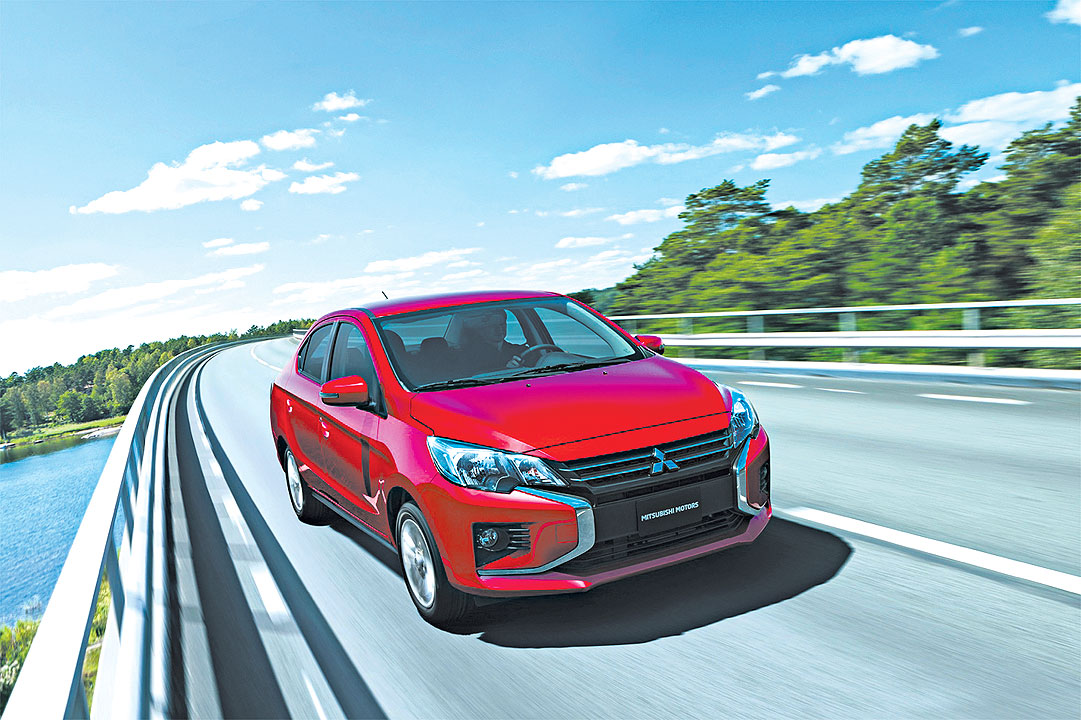
The new Mitsubishi Mirage G4 gets in on the brand’s Dynamic Shield fun — and more

THE IMPOSITION of the enhanced community quarantine following an upsurge of COVID-19 cases pushed the media launch from Aug. 12 to Aug. 26, and the public reveal to last Saturday. But surely, that postponement merely served to heighten the excitement over the local unveiling (albeit digitally) of the refreshed Mirage G4 — one of the best-sellers of Mitsubishi Motors Philippines Corp. (MMPC).

The current (sixth) generation of the storied Mirage nameplate has not only proven popular (with an excess of 92,000 units sold) here since its 2013 launch, but additionally plays an important role in helping spur the local economy. In 2017, MMPC commenced producing the Mirage G4 locally. The company reported in a release that “more than 54,000 cars” have rolled out of its 23-hectare Sta. Rosa, Laguna plant since.

It is significant to note that MMPC is one of only two car makers (the other being Toyota Motor Philippines) participating in the government’s Comprehensive Automotive Resurgence Strategy (CARS) seeking to spur the growth of the local manufacturing industry. Among the salient points of the commitment is the production of a minimum of 200,000 vehicles over six years (ending in 2023 for MMPC). The program is envisioned to create “direct and indirect jobs in auto manufacturing, parts making, distribution, and ancillary services,” as well as serve as an impetus for corollary industries.

Of course, the pandemic, which has dragged on for a year and a half now, has negatively impacted businesses and industries — including all things automotive. The Inter-Agency Committee (IAC) on Automotive Industry Development is said to be lobbying to extend CARS for another three years, without prejudice to the original 200,000 unit output each for the two manufacturers. MMPC enrolled the Mirage under the program.

A recent BusinessWorld article penned by Jenina P. Ibañez reported that the two car companies “have manufactured just over a third (or a total of about 147,000) of their target as of May,” according to the Department of Trade and Industry. Again, Mitsubishi presently has until 2023 to meet its Mirage production target.

Replying to a question from “Velocity” during the Mirage G4 media launch, MMPC Vice-President for Planning and Development Xavier Eyadan said that the company “cannot disclose yet the current situation with CARS,” but conceded that the pandemic “had an effect on (the company’s) performance.” He added, “However, we are continuously (asserting) our commitment to reviving our auto industry.”

Although MMPC officials were reluctant to share sales projections, the unveiling of the new Mirage G4 is certainly expected to boost sales in this affordable segment.

The most significant update to the G4 was undoubtedly the one done to its front fascia. It now sports the familiar Dynamic Shield — better aligning it with the rest of the Mitsubishi portfolio. Mitsubishi Motors Corp. Head of Design Division Seiji Watanabe said that this imbues a wide and bold character to the vehicle, “with a certain coolness.” A sense of greater width is also lent by the arrangement of lamps and a larger grille — also giving it what he called a “game face.” An edge-to-edge rear bumper also serves to enhance the illusion of width, as well as facilitate airflow in aid of aerodynamics.

Mr. Watanabe asserted that the Dynamic Shield “unifies the Mitsubishi design identity across the lineup.” The grille is fringed by new sporty headlights; the taillights are also new, as are 15-inch alloy wheels and foglamps.

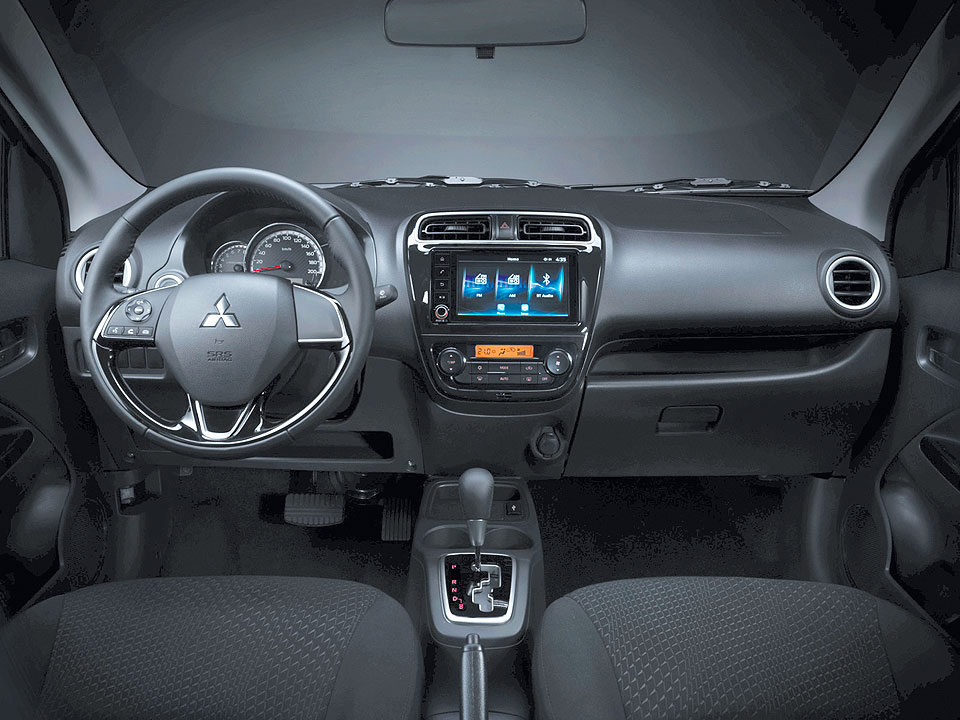
The G4 instrumentation has been made more legible, and receives a carbon fiber motif. The fabric-covered seats, on the other hand, feature dynamic geometric shapes. The trunk still boasts a 450-liter capacity.

Powering the vehicle is the familiar 1.2-liter L MIVEC engine mated to an INVECS-III CVT transmission for “dependable power and exceptional fuel efficiency.” The top-spec GLS gets “convenient features such as keyless operation system, push start button, electric power steering, auto climate control, audio mounted controls and seven-inch Smart Phone Link Display Audio (SDA) touchscreen multimedia system.” Its infotainment system is now Apple CarPlay- and Android Auto-compatible.

Anti-lock brakes with electronic brakeforce distribution, reverse camera, and foglamps are standard fitments on the GLS CVT trim. Across all three variants, the Mirage G4 gets a Reinforced Impact Safety Evolution (RISE) body, dual SRS air bags, and Isofix tethers, and automatic-off headlights.

Still assembled at Santa Rosa, the new Mirage G4 comes in the following colors: Red Metallic (for GLX CVT and GLS variants), Titanium Gray Metallic, Cool Silver Metallic, and White Gold (for advance order of GLX CVT and GLS CVT variants only).

The new Mitsubishi Mirage G4 is priced as follows: P769,000 (GLX MT), P819,000 (GLX CVT), and P899,000 (GLS CVT), and is available in all 57 MMPC dealerships nationwide. Buyers until Nov. 30 get two years/25,000-km free preventive maintenance service. For more information, visit www.mitsubishi-motors.ph or contact a dealership.

MinDA to aid LGUs in acquiring solar-powered water systems

THE MINDANAO Development Authority (MinDA) said it will help local government units (LGUs) adopt solar-powered water systems for drinking and irrigation.

MinDA Chairman Emmanuel F. Piñol said each solar-powered water generation system unit can provide irrigation water for up to 100 hectares of farm area, depending on the water source, and also for drinking.  

“It saves farmers from the high cost of diesel fuel which they need for their water pumps. Using solar panels to power water drawing engines, the solar-powered irrigation system could source water from deep rivers, creeks, water impounding areas and even wells,” Mr. Piñol said in a social media post over the weekend.

According to Mr. Piñol, MinDA will help Mindanao LGUs develop schemes to recover the initial investment in solar-powered irrigation and solar-powered water systems.

He added that MinDA will seek the help of the Development Bank of the Philippines to offer low-interest loans to LGUs. 

“Since it relies on solar power, the solar-powered irrigation system is ideal for dry-season planting, including periods of drought when even the regular irrigation systems of the National Irrigation Administration (NIA) cannot provide water,” Mr. Piñol said.  

“The Mindanao Water Supply Program… aims to provide every community in Mindanao with safe potable water and irrigation water to improve agricultural production,” he added.

Mr. Piñol said solar-powered irrigation system will cost about P120,000 per hectare against P450,000 in NIA systems. Solar-powered systems can be built in less than six months and the coverage area can be expanded by constructing a bigger reservoir and laying additional pipe.

He added that LGUs should fund their own solar-powered irrigation and water systems with their higher share of internal revenue allotment starting next year due to the Supreme Court Mandanas ruling. — Revin Mikhael D. Ochave

ECB out-doving US Fed to boost euro’s allure

JACKSON HOLE sharpened the contrast between a Federal Reserve telegraphing an end to stimulus and a dovish European Central Bank (ECB). For the euro, that means its status as a preferred funding currency just got a boost.

The discount on the overnight rate to borrow the common currency instead of dollars rose earlier this month to the most since 2020. That juiced up returns on carry trades funded by the euro, which have been some of the best performers this year.

That trend got extra legs on Friday after Federal Reserve Chairman Jerome H. Powell said it could be appropriate to start scaling back its $120-billion-a-month bond-buying program this year, though the central bank won’t be in a hurry to begin raising rates thereafter. That approach is miles ahead of the ECB, which said large-scale bond buying will continue next year, even after emergency asset purchases end.

“If the ECB was to persist in dovishness versus other central banks over the next few years, this would increase the attractiveness of the euro as a funder,” said George Saravelos, global head of FX research at Deutsche Bank in London.

EURO FUNDING
Against this backdrop, Brandywine Global Investment Management says it’s using the common currency instead of the dollar to finance purchases of emerging-market currencies. Nordea Investment Management sees it as a trend that’s bound to gain traction.

Traders are able to finance positions in higher-yielding assets using the euro at a rate of minus 0.48% overnight versus 0.09% for equivalent dollar funding, often seen as the default option for investors in the developing world.

What’s more, they can rest easy that their investments are less likely to get derailed by a sudden shift in outlook. ECB officials are still erring on the side of more stimulus even as they signaled last week that their latest shift in forward guidance doesn’t necessarily mean a longer period of low interest rates.

“We’re not using the dollar as a funding currency — it’s really the euro and the yen,” said Jack McIntyre, a Philadelphia-based money manager at Brandywine Global Investment Management, who has an underweight position in the common currency to finance purchases of emerging-market crosses.

Already this year, volatility-adjusted carry trades funded with euros delivered positive returns for 17 out of 23 emerging markets tracked by Bloomberg. The same measure for those funded by the greenback have delivered losses for 15 of them.

While a bulk of that performance can simply be explained by the euro’s weakness — it has dropped about 5% against the dollar since the beginning of the year — it also underscores the impact of the widening policy divergence across the world’s biggest central banks.

It’s a rift that’s poised to remain wide — according to market pricing — as Mr. Powell cited the US economy’s progress toward the Fed’s inflation objective, even as he indicated a careful assessment of incoming risks related to the COVID-19 delta variant.

Indeed, the discourse in financial markets is already beginning to shift away from when the Fed will start tapering its asset purchases, to how quickly they’ll wrap up the operation.

‘RELATIVE MARGIN’
“Since the Fed is sounding relatively more hawkish, it brings the relative margin of policy to the forefront,” Brandywine’s Mr. McIntyre said. He is betting that the global economy gets past the delta variant relatively unscathed, that the US continues to experience robust growth into 2022 and that China adds stimulus to its economy.

That backdrop would lead to a payoff for riskier currencies such as the Chilean peso, the Mexican peso, the Brazilian real, the Malaysian ringgit and the ruble, he said.

Traders are betting the Fed will hike interest rates 25 basis points by the beginning of 2023, while the ECB isn’t expected to increase the deposit rate until 2024.

“Short-term, this Fed-ECB divergence is quite disruptive as it contributes to tightening global monetary conditions via a stronger dollar,” said Witold Bahrke, a senior macro strategist at Nordea Investment Management.

But over the medium term, the euro should continue to “gain attraction” as a funding currency, since the ECB will stick with its ultra-easy policy, he said. — Bloomberg

CA backs SEC’s cease-and-desist order against Planpromatrix

THE Court of Appeals (CA) upheld the Securities and Exchange Commission’s (SEC) cease-and-desist order (CDO) against Planpromatrix Online Co. for its unlicensed investment solicitation activities.

“In a 17-page decision dated July 19, the CA Special 10th Division affirmed the [CDO] issued by the SEC against Planpromatrix for perpetrating fraud and causing grave injury to the investing public,” the commission said in an e-mailed statement on Friday.

The commission en banc issued the order against Planpromatrix in July 2019 after receiving complaints from the public. The commission issued an advisory against the entity in February 2018 for offering investment schemes ranging from P600 to P1,850 where an individual can apparently earn from an e-loading business, data entry job, and advertising package.

“The SEC Markets and Securities Regulation Department, Corporate Governance and Finance Department, and Company Registration and Monitoring Department issued certifications that Planpromatrix had neither a secondary license to solicit investments from the public nor the requisite registration statements,” the SEC said.

Planpromatrix filed a motion to lift the order, however, the SEC denied the motion and ordered a permanent decision via a resolution dated Nov. 11, 2019.

The entity then filed a petition for review before the CA, assailing the validity of the SEC’s CDO, resolution, and the commission’s findings against Planpromatrix.

However, in the July decision, the CA said there is “wisdom in the issuance and continuance of the CDO” against Planpromatrix.

“There can be no debate on the authority of the SEC to issue the subject CDO, provided that the conditions therefore, i.e. that fraud has been perpetrated and grave injury is likely to be caused to the public,” the CA said.

Further investigation by the Enforcement and Investor Protection Department (EIPD) with the SEC Legazpi Extension Office revealed that Planpromatrix also lacked the required business permit.

The CA also noted the implied admission made by Planpromatrix President and Chief Executive Officer George Naval for not disputing the contents of the advisory issued by the SEC in February 2018 when it met with the commission’s EIPD.

The CA also said that the commission did not violate due process for issuing the CDO, which was not final and could have been refuted with evidence.

“[T]he subject CDO was not cast in stone that its efficacy and application are beyond challenge… Petitioner had the opportunity to cause the recall of the CDO; it availed of the opportunity to cause the recall of the CDO; it availed of the opportunity; and with that, it was accorded due process,” the CA said. — Keren Concepcion G. Valmonte

Trying something new

Y.O.U Rouge Velvet Matte Lip Cream — PHOTO FROM SHOPEE.PH/YOUBEAUTYPH

JUST because we’re all staying indoors doesn’t mean we have to stop taking caring of our looks. And this might just be the perfect time to try something different — after all, who is going to see your mistakes? If something doesn’t work out, you can always use a filter during online meetings.

Something new to try would be the products of Hong Kong beauty brand, Y.O.U Beauty, which had its Philippine launch last week via a Zoom press conference.

Y.O.U (according to PR Manager Claire Miguel, it stands for Youthful, Outstanding, Unique) is under the HEBE Beauty Group, which was listed in Hong Kong in 2017. By 2020, it had placed 4th in Shopee’s Beauty and Skincare category.

During the launch last week, they presented the Radiance White Series. It has five components: a facial foam (which removes impurities and makeup), a toner (meant to be soothing, hydrating, and skin-regenerating), a serum (with brightening active ingredients), a day cream with sun protection, and a night gel that moisturizes and revitalizes skin while you sleep.

According to HEBE Beauty Spokesperson Jaclyn Cayetano, this line helps with eliminating dullness and hyperpigmentation. The products prices range from P299 to P499.

Next up was their Rouge Velvet Matte Lip Cream (basically a long-lasting liquid lipstick). It contains moisturizing coconut oil and Vitamin E which provides moisture and keeps lips soft. It has 19 shades in total, ranging from soft pinks to rich reds. These are priced at P329.

Said Ms. Cayetano, “I’d like to tell everyone that the brand values Y.O.U Beauty are accessible luxury, diversity, and inclusivity.

“Anyone can wear it.”

Y.O.U Beauty has official stores in Shopee and Lazada. — JLG

Maz-ja!

Mazda’s CX family — PHOTO FROM MAZDA PHILIPPINES

Mazda vehicles seem to be winning even the Germans over

BERLIN, GERMANY — As I currently write this story while I am in Germany, I am positively surprised to find out that one of Mazda’s three global research and development centers is in fact, located in Oberursel, Germany. The facility is called Mazda Research Europe (MRE) and it is one of the car brand’s product development arms that specifically provides its Japan HQ with crucial information about Europe’s car market trends and the latest automotive technology.

It is also interesting to discover that Mazda had already been exporting automobiles to Europe full-tilt since 1967. And that five years later, in 1972, Mazda Motors Deutschland was established. But probably even more interesting for us to know is that the new market in this continent is what drove the development of the Mazda 323 — a Mazda3 predecessor.

Simply put, the Mazda 323 was in fact, the first Mazda vehicle that was designed specifically for the European market! And look at the beauty that it’s evolved into, over time — now embodied in the multi-awarded Mazda3.

Now, I’ve also got a few more things to share about Mazda that has more current relevance with the Philippine market. First, it is the news that Mazda Philippines has recently announced a special service campaign that is meant for first-generation BK Mazda3 owners. The ongoing campaign offers a 50% discount on BK-series Mazda3 original parts in its current inventory, for owners who are interested in restoring some aspects of their older car. “Due to the age of the BK-series Mazda3, we believe providing easier access to maintenance and replacement parts will benefit our Mazda3 owners and allow them to further enjoy reliable service from their vehicles,” shares Mazda Philippines President and CEO Steven Tan.

Meanwhile, BK-series Mazda3 vehicles that were produced between 2004-2008 (and which were sold by Mazda’s previous distributor in the Philippines) qualify for a free replacement of the car’s steering wheel brand emblem, which may have deteriorated and become brittle over time. Such replacement fosters greater car safety as a brittle emblem may potentially break apart and be dislodged as projectiles in the event of a driver-side air bag deployment. And while no injuries have yet been reported specifically due to this issue, Mazda Philippines just wishes to proactively go ahead with this campaign in the interest of its customers’ safety.

All the owners of the mentioned BK-series Mazda3 units need to do is contact the Mazda dealership of their preference and express their desire to be included in the special service campaign. The service procedure will only take approximately 45 minutes and, to every customer’s delight, Mazda Philippines will bear the cost of labor and new parts for the said component replacement job. All contact information of Mazda’s authorized dealerships nationwide can be found at www.mazda.ph.

“We believe the safety of Mazda owners is paramount and is essential as we ensure the proper and continued operation and service of their vehicles during these trying times,” added Mr. Tan.

Furthermore, Bermaz Auto Philippines — the exclusive distributor of Mazda vehicles in the country — is happy to share that Mazda Philippines sales grew by 38% in the first half of 2021, compared to the same time in the previous year, 2020. It attributes this significant sales improvement to the ever-growing popularity of Mazda crossovers amongst Filipinos — namely, the CX-9, CX-8, CX-5, CX-30 and CX-3 — as it is these crossovers that make up 60% of the total sales figure.

Interestingly, I have also noticed during my time here in Europe that of all the Japanese car brands, the one that I see the most units of in parking lots and driving around on local roads and highways — at least in Germany, Switzerland, and Austria — is Mazda. And mind you, I’ve been out and about quite a lot — and in different neighborhoods, too. Of course, German cars still dominate the market, and European-made vehicles are always in the majority; that’s a given. But the European car market is ultra-competitive and extremely tough to penetrate, and it looks like so far, Mazda vehicles have begun winning over the hearts of choosy Europeans!

Perhaps it is the brand’s iconic emotional styling, minimalistic designs, driver-centric approach and, most especially, its proposition of offering premium features, materials and workmanship at a more affordable price point, that makes its products extra desirable. After all, European highways are among the best to drive on in the world. Standards are always high; motorists need more than what is utilitarian.

They seek an emotional connection.

Fishing association opposes plan to import 60,000 MT

PHILIPPINE STAR/ MICHAEL VARCAS

THE GOVERNMENT’S plan to import 60,000 metric tons (MT) of fish to augment supply during the closed fishing season has met with opposition from the association of small fishermen.

The chairman of the Pambansang Lakas ng Kilusang Mamamalakaya ng Pilipinas, Fernando L. Hicap, said in a statement Sunday that the planned imports will deprive fishermen of good prices for their catch during the closed season for major fishing grounds.

“We attest that the shortage of fish is artificial. Following the government’s reasoning for importation, why declare a fishing ban that generates alleged shortages in the first place? Moreover, even with closed seasons, we have lots of fish in our seas. Imports are unnecessary,” Mr. Hicap said.

On Aug. 27, the Department of Agriculture announced that it has approved the issuance of certificates of necessity to import 60,000 MT of fish to maintain supply and keep prices low during the closed fishing season.

“Our primordial concern is to enhance and sustain the development of our fisheries sector, and provide our fellow citizens affordable fish,” Agriculture Secretary William D. Dar said.

Fish species to be shipped under the certificates of necessity to import include small pelagic varieties such as round scad (galunggong), mackerel, and bonito.

However, Mr. Hicap said the closed fishing season affects livelihoods, and called for compensation and government subsidies for the idling of the fishing fleet.

“Instead of holistically addressing the constant agricultural crisis, the government always resorts to band-aid solutions like imports,” Mr. Hicap said.

The closed fishing season was implemented in the Davao Gulf (June 1 to Aug. 31), Visayan Sea (Nov. 15 to Feb. 15), Sulu Sea (Dec. 1 to Feb. 28), and Northeast Palawan (November to January).  

The closed fishing season is enforced by the Bureau of Fisheries and Aquatic Resources, to allow the regeneration of small pelagic fish and other species, in response to the dwindling fish catch over the years. — Revin Mikhael D. Ochave

Cebu Pacific cancels 30 flights, PAL mounts more repatriation flights during extended MECQ

CEBU PACIFIC

CEBU Pacific and its regional brand Cebgo canceled several flights as the government extended the strict community quarantine status of the capital region until Sept. 7.

“The Philippine government, through the Inter Agency Task Force (IATF) Resolution No. 135-A, has retained the Modified Enhanced Community Quarantine (MECQ) status of the National Capital Region until Sept. 7, 2021,” Cebu Pacific said in a statement over the weekend.

“Following this, Cebu Pacific and Cebgo have canceled… flights from Sept. 1 to 5, 2021,” it added.

The airline canceled 30 domestic flights. Among the affected flights are those from Manila to Bohol, Boracay, Cebu, Coron, Davao, Tacloban, Masbate, San Jose, and Siargao.

It also canceled flights from Cebu to Boracay, Butuan, Cagayan de Oro, Siargao, and Tacloban.

The budget carrier said it will continue to operate flights for essential travel during the period.

PHILIPPINE AIRLINES
Meanwhile, flag carrier Philippine Airlines (PAL) said in an advisory that it will be mounting more repatriation flights from the United Arab Emirates, Malaysia, and Thailand next month.

It will have repatriation flights from Dubai to Manila on Sept. 2, 4, 6, 8, and 14. Its flight from Kuala Lumpur will be on Sept. 4, followed by a flight from Bangkok on Sept. 9.

PAL said only Philippine passport holders are allowed to board the repatriation flights.

PHILIPPINE AIRASIA
Low-cost carrier Philippines AirAsia is offering a promo fare (P199 one-way base fare) for authorized travelers, especially returning overseas Filipino workers.

Destinations include Puerto Princesa, Iloilo, Caticlan, Tacloban, Bohol, Kalibo, Cagayan De Oro, Bacolod, Davao, General Santos, and Zamboanga.

“Booking should be made from 30 Aug. to 5 Sept. to avail of the promo which is available for travel from 30 Aug. 2021 to 31 Jan. 2022,” the low-cost airline said.

Philippines AirAsia also offers an unlimited date change. — Arjay L. Balinbin

Chery Tiggo 5X: A wallflower with star power

Lending presence and some Euro inspiration to this crossover in the middle of the local Chery portfolio are a big blacked-out grille, black mesh side air intakes, and aggressive-looking headlamps. — PHOTO BY MANNY N. DE LOS REYES

Priced just right, this crossover contender punches above its class

SANDWICHED BETWEEN its siblings, the price-leading entry-level Tiggo 2 (which starts at a stunningly low P695,000 for the stick-shift version) and the head-turning European-inspired all-new Tiggo 7 Pro (which retails for P1.198 million and boasts a staggering array of standard comfort, luxury and safety features), the Chery Tiggo 5X finds itself in somewhat of a gray area.

It’s not as generously sized and upscale as its more expensive sibling, but isn’t exactly priced to draw out the budget-conscious buyers like its entry-level little brother.

So while the Tiggo 2 does a good job of attracting potential buyers who would otherwise be looking at tiny hatchbacks or entry-level variants of subcompact sedans, the Tiggo 5X finds itself being compared to a lot of other cars, from a stalwart crossover like the MG ZS, to the ever-popular subcompact sedans like the Toyota Vios and Honda City.

The Tiggo 5X 1.5 starts at P818,000 for the manual transmission variant — curiously the same price as the starter manual-equipped MG ZS 1.5 Style. Pricing stays very close even with the lowest priced automatic models (P860,000 for the Tiggo 5X AT and P868,888 for the ZS Style AT).

But while the ZS has two more higher-end automatic variants at P898,888 and P998,888, the Tiggo 5X only has one at P970,000. Its pricing also puts it smack dab in the upper half of the vast range of the Vios lineup (as well as that of almost all other subcompact sedans).

For many people, a spacious and high-riding crossover that’s priced the same as a small and less versatile sedan is a no-brainer. This alone dramatically expands the Tiggo 5X’s potential market.

Of course, I cannot always be on the same wavelength as others when it comes to a vehicle’s looks and a new brand’s perceived reputation and image. Those would be mostly subjective.

Nonetheless, I find the Tiggo 5X’s design good-looking enough in a chunky way — almost like a Nissan Juke but with less of the visual quirkiness. The chunky side panels, high beltline, and thick C-pillar all connive to make the car look shorter than it is, but it’s actually longer and more spacious than it seems.

This crossover punches above its weight with a generous array of standard features inside and out. The big blacked-out grille, black mesh side air intakes, and aggressive-looking headlamps lend the Tiggo 5X that “Euro-inspired face” that’s both compelling and characterful.

The Tiggo 5X’s 17-inch alloy wheels wear a very sporty five-triple-split spoke design and are wrapped by big 215/60R17 rubber that works wonders in soaking up bumps and potholes and makes curb-jumping relatively painless — as opposed to some crossovers’ tires that have aspect ratios of 50 or even less and result in a choppy or jarring ride.

Inside the well-crafted cabin with plenty of soft-touch surfaces (in contrast to many small sedans’ hard plastic inner door panels), judicious space utilization results in a spacious cabin with generous headroom, legroom, and shoulder room for both front and rear passengers. Cargo space is better than most sedans’ trunk space and can be increased a lot more by folding down the 60:40-split rear seats.

The faux leather upholstery on the highly supportive and comfortable seats feels plush, with multi-way power adjustments for the driver’s seat. Yet another premium feature is the electronic parking brake, which does away with the conventional handbrake lever for greater convenience (and more space on the console). There’s also push-button engine start/stop, a power sunroof and rear aircon vents.

Under the hood of the Tiggo 5X is a smooth and impressively refined 1.5-liter four-cylinder petrol engine that produces 114ps and 141Nm of torque — hardly superlative numbers but plenty adequate for everyday driving. No less than automotive giant Borg Warner developed the engine’s dual variable valve timing system. Other advanced engine technologies include cylinder head-integrated exhaust manifolds, and an intake manifold-integrated water-cooled intercooler.

Since the Tiggo 5X is a step above the Tiggo 2, there are a lot more safety features included like HDC or hill descent control, which allows the car to safely descend steep roads in full control, and HHC or hill hold control, which automatically uses the brakes to prevent the car from rolling backward when you want to accelerate from a standstill on a slope.

Another safety feature of the car is the 360-degree around-view monitor, which provides more viewing angles and wider vision for a stress-free drive. The Tiggo 5X’s instrument display utilizes a seven-inch LCD, which is among the largest in its class. For infotainment, the Tiggo 5X’s huge and nicely intuitive nine-inch touchscreen display allows you to control and display your phone’s various functions (including playlist and navigation) via Mirror Link.

The Tiggo 5X’s leather-wrapped steering wheel has intelligent speed control, which integrates cruise control, overspeed alarm, active speed limit and other functions. A welcome change from most cars is the four-door power window in which all four windows support one-touch push-button descend. I also applaud the use of idiot-proof large knobs and buttons for the climate control that let you set the cabin climate without taking your eyes off the road.

All things considered, the Chery Tiggo 5X has what it takes to steal sales from any number of sedans or crossovers — and not just based on a lower price. And if you’re still having second thoughts about the after-sales experience, there’s always Chery’s industry-leading five-year/150,000-km general warranty and 10-year/one-million-km engine warranty plus three-year free PMS and three-year roadside assistance.