Home Blog Page 7434

Stocks rise as remittances hit seven-month high

PHILIPPINE shares snapped three days of decline on Thursday amid improved remittances and as the implementation of an alert level system in Metro Manila started.

The benchmark Philippine Stock Exchange index (PSEi) gained 88.23 points or 1.28% on Thursday to close at 6,968.43, while the all shares index climbed 45.90 points or 1.07% to 4,323.53.

“Market went on bargain hunting after three days down at the start of localized or granular lockdown as NCR’s (National Capital Region)… and with remittances higher year on year,” Diversified Securities, Inc. Equity Trader Aniceto K. Pangan said in a text message.

Metro Manila is now under Alert Level 4 as the government shifted the capital to looser restrictions despite rising infections and hospitals remaining full.

The Health department reported 16,989 new coronavirus disease 2019 (COVID-19) cases on Wednesday, bringing active cases to 170,446.

The Health department’s COVID-19 vaccination dashboard showed the country has administered over 40.03 million jabs so far, with nearly 17.68 million fully vaccinated.

Meanwhile, money sent home by overseas Filipino workers (OFWs) reached a seven-month high in July, reflecting the improved employment situation in major economies that have begun recovering from the coronavirus pandemic.

Cash remittances rose 2.5% to $2.853 billion in July from $2.783 billion a year earlier, the Bangko Sentral ng Pilipinas (BSP) reported on Wednesday.

For the first seven months of 2021, cash remittances stood at $17.771 billion, up 5.8% from the $16.802 billion in the same period of 2020.

“Though still in trickles and inspired by the inoculation ramp-up and economic reopening, foreign investors are buying up the market in increasing frequency of late and at the higher range of the PSE trading band, which suggests the rally may have further to run,” First Metro Investment Corp. Head of Research Cristina S. Ulang said in a Viber message.

Foreigners turned buyers anew, recording P53.9 million in net purchases on Thursday from the P73.03 million in net outflows logged on Wednesday.

All sectoral indices posted gains on Thursday. Services went up by 44 points or 2.40% to end at 1,871.30; property gained 66.14 points or 2.19% to 3,075.79; industrials rose 150.05 points or 1.48% to 10,246.84; financials went up by 8.83 points or 0.62% to 1,432.53; holding firms improved by 40.13 points or 0.57% to 7,013.71; and mining and oil inched up by 6.25 points or 0.06% to 9,609.74.

Value turnover inched down to P7.37 billion with 1.07 billion shares traded on Thursday, lower than the P7.55 billion with 1.51 billion issues logged the previous day.

Advancers beat decliners, 103 versus 90, while 47 names closed unchanged. — K.C.G. Valmonte

Bolts mark return with win

THE Meralco Bolts marked their return to Philippine Basketball Association action with a victory, 95-83, over the Terrafirma Dyip on Thursday in Pampanga. — PBA IMAGES

By Michael Angelo S. Murillo, Senior Reporter

THE Meralco Bolts marked their return to Philippine Basketball Association (PBA) action with a victory, 95-83, over the Terrafirma Dyip on Thursday at the Don Honorio Ventura State University (DHVSU) Gym in Bacolor, Pampanga.

Held out as a team for two weeks over the league’s health and safety protocols, it took a while for Meralco to shrug off Terrafirma, but when it got the leverage it needed, the team was not to be denied en route to the win that saw the Bolts improve to 6-2 in the Philippine Cup.

The Bolts did it minus key cogs Chris Newsome and Cliff Hodge, who had yet to be cleared for play in accordance with the PBA’s health guidelines, and sophomore Aaron Black, who hurt his hand early in the contest and was taken to the hospital to be checked.

The teams played it back-and-forth for three quarters, fighting to a 73-70 count, with the Bolts ahead, after 36 minutes of play.

In the fourth quarter, Meralco got early traction on the lead by veteran Reynel Hugnatan and guard Anjo Caram.

The Bolts outscored the Dyip, 12-9, to build a six-point cushion, 85-79, by the 6:17 mark.

They extended their lead, 93-79, four minutes later and were never threatened after.

Bong Quinto led five Meralco players in double digits with 17 points, with Mr. Caram adding 13 and Allein Maliksi 12 points. Raymond Almazan finished with 11 while Mr. Hugnatan had 10.

“We we’re missing some key players so I just  told them to play as a team, play for one another. Good thing some players stepped up,” said Meralco coach Norman Black after the game.

With the loss, Terrafirma is now on the brink of elimination with a 3-7 record.

Aldrech Ramos top-scored for the Dyip with 15 points, followed by Joseph Gabyani with 14. Juami Tiongson and Reden Celda each had 10 points.  

 ALASKA STARTS GRIND
Meanwhile, the Alaska Aces begin their grind of three straight matches on Friday with a clash against defending champions Barangay Ginebra San Miguel Kings.

Out for two weeks because of the league’s health and safety protocols, the Aces (2-4) look to get wind in their push for the playoffs although under tough conditions, playing three in a row, beginning with the Kings set for 6 p.m.

They then take on league-leading TnT Tropang Giga (9-1) on Saturday and Terrafirma on Sunday.

Against the Kings (4-5), Alaska will be facing a team fresh from a huge come-from-behind win in their previous game and are looking to sustain the momentum.

Despite the adversity they are set to face, the Aces remain hopeful, taking it “a game at a time.”

Volleyball Champions League set for November

THE Philippine National Volleyball Federation (PNVF) will be holding Champions League tournaments for men and women in November, the sports body announced on Thursday.

Federation chief Ramon Suzara said that they have approved the staging of the Champions League (CL) early this week upon the recommendation of a dedicated working group.

With the targeted national league, the PNVF aims to bring together all volleyball stakeholders through a high level of club play.

The Women’s CL is eyed to take place from Nov. 13 to 19, with the Men’s CL following suit from Nov. 20 to 26.

Eight teams are expected to play in each tournament, playing as many as 24 matches.

The PNVF is eyeing either the Ilocos Norte Centennial Arena in Laoag City, Claro M. Recto Events Center in Lipa City or Tagaytay City as a potential venue for the semi-bubble competitions.

In the preliminary round, the eight clubs will be divided into two pools of four teams playing in a round-robin format. At the end of pool play, the teams will be ranked and will advance to the quarterfinals playing a cross-over single elimination.

The quarterfinal winners will advance to the semifinals, while the losing clubs will play in the classification round.

The semifinal winners will progress to the gold medal match, while the losing teams will play for the bronze medal.

The two winning clubs in the first stage of the classification phase will figure in the fifth to sixth place match, while the losing teams will play in the seventh to eighth place match. Deadline for the submission of 20-player rosters is on Oct. 20.

“One of the PNVF’s 10-point agendas is to serve Filipino families with entertainment through volleyball and to make volleyball a widely played sport by elevating it through high-performance competition,” said Mr. Suzara in a statement just as he underscored their push to strengthen and sustain the country’s national team program through an alternate yet equally strong platform like the Champions League.

The PNVF said that with Mr. Suzara in the meeting were federation Secretary-General Don Caringal, Vice-President Arnel Hajan and board members Charo Soriano, Carmela Gamboa and Yul Benosa, and Technical and Coaching Commission Chairman Jerry Yee.

Present, too, were representatives from Metro Manila clubs Cignal HD, Black Mamba-Army, Sta. Lucia, Chery Tiggo, PetroGazz and F2 Logistics, as well as teams from Baguio City and Iligan City. — Michael Angelo S. Murillo

Malditas begin Asian Cup Qualifiers bid anchored on ‘Remember The Goal’ push

THE Philippine national women’s football team begins its 2022 AFC Women’s Asian Cup Qualifier campaign this weekend, seeking to do well in the competition and beyond. — PHILIPPINE FOOTBALL FEDERATION

THE Philippine national women’s football team begins its 2022 Asian Football Confederation (AFC) Women’s Asian Cup Qualifier campaign this weekend, seeking to do well in the competition and beyond.

The team, collectively known as the Malditas, will start its bid in Group F where it is lumped with Hong Kong and Nepal.

World 68th ranked Philippines plays Nepal (101st) on Sept. 18 at the JAR Stadium in Tashkent, Uzbekistan, then collides with Hong Kong (78th) on Sept. 24.

Qualifying phase format has the top teams in each of the eight groupings advancing to the AFC Women’s Asian Cup, where they get to vie for spots in the 2023 International Federation of Association Football (FIFA) Women’s World Cup.

“As further motivation to the players, we came up with the rallying cry of ‘Remember The Goal,’ which is to qualify for the FIFA Women’s World Cup in 2023, and it starts here in Tashkent,” shared national team coach Marlon Maro in a virtual press conference with Filipino media on Wednesday from Uzbekistan.

The team, some coming from here and the training camp in California, left for Tashkent early this week and arrived safely, with the squad happy to report that all of the members tested negative for coronavirus disease 2019 (COVID-19) in tests done upon their arrival.

Mr. Maro said the team is in high spirits and looking forward to playing and representing the country.

He is confident that they have assembled a good team and prepared well for the competition at hand.

“This is definitely a new team, an exciting team to watch. And they are very motivated. When it comes to the lineup, I think this is the best lineup that we were able to assemble. It’s a combination of young and senior players and we have a combination of big and tall players from goalkeeper, midfield, and strikers,” the coach said.

Adding, “We were able to prepare for the competition through the training camp and competitive matches where the team continued to improve day by day.”

Named team captain of the Maldita is goalkeeper Inna Palacios, with defender Hali Long serving as co-captain.

Also part of the team are goalkeepers Olivia Davies McDaniel and Isabelle Mapanao; defenders Sofia Harrison, Chelo Hodges, Tara Shelton and Patricia Tomanon; and midfielders TahSara Castañeda, Anicka Castañeda, Malea Cesar, Charisa Lemoran, Rocelle Mendano, Jessica Miclat, Camille Rodrigue, Alyssa Ube and Camille Wilson.

Completing the squad are forwards Alisha Del Campo, Arianna Lepage and Chandler McDaniel.

The team will be sans veterans Tahnai Annis and Ryley Bugay, who are with their respective clubs in Japan, but Mr. Maro said the team they have can manage.

“We will miss their services, but the team, as it is, is very competitive,” said Mr. Maro.

Team captain Ms. Palacios also shared her coach’s confidence in the team.

“We’re confident of the tactics we have for the competition. We just have to follow the game plan. We’ll play our best and we’re very much motivated by the campaign that we have #RememberTheGoal in our heads at all times,” said Ms. Palacios, part of the Malditas team which saw action in the 2019 Southeast Asian Games.

In the lead-up to the qualifiers, the team conducted online training sessions early this year before going to camp in Irvine, California, from Aug. 4 to Sept. 11.

The team’s campaign is supported by the Philippine Sports Commission and MVP Sports Foundation.

The Philippine Football Federation said it is currently working on ways to show the Malditas’ matches, if not on live television, at least through livestream.

In the 12-country AFC Women’s Asian Cup happening in India next year, five spots in the FIFA Women’s World Cup are up for grabs. — Michael Angelo S. Murillo

Man City survives Nkunku hat trick to overwhelm Leipzig 6-3

MANCHESTER CITY’S Bernardo Silva in action with RB Leipzig’s Tyler Adams. — REUTERS

MANCHESTER, England — Manchester City, last season’s Champions League runners-up, crushed RB Leipzig (6-3) in a thrilling Group A game on Wednesday as Christopher Nkunku scored a hat trick for the German side.

It was a hugely entertaining match at the Etihad Stadium and although City manager Guardiola will be happy with the three points he will be concerned about the spaces his team left for the German side to exploit on the break.

Nkunku became only the fourth player to score a Champions League treble and end up on the losing side and he deserved his player of the match award as Leipzig showed real spirit to keep fighting back against City’s impressive firepower.

Defender Nathan Ake put City ahead in the 16th minute with a header from a Jack Grealish corner and the hosts doubled the lead 12 minutes later when Kevin De Bruyne produced wonderful skill to leave three defenders for dead before his deep cross was headed into his own net by Leipzig defender Nordi Mukiele.

Leipzig got back in the game with a 42nd-minute header from Nkunku, only for City to restore their two-goal advantage on the stroke of half time.

Lukas Klostermann was ruled to have handled after the referee went to the pitchside monitor to check the incident and Riyad Mahrez blasted home the spot-kick.

Leipzig were not deterred, though, and Nkunku reduced the deficit again in the 51st minute by heading in a cross from the excellent Spanish midfielder Dani Olmo.

Grealish then delivered a wonderful solo goal to mark his first European club appearance, collecting the ball on the left flank and jinking inside before giving Péter Gulácsi no chance with a curling shot into the far corner.

That was surely that, the City fans could be forgiven for thinking, but once again French forward Nkunku kept the game alive, completing his hat trick with a crisp drive after being set up by Yussuf Poulsen.

Incredibly, City responded immediately with an unstoppable long-range drive from Portuguese full back João Cancelo and any hopes the visitors had of a comeback ended when they went down to 10 men when former City full back Angelino was sent off in the 79th minute.

Substitute Gabriel Jesus added the sixth from close range five minutes from time and the home crowd were delighted with the display of Grealish, in front of his England manager Gareth Southgate.

“I loved it,” Grealish said of his first taste of the competition.

“I’ve been waiting a while. The past few weeks, I couldn’t wait for this game. It’s a great night.

“It was one of those games. It had absolutely everything. In the end, we’re delighted to get the win against a good team full of energy and young players,” he said.

City lead the group on three points after Paris St.-Germain were held to a 1-1 draw at Club Brugge in their opener. — Reuters

Yankees rally past Orioles, keep pace in wild card race

BRETT Gardner hit a go-ahead, two-run single in the ninth inning and the New York Yankees beat the host Baltimore Orioles (4-3) on Wednesday night after blowing a one-run lead in the eighth.

Luke Voit opened the ninth off Tyler Wells (2-3) with a walk, and Gleyber Torres followed with a single. With one out, pinch runner Tyler Wade and Torres pulled off a double steal that was upheld via replay, and both scored when Gardner lifted a 1-2 slider into short left field after fouling off three consecutive pitches.

Shortstop Richie Martin ran out and attempted to make a diving catch, but had his back turned and the ball fell in just before he could make the catch.

Gardner’s clutch hit in the rain occurred after New York’s Chad Green was one strike away from preserving a 2-1 lead. Green allowed a two-run homer to Austin Hays that gave Baltimore a 3-2 lead, and Wandy Peralta (5-3) got the final out of the eighth after Green allowed his 14th homer in 60 appearances this season.

The homer was Hays’ second of the night and 20th of the season.

Aroldis Chapman, pitching for the third straight day, needed only eight pitches to toss a perfect ninth and convert his 27th save in 31 chances.

The Yankees (82-64) earned their third straight win after a 3-12 skid that followed their first 13-game winning streak since 1961. New York remains tied with the Toronto Blue Jays (82-64) and the Boston Red Sox (83-65) for the two American League wild card spots.

Baltimore (46-99) took its fifth straight loss.

Yankees starter Nestor Cortes, Jr. logged a career-high 11 strikeouts and allowed one run and Hays’ solo homer among three hits in 6 1/3 innings. He walked two.

Gio Urshela hit a two-run homer in the third, but the Yankees did little else offensively most of the night after tying a season high with five homers while winning the series opener on Tuesday.

Hays slugged a solo shot in the sixth before his two-run homer in the eighth.

Baltimore left-hander John Means allowed two runs on four hits in 5 2/3 innings. He struck out four and walked two. — Reuters

Henderson fires winner as Liverpool beats Milan in thriller

LIVERPOOL, England — Liverpool captain Jordan Henderson struck a rare Champions League goal to earn his side a 3-2 victory over AC Milan in a rip-roaring Group B opener at a rocking Anfield on Wednesday.

Henderson rifled home in the 69th minute to settle an absorbing contest between the two European heavyweights whose only two previous meetings had been in finals.

With Anfield welcoming back fans for a Champions League night for the first time in 18 months, Liverpool had threatened to run riot when Fikayo Tomori’s own goal handed them an early lead in a barnstorming start.

Remarkably, after weathering the storm which included a Mohamed Salah penalty miss, Milan struck twice in quick succession at the end of the first half with Ante Rebić and Brahim Diaz silencing the home crowd.

Milan then had a goal disallowed shortly after the break before Salah made amends for his penalty miss by equalizing from close range in the 49th minute.

The outcome was still in doubt until Henderson capped a memorable Anfield night with a thumping effort — only his second in the competition and first for seven years.

“First half an hour, we blew them away,” Liverpool left back Andy Robertson said. “Then we got sloppy and stopped doing the things we were doing really well. We let them back into the game and walk in at half time thinking ‘how have we let this happen?’”

Milan’s return to Europe’s top club competition for the first time in seven years began in torrid fashion as the seven-time champions were initially overwhelmed.

With Zlatan Ibrahimović unavailable and several players making their Champions League debut, Milan looked ill-equipped to compete and fell behind in the ninth minute when Trent Alexander-Arnold got in on the right side of the area and his cross struck former Chelsea player Tomori and beat Milan keeper Mike Maignan.

MISSED PENALTY
Before Milan could clear their heads, they conceded a penalty when Ismael Bennacer blocked Robertson’s shot with his arm.

But Maignan dived to his right to keep out Salah’s penalty.

It was only the second time in 19 attempts that Salah had failed to convert a spot kick and it proved a turning point.

Salah fired over and Joel Matip headed straight at Maignan as the chances kept coming, but Liverpool were rocked on their heels as Milan turned the game on its head — Liverpool manager Klopp saying later that his team had got a bit “carried away.”

For the first time, Liverpool’s high press relented and Milan worked the ball neatly forward before Franck Kessie’s pass played in Rebić to sweep a low shot past Alisson.

Klopp wore a wry smile after that, but one minute and 48 seconds later he looked as stunned as everyone else.

Milan attacked down the left again with Kessie and Rebić combining to set up Alexis Saelemaekers whose shot was blocked on the line by Robertson only for Diaz to pounce and convert.

It could have got even worse for Liverpool a minute after the restart when Saelemaekers scored from close range following a corner, but an offside flag spared Liverpool.

The frantic pace continued and Liverpool were level in the 48th minute as Divock Origi, given his first action of the season, scooped a ball over Milan’s defense for Salah to dink a bouncing ball past Maignan for his 14th Champions League goal at Anfield, equaling former captain Steven Gerrard’s record.

Milan did well to soak up Liverpool pressure, but they finally cracked when a corner was cleared to the edge of the area and Henderson smashed the ball home. — Reuters

Koepka on Woods: ‘I’m going to catch him on majors’

BROOKS Koepka is shooting for the moon in regard to winning major titles.

Koepka, who has four major championships to his credit, said time is on his side in his bid to catch Tiger Woods (15 majors) — or even Jack Nicklaus (18 majors).

“In my mind, I’m going to catch (Woods) on majors. I believe that. I don’t see any reason that can stop me,” Koepka said in a recent interview with Golf Digest.

“I’m 31. I have another 14 years left. If I win one a year, I got Jack. People misconstrue that as being cocky. No, that’s just my belief. If I don’t have that belief, I shouldn’t be out there. If you don’t think you can win, why the hell are you teeing it up?”

Koepka has won the 2017 and 2018 US Open as well as the 2018 and 2019 PGA Championship. He finished in a tie for second place in the 2019 Masters, which was won by Woods. — Reuters

Next-gen taekwondo athletes in PSC’s Rise Up Shape Up

YOUNG and promising women and girls taekwondo practitioners of the country will headline the webisode of Rise Up Shape Up (RUSU) on Sept. 18.

RUSU is a weekly web series of the Philippine Sports Commission (PSC) under the Women in Sports program. It highlights the inspiring stories of women and girls who demonstrated excellence in the field and provides equal opportunity and exposure for them.

In the latest webisode, PSC-RUSU will feature 45 taekwondo rising stars who showcased what they could do in the recent 7th Women’s Martial Arts Festival.

“Courtesy, integrity, perseverance, self-control, and an indomitable spirit — these are the five tenets of taekwondo that any practitioner or athlete knows by heart. These are also the same characteristics manifested by these 45 young taekwondo champions,” shared PSC Women in Sports Commissioner oversight Celia H. Kiram.

The brief history of taekwondo will also be discussed during the 10:30 a.m. web program which will be explained further by Commissioner Kiram in the “K-Isport: Kwentong Isport” segment.

“This project echoes the agency’s commitment to supporting and nurturing women in the field of sports.” told the lady commissioner.

In the previous webisodes, PSC’s Rise Up Shape Up also starred different martial arts presented in the 7th Women’s Martial Arts Festival such as karatedo, judo, arnis, muay thai, wrestling, among others.

Long dragged-out story

Ben Simmons has wanted out since Sixers head coach Doc Rivers and top dog Joel Embiid threw him under the bus for his poor showing in the 2021 Playoffs. True, he did admit that his confidence got the better of him to the point where he could not — did not — want to shoot, especially in the crunch. That said, he likely saw criticism of his extreme timidity on the court, particularly since it came from quarters supposed to close ranks with him, as the last straw.

Simmons cannot be blamed for thinking the way he did and thereafter moving to cut cleanly. Needless to say, the fact that the Sixers actively shopped him around did not help things any. And after a meeting with top brass, one also attended by super-agent Rich Paul, there was agreement that he would be dealt. Where didn’t seem important to him; the bottom line is that he no longer wanted to stay.

There was one problem, however: The Sixers didn’t feel like trading Simmons for pennies to the dollar. They were bona fide contenders, and far be it for them to thumb up a deal in which they stood to acquire draft picks instead of another vital cog. They wanted apples for apples, not a bunch of grapes. Which, as handicapped players in an already-depressed market, gave them little room to maneuver. His continued inability to shoot five seasons removed from being chosen first overall in the 2016 draft appeared to be a long-term concern.

The bottom line is that Simmons comes off as damaged goods. And he’s pushing to leave pronto, thus eroding whatever leverage the Sixers have left. That he’s prepared to sit out training camp when it begins on Sept. 28 does not help their cause any. And, nope, their threat to fine him in accordance with National Basketball Association rules and provisions on his contract won’t help. Were he compelled to return, he would be a distraction at best, and certainly far from motivated to perform up to par.

In other words, the Sixers would do well to move on, and fast. While general manager Daryl Morey has developed a reputation as a hard-nosed negotiator, he squeezes little to no value in encouraging a toxic atmosphere. Waiting may or may not have its rewards, but not taking action in the immediate to short term is a decidedly bad idea. In a dragged-out situation, there are no winners.


Anthony L. Cuaycong has been writing Courtside since BusinessWorld introduced a Sports section in 1994. He is a consultant on strategic planning, operations and Human Resources management, corporate communications, and business development.

Tax avoidance and moral issue

If we rewind to 10 years ago when the global economy was busy recovering from the global financial crisis, and fiscal authorities were dialing back public spending and central banks were thinking of normalizing monetary policy, tax avoidance would not have made a lot of noise. But noise they made anyway when global firms such as Google and Amazon were accused of avoiding paying tax on their British sales.

The culture of naming and shaming big companies became more entrenched.

However, at the time, given these companies’ complicated tax structures, it proved difficult for tax authorities to prove illegal activities in what, for instance, Starbucks was reported to have done in 2013. With sales of about £400 million in UK, the British Broadcasting Co. (BBC) reported it “paid no corporation tax, transferred some money to a Dutch sister company in royalty payments, bought coffee beans from Switzerland and paid high interest rates to borrow from other parts of the business.”

What about Google and Amazon?

The BBC cited Google’s UK unit payment of only £6 million from sales turnover of £395 million. Amazon made £3.35 billion in the UK in 2011 but only reported tax expense of £1.8 million.

Like the coffee giant, these Silicon Valley behemoths were found to have avoided, but not evaded, tax obligations. All that the civil society could do was to name and shame them by saying something like “avoiding tax robs our public services.”

Today, when the world is imprisoned in economic lockdowns in a never-ending cycle of health protocols and prohibition of face-to-face gatherings and the demand for public money has never been so high, even tax avoidance, not to mention plunder of public money, may be considered a moral issue.

Even if naming and shaming produced results and public opinion should force big companies to pay the right taxes, this is far from socially desirable. A “voluntary” tax system could not be sustainable and, more important, predictable, in programming public spending for both social and economic services and infrastructure.

There is nothing new to this so-called tax avoidance. If we go by the tax books, conglomerates do it but the issue arises when companies cross a line that may be considered morally and legally inappropriate. This occurs when their accountants start employing “black-box” arrangements in which transactions are done for no commercial reason but to avoid paying tax.

Of the so-called Silicon Six — Amazon, Apple, Facebook, Google, Microsoft, and Netflix — it was reported by the Fair Tax Foundation that between 2011 and 2020, cash tax paid relative to their revenues ranged from only 0.4% for Amazon to Facebook’s 5.1%. Value-wise, Amazon made $1.6 trillion in revenues and paid only $5.9 billion in income tax. Facebook’s revenues of $327.8 million yielded income tax of a relatively big $16.8 million. In contrast, Apple’s $2.1 trillion in revenues resulted in tax payment of $101 billion and Microsoft’s $963 billion in revenues warranted a tax payment of $55 billion.

Amazon justified its modest tax payment based on its retail business model where profit margins are supposedly low and its huge investments in job creation and infrastructure. Facebook, on the other hand, explained that it would be more meaningful to compare their tax payment with their profits rather than revenues. Even if one were to do this, we see that Apple, with profits 4.5 times that of Facebook, paid nearly six times more than Facebook in taxes.

While Google and Amazon are the most visible of these digital companies that conduct business across borders, financial technology companies have mushroomed in recent years and have therefore posed new tax challenges on existing fiscal framework and ground rules.


In the Philippines, as in the rest of Asia, these new tax challenges could not have come at a more appropriate time than today. Digitalization has become more entrenched, opening up new grounds in driving fintech, e-commerce, and online services. These have enabled various applications in mobile money transfers, online procurement, and no-touch services transactions that are crucial in coping with the pandemic. With increased use of digitalization, tremendous opportunities have been opened to collect more revenues to finance the huge cost of containing the health crisis and to engineer economic recovery.

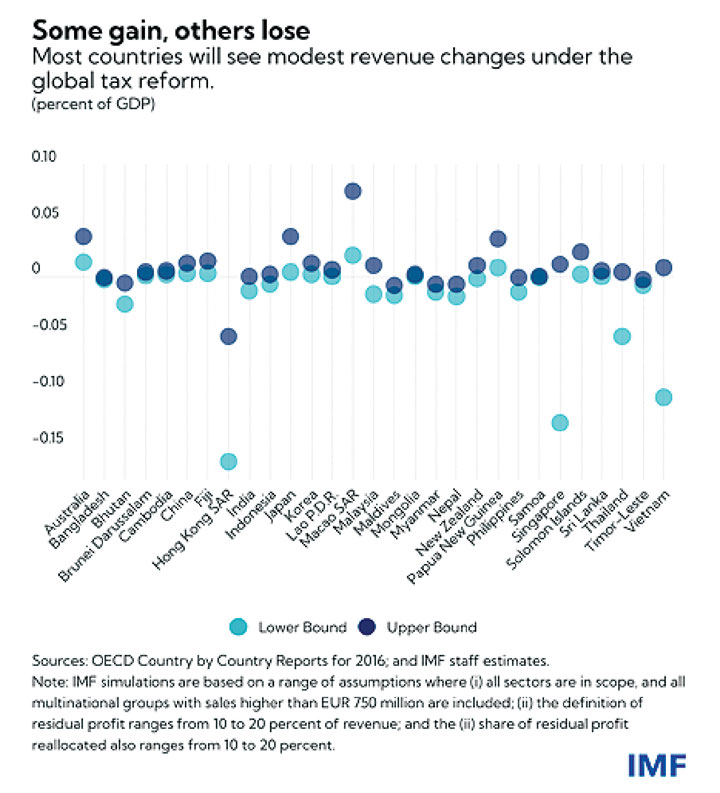
The view of the IMF’s Asia Pacific Department and Fiscal Affairs Department is reflected in their joint publication Digitalization and Taxation in Asia, and the webinar to launch it held three days ago, Sept. 14. A blog entry was also released in the IMF website by some of the 10 authors, Era Dabla-Norris, Ruud De Mooij, Andrew Hodge, and Dinar Prihardini. The common idea is that it’s been challenging for many Asian countries to tax tech giants because their presence is virtual.

First, what is the opportunity base in Asia? The Fund noted that in Asia, the market consists of about two billion internet users with great prospects for the future. Asia runs tech giants Alibaba, JD.com, Rakuten, and Tencent and hosts foreign tech giants like Facebook. Current tax regimes have issues on where these tech giants that straddle borders should pay. These tech giants are not exactly physically around Asia, their presence is limited in the digital platform. Collecting taxes on e-services and small-parcel deliveries is therefore less than straightforward.

Second, what are the potential issues? While some Asian countries have started to collect digital taxes by withholding taxes on payments for cross-border digital services or user-based turnover taxes on digital activities, it is possible this initial fiscal effort may be rendered superfluous should a new global system for profit taxation is agreed upon. The Fund reported that aside from the US and major Asian economies, some 134 countries under the umbrella of the Inclusive Framework of the Overseas Co-operation and Development have decided to allocate taxing rights on profits to countries where consumers and users are located, reflecting that tax administration is based on digital presence.

Does this mean trouble for multinational companies and tech giants? It might be too early to judge because innovative accounting techniques or the actual implementation of the future tax regime could change the possible outcome.

What is somewhat clear at this point is that some portion of the profits of those companies with global revenues in excess of a certain threshold would be allocated across countries in proportion to local sales and taxed under domestic laws.

The 75-page report of the Fund outlined the potential outcome of the proposal on corporate tax revenues across Asian countries. In addition, the Fund also laid down the merits of digital services taxes and their revenue potential. An estimate of potential gains from collecting value-added tax on digital services and cross-border e-commerce sales of goods was presented in the report.

It was clarified that while easier to implement, the potential of digital services taxes is not very significant. For the Philippines, together with Bangladesh, Indonesia, and Vietnam, the estimate is just about 0.02% of GDP. With our current GDP level of around P21.5 trillion in 2019, this would only be about P4.3 billion. The other side to this small gain is its possible distortionary effect on business decisions without the assurance that it would deter tax avoidance. Trade relations could also be strained.

On the other hand, implementing the value-added tax would be difficult because online sales are exempted. This may be resolved by requiring non-resident suppliers of digital services to register with local tax authorities and pay appropriate taxes on their local sales. From this source, the Fund estimated a possible additional revenue of some $365 million or P18.3 billion for the Philippines.

Our take of these computations is that the Department of Finance should carefully assess the dynamics of these proposals and their possible impact on both tax administration — on whether this type of taxation would be simple enough to encourage tax payment and discourage tax avoidance — and tax take — whether under different scenarios, the numbers would remain pathetically insignificant.

At this time, every peso of public revenue is too precious to be lost either in tax avoidance or the plunder of the government treasury.


Diwa C. Guinigundo is the former Deputy Governor for the Monetary and Economics Sector, the Bangko Sentral ng Pilipinas (BSP). He served the BSP for 41 years. In 2001-2003, he was Alternate Executive Director at the International Monetary Fund in Washington, DC. He is the senior pastor of the Fullness of Christ International Ministries in Mandaluyong.


Dark legacy

SENIVPETRO-FREEPIK

Forty-nine years ago this month, on Sept. 21, 1972, then President Ferdinand Marcos, whose second four-year term under the 1936 Philippine Constitution was ending in 1973, signed Presidential Proclamation 1081 placing the entire country under martial law. By doing so he extended his time in office indefinitely, and made himself dictator of this rumored “show window of democracy in Asia.”

The military implemented PP 1081 on the 23rd, with the arrest of independent journalists; academics; artists and writers; labor, student and farmer leaders; and members of the political opposition. Congress, newspapers, and broadcast stations were shut down, and international flights and passports canceled.

In the next few days and weeks, as Commander-in-Chief of the Armed Forces of the Philippines (AFP), Marcos issued one general order after another to tighten his grip on power, and, as the country’s sole lawmaker, presidential decrees that had the force of law. Already president for seven years, Marcos was to remain in power for 14 more until he was overthrown in 1986 by the civilian-military mutiny known as the EDSA 1 People Power “Revolution.”

The arbitrary arrests, torture, enforced disappearances, and extrajudicial killings; the economic decline; the surge in the numbers of the poor and hungry; and the centralized looting of the public treasury that went on during those 14 years were bad enough. But what was even worse was the further damage that the Marcos kleptocracy did to the country’s political culture from which it has yet to recover.

The political culture of violence and corruption is the creation of a ruling elite whose monopoly over public power is assured through the dominance of a few families in Philippine governance. Himself no stranger to political violence, Marcos was an astute student and practitioner of traditional Philippine politics who made himself president by skillfully manipulating the electoral system that that culture nourished. In full awareness of the fact that keeping his name in the public mind was crucial, he had begun spending millions in political advertising when he was campaigning for a seat in the House of Representatives and later, in the Senate. When he ran for President in 1965, he also financed the making of a film to assure his election to that office and put even more corrupt journalists on his payroll, while, at the same time, cobbling together alliances with local warlords.

The electoral system, generated and sustained by a corrupt political culture, was severely flawed. But it was nevertheless based on periodic, law-mandated elections, during which, so the fiction went, the citizenry chose whom it would delegate its sovereign powers of self-government. Marcos changed all that by demonstrating that the laws — and the very Constitution itself, which mandated that his two four- year terms as President would end in 1973 and could no longer be renewed — were only as good as the willingness of those in power to observe them. That is the one lesson that over the last five decades this country’s political dynasties have taken to heart: it is evident in their use and observance only of those laws that suit their interests, and their ignoring those that do not. They zealously implement the laws protecting their property rights but violate with impunity the Constitutionally protected rights to free expression and freedom of assembly, for example.

Absent from Marcos’ declared reasons for the declaration of martial rule — to curb a so-called “leftist-rightist” conspiracy, and to “save the Republic and reform society” — was the real reason behind it: his determination to remain in power beyond 1973 and to be president for life.

He did manage to last for 13 more years beyond the end of his second term, and would have achieved the second aim had EDSA 1 not happened. But he nevertheless left behind him a politicized police and military establishment whose support has since then been crucial to every regime and every aspirant for the presidency.

That the military and the militarized police forces have become power brokers was the implicit reminder to the nation of the coup attempts that military units, led by Marcos-era officers, launched during the Corazon Aquino presidency. They failed to oust Mrs. Aquino and to install their political patron in her place, but they nevertheless made their point clear each time they tried to overthrow the first Aquino administration: no president can rest easy without their support, and woe to those who lose it. Mrs. Aquino herself survived because she was supported by the Ramos wing of the military, but part of the same dark legacy of the martial law period was the demise of the democratic principle of civilian supremacy.

The presidency of former AFP Chief of Staff and Defense Secretary Fidel Ramos (who was also chief of the dreaded, now defunct Philippine Constabulary) that succeeded Mrs. Aquino’s was free from coup threats because Ramos was one of the military’s own. But concerns over military support has been a sub-theme in the political calculations of every regime since then.

The military’s withdrawal of support from former President Joseph Estrada was crucial to his removal from office in 2001. The Gloria Macapagal-Arroyo regime had to contend with at least one attempted military coup, as a result of which Mrs. Arroyo was tempted to declare martial law in response to supposed attempts to overthrow her. The late President Benigno Aquino III, who succeeded her in 2010, had no problems with the military among other reasons because he continued its “modernization” and, at its urging, signed the Enhanced Defense Cooperation Agreement (EDCA) with the United States.

The military and the supposedly civilian but actually militarized police have been most empowered during the incumbency of President Rodrigo Duterte. In 2017, Mr. Duterte declared that to prevent what he said was a brewing coup attempt, he would appoint former military personnel to his cabinet to “complete (his) junta” so that “they (the military) would be in charge” and would have no reason to oust him.

Mr. Duterte in effect launched his own coup, and has since kept his word about completing his junta. The upper levels of his administration, from defense to local governments to social welfare, are dominated by retired military and police officers. His is the most militarized regime on record, surpassing even that of Ferdinand Marcos, whose leading officials even during the martial law period were civilians with appropriate backgrounds and expertise in education, labor, agriculture, and other areas.

In addition to the dominance of the coercive military mindset in policy-making, one of the most obvious consequences of Mr. Duterte’s appointing officials on no other basis than their military backgrounds is many a top bureaucrat’s inability to competently do the tasks assigned their agencies. It has led to the gross incompetencies that have made the Philippines number one in the tally of COVID-19 cases in Southeast Asia, which has, in turn, made economic recovery difficult if not impossible.

The inevitable conclusion is that this dark legacy of the Marcos dictatorship in Philippine politics and governance has become a matter of life or death for the millions of Filipinos who have lost their jobs and are under threat from the pandemic. The martial law episode ended 35 years ago but still casts a long shadow on the lives of the Filipino people. That reality has thrust upon future administrations the responsibility of restoring civilian supremacy in government, and of choosing competent and honest officials so as to put some order and sanity in the way this country is governed.


Luis V. Teodoro is on Facebook and Twitter (@luisteodoro).

www.luisteodoro.com