Home Blog Page 7433

Rates of T-bills, T-bonds likely to inch up further

BW FILE PHOTO

RATES of government securities on offer this week may rise further as the market turns cautious after Fitch Ratings revised its outlook for the Philippines and the detection of local transmissions of the Delta variant of coronavirus disease 2019 (COVID-19).

The Bureau of the Treasury (BTr) will auction off P15 billion in Treasury bills (T-bills) on Monday, broken down into P5 billion each in 91-, 182- and 364-day debt papers.

On Wednesday, the BTr will offer P35 billion in fresh 10-year Treasury bonds (T-bonds). The T-bond auction was moved from the initial Tuesday schedule as July 20 is a regular holiday in observance of Eid’l Adha.

Two bond traders expect T-bill yields to move sideways or higher by up to 5 basis points (bps).

For the 10-year bonds, the first trader sees its coupon settling between 3.875% and 4.125%, while the second trader gave a narrower forecast range of 3.875% to 4%.

“Market is still very much armed with liquidity and still opts to place in government securities even for longer tenors to reach for yields,” the first trader said via Viber.

Investors will likely continue to price in Fitch Ratings’ revised outlook for the Philippines in the upcoming auctions, the trader added.

Fitch last week maintained its investment grade “BBB” credit rating for the Philippines but revised its outlook to “negative” from “stable” due to the impact of the prolonged coronavirus pandemic.

The “negative” outlook means Fitch may downgrade the Philippines’ credit rating if it reverses reforms or departs from the prudent macroeconomic policy framework that leads to continued higher fiscal deficits. A weaker macroeconomic outlook over the medium-term and “diminishing policy credibility” may also lead to a downgrade.

Fitch has kept the Philippines’ rating at “BBB,” which is one notch above the minimum investment grade, since December 2017.

Meanwhile, the detection of the first cases of local transmissions of the Delta variant of COVID-19 in the country will also affect yield movements this week, according to the trader.

The Health department on Friday reported 16 new Delta variant infections, with 11 of these locally transmitted. This brought the country’s case count for the highly infectious variant to 35.

It also reported 6,040 new COVID-19 infections on Saturday, bringing active cases to 47,257 so far.

The first trader said local yields will also take their cue from the recent dovish speech of the US Federal Reserve Chairman Jerome Powell at a congressional hearing, where he said the US jobs data was “still a ways off” from the progress they are aiming for before they can reduce central bank support for the economy.

The BTr last week fully awarded the P15 billion in T-bills it auctioned off even as rates inched up across the board. The short-term securities attracted combined tenders worth P42.086 billion.

Broken down, it borrowed the programmed P5 billion via the 91-day papers at an average rate of 1.068%, up from the 1.044% seen during the July 5 auction.

The Treasury also raised P5 billion as planned via the 182-day T-bills. The six-month papers fetched an average rate of 1.384% from 1.351% previously.

Lastly, the government made a full P5-billion award of the 364-day securities at an average yield of 1.593%, higher than the 1.568% quoted for the tenor the week prior.

Meanwhile, the last time the BTr offered 10-year T-bonds was on June 22 when it raised P35 billion as planned from the reissued papers with a remaining life of five years and 10 months.

Total bids for the tenor hit P65.091 billion at that auction, higher than the P50.25 billion in tenders seen when the bond series was last offered on March 9. The notes were quoted at an average rate of 3.185%, down from 3.732% previously.

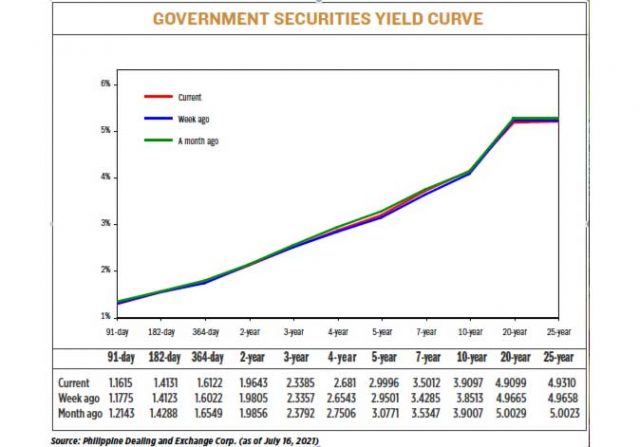
At the secondary market on Friday, the 91-, 182- and 364-day T-bills were quoted at 1.162%, 1.413%, and 1.612%, respectively, while the 10-year T-bonds fetched a yield of 3.9097%, based on the PHP Bloomberg Valuation Reference Rates published on the Philippine Dealing System’s website.

The Treasury is looking to raise P235 billion from the local market this month: P60 billion via weekly offers of T-bills and P175 billion from weekly auctions of T-bonds.

The government wants to borrow P3 trillion from domestic and external sources this year to help fund a budget deficit seen to hit 9.3% of gross domestic product. — B.M. Laforga

Dole plans Philippine expansion

DOLE Sunshine Co., the food and beverage company with global reach that grows most of its pineapples in the Philippines, is planning to expand its operations in the provinces while increasing its investments to include growing other fruits and producing biofuel from crop waste.

Christian Wiegele, global president of Dole Sunshine’s fresh produce group, said in an online interview with BusinessWorld on July 14 that the company plans to increase its farm production area in the country. He declined to disclose specific figures.

“We are working together with our local teams, local municipalities, and local partners to increase our hectares for pineapples. The same goes for other selected produce. We definitely plan to continue investing and growing our business here in the Philippines across the whole brand portfolio,” Mr. Wiegele said.

Mr. Wiegele said the firm had been growing its produce across more than 30,000 hectares of farmland that cover areas in Davao, General Santos City, Bukidnon, and Cagayan de Oro in Mindanao, and a small farm operation in Luzon.

Dole provides direct and indirect employment to 40,000 employees, he said, adding that the majority of the company’s overall output comes from the Philippines, particularly for bananas and pineapples for export to other countries. He did not give exact production numbers.

“In terms of pineapple production, it is definitely much more than half. The majority of our pineapples are grown in the Philippines and are sold as fresh produce or packaged into processed products out of the Philippines. For bananas, it is definitely more than half,” Mr. Wiegele said.

“The main export markets of Dole’s fresh produce grown in the Philippines include Malaysia, Hong Kong, Singapore, China, Japan, New Zealand, Saudi Arabia, and the United Arab Emirates,” he added.

In terms of investments, Mr. Wiegele said Dole is preparing for the launch of a new packing house in the northern part of Mindanao as part of efforts to reduce food waste during the packing process, together with the growing of other fruits such as papaya and avocado.

He added that other planned investments of the company include employee training, biofuel, artificial intelligence technology, and drones to help Dole move forward with agricultural technology.

“There are some exciting plans on repurposing our waste and some tangible benefits we are investing into biofuel, which will repurpose banana waste, pineapple waste into biofuel,” Mr. Wiegele said.

Further, Mr. Wiegele said the company also allocated a significant amount for capital expenditure this year but did not provide figures.

“It is definitely a significant amount. It’s definitely much more than $10 million dollars. It is significantly more than last year,” he said.

Moving forward, Mr. Wiegele said the company is looking at double digit revenue growth and is expecting positive momentum despite the pandemic.

He added that there is enough demand in the markets around the world for healthy nutrition.

“One of our commercial strategies is not only to grow our products in the Philippines, but also to offer those products to Philippines’ operations. That is one of the opportunities that we have, not only to grow and export, but also offer these products to the Philippines itself as a market, a very important market in Asia,” Mr. Wiegele said. — Revin Mikhael D. Ochave

Full-inspection regime for farm imports deemed impractical

SBMA

THE DEPARTMENT of Agriculture (DA) needs to implement a risk-based method for determining which agricultural import shipments to inspect, a University of the Philippines economist said.

Ramon L. Clarete, chief of Party of the B-Safe Project and a University of the Philippines School of Economics professor, said costs will rise if the DA goes ahead with its plan for 100% inspection of all agricultural cargoes.

“We are against smuggling and importation of unsafe food. But to do this (inspection) in every case is really just crazy. It is mind boggling how the DA can do that,” Mr. Clarete said during a webinar over the weekend.

“We need to have a risk-based strategy of conducting this inspection. Otherwise, it imposes a huge burden on the part of importers,” he added.

According to Mr. Clarete, the sanitary and phytosanitary clearance system does not incorporate a risk-based management strategy since it requires the registration of all products, regardless of the risk profiles of goods.

“If true that there is 100% inspection of all goods covered by sanitary and phytosanitary measures under the first border inspection, the plan may be just another illustration of a weak understanding of what a risk-based management system requires,” Mr. Clarete said.

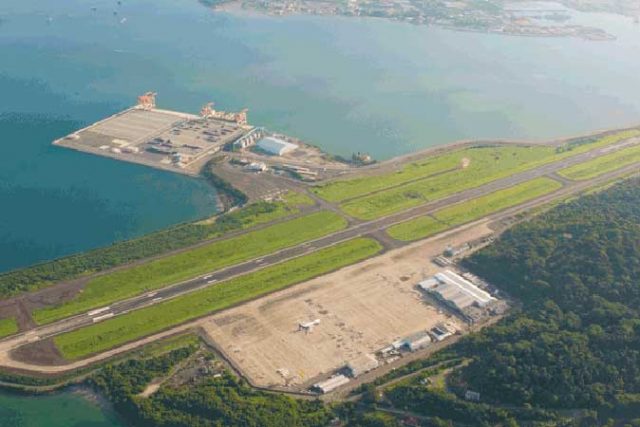
On June 30, Agriculture Secretary William D. Dar met with Subic Bay Metropolitan Authority (SBMA) Chairperson Wilma T. Eisma on the DA’s proposal to use a 2,000 square-meter lot at the Subic Bay Freeport Zone for an agricultural import inspection facility.

The DA and the SBMA have reached an agreement in principle for the construction of the facility, pending approval from the SBMA Board.

“Once operational, the facility will conduct full and thorough inspection of containerized agricultural commodities through risk assessment, complemented by x-ray screening of the Bureau of Customs. This means all farm, fishery, meat, and food imports will be subjected to 100% sampling and laboratory testing,” the DA said.

“Each facility will feature controlled temperature systems that will capacitate quarantine officers to thoroughly inspect the contents of an identified high-risk containerized shipment and prevent the possible spread of hazardous biological agents, such as toxins, and radioactive elements carried by imported agricultural products,” it added.

Other inspection facilities are also planned for the ports of Manila, Batangas, Cebu, and Davao. Funding for the facilities is P521 million, provided by the Office of the President. — Revin Mikhael D. Ochave

Emira calls

The mid-engined Emira is the last of a legendary line of petrol-burning Lotuses — each one a legacy of Colin Chapman, the genius engineer/designer whose initials adorn the logo of the cars. — PHOTO FROM LOTUS CARS

Lotus celebrates its last petrol-powered sports car with the all-new Emira

EMIRA.

The name alone sounds like royalty — an elegant name given to the latest of a long and illustrious line of world-beating sports cars from Hethel, a small historic village in Norfolk, England.

It’s also the last of a legendary line of petrol-burning Lotuses — each one a legacy of Colin Chapman, the genius engineer/designer whose initials adorn the logo of the cars. All future Lotuses will be purely electric-powered.

“The Emira is an absolute game-changer for Lotus. It’s a hugely significant milestone in our path to becoming a truly global performance car brand. It’s a new sports car — our first in many years — and what an offering it is from Lotus!” exclaimed Lotus Cars Managing Director Matt Windle.

The mid-engined Emira looks more like a supercar than just another new sports car. There are traces of its predecessor, the Evora, as well as newer design elements from Lotus’s upcoming Evija electric hypercar.

The Emira measures 4,412mm x 1,895mm x 1,225mm (LWH). It’s less than an inch longer and a hairline (2mm) taller than the 11-year-old Evora but is a substantial three inches wider. It also mirrors the Evora’s 2,575mm wheelbase (including that car’s ultra-light extruded and bonded aluminum construction).

Just as in the Exige and Evora, power comes from the same 3.5-liter Toyota Camry V6 engine turbocharged to the tune of 394bph and mated to a manual or automatic transmission. Available for the Emira next year is a turbocharged four-cylinder Mercedes-AMG engine developing 355bhp (mated exclusively to AMG’s dual-clutch automatic). Performance targets are zero to 100kph in under 4.5 seconds and a top speed of 290kph.

Lotus, now owned by Geely, is targeting prices under £60,000. Price-wise and performance-wise, the two-seater Lotus Emira V6 matches up with the two-seater Porsche 718 Cayman GTS.

Driving purity comes from a hydraulic power steering system and rear-wheel drive — a snub to modern sports cars’ electric power steering and all-wheel drive. Tires are bespoke-compound Goodyear Eagle F1 Supersport as standard or Michelin Cup 2 as options.

Inside, the Emira’s fully lined cockpit is easily the most luxurious — and most spacious — ever from Lotus. There is space for a bag in the trunk and a couple of small suitcases behind the seats. There are even cupholders and storage bins on the console and door panels.

The hour-long live-action unveiling was centered on the iconic Hethel test track and culminated in a high-octane lap of the north circuit by an Emira.

Former Formula 1 World Champion and Lotus customer Jenson Button was the evening’s special guest. A video of him putting the Emira through its paces on the Hethel track was played, with Jenson delivering his exclusive “first drive” review live to the audience.

“It’s being called a junior supercar, but it would give a lot of supercars a run for their money… and it’s more comfortable than most of them! The Emira is exceptional and I’m a big fan,” he shared.

The Emira premiere was broadcast live via the Lotus website and social media platforms. In a nod to global travel restrictions, Lotus had invited scores of international Lotus “superfans” to be involved in the premiere. Exactly 131 of these owners and enthusiasts were selected to be part of a high-tech real-time “fan wall” which appeared on the box’s TV screens. The number “131” reflects the Lotus type number allocated to the Emira before it was officially named.

Lotus retailers across the globe — from China and Japan to North America and Europe — staged parties in their showrooms, inviting valued customers and Emira prospects to watch the event live. In addition, highlights from the broadcast played through the next week on billboards internationally — at London’s busy Liverpool Street station, where the train line from Norwich ends in London, and in downtown Los Angeles.

Guests were also treated to a parade of historic Lotus cars on the test track, including an Elan S3 and Colin Chapman’s own Esprit Turbo.

As well as providing a platform for the Emira’s debut, the event was designed to turn the spotlight on Hethel itself — upgraded as part of a £100-million-plus investment in Lotus UK operations. Guests took part in a walking tour of the site to see the transformation, which includes the all-new production line and paint shop where the Emira will be built, starting later this year.

Just two days after its global reveal, the Emira stunned attendees of last weekend’s Goodwood Festival of Speed, where the car turned a wheel in anger in public for the first time. Lotus is the “Featured Marque” at this year’s GFOS event, which means the “Central Feature” — the giant sculpture outside Goodwood House — will celebrate Lotus.

As the event closed, Matt Windle commented: “What an amazing night we’ve had and what a fantastic way to launch the Emira. We have a sensational new sports car — the most accomplished Lotus ever — and we’ve unveiled it at a rejuvenated Hethel, a site still changing every week because of our investment. Together they are the perfect illustration of the ongoing transformation of Lotus.”

French fashion school offers scholarships

ISTITUTOMARANGONI.COM/EN

ISTITUTO Marangoni’s Paris School of Fashion is offering 15 scholarships to young talents for its 15th anniversary, with applications accepted until July 23.

SoFA Design Institute is Istituto Marangoni’s official affiliate in the Philippines, serves as an information and application hub, which facilitates all inquiries, requirement processing and applications for Istituto Marangoni. SoFA Design Institute founders, Amina Aranaz-Alunan and Loralee Baron-Soong are both graduates of Istituto Marangoni.

The Paris school will award 15 scholarships to young talents starting their studies in the Intensive courses (styling, fashion business, digital marketing), first year of the BA Hons Degree or the Cycles de Spécialisation (Fashion Design; Buying and Merchandising; Styling, Creative Direction, and Digital Content; Luxury Brand Management; Fashion Communication and Digital Media) in the academic year 2021/2022.

Participation in the Initiative is free: each candidate can submit only one application by uploading the required documents on the scholarship platform. Documents for intensive courses application include a high school diploma, high school grades certificate, passport scan or ID, a signed personal statement serving as a letter of motivation explaining why one wishes to join and one’s career goals, and six creative ideas (sketches, photographs, and the like). All items must be submitted in A4 or A3 format, in .pdf,.tiff, .jpg, .zip.

The Three-year Courses and the school’s BA offerings also add a language certificate to the requirements. The Cycles De Spécialisation programs require a university transcript of records and diploma, two letters of reference, a CV, and a portfolio with 10-12 items; in addition to the requirements for BA applications.

Istituto Marangoni was founded in Milan in 1935. It has branches in Florence, London, Paris, Miami, Mumbai, and Shanghai.

Global names attached to the institute include Moschino founder Franco Moschino, Alessandra Facchinetti (formerly of Prada, Gucci, Valentino, and Tod’s), and Domenico Dolce (of Dolce & Gabbana — though he did only stay for a few months).

DAR cuts requirements for transfer of private agricultural land

THE DEPARTMENT of Agrarian Reform (DAR) said it has streamlined the process of obtaining clearances for the transfer of private agricultural land.  

Agrarian Reform Secretary John R. Castriciones said DAR Administrative Order No. 4 was issued streamlines the process for land transactions involving private agricultural land whose owners have not been issued a notice of coverage.   

“We have reduced the number of processing days in compliance with certain provisions of the government which require the revision of existing rules and guidelines on the transfer of agricultural lands and also to adjust to the new normal brought about by the coronavirus disease 2019 (COVID-19) pandemic,” Mr. Castriciones said in a statement over the weekend.

According to Mr. Castriciones, the administrative order is authorized by Republic Act (RA) No. 11032 or the Ease of Doing Business and Efficient Government Service Delivery Act, Proclamation No. 922, which declared a state of public emergency throughout the Philippines, Proclamation No. 929, which declared a state of calamity throughout the Philippines due to COVID-19, and RA No. 11494 or the Bayanihan to Recover as One Act.

“The issuance of the land transfer clearance (LTC) on this administrative order excludes agricultural lands covered under any other agrarian reform program, under Presidential Decree No. 27, RA No. 6657, as amended, and land transactions with exemption/exclusion/conversion orders issued by the DAR,” Mr. Castriciones said.   

“The applicant-transferor and transferee, or the duly authorized representative shall file a written application or request for the issuance of LTC before the DAR provincial office where the property is registered with the Register of Deeds,” he added.

Mr. Castriciones said DAR will not accept written applications or requests sent through e-mail or filed personally unless proof of payment and all documentary requirements are attached and submitted.

He added that electronic copies of all applications or requests and their annexes will be accepted, but DAR will also require the submission of printed copies through mail or personal submission, in order to check the authenticity of the documents.

“Applicants may also store the files, applications, or requests and documentary requirements, in a portable storage device … which should be properly labeled as to their contents and submit the same to the DAR provincial office in a sealed envelope through the postal office or by any other accredited couriers,” Mr. Castriciones said.

“A filing fee P2,000 for every land transaction shall be collected by the issuing DAR provincial office through its cashier or through online banking, and deposited to the Bureau of Treasury local accounts,” he added. — Revin Mikhael D. Ochave  

Ayala Land unit eyes geothermal power for green energy option – DoE

AYALA Land, Inc. subsidiary DirectPower Services, Inc. will be largely sourcing 360 megawatts (MW) of clean power from geothermal facilities for the government’s green energy option program (GEOP), the Energy department said last week.

The Department of Energy’s Renewable Energy Management Bureau (DoE-REMB) told BusinessWorld in an e-mail on July 16 that based on submitted documents, Tiwi and Makban geothermal plants have available capacity to supply to the GEOP customers of DirectPower.

The bureau said the main source of the Ayala Land unit for the required capacity for the program will be AP Renewables, Inc. — at 130 MW from Tiwi and 230 MW from Makban geothermal plants.

AP Renewables is a subsidiary of listed holdings firm Aboitiz Power Corp.

The Tiwi facility has a total capacity of 234 MW, while the Makban plant has 448.8 MW.

The DoE earlier announced that DirectPower is the latest firm to join the government’s GEOP.

DirectPower, a retail electricity supplier (RES), currently supplies the requirements of 45 contestable customers or those whose consumption is big enough to allow them the choice of power providers.

According to the DoE-REMB, the wholly owned Ayala Land unit received its operating permit, which was approved and signed by the Energy secretary, on June 18.

Launched in 2018, GEOP is a voluntary policy mechanism that allows consumers using at least 100 kilowatts of power to source renewable energy supply from a qualified RES.

The Energy department believes that it is an opportunity for end users to “contribute to the development and use of renewables in a least-cost and sustainable manner.”

At present, the DoE-REMB is evaluating the applications of two retail electricity suppliers and one power generation company for the program.

DirectPower’s entry into the GEOP brings the number of eligible power firms to 13 as of June.

The other entities are Shell Energy Philippines, Inc.; Green Core Geothermal, Inc.; Citicore Energy Solutions, Inc.; Aboitiz Energy Solutions, Inc.; Prism Energy, Inc.; Adventenergy, Inc.; Bacman Geothermal, Inc.; First Gen Energy Solutions, Inc.; SN Aboitiz Power-Magat, Inc.; SN Aboitiz Power-Res, Inc.; AC Energy Philippines, Inc.; and the Sparc-Solar Powered Agri-Rural Communities Corp.

In April last year, the DoE issued the rules for suppliers who wanted to participate in the program.

Approved renewable energy suppliers must ensure that the total power dispatched from their facilities are greater or equal to the total kilowatt per hour sold to their consumers. They must also register in the spot market before supplying power to end users. — Angelica Y. Yang

Tow the stars

PHOTO FROM VIRGIN GALACTIC AND LAND ROVER

The Landy gets involved in a heavenly mission

WE’VE LIVED through the electronic revolution, the rise of microtechnology, the dawn of the internet, and now, the beginning of mankind’s first commercial space flights. Frankly, I can’t get over it. What a time to be alive!

Surely, you must have heard about Virgin Galactic founder and billionaire Richard Branson’s fairly recent flight to the bounds of outer space. He, alongside three other crewmates and two pilots, took off from Virgin Galactic’s Spaceport America in New Mexico in the United States, and shot up 90 kilometers (approximately 295,000 feet) through the sky to achieve weightlessness in that blurry area between the earth’s atmosphere and outer space. The mission was aboard the sub-orbital vehicle “Unity” and took a total of 90 minutes to complete.

It was the company’s fourth space flight to carry a full crew. Richard Branson decided to join this one because he said he wanted to evaluate the experience before they actually started boarding customers by sometime next year.

But did you know that Land Rover has been a long-time supporter of Virgin Galactic’s journey to realizing commercial space flights? As a matter of fact, Land Rovers have been towing Virgin Galactic space vehicles — transporting their astronauts around the field, and in many other ways supporting their day-to-day operations — since 2014.

Having said that, Richard Branson arrived in the very special Range Rover Astronaut Edition (which was first unveiled by Jaguar Land Rover’s Chief Creative officer, Prof. Gerry McGovern, together with Branson back in 2019), prior to boarding the “Unity 22” for their highly publicized mission. And upon their safe return, their spacecraft was towed back by an ever-dependable Land Rover defender 110.

Moreover, when Virgin Galactic starts boarding their 600 lined-up, paying customers beginning next year, these explorers will likewise all be transported to the spacecraft in Land Rover vehicles.

“It was completely fitting that these capable luxurious and iconic vehicles played a central part in this historic event,” shared Virgin Galactic’s Chief Customer Officer Stephen Attenborough. He added, “As we look ahead to the start of a full commercial service, we couldn’t be more delighted to know that Land Rover will be going above and beyond, as together we open space to change the world for good.”

The very special Range Rover Astronaut Edition was created by Land Rover SV Bespoke and is offered exclusively to Virgin Galactic’s “future astronaut” customers.

In the Philippines, Coventry Motors Corp. President Chris Ward shared his thoughts regarding the Virgin Galactic partnership: “Land Rover’s significant participation in this revolutionary event is such a remarkable move for the brand! For years, the brand has worked on evolving on its research and technology, partnering with brands and efforts that would challenge its passion for adventure and technological advancement. In line with its global plan, “Reimagine,” Land Rover only proves to fulfill its promise to explore and conquer challenges not most are willing to take.”

Yields on gov’t debt end flat after Fitch move

YIELDS ON government securities (GS) traded in the secondary market ended flat last week following the Fitch Ratings’ outlook revision for the Philippines.

GS yields, which move opposite to prices, rose by an average of 0.88 basis point (bp) week on week, based on the PHP Bloomberg Valuation Service Reference Rates as of July 16 published on the Philippine Dealing System’s website.

Yields on Treasury bills (T-bills) were mixed last week. The rates of the 182- and 364-day papers inched up by 0.08 bp and 1 bp, respectively, to 1.4131% and 1.6122%. On the other hand, the yield on the 91-day T-bills fell by 1.60 bps to 1.1615%.

A similar trend was seen in the belly of the curve as yields on the three-, four-, five-, and seven-year Treasury bonds (T-bonds) increased by 0.28 bp (to 2.3385%), 2.67 bps (2.6810%), 4.95 bps (2.9996%), and 7.27 bps (3.5012%), respectively. Meanwhile, the rate of the two-year T-bonds went down 1.62 bps to 1.9643%.

At the long end of the curve, the 10-year debt paper saw its yield pick up by 5.84 bps week-on-week to close at 3.9097%, while the rates of the 20- and 25-year tenors fell by 5.66 bps (4.9099%) and 3.48 bp (4.931%), respectively.

Philippine Bank of Communications Senior Trader Justin Robert G. Ladaban said in an e-mail that Fitch’s outlook revision for the country to “negative” from “stable” affected yield movements last week.

“This brought some defensiveness initially and heading into the 20-year auction last Tuesday,” Mr. Ladaban said. “However, following a relatively tame bond auction and with global yields staying largely range bound, we eventually saw some bargain hunting which generated some buying interest towards the end of the week, particularly in the short end of the curve.

Fitch last week revised its outlook for the Philippines to “negative” from “stable,” while keeping its “BBB” credit rating for the country.

The “negative” outlook means Fitch may downgrade the Philippines’ credit rating if it reverses reforms or departs from the prudent macroeconomic policy framework that leads to continued higher fiscal deficits. A weaker macroeconomic outlook over the medium-term and “diminishing policy credibility” may also lead to a downgrade.

Fitch has kept the Philippines’ rating at “BBB,” which is one notch above the minimum investment grade, since December 2017.

Meanwhile, the Bureau of the Treasury (BTr) raised P16.799 billion via its offer of fresh 20-year T-bonds on Tuesday, less than half of the programmed P35 billion, after yields increased following Fitch’s move. Total bids for the bonds reached P63.069 billion, making the offering nearly twice oversubscribed.

The 20-year notes fetched a coupon of 5.125%, higher by 15.7 bps against the 20-year tenor’s 4.968% rate at the secondary market prior to the auction.

On the other hand, a bond trader attributed the yield movements last week to Federal Reserve Chairman Jerome Powell’s semi-annual testimony to the US House of Representatives last week.

“Yields were actually higher until Mr. Powell’s dovish statement, which then put a cap on yields. Most benchmark bonds are mostly unchanged from last week’s levels,” the bond trader said in a Viber message.

Mr. Powell said the US economy “is still a ways off” from the levels the central bank’s expectations before narrowing its support to the economy, Reuters reported.

In testimony, Mr. Powell also said he is confident higher inflation was connected with the country’s post-pandemic reopening and will ease in the coming months. Data showed that consumer prices increased by the most in 13 years in June while producer prices accelerated to the largest annual increase in more than a decade.

The bond trader expects yields this week to move “sideways with a downward bias.”

“We shall monitor the presence of Delta variant [of the coronavirus] and its effect on phase of reopening,” the trader said.

“[This] week, market players will likely look towards the results of the 10-year auction for some direction although I expect yields to stay generally range bound,” Mr. Ladaban added.

The Treasury will offer P35 billion in fresh 10-year bonds on July 21. — Lourdes O. Pilar

Lexus Design Award 2022 is now open for entries

“Algorithmic Lace,” a 3D printing technology that works in conjunction with handmade elements to create, among other groundbreaking things, a bra for breast cancer survivors.

THE LEXUS Design Award — an international design competition targeting the next generation of innovators around the world — is now open for entries to the 2022 edition. Entries can be submitted online at LexusDesignAward.com from now until Oct. 10.

The Lexus Design Award provides “an opportunity for innovators to work with a world-famous designer as a mentor to create prototypes of their designs,” according to a recent release. The international design competition was launched in 2013.

“Entrants need to demonstrate how their creative ideas express three key principles of the Lexus brand: Anticipate, Innovate and Captivate,” said the release. “Their design should anticipate global challenges facing future society and imagine engaging and innovative ways to contribute to a sustainable and happy future for all. Lexus is looking for captivating designs that intersect with thoughtful solutions and can truly make a brighter future for people and societies in diverse circumstances.”

Among the past winners of the award are Algorithmic Lace, a 3D printing technology that works in conjunction with handmade elements to create, among other groundbreaking things, a bra for breast cancer survivors; Ooho!, an edible capsule-shaped packaging made from seaweed as an alternative to the plastic bottle; and a Portable Solar Distiller which makes clean drinking water from polluted water or sea water, using sunlight.

Six finalists will be announced in early 2022. They will work with four internationally renowned creators who will be their mentors and who “will help the finalists to build prototypes that bring out the potential of their ideas.”

Lexus will fund each of the finalists’ prototype development with a budget of £20,000 (roughly P1.4 million). The final prototypes will be presented to judges in mid-2022. One Grand Prix winner will be chosen.

To learn more, visit the Lexus website at lexus.com.ph or visit its social media pages on Facebook and Instagram @lexusmanila.

Brazil states seek int’l funds to fight deforestation

REUTERS

BRASILIA — Nine Brazilian states that are wholly or partially in the Amazon rainforest are negotiating with international organizations for aid to combat deforestation, circumventing the federal government, their governors said on Friday.

Flávio Dino, the leftist governor of Maranhao state who is often floated as a potential presidential candidate for elections in 2022, presented the project, known as Plano de Recuperação Verde, or Green Renewal Plan, at a press conference in Brasilia.

Among the goals of the group is eliminating illegal deforestation by 2030, generating employment and aiding the region’s transition to a greener economy.

“The world is moving and Brazil can’t stay still due to domestic political reasons. The price for the country could be very high,” Dino said.

Deforestation has surged since right-wing President Jair Bolsonaro took office in January 2019, drawing international outcry from foreign governments and environmentalists. Bolsonaro has called for mining and agriculture in protected areas of the Amazon and has weakened environmental enforcement agencies.

That in turn has caused some states to more actively participate in environmental matters.

The consortium has already begun negotiating with the LEAF Coalition, a fund organized by the US, British and Norwegian governments to protect the rainforest. The Plano de Recuperação Verde consortium will deliver the nine governors’ deforestation reduction targets to LEAF this week, Dino said.

He added that the group plans to begin its work this year and to stop the growth of intentional forest fires and deforestation in the second half of 2021. — Reuters

Chery sales register 351% growth in H1

PHOTO FROM CHERY PHILIPPINES

CHERY AUTO Philippines reported in a release that its vehicle sales in the first half of 2021 grew by a remarkable 351% compared to the same period last year. Its June figure also trended upward by 355% compared to June 2020.

“The growth reflects the warm reception of the Philippine market toward the all-new Chery Tiggo 7 Pro [which accounted for] 37% of total Chery sales in the first six months of the year. Launched just last January, the Tiggo 7 Pro posted June sales 160% higher than the previous month of May. Orders for July onwards project continuous sustained demand for the head-turning, high-performance turbocharged compact SUV,” said the company in a release.

The entry-level Chery Tiggo 2 comprised 33% of total sales, with the brand noting that it “(costs) less than many hatchbacks and subcompact sedans.” With a starting price of P695,000, the Tiggo 2 “presents a compelling proposition with its SUV space and versatility.” The crossover is also available in unique two-tone finishes and comes in manual and automatic transmission.

Said United Asia Automotive Group, Inc. (UAAGI) President Rommel Sytin, “We are buoyed by the strong interest and demand for our Chery Tiggo models, particularly the all-new Tiggo 7 Pro and Tiggo 2. Together with the subcompact Tiggo 5X and the luxurious midsize flagship 7-seater Tiggo 8, they propel the brand’s vision of establishing Chery as the leading crossover brand in the Philippines.”

The company said it is continuing to grow its dealership network — currently 19 strong — “unprecedented for a new brand that’s introduced only less than two years ago.” Chery is said to be continuing to scout unserved areas through the metropolis and the rest of the country.

Chery boasts an industry-leading warranty and preventive maintenance service (PMS) program, which features a 10-year/one-million-km engine warranty, five-year general warranty, three-year roadside assistance, and a free full PMS for three years. For more information, follow Chery Auto Philippines Facebook and Instagram, call the 24/7 Chery Auto Philippines hotline at 0917-552-4379, or e-mail chery@uaagi.com.