Home Blog Page 7233

UnionBank Private Banking, Lombard Odier, to push for Circular, Lean, Inclusive, Clean (CLIC™) economy in the Philippines

From resource-intensive mass production methods that often lead to overconsumption, to anti-green practices that contribute to the continuous degradation of the environment, many of today’s investment strategies employ models that are not sustainable. Lombard Odier has aptly named these models WILD or “Wasteful, Idle, Lopsided, Dirty”, an issue UnionBank Private Banking is similarly trying to address, in the context of sustainable investing in the local landscape.

There are many factors that Filipino ultra-high net worth individuals consider when choosing a bank. Sustainability, one such factor, is starting to grow in weight of preference. According to the whitepaper “Connection, Transition, Transformation: engaging Asia’s UHNWI in the New Normal” published in February 2021 by Lombard Odier and UnionBank Private Banking together with Lombard Odier’s other strategic alliances in the region, many UHNWIs have noted their concern for climate change and the need for action once the pandemic has ended with 89% of the respondents believing that the sustainability trend in one form or another is here to stay in the long run.

As an answer to the WILD model, Lombard Odier has created the CLIC™ framework. Short for “Circular, Lean, Inclusive, Clean,” the CLIC™ framework promotes sustainable and forward-looking business practices and further drives the ongoing shift toward a circular and leaner economy, where waste and emissions are minimized, and growth is inclusive. Through the framework, Lombard Odier aims to meet the long-term objectives of its private banking clients through strategies that are aligned with the United Nations Sustainable Development Goals.

“The CLIC™ economy leverages efficient production and consumption, and the sharing economy, reducing the wasteful accumulation of idle assets. It reduces the dependence on ever-greater extraction of mineral resources and draws on the substantial value of the materials and components that constitute the products that we so readily discard today. The transition to a circular, lean economy; one which invests to protect and regenerate its natural capital; will unlock trillions in untapped value,” said Dr. Christopher Kaminker, Head of Sustainable Investment, Research, Strategy and Stewardship at Lombard Odier.“The transition is already underway, and we are seeing many regions across Asia embrace the CLIC™ revolution.”

UnionBank Private Banking believes in the power of the CLIC™ framework to usher in a new age where economic growth can enjoy a harmonious co-existence with eco-conscious efficiency and innovation. Because the framework synergizes perfectly with UnionBank’s “Tech Up Pilipinas” advocacy, the Bank is once again leveraging on its strategic alliance with Lombard Odier to inspire Filipino UHNWIs to become catalysts of the CLIC™ economy in the Philippines.

“UnionBank’s “Tech Up Pilipinas” sustainability thrust revolves around three focus areas- Digital Transformation, Sustainable Finance, and Inclusive Prosperity, which are compatible with Lombard Odier’s CLIC™ framework. We are happy that this synergy allows us to be one of the movers in the local banking industry to pioneer an ESG-led investment program for our UNHWI clients.” said UnionBank Senior Vice President and Head of Private Banking Atty. Arlene Agustin.

“The Philippines is one of the countries in the region that is on the lower side of the transition towards Sustainable Investments. However, we see positive change where more and more investors are looking towards the better business models and practices. UnionBank Private Banking continues to strive towards a more cognizant approach towards sustainable investing and pave a way towards more sustainable frameworks such as CLIC™. We are committed towards this positive change that could lead to a shift in methods within the local market. We share the same belief as Lombard Odier that it is time to let go of old wasteful, idle, lopsided, and dirty practices to bring forth a clean change towards society.” Arlene added.

Join UnionBank Private Banking and Lombard Odier in a live virtual event “E-conoMix: Shaping the Future with Sustainable Investing” on July 29 where subject-matter experts from both banks will share their current global and local market views as well as insights on sustainable investing and transitioning to a CLIC™ Economy.
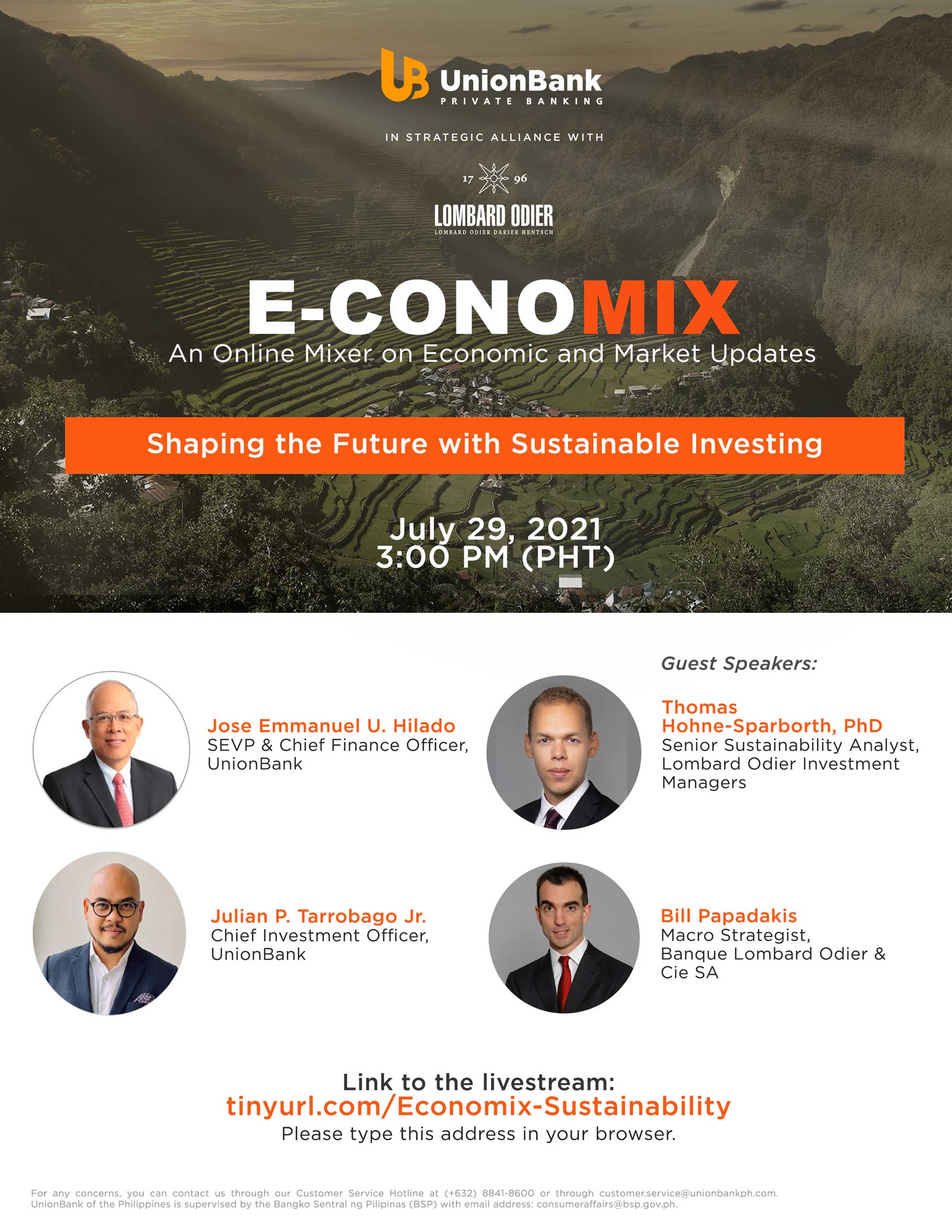
The event is open to the public and will be live-streamed via YouTube on July 29 from 3:00 to 4:30 PM. To access the event, visit tinyurl.com/Economix-Sustainability.

For any concerns, you may contact us through our Customer Service Hotline at (+632) 8841-8600 or through customer.service@unionbankph.com. Union Bank of the Philippines is an entity regulated by the Bangko Sentral ng Pilipinas (BSP) with website address: https://www.bsp.gov.ph.


NextPay raises $1.6M to develop digital banking solutions for MSMEs

Financial technology startup NextPay raised $1.6 million in its new round of seed funding, which was led by Golden Gate Ventures, a Singapore-based venture capital firm; and Gentree Fund, a private investment vehicle of the Sy Family, which owns Filipino conglomerate SM Group.    

The funds will be used to develop digital banking solutions for micro, small, and medium enterprises (MSMEs), allowing them access to financial services such as digital invoicing, cash management, and batch payments to local banks or e-wallets. 

“We believe that business banking will continue to digitally evolve, as the Philippines accelerates its digital transformation initiatives,” said Don Pansacola, NextPay chief executive officer and co-founder, in a statement on Wednesday. “This investment supports our goal of putting the power of big banks in the hands of small businesses.”  

Other investors include Tribe Capital; Broadhaven Ventures; Ayala Group’s Kickstart Ventures; Lisa Gokongwei-Cheng of JG Summit; Rohit Mulani of GoTrade; and Goodwater Capital, which has invested in Facebook, Spotify, and Twitter.  

“NextPay uniquely addresses the local needs of its customers by matching SMEs looking to go digital with mobile and convenient digital financial tools, which scales dynamically with their businesses,” said Mark Sng, Gentree Fund vice-president.  

The fundraiser adds to the $125,000 pre-seed investment the startup received after graduating from the Y-Combinator program in April. Since its launch in 2020, NextPay has processed $9.1 million (P457.5 million) in digital transactions for more than 100 businesses. — Brontë H. Lacsamana 

Sydney adds four weeks to lockdown as Australia COVID-19 cases grow

REUTERS

SYDNEY — Australia’s biggest city, Sydney, extended a lockdown by four weeks on Wednesday after an already protracted stay-at-home order failed to douse a coronavirus disease 2019 (COVID-19) outbreak, with authorities warning of tougher policing to stamp out non-compliance.  

Far from a planned exit from lockdown in three days, the city of 5 million people and neighboring regional centers spanning 200 km (120 miles) of coastline were told to stay home until Aug. 28 following persistently high case numbers since a flare-up of the virulent Delta variant began last month.  

The state of New South Wales (NSW), of which Sydney is the capital, reported 177 new cases for Tuesday, from 172 on Monday. That is the biggest increase since an unmasked, unvaccinated airport driver was said to have sparked the current outbreak. The state also reported the death of a woman in her 90s, the 11th death of the outbreak.  

Of particular concern, at least 46 of the new cases were people active in the community before being diagnosed, raising the likelihood of transmission, said authorities. They have cautioned that active community transmission must be near zero before rules are relaxed.  

“I am as upset and frustrated as all of you that we were not able to get the case numbers we would have liked at this point in time but that is the reality,” state Premier Gladys Berejiklian told a televised news conference.  

Ms. Berejiklian added police would boost enforcement of wide-ranging social distancing rules and urged people to report suspected wrongdoing, saying “we cannot put up with people continuing to do the wrong thing because it is setting us all back.” 

In one case, a mourning ceremony attended by 50 people in violation of lockdown rules resulted in 45 infections, she said.  

The extension turns what was initially intended to be a “snap” lockdown of Australia’s most populous city into one of the country’s longest since the start of the pandemic, and may spark the second recession of the $1.47 trillion national economy in two years, according to economists.  

To minimize the economic impact, the NSW government said it would lift a ban on non-occupied construction in most of Sydney. However, it expanded a list of local government areas within the city where the ban would stay because of the prevalence of COVID-19 cases there.  

“It’s getting really difficult, day in and out, day by day, for us to continue running the same business,” said Raihan Ahmed, a convenience store owner at Bankstown, one of the main affected suburbs. “Somehow we have to survive, and we are trying our best.”  

FEDERAL FALLOUT 
Opinion polls have shown slipping support for Prime Minister Scott Morrison’s government amid criticism of a slow vaccination roll-out that has been blamed on changing regulatory advice and supply shortages.  

“There is no other shortcut, there is no other way through, we have to just hunker down and push through,” Mr. Morrison said during a televised news conference in the national capital Canberra.  

All Australians who wanted a vaccination would receive it by the end of the year, and “I would expect by Christmas that we would be seeing a very different Australia to what we are seeing now,” he added.  

The NSW government said it was redirecting Pfizer Inc vaccine doses, which have so far been restricted to people aged 40–60, from relatively unaffected regional areas to final-year school students in the worst-affected Sydney neighborhoods.  

The state and federal governments also said they were expanding relief funding to enable affected companies to keep paying wages through the closure.  

In contrast to New South Wales, the states of Victoria and South Australia began their first day out of shorter lockdowns that halted outbreaks there. Victoria reported eight new cases, all of them isolated throughout their infectious period, and another case still under investigation.  

Australia has kept its COVID-19 numbers relatively low, with just over 33,200 cases and 921 deaths, out of a population of about 25 million, since the pandemic began. — Renju Jose and Byron Kaye/Reuters

US concern over China nukes buildup after new silos report

Screenshot via Google Earth

WASHINGTON — The Pentagon and Republican congressmen on Tuesday aired fresh concerns about China’s buildup of its nuclear forces after a new report saying Beijing was building 110 more missile silos.  

An American Federation of Scientists (AFS) report on Monday said satellite images showed China was building a new field of silos near Hami in the eastern part of its Xinjiang region.  

The report came weeks after another on the construction of about 120 missile silos in Yumen, a desert area about 240 miles (380 km) to the southeast.  

“This is the second time in two months the public has discovered what we have been saying all along about the growing threat the world faces and the veil of secrecy that surrounds it,” the US Strategic Command said in a tweet linked to a New York Times article on the AFS report.  

The State Department in early July called China’s nuclear buildup concerning and said it appeared Beijing was deviating from decades of nuclear strategy based around minimal deterrence. It called on China to engage with it “on practical measures to reduce the risks of destabilizing arms races.”  

Republican Congressman Mike Turner, ranking member of the House Armed Services Subcommittee on Strategic Forces, said China’s nuclear buildup was “unprecedented” and made clear it was “deploying nuclear weapons to threaten the United States and our allies.”  

He said China’s refusal to negotiate arms control “should be a cause for concern and condemned by all responsible nations.”  

Another Republican, Mike Rogers, ranking member of the House Armed Services Committee, said the Chinese buildup showed the need to rapidly modernize the US nuclear deterrent.  

A 2020 Pentagon report estimated China’s nuclear warhead stockpile in “the low 200s” and said it was projected to at least double in size as Beijing expands and modernizes its forces. Analysts say the United States has around 3,800 warheads, and according to a State Department factsheet, 1,357 of those were deployed as of March 1.  

Washington has repeatedly called on China to join it and Russia in a new arms control treaty.  

The report on the new silos comes as Assistant Secretary of State Wendy Sherman is due to hold arms control talks with Russia in Geneva on Wednesday.  

Ms. Sherman was in China earlier this week for talks at which Beijing accused Washington of creating an “imaginary enemy” to divert attention from domestic problems and suppress China.  

Beijing says its arsenal is dwarfed by those of the United States and Russia and it is ready to conduct bilateral dialogues on strategic security “on the basis of equality and mutual respect.” — Reuters

US urges vaccinated Americans to wear masks indoors in many places

FREEPIK

WASHINGTON — Americans fully vaccinated against coronavirus disease 2019 (COVID-19) should go back to wearing masks in indoor public places in regions where the coronavirus is spreading rapidly, US health authorities said on Tuesday.  

In a toughening of guidance issued earlier this month, the US Centers for Disease Control and Prevention (CDC) also recommended all students, teachers, and staff at schools for kindergarten through 12th grade wear masks regardless of whether they were vaccinated.  

US coronavirus cases have been rising due to the highly contagious Delta variant, which emerged in India but has quickly spread and now accounts for more than 80% of US coronavirus cases.  

US President Joseph R. Biden, Jr., said that increased vaccination and mask wearing would help the United States avoid the pandemic lockdowns, shutdowns and school closures that the country faced in 2020. “We are not going back to that,” Mr. Biden said.  

The CDC said that 63.4% of US counties had transmission rates high enough to warrant indoor masking and should immediately resume the policy. Manhattan, Los Angeles, and San Francisco meet the transmission criteria, as does the entire state of Florida, but Chicago and Detroit do not.  

American Federation of Teachers President Randi Weingarten praised the new CDC mask guidance in a statement, calling it “a necessary precaution until children under 12 can receive a COVID vaccine and more Americans over 12 get vaccinated.”  

The CDC’s previous guidance for schools only called for unvaccinated students to wear masks.  

However, the new CDC recommendations are not binding and many Americans, especially in Republican-leaning states, may choose not to follow them. At least eight states bar schools from requiring masks.  

Arizona Governor Doug Ducey, a Republican, rejected the CDC guidance. “Arizona does not allow mask mandates …,” he said in a statement. “We’ve passed all of this into law, and it will not change.”  

The United States leads the world in the daily average number of new infections, accounting for one in every nine cases reported worldwide each day. The seven-day average for new cases has been rising sharply and stands at 57,126, still about a quarter of the pandemic peak.  

Two months ago, when the CDC announced that fully vaccinated people could shed their face coverings, COVID-19 was on the decline. Vaccinations have since slowed dramatically and only 58% of people eligible are fully vaccinated.  

New studies show that fully vaccinated people who become infected carry as much virus as unvaccinated people do, suggesting they may be able to transmit the infection to others, CDC Director Dr. Rochelle Walensky told reporters on a telephone briefing.  

“We felt it was important for people to understand that they could pass the disease onto someone else,” she said.  

On Monday, the Biden administration confirmed it will not lift any existing international travel restrictions, citing the rising number of COVID-19 cases and the expectation that they will continue to rise in the weeks ahead.  

Ford Motor Co. said it would reinstate mask requirements for all employees and visitors at its Missouri and Florida facilities.  

The 1.3-million member United Food and Commercial Workers Union said the new mask guidance was a “critical step” but did not go far enough. — David Shepardson and Julie Steenhuysen/Reuters

Dusit Thani Residence Davao: Safety in luxury

Located at the bustling economic and cultural capital of Mindanao, Dusit Thani Residence Davao has become a paragon in the region in how leisure and luxury can safely thrive in the middle of the pandemic.

Launched in 2019, the Dusit Thani Residence is part of a larger, mixed-use complex that has become one of Davao’s most exciting addresses. Combining well-appointed interiors with full-service amenities, Dusit Thani Residence Davao exudes the elegance and graciousness that the Dusit brand has come to be known for.

“We actually started our turnover this year, allowing our buyers and investors to safely occupy their new homes in line with health protocols,” notes Tomas Lorenzo, chief executive officer of Torre Lorenzo Development Corporation. The pioneer in student residences in the country, Torre Lorenzo has grown its portfolio to include leisure and mixed-use developments, including the Dusit Thani Residence Davao.

Hotel living


Lorenzo highlighted the company’s commitment to deliver elevated living experiences to its buyers and investors. “Our commitment, of course, does not stop with turnover of units, but continues with our topnotch property management that allows our residents to enjoy impeccable service and amenities, as well as a myriad of conveniences that come living close to a premium hotel.”

Dusit Thani Residence Davao is part of a complex that also features the dusitD2 Davao Hotel, allowing residents access to hotel-style services and amenities, thus elevating their living experiences.

Residents get to enjoy privacy with amenities exclusive to them, such as a dedicated building entry, residential lobby, swimming pool, and fitness center. Additionally, residents may accessdusitD2’s lap pool, spa, and fitness center at special rates. Residential units have self-contained kitchenettes and private balconies, some of which have sweeping views of the expansive Davao gulf.

Just an elevator ride away too are some of Davao’s most noteworthy culinary attractions, all located at dusitD2 – Benjarong Bar and Restaurant serves authentic Thai cuisine, Madayaw Cafe provides flavor experiences from the world’s major cuisines, and the Siam Lounge transforms into a relaxing refuge for intimate gatherings over tea or drinks. A private jetty is also close to the hotel. This serves as an entry point for guests traveling to Dusit Thani Lubi PlantationResort, nestled just off the coast of the Davao Gulf.

Peace of mind


Perhaps the most essential requirement for any resident or guest at the moment is safety – and this is something the Dusit Thani Residence Davao management has prioritized.

Beyond adhering to government health protocols, all of the residences and hotel staff have been vaccinated, giving residents and guests peace of mind

“Safety is our utmost concern, and we aim to give our residents truly elevated living experiences without compromising security and safety,” underscores Lorenzo, who is optimistic about the region’s post-pandemic recovery.

Tough times, tougher entrepreneurs: 10 lessons during a pandemic

By: Robbie Antonio

As the coronavirus outbreak ravaged the world, people were locked down, hospitals got overcrowded, and the global economy shut down. 

Revolution Precrafted Philippines, Inc., my property tech firm that set out to democratize the ownership of designer homes, found itself in the middle of a supply chain disruption. This resulted in cross-default situations and forced my company to pivot back to our core business.

In this article, I take stock of lessons I learned and share them to aspiring and fellow entrepreneurs. I hope these will help inoculate businesses against threats in this volatile, uncertain, complex, and ambiguous world now under a COVID-19 siege.  

  1. An asset-light business model is not always a good model.

I have always envisioned Revolution Precrafted to be an asset-light, intellectual property-based company. Our exclusive designs are our primary assets. However, the downside of this is that you will have less control over other parts of the business. As you outsource some segments of your operations, you exercise less supervision over contractors compared to full-time employees. Since independent contractors have greater flexibility over what they can contribute, you are taking on a risk that they may be unreliable, may not fulfill your business requirements, or may not deliver the quality you expected.

With the disruptions to the housing and property sector, we at Revolution found our own operations as a builder-supplier of homes to partner-developers affected by the general economic downturn. 

The lesson is that we must never stray again into such aspects as building the homes ourselves, and instead concentrate on our core and high value-added work of promoting home designs and art creations. And so our pivot now involves going back to our core business which is to leverage on our intellectual property, our revolutionary home designs, and license them to any developer or end-user for their own homes or projects, using their own contractors.

  1. Practice constant communication.

I believe that empathetic and transparent communication is very important especially in times of a crisis when employees and consumers are confused and feeling vulnerable. 

During a pandemic, consumers generally understand that most companies are facing a difficult time and they are more tolerant of minor mistakes and delays, as long as we communicate with them in an honest and timely manner.

  1. Going global is very difficult.

My big idea was to make globally acclaimed designer homes affordable to a mass market by rolling them out using new prefab home technology. But I realized that an aggressive vision of going global immediately sometimes does not work. 

As international borders closed and the global economy shut down, vulnerabilities in Revolution’s supply chain were exposed. Temporary trade restrictions pushed economies to be self-reliant and placed domestic companies under immense pressure to look inward and reduce their reliance on global supply chains that are now perceived as risky. 

  1. Decentralization is the new normal.

The pandemic has compelled society to take action and seize the moment in many areas where we have dilly-dallied in the past — such as climate action and decongesting cities and even in providing connectivity for all. The push for decentralization is an irreversible trend given the government and private sector’s massive infrastructure build-up and reverse transmigration (e.g., Balik Probinsya) programs.

I believe that the new systems and protocols such as blended-distanced education and telecommuting or work-from-home will become permanent options for people and institutions. These have positive impacts on society, such as less traffic, and just better public health, order, and safety. Single-detached homes have become increasingly relevant in this New Normal. More and more people are moving out of the metropolis, supported by more robust digital infrastructure and they are again choosing single detached homes — on the ground.

  1. Adapt quickly.

With the pandemic, decision-makers are faced with a rapidly-changing business environment that gives us very little time to respond to threats. 

The key is to develop the ability to evaluate ongoing changes and react immediately and appropriately to disruptions, and to continuously repeat this cycle. 

We should practice new ways of problem-solving in an unpredictable environment and be prepared to reinvent ourselves in order to survive and cushion the impact of the crisis on our businesses.

  1. Leverage technology.  

With government-imposed lockdowns, we saw that companies with established online platforms are in a better position to take advantage of the rapid migration of consumers to online channels. Quick-thinking entrepreneurs accelerated their digital transformations — selling their products on social media and mobile applications, accepting online payments, and partnering with delivery services. 

I believe that physical distancing and the trend of in-home consumption are likely to continue even after the pandemic, and that businesses must embrace technology in order to connect to customers. Those that still do not have an online presence need to react fast and implement their long-overdue digital transformation.

  1. Associate your brand with the good.

In this time of crisis, consumers will not forget brands that displayed acts of kindness, especially if done with genuine generosity. 

These could be in the form of donations of medical supplies or assistance to the community, or by sharing messages that promote positivity despite the pandemic.

  1. Prepare an emergency plan. 

Micro-entrepreneurs without formal crisis management planning are among the hardest hit by the pandemic. This highlights the importance of a business continuity plan, which may include prevention, response, and recovery. 

A contingency plan will help leaders remain rational as we are guided by a planned set of tactics when responding to a crisis and making decisions, allowing our businesses to bounce back stronger after a disaster. 

  1. Know your customers’ needs. 

The pandemic and the resulting economic downturn resulted in changes in consumers’ buying behavior. These include prioritization of essential needs and sanitization products amid a tightening of household budgets. As a consequence, some products suffered from slowing demand. 

As entrepreneurs, we need to be flexible and to make the necessary adjustments to ensure the survival of our businesses.

  1. Coopetition is key.

Lastly, we can only defeat this crisis if we put aside our differences and present a unified front. Coopetition, which is simultaneous cooperation and competition, can help us overcome lack of resources. 

By looking at joint vaccination drives among local companies, we can see that strategic alliances may be a good option for businesses and may provide opportunities that are otherwise not available. Entrepreneurs must consider possible partnerships and start communicating with potential allies.


EDITOR’S NOTE:

Spotlight is BusinessWorld’s new sponsored section that allows advertisers to amplify their brand and connect with BusinessWorld’s audience by enabling them to publish their stories directly on the BusinessWorld Web site. For more information, send an email to online@bworldonline.com.


Join us on Viber to get more updates from BusinessWorld: https://bit.ly/3hv6bLA

IMF raises growth forecasts for rich nations, dims outlook for developing world

PHILIPPINE STAR/ MICHAEL VARCAS

WASHINGTON  The International Monetary Fund (IMF) on Tuesday maintained its 6% global growth forecast for 2021, upgrading its outlook for the United States and other wealthy economies but cutting estimates for developing countries struggling with surging coronavirus disease 2019 (COVID-19) infections.  

The divergence is based largely on better access to COVID-19 vaccines and continued fiscal support in advanced economies, while emerging markets face difficulties on both fronts, the IMF said in an update to its World Economic Outlook.  

“Close to 40% of the population in advanced economies has been fully vaccinated, compared with 11% in emerging market economies, and a tiny fraction in low-income developing countries,” Gita Gopinath, the IMF’s chief economist, said during a news conference.  

“Faster-than-expected vaccination rates and return to normalcy have led to upgrades, while lack of access to vaccines and renewed waves of COVID-19 cases in some countries, notably India, have led to downgrades,” she said.  

The IMF significantly raised its forecasts for the United States, which it now expects to grow at 7.0% in 2021 and 4.9% in 2022  up 0.6 and 1.4 percentage points, respectively, from the forecasts in April. The projections assume the US Congress will approve President Joseph R. Biden, Jr.’s roughly $4 trillion in proposed infrastructure, education and family support spending largely as envisioned by the White House.  

Positive spillovers from the US spending plans, along with expected progress in COVID-19 vaccination rates, are boosting the IMF’s 2022 global growth forecast to 4.9%, up 0.5 percentage point from April.  

The Fund gave its biggest upgrade to Britain, lifting its 2021 growth by 1.7 percentage points to 7.0%, reflecting better adaptation to COVID-19 restrictions than previously anticipated.  

The euro zone saw a smaller 0.2 percentage point upgrade for 2021, while Japan saw a 0.5 percentage point cut, reflecting higher infections and tighter restrictions in the first half of the year.  

India, which has struggled with a massive wave of coronavirus infections this year, saw the biggest cut in its growth forecast  three percentage points  to 9.5% for 2021. The IMF also reduced its 2021 forecast for China by 0.3 percentage point, citing a scaling back of public investment and overall fiscal support.  

The IMF also forecast lower prospects for Indonesia, Malaysia, the Philippines, Thailand and Vietnam where recent waves of COVID-19 infections are weighing on activity. The Fund forecast that emerging Asia would grow 7.5% this year, down 1.1 percentage points from the April forecast.  

Low-income countries saw a downgrade of 0.4 percentage point in their 2021 growth, with the Fund citing the slow rollout of vaccines as the main factor impeding their recovery.  

INFLATION WATCH  

Ms. Gopinath said the IMF views inflation pressures as transitory due to “supply-demand mismatches” as economies reopen, with high inflation readings this year, especially in the United States, returning to normal levels next year.  

But she said that if supply bottlenecks proved long-lasting, they could cause inflation expectations to become unanchored next year, which would be a concern.  

“While we are seeing wages going up for some sectors, we are not seeing that as a broad-based phenomenon and inflation expectations are anchored,” she said. “However, we still aren’t out of the woods yet.”  

If the Federal Reserve reassesses its inflation outlook and takes pre-emptive action to tighten monetary policy, this would add a “double-hit” to emerging markets, adding capital outflows and higher borrowing costs to their growth challenges, the Fund said.  

VIRUS, SPENDING RISKS  

The IMF said other downside risks remain significant globally, including the potential for new, highly contagious coronavirus variants to lead to new restrictions on movement and reduced economic activity.  

In one scenario affecting both emerging markets and advanced countries with high vaccine hesitancy, the Fund said 0.8 percentage point could be shaved from global GDP growth this year and in 2022  resulting in a global output loss of around $4.5 trillion by 2025.  

Another significant downside risk is the potential for US infrastructure and social spending plans to be scaled back, the IMF said, amid deep divisions between Democrats and Republicans in Congress. The IMF estimated the proposed spending would boost US growth by 0.3 percentage point in 2021 and 1.1 percentage points in 2022.  

The Fund left its policy prescriptions for countries largely unchanged: prioritize health spending, especially for vaccinations, support vulnerable households and firms and invest in education, training and projects that boost productivity, and accelerate the transition to a low-carbon economy. — David Lawder/Reuters

KMC Solutions partners with resorts for your dream workcation

Innovative flexible workspace company brings more style and flexibility to work with new resort partnership

Innovative workspace company KMC Solutions announced today that it is partnering with resorts across the Philippines to provide a new inspiring, high-quality, and flexible workspace solution to its members.

Launching this month, Flex By KMC will allow staff, clients, and members to work from hotels at discounted rates including the most picturesque locations across the Philippines. Starting with resorts such as Bravo, in the beautiful Siargao Island; Hue Hotels and Resorts in sunny Boracay; and Amorita Resort, on the southern edge of Bohol’s Panglao Island, the new program gives leaders and members the opportunity to foster a healthier work-life dynamic with a dream workcation.

Flex is designed as an incentive for which KMC staff, but members and our staff leasing clients can also purchase for their staff as a reward, so they can lounge by the beach, while still staying productive. The KMC brand promise is that every room is properly equipped with a ‘productivity space’ consisting of desk and chair, good internet for optimal working, and coming soon, productivity coaches on demand.

“With extended lockdowns in the Philippines and more people experiencing fatigue and mental health issues from isolation, and being true to our vision of ‘making work + life better’, we wanted to offer a way to find a better work-life balance that is truly inspiring,” said Gian Reyes, VP of Marketing & Strategic Partnerships. “Likewise, due to a significant decrease in tourism, we’re also supporting resort operators for results that are twofold.”

As people across the country return to work for the first time since Covid-19, increased flexibility is in high demand. With flexible workspaces in over 20 locations around Metro Manila, Cebu, Clark and Iloilo, KMC Solutions enables their clients to work in the most efficient, effective, and safest way possible.


‘Talent war’ pushing white-collar pay higher, British recruiter says

Unsplash

The coronavirus disease 2019 (COVID-19) pandemic has worsened a shortage of white-collar workers in many countries, forcing companies to pay higher salaries to woo talent, a top London-based recruiter said on Tuesday.  

Robert Walters — which specializes in the likes of accountants, legal and tech staff — said demand was outstripping supply in many of its 31 markets globally including the United States, the UK, and Japan, as hiring in the last six months had sped up.  

“A war for talent and significant wage inflation is beginning to emerge,” Robert Walters’ eponymous chief executive said in a statement accompanying the group’s first-half results, though he didn’t specify what level of pay rises the company was seeing.  

Mr. Walters’ remarks on higher salaries align with stories of pay hikes by European lenders Deutsche Bank and UBS, and at Wall Street banks, while data has shown more people are changing jobs or quitting following months of uncertainty during lockdowns.  

While the pandemic slowed hiring for much of 2020, it also hit immigration levels, making it challenging for businesses to fill vacant posts and often tilting salary conversations at companies in favor of valued existing employees and incoming candidates.  

As hiring speeds up further, Robert Walters said it was performing above market expectations for the year ending December. Its pretax profit rose to 22.1 million pounds ($30 million) in the six months ended June, a 6% rise from pre-COVID levels and a 414% surge from a year earlier.  

It also announced a 20% increase in its fist-half dividend to 5.4 pence a share.  

“Activity levels (are the) highest in London and across commerce finance, legal and technology,” Robert Walters said of its UK operations.  

The company and its British rivals, SThree, PageGroup and Hays Plc, have all raised financial expectations in recent weeks as economies reopen and companies hire again.  

Shares in Robert Walters were little changed in early trading on Tuesday, having risen more than 50% since the start of the year. By comparison, the UK’s FTSE 250 index of mid-sized companies is up 12% in the same period. — Chris Peters/Reuters  

Envisioning work and education after COVID-19

Perhaps one of the biggest impacts of the COVID-19 pandemic is how it has affected work and education. To protect against infection risks, companies and schools all over the world have shut down and migrated to digital platforms, virtually overnight. Now that it has been nearly two years since the virus’ outbreak, it seems inevitable that these changes will be here to stay.

Remote work might be one of those changes. Management consulting firm McKinsey & Company, which analyzed the potential of remote work and how extensively it might persist past the pandemic across more than 2,000 tasks in around 800 occupations in eight different focus countries, found that about 20% to 25% of workforces in advanced economies could work from home between three and five days a week, considering only remote work that can be done without a loss of productivity.

“This represents four to five times more remote work than before the pandemic and could prompt a large change in the geography of work, as individuals and companies shift out of large cities into suburbs and small cities,” McKinsey wrote.

However, some tasks remain best done in person, despite technically being possible in a remote setting. These include negotiations, critical business decisions, brainstorming sessions, providing sensitive feedback, and onboarding new employees, as such tasks may lose some effectiveness when done remotely.

“Some companies are already planning to shift to flexible workspaces after positive experiences with remote work during the pandemic, a move that will reduce the overall space they need and bring fewer workers into offices each day. A survey of 278 executives by McKinsey in August 2020 found that on average, they planned to reduce office space by 30%. Demand for restaurants and retail in downtown areas and for public transportation may decline as a result,” the firm continued.

As the business world adapts to new realities, so too must workplaces, multinational technology solutions firm ASUS stated, adding that forward-thinking small and medium businesses (SMBs) are creating flexible offices and spaces where teams can meet in small numbers, comfortably, and safely.

Similarly, schools all over the world have wholly relied on technology and digital tools to minimize the disruption to education and create adaptive learning environments, and that fact is unlikely to change moving forward. ASUS said that the latest technologies support multiple types of learning scenarios and environments, which can help teachers improve the learning experience of each student. Education administrators also require the innovative education solutions that tech firms provide to adapt to change and overcome challenges brought about by the pandemic.

“Reliance on technology has been the core ever since the start of the pandemic. Usual classroom setups have shifted to remote learning over digital platforms. ASUS solutions help prepare students for the future with innovative learning experiences. With ASUS technology, students can access online learning resources, engage in interactive and collaborative projects, enjoy immersive learning, and develop skills that are essential in the digital age,” ASUS said in an e-mail.

Technologies like AI noise-canceling, advanced webcam visuals, 360-degree flip laptops, and other features make it easier for students to simulate an actual school environment and continue their learning. Cloud-based devices and services are also increasing in prevalence, making cloud collaborative learning programs and value-added learning software applications like Google Classroom and Blackboard Learn available. ASUS notes that educators can now use these technologies to promote teamwork and collaboration on projects for student-led learning.

“At ASUS, we think that remote working and distance schooling can still be pursued even after the pandemic. Based on what we have right now, we could conclude that the current setup through digital means is feasible with some things that require some ironing to become fully effective as an alternative means of education,” the company said.

COVID-19’s influence on work and education has kickstarted the acceleration of the adoption of technology into integral facets of daily life. However, the challenges that arise from such rapid developments must therefore also be addressed promptly.

“The scale of workforce transitions set off by COVID-19’s influence on labor trends increases the urgency for businesses and policymakers to take steps to support additional training and education programs for workers. Companies and governments exhibited extraordinary flexibility and adaptability in responding to the pandemic with purpose and innovation that they might also harness to retool the workforce in ways that point to a brighter future of work,” McKinsey wrote. — Bjorn Biel M. Beltran

The road to 70% is paved with collaboration

Insights to Inspire aims to spark ideas that empower businesses to pursue bigger goals through data and information. Read our insights on current issues and learn new ways to make an impact in your industry.

While many are distressed that COVID-19 took away some of modern life’s comforts, it’s a sad reality that in most rural areas of our country, people are still struggling to access basic financial services — and this was true even before the pandemic.

In our March 2021 nationwide Consumer Pulse study, we found that 93% of Filipinos saw their household income negatively impacted by the pandemic (65% currently, 28% not currently). Of those whose income is currently negatively impacted, 17% plan to take out a personal loan to pay their dues and address their current financial challenges. Unfortunately, it’s harder to do so in rural communities where access to credit is limited.

Latest data from the Central Bank (BSP) shows that 509 local government units nationwide remain without a banking presence as of Q2 2020. Of this, 75 have no other access points such as cooperatives offering financial services, microfinance NGOs, pawnshops, or cash agents. This gap in distribution channels hampers the central bank’s goal of expanding the financially included to 70% of Filipino adults by onboarding them to the formal financial system by 2023.

While there isn’t an instant solution, data and technology empower us to try. At TransUnion, we see data not just for what it can do but for what it can help people achieve. In line with our nation-building advocacy and purpose of using information for good, we partnered with 1 Cooperative Insurance System of the Philippines (1CISP), a federation of about 3,000 cooperatives serving hundreds of thousands of Filipinos, and its partner systems integration company TraXion Tech, to transform their capabilities and help accelerate financial inclusion in mainly rural and underprivileged areas. Membership in a credit information ecosystem is a natural evolution for cooperatives, considering that credit is among their most common lines of business.

Credit information processing enables cooperatives to better assess the creditworthiness of borrowers so they can manage risk and lend with greater confidence. The technology empowers them to move from collateral-based loan application reviews into insight-based credit decisioning so they can continue driving financial inclusion at the grassroots level. Three main benefits stand out from employing this innovation:

Faster and more accurate decisioning
A robust credit scoring technology, coupled with regular portfolio reviews, provide cooperatives with powerful insights that allow for faster and more accurate decisioning on whom to trust with credit. With a proven risk rating system in place, cooperatives no longer need to manually review applications, a system vulnerable to bias and other human errors. In the process, turnaround time for credit approvals shortens, making it more convenient for consumers.

Frequent portfolio reviews, meanwhile, enable cooperatives to stay up-to-date on the health of their portfolio especially as the overall economic situation continues to shift due to the pandemic. As recovery is not a smooth transition, it’s crucial that businesses are well-informed to quickly adjust their strategies when needed.

Wider scope
Insights from a comprehensive credit database can expand cooperatives’ scope, allowing them to achieve financial inclusion faster while doing it in a safe way. Digital solutions available today also empower cooperatives to create new services, making them more competitive in the market.

Likewise, the cooperative data contributed to us provides us with richer information on previously “non-visible” consumers, thereby solidifying our ability to score even new-to-credit consumers.

Cost-effective and sustainable
Data-based lending proves more cost-effective and sustainable for all stakeholders with its level of accuracy and efficiency alone. Bolstered by digital solutions, data helps cooperatives keep their risk flat whilst onboarding more consumers, or lower it whilst maintaining lending at consistent levels, which is critical at this time of prevailing uncertainty. As a result, cooperatives can channel any savings into their other worthy endeavors.

Financial inclusion takes a village and is not an issue exclusively for just one organization. Now that we have the technology and a concrete goal — 70% by 2023 — with proactive collaboration of all stakeholders in our ecosystem, it’s time to hit the road and make it happen!

Insights to Inspire is a regular column by Pia Arellano, CEO and President of TransUnion Philippines, a global information and insights provider. It aims to empower businesses to revolutionize their operations through data and information so they can work towards serving their customers better. For questions, email tuphcomms@transunion.com.

Pia Arellano is a seasoned financial services leader with over 25 years of industry experience across banking, payment solutions, telecommunications, and remittance services. She is instrumental in establishing TransUnion as a risk management and data solutions and insights partner of financial institutions in the Philippines.

For questions, email tuphcomms@transunion.com.