Home Blog Page 7181

Body cameras distributed to police at border checkpoints

PNP.GOV.PH

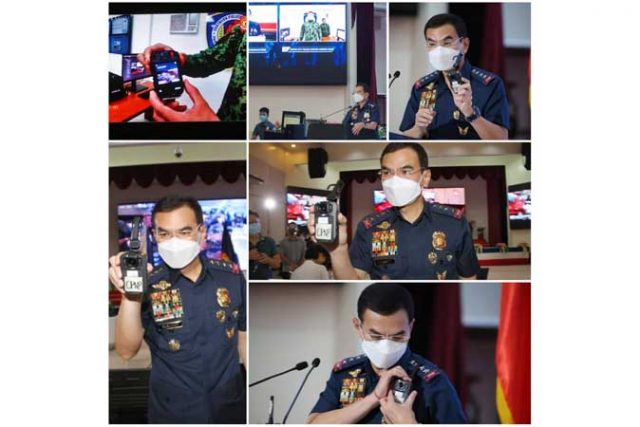
COPS deployed at checkpoints in areas under strict quarantine rules are among the first to use body-worn cameras in the country to ensure that they will be “courteous at all times” and for their protection against accusations of abuse.   

“Our personnel on the ground have been dealing with a large number of people on a daily basis since Day One of the ECQ (enhanced community quarantine) on Aug. 6,” police chief Guillermo Lorenzo T. Eleazar said in a news release on Monday.   

“These body-worn cameras will serve as the constant reminder for them to be courteous at all times and at the same time, their protection against claims and allegations of abuses,” he said.   

The cameras were first used on Monday by police officers stationed at quarantine checkpoints set up around the capital region Metro Manila.  

The use of the cameras are monitored by technical experts at the Philippine National Police Command Center in Quezon City through live video feeds. 

“Through real-time videos that we capture at various borders of Metro Manila including traffic situations at QCPs (Quarantine Control Points), commanders are assisted for any security adjustments, and it is also quickly communicated to our personnel for immediate implementation,” Mr. Eleazar said.   

The rules on the use of body-worn cameras in serving search and arrest warrants, promulgated by the Supreme Court, took effect on July 31.  

As of June 4, Mr. Eleazar said the police had a total of 2,696 body-worn cameras, and 600 cops have so far been trained to use the gadgets. — Bianca Angelica D. Añago 

ILO, US labor dept. launch project to improve labor conditions in agri, mining sectors 

BW FILE PHOTO

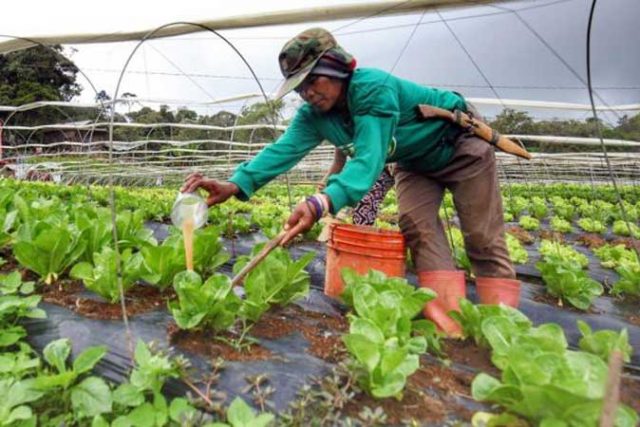
THE UNITED Nations’ International Labour Organization (ILO) and the United States Labor department will launch a project in the Indo-Pacific region, including the Philippines, to help improve the country’s compliance to labor laws, occupational safety and gender equality standards, particularly in the agricultural, fishing, and mining sectors.   

ILO has reported that nine million workers in the rural sector were affected by the coronavirus pandemic, 22% of whom are women.   

It noted that the three specific sectors are “characterized by poverty, poor working conditions, and high risk of occupational accidents and diseases.”   

In addition, the work of women in these sectors are often undervalued, hence they face greater risks of job income losses, unsafe and unhealthy working environments, and have a double burden of balancing work for profit and family responsibilities, the ILO said in its report.  

ILO and the US will launch the program “Improving Workers’ Rights in the Rural Sectors of the Indo-Pacific with a focus on Women” on Wednesday, which is part of the UN agency’s Safety + Health for All project.  

Philippine Labor Secretary Silvestre H. Bello III, who currently chairs the ILO government group, said in a press conference Monday that the country has “a continuing program for the protection of women and of children from child labor.” — Bianca Angelica D. Añago  

Police assures teams, online platform ready to address violence against women, children 

PHILSTAR

NATIONAL police chief Guillermo Lorenzo T. Eleazar assured the public on Monday that special teams are ready to respond to cases involving violence against women and children amid concerns of a potential rise in domestic and online abuse during the two-week lockdown in Metro Manila and other areas.   

“We have created ways to address this issue, including our e-sumbong (e-report) which has made it easier for our compatriots to ask for help and complain because the Facebook platform itself is available for police intervention,” Mr. Eleazar said in Filipino in a news release.   

He urged the public to report incidents of violence against women and children to authorities, either through help desks at police stations or through the online platform.  

“We encourage our fellow citizens to trust your PNP (Philippine National Police) in this issue,” Mr. Eleazar said. “We must remember that there will be no abuser if no one will allow themselves to be abused.”  

Two senators have called for heightened vigilance, citing an increase in cases of abuse and exploitation during previous impositions of strict lockdowns around the country.   

“Abuse and exploitation of children inside the home is more common than our society would like to admit. Various kinds of abuse are being experienced by our children — sexual or physical — and at most times, in the hands of individuals whom they trust,” Senator Ana Theresia N. Hontiveros-Baraquel said in Filipino in a statement on Monday.  

Sherwin T. Gatchalian, chair of the Committee on Basic Education, Arts and Culture, said in a separate statement that economic hardships during the lockdown could again trigger domestic violence.    

He also said stricter quarantine measures might make it difficult for victims to ask for help.  

Mr. Gatchalian cited police records showing cases of violence against women and children more than doubled to 3,600 in June 2020 from 1,284 in March the same year when the first lockdown was implemented.   

Ms. Hontiveros called on barangays and local governments to ensure that help channels are open for victims of sexual or physical abuse. — Bianca Angelica D. Añago and Alyssa Nicole O. Tan

The 2021 Code of Conduct for the South China Sea: Navigating between norms and power politics

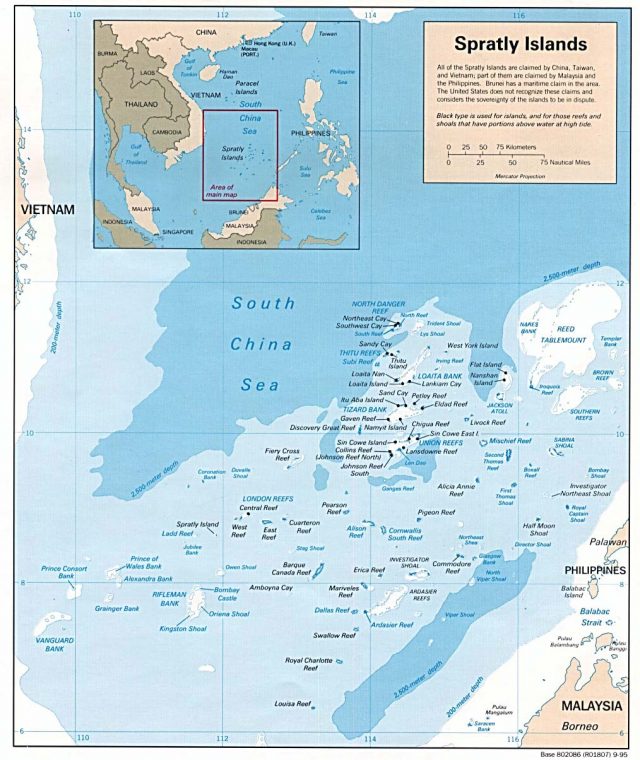
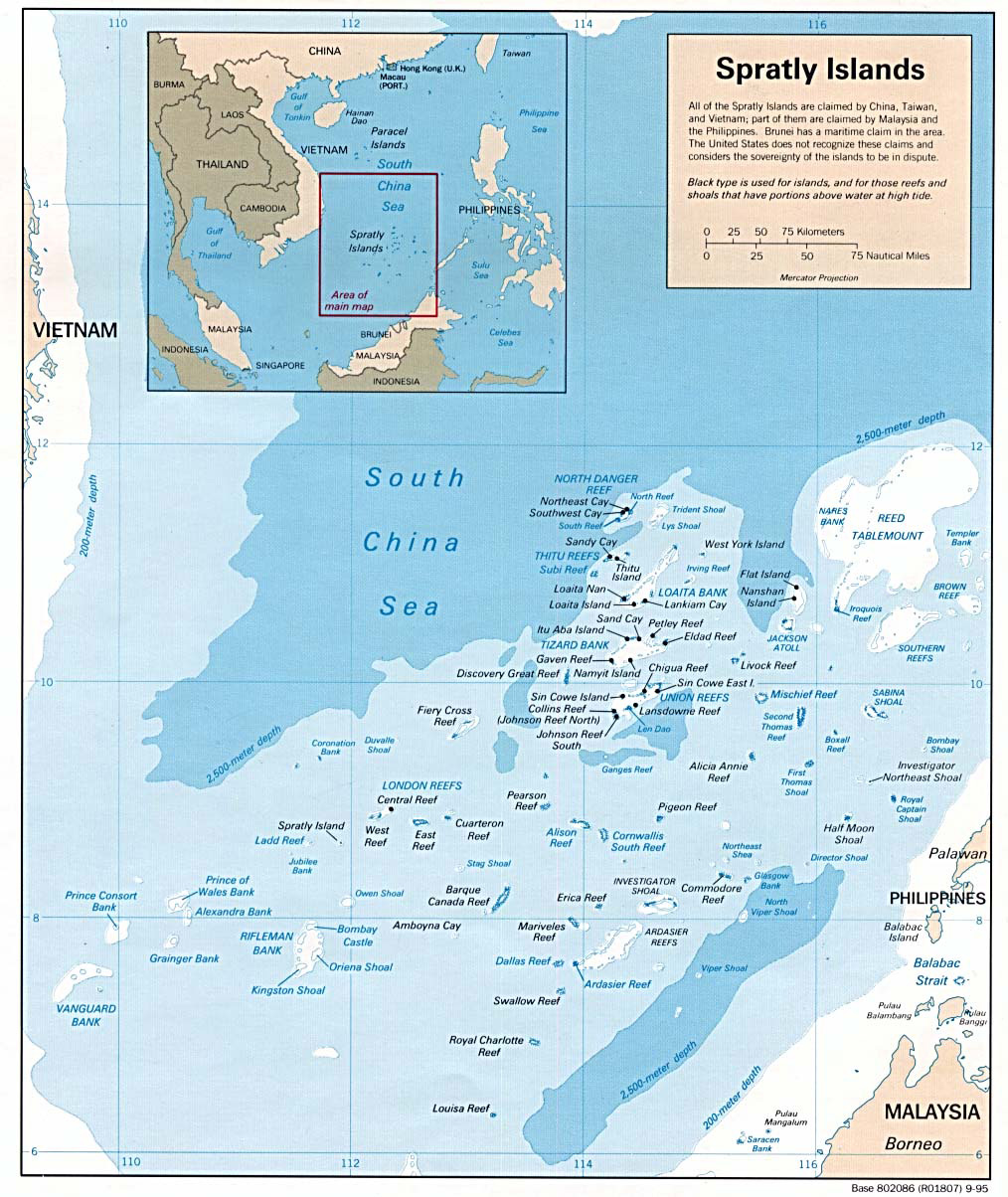
Renewed interest and hopes for a final Code of Conduct for the South China Sea surfaced during the 37th ASEAN Summit. The focus is on moving forward an “effective and substantive” code from the Single Draft Negotiating Text (SDNT) that forms part of the latest agreement between ASEAN-China leaders as of 2019. This should have been seen as a positive turn for ASEAN and China relations in the light of establishing a rules-based governance and dispute settlement system for the users/littoral states in the region. However, bilateral developments marked by China’s aggression against claimant member states before and during the pandemic have pushed the claimant states of ASEAN to resort to legal measures outside of the yet evolving regional code arrangement.

Between 2017 and 2018 when the Framework and the SDNT were formulated, China upped the ante of making counterclaims against its own in this vital waterway. During the pandemic, Chinese navy, coast guard, and fishing vessels’ use of complex military and militia tactics — firing water cannons, swarming and ramming Philippine, Vietnamese, and Malaysian fishing and oil exploration vessels — have resulted in parallel militarism among ASEAN member states including the Philippines. One of the more recent forms of intimidation in 2019 was the swarming of hundreds of Chinese military and non-military vessels in Pag-asa Island in the West Philippine Sea, where the Philippine military and civilians established a community.

But the real tensions between parties are actually found in the provisions of the draft. The future of negotiations for what is hoped to be an enforceable regional code will have to address the polar opposite views of China and individual ASEAN member states on framing the South China Sea as exclusive to the littoral states of the waterway or as part of the global commons. Needless to say, China is the proponent of exclusivity in the South China Sea. Alternatively, the view which seeks to guarantee freedom of the seas and navigation has the support of Malaysia, Vietnam, and the Philippines. Another thorny issue is China’s non-recognition of the UN arbitral ruling of 2016 (Philippines vs. China) which is detrimental for a governance regime anchored on the United Nations Convention on the Law of the Sea (UNCLOS). Failure to align the code to the UNCLOS and the arbitral ruling is the first bottleneck for an effective dispute settlement arrangement in the South China Sea. Vietnam is most vocal about implementing an UNCLOS-aligned code of conduct. Given the asymmetrical nature of the power play in the negotiations and the facts on the ground, could an effective code of conduct be on the horizon?

How regional parties bridge competing ideas in the code poses a major challenge. The first set of these includes the narratives already mentioned in the preferences of parties for or against aligning the code to the UNCLOS and hence to the practice of freedom of navigation. These issues mirror the politics and ideologies of China and are mobilizing points for counter-US involvement. This is thus an example of how an interface of norms and great power politics can dangerously impact the region.

On the other hand, there are practical cooperative measures that are proposed in the draft, notably, to advance marine environmental protection, research, safety of navigation and communication at sea, transnational crimes, search and rescue, and resource exploration, which, when implemented at bilateral and mini-lateral levels within ASEAN, will help build confidence and maritime security among users. These practical arrangements also serve to cushion the limitations of a code that is increasingly being embedded in a precarious geopolitical environment.

Under the current circumstances, the ASEAN may not be able to fully depend on an enforceable code of conduct that incorporates global rules and norms and the voices of smaller claimant states vis-a-vis China’s revisionism. The ASEAN should strengthen the cooperative security institutions it has built over time. Revisiting the ASEAN way in order to strengthen ASEAN centrality is a pragmatic move, as well as the strengthening of defense level security arrangements such as the ASEAN Defense Ministers Meeting (ADMM) Plus to further practical cooperation in jointly safeguarding against the unintended consequences of asymmetrical power relations in the South China Seas.


Alma Maria O. Salvador PhD is a full-time member of the Ateneo de Manila University Department of Political Science.

Greening is the new black

FREEPIK

Is it so difficult to make a company green? Let us take a look.

THE COMMUTE
How many of your workers now commute using bicycles? Since we experienced MECQ, ECQ, GCQ and all other kinds/levels of lockdown and limited public transportation, it has been a focus of many companies to look for solutions to employee mobility. Even SMEs, like ours, had to find ways to make workers come to work, even on a reduced capacity at offices and stores.

1. Walking is the best. Now that we have filtered our staff to only retain those who live near their place of work, the recommended mode of transportation is no transportation. In the Makati Business District, we see more people walking to work.

2. Bicycles. I always smile when I see food deliveries on bicycles, rather than motorcycles.

They DO NOT pollute the air with smoke emissions and the bigger benefit is making the riders healthier with all the exercise they get from biking.

How much would it cost to give each employee a bicycle to use? Or maybe a rent-to-own scheme would be much appreciated by many workers who will not only save on transportation but be super safe as they bike to work alone.

3. Motorcycles. Yes, it is the dream of every blue-collar worker to own one. It is like a badge of success for someone who earns minimum wage to be able to afford a motorcycle and “drive” it to work. We have workers who do not mind a three-hour motorcycle commute as long as they do not have to wait for a bus or jeep during rush hour.

4. Hybrid cars. This can be the next Executive Compensation package. Only hybrid cars must or could be subsidized by management so staff can also help in Environmental, Social and Governance (ESG) goals of a company. There are many brands now, like Prius and the Nissan Leaf, among others.

5. Electric cars. Only reserved right now for those who can afford a TESLA.

6. Electric jeeps and trikes. They have been around for a long time, like golf cars and tricycle models for resorts, clubs, and golf courses. But sooner or later, we will see them in the mainstream as more people turn to renewable energy and these vehicles would be an easy choice.

USING NATURAL AIR
Next is the workplace. We must look for open spaces that may not require air-conditioning due to the new COVID variants. So, it may be time for companies to look at work spaces that have a lot of distances between workers. It had to take COVID-19 to make us think about using less air-conditioning because of the fear of contamination. So now we are forced to stretch and think of what was almost impossible — working in open spaces. We’re doing it now.

The idea of buying farm lots is also high on every company’s “to do” list. Farms are not only good for companies to send workers to — for relaxation, some meditation, or a retreat, and also for team-building activities. Others may find the bosses converting their formerly personal farm lands into company meeting places or similar outdoor function areas as well-ventilated spaces.

NO PLASTICS, JUST GARDENS
Every good meaning manager must look at company policies and check how updated they are. Do they now include policies on greening, waste segregation, using less water in toilets and maybe even having a company “grow your own food” project to ensure food security for all?

A lot of company manuals, if we must be updated, must include policies on ESG and that starts with looking at everyday things in the office. Thus, we suggest taking a peek at the everyday commute, everyday lifestyle at the office, and simple ideas like having a community garden for vegetables.

So, is greening a company only for getting scores on Sustainability ratings as a public company? I think every company, private or public, must start to heed the signs. This pandemic serves as a sign for us to listen to Mother Nature and her signals — climate change, the pandemic, rising sea levels, and other global concerns. Our company is but a tiny dot in the Universe but if we all became conscious of what changes need to be done, the sooner the planet will be cooler and the sooner we can go on with a better new kind of lifestyle.

Greening your company is an adaptation to the pandemic for some, but a well-thought-out corporate direction for futurists and visionary leaders. And we hope to have more of the latter.

How green can you be? How do we start inculcating green practices into our corporate culture?

Just like Corporate Social Responsibility (CSR), it starts from the top. We hear of companies where the boss takes the staff on mountain hikes to appreciate nature. We hear of bosses who preach about avoiding plastics and talk about energy savings and walk the talk by closing irrelevant companies and opening sustainable ones. Which kind of boss or leader are you?

It is an imperative to go green now, not just as a fad or trend to look good for PR. Greening is the only way we can make our companies sustainable, to see them thriving into the next generations.

GREEN is the new BLACK.

This article reflects the personal opinion of the author and does not reflect the official stand of the Management Association of the Philippines or MAP.


Chit U. Juan is a member of the MAP Inclusive Growth Committee and the President of the Philippine Coffee Board, Inc.

pujuan29@gmail.com

map@map.org.ph

http://map.org.ph

10 trends in mortality 2020 in the Philippines

This is Part 2 of this column’s piece five months ago, “10 trends in mortality and spending economics” (March 23, https://www.bworldonline.com/10-trends-in-mortality-and-spending-economics/).

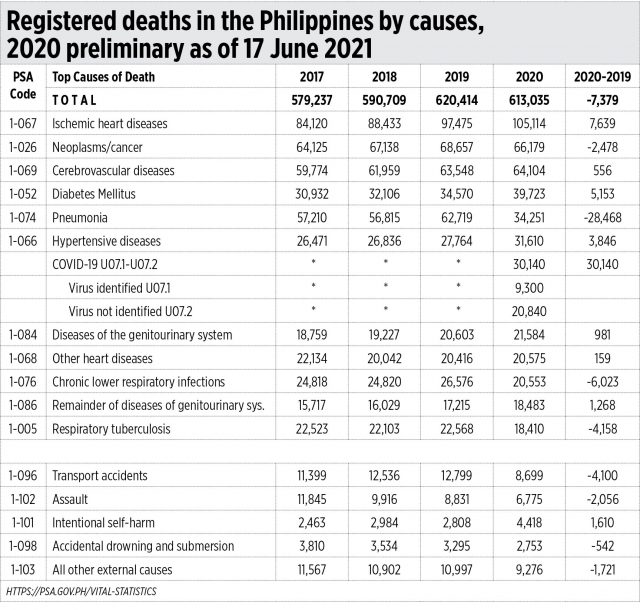
The Philippine Statistics Authority (PSA) released the updated data last month on causes of death in 2020 and the results may be shocking for those who have been peddling the scary-alarming impact of COVID-19 in the country (see Table).
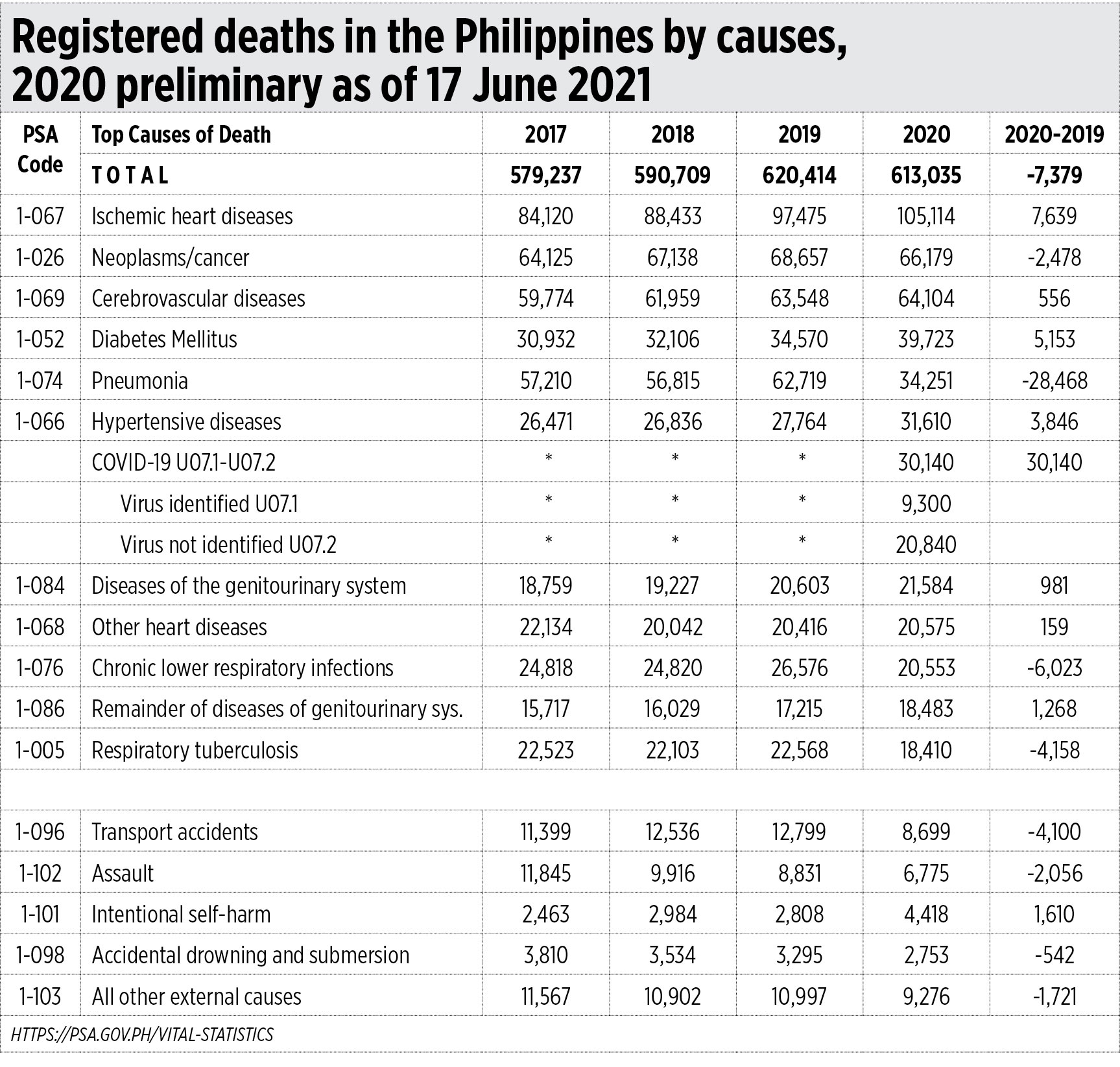
10 trends can be derived from the numbers related to COVID-19 and the strict lockdown in 2020:

One, there was no “excess mortality” as expected compared with 2019. There was, in fact, a decrease in mortality, fewer deaths by nearly 7,400. So the actual health damage is not as grave as told by government and many media narratives.

Two, ischemic heart diseases (heart attacks, etc.) remain as the main cause of death. An increase of 7,600+ was consistent with the trend in recent years.

Three, expected “excess mortality” would have been 30,000+ due to COVID-19 deaths. So, the expected deaths in 2020 would have been around 650,000, not 613,000.

Four, the annual deaths were equivalent to 1,700/day in no-pandemic 2019 and 1,680/day in pandemic 2020. The first reported COVID-19 death in the country was on March 11, 2020. So from March 11 to Dec. 31, 2020: (30,140 COVID-19 deaths) / (296 days) = 102 COVID-19 deaths per day. A real pandemic with excess mortality should have resulted in 1,802/day in 2020, not 1,680/day.

Five, there was large-scale renaming or labeling of many deaths from pneumonia, respiratory infections, and tuberculosis to COVID-19 deaths. There were fewer pneumonia deaths at nearly 28,500, fewer lower respiratory infection deaths at 6,000, fewer tuberculosis deaths at 4,100+. Also, fewer cancer/neoplasm deaths at nearly 2,500.

Six, pneumonia slid from fourth to the fifth killer disease, largely because of the re-labeling many pneumonia deaths as COVID-19 deaths. An average of 58,915 people died from pneumonia yearly from 2017-2019.

Seven, the 20,840 who died from an unidentified virus which is 69% of all reported COVID-19 deaths may be false positives and resulted in the exaggeration of the total number of COVID-19 deaths. Reporting of COVID-19 cases and deaths has been inadvertently incentivized by PhilHealth. The hospital reimbursement for COVID-19 cases (both for patients who survived or died) is P143,267/patient for moderate pneumonia, P333,519/patient for severe pneumonia, and P786,384/patient for critical pneumonia (see PhilHealth Circular No. 2020-0009, dated April 8, 2020).

Eight, the big increase in diabetes deaths of 5,100+ and hypertension deaths of 3,800+. Two possible reasons are: patients are unable to have regular check-ups and treatment due to the fear of going to hospitals and various mobility restrictions, thus their conditions deteriorated, and financial support by government (Philippine Charity Sweepstakes Office, Philippine Amusement and Gaming Corp., provincial, city governments) for other diseases have been either reduced or stopped and the money diverted to COVID-19 cases.

Nine, fewer external causes of deaths. Fewer transport accidents by 4,100, fewer stabbings and physical assaults (2,000+), fewer drownings, fewer falls and deaths from other external causes. This is because of the lockdowns, closure of bars, checkpoints, curfew, etc.

Ten, more intentional harm and suicides. From an average of 2,752 per year in 2017-2019, the cases went up to 4,418 in 2020 or 1,666 more suicides last year. The psychological, financial, and emotional stress to many people from losing their businesses and jobs, the feeling of helplessness from being prevented from casually going out and meeting friends face to face, contributed to this.

So, the “gains” of indefinite lockdown are fewer transportation accidents, fewer fights and physical assault, fewer drownings and deaths from other external causes, and fewer “pneumonia deaths” because of re-labeling.

But the pain and damage of lockdown is too much. More suicides, more patients sick of other diseases, more business closures and job losses. The number of employed people in pre-lockdown January 2020 was 42.54 million, and this went down in lockdown October 2020 (last data available for the year) at 39.84 million, or 2.70 million fewer employed people.

The Philippines’ GDP contraction of -9.6% in 2020 was the worst since post-World War II, the worst in East Asia, and the fourth worst among the world’s top 50 largest economies. The GDP level (at constant 2018 prices) in 2020 of P17.53 trillion was far from 2019 level of P19.38 trillion, and nearly equivalent to the 2017 level of P17.18 trillion — we lost three years of economic output despite a population increase of about 5 million over those three years.

The GDP level (at constant 2018 prices) in first quarter 2021 of P4.24 trillion was equivalent to first quarter 2018 of P4.22 trillion, again a three years loss in economic output.

The issue of implicit mandatory vaccination — via actual discrimination and rumor mongering that “no jab, no job, no aid” — is getting worse. Forcing and deceiving millions of people to take experimental vaccines, to disregard natural and innate immunity, and believe only in vax immunity, is wrong.

Discriminatory government (national or local) plans of disallowing unvaccinated people from using public transportation, public hospitals and schools, public offices and buildings, can be justified only if government will also discriminate when it comes to tax payment, where the unvaccinated will pay zero or reduced income tax, zero or reduced taxes in gasoline, electricity, and so on.


Bienvenido S. Oplas, Jr. is the Director for Communication and Corporate Affairs, Alas Oplas & Co. CPAs

nonoyoplas@alasoplascpas.com

Singapore PM plans to fine-tune foreign worker policies

REUTERS
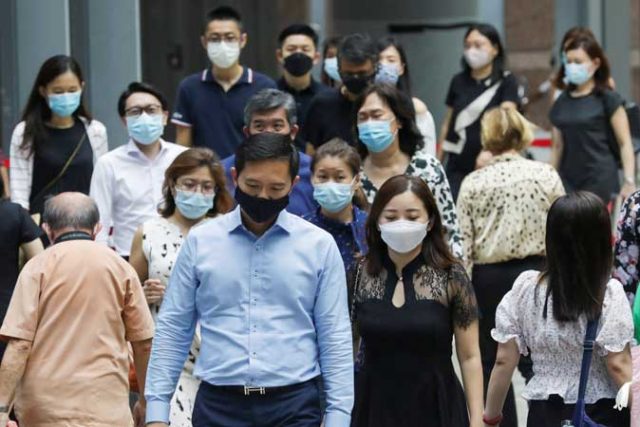
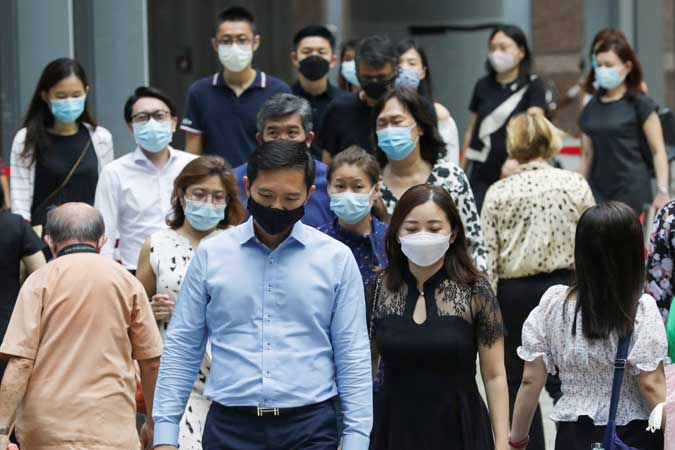
OFFICE WORKERS wearing masks cross a street during lunch hour, amid the coronavirus disease (COVID-19) outbreak, in Singapore, May 12. — REUTERS

SINGAPORE will recalibrate its foreign worker policies to strike a balance between accepting overseas workers and addressing the economic and social concerns of its citizens, Prime Minister (PM) Lee Hsien Loong said.

The government is aware such anxieties over the foreign worker population have worsened because of uncertainties caused by the Covid-19 pandemic, and authorities are addressing them, Mr. Lee said in a televised message Sunday on the eve of the country’s 56th National Day. Other tough issues that have come to the fore during this period that need to be dealt with include support for low-wage workers and the challenge of maintaining racial harmony, he said. “We have to adjust our policies to manage the quality, numbers and concentrations of foreigners in Singapore,” Mr. Lee said. “If we do this well, we can continue to welcome foreign workers and new immigrants, as we must.”

Singapore’s success as a financial hub has long been tied to its openness to global talent, and the island’s low taxes and modern infrastructure make it one of the most attractive places in Asia to do business, particularly as Hong Kong gets caught in the crossfire of US-China tensions. But foreign labor has also been a flash point for over a decade amid competition for good jobs and better wages, putting the government constantly under pressure to explain its approach.

“Turning inwards is against our fundamental interests,” Mr. Lee said. “It would damage Singapore’s standing as a global and regional hub. It would cost us jobs and opportunities.”

The island’s economy is forecast to rebound 4% to 6% in 2021, with the projection due to be revised this month. After recent virus outbreaks forced Singapore to delay its plans for reopening the economy, officials on Friday announced an easing of restrictions on daily life as well as a slight loosening of border controls, with over two-thirds of the population fully vaccinated.

“We are in a more resilient position,” Mr. Lee said. “We can now look forward to a careful, step-by-step re-opening of our economy.”

Even as Singapore moves toward a new normal, Mr. Lee said the pandemic has “taken a toll on all of us” and “strained fault lines in our society.” He highlighted a need to support lower-wage workers who have suffered the impact most acutely, and who will need sustained backing as Singapore becomes a more skills-based economy.

Mr. Lee also spoke about recent incidents of racial and religious intolerance, saying that “maintaining social harmony takes unremitting work.” The country prides itself on its multiculturalism, with its people ingrained especially since independence to set aside such differences to ensure peace and prosperity.

“It took several generations of sustained effort to bring our races and religions together, and grow the common space that we now share,” Mr. Lee said, adding that it’s the government’s duty to manage the balance of social cohesion. “With every new generation, our racial harmony needs to be refreshed, reaffirmed, and reinforced.” — Bloomberg

China punishes dozens of officials amid Delta surge

REUTERS

CHINA has punished a slew of officials for failing to curb a coronavirus disease 2019 (COVID-19) outbreak that’s spawned nearly 900 symptomatic infections across the country in less than a month, a resurgence that complicates Beijing’s strategy of keeping the virus out entirely.

The eastern Chinese city of Yangzhou issued warnings to five officials for mishandling mass testing that they said allowed the virus to continue spreading. The city has overtaken nearby Nanjing, where the delta-driven outbreak first started, as the biggest hotspot in China, with 308 confirmed cases reported as of Monday. Six patients are critically ill and if any were to die it would be China’s first COVID death in more than six months.

More than 30 officials nationwide, ranging from mayors and local health directors to the heads of hospitals and airports, have been punished for negligence and mishandling local outbreaks, according to the state-backed Global Times.

China is dealing with its broadest outbreak of COVID since it crushed the virus that first emerged in the central Chinese city of Wuhan in late 2019. The latest resurgence has spread across more than half of the mainland’s 31 provinces. Though the majority of China’s vast population is vaccinated, authorities are not taking the chance of relying on inoculations and instead have defaulted to their playbook of mass testing and targeted lockdowns to stamp the virus out.

TESTING WUHAN
Wuhan has also seen infections take root again after the virus was brought under control there in early 2020. Fearing it could spread further and draw unwanted global attention, local health authorities tested the city’s 11.3 million residents this weekend, finding nine locally transmitted infections.

Beijing has long held local officials accountable for the virus’s breach into China, blaming them for failing to diligently enforce precautions and restrictions that allowed flare-ups to turn into major outbreaks on domestic soil. The recent disciplinary actions come as the delta variant breaks through the most stringent COVID defenses across the world, exposing the limits of the so-called COVID Zero approach to eliminating the virus pursued by countries from China to Australia.

Still, Beijing is showing no signs of pivoting its strategy. Health officials expect to bring the ongoing outbreak under control in two to three weeks, if containment measures are fully enacted.

In a commentary published over the weekend, a former health minister spurned the idea of “learning to co-exist with the virus.” That approach is being increasingly adopted elsewhere, by western economies and some previously COVID Zero countries like Singapore, who will instead rely on vaccinations to limit the virus’s damage.

Gao Qiang, the country’s former health chief, and current chief consultant to China Health Economics Association, urged authorities to further tighten curbs. — Bloomberg

Japan PM Suga’s support slides to record low as Olympic Games close

TOKYO 2020 FACEBOOK PAGE

TOKYO — Support for Japanese Prime Minister (PM) Yoshihide Suga slid below 30% for the first time since he took office, a survey showed on Monday, a sign the Tokyo Olympic Games failed to boost his ratings amid a resurgence of coronavirus infections.

Roughly a third disapproved of holding the Games which closed on Sunday and 60% said they did not want Mr. Suga to stay on as premier, according to the poll conducted by Asahi newspaper, darkening his ruling party’s prospects in general elections to be held later this year.

In the poll conducted over the weekend, Suga’s support slid to 28%, the lowest since he became prime minister in September last year.

Of those polled, 56% of those who replied said it was good to hold the Tokyo Games, while 32% thought it was a bad idea. Japan’s slow vaccination rollouts have hurt Mr. Suga’s popularity and a spike in new infections, caused by the rapid spread of the Delta variant, has overshadowed the Olympic Games with cases hitting a milestone of one million on Friday.

Mr. Suga and Olympics organizers have said there was no link between the Games and the spike in cases. — Reuters

CDM Araneta glad Team PHL finished Tokyo Olympics safely

PHILIPPINE chef de mission for the Tokyo Olympics Mariano V. Araneta.

By Michael Angelo S. Murillo, Senior Reporter

WITH the pandemic very much a concern during the staging of the just-concluded Tokyo Olympic Games, Philippine chef de mission (CDM) Mariano V. Araneta said the entire delegation is thankful that it got through the competition safely.

Speaking on the Power & Play program on Saturday, Mr. Araneta shared that they are proud and happy with how things panned out for Team Philippines in the Olympics, not only in terms of medals won and competitive showing of the athletes but also health-wise.

“It was very satisfying for all those involved, not only the athletes but all those working behind,” said Mr. Araneta.

“The biggest challenge really for this Olympics was how to survive the pandemic, to keep the entire Philippine contingent safe throughout the competition.”

Save from one coach who tested positive days before the official start of the Tokyo Olympics, there were no other cases of the coronavirus involving the rest of the country’s contingent — athletes, staff, officials and media.

Mr. Araneta said it was a testament to how everybody in the Philippine team made a conscious effort to make their health a priority by following the protocols in effect at the Games.

Proper coordination, too, among all concerned, particularly the officials of the Philippine Sports Commission (PSC) and Philippine Olympic Committee (POC) present in Tokyo, went a long way in preventing any problem from escalating.

In the case of the coach who tested positive, Mr. Araneta said, the PSC and POC moved in and immediately assessed the situation before deciding the next course of action, including the isolation of the person involved.

Such collaboration was an extension of how things were in the lead-up to the Games, the Philippine CDM underscored.

“The PSC and POC really communicated throughout the process to address the needs of the athletes and the results were great as we have seen,” Mr. Araneta said.

On a personal level, Mr. Araneta said it was a great experience to be part of an historic Olympic campaign for the Philippines, and contribute his fair share.

“From my end, it was a privilege to be given the chance to be the chef de mission for this historic Olympics for the Philippines. But it is not only me, of course. There are many people involved, who worked on the ground as well to ensure that we have the best campaign possible. Thank you to them as well,” Mr. Araneta said.

In the Tokyo Olympics, the Philippines finished tied for 50th place on the strength of the country’s first-ever gold medal courtesy of weightlifter Hidilyn F. Diaz, two silvers (boxers Nesthy A. Petecio and Carlo Paalam) and a bronze (boxer Eumir Felix D. Marcial).

Yuka Saso looks to build on Tokyo Olympics experience

YUKA SASO of the Philippines ended up with a 10-under 274 total in the women’s individual stroke play at the Tokyo Olympics, seven shots behind American gold medalist Nelly Korda and three shots out of a medal. — NGAP FB PAGE

FILIPINO-Japanese golfer  Yuka Saso did not win a medal in the just-concluded Tokyo Olympic Games, but her experience there has taught her a lot and something she now looks to build on.

Ms. Saso, 20, born to a Filipino mother and Japanese father, finished her Olympic campaign tied for ninth place in the field of 60 top-class women’s golfers in proceedings held at the Kasumigaseki Country Club.

While she landed outside of the podium, her finish carried much more significance considering she fought all the way from the back of the pack after struggling in the first round.

Reigning US Women’s Open champion Ms. Saso scored a 3-over 74 in the first 18 holes of the women’s individual stroke play, which was marred by five bogeys, sending her tied for 47th place.

But Ms. Saso was undeterred and kept improving as the tournament progressed, managing to move to 34th place after the second round and then to 20th on the penultimate day.

In the last round, the Philippine bet went out swinging, going 6-over in a seven-hole stretch and made five birdies and an eagle at the drivable par-4 17th, which she reached in two before making a short putt.

Ms. Saso ended up with a 10-under 274 total, seven shots behind American gold medalist Nelly Korda and three shots out of a medal.

In assessing her performance, Ms. Saso took pride in what she was able to do, underscoring that while she did not go on and win a medal, the experience from the Olympics should only serve her well moving forward.

“It felt really good to end that way, this is really a good (Olympic) experience and maybe for my next tournaments, I can keep it going,” Ms. Saso was quoted as saying by the National Golf Association of the Philippines (NGAP).

Ms. Saso is now set to resume her professional career where she is currently ranked number 10 in the Ladies Professional Golf Association. — Michael Angelo S. Murillo

Alex Eala hurdles first round of qualifying draw in ITF Belgium

ALEX EALA — ALEX EALA FB PAGE

FILIPINO teen tennis ace Alex M.  Eala is through to the next round of the qualifying draw of the International Tennis Federation’s  (ITF) W25 Koksijde in Belgium after defeating Uzbekistan’s Sevil Yuldasheva in straight sets, 6-0, 6-1, Sunday night.

Sixteen-year-old Ms. Eala, a Rafa Nadal Academy scholar, struggled with double faults in the contest but stayed dominant en route to the easy win.

She now faces American Taylor Ng in the second round of the qualifying where the winner advances to the main draw of the $25,000 clay tournament.

Ms. Eala, the number two junior player in the world and no. 639 in the Women’s Tennis Association (WTA), is coming off a bid in her first WTA 250 tournament last week in Romania, where she reached the Round of 16. — Michael Angelo S. Murillo