Home Blog Page 7179

PSC starts mediation process of PATAFA row

THE Philippine Sports Commission (PSC) has officially started mediation procedures to resolve the impasse between Filipino pole vault ace Ernest John “EJ” Obiena and the Philippine Athletics Track and Field Association (PATAFA) yesterday.

But both parties would have to sign the paper the PSC called “mediation submission agreement” before the process could even progress.

If Mr. Obiena and the PATAFA sign the agreement, the next step will be the appointment of a mediator like PSC Chairman William Ramirez, who has volunteered for the job.

“The role of the mediator is merely to facilitate communication, identify issues and help the parties arrive at a settlement,” said Mr. Ramirez. “My role as mediator is not to decide who is right or wrong.

“We are after a win-win solution for both sides. The goal is to preserve relationships of the disputing parties,” he added.

The agreement contains the rules to be observed, the language and where the mediation will be held.

It also stated that the issue will be resolved via arbitration should it remain unsolved within 30 calendar days from the start of the mediation.

But the PSC will do everything within its powers to put an end to the controversy that started when PATAFA accused Mr. Obiena of allegedly falsifying liquidations regarding the coach’s fee of Vitaly Petrov.

The Tokyo Olympian vehemently denied it.

Mr. Ramirez expresses his worry over both Mr. Obiena and PATAFA and hopes it will be settled soon.

“I am worried about them both. EJ is carrying this burden all alone overseas, away from family and friends. I am concerned about (PATAFA President) Mr. (Philip Ella) Juico’s health. The earlier we can sit down and talk, the earlier we can resolve this,” he said. — Joey Villar

Gabriel Jesus strike sinks PSG as Manchester City tops group

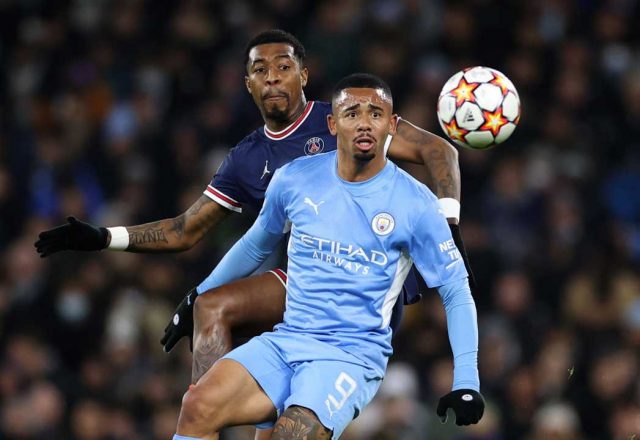
Paris St.-Germain’s Presnel Kimpembe in action with Manchester City’s Gabriel Jesus.

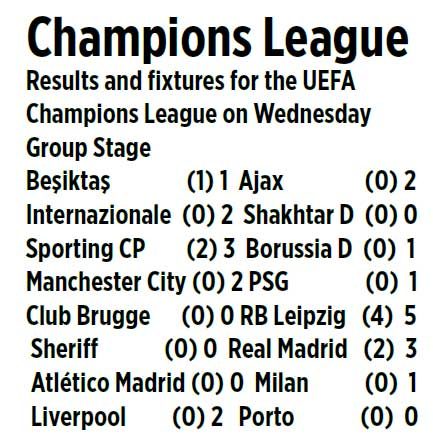
MANCHESTER, England — Gabriel Jesus scored a 76th-minute winner as Manchester City beat Paris Saint-Germain (PSG) (2-1) at the Etihad Stadium on Wednesday to take their place in the Champions League knockout stages as Group A winners.

PSG also advanced to the last 16 thanks to Leipzig’s win over Club Brugge, but the loss highlighted their continued problems in finding an effective way to harness their star-studded attack.

For the opening 45 minutes, City dominated playing with their usual invention and verve while PSG’s front three of Lionel Messi, Neymar and Kylian Mbappé too often watched on from afar.

It remains a major question as to whether PSG coach Mauricio Pochettino can build a team capable of winning the Champions League when his side is so lop-sided and with his three big-name forwards reluctant to work back and assist off the ball.

City has no such problems with Pep Guardiola’s well-drilled machine combining the technique and class with a high work ethic.

Iklay Gundogan hit the post in the 32nd minute and Riyad Mahrez twice went close while the most Paris managed before the interval was a breakaway which ended with Mbappé curling a shot over the bar.

Four minutes after the break, however, PSG grabbed the lead, Mbappé drilling the ball home at the back post after Messi’s cross had deflected off Kyle Walker into the French forward’s path.

City drew level when Raheem Sterling poked home after a lovely ball from Rodri had set up Walker for a trademark low cross. — Reuter

Booker scores 35 as Suns win 14th straight 120-115 over Cavaliers

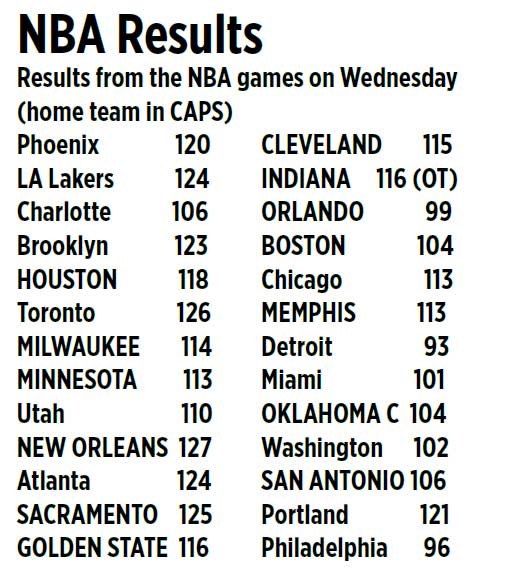
DEVIN Booker scored 24 of his 35 points in the first half to propel the visiting Phoenix Suns to their 14th straight victory, courtesy of a 120-115 win over the Cleveland Cavaliers on Wednesday.

Booker made 14 of 21 shots from the floor to help the Suns match the third-longest win streak in franchise history. They sit three victories shy of equaling their franchise record, set in the 2006-2007 season.

Booker also tormented the Cavaliers in the teams’ first meeting this season. He celebrated his 25th birthday by collecting 27 points and nine assists in Phoenix’s 101-92 win on Oct. 30. That victory ignited the Suns’ current win streak.

Chris Paul recorded 17 points and 12 assists, Deandre Ayton had 16 points and nine rebounds and JaVale McGee added 13 points and 12 boards for Phoenix.

Cleveland’s Jarrett Allen collected 25 points and 11 rebounds to record his second straight double-double and seventh in nine games. Cedi Osman had 23 points, Darius Garland contributed 19 points and seven assists and Ricky Rubio added 15 points for the Cavaliers, whose skid reached a season-high five games.

Paul drained a midrange jumper to give Phoenix a 111-109 lead with 1:45 to play. Paul drew the sixth personal foul by Garland on the next possession before joining Jae Crowder in sinking a pair of free throws to run the Suns’ advantage to six points. — Reuters

PSC’s Rise Up, Shape Up honors information and media workers

THE Philippine Sports Commission (PSC) joins the celebration of UNESCO’s World Development Information Day with a special episode featuring select media workers and personalities on Saturday, Nov. 27.

PSC Commissioner Celia Kiram and the PSC recognize that information and effective dissemination are vital to improving the day-to-day lives of Filipinos.

“Factual information is very important now and always, especially now that we are in a global health crisis. We want to honor the people doing a great job in disseminating information with integrity and reliability,” Ms. Kiram said.

In this episode, PSC’s Rise Up, Shape Up goes on a hike to Mt. Batolusong, also known as Mt. Susong Dalaga, in Jalajala, Rizal with influencers Renz Marcelino and Aliyah Bianca Dio, film director Enzo Manago, news correspond-ent Jasmine Payo, and sports and features correspondent Pauline Verzosa.

“We are grateful for the cooperation and partnership extended to us by friends in the information and media industry.” Ms. Kiram explain. She adds that the upcoming episode will also demonstrate how a mindful walk in nature can be beneficial for the fitness of the body and mind.

“From the onset, this web series aimed to spread awareness of how sports and physical activities can uplift physical, mental, emotional, and social wellness. This web series can reach Filipinos nationwide and encourage them to engage in sports and physical activities through the help of effective information dissemination,” Ms. Kiram remarks. She will also discuss a brief history of trekking in “K-Isport” segment.

The episode will also present tips and benefits of mindful walking to be discussed by Eileen Tupaz, a mindfulness advocate, meditation teacher, and co-founder of WhiteSpace Mind and Body Wellness Studio.

Australia considers diplomatic boycott of Beijing Winter Olympics

SYDNEY — Australia is considering not sending any government officials to the Winter Olympics to be held in Beijing next year amid growing calls from lawmakers for an official diplomatic boycott, the Sydney Morning Herald said in a report on Thursday.

Australian politicians from the ruling Liberal-National coalition and the opposition Labor party are urging the federal government to boycott the event, which will be held in February, the newspaper reported without citing a source.

A diplomatic boycott would involve not sending a delegation of officials, but allowing athletes to participate.

“A decision on (Australia’s) representation at the Beijing Winter Olympics is yet to be made,” a spokesperson for Sports Minister Richard Colbeck said in an e-mailed response. Australia’s foreign affairs department did not re-spond to a request seeking comment.

President Joseph R. Biden, Jr. last week said the United States is considering a diplomatic boycott of the Olympics, a move that would be aimed at protesting China’s human rights record, including what Washington says is geno-cide against minority Muslims.

Britain has not yet made any decision on who will represent its government at the Olympics but Prime Minister Boris Johnson does not support the idea of boycotts, said his spokesman earlier this week.

The Australian government is awaiting the decision by the Biden administration before it makes a call on a diplomatic boycott, the report in the Sydney Morning Herald said.

Both the United States and Britain are close allies of Australia and the countries in September entered into a security partnership to help Australia build nuclear submarines. The trilateral deal riled China, the major rising power in the Indo-Pacific region.

Australia’s relationship with China, its largest trading partner, soured after it banned Huawei Technologies Co. Ltd from its 5G broadband network in 2018 and called for an independent investigation into the origins of corona-virus disease 2019 (COVID-19). Beijing responded by imposing tariffs on several Australian commodities. — Reuters

Rams, league settle lawsuit over team’s relocation for $790 million

THE city and county of St. Louis and other parties have agreed to settle for $790 million a dispute over whether the NFL violated its relocation guidelines when it allowed the Rams to move to Los Angeles in 2016.

The settlement agreement was reached with Rams owner Stan Kroenke and the National Football League (NFL), the city said in a statement on Wednesday.

NFL owners voted overwhelmingly to permit the move in 2016, ending the league’s 21-year absence in the United States’ second-largest TV market.

The relocation, however, broke the hearts of Midwest football fans who followed the team since it moved to St. Louis in 1995.

“This historic agreement closes a long chapter for our region, securing hundreds of millions of dollars for our communities while avoiding the uncertainty of the trial and appellate process,” Mayor Tishaura O. Jones said in a statement.

The city had argued in a civil lawsuit that the loss of the Rams hurt the region and benefited the league and its owners, who received a $550-million relocation fee.

An NFL spokesman confirmed the agreement and said “we appreciate the effort by all parties to reach a settlement and thank Judge Jack Garvey for his service as mediator.”

The Rams did not immediately respond to a request for comment.

The team, which won the Super Bowl while playing for St. Louis in 2000, shares the $5-billion SoFi Stadium in Inglewood, California, with the Los Angeles Chargers — who previously played in San Diego.

The facility, the first new football stadium built for Los Angeles in nearly a century, opened a year ago. — Reuters

COVID injury

Aaron Rodgers was businesslike in his virtual press conference following the Packers’ loss to the host Vikings over the weekend. Needless to say, much of the talk in the post-mortem focused on his injured left pinky toe, and not simply because it was aggravated by incidental contact in the first half of the close contest. He left early to have it treated, and whatever was done in the locker room must have helped tremendously; he was close to perfect in the final two quarters, going for touchdown passes in each of four drives covering at least 74 yards.

So good was Rodgers that the outcome of the set-to could well have been different were the timing more favorable; his last push knotted the score at 31 heading into the two-minute warning, with only a game-ending field goal by the Vikings clipping the rally short. In any case, he was prepared for inquiries from scribes on the state of his toe. In large measure, he anticipated the interest after he himself referred to it in an appearance on The Pat McAfee Show the pre-vious week as a “COVID injury.” And he was ready with his reply.

Interestingly, Rodgers moved to quash speculation borne of his statement uttered in a light-hearted moment by showing his left foot on camera. He went about proving that it did not suffer from the discoloration said to be a symptom of “COVID toes.” Why it would be significant for him to go through such lengths to disabuse fans of news he fueled is subject to debate. He even sought an apology from The Wall Street Journal for previously reporting on it, never mind that he made a mistake as to who crafted the article; he called out former The Athletic scribe Molly Knight and not actual writer Andrew Beaton.

That said, any information on Rodgers, and especially when it comes to the virus, will continue to be media fodder. And, bottom line, the reigning league Most Valuable Player need just look in the mirror to find who to blame. After all, he misled the public with his declaration that he is “immunized” from COVID-19 despite being unvaccinated. Is his intent to keep deliberately fudging the facts, if for no other reason than to give all and sundry the finger? Who knows? Meanwhile, there’s no question on his impact on the field, COVID toes or no.


ANTHONY L. CUAYCONG has been writing Courtside since BusinessWorld introduced a Sports section in 1994. He is a consultant on strategic planning, operations and Human Resources management, corporate communications, and business development

Withering away of democracy?

Source: International IDEA, Global State of Democracy Report 2021

It was quite common back then to hear some Marxists assert that when a classless society has been achieved and the State as a coercive institution, interfering in social relations, ceases to be necessary, the State simply withers away. It dies out.

It did not happen in Russia, or anywhere else. It has not happened today. What used to be the Soviet Union disintegrated into independent republics after 69 years from its foundation in 1922. Totalitarian dictatorship was repu-diated; the hammer-and-sickle flag yielded to the pre-revolutionary white-blue-red flag.

Ironically, the trend that is most evident today, as reported by the International Institute for Democracy and Electoral Assistance (International IDEA), is that “a greater number of countries are sliding toward authoritarianism, while the number of established democracies under threat has never been so high.”

Are we seeing the withering away of democracies?

International IDEA is an intergovernmental organization formed to “promote and advance democracy worldwide.” It aims to see democracy flourishing, rather than dying out. It is driven by its vision to see a world in which democratic processes, actors and institutions are inclusive and accountable.

Three impact areas are the focus of International IDEA: electoral processes, constitution-building processes, and political participation and representation. Based in Stockholm with regional and country offices in Africa, the Asia-Pacific region, Europe, Latin America, and the Caribbean, it has gravitas. International IDEA is a permanent observer at the United Nations and is accredited by the European Commission and the European Parliament.

There has been a sea change in democratic space across the world over time.

Source: International IDEA, Global State of Democracy Report 2021

In its retrospective report 2012-2017 entitled “Supporting Democracy Worldwide,” International IDEA documented the implementation of its “Strategy” in the time of citizens-led uprisings across the Middle East and North Africa, culminating in the downfall of autocratic regimes of long standing. In more established democracies, populism held ground due to the failure of democracies and the ruling class to deliver fair access to opportunities, employment, and education. Great advances in information and communication technology helped in the cause of demanding accountability from policy makers. What was essential was championing the centrality of the citi-zenry in a democracy.

It was correct for International IDEA to shift the public debate away from the “perception that democracy can be built by occupying a central space like Cairo’s Tahrir Square or protesting on Wall Street.” Instead, democracy thrives when citizens are mobilized into institutions and processes that can influence real policy action. By sharing country experiences globally in upholding democracy, International IDEA has contributed to increasing democ-racy’s capacity, legitimacy, and credibility.

Of late, 33 countries have signed up with International IDEA including Asia-Pacific countries, namely Australia, India, Indonesia, and the Philippines which joined in 2013. Japan participates as an official observer.

But in the last few years, International IDEA recently observed that “the world is becoming more authoritarian as autocratic regimes become even more brazen in their repression. Many democratic governments are back-sliding and are adopting authoritarian tactics by restricting free speech and weakening the rule of law, a trend exacerbated by the COVID-19 pandemic.”

This is the key message of International IDEA last Monday with the release of its latest assessment, “The Global State of Democracy 2021 (Building Resilience in a Pandemic Era).” The Report was released three weeks before US President Joe Biden’s Summit for Democracy on Dec. 9-10. About 100 countries will gather to discuss the challenges of keeping democracy alive.

International IDEA’s report is indeed an alarm bell.

Authoritarianism has been observed to be rising in every part of the world. Universal values of democracy are under threat. Backsliding now seems to be the norm as it has doubled in the last 10 years, covering about a quar-ter of the world’s population. The US is the prime example of a backslider as well as some European member states like Hungary, Poland, and Slovenia. What happened in the US Capitol after the Trump defeat was everything that a democracy should not be.

The democracy organization noted that there were more countries in 2020 that moved to more authoritarianism than to more democracy. We are not surprised that as shown previously by press reports, four democracies were lost to fraudulent electoral exercise or military coups. Using various indices, the Report disclosed an increase in state repression, the worst in years.

Not all the democratic losses were due to political factors. The health pandemic has actually entrenched the trend of democratic descent. As of August 2021, around 64 countries “have taken an action deemed to be dispro-portionate, unnecessary or illegal to curb the pandemic.”

What drive democracies to swing to the other side are slippages in political processes and, in International IDEA’s words, social fault lines unmasked by the pandemic. We are all witnesses to how the Philippines’ pandemic response was shaped. Easy-to-implement policies were resorted to like lockdowns and prohibitions of personal mobility. Establishing a more sophisticated, science-based centralized and digital database system was more chal-lenging but that could have enabled the granular community quarantine with a manageable hit on economic growth. Blanket tagging of individuals as insurgents on mere suspicion was even enacted into law.

In addition, as Dindo Manhit of the Stratbase Group recently wrote, “another pandemic threatens to destroy our way of life. Disinformation is an insidious instrument that deprives people of their right to credible information. It dispossesses them and diverts their attention from pressing public issues.” This is anti-democracy. It happened in Myanmar, Peru, and even in the United States.

The only good news is that there are newly observed contrary movements. Some democracies proved to be more resilient despite all the odds. They introduced or broadened democratic innovations and adaptability of their practices and institutions.

It is good civic activism that continues to strengthen, defying state repression especially in Belarus, Cuba, and Myanmar. In addition, issues of global sustainability like climate change and racial justice have creeped into public debates. The democracy organization also reported that over 80 countries went through various forms of protests and mass actions during the pandemic despite repressive state actions.

For democracy to continue to thrive, International IDEA recommends “embracing more equitable and sustainable social contracts, reforming existing political institutions, and shoring up defenses against democratic backslid-ing and authoritarianism.”

What does the Report have to say about the Philippines and the rest of the Asia-Pacific region?

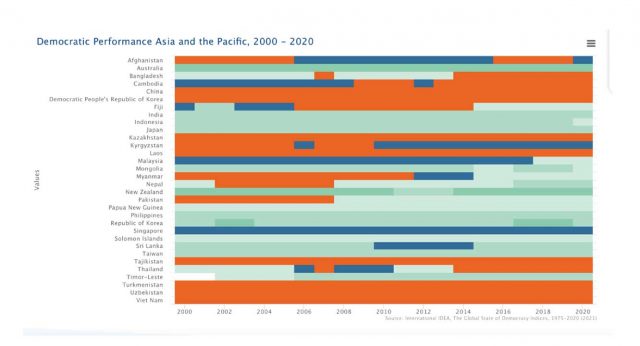
In the press release issued on Nov. 22, International IDEA noted that “democratic erosion is also widespread, including in India, the Philippines, and Sri Lanka with many of them suffering from rising internationalism and the militarization of politics.” The Philippines has remained as a mid-range (green) performing democracy compared to either weak (light green), high-performing (dark green), hybrid (blue) and authoritarian (orange). The chart accompanying this piece shows in no uncertain terms the growing dominance of orange, pointing towards authoritarianism.

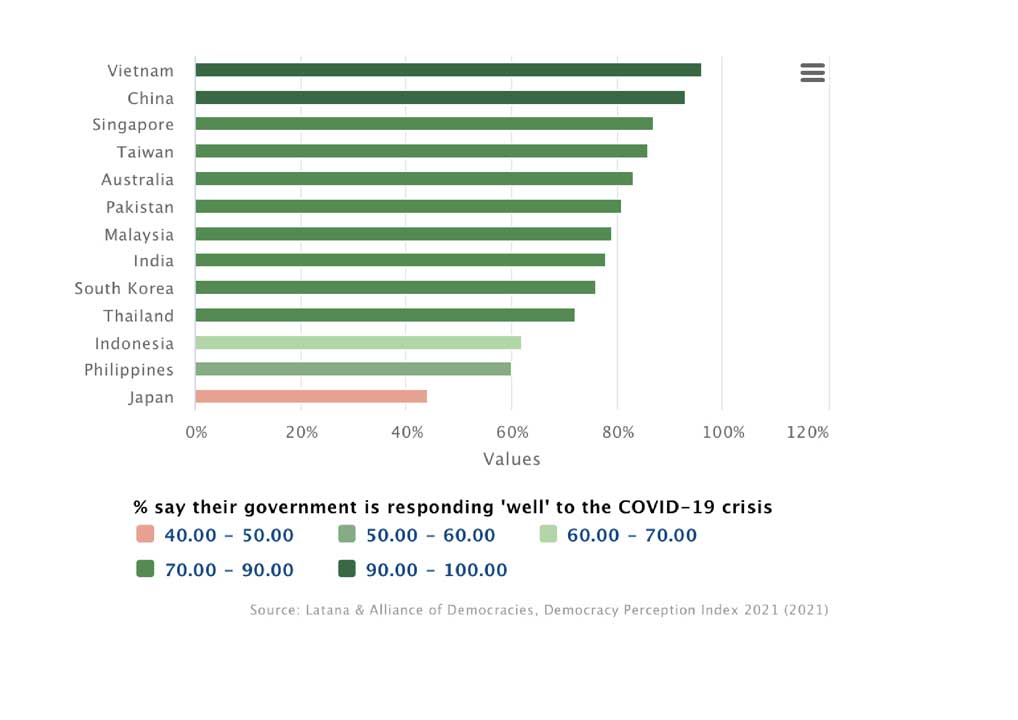
One interesting finding of International IDEA is that Vietnam’s authoritarian regime did not prevent it from getting popular support and people’s trust in, for instance, pandemic management. It delivered, and delivered well. China, Singapore, and Taiwan also received good feedback despite their democratic performance. Singapore has a hybrid regime while Taiwan, like the Philippines, is a mid-range performing democracy.

The clear challenge for the next President of the Republic is to ensure democracy work well especially in the areas of electoral reforms, fighting corruption, upholding the rule of law, defense of our sovereignty, strengthening of our public health system, restructuring of the Philippine economy and mainstreaming of marginalized sector, ensuring universal education, promoting social justice, and building resilient communities.

We cannot afford to see democracy wither away.

Diwa C. Guinigundo is the former deputy governor for the Monetary and Economics Sector, the Bangko Sentral ng Pilipinas (BSP). He served the BSP for 41 years. In 2001-2003, he was alternate executive director at the International Monetary Fund in Washington, DC. He is the senior pastor of the Fullness of Christ International Ministries in Mandaluyong.

Reporting the circus

With only a year before the most crucial Philippine elections in decades, nearly 40 media organizations and 300 journalists and media workers signed on June 17 a pledge to do a better job in reporting the campaign for President, Vice-President, and other national as well as local posts.

The pledge declared that every election “is a reckoning for democracy,” hence the duty of journalists “to provide accurate, reliable and essential information that will empower voters and encourage public discussion and debate.”

The signatories vowed to “put voters and the integrity of the electoral process at the center of (their) reporting” — to depart from the usual media focus on personalities, concentrate on the issues that matter to the citizenry, and make sure that the elections are clean and fair.

As part of the commitment to issue-focused reporting, they also pledged to look into and report on the track records of candidates, check and challenge false information and hate speech, provide the context of whatever events and issues may arise, monitor the independence of the State and other agencies involved in the elections, and encourage and support best practice in journalism.

The pledge basically reiterated the need for journalists to observe in the critical months ahead the professional and ethical standards that enable journalists to discharge the essential duty of truth-telling in behalf of the making of an informed electorate capable of making intelligent choices during elections.

Five months since, however, compliance with the pledge in much of the reporting on the politics of the campaign has been spotty at best. While some media organizations and practitioners have done a yeoman’s job of re-porting the political circus, their work in the context of the huge amounts of airtime and space that have been spent on the coverage of the prelude to the official campaign period in February 2022 has been the exception ra-ther than the rule.

Much of media coverage of what transpired as the Nov. 15 deadline for candidate substitutions came and went was no different from that of past election campaigns.

Glaring enough was the focus on personalities — on Sara Duterte, Ferdinand Marcos, Jr., Rodrigo Duterte, Christopher “Bong” Go, etc. — as that much awaited date passed.

The media closely covered what those worthies said and did without pointing out that, as they jumped from this or that “political party” and became their candidates, it had become quite obvious that keeping power and getting it are all that drive this country’s officialdom and pretenders to the Presidential throne.

It took political scientists to point this out and the truth that the groups that call themselves “political parties” have neither program nor principle and are mere vehicles of convenience for the realization of these and other power-seekers’ ambitions.

Neither was any context provided by much of the media reports on the disqualification complaints against Marcos Junior. Instead, they covered the usual caravans and parades, and quoted him and his lawyers as the Commission on Elections (Comelec) granted his appeal for an extension of the period within which he has to answer the complaints.

Only in the social media pages of some commentators were there any attempts at analysis, as it became evident that the Duterte-Marcos Axis has collapsed, and that Marcos’ disqualification in the context of growing doubts over Comelec inde-pendence would be advantageous to the Dutertes’ drive to remain in power at all cost.

Again, only some of the media provided contextual information on the suggestion that because Marcos and Sara Duterte are supposedly leading among the voters’ preferred candidates for President, they could enter into a term-sharing agreement. It could mean Sara Duterte’s completing the last three years of Marcos’s six-year term should they both win in 2022.

A handful of reports said it would be unconstitutional, and cited the provisions of the Constitution mandating separate six-year terms for the President and Vice-President as well as the rules of succession which say that a Vice-President can succeed a President only if he or she can no longer perform the duties of that office.

The rest reported it without that context, which could have led their audiences to mistakenly conclude that once in power, government officials can do whatever they please, including violate the Constitution. The exceptions stood out for the rarity of their dedication to providing the information voters need to prevent their again electing into office the bogus leaders that have made this country the development basket case of Asia.

The three dozen-plus media organizations and 300 journalists and media practitioners that signed the June 17 pledge seem like a lot, but they are not. There are thousands more that did not sign for a number of reasons, among them the different and often conflicting political and economic interests of corporate media that have long prevented the making of a community of shared values; the vast differences in the training of practitioners in the professional and ethical principles of journalism practice; the corruption and patron-client relations between some practitioners and their sources; and the fear factor engendered by the continuing harassment and killing of journalists.

The last has been even more of a media concern during the Duterte regime. Mr. Duterte himself aggravated it. After justifying the killing of journalists in 2016, he proceeded to insult reporters for asking questions about his health, persecuted media organizations and independent journalists for their supposed bias, accused individual journalists and media organizations of conspiring to bring down his regime, and orchestrated the shutdown of the free TV and radio services of ABS-CBN network.

His spokespersons have denied the “chilling effect” on the media of these acts and threats. But among their consequences is a decline in critical reporting, and the resulting dominance of the regime narrative on such issues as the extrajudicial killings and human rights violations that characterize its rule.

All the above factors contribute to the failure of the media to go beyond “he-said-she-said” reporting. So few are the exceptions that they escape the attention of much of the mass audience. There is also the uncritical ac-ceptance of such precepts as “objectivity” and non-interpretation that have been drummed into the heads of many practitioners by the journalism schools. The result is a fetish in reporting without analysis, critical discernment or context of the claims, no matter how outrageous, absurd, tasteless and dangerous they are, of this or that prominent, usually government source about an issue or event.

Meanwhile, the conflicting loyalties and interests of corrupt practitioners leads to many journalists’ being no more analytical than their cameras and sound recorders. The subservience of corrupt practitioners to this or that source also contributes to mass disinformation.

The result of the dominance in much of the media of the fear of provoking State retaliation for a critical report and of corrupt and business-as-usual practices is an information crisis — and multiple crises in Philippine governance and what little remains of Philippine democracy.

The failure of the mass of the electorate to vote wisely is among the lethal by-products of the media inability and/or unwillingness to provide their audiences not only with information on what happened, but, even more importantly, why— and what it means to them. Unless things change in the way the media report the circus that politics in this country has become, the consequences to the democratization process and the way this country is governed will condemn many more to needless suffering and even death.


LUIS V. TEODORO is on Facebook and Twitter (@luisteodoro). www.luisteodoro.com

Killing Roe vs. Wade

Next year may just be the year that Roe vs. Wade is finally overturned by the US Supreme Court. And in doing so, correct a grievous constitutional error that resulted in the deaths of 62 million babies.

That’s 62 million. One study tracked it at a million aborted babies a year from 1975 to 2012. That’s far more than the 775,000 alleged COVID deaths in the US. Or the 5.16 million alleged COVID deaths worldwide.

Because what the US Supreme Court did in 1973 was to rule that a pregnant woman has the right to have an abortion without government interference. In essence, authorizing abortion on demand. And with its companion case Doe vs. Bolton, as well as 1992’s Planned Parenthood vs. Casey, was crafted a judicially legislated national abortion regime where:

• “States may not prohibit abortion before viability, or when an unborn child is ‘potentially able to live outside the mother’s womb,’ which occurs at approximately 24 weeks of pregnancy.

• “States may not restrict or regulate abortion before viability with ‘the purpose or effect of placing a substantial obstacle in the path of a woman seeking an abortion of a nonviable fetus.’

• “States may prohibit abortion after viability ‘except when it is necessary, in appropriate medical judgment, for the preservation of the life or health of the mother.’

• “The ‘health’ exception encompasses ‘all factors — physical, emotional, psychological, familial, and the woman’s age — relevant to the well-being of the patient.’”

The US Supreme Court “thus created one of the most permissive abortion regimes in the world; the United States, for example, is one of only seven nations allowing elective abortions after 20 weeks of pregnancy.” (“Dobbs v. Jackson Women’s Health Organization: An Opportunity to Correct a Grave Error.” The Heritage Foundation, 2021)

The US Supreme Court did this through the mistaken theory of the “living constitution,” where the Constitution’s words can be flexibly interpreted to take a meaning not rooted in the actual text for the purpose of achieving a certain policy objective. In the case of Roe, the “right” to abortion was created out of nowhere, under a supposed constitutional right to “privacy.” Never mind that the words “abortion” and “privacy” never even appear in the US Constitution.

This was done by building on previous rulings within the confused idea of “substantive due process,” most infamously by upholding a so-called “right” to contraceptives (never mind again that the word “contraceptives” does not appear in the US Constitution), flimsily reasoned out, as Justice William Douglas did in Griswold vs. Connecticut, that “specific guarantees in the Bill of Rights have penumbras, formed by emanations from those guarantees that help give them life and substance.”

The ruling in Roe was so egregious, so mistaken, so wrong, that even a liberal legal academic, Stanford Law Dean John Hart Ely, was famously moved to write about it being completely untethered to the text, structure, and understanding of the US Constitution. That it was “not constitutional law and gives almost no sense of an obligation to try to be” (“The wages of crying wolf,” 1973).

But now comes Dobbs vs. Jackson Women’s Health Organization, which arose from a 2018 Mississippi law entitled the Gestational Age Act. This law bans any abortion operation after the first 15 weeks of pregnancy (with an exception carved out for medical emergencies or severe fetal abnormality).

Relatedly, this was on the heels of Georgia’s House Bill 481 in 2019, which banned abortions after six weeks, and the 2021 Texas Heartbeat Act, which made illegal abortions done after the sign of fetal heartbeat (usually six weeks after pregnancy).

What makes the Dobbs case additionally interesting is the monumental shift in the make-up of the US Supreme Court, what with the appointment of Chief Justice John Roberts, Clarence Thomas, Samuel Alito, Neil Gorsuch, Brett Kavanaugh, and Amy Coney Barrett. All (to varying degrees) conservative judges. All Catholics. And with the exception of Roberts, all “originalists” or “textualists,” which means that they interpret the US Constitution as written. As it should be.

Of course, their presence does not guarantee a proper ruling. Casey is a good example of that. Two decades after Roe, the US Supreme Court had a great opportunity to overturn it (or at least pave the way for its eventual demise) with the 1982 Pennsylvania Abortion Control Act. Instead, that law, which provides among others requirements of a waiting period, spousal notice, and (for minors) parental consent before an abortion could be had, was rendered unconstitutional by a vote of 5-4. Even more painfully, three of those justices were nominated by conservatives: Sandra Day O’Connor, Anthony Kennedy (who’d go on to later pen the equally erroneously ruled Obergefell v. Hodges), and David Souter. Under the most callow of reasons: stare decisis and judicial legitimacy.

Hopefully next year the US Supreme Court will finally do the right thing: protect the rights of the unborn child.


JEMY GATDULA is a senior fellow of the Philippine Council for Foreign Relations and a Philippine Judicial Academy law lecturer for constitutional philosophy and jurisprudence https://www.facebook.com/jigatdula/

Twitter @jemygatdula

Cultivating resilience

The ongoing Ako Para Sa Bata (APSB) conference webinars have presented many facets about child protection.

Among them is “Resilience, the ability to thrive amidst difficult situations. It is the buffer between stressors and one’s mental health. People tend to rely on others. Going through failure and hardship in life tends to strengthen resilience.”

The objective is to see the factors that affect individual resiliency and how organizations survive and thrive amidst adversity and turbulence.

Ma. Regina Hechanova-Alampay PhD, RPsy, (professor at Ateneo de Manila University, Chief of Party, USAID RenewHealth project) highlighted a chart that reveals COVID-19 Mental Health Concerns of Filipinos which showed the youth (age 25 and below) and women are at risk.

Those suffering from severe to extreme stress came up to 55% of those studied, with 70% suffering from anxiety and 55% from depression. The stressors included health exposure to COVID, and illness. Occupational Stressors in-cluded increased responsibilities, while Social Stressors were lack of social support, discord in the family, and COVID news, and Governance Stressors were access to basic needs, and loss of income.

Coping behaviors matter. How people cope affects how resilient they feel. Spiritual behavior (looking at thing in a different way) lead to diminished depression and anxiety especially among the mature population. Resilience is both “Nature and Nurture: innate and developed.”

“While there are individual resources which contribute to resilience, communities and societies also provide resources which are key to facilitating resilience.”

She focused on workers in companies and organizations. There was a decline, she noted, in problem solving, perspective taking, and spirituality. There was an increase in distraction, denial and substance use. Organizations can help employees become resilient by providing the basic needs: safety, medical service, self-care information, and education on self-care. For Employee Care they can embark on Wellness programs and benefits, psychological first aid, training supervision, the prevention of stigma and discrimination, mental health stress management programs, counseling and coaching, psychological debriefing, and peer support group. Specialized services include the referral to mental health professionals and coverage of mental health service.

Among the programs is Katatagan — a psychoeducational intervention of the future; a way of finding strength to develop resilience skills for those with mild or moderate distress. It is composed of: Making the future; Finding and cultivating strengths; Managing physical reactions; Managing thoughts and emotions; Positive activities; and, Seeking solutions and support. It is delivered though synchronous small groups meeting virtually for three to six weeks; asynchronous facilitated online classes wherein participants go through modules on their own time; and the innovative Lusog Isip (Mental Health) App that allows one to monitor mood, coping mechanism and stress levels.

The Johns Hopkins Model has three phases with organization strategies that would enable organizational resilience in the Philippines. These are:

1.) Resistance has communication system, formation and training of response teams, business continuity plans, database of employees and monitoring system;

2.) Resilience has impact assessment on employees and organization, psychological first aid, provision of materials and financial resources to affected employees;

3.) Recovery has access to resilience programs, counseling, review of protocol, and, restoration of facilities.

Dr. Bernadette J Madrid, executive director of the Child Protection Network Foundation, head of the PGH Child Protection Unit, and a pediatrician, talked about Organizational Resiliency as “the ability of an organization to anticipate, prepare for, respond, and adapt to incremental change and sudden disruptions in order to survive and prosper. Resilience, being prepared, proactive and flexible are guides against failure, she said.

She said that “Successful organizations have well-established routines. Work is predictable.” She said that they have simple rules or heuristics — “rules of thumb that help you speed up decision making and prioritize the use of resources in less-predictable contexts.” And, improvisation —“spontaneous and creative efforts to address an opportunity or a problem.”

“The ease with which teams refashion how specific tasks get done — whatever the level of turbulence — is the defining capability of a resilient organization,” she said.

Managing Risk and Resilience were discussed by Fernando F. Suarez and Juan S. Montes in the Harvard Business Review (November/December 2020). Dr. Madrid explained, “No one was really prepared for a pandemic. It’s world-wide. It’s deadly! It affects everybody from all sectors. Existing problems become worse…. We don’t know when it will end. It’s unpredictable. It’s not in our control. You can be unemployed. Your whole family can be affected.”

The University of the Philippines (UP) Philippine General Hospital (PGH) Child Protection Unit charts the reported cases of Violence against Children. It showed a high in January 2020, a decline that April, and an increase in December. However, not all cases are reported because some resources shifted to responding to COVID-19, and social workers were busy. No home visits were allowed. Schools were closed. No transportation was available during the strictest quarantine. People were afraid to go to the hospital. The perpetrators were at home with the victims, preventing them from seeking help. These exacerbated the crisis.

The response of UP-PGH COVID 19 Operations center was the expansion of the hotline to include child abuse. Around the country, the Women and Children Protection Units Helpline was active from Batanes at the tip of Luzon, through the Visayas, and down to Mindanao. In partnership with the UNFPA (United Nations Population Fund), the virtual access, Child Protection Network (CPN) web-based database collected date for processing and analysis. With UNICEF, there is digitalization of services, telemedicine consults, there are video-visits or cellphone follow-ups.

Case conferences are virtual. Online court hearings are being done.

Parenting tip sheets — “Masayang Pamilya Parenting Program” in Filipino and seven other Philippine languages (with information from Ateneo, Oxford University, the CPN, and UNICEF) — were prepared and are being dis-tributed.

Child maltreatment is being addressed despite the limitations and restrictions of the pandemic lockdown.

In partnership with the ICTSI Foundation, the more complex cases are being handled.

In partnership with UNICEF, CPU has multidisciplinary teleconsultation with 55 barangays in 13 cities. The barangays and cities have TeleCPU and Child Helpline.

The challenges of CPU are staff burnout, the need for increased resources to help staff and patients, and mental health support.

The open forum was very lively with Kara Patricia David —GMA TV host, assistant professor at the UP College of Mass Communications, and Founder of the Malasakit Foundation — interacting with panelists and partici-pants.

Dr. Madrid and Dr. Hechanova-Alampay assessed staff burnout and exhaustion. “Feeling there is nothing left to give. The lack of empathy comes from exhaustion… When you stop loving the work you do, it becomes some-thing you dread.”

It was noted that hyper-independent people do not ask for help because there is hiya or shame. The message should be: “It is okay to ask for help.”

The strongest predictor of meaningful work is feedback from clients, bosses, or peers. Leaders should be more expressive of their praise of others. “One strategy is the sandwich method — the affirmations of the work, the feedback itself, then closing with encouragement.”

The discussion led to the possible triggers of suicidal thoughts. Parents should be educated about the principle of trauma-informed care and prevention. Thoughts are not innate — they could be traced to trauma.

Dr. Madrid recommends the book The Body Knows and asserts that every experience is absorbed by the body and can have symptoms.

At the end, the panelists said, “Together, we can stop violence against children.”

The APSB conference ends on Nov. 25 with the 8th and final webinar: “Violence for, by and with the Children and Youth.”

It has been an enlightening experience for more than 10,000 participants.

Our warm congratulations and thanks to Child Protection Network Foundation, UNICEF, the partner-sponsors, and the efficient organizers and team who have presented the broader view and deeper insights on the Child.


MARIA VICTORIA RUFINO is an artist, writer and businesswoman. She is president and executive producer of Maverick Productions. mavrufino@gmail.com


Singapore to avoid a Europe-style COVID resurgence, official says

REUTERS

One of the highest vaccination rates in the world and growing natural immunity could protect Singapore from a Covid-19 resurgence like those currently engulfing Europe and the US, even if another wave hits as expected, Health Minister Ong Ye Kung said.

Singapore’s immunized population is half as likely to die of Covid than influenza, while those who aren’t vaccinated are five times more likely to succumb to the infection, Mr. Ong said in an interview with Bloomberg News on Wednesday at the Asia Summit on Global Health in Hong Kong. That shows that the virus can be endemic, provided enough people are immunized, he said.

About 85% of Singaporeans are fully vaccinated, and the city state is the third-most inoculated place in the world, according to Bloomberg’s Vaccine Tracker. Some 94% of those eligible for Covid shots have gotten them, according to the health ministry, and nearly one-in-four people have already received a booster shot, Mr. Ong said.

Ong Ye Kung, Singapore’s health minister, speaks during the Asia Summit on Global Health in Hong Kong, China, on Wednesday, Nov. 24, 2021. The inaugural event discusses public healthcare challenges during the pandemic and the future direction of public health policies.

“Can we keep ICU cases and deaths as low as possible, to the extent that it’s no different from an influenza wave?” he asked. “I think it’s possible,” he said. “Even when it’s a wave you can withstand it. There are casualties but you are able to work through it with society still functioning very normally.”

The number of people infected in Europe and many parts of the US is rising again, with some places reporting record increases and imposing new restrictions. While shots protect against severe disease, deaths are also climbing, particularly among the unvaccinated, and some hospitals are starting to ration care for the first time since the pandemic began nearly two years ago. The virus’s cyclical nature has policy makers in other parts of the world trying to anticipate when they may get hit again, and if so how hard, with vaccines altering the outlook.

Singapore has slowly been pivoting away from a COVID Zero strategy of walling out the virus, gradually allowing more cases and opening its border to different countries. The relaxation of mitigation measures means the virus will continue to spread, but vaccinations, boosters and other steps like mask-wearing and social distancing will keep the number and severity of infections down, Mr. Ong said.

CRUCIAL WEEKS

The next two weeks will be critical for Singapore, he said.

Officials won’t decide whether to ease pandemic restrictions further, or to hit pause on the reopening, until it’s clear where the outbreak is headed, he said. The country, which has been seeing around 1,500 new cases a day — up from double digits at the start of the year, but down from the peak above 4,500 last month — recently allowed five people from different households to dine together in a restaurant, up from two.

“Cases ought to go up,” he said. “On the other hand, we are also boostering at a fairly decent pace. We are also seeing more people recovering safely, and there will be natural immunity. With all three measures in place, it applied brakes on the natural rise of infections. We will have to monitor closely for the next two weeks, and then we will know.”

Singapore recorded 2,030 cases in the community on Wednesday, more than 1,000 fewer than on the same day last week and the lowest Wednesday total since September. The city-state’s week-over-week infection ratio dropped to 0.75, the lowest number logged since officials began releasing it.

One of the next relaxation moves will be to ease work from home requirements, Mr. Ong said, without giving a timeline for when or how that may occur.

Singapore reopened dining-in in August, and just weeks later began battling a new wave of cases, prompting its leaders to pull back and reimpose some virus measures. Prime Minister Lee Hsien Loong said last week the country is taking a “step-by-step” approach to reopening. It has also taken a tough line on inoculation, saying those who choose not to take the shots will have to pay for any hospital treatment if they get Covid.

While easing restrictions has triggered rising case rates, severe disease and deaths have remained a fraction of what occurred in other countries. Mr. Ong said he expects the virus to return and hit Singapore again even after this wave is contained, since that’s its normal cycle.

The city, he hoped, will be able to withstand the onslaught.

“The direction is clear, we want to progressively open up more and move toward a stage where it becomes an endemic disease,” he said. — Bloomberg