Home Blog Page 7153

Nuclear envoys from Japan, U.S., and S.Korea met after N.Korea missile test

TOKYO – Top nuclear envoys from Japan, the United States and South Korea held talks in Tokyo on Tuesday to discuss how to rein in North Korea’s missile and nuclear programmes, a day after Pyongyang said it conducted a new long-range missile test.

North Korea’s state media announced on Monday what it said were successful tests of a new long-range cruise missile that analysts said could be the country’s first such weapon with nuclear capabilities.

“The recent developments in the DPRK are a reminder of the importance of close communication and cooperation from the three countries,” Sung Kim, the U.S. special envoy for North Korea, said in his opening remarks, using the initials of the Democratic People’s Republic of Korea, its official name.

The three countries have been discussing ways to break a standoff with North Korea over its nuclear weapons and ballistic missile programmes, which have drawn international sanctions.

In meeting with his Japanese counterpart Takehiro Funakoshi and South Korean counterpart Noh Kyu-duk, Kim said Washington remained open to diplomacy to deal with North Korea issues.

The White House said they were still prepared to engage with Pyongyang despite the recent missile test, but U.S. President Joe Biden’s administration has shown no willingness to ease sanctions.

Pyongyang has said it sees no sign of policy changes from the United States, citing issues such as sanctions as well as joint military drills with South Korea, which it says are preparation for an attack.

While Washington is a close military and economic ally of both Japan and South Korea, ties between the Asian neighbours have often been strained over issues including sovereignty disputes, Japan‘s 1910-45 occupation of the Korean peninsula, and their wartime history. – Reuters

Stop funding coal abroad, NGO group tells top investor Bank of China

SHANGHAI – Bank of China (BoC) , a top global investor in coal- power plants, must end the financing of such projects outside the mainland and support clean and renewable energy instead, an alliance of 35 non-governmental organisations said on Tuesday.

The comments, made in an open letter to state-controlled BoC’s chairman Liu Liange and signed by groups from 13 countries in Asia, Africa and Europe, add to the growing criticism of China for financing coal-fired power stations overseas, especially as part of its Belt and Road Initiative.

While China has said that it would respect the right of local communities to decide what sort of energy they needed, the letter, which has been signed by organisations from several Belt and Road countries, indicates growing opposition to coal even in developing nations.

Bank of China’s total overseas financing of coal-based power projects since the Paris climate agreement in 2015 stands at more than $35 billion, the most by any investor globally, and is “out of step with China’s climate change ambition”, the letter said.

It said more than 130 financial institutions have already decided to restrict fossil fuel investments, and urged Bank of China to follow suit.

Bank of China declined to comment on the letter. Its President Liu Jin said at the end of August that the bank would “gradually reduce” the share of total credit extended to coal projects during the 2021-2025 period, but would also issue more loans for technical upgrades in the sector.


GRADUAL SHIFT

Julien Vincent, executive director of Market Forces, an Australian organisation that campaigns against fossil fuel finance, said dozens of coal-fired power plants around the world would not go ahead without the bank’s support.

“The narrative on coal from Chinese business and finance leaders is clearly shifting, but what really counts is action,” he told Reuters.

Chinese financial institutions have been gradually shifting away from coal. Industrial and Commercial Bank of China , the world’s biggest bank by assets, has already pledged to draw up a “road map” to pull out of coal.

In recommendations published last week, a government advisory body also called on China to “restrict and gradually stop” the use of public funds in overseas coal power investment, and encourage state banks to make similar commitments.

According to research released on Tuesday by European think-tank E3G, 44 countries have already committed to “no new coal”, with 1,175 gigawatts of coal-power capacity cancelled since 2015.

It said a similar pledge by China would remove 55% of all of the world’s proposed new coal-fired power projects. – Reuters

Cyber arms dealer exploits new iPhone software vulnerability – researchers

A cyber surveillance company based in Israel developed a tool to break into Apple iPhones with a never-before-seen technique that has been in use since at least February, internet security watchdog group Citizen Lab said on Monday.

The discovery is important because of the critical nature of the vulnerability, which requires no user interaction and affects all versions of Apple’s iOS, OSX, and watchOS, except for those updated on Monday.

The tool developed by the Israeli firm, named NSO Group, defeats security systems designed by Apple in recent years.

Apple said it fixed the vulnerability in Monday’s software update, confirming Citizen Lab’s finding. https://citizenlab.ca/2021/09/forcedentry-nso-group-imessage-zero-click-exploit-captured-in-the-wild

“After identifying the vulnerability used by this exploit for iMessage, Apple rapidly developed and deployed a fix in iOS 14.8 to protect our users,” said Ivan Krstić, head of Apple Security Engineering and Architecture, in a statement. “Attacks like the ones described are highly sophisticated, cost millions of dollars to develop, often have a short shelf life, and are used to target specific individuals.”

“While that means they are not a threat to the overwhelming majority of our users, we continue to work tirelessly to defend all our customers, and we are constantly adding new protections for their devices and data,” he added.

An Apple spokesperson declined to comment on whether the hacking technique came from NSO Group.

In a statement to Reuters, NSO did not confirm or deny that it was behind the technique, saying only that it would “continue to provide intelligence and law enforcement agencies around the world with life-saving technologies to fight terror and crime.”

‘SOFT UNDERBELLY OF DEVICE SECURITY’

Citizen Lab said it found the malware on the phone of an unnamed Saudi activist and that the phone had been infected with spyware in February. It is unknown how many other users may have been infected.

The intended targets would not have to click on anything for the attack to work. Researchers said they did not believe there would be any visible indication that a hack had occurred.

The vulnerability lies in how iMessage automatically renders images. IMessage has been repeatedly targeted by NSO and other cyber arms dealers, prompting Apple to update its architecture. But that upgrade has not fully protected the system.

“Popular chat apps are at risk of becoming the soft underbelly of device security. Securing them should be top priority,” said Citizen Lab researcher John Scott-Railton.

The U.S. Cybersecurity and Infrastructure Security Agency had no immediate comment.

Citizen Lab said multiple details in the malware overlapped with prior attacks by NSO, including some that were never publicly reported. One process within the hack’s code was named “setframed,” the same name given in a 2020 infection of a device used by a journalist at Al Jazeera, the researchers found.

“The security of devices is increasingly challenged by attackers,” said Citizen Lab researcher Bill Marczak.

A record number of previously unknown attack methods, which can be sold for $1 million or more, have been revealed this year. The attacks are labeled “zero-day” because software companies had zero days’ notice of the problem.

Along with a surge in ransomware attacks against critical infrastructure, the explosion in such attacks has stoked a new focus on cybersecurity in the White House as well as renewed calls for regulation and international agreements to rein in malicious hacking.

The FBI has been investigating NSO, and Israel has set up a senior inter-ministerial team to assess allegations that its spyware has been abused on a global scale.

Although NSO has said it vets the governments it sells to, its Pegasus spyware has been found on the phones of activists, journalists and opposition politicians in countries with poor human rights records. — Reuters

Philippines to hold pilot test of localized lockdowns in capital region

PHILIPPINE STAR/ MICHAEL VARS

MANILA – The Philippines’ capital region will shift to localized lockdowns and an alert level system starting Sept. 16 to prevent the spread of coronavirus while allowing more businesses to resume operations, the president’s spokesperson said late on Monday.

Wide-scale, strict and lengthy lockdowns since last year have decimated the Philippine economy, which was one of Asia’s fastest growing before the pandemic.

“We should strive for total health and this can only be realized by carefully balancing our COVID-19 response by considering both the health of our people and the economic health of the nation,” presidential spokesperson Harry Roque said in a statement.

Under the new guidelines, quarantine curbs will cover entire cities, replacing the existing four-degree classification imposed on large groups of cities and provinces, the coronavirus task force said in a statement.

The health ministry will determine which parts of the capital region, an urban sprawl of 16 cities home to more than 13 million people, will be placed under tight or loose levels, depending on case transmission rates and hospital occupancy.

Granular lockdowns in critical areas will be imposed for at least 14 days, the task force said.

But mayors in areas under lowest alert levels can allow the operation of indoor entertainment venues like theaters, bars, clubs, cinemas and amusement parks, which were businesses banned from operating even in low-risk areas since last year.

Limited in-person classes and other education-related activities at all levels can resume in areas with low virus transmission and hospital usage, the task force said.

The Philippines, which has the second-highest number of COVID-19 cases and deaths in Southeast Asia, is battling its worst surge in infections, overwhelming hospitals and healthcare workers.

Cases in the past 30 days alone accounted for more than a fifth of the country’s 2.2 million cases, while total deaths have reached 35,145. — Reuters

BW One-on-One with Kevin Andrew L. Tan

As BusinessWorld celebrates its 34th anniversary this year, the One-on-One interview series returns with timely discussions with the country’s top business leaders.

Watch Kevin Andrew L. Tan talk with BusinessWorld Editor-In-Chief Wilfredo G. Reyes about how he is taking Alliance Global Group Inc. through the COVID-19 crisis with a view to a post-pandemic market.

Gov’t readies retail dollar bond offer

REUTERS

THE Philippines is looking to raise at least $400 million from its first-ever retail dollar bond offering, as part of efforts to beef up state coffers for its pandemic response.

The Philippines will set the pricing for the dual-tranche offering of retail onshore dollar bonds (RODBs) on Wednesday, according to a notice posted on the Bureau of the Treasury’s (BTr) website.

The government aims to raise $200 million each from the five-year dollar-denominated bonds and 10-year notes.

The public offering will run from Sept. 15 to Oct. 1.

However, the BTr said it can choose to adjust the offer period and the offer volume as necessary.

Investors can buy the dollar-denominated bonds for a minimum investment of $300 (P15,000), and multiples of $100 thereafter.

The country’s first-ever onshore RODBs aim to provide alternative and safe investment opportunities for retail investors, especially overseas Filipino workers (OFWs).

The BTr initially planned to offer RODBs in mid-August but decided to postpone it after Metro Manila was placed under the strictest form of lockdown due to a spike in coronavirus cases.

“I think there will be strong demand since market is actively looking for investment outlets,” a bond trader said via Viber.

The BTr said the final interest rate of each tenor will be determined through a Dutch auction on Wednesday, based on the prevailing market rates for five-year and 10-year Republic of the Philippines (RoP) tenors.

The debt papers will be settled on Oct. 8 and will be listed and traded on the Philippine Dealing and Exchange Corp.

To attract more investors, the Treasury and its partner banks agreed to remove the maintaining balance of dollar accounts that will be used to buy the securities.

The bonds can be purchased through various online platforms such as the BTr’s online ordering facility, Bonds.PH mobile app, and the Overseas Filipino Bank mobile app.

The government last offered onshore dollar-denominated bonds in December 2012, when it raised $500 million in 10.5-year bonds from $1.7 billion in total tenders. The issuance, however, was only available to institutional investors due to high minimum investment requirement.

The RODB is similar to the peso-denominated retail Treasury bonds (RTBs) that the government offers every year to cater to small local investors.

In March, the BTr raised P463.3 billion in three-year RTBs to mark its second-biggest retail bond sale in history, following the record P516.3 billion sold in five-year papers last year. — Beatrice M. Laforga

CEO confidence inches up amid coronavirus surge

REUTERS

ALMOST three-quarters of chief executive officers (CEOs) are confident about their organizations’ revenue growth over the next year, reflecting an improvement in their outlook even as the pandemic drags on, according to results of the PwC Philippines-Management Association of the Philippines survey.

Results of the survey conducted in July and August 2021 showed that 74% of 178 CEOs are confident about revenue growth over the next 12 months, compared with 59% of respondents in 2020 and 63% in the second quarter this year.

CEO confidence is, however, still lower than pre-pandemic levels, or 88% in 2019 and 89% in 2018.

Majority of the survey respondents were in the financial services, professional services, manufacturing, and technology sectors, mostly representing large firms.

PwC Philippines Vice Chairman and Assurance Managing Partner Roderick Danao said the improvement in business confidence can be attributed to the expected strong rebound this year coming from the slump in 2020.

“There’s no other way but go up given the worst conditions that we had in 2020. So, we see supply chain normalizing. We see workforce now adapting to the ‘new normal.’ We see companies investing in more and more technology so that the business will continue,” Mr. Danao said during a briefing on Monday.

The Philippine economy exited recession in the second quarter, growing by 11.8% in the second quarter as lockdowns eased.

However, the government lowered its gross domestic product (GDP) forecast to 4-5% this year from 6-7%, to reflect the impact of the two-week stricter lockdown in August amid a surge in coronavirus cases.

According to the survey results, CEOs who expressed the most confidence represent the largest and smallest firms.

While 37% of micro-businesses are “very confident,” 31% of large businesses said the same. Meanwhile, 18% of small firms are very confident, along with 12% of medium-sized companies.

Most firms in the Philippines are micro-, small-, and medium-sized enterprises.

Companies are more confident about longer-term prospects, with 91% of CEOs saying that their companies will experience revenue growth over the next three years.

More than 70% of the respondents said that the Philippine economy would recover within the next three years.

A little over half said that the GDP is expected to grow more than 4% in 2022. This is lower than the government’s 7-9% growth goal for next year.

Most respondents said that the growth drivers are infrastructure development, domestic consumption, and government spending.

DISSATISFIED WITH VACCINE ROLLOUT
Despite the improved confidence, businesses are still being impacted by the effects of the pandemic as 70% of respondents said that average revenues fall by at least 10% each time lockdown restrictions are put in place.

“This is the point: predictability. Business now knows what happens and they have adapted on the digital transformation and they’re investing more money into digital transformation,” PwC Philippines Chairman and Senior Partner Alexander B. Cabrera said.

“They will know that they will lose some money, but they can also predict how much it’s going to go forward and how much is going to go back. And give business predictability and they are going to go forward.”

Around 76% of CEOs said that the slow vaccine rollout will delay economic recovery, and another 44% said that political uncertainty will do the same.

“With just 12.9% of the Philippine population fully vaccinated as of 03 September 2021, 66% of the CEOs are dissatisfied with the vaccine rollout in the country,” the report read.

The Philippines is aiming to vaccinate 70% of its 110 million population against COVID-19 this year. However, the vaccine rollout has been hampered by delays in the delivery of vaccine supplies.

At the same time, CEOs believe that reliance on lockdowns (43%) and the threat of new COVID-19 variants (34%) will impede recovery.

The government is planning to shift to smaller and localized lockdowns, as it hopes to revive economic activity even as COVID-19 cases continue to rise.

Companies have also been affected by COVID-19 related global disruptions, including supply and labor constraints.

In response to the pandemic, 74% of CEOs are planning to increase their digital investments, while another 74% said they plan to boost cybersecurity and data privacy investments. They plan to invest in data platforms, artificial intelligence, and contactless payment systems.

Around 39% said they would invest less than 10% of revenues into digital, while 29% plan to invest between 10% and 20% of revenues.

When it comes to organizational growth, 84% said they would increase investments in leadership and talent development. — Jenina P. Ibañez

Optimism among CEOs up, but concerns remain amid pandemic

Dollar reserves rise to seven-month high

REUTERS

By Luz Wendy T. Noble, Reporter

THE country’s dollar buffers as of end-August increased to its highest level in seven months, thanks to the increase in special drawing rights (SDRs) from the International Monetary Fund (IMF).

The gross international reserves (GIR) as of end-August hit $108.046 billion, based on preliminary data from the Bangko Sentral ng Pilipinas (BSP). This is 0.84% higher than the $107.151 billion as of end-July, and 9.2% up from the $98.954 billion as of end-August 2020.

The end-August GIR level is the highest since the $108.673 billion as of end-January.

“In August, the increase in the reserves was due mainly to the additional allocation of special drawing rights to the Philippines given the IMF’s efforts to increase global liquidity amid the pandemic,” the BSP said in a statement on Monday.

The Philippines gained SDRs equivalent to $2.777 billion, as part of the IMF’s distribution of around $650 billion in SDRs to its members as part of its efforts to help countries recover from the coronavirus pandemic.

“This was partly offset, however, by the National Government’s (NG) foreign currency withdrawals from its deposits with the BSP as the NG settled its foreign currency debt obligations and paid for various expenditures, and the BSP’s net foreign exchange operations,” the BSP said.

An ample level of foreign exchange buffers safeguards an economy from market volatility and is an assurance of the country’s capability to pay debts in the event of an economic downturn.

At its end-August level, the GIR is enough to cover 12.3 months’ worth of imports of goods and payments of services and primary income. It is likewise equivalent to about 7.8 times the country’s short-term external debt based on original maturity and 5.4 times based on residual maturity.

Broken down, reserves in the form of SDRs surged by 2.26 times to $3.996 billion from $1.223 billion as of end-July and by 2.29 times versus the $1.214-billion level a year earlier.

Meanwhile, foreign currency deposits rose 2.7% to $3.417 billion from $3.327 billion in the previous month and by 32.6% from $2.577 billion as of end-August 2020.

The value of buffers in gold holdings also inched up 0.07% to $9.155 billion from $9.148 billion. However, it was 24% lower than the $12.039 billion a year ago.

On the other hand, the country’s reserve position in the IMF slipped 0.3% to $797.2 million from $799.7 million as of end-July. This was also 5.8% lower than the $753.7 million in August 2020.

Foreign investments also decreased 2.1% to $90.679 billion as of end-August from the previous month. It increased by 10% from the $82.370 billion in August 2020.

The country’s ample GIR level can be used by the BSP to ease volatility in the spot market, ING Bank N.V. Manila Senior Economist Nicholas Antonio T. Mapa said.

“With the impending US Federal Reserve’s policy normalization, it remains imperative that the BSP maintains a sizeable amount of GIR at its disposable to deal with potential bouts of volatility and foreign exchange instability,” Mr. Mapa said in an e-mail.

Meanwhile, Rizal Commercial Banking Corp. Chief Economist Michael L. Ricafort said the sufficient GIR buffers strengthens the case for the Philippines to retain its favorable credit rating as this reflects strong external position.

The country’s GIR reached an all-time high of $110.117 billion at end-2020. The BSP expects this to climb to $115 billion by end-2021.

Ruling party tensions could distract focus from economic recovery

PHILIPPINE STAR/ MICHAEL VARCAS

THE internal conflict among members of ruling political party may derail the Duterte administration’s policy making and reforms in its remaining months, Fitch Solutions Country Risk and Industry Research said.

“There is a risk that policy-making processes will slow as attention is turned to political jostling rather than measures to speed up the Philippines’ economic recovery from the coronavirus disease 2019 (COVID-19) pandemic and longer-term reforms,” Fitch Solutions said in a note on Monday.

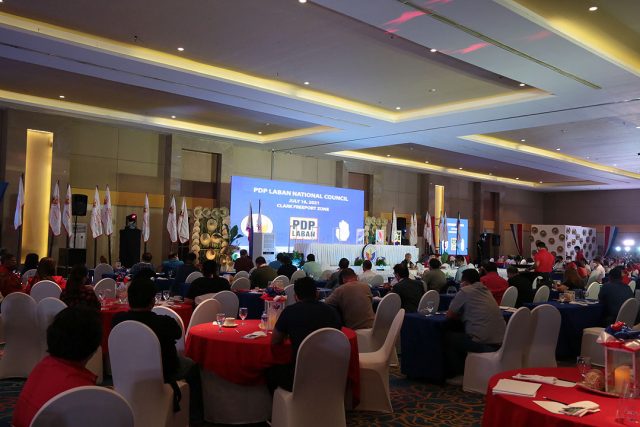
The think tank raised concern over the infighting within the Partido Demokratiko Pilipino – Lakas ng Bayan (PDP-Laban), as the ruling party prepares to field candidates for the presidential elections in May.

The two camps led by President Rodrigo R. Duterte and Senator Emmanuel “Manny” D. Pacquiao, Sr. are now preoccupied with gaining control of the political party, even as the country battles a Delta-driven surge in COVID-19 infections.

“The PDP-Laban infighting and potential switching of allegiances in the coming months could disrupt policy making at a time when the Philippine economy remains hampered by COVID-19. The confusion over the easing of containment measures in Metro Manila on Sept. 8, highlights the uncertainty facing the economy in the near term,” Fitch Solutions said.

This prompted Fitch Solutions to lower the country’s Short-Term Political Risk Index (STPRI) score to 64 from 64.9 out of 100 to reflect the higher near-term risks of political instability and its impact on policies.

“Indeed, signs of significant disruptions to policy making, such as delays to the passing of the 2022 budget, could prompt us to revise our score even lower,” it said.

Fitch Solutions noted these “political distractions” may affect efforts to support economic recovery.

“Focus will likely shift away from the need to boost the Philippines’ vaccine uptake rates and address supply issues,” it added, referring to the sluggish vaccine rollout.

The Philippines has only vaccinated less than 15% of its population, lagging behind its Southeast Asian neighbors and was only better than Vietnam’s 4.91%.

The Health department on Monday reported 20,745 new COVID-19 cases, bringing the active caseload to 180,293.

“Longer-term reforms that would benefit the next president could also stall. These include proposed reforms to ease restrictions on foreign ownership in the utilities and retail sectors, as well domestic hiring requirements, which could be key to reinvigorating investor interest in the Philippines,” it said.

Fitch Solutions also noted the squabbling among PDP-Laban members has also raised the prospects for opposition candidates winning the presidency in next year’s election.

‘LIMITED SUPPORT’
Meanwhile, Nomura Global Markets Research said the Philippine economy could face a sluggish rebound this year as fiscal support remained limited amid the new virus surge.

Nomura lowered its 2021 growth forecast for the Philippines to 4.8% from the 5.4% it previously gave. This falls within the downgraded 4-5% full-year target set by the government.

It also maintained its growth forecast of 8.7% for the Philippines in 2022, also within the 7-9% government target.

“Vaccinations have picked up, but new COVID-19 cases are rising more sharply, threatening the economic recovery amid still-limited signs of large fiscal stimulus,” Nomura Chief ASEAN economist Euben Paracuelles and analyst Rangga Cipta said in a monthly economic note on Monday.

Nomura expects the Philippines will fully vaccinate up to 45-55% of its population by end-2021, based on the 451,200 average number of doses administered per day as of end-August. This is still below the government’s target to have 70% of the population vaccinated against COVID-19 by end-2021.

“If the pace of vaccination does not pick up (i.e., the August pace is maintained), Indonesia, the Philippines and Thailand would only reach 80% full vaccination coverage by Q3 2022,” it added.

Nomura also warned that the government’s plan to implement granular lockdowns may be a “risky approach” given cases remain high.

Despite the need for support amid the new wave of infections, Nomura believes fiscal measures are likely to remain limited “given the government’s continued aversion to higher debt ratios.”

“We also think the reforms in the pipeline will be difficult to pass in the congress, as political noise will likely continue to pick up, ahead of next year’s presidential elections in May,” the report said. — Luz Wendy T. Noble

Time is a major point in TV5 drama ‘Di Na Muli

WHAT would you do if you could tell how long a person had to live just by looking at their hand? That is the premise of TV5’s drama series ‘Di Na Muli, starring Julia Baretto.

“She comes from a family of fortunetellers. And then, she discovers this gift. She has the ability to see the lifespan of a person by just holding their hand,” Ms. Baretto explained during an online press conference on Sept. 6.

“That’s what drove her to be fearful [of getting] close to people, because she doesn’t want to know until when she has time with them,” she added.

“All of us have regrets, and most of them are about things we did not do because we thought we still had a lot of time),” the show’s writer, Noreen Capili, said in Filipino.

“[Yanna] uses that gift [precognition] to help the people around her to deal with their regret,” Ms. Capili added.    

Directed by Andoy Ranay, the series is produced by Cignal and Sari-Sari Channel together with Viva Entertainment.    

The show is Ms. Baretto’s first drama series outside ABS-CBN, and her first project with VIVA Entertainment after transferring to VIVA Artists Agency in 2020.   

Ms. Baretto stars alongside Marco Gumabao who plays Mico, the man who challenges Yanna’s perspective on love. Marco Gallo stars as CJ, Yanna’s long-time friend, with whom she learns to value time with loved ones.

Also in the cast are Angelu De Leon, Bobby Andrews, and Baron Geisler.

“We hope that after watching this series, people will value time more,” Ms. Capili said.

‘Di Na Muli premieres on Sept. 18, 8 p.m., on TV5, Sari Sari on Cignal TV Ch. 3 and SatLite Ch. 30, and on Live and On-Demand via the Cignal Play app. New episodes will be released every Saturday. — MAPS

How ‘sissy men’ became the latest front in China’s campaign against big tech

ZHANG ZHEHAN of the Chinese drama Word of Honor

THE CHINESE government has recently taken action against what it calls “sissy men” — males, often celebrities, deemed too effeminate.

On Sept. 2, 2021, government regulators banned their appearance on both television and video streaming sites. Using the Chinese derogatory slur “niang pao” — literally, “girlie guns” — Chinese cultural authorities explained that they were rolling out a rule to purge “morally flawed celebrities” in order to “correct aesthetics” in “performing styles” and “wardrobes and makeups.”

Technically this is a rule, not a law. But thanks to the strong control the Chinese government exerts over industry, the tech companies that give these celebrities a platform have quickly fallen in line.

The international community may view the rule as yet another example of Chinese repression centered on LBGTQ communities.

And this could be true, to an extent.

However, as someone who studies China’s queer cultures, I’m also attuned to the way pronouncements made by the Chinese government often cloak a hidden agenda.

To me, it’s no coincidence that the ban has come during the intense national campaign against China’s domestic big tech giants, which the government increasingly sees as a threat to its ability to keep tabs on its citizens.

In the mid-2010s the Chinese government’s grip on the country’s entertainment sector began to weaken after decades of control over who could star on TV and what sort of stories could be told. TV dramas, films, and talent shows produced by private tech companies started to take off, while ratings and ad revenues of state-owned television stations tumbled.

Beginning in 2016, the government started to censor web videos with the same criteria it had been using for television. However, the restrictions seemed to only inspire more creative and subversive expressions of sexuality on video streaming sites.

For example, images of two men kissing and holding hands were banned. So, creators simply used dialogue and gestures, like intense eye contact, to convey homosexual intimacy. Furthermore, these rules didn’t regulate the physical appearance of characters.

Since 2017, shows produced by the country’s leading video streaming platforms — many of which mimic the basic format of shows like American Idol and The Voice — have launched the careers of a number of effeminate male celebrities.

These shows include The Coming One and CHUANG 2021, which appear on Tencent Video, a streaming site owned by Tencent, the Chinese technology conglomerate that also owns WeChat. Meanwhile, Idol Producer and Youth With You appear on another video service provider, iQiyi, a subsidiary of Baidu, the Chinese equivalent of Google. The male participants in these shows are often young, dress in unisex clothing, and apply orange-red eye shadow and lipstick, along with heavy makeup that whitens their skin and thickens their eyebrows.

In the past, female audiences would clamor for masculine looks or physiques in their male celebrities. Today’s young Chinese people, on the other hand, are more open to challenging gender stereotypes. Within online fan communities, femininity in male celebrities isn’t stigmatized; instead, it’s celebrated. They’ll call their female idols “brother” or “husband” and their male idols “wife” — names meant more as compliments than insults.

This shift can be traced, in large part, to the influence of K-pop, the South Korean pop music phenomenon in which many of the singers reject traditionally masculine ideals.

An easy way for male actors to achieve stardom is to appear in adaptions of “boys’ love novels,” an online fiction genre originating in Japan that features homoerotic relationships between men.

Take the actor Zhang Zhehan. For years, he played masculine characters in several TV shows. Still, he remained largely unknown until he appeared in the adaption of the boys’ love novel Word of Honor, which appeared in early 2021 on Youku, a streaming service owned by the tech giant Alibaba.

His female fans even invented a meme to describe Mr. Zhang’s rapid rise to fame: “manning up for a decade failed, but [he] succeeded as a wife overnight.”

Despite their perceived effeminate mannerisms, these male celebrities have amassed a huge following among female viewers. Typically, their shows can generate billions of views and considerable ad revenue.

Celebrities whose fame emerged out of shows like The Coming One and Idol Producer are called “traffic stars” because they’re more dependent on their massive followings than on any specific skill such as singing, acting, or dancing.

Since views, shares, and likes have become the dominant metric for a celebrity’s popularity and market value, fans will organize to actively manipulate social media features such as ranking lists and trending topics in support of their idols. This “data worship” — to use the terminology of the Chinese authorities — ultimately boosts the revenue of the big tech companies that promote and host the stars.

Therefore, the profits of tech companies and the proliferation of internet influencers, movie stars, and TV personalities have become increasingly intertwined.

For a country seeking to rein in the power of big tech companies, these effeminate idols become an obvious target.

Although it could be argued that everyday LGBTQ people aren’t the real target of the most recent policy, I believe it will almost certainly have a pernicious effect on China’s marginalized gender groups and LGBTQ communities.

In China, the government has long exploited gender and sexuality in the service of political needs. During the first three decades of the People’s Republic of China — from 1949 to 1978 — homosexuality was portrayed as the epitome of capitalist vice and was, therefore, seen as incompatible with the values of the Communist party-state.

After China’s market reforms in 1978 and the “opening up” of the country, people — especially in China’s cities — became more comfortable calling themselves gay.

In the lead-up to the 2008 Beijing Olympics, the state-run News agency even published articles championing the gay website Danlan — a precursor to Blued, the most popular gay dating app in the world — in order to portray China as an inclusive and diverse place and to deflect international criticism of China’s poor record on human rights.

Thanks to digital technology and the growth of online subcultures, China has achieved some real progress in the acceptance of gender and sexual minorities over the past decade. Young women often speak of having a “gay confidant” (“gaymi” in Chinese), while young straight men are keen to call their male friends “good gay buddies” (“hao jiyou”).

So, it’s a bit surprising to see a gender slur — “girlie guns” — being written into government policy and repeated throughout the country’s mainstream media outlets.

And it isn’t difficult to envision more anti-LGBTQ bullying, harassment and violence in schools and workplaces as a result.

After all, if the government condones a slur, who’s to say it’s wrong to use it to attack others?

Shuaishuai Wang is a Lecturer of New Media and Digital Culture, University of Amsterdam.

Int’l Film Industry Conference will feature masterclasses  

AS PART of the Philippine Film Industry Month, the 5th International Film Industry Conference (IFIC) has organized 11 free public panels and seven masterclasses from Sept. 16 to 19, featuring local and international film industry professionals from of the global film industry.      

Organized by the Film Development Council of the Philippines (FDCP), since 2017, the IFIC consists of a series of panels and masterclasses which bring together big names from the local and international film industries.    

Last year, the conference was held online because of the coronavirus disease 2019 (COVID-19) pandemic. It drew over 2,000 attendees to eight online public sessions and six online masterclasses. It featured 16 local and international partners, and 32 local and international speakers.     

This year, the conference will open with a keynote address from Asia-Pacific Region-Motion Picture Association, Communications Vice-President Stephen Jenner.   

“As we expand the annual conference to IFIC along with the eventful celebration of the very first Philippine Film Industry Month, we also elevate the sessions and masterclasses by purposefully curating the lineup of topics and bringing in exceptional filmmakers and professionals in the industry. There’s so much going on right now in the international arena and through IFIC, we are brought together to know more about the direction and future of cinema,” FDCP Chairperson and CEO Mary Liza B. Diño-Seguerra said in a statement.   

IFIC features speakers from various international programs including SEAFIC Lab and Torino Film Lab.       

The 11 public sessions are: “Nurturing Your Narratives through Film Labs”; “Essentials on Film Financing”; “Fundamentals of Dossier Making”; “Filming With the ASEAN Region: The Future of Film Funding and Grant Opportunities”; “Backstage Access: Bringing Philippine Animation to the World”; “Shaping the New Landscape of ASEAN Film Industry”; “Film Market Strategies and Trends”; “Preserving the Future with Film Archiving”; “Netflix: Bringing Filipino Stories to Audiences Everywhere”; “Behind the Scenes of International Distribution”; and, “Building Strategies Towards the Future of Film Exhibition.” The 11 public sessions will be held via Zoom for free and streamed on the FDCP Facebook and YouTube pages.   

The seven masterclasses offered in the conference are “Writing Essentials: Creating Character-Driven Stories” with film producer, consultant, and screenwriter Samantha Horley; “Unveiling Success Behind Documentary Co-Production” with film producer Alexander Nanau;  “To the Next Level: Fundamentals of Dossier Making” with film producer Armi Rae Cacanindin; “Packaging Your Films for Release” with film sales agent Kataryzna Siniarska; “Finding the Right Tune for Your Film Pitch” with script editor and producer Naomi Levari; “Forging Paths for Wider Reach: A Guide to Film Marketing” with Boris Pugnet, the CEO of French film company Tiramisu and “Reality Check: Transformations in Film Distribution” with Vincent Quek, founder of Anticipate Pictures. The masterclasses are priced at P800 to P1,000 per class; and P5,000 for premium access to all seven. The masterclasses will be held via Zoom.      

For the complete schedule and details, visit www.fdcp.ph/ific. Registration is ongoing until Sept. 15.