Home Blog Page 7148

Alex Eala hurdles first round of qualifying draw in ITF Belgium

ALEX EALA — ALEX EALA FB PAGE

FILIPINO teen tennis ace Alex M.  Eala is through to the next round of the qualifying draw of the International Tennis Federation’s  (ITF) W25 Koksijde in Belgium after defeating Uzbekistan’s Sevil Yuldasheva in straight sets, 6-0, 6-1, Sunday night.

Sixteen-year-old Ms. Eala, a Rafa Nadal Academy scholar, struggled with double faults in the contest but stayed dominant en route to the easy win.

She now faces American Taylor Ng in the second round of the qualifying where the winner advances to the main draw of the $25,000 clay tournament.

Ms. Eala, the number two junior player in the world and no. 639 in the Women’s Tennis Association (WTA), is coming off a bid in her first WTA 250 tournament last week in Romania, where she reached the Round of 16. — Michael Angelo S. Murillo

Tearful Messi confirms he is leaving Barça, in talks with PSG

LIONEL MESSI holds an FC Barcelona press conference at Camp Nou stadium, Barcelona, Spain. — REUTERS

BARCELONA — Lionel Messi wept on Sunday as he bade farewell to his boyhood team FC Barcelona and confirmed he was talking with French club Paris St.-Germain (PSG) over a possible move.

The 34-year-old Argentine’s emotional news conference followed Barça’s announcement last week that it could no longer afford him after a glittering two decades.

French newspaper L’Equipe reported on Sunday that he will travel to Paris either Sunday or Monday to undertake a medical and finalize a deal with the Qatar Sports Investment-owned club.

Spanish newspaper Marca reported PSG formally sent their offer to Messi on Sunday morning, just as the Argentine held the news conference.

While Messi did not confirm he would definitely join the Parisians, he said his plans were to carry on playing as long as possible, adding he still harbors ambitions to win another Champions League trophy.

“As long as I go on being competitive and as long as my body responds (I’ll carry on playing),” he told a news conference.

“As long as I can, I will carry on competing.”

PSG declined to comment on the report that Messi would be arriving in Paris later on Sunday. “We are not in a position to confirm anything,” a club spokesman said.

“I tried to behave with humility and respect and I hope that is what remains of me when I leave the club,” said an emotional Messi as hundreds of fans, many wearing his No. 10 jersey, massed outside Barça’s Camp Nou stadium to bid farewell to the player they called Messiah.

Messi broke down as he walked onto the stage before conducting his news conference and was handed a tissue by his wife Antonella Roccuzzo as he fought back the tears.

“This is the toughest moment of my career. When the club told me, I just froze. This is all like a bucket of cold water has been poured over me and we are still coming to terms with it,” he sobbed.

“When I get home, I’m sure it’ll be even worse. But I’ll be surrounded by my loved ones and I’ll carry on playing football, and when I do so, I’m sure it’ll become a bit easier.”

FINANCIAL ISSUES
It had been widely reported by local media that Messi was set to stay at Camp Nou, with the player admitting he had agreed to a five-year deal involving a 50% pay-cut.

Barça, whose debts total way over €1 billion ($1.18 billion), were unable to make the deal work within the frameworks of La Liga’s financial fair play regulations — prompting their surprise u-turn announcement last Thursday.

“Honestly, when the elections happened (in March), I spoke with (Barça president Joan) Laporta, we had dinner and after that I was convinced I would be staying,” Messi said.

“My contract was never the issue… What I know is that I did everything I could. The club says it could not happen because of La Liga. I can guarantee you that I did everything I could to stay. Last year, I didn’t want to and I said that, but this year it was different.”

La Liga announced last Wednesday that it had secured a private equity injection of €2.7 billion from firm CVC, with the funds to be shared amongst the clubs in return for a 10% of the league’s revenue.

It had been believed this would allow Barcelona to get the Messi deal over the line, however after Real Madrid rejected the proposal and said they would take legal action against La Liga, Barça also came out against it.

Laporta told a news conference on Friday that Barça’s finances were in worse shape than he had thought after conducting an audit.

He added the league informed him that accepting this injection was the only way they would approve a new contract for Messi, but rejected that saying he had to put the long-term interests of the club above any player.

Marca also reported on Sunday that Barça fans had hired a French lawyer, who had lodged a case with the Paris Appeals Court to try and block Messi’s move to PSG.

RECORD BREAKER
Messi, Barça’s all-time record goalscorer with 682 in 21 years, received a lengthy standing ovation from the media, current and former team mates and coaches in attendance.

It was noticeable that he was not accompanied by Laporta or any of the other Barcelona directors.

All 35 trophies he won during his time at the club were laid out for what the club described would be a private photo session after the news conference. — Reuters

Chery Tiggo Crossovers force Choco Mucho to a semifinal rubber match

THE CHERY Tiggo Crossovers leveled their best-of-three PVL Open Conference semifinal series with the Choco Mucho Flying Titans after taking Game Two in straight sets on Monday. — PVL MEDIA BUREAU

THE Chery Tiggo Crossovers lived to fight another day after they took Game Two of their best-of-three Premier Volleyball League (PVL) Open Conference semifinal series with the Choco Mucho Flying Titans in straight sets on Monday at the PSV Socio-Civic & Cultural Center in Bacarra, Ilocos Norte.

Came back with more bounce to their game after losing in the series-opener on Sunday, the Crossovers were steady on being on top of things in the second game, frustrating the Flying Titans en route to the shutout win, 25-18, 25-22, 26-24.

Sisters Dindin Santiago-Manabat and Jaja Santiago showed the way for Chery Tiggo in the victory, finishing with 19 and 13 points, respectively.

In the opening set, the Crossovers had their way to claim the early lead in the contest, 1-0.

But in the next two sets, Chery Tiggo was to be challenged hard by Choco Mucho. It, however, had the answers to everything the Flying Titans threw its way.

Ms. Santiago finished things off for the Crossovers, scoring the last two points in the third set.

With the count knotted at 24-all, the former National University standout first scored with a kill and then in the ensuing play connected on a service ace.

Mylene Paat also scored in double digits for the Crossovers with 10.

“We just have to work harder and I think whoever is hungrier, more aggressive, has the will to win, will have the advantage. We just have to remain focused and take up from where we left off and continue fighting,” said Chery Tiggo coach Aaron Velez after their game.

For Choco Mucho, Kat Tolentino was the lone player in double-digit scoring with 14 points.

Game Three of the semifinals between Chery Tiggo and Choco Mucho takes place on Tuesday. — Michael Angelo S. Murillo

Biles, Belarus and sports drama: Tokyo’s Olympics were full of surprises

TOKYO — In an action-packed Tokyo Olympics that were held in the shadow a pandemic, the upsets were not just confined to the stadiums and sports fields.

The following were some of the biggest surprises in the Tokyo Games:

BELARUS DEFECTION: Arguably one of the most dramatic moments of the Games was when Olympic sprinter Krystsina Tsimanouskaya refused to board a flight home after she was removed from the Games and taken to the airport against her wishes.

The 24-year-old athlete was granted a humanitarian visa from Poland after she publicly criticized the national coaching team of negligence.

Speaking in Poland, Tsimanouskaya said her family had been afraid that if she had returned to Belarus she would be sent to a psychiatric ward.

BILES OUT: US gymnast Simone Biles dropped out of the women’s team event after a single vault at the Tokyo Olympics, only to return after battling a case of “the twisties” to win a bronze on the balance beam.

The 24-year-old American had come to Japan eyeing a record haul of six golds, but shocked the sports world when she pulled out of the opening event after just one vault.

Biles returned to the competition, extolling the importance of prioritizing mental health.

“I did it for me and I was just proud of myself for being able to compete one more time,” she said.

CAN WE HAVE TWO GOLDS?: Qatar’s Mutaz Essa Barshim, 30, and Italy’s Gianmarco Tamberi, 29, had been neck and neck in the men’s high jump competition when they were offered a jump-off to decide the winner.

Instead, Barshim asked: “Can we have two golds?”

In an image that became one of the most memorable of the Tokyo Games, the official nodded, and the two athletes clasped hands and whooped for joy.

TEEN REVOLT: The Tokyo Olympics marked the launch of new youth-centric sports, with surfing and skateboarding in particular capturing new audiences.

Teens and tweens were center stage in skateboarding, where at 13, Momiji Nishiya became the youngest Japanese gold medalist after she won the women’s street skateboarding event.

JAPAN MEDAL HAUL: The host nation smashed its own records for medals in Tokyo. Japan won 58 overall, the fifth highest count, with 27 golds — behind only the United States and China — in sports ranging from skateboarding to wrestling.

FALLING AND RISING: Dutchwoman Sifan Hassan was unable to realize her dream of winning an Olympic treble even after her surprise recovery in the 1,500m heat, where she tumbled and fell.

In a remarkable feat, Hassan recovered and ran through the field to win the heat and advance to the semifinals.

In the end, Hassan had to settle for bronze in the 1,500m although she bounced back to add the 10,000m gold to the 5,000m she had already secured.

VICTORY FOR THE TEACHER: Little-known Austrian amateur women’s cyclist Anna Kiesenhofer, a full-time teacher, made an audacious solo breakaway in the road race and somehow stayed clear to cross the line looking absolutely incredulous.

“I am happy that I was not too scared and I just went for it,” said Kiesenhofer after winning Austria’s first cycling gold since the inaugural Games of 1896.

TUNISIA STUNS: Perhaps no medal of the Games will be celebrated more wildly than that earned by 18-year-old Ahmed Hafnaoui of Tunisia, who stunned swimming superpowers with victory from lane eight in the men’s 400m freestyle.

“It’s a dream and it became true — it was my best race ever,” Hafnaoui said in an Olympic-level understatement after he held off heavily fancied Australian Jack McLoughlin and American Kieran Smith despite qualifying slowest for the final.

Hafnaoui received the ultimate validation as American medal machine Michael Phelps, the greatest swimmer in history, labeled his performance an “unbelievable swim.”

OSAKA’S EXIT: Days after lighting the Olympic cauldron, Japanese superstar Naomi Osaka exited the tennis competition in the third round.

The world number two was knocked out by Czech Markéta Vondroušová in her first tournament since pulling out of the French Open in May, when she said she had been suffering from depression for almost three years.

“I definitely feel like there was a lot of pressure, this time around,” Osaka said. “I think it’s maybe because I haven’t played in an Olympics before and for the first one to be here was a bit much.”

ITALIAN DREAMIN’: Italians rejoiced after their athletics team won their fifth gold in Tokyo, pushing their overall medals total above the previous record of 36 at the 1960 Rome Games.

Lamont Marcell Jacobs delivered probably the biggest shock win in the history of the 100 metres when he took gold.

“Italy keeps on dreaming… we’re the fastest in the world,” read the headline of daily Corriere della Sera after Italy then added a surprise 4×100 meters men’s relay gold, beating Britain by one-hundredth of a second.

WOMEN IN THE GAMES: Some of the most dazzling and dramatic moments of the Games came from women.

American Raven Saunders made a protest from the podium and Kiwi Laurel Hubbard became the first openly transgender Olympian to compete in a different gender category to that assigned at birth.

“The Duel in the Pool” between American Katie Ledecky, the dominant woman in swimming at the 2016 Rio Games, and Australian Ariarne Titmus was one of the most exciting of the Games.

Titmus, dubbed “The Terminator,” took Ledecky’s crown in 200m and 400m freestyle while Ledecky proved untouchable in the longer distances winning gold in the 800m and 1,500m.

Another Australian, Emma McKeon, made history by becoming the first woman swimmer to win seven medals in a single Games, four of them gold. — Reuters


Tokyo treated to flair and flamboyance of Cuban boxing master class

TOKYO — With four gold medals from a team of just seven fighters, Cuba put on another show of flair and Olympic flamboyance in Tokyo, reminding the world of its decades of dominance in a boxing contest where no other country came close.

The big-hitters of Havana won all their gold-medal matches, outclassing rivals with precision, power and composure to top the boxing medals table with the best Cuban performance since their five golds at the 2004 Athens Games.

The gold rush started with men’s welterweight Roniel Iglesias and light heavyweight Arlen Lopez, who saw off their British opponents, before heavyweight Julio La Cruz won his second Olympic gold, grinning with gold teeth during exuberant celebrations.

Lightweight Andy Cruz made it four on Sunday, his slick dancing delighting the cameras at the Kokugikan Arena after a win he said came from strong team preparations.

“We Cubans really worked hard in the run up to the Games. It all came together,” Cruz said.

“We’re a close-knit family in the boxing community and we really brought that together here in Tokyo.”

Britain were a distant second overall, with golds from middleweight Lauren Price and flyweight Galal Yadfai, plus two silvers and two bronzes, in their best performance since hosting the Games in 2012.

Uzbekistan had a disappointing competition after winning overall at the Rio Olympics, with Bakhodir Jalolov’s super heavyweight gold the country’s only medal, compared to three golds, two silver and two bronze in 2016.

The women’s contest, expanded to five weight categories from three in the Rio Games, served up some thrilling encounters, with the gold medals going to boxers from five different countries, with winners aged 20 to 35.

All but one were historic, with Irie Sena of Japan, Ireland’s Kellie Anne Harrington, Bulgaria’s Stoyka Krasteva and Turkey’s Busenaz Surmeneli their countries’ first-ever women’s boxing Olympic champions.

Apart from a sit-in by French super-heavyweight Mourad Aliev over his quarterfinal disqualification for headbutting, there was a rare absence of discord over judging, owing largely to the International Olympic Committee’s (IOC) decision to sideline boxing’s troubled world governing body from Tokyo.

The IOC ran the competition through a special task force with new transparency measures that went down well with most of the fighters.

“These are very close, tightly-fought bouts. The judges did a good job,” said Cuban Julio La Cruz.

“We come here, we give the world a good show and the judges are a part of that equation.” — Reuters

Five financial implications of the Olympics

THE close of the Tokyo 2020 Olympics does not mean the end of financial questions surrounding an event that went ahead without spectators and cost more than twice as much to host as initially planned.

BUDGET: The bill for the Tokyo Olympics and Paralympics is expected to be ¥1.64 trillion ($15 billion), 22% higher than it was before the Games were delayed in 2020. That figure is also twice as much as the ¥800-billion estimate Tokyo submitted in its bid to host the games.

The bill, which will have to be fully funded after the Games end, is split three ways among the Tokyo 2020 organizers, Tokyo Metropolitan government and Japan’s central government. The host city is responsible for the biggest chunk.

TICKETS: Before the decision in 2020 to delay the Games, 4.48 million tickets had been sold, which had been expected to generate ¥90 billion ($816 million) in revenue. That figure will now be close to zero.

The Tokyo organizing committee is responsible for ticket sales, and after using up much of its event cancelation insurance policy, is unlikely to get much of a pay-out on lost ticket sales, according to insurance industry sources.

INSURERS: Ratings agency Fitch estimates the total insured cost of the Olympics at around $2.5 billion, with analysts at Jefferies saying $2 billion is on TV rights and sponsorships and $600 million for hospitality.

Travel and hospitality groups and the International Olympic Committee could face losses due to disruptions from the spectator ban and claims on their event cancellation policies, sources said.

The Olympics are typically insured by firms such as Lloyd’s of London, Beazley and Tokio Marine Kiln.

Reinsurers, which insure the insurers, may face the bulk of any claims, which according to Fitch could be as much as $400 million.

SPONSORS: In Japan alone, 60 Japanese companies, including Toyota, Bridgestone, and Panasonic, paid a record of more than $3 billion to sponsor the Games. They forked out another $200 million after the Olympics were postponed.

While they would normally look to recoup that outlay from sales linked to interest in the Olympics, some big corporate names worried about the potential damage to their brands as public opinion in Japan turned against the Games.

Toyota chose not to run Olympics-related TV commercials in Japan. Others, including Panasonic, had to scale back client entertainment plans at Games venues after spectators were banned.

ECONOMY: A key reason for Japan to host the Olympics was to boost tourism, which in the decade before the pandemic halted most international travel had quadrupled to more than 30 million visitors a year.

In 2019, they spent nearly ¥4.81 trillion ($43.6 billion) in Japan at hotels, restaurants, shops and for other services.

A normal Olympics could have added 0.33% to gross domestic product (GDP), or around ¥1.8 trillion, Nomura Research Institute estimated before the Games.

Instead, Japan’s government has to convince an already skeptical public that hosting the Olympics was the right decision even without the economic windfall. — Reuters

EDC starts vaccination of employees

First Gen-owned geothermal power leader Energy Development Corporation (EDC) has kicked off its COVID-19 vaccination program for its strong workforce of nearly 1,500 and their dependents across the country to help keep them safe and support the government’s aim of achieving herd immunity against the virus.

“We are one with the government in its goal to protect all Filipinos against the COVID-19 virus. As part of our support to the national vaccination program, we procured vaccines for our employees and their dependents through multi-party agreements in partnership with the Philippine government. We also urged and encouraged our employees, through a series of health dialogues with our medical experts, even before the arrival of the vaccines to ease their worries and help them decide to get vaccinated,” said Atty. Allan V. Barcena, EDC Assistant Vice President and Head of Corporate Social Responsibility and Public Relations.

EDC piloted its vaccination in its Pasig City Head Office last July 24. It was soon followed by the inoculation of employees in its geothermal sites in Leyte and Negros Island. Its Bicol, Kidapawan City, and Ilocos Norte workforce will have their first dose this early August. The company expects to complete its vaccination program within the fourth quarter of this year.

EDC’s vaccination administration is being done by its partners from AC Health and Reliance United that both have the capacity and manpower to conduct the inoculation of its employees in all its sites across the country.

EDC gave its employees the opportunity to have their dependents inoculated under its vaccination program as part of its commitment to help keep their families safe. More than 3,600 dependents across all sites were listed in the program.

Beyond producing clean and renewable sources of power, EDC’s top priority is the safety of its employees. It can be recalled that to ensure the safety of its employees when the pandemic hit the country in early 2020, EDC already declared a work-from-home arrangement for all employees whose work did not require them to be physically present in its power plant facilities even before the national government declared a lockdown in the second week of March 2020.

Employees and their dependents who got their first shot under the company’s vaccination program surely felt safe with the constant disinfection of chairs that were done by its support staff during the kick-off inoculation last July 24 in its headquarters in Pasig City.

“Safety is our culture in EDC. While we value producing that much-needed power for our country, especially during this pandemic, we always make sure that our workforce is safe. Having our employees vaccinated against COVID-19 is one step closer to our country’s way to recovery,” Barcena added.

EDC, the largest pure renewable energy company in the Philippines, operates  1,186 MW of geothermal, 150 MW of wind, 132 MW of hydroelectric power, and 12 MW of solar power plants— for a total of 1,480 MW of clean and renewable energy.

It accounts for 19 percent of the country’s total installed renewable energy capacity  and 62 percent of the country’s total installed geothermal capacity as of December 2020, putting the Philippines on the map as the 3rd largest geothermal producer in the world.

Pag-IBIG Fund earns COA’s highest audit rating for 9th straight year

Pag-IBIG Fund has earned the Commission on Audit’s highest audit rating for the ninth consecutive year even amid the pandemic, top officials announced last Friday, Aug. 6.

In a letter dated July 29, COA informed the agency that it has rendered an unmodified opinion – its highest rating – on the fairness of the presentation of Pag-IBIG Fund’s financial statements for the year 2020.

“We faced many challenges last year. However, we remained committed in managing the Filipino workers’ fund excellently. We implemented a number of loan payment reprieves and stimulus programs to help our members and stakeholders during the lockdown while ensuring that these did not affect our robust financial standing. Our ninth straight top rating from state auditors is a milestone for us as an organization and serves as proof that even amid the health emergency, we heed the call of President Duterte in ensuring that government offices like ours are run professionally and remain corruption-free,” said Secretary Eduardo D. del Rosario, Chairman of the Department of Human Settlements and Urban Development (DHSUD) and of the 11-member Pag-IBIG Fund Board of Trustees.

From 2012 to 2017, Pag-IBIG Fund earned COA’s unqualified opinion and from 2018 to 2020, it has gained its unmodified opinion. Auditors use both the unqualified opinion and unmodified opinion, which are the highest ratings that COA gives to a government agency or corporation, to mean that the financial statements of an agency are presented, in all material respects, in accordance with applicable financial reporting frameworks.

Pag-IBIG Fund Chief Executive Officer Acmad Rizaldy P. Moti added that even while they rapidly responded to the needs of members, stakeholders, and their own personnel through numerous programs and interventions, the agency made sure that all requisite processes were strictly followed ensuring that all were above-board prior to implementation.

In 2020, Pag-IBIG Fund aided 4.8 million borrowers by automatically providing them with grace periods totaling 6 months in accordance with the Bayanihan I and II Acts. The agency also aided 320,406 borrowers through its own 3-month loan payment moratorium program. Home loan borrowers were also offered a special loan restructuring program, which resulted in 85,440 members gaining better payment terms on their home loans during the health crisis.

The agency also deployed programs to aid in the recovery of the Philippine economy through a stimulus in the housing industry. A P10 billion home construction fund was made available to accredited developers to encourage production and boost the supply of housing units, while home loan promo rates were offered to members to encourage demand. These allowed housing industry players to maintain operations and continue generating jobs.

These responses to aid members and stakeholders cope with the Covid-19 pandemic won the agency a gold award under the Most Valuable Government Response category in the recently concluded 2021 Asia-Pacific Stevie Awards.

Internally, Pag-IBIG Fund adopted a blended working arrangement and provided more transportation to ferry its workforce.  These ensured that the agency remained in full operations while minimizing the risk of the spread of the virus among its personnel.  Staff were provided personal protective gear, supplies to maintain hygiene, and improved medical coverage – all to protect its workforce so that they can continue to serve members.

“In 2020, the economic slowdown may have dampened our performance, but it did not stop us from extending benefits to our members and stakeholders. It was an extraordinary year which necessitated extraordinary steps to help. Prior to the pandemic, we achieved record-highs year after year in terms of loans released, collections and net income.  Last year, our record-high was the number of members we helped cope and recover from the effects of the pandemic.  Our latest unmodified opinion from COA shows that we have achieved three things last year. First, we were able to safeguard the health and welfare of our workforce which was necessary for the Fund’s continued service to the public. Second, we took good care of our members through the speedy deployment of programs responsive to their needs. And lastly, we were able to do all these while still maintaining the highest standards of financial integrity. That is LingkodPag-IBIG service at work,” Moti said.

Indian mining state shifts from coal to forest fruits and flowers 

PIXABAY

CHENNAI, India — In the forests of Bastar in eastern India, indigenous women have been busy plucking the tan-colored fruits of the tamarind tree — a tangy staple of Indian cooking that earned them rare profits this year thanks to a bumper harvest.  

For decades, mining has eaten into the forests of mineral-rich Chhattisgarh. But as the state moves away from opening coal mines, authorities have introduced measures to boost output of forest goods  from tamarind to cashew nuts and medicinal seeds.  

“The setting of a minimum price has meant that middlemen and traders have to pay a fair price. Family incomes have gone up,” said Sushma Netam, who oversees implementation of the state program aimed at promoting “tribal entrepreneurship.”  

Ms. Netam said production had soared since the state launched its “just transition” plan, a green economy strategy set up to cushion the impact of the shift away from coal.  

“We have more than 200 village groups in the region now, 49 haat (local market) groups and 10 processing centers,” she said.  

While India pushes to expand coal mining to meet its energy needs, Chhattisgarh Chief Minister Bhupesh Baghel announced the state would move away from opening new coal mines in 2019 to help reduce emissions and protect forests.  

Chhattisgarh has India’s second-largest coal reserves and significant deposits of iron ore, limestone and bauxite, but it remains one of the nation’s poorest states, with more than 40% of its population living below the poverty line.  

Under the “Van Dhan” plan, the state raised the procurement price of 52 forest products in 2019 and bought 73% of all produce gathered in the state last year.  

“Mining has been key to the economy and continues under strict norms. But our priority is now the forest,” Manoj Kumar Pingua, state principal secretary for forests and industries, told the Thomson Reuters Foundation.  

“We are willing to forgo millions of rupees generated from mining to protect and improve the livelihoods of forest gatherers. In mining a few make money, but in the green economy, the profit goes directly into the hands of the people.”  

‘SO MUCH BETTER’ 
Chhattisgarh, which has 44% of its territory covered by forest, is now looking to build an organized industry around non-timber forest products, which it says would benefit about 1.7 million families working as gatherers.  

The deforestation of land for mining has greatly impacted the livelihoods of indigenous communities, who earn up to 40% of their income from forest goods.  

Revathi Bagel, 21, works at a recently revived cashew plant in Bakawand village where she and other local women prepare the nuts for dispatch to markets across the country. Previously, she traveled hundreds of miles to work as a seasonal laborer.  

“I walk to work and get paid 8,000 Indian rupees ($108) a month. It’s so much better than going to (the western state of) Gujarat to repay an advance and toil on someone else’s fields,” she said by phone, as piles of cashews were unloaded.  

Forest produce is traditionally gathered primarily by women, who sell it at village markets and use the income to buy essentials, but a vast network of middlemen has limited the benefits for forest communities.  

A lack of storage facilities and processing units in remote villages also limits their profits, said Anushka Rose, research coordinator at the Center for Labor Research and Action, a charity promoting informal workers’ rights.  

“If you look at mahua, people gather and sell it in May to local traders because they can’t store it,” she said, referring to the flowers of the Madhuca longifolia tree, which have numerous medicinal uses and are brewed to make a festive spirit.  

“Two months later they buy it back at a higher price to use in their festivities. If the Van Dhan scheme is strictly monitored, this situation will change.”  

‘DELAYS IN PAYMENTS’ 
But despite such optimism about the programme’s potential, patchy implementation and banking issues have limited its impact so far, said Rajim Ketwas, coordinator of the Dalit Adivasi Manch, a collective working on indigenous rights.  

“Delays in payments or digital transfers are still a hurdle. The families want cash-in-hand and waiting to be paid for hard work will not be acceptable,” she said.  

Deep in the forest in the state’s Baloda Bazar district, village resident Kaushalya Chauhan said by phone her community’s payment for chironjee seeds — used medicinally — had been delayed.  

Mr. Pingua acknowledged such glitches and said state authorities were working with the banking industry to ensure women in local markets could access digital payments.  

Ms. Netam, the forest officer, said her greatest accomplishment so far had been to ensure the 3,741 tonnes of tamarind collected in Bastar over the last eight months were de-seeded and processed in record time.  

It was the district’s biggest-ever tamarind harvest.  

“It just made me so happy that the work got done and the women got paid,” she said. — Anuradha Nagaraj/Thomson Reuters Foundation

New York Governor Cuomo’s top aide resigns amid sexual harassment scandal

Image via Delta News Hub/CC BY 2.0/Wikimedia Commons

A senior aide to New York Governor Andrew Cuomo resigned on Sunday in the wake of a state attorney general’s report that the governor sexually harassed 11 women.  

Melissa DeRosa, secretary to the governor, was linked in the report to efforts to cover up the governor’s actions and retaliate against one of his accusers. Her name was mentioned 187 times in the 168-page report that was released on Tuesday.  

“Personally, the past 2 years have been emotionally and mentally trying. I am forever grateful for the opportunity to have worked with such talented colleagues on behalf of our state,” Ms. DeRosa said in a statement.  

The report found that Mr. Cuomo groped, kissed, or made suggestive comments to 11 women in violation of the law, prompting local prosecutors to launch a criminal investigation and re-igniting calls for him to resign or be impeached.  

Mr. Cuomo has thus far resisted widespread calls for him to step down, including from fellow Democrats such as President Joseph R. Biden, Jr., but he could soon face impeachment and removal from office by state lawmakers.  

The New York State Assembly’s Judiciary Committee has scheduled a meeting to address impeachment proceedings on Monday at 9:30 a.m. EDT (9:30 p.m. in Manila).  

Meanwhile, a former assistant who filed a criminal complaint against Mr. Cuomo last week on accusations he groped her in the Executive Mansion in Albany is speaking publicly for the first time in a televised interview to be broadcast on Monday, saying the governor “needs to be held accountable.”  

Brittany Commisso, one of the 11 women Mr. Cuomo is accused of sexually harassing, was identified only as “executive assistant #1” in the report.  

She told state investigators that Mr. Cuomo fondled her breast on one occasion, the most serious allegation the governor faces. She also said he rubbed her backside while taking a photo.  

Last week, she filed a criminal complaint with the Albany sheriff’s office. The sheriff, Craig Apple, told reporters on Saturday his agency and the county district attorney’s office would conduct a thorough investigation before determining whether a criminal charge is supported.  

In an interview with CBS News and the Albany Times-Union that is scheduled to air on Monday morning, Ms. Commisso said she filed the report to hold Mr. Cuomo responsible for his actions.  

“What he did to me was a crime,” she said in an excerpt released by CBS on Sunday. “He broke the law.”  

Mr. Cuomo has denied any wrongdoing, though he has acknowledged that his efforts to be affectionate with people he encounters may have made some people uncomfortable.  

His lawyer, Rita Glavin, told reporters on Friday that Ms. Commisso’s account was fabricated, citing emails and other documentary evidence she said undermines her story.  

In another excerpt released by CBS, Ms. Commisso said occasional hugs and kisses on the cheek escalated when one time Mr. Cuomo quickly turned his head and kissed her on the lips.  

Yet she “didn’t say anything” at the time, Ms. Commisso said.  

“People don’t understand that this is the governor of the state of New York. There are troopers that are outside of the mansion and there are some mansion staff. Those troopers that are there, they are not there to protect me. They are there to protect him,” Ms. Commisso said. — Reuters 

Who won the most medals in Tokyo 2020? It depends… 

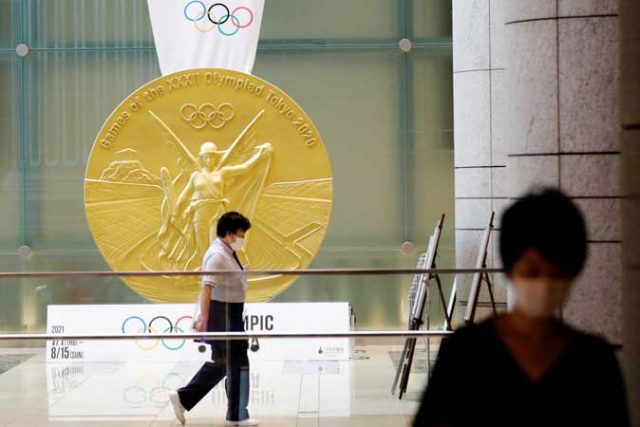
A woman walks past a large-scale reproduction of Tokyo 2020 Olympic Games medal at Nihonbashi Mitsui Tower in Tokyo, Japan, July 14. — REUTERS/KIM KYUNG-HOON

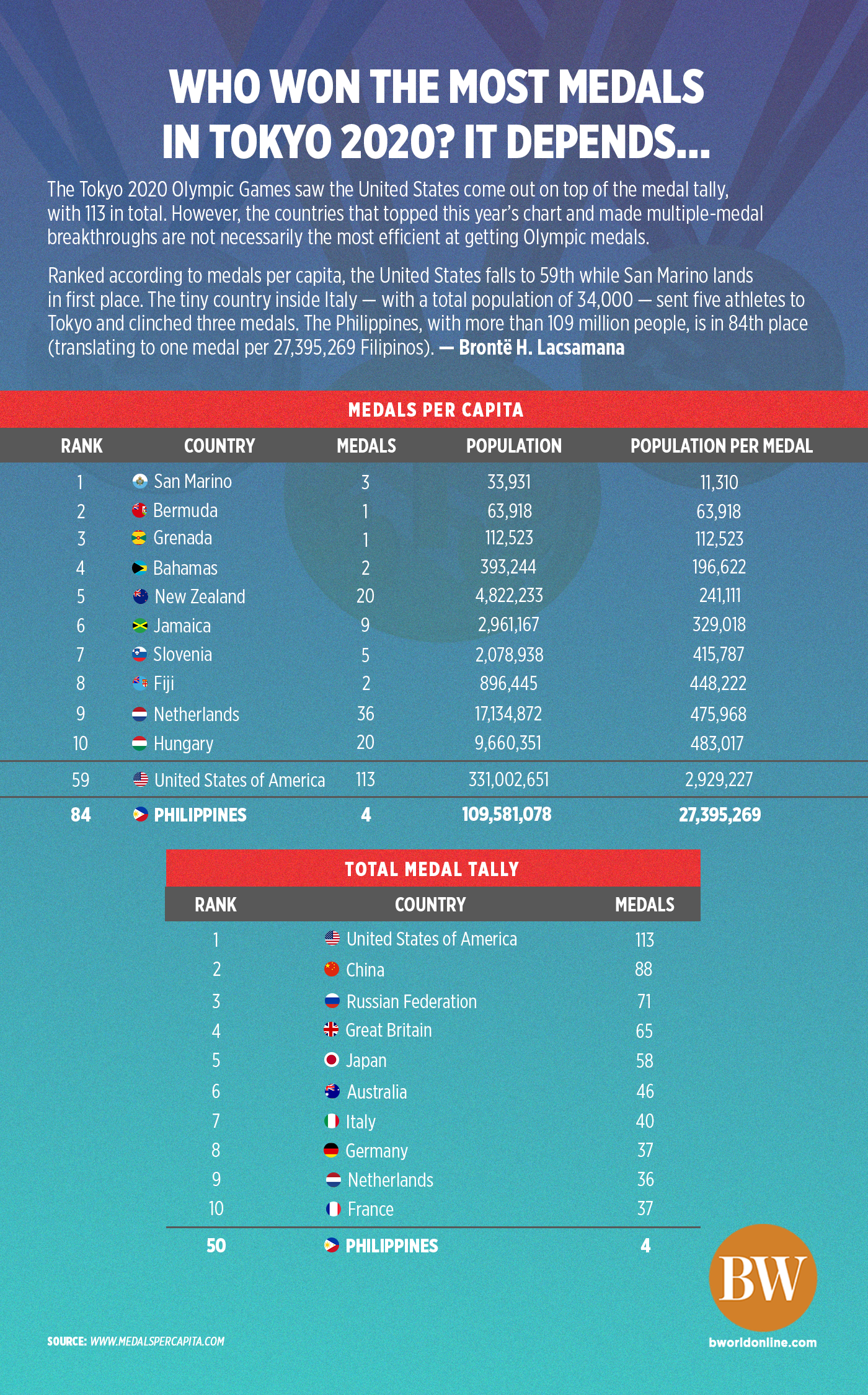
The Tokyo 2020 Olympic Games saw the United States come out on top of the medal tally, with 113 medals in total. Meanwhile, the Philippines achieved its biggest haul in history, boasting four medals that include the first-ever gold won by Hidilyn F. Diaz, and two silvers and a bronze care of the Philippine boxing team.   

However, the countries that topped this year’s chart and made multiple-medal breakthroughs are not necessarily the most efficient at getting Olympic medals.  

Ranked according to medals per capita, the United States falls to 59th while San Marino lands in first place. The tiny country inside Italy — population, 34,000 — sent five athletes to Tokyo and clinched three medals. 

Bermuda and Grenada  at second and third place, respectively  are small nations that managed one medal each. The Philippines, with more than 109 million people, is in 84th place (translating to one medal per 27,395,269 Filipinos).

Notably, the Netherlands did well in both rankings: it’s in the top 10 in terms of medals per capita and total medals with its 36-medal haul. — Brontë H. Lacsamana

Who won the most medals in Tokyo 2020? It depends...

Israeli survey finds 3rd Pfizer vaccine dose has similar side effects to 2nd

JERUSALEM — Most people who received a third dose of Pfizer Inc.’s coronavirus disease 2019 (COVID-19) vaccine felt similar or fewer side effects than they did after receiving the second shot, according to an initial survey in Israel.  

Israel began offering the booster shots about 10 days ago to people over age 60 as part of efforts to slow the spread of the highly contagious Delta variant. That effectively turned Israel into a testing ground for a third dose before approval by the US Food and Drug Administration.  

Israel’s largest healthcare provider, Clalit, said on Sunday it had administered a third dose of the Pfizer/BioNTech vaccine to more than 240,000 people.  

About 4,500 people, all of whom received the booster shot from July 30 to Aug. 1, responded to questions and were included in the survey.  

Eighty-eight percent of participants in the survey said that in the days after receiving the third shot, they felt “similar or better” to how they felt after the second shot.  

Thirty-one percent reported some side effect, the most common being soreness at the injection site.  

About 0.4% said they suffered from difficulty breathing, and 1% said they sought medical treatment due to one or more side effect.  

Ran D. Balicer, Clalit’s chief innovation officer, said that even though the results are “initial and self-reported,” they allow a comparison of side effects with the second dose, and “it turns out that in most cases they are similar or less in the booster.”  

“Although we do not yet have long-term research on the efficacy and safety of the third booster dose, for the personal risk management of any person aged 60 plus, these findings continue to point to the benefit of immunization now, along with careful behavior among adults and avoiding gathering in closed spaces,” Mr. Balicer said. — Reuters