Home Blog Page 6992

BPO Philippines: A shift to higher value services

Since the turn of the century, the outsourcing industry in the Philippines has experienced phenomenal growth as leading companies around the world have taken advantage of the high-quality/high-value BPO services provided by the country. The industry has provided good, well-paying jobs to millions of Filipinos. In addition, it has contributed to robust economic activity in the country and continues to attract global investments. However, the nature of outsourcing services is evolving, and soon BPO providers in the Philippines will need to shift their business model to providing more complex, higher-value services to remain competitive.

“Artificial intelligence (AI) is changing the game for BPO providers the world over. Simple and highly repetitive tasks, which make up the bulk of work for offshore destinations like the Philippines, will soon be almost entirely handled by AI. Many tasks are already being automated by new technologies, particularly through voice assistants that are getting smarter every year. One good example is the chatbot that responds to customer requests on a company’s website,” says Ralf Ellspermann, CEO of PITON-Global, an award-winning mid-sized BPO in the Philippines.

The continued use of AI will help companies provide the information customers need in a faster, more convenient, and cost-efficient way. Of course, the impact of this for BPO providers in the Philippines and elsewhere will be the need for much more technology-centric enterprises. To accomplish this, outsourcing vendors in the Philippines will need to upskill their BPO employees to meet this demand.

“This shift won’t happen overnight, but BPOs should start transitioning their workforce composition now. Future tasks that will be outsourced to the Philippines will very likely be more complex in nature. These will be processes that can’t easily be automated and still require human interaction. And of course, the more complex the outsourced tasks are, the fewer agents will be needed to handle them. BPO leaders need to ensure they are developing the right BPO workforces for today and tomorrow,” explains Mr. Ellspermann.

With the utilization of AI for simple, repetitive tasks, there will be an increased demand for knowledge process outsourcing (KPO). These are the kinds of tasks that are more complex and typically very specialized in nature. They require a more concentrated or technical skillset by agents, such as accounting, research, web design, and digital marketing, for example. The Philippines will face a challenge in the sense that India still maintains a stronghold on these types of high-value (non-voice) BPO and KPO services.

The Philippines does have some advantages, however; the BPO industry in the country is now mature enough to make the transition to higher-value services. The Philippines is already the worldwide leader in all voice-related outsourcing services and BPOs have begun shifting their focus onto more complex services. This involves new technologies, data analytics, and process design that can’t be easily automated. In addition, BPO providers are investing more into training their workforces on these high-value services through curricula development in colleges and in-house training initiatives.

The Philippines’ success as a BPO haven has seen it emerge as a global leader in providing value-added business processes and outsourcing services in the last twenty years. The country is ranked second overall in the world as an outsourcing destination, and number one for voice-related services. With the rise of AI however, BPO companies in the Philippines must continue their investment into training and resources to provide higher-value services. Just as machines have replaced humans in many factory settings, AI will soon supplant agents performing simple, lower-level tasks. “BPOs in the Philippines must begin preparing their workforces for this inevitability and transitioning BPO work to higher-value services that will maintain their position as a global leader into the next decade and beyond,” says Mr. Ellspermann.


Spotlight is BusinessWorld’s sponsored section that allows advertisers to amplify their brand and connect with BusinessWorld’s audience by enabling them to publish their stories directly on the BusinessWorld Web site. For more information, send an email to online@bworldonline.com.

Join us on Viber to get more updates from BusinessWorld: https://bit.ly/3hv6bLA.

Beyond customer satisfaction: Making a difference this holiday season

MyBusyBee Inc. has a long history of providing inspiring corporate social responsibility service in various parts of the Philippines since its early-founding days. In fact, its flagship foundation “Hands and Feet Good News Foundation” has been making a positive impact in the lives of Filipino children and youth since 2014.  

The foundation started as a small Saturday Kids Bible study group with just a little over 70 children. Over the past few years, the foundation has grown to reach over 200 children with the help of over 50 volunteer youth leaders ready to teach God’s word. These same youth leaders were the first beneficiaries of the HFGN foundation.

In addition to these programs, the foundation has been developing House Churches since 2016, organizing “operation tuli” or free circumcision drives since 2015, providng scholarship grants to deserving students, and during this Christmas Season, sharing gifts and noche buena packages to the children and their families . On these same house churches, the foundation conducts weekly Bible studies and sponsors junior and youth summer camps to train and develop children and parents’ God-given gifts so they can better serve their community and the church.

One of the foundation’s projects is a livelihood program for the residents of Sitio Payong, Quezon City. The foundation is facilitating dressmaking workshops with housewives and unemployed residents of Sitio Payong as its primary participants. The objective is to upskill them so they can build their own community dressmaking business or search for better opportunities to provide for their daily needs.  

More than just a tech company

“The quality of our output sets us apart from our competitors and helps us achieve our aim of constantly exceeding our clients’ expectations, which is something we take great pride in at BUSYBEE. With that comes a significant duty in terms of our philanthropic responsibilities; to be able to make a difference not just in our clients’ businesses but also in our communities. This has been a cornerstone of our firm since its inception, and the positive influence our foundation has on the lives of these individuals is what I believe distinguishes us.” Said BUSYBEE Founder Rico Hernandez. 

With HFGN Foundation as its partner in service, MyBusybee, Inc. has become more confident that its efforts really help change lives. 

Join Hands and Feet Goods News Foundation and BUSYBEE in spreading the word of God while providing an impact to underprivileged communities across the Philippines.  To know more about their activities, log on to hgf.org.ph


Spotlight is BusinessWorld’s sponsored section that allows advertisers to amplify their brand and connect with BusinessWorld’s audience by enabling them to publish their stories directly on the BusinessWorld Web site. For more information, send an email to online@bworldonline.com.

Join us on Viber to get more updates from BusinessWorld: https://bit.ly/3hv6bLA.

Why keep a nasal spray like Vicks First Defence handy for early intervention of a common cold?

For the first signs of a cold, early intervention is key.

A common occurrence, catching a cold can happen anywhere at any time. And in this new normal, sensing the chances or risks of getting one may tend to raise uneasiness within yourself and the people surrounding you. Early intervention may be helpful to stop the first signs of a cold from becoming a full blown cold — and this can come in nasal sprays.

A nasal spray is a handy solution when initial symptoms of a common cold appear like that of a tickly nose or scratchy throat. When such discomfort arises at home, the office, while traveling, or being in close contact with someone experiencing colds, a nasal spray can be used to serve as your early intervention, thus making it worth keeping at hand anytime, anywhere.

Having understood our need for a handy comfort from common cold concerns, Vicks brings its new, clinically proven nasal spray Vicks First Defence that can help stop a cold in its tracks when used at first signs.

Being a handy nasal spray, Vicks First Defence can fit right in your bag pockets or pouches and is ready to help ease your concerns when you feel the first signs of a cold or when you’re at risk such as having someone in the household infected with a cold, or when at a crowded place like that of public transports. It is also an ideal medical device for people who keep health essentials for themselves and their families at all times.

Vicks First Defence has a microgel technology that would target and help trap the common cold viruses developing at the back of your nose. The microgel has a pH of 3.5 which helps inactivate the viruses and remove them by contributing to a nasal washout effect to flush them through the nose or down to the stomach.

Use Vicks First Defence at the early signs and exposure to common colds. Insert the nozzle into your nostril and incline the nozzle outward the direction of your ear. Do not inhale or tilt your head backward while pumping.

You can apply two to three sprays per nostril up to four times a day. Keep in mind, however, to use up to four days only if no symptoms develop. When symptoms develop, use until they subside.

Make sure to have a science-backed intervention kept within your reach to aid in defending you against developing a full-blown cold.

Vicks First Defence is available in all leading drugstores and supermarkets nationwide!

You may also buy Vicks First Defence online: Watsons Website, Watsons Lazada, or Watsons Shopee

Always read the label. Follow the directions for use.
Vicks First Defence is not a cure or treatment against COVID-19 and its symptoms.

If symptoms persist, consult your doctor.
ASC Reference Code: P046P121721VS


References:

  1. (2005) Satellite Symposium Logopedics Phoniatics Vocology, 30:supl, 41-47
  2. Giranda VI, Heinz Ba, Oliveira Ma, Minor I, Kim Kh, Kolatcar Pr, Rossmann Mg. Rueckert Rr. (1992) Acid-induced Structural Changes in Human Rhinovirus 14: Possible Role in Uncoating, Proc NatlAcad Sci Usa, 89(21):10213-17.
  3. Retrieved November 11, 2021 from https://www.everydayhealth.com/ear-nose-throat/nasal-sprays.aspx; Online source medically reviewed by Pat F. Bass III, MD, MPH
  4. Mayo Clinic Staff. (2019). Nasal congestion. Retrieved November 11, 2021 from https://www.healthline.com/health/nasal-congestion
  5. Retrieved November 11, 2021 from https://www.webmd.com/cold-and-flu/cold-guide/decongestants-antihistamines-cold
  6. Retrieved November 11, 2021 from https://www.cdc.gov/antibiotic-use/colds.html


Spotlight is BusinessWorld’s sponsored section that allows advertisers to amplify their brand and connect with BusinessWorld’s audience by enabling them to publish their stories directly on the BusinessWorld Web site. For more information, send an email to online@bworldonline.com.

Join us on Viber to get more updates from BusinessWorld: https://bit.ly/3hv6bLA.

Six regions now under state of calamity

Siargao is one of the areas most affected by typhoon Rai, locally known as Odette. This photo is taken by the national disaster response team of the Philippine Red Cross. COURTESY OF THE PHILIPPINE RED CROSS FACEBOOK PAGE

By Kyle Aristophere T. Atienza, Reporter

PHILIPPINE President Rodrigo R. Duterte placed six regions devastated by Typhoon Rai under a state of calamity, in order to expedite aid to the affected areas.

The declaration will hasten the relief and rehabilitation efforts of the government and the private sector, Mr. Duterte told a taped Cabinet meeting aired on Tuesday night.

He said this will also effectively control the prices of goods and commodities in the areas, where supplies have dwindled due to the widespread devastation.

Western Visayas, Central Visayas, Eastern Visayas, Mimaropa (Mindoro, Marinduque, Romblon, Palawan), Northern Mindanao and Caraga Administrative Region have been placed under state of calamity.

Cabinet Secretary Karlo Alexei B. Nograles said Mr. Duterte only declared a state of calamity in the six regions on Tuesday because he waited for the assessment of the damage caused by Rai, locally known as Odette.

“Before the declaration, we need to have a full assessment of the extent of damage done by the typhoon,” Mr. Nograles said at a televised news briefing on Wednesday.

As of Wednesday, the government estimated that damage to infrastructure reached P585.8 million, while agriculture damage and losses hit P2.6 billion.

Several local governments affected by the typhoon were allowed to declare a state of calamity “within their jurisdiction” even without the President’s order, he added.

Budget Undersecretary Tina Rose Marie Canda said at the same briefing that at least P6 billion of the P10-billion typhoon response funds promised by Mr. Duterte in his meeting with the Cabinet on Tuesday night would come from the proposed P5.024-trillion national budget for 2022.

It will be “available in a couple of days once the GAA or the General Appropriations Act is signed for 2022,” she said.

Ms. Canda said P2 billion of the P10-billion promised funds are already available under the government’s calamity fund, while another P2 billion would come from the President’s contingency fund.

Meanwhile, the President reiterated his earlier claim that pandemic response efforts have already depleted public coffers.

“I am really worried because, let me be frank to the public, our money here in the Philippines is depleted, even coping up with the growing expenses for the typhoon victims,” Mr. Duterte said at the Tuesday meeting.

Mr. Nograles clarified in his regular news conference that the government still has money to spend for the pandemic response and Typhoon Odette.

“When the President made those statements, it was, remember, in the context of informing the Filipino nation, our fellow Filipinos that we really faced a lot of challenges in terms of pandemic response, and we have spent a lot for it,” he said.

STATE OF CALAMITY
The Philippine Disaster Risk Reduction and Management Act defines a state of calamity as “a condition involving mass casualty and/or major damage to property, disruption of means of livelihoods, roads and normal way of life of people in the affected areas as a result of the occurrence of natural or human-induced hazard.”

The declaration allows authorities to impose price caps on basic and prime commodities and mandates them to stop overpricing, profiteering and hoarding of food, medicines and fuel.

Whenever there is a declaration of a state of calamity or emergency, prices of basic necessities shall be placed under automatic price control at their prevailing prices for 60 days or until “lifted sooner by the President,” according to Republic Act No. 7581.

The law defines the prevailing price as “the average price at which any basic necessity has been sold in a given time within a month from the occurrence” of any calamity or emergency.

“This would help temper the temporary spike in inflation until supplies start to normalize in the coming weeks,” Michael L. Ricafort, chief economist at Rizal Commercial Banking Corp., said in a Viber message.

Arthur Yap, governor of Bohol in central Philippines, earlier said there have been small-scale looting incidents in his province amid growing hunger. He warned that the incidents could worsen if hunger is not addressed.

“Partly, the expeditious deployment of relief goods, with more funds and price controls, would fundamentally address these,” Mr. Ricafort said.

He said the declaration would also help expedite the release of insurance claims on damaged properties and justify the release of various calamity loans and assistance offered by government instrumentalities, including its controlled corporations and financial institutions, to individuals and businesses.

Mr. Ricafort said if the government would be able to conduct reparation and rehabilitation activities in calamity-stricken areas there might be “some pickup” in the country’s fourth-quarter growth.

“The declaration of the state of calamity would mitigate the adverse economic impact of Typhoon Odette’s storm damage and would help expedite recovery/reconstruction/rebuilding activities,” he said, noting that the declaration would allow the government to tap its calamity funds.

“Faster pace of restoration activities in areas hit by the storm would ironically add to economic activities,” Mr. Ricafort said. “That would entail additional spending by the private sector and the government.”

Deadliest & costliest typhoons in the Philippines (so far)

Cebu’s IT-BPM companies struggle in Odette aftermath; daily losses at P500 million

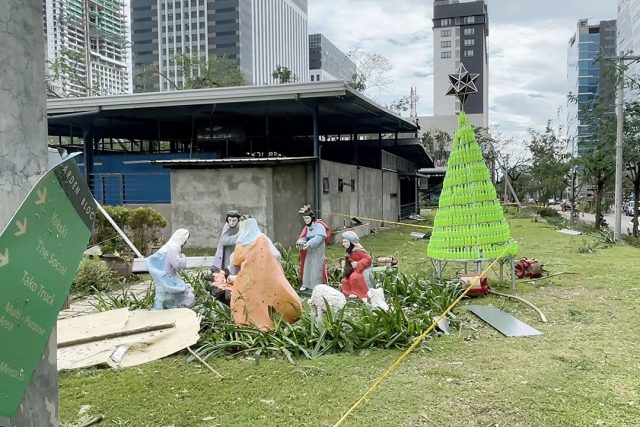
A view of the nativity scene in a typhoon-damaged garden in Cebu City, Philippines Dec. 17, 2021 in this still image taken from social media video. @MARCELO_GRAM VIA REUTERS

By Arjay L. Balinbin, Senior Reporter

MANY Cebu-based information technology and business process management (IT-BPM) firms have been badly affected by typhoon Rai (local name: Odette), an industry leader said on Wednesday, adding that estimated losses are at P500 million a day due to the inability to operate.

“I would say that 80% of the IT-BPM companies are down. Because during the pandemic we’ve been working on a work-from-home model, and this model is the biggest victim of Odette this time,” Cebu IT-BPM Organization (CIB.O) President Exuperto P. Cabataña told BusinessWorld in a phone interview.

He said more than 250 IT-BPM companies in the province are concentrated in the highly urbanized cities of Cebu, Mandaue and Lapu-Lapu, which all experienced heavy damage due to the typhoon. Around 75% to 80% of these companies have adopted the work-from-home setup.

“The houses have no power and if there’s no power, even if there’s signal, they cannot communicate or use the internet,” Mr. Cabataña said. “The internet is also intermittent, so it’s very, very bad.”

Most IT-BPM firms adopted the work-from-home model to cope with the pandemic. “The pandemic did not really affect us in terms of revenue or growth, because we were able to continue operating despite the pandemic,” he added.

The typhoon slammed into the Philippines on Dec. 16 and left the country on Dec. 18, killing nearly 400 people and affecting 1.8 million, displacing 630,000 of them, according to the United Nations Office for the Coordination of Humanitarian Affairs.

Meanwhile, the lone business process outsourcing company in Siargao is transporting its employees back to the main cities, as many of the city’s facilities have been destroyed and power restoration is expected to take months.

Callbox’s villas in Siargao, where the typhoon made its first landfall, were destroyed, affecting more than a hundred employees.

“These workers are from different places such as Cebu, Dumaguete, and Davao, while some are locals,” Callbox Siargao Manager Carl M. Biaoco said in a phone interview.

“The third floor of our building, which is still unfinished, was totally wrecked. Some of our computers were still in the villas, five villas with 10 to 20 computers each, and they were all damaged,” he added.

He said the non-local workers will be offered to relocate to other Callbox branches, such as those in Iloilo and Davao.

“Our problem now is that the locals can’t leave their place, and we can’t offer a work-from-home arrangement because the network is still down. According to some engineers we’ve spoken with, the restoration of electricity could take six to eight months,” Mr. Biaoco also said.

In Cebu, Mr. Cabataña said that prior to the typhoon, the IT-BPM workers were already preparing to return to their offices.

“We were actually starting to actually work on going back to the office. I told NEDA (National Economic and Development Authority) that 75% [of the workers] were expected to go back to the office, while only around 20% would continue to work from anywhere; but while we were preparing to go back to the office, this Odette happened, destroying the facilities,” he said.

He also noted that many of the business process outsourcing companies have their own generator sets, but they are facing challenges in securing enough fuel as they wait for electricity to be restored.

“There’s no real shortage of fuel. I can say it’s an artificial shortage. It’s just that people are panic-buying and hoarding,” he said.

Water supply is also another big challenge for their operation. “In my case, what I do is I buy water from a water refilling station for our employees,” Mr. Cabataña said.

For the province’s recovery, he suggested that the government take a “sharp-shooting approach” rather than a “shotgun approach.”

“If the objective is to minimize revenue loss and to recover very quickly, we can actually allocate attention that is more focused on the business districts by making sure that telcos are working, there’s 100% power, there’s 100% fuel and 100% water,” Mr. Cabataña said.

“It’s for the business to continue working while the rest of the island is being fixed, because ang nangyayari there’s a tendency to shotgun, or trying to fix everything all at once,” he added.

WB approves $300-M PHL loan for vaccines

PHILIPPINE STAR/ MICHAEL VARCAS
A health worker shows vials of the Pfizer vaccine at the Marikina Sports Center on Nov. 16. — PHILIPPINE STAR/ MICHAEL VARCAS

THE World Bank (WB) on Wednesday announced that it approved a new $300-million loan to help fund the Philippine government’s coronavirus disease 2019 (COVID-19) vaccine rollout, amid the threat from the new Omicron variant. 

The new loan covers about 27 million COVID-19 vaccine doses, including booster shots for adults and jabs for minors aged 12 to 17.

“Fair, broad, and fast access to effective and safe COVID-19 vaccines is vital to save lives and strengthen economic recovery,” World Bank Country Director for Brunei, Malaysia, Philippines and Thailand Ndiamé Diop said in a press release.

“This funding operation is critical for the country to safely reopen the economy and resume economic and social development activities, including face-to-face learning, that were disrupted by the COVID-19 pandemic.”

Booster doses will be used for at-risk groups like immunocompromised individuals and senior citizens, along with health workers and the wider population, the multilateral lender said.

The loan could also finance vaccines for children under 12, once approved by the regulator.

Over 40% of Filipinos have been fully vaccinated against COVID-19, the Johns Hopkins University tracker showed. The government aims to fully vaccinate 54 million people by the end of this year.

The Philippine government is ramping up its vaccine rollout amid a surge in Omicron cases in many countries. According to the World Health Organization, Omicron is causing infections to double in 1.5 to 3 days.

The Health department on Tuesday said adults can now receive a booster shot at least three months after the second shot of a two-dose vaccine, from six months previously. Those who received a single-dose vaccine can get a booster shot after two months.

Vaccine czar Carlito G. Galvez, Jr. last month said the government plans to start vaccinating children aged 5 to 11 in January next year.

“The five-year old shots are not yet approved here in the Philippines, but we are already ready to buy it as soon as it gets approved,” Finance Secretary Carlos G. Dominguez III said at a press briefing last week.

Mr. Diop said negotiating supply agreements ahead of the scale up of vaccination efforts next year is a “step in the right direction” for the Philippines, noting a supplier-driven global vaccine market that creates uncertainties for low- and middle-income countries.

The World Bank in April last year extended a $100-million loan to help support public health responses to the pandemic and another $500 million in March 2021 to fund the initial vaccine rollout.

The newly approved loan is one of several multilateral funds that will be used to buy vaccine boosters and doses for children.

The Asian Infrastructure Investment Bank last week also approved a $250-million loan to help the Philippines buy more coronavirus vaccines. South Korea has also granted the Philippines a $100-million loan to support its vaccination program.

The government borrowed $23.4 billion from foreign sources to fund its pandemic response from March 2020 to Dec. 7, 2021, Mr. Dominguez said. Of the total, $21 billion covers the decline in government revenue collections, while the rest was set for COVID-19 response and recovery projects, including vaccine procurement. — Jenina P. Ibañez

RRR cuts still on the table

By Luz Wendy T. Noble, Reporter

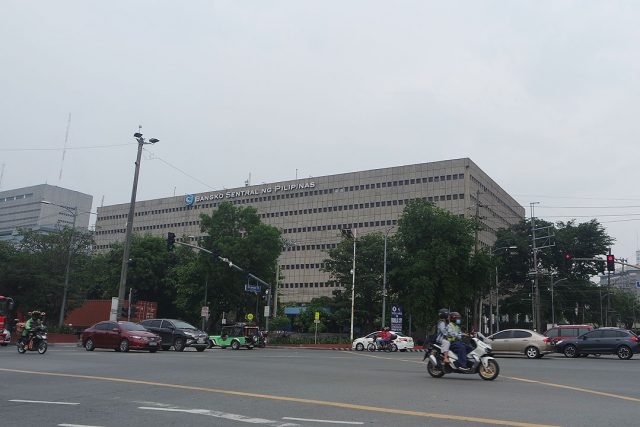
THERE is still room to reduce the reserve requirement ratio (RRR) of big banks to achieve the Bangko Sentral ng Pilipinas’ (BSP) goal to bring this down to a single digit by 2023, officials said.

“Further adjustments on the RRR remain on the table, depending on domestic liquidity and recovery in credit demand in the coming months,” BSP Deputy Governor Francisco G. Dakila, Jr. said in at online briefing on Dec. 16.

It was in 2020 when the central bank last reduced the RRR of lenders — by 200 basis points for big banks in April and another 100 bps for thrift and rural banks in July.

The RRR for big banks is currently at 12%, one of the highest in the region. Reserve requirements for thrift and rural lenders are at 3% and 2%, respectively.

“The gradual buildup in the volume of issuance of BSP securities will also support efforts to align RR ratios with the region by allowing liquidity absorption using auction-based monetary operations,” Mr. Dakila said.

The central bank has started offering BSP securities in September 2020. The one-month bills, together with the term deposits, are the central bank’s tools used to mop up excess liquidity in the financial system and guide market interest rates.

BSP Governor Benjamin E. Diokno said the central bank has already infused liquidity worth more than P2 trillion into the financial system through these measures during the pandemic.

Security Bank Corp. Chief Economist Robert Dan J. Roces said the next RRR cut may be done when there is already stable growth, which may be seen by the second half of 2022.

“As activities strengthen, domestic liquidity could slowly get sapped enabling BSP to cut RRR to support easing liquidity,” Mr. Roces said in a Viber message.

UnionBank of the Philippines Chief Economist Ruben Carlo O. Asuncion said the central bank will consider the financial system’s need for liquidity and macroeconomic recovery in determining the timing for the next RRR cut.

“If fourth-quarter gross domestic product comes out better than expected, we may expect the RRR cut sooner rather than later,” Mr. Asuncion said in a Viber message.

Prior to the pandemic, Mr. Diokno vowed they will slash the RRR to a single digit to make the reserve requirements for the local banking industry at par with its regional neighbors.

Haus Talk prices IPO shares at P1.50 apiece

BW FILE PHOTO

By Keren Concepcion G. Valmonte, Reporter

RESIDENTIAL developer Haus Talk, Inc. has priced its initial public offering (IPO) shares at its ceiling of P1.50 apiece, the company said in a letter to the exchange on Wednesday.

“This may be a sign of optimism, given the better market sentiment amid the COVID-19 (coronavirus disease 2019) cases in the country remaining low over the past few weeks,” Timson Securities, Inc. Trader Darren Blaine T. Pangan said in a Viber message. 

With the P1.50 per share price tag, the company may raise up to P750 million from the sale of 500 million primary common shares.

In its preliminary prospectus dated Dec. 14, Haus Talk said it plans to use net proceeds “to bolster its growth” through land acquisitions and project development. The company also plans to use proceeds for general corporate purposes.

Haus Talk will be allocating 64% of the proceeds or P462 million to acquire properties in Antipolo City, Bacoor in Cavite, and Calasiao in Pangasinan. It plans to develop the properties from 2022 to 2024.

“In the case of the land acquisition activities of the Company amounting to an estimated value of [P640 million], the difference between the estimated value and allocation of proceeds amounting to P462,014,575, will be sourced from internally generated funds and debt,” the company said.

Meanwhile, Haus Talk plans to use 30% or P216.58 million to develop its 240,647-square meter (sq.m.) property in Mariveles, Bataan. The company is eyeing to build a 2,200-unit horizontal socialized housing project, which is expected to bring in P2.8 billion in revenues. 

“The project will be developed in three phases, with each phase commencing within the first three years of disbursement. The P216.58 million will be split among the land development, construction, and administration expenses of the project,” Haus Talk said.

Haus Talk is also allocating 6% or P45.10 million of net proceeds to acquire equipment and to hire “executive-level talents,” which include heads of finance, information and technology, investor relations, audit and risk management, and human resource.

According to the Dec. 14 prospectus, the company plans to conduct its offer period from Jan. 3 to 7 next year, while its listing at the small, medium, and emerging (SME) board of the Philippine Stock Exchange (PSE) is tentatively scheduled for Jan. 17.

Haus Talk is slated to be the first company to debut at the PSE next year. It will list under the stock symbol “HTI.”

“With the offer period scheduled next year, this may give investors enough time to decide on their subscriptions given the upcoming holidays,” Mr. Pangan said.

Haus Talk tapped the Investment & Capital Corp. of the Philippines to be the offer’s underwriter and issue manager.

SMIC registers P15-billion fixed-rate bonds

THE Securities and Exchange Commission (SEC) said it received on Wednesday the registration statement of SM Investments Corp. (SMIC) for a P15-billion fixed-rate bond offering.

SMIC is planning to offer P10-billion fixed-rate bonds with a P5-billion oversubscription option. The offer will consist of Series I bonds due in 2025 and Series J Bonds due in 2027.

This will be the second tranche from the company’s P30-billion shelf-registered debt securities program. SMIC issued the P10-billion initial tranche in October last year.

Proceeds from the P15-billion fixed-rate bond issuance will be used to refinance its existing debt obligations as well as for general corporate purposes.

According to SMIC’s offer supplement, the company aims to issue its Series I and Series J bonds in February 2022. The bonds will be listed at the Philippine Dealing & Exchange Corp.

SMIC tapped BDO Capital & Investment Corp. and China Bank Capital Corp. as joint issue managers of the offer.

BDO Capital and China Bank Capital will be joined by BPI Capital Corp., EastWest Banking Corp., First Metro Investment Corp., RCBC Capital Corp., and SB Capital Corp. as joint bookrunners and joint lead underwriters.

On Wednesday, shares of SMIC at the stock market closed 2.88% or P28 lower to end at P943 each. — Keren Concepcion G. Valmonte

A milky Christmas

CATHEDRAL WINDOW

POPULAR YouTube chef Ryan Morales Reyes (otherwise known as Ninong Ry, with 1.25 million subscribers) entertained guests at a webinar last week called Shume-chef with Nestlé Carnation. The canned milk brand used the opportunity to launch its new formulation of evaporated milk (called “Evap” on the label and in many households as such), with more milk and in a new easy-to-open box package.

Jero Jhocson, Ground Brand Manager of Nestle Dairy Culinary said, “With this new product, we truly believe that anyone can be a home chef.” The brand also introduced a recipe via a new commercial, played during the webinar, which showed a mother cooking “Braised Chicken in Milky Glaze” —  a take on the familiar chicken pastel. (More recipes are available on https://cookwithcarnation.ph/)

Mr. Reyes is popular for his down-home approach, appearing like a favorite (and slightly rude) relative while whipping up quite tasty dishes on his YouTube channel, which debuted last year.

Ang ninong, nagtatago talaga iyan’ pag pasko, eh (Godfathers usually hide during Christmas),” he said during the webinar. He made the dish in the commercial, chicken pastel, peppering it with his signature attitude. “Ang sikreto lang naman talaga sa paglelevel-up sa mga masarap nating lutuin ay, una — cook with love talaga (The secret, really, to level up our cooking is to, really, cook with love),” he said. “Pagmamahal ang isa sa pinaka-importanteng ingredients ng pagluluto natin (Love is one of the most important ingredients in our cooking).”

But then, he says, “Siempre, gagamit tayo lagi ng high-quality ingredients (Of course, we should always use high-quality ingredients).”

Turning the cap on the box of milk, he said, “Wala nang can opener needed. Hindi kayo pwersadong ubusin (You don’t need a can opener anymore. You’re not forced to finish the can).”

Mr. Reyes gave a few tips on preparing the chicken quarter: one, to look for the joint to cut it more easily, bend the chicken to hear a sound, then cut where you hear the sound. “Madali lang siya. Hindi niyo kailangang ma-pressure (It’s easy. There’s no need to be pressured).”

He seared the chicken in butter after sprinkling it with Magic Sarap (flavor granules from Maggi) and freshly ground pepper. After searing, he sauted this in onion and garlic: “Sa mga nagtatanong kung anong dapat unahin — sibuyas o bawang —  pagsabayain na natin para walang magtanong (To those who are asking which should go first — onion or garlic – let’s just put them at the same time so nobody asks any questions).”

He then added some of the Nestle Carnation Evap: “Mas marami, mas milky, mas masarap (more, milkier, tastier).” After adding his potatoes, he poured even more milk, then remarked at the easy-open cap: “O kita niyo? Hindi ko naubos. Takpan natin. (See? I didn’t finish it. Let’s cover it).”

After finishing this dish, Mr. Reyes also prepared a dessert, Cathedral Window (colored gelatin squares in a milky white gelatin base). Jokes aside, he was asked if he liked preparing main dishes or desserts more. He said that he liked preparing savories more. “Ramdam mo yung init. I feel like, that way… mas connected ako sa pagkain, and kapag connected ako sa pagkain, connected ako doon sa taong pinapakain ko (You feel the warmth. I feel like that way… I’m more connected to the food, and when I’m connected to the food, I’m connected to the person I’m feeding).”

After that, he asked for a sash and crown for his pageant-style answer. — JLG


BRAISED CHICKEN IN MILKY GLAZE

Ingredients

1 kg chicken leg and thigh

2 sachets Maggi Magic Sarap

3 tbsp butter

1 head garlic, minced

1 pc large onion, chopped

1 pc potato, diced

1 pc small carrot, diced

1 pc Chorizo de Bilbao, sliced

1 small can whole button mushroom, rinsed and quartered

2 tbsp all-purpose flour

2 cups water

½ cup Nestle Carnation Evap

12 pcs quail eggs, boiled and peeled

¼ cup green peas, frozen

Directions

Season chicken with 1 sachet of Maggi Magic Sarap. Lightly sauté chicken in butter. Remove and set aside.

Sauté garlic, onion, potato, carrot, chorizo and mushroom in the same pan.

Add flour and cook for 2 minutes while stirring. Pour water and bring to simmer. Add chicken and cook for 15 minutes.

Season with remaining sachet of Maggi Magic Sarap. Stir in Nestle Carnation Evap, quail eggs and green peas. Transfer to a serving plate and serve.

CATHEDRAL WINDOW

Ingredients

Gelatin Squares in different colors

For White gelatin:

1 tbsp unflavored gulaman (gelatin) powder

1 cup water

1 tsp vanilla extract

1 pack Nestle Carnation Evap 250 ml

2/3 cup Nestle Carnation Condensada

Directions

To prepare milk mixture, combine gulaman powder, water, Nestle Carnation Evap, Nestle Carnation Condensada and vanilla extract. Gently simmer. Pour half of the mixture into the cathedral mold. Scatter diced red, green and yellow gulaman. Pour the rest of the milk mixture. Set aside to cool for 15 minutes. Refrigerate overnight to set. Dip the cathedral mold in warm water for 10 seconds. Unmold into a plate and serve.

Ahanmisi, Alaska Milk dominate skidding Blackwater Bossing

AHANMISI tallied 17 points, 8 rebounds, and 2 assists to lead Alaska over Blackwater. — PBA IMAGE

By Olmin Leyba

GAMES ON SATURDAY
(Smart Araneta Coliseum)
4 p.m. – NLEX vs Phoenix
6:45 p.m. – Ginebra vs. Magnolia

MAKING the most of the opportunity against a long-skidding opponent, Alaska Milk steamrolled Blackwater, 98-75, to regain traction in the 46th Philippine Basketball Association (PBA) Governors’ Cup on Wednesday at the Smart Araneta Coliseum.

Skipper Maverick Ahanmisi took charge with 17 points plus eight rebounds as the Aces arrested a two-game slump and improved to 3-2 in a game that was essentially an all-Filipino battle with both imports playing sparingly due to injuries.

Alaska’s Olu Ashaolu strained his calf and managed to score 10 in 22 minutes while Blackwater’s Jaylen Bond, bothered by groin injury, posted two in what could possibly be his farewell outing for the Bossing (0-5).

Jeron Teng added 14 while Rob Herndon and former Blackwater Mike Tolomia chipped in 12 apiece for Jeff Cariaso’s squad, which bounced back from heartbreaking losses to Barangay Ginebra (80-77) and TNT (81-77).

“We felt those two were winnable games so going into this game, we just focused on the intangibles and not committing many turnovers,” said Mr. Cariaso.

“Just staying hungry, staying focused, and playing within what we do and we believe good things will happen to us.”

Mr. Cariaso added they made sure they had the right mentality in the clash with the Bossing, who were determined to snap a long-standing 23-game losing streak prior to Wednesday’s matchup.

“We used an analogy of playing against your older brother in one-on-one pickup all your life. There’s always one time when you’re going to beat your older brother so we focused on making sure that tonight, that doesn’t happen to us,” he said. “I think perspective played a big part in understanding that they (Bossing) are gonna be ready to play.”

A limping Mr. Ashaolu exited the game in the third quarter and Mr. Cariaso is praying he will recover fully in time for the Aces next assignment after the holidays.

The Aces unleashed a 17-7 second-quarter closeout to establish initial separation from the Bossing, 50-43.

Further tightening the defensive screws after the break, the Aces held Blackwater to only 17 points in the third quarter on a 29.4% clip and enjoyed a 20-point lead at one point.

They later widened the gap to as many as 26 at 92-66 before settling for a 23-point winning margin.

SEC revokes registration of iWATCH.PH

THE Securities and Exchange Commission (SEC) has revoked the registration statement of iWATCH.PH Corp. for its unlicensed investment solicitation activities similar to a “pyramid scheme.”

The SEC released two advisories against the entity earlier this year. In April, the regulator warned that the investment program of iWATCH.PH has “the characteristics of a pyramid scheme.” The SEC released another advisory in Filipino the following month.

“iWATCH.PH’s employment of executive soaps as its products is nothing but a smokescreen to ostensibly make it appear that it is involved in selling consumer products,” the SEC said in an order of revocation dated Dec. 13.

“The fact of the matter is that it is offering the opportunity to earn profits by investing in its investor-recruitment business in the guise of selling product packages,” it added.

The SEC noted that the entity describes itself on its website as an “online business that gives Filipinos a lifetime reason to earn in 20 different ways and with multiple features, giving them no excuses to have nothing coming in to have a greater life even further.”

“The company also posted pictures of its registration from different government agencies and claimed that its operation is legitimate,” the regulator said.

Investors have to pay a membership fee of P2,188 before getting the opportunity to earn as an “iWatcher.” 

The entity is luring investors to earn through its avail package, direct referral bonus, leadership bonus, salesmatch bonus, maintenance bonus, repeat direct referral bonus, and unilevel bonus, among others.

While iWATCH.PH was registered with the commission on Dec. 10, 2018 under company registration number CS201842541, it did not have the secondary license to sell or offer securities to the public.

iWATCH.PH requested the SEC to lift its advisory against the entity in April. However, the SEC’s Enforcement and Investor Protection Department (EIPD) informed the entity that it “is not inclined to favorably recommend the approval of its request to lift the advisory.” 

The EIPD also required iWATCH.PH to submit the company’s audited financial statements and income tax return in the previous years, as well as copies of its contracts or agreements.

The regulator also requested a detailed explanation of how investors earn in the company’s program as well as a Food and Drug Administration certificate of approval for its products.

The SEC met with iWATCH.PH’s counsel in June, where the company’s representative discussed its marketing scheme and its business model.

In July, the SEC issued a show-cause order against iWATCH.PH and its stockholders-directors-incorporators, including Reiner Cadiz, Mark Joseph Regalario, Jerome Joseph Operio, Norman Galanza, and Rex Panganiban Regalario.

The company and the persons involved replied to the SEC’s show-cause order and denied that it is engaged in a pyramid scheme. It explained that “the customer or distributor earnings are not dependent on the number of recruits, rather, it is based on the perseverance and hard work in performing [the] avenues of earning.”

The SEC denied iWATCH.PH’s settlement offers twice. In November, the regulator denied the settlement offer as “the company has failed to raise any substantial argument that would warrant the lifting of the advisory and to accept the offer.”

BusinessWorld tried to reach out to iWATCH.PH’s main office through the number listed on its website for comment; however, the number could not be reached. Mr. Operio and Mr. Regalario have yet to respond to BusinessWorld’s request for a statement via Facebook Messenger as of press time. — Keren Concepcion G. Valmonte