Home Blog Page 6915

Pharmally tax deficiency at P6.3B, other red flags raised by accounting consultant

CONTROVERSIAL Pharmally Pharmaceutical Corp. has a tax deficiency of P6.3 billion, according to a certified public accountant invited by the blue ribbon committee for a probe on the alleged overpricing of pandemic health supplies sold by the company to the government.

During a committee hearing Thursday, accountant Raymond A. Abrea, who works as a Bureau of Internal Revenue (BIR) consultant, also said that the company had P7.3 billion in unsupported purchases, meaning there are no documents proving its validity under the country’s tax code. 

Mr. Abrea reviewed Pharmally’s audited financial statements and other documents submitted by different agencies. 

He also pointed out a P1.3-billion undeclared sales in 2020 and purchases worth P3.9 billion that were disallowed from value-added tax exemption.

The accountant also flagged the company’s major suppliers, which documents showed were new firms registered in the same month as Pharmally in 2019.

“We also did not see any documents proving they are legitimate suppliers as they did not have records based on what BIR has submitted,” Mr. Abrea said in a mix of English and Filipino. 

“Based on the documents, what’s being revealed is that there are no legitimate suppliers,” he said. — Alyssa Nicole O. Tan 

Marawi residents, leaders continue push for compensation bill passage 

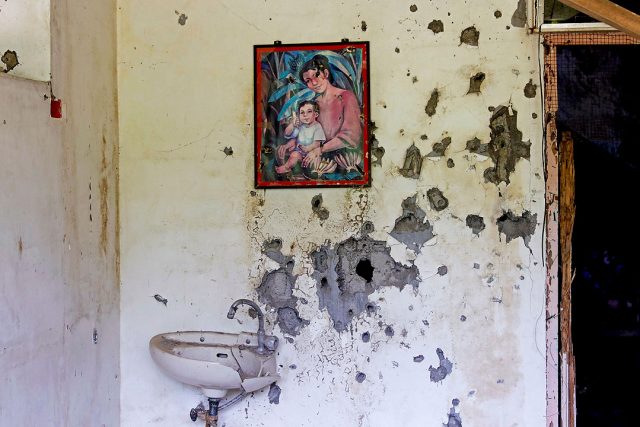
A PAINTING of a mother and child hangs on a wall at a bullet-riddled structure in Marawi City in this photo taken May 2019. — REUTERS

A PROPOSED measure that will give Marawi City residents monetary compensation for properties destroyed during the 2017 siege is a step closer to becoming a law after Wednesday’s approval by the Senate on second reading. 

Senate bill 2420 or the Marawi Siege Victims Compensation Act, which consolidates two bills as well as the House of Representatives’ version, is now up for final reading and approval before transmission for the President’s review and signature.

Under the bill, claims may be made for residential, cultural, commercial and other properties such as home appliances, jewelries and equipment that were affected during the five-month heavy firefight between government forces and extremist groups who laid siege on the city. 

The measure covers 32 barangays or villages, including 24 located in what is referred to as the MAA or main affected areas. 

“The approval of Senate Bill 2420… is the government’s recognition of its obligation to rebuild the lives and bring back the dignity of more than 300,000 Marawi siege victims and correct its failure to protect its citizens during the siege,” multi-stakeholder group Marawi Reconstruction Conflict Watch said in a statement on Thursday. 

“The passage of the Bill on second reading is a major step towards this recognition,” it said. 

House Deputy Speaker Mujiv S. Hataman, among the authors of the House version, said he is hopeful that the measure will keep moving and be signed into law. 

“It has been five years since the Marawi Siege in 2017, and until now many of our people there have yet to go back home, have not rebuilt their businesses, and yet to recover from the nightmare of the battle,” Mr. Hataman said in a statement in Filipino.

The compensation will be tax-free for legitimate owners or their legal heirs as provided for in the Code of Muslim Personal Laws of the Philippines or the Civil Code of the Philippines. 

The amount will be assessed based on “the current market value of the land and the replacement cost of structures and improvements therein,” the bill states. 

Assessment will be undertaken by a government financial institution with adequate experience in property appraisal, or an independent property appraiser or group of appraisers accredited by the Philippine central bank. 

Implementation of the law will be led by a nine-member board, whose chairman and members will be appointed by the President. Traditional leaders within the Bangsamoro region, professionals, and civil society organizations may submit nominations.

Funding for the compensation will be sourced from the current year’s National Disaster Risk Reduction and Management Fund, specifically the budget for the Marawi Recovery, Rehabilitation and Reconstruction Program. Future payments will be included in the annual national budget. 

“(We) reiterate and emphasize our call to push through with the bill’s passage on the third and final reading before the Congress session adjourns next week… We also call on the House of Representatives to proactively support the bill’s swift passage and for President (Rodrigo R.) Duterte to urgently sign this bill into law,” Marawi Reconstruction Conflict Watch said. — MSJ

Ong appointed new Court of Appeals associate justice

SUPREME COURT PIO
SUPREME COURT PIO

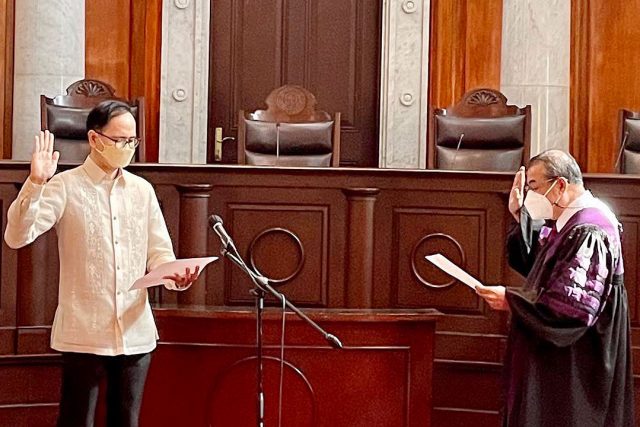
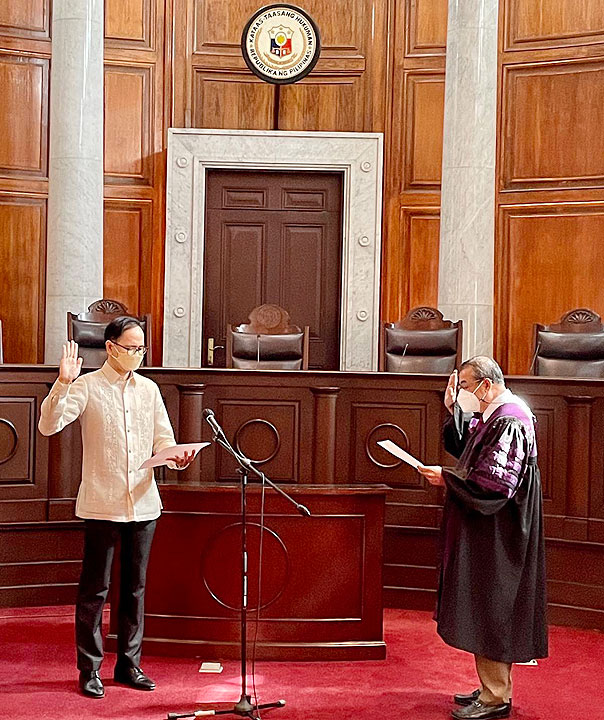
PRESIDENT Rodrigo R. Duterte has appointed Michael P. Ong, who used to work at the Office of the President as senior deputy executive secretary for legal affairs, as the newest member of the Court of Appeals on Thursday.

Mr. Ong will replace Justice Samuel H. Gaerlan, who was appointed to the Supreme Court (SC) in Jan. 2020. 

The appointment paper was dated May 20, 2020 but was only marked as received by the High Court on Wednesday.

Mr. Ong took his oath before SC Chief Justice Alexander G. Gesmundo Thursday morning.

The newly appointed appellate court judge is a graduate of the University of the Philippines College of Law.

He was an assistant secretary under the Office of the Deputy Executive Secretary for Legal Affairs during the late President Benigno S.C. Aquino III’s administration. — John Victor D. Ordonez

Privacy commission pursuing other leads on alleged Comelec hacking

THE NATIONAL Privacy Commission (NPC) said on Thursday that it is pursuing other leads on the alleged hacking and data breach of the Commission on Elections’ (Comelec) servers. 

“Rest assured we are continuing the investigation to determine if personal data was compromised, violations of the Republic Act No. 10173 or the Data Privacy Act were committed, and the responsible individual or group for this incident,” Privacy Commissioner John Henry D. Naga said in a statement. 

The commission said it is looking into a group of hackers claiming responsibility for the hack, while a third-party provider of Comelec possibly involved in the issue has been summoned to appear in a clarificatory hearing. 

NPC held separate clarificatory meetings on Jan. 25 with representatives of Comelec and daily broadsheet Manila Bulletin, which first reported about the alleged hacking and data breach. 

Comelec denied that the database of overseas voters was compromised, according to NPC.

The poll body explained that while a list of overseas voters is made publicly available on their website as mandated by law, this data has yet to be generated for the elections in May. 

“On the topic of their full incident report, Comelec sought for extension of time to submit the approved report. NPC issued a subsequent order reiterating to the Comelec to submit said incident report and provide answers to the clarificatory questions stated in the order dated Jan. 21, 2022,” NPC said. 

Comelec was given until Jan. 27 to send the report.

In a separate meeting, NPC said Manila Bulletin confirmed that the artifacts gathered by the commission are the same ones that were the basis of their published report. — Revin Mikhael D. Ochave 

Coalition against disinformation

FREEPIK

The other day, the broadsheets reported the relaunch of a fact-checking alliance with broader planks of membership and goals. Twenty-three academic institutions, media organizations, and civil society groups decided to come together again, more of them this time, as “a coalition to combat disinformation in the 2022 elections.”

This revitalized coalition alliance which calls itself Tsek.ph was birthed in time for the mid-term elections in 2019. It now includes academic partners such as the Asian Center for Journalism at the Ateneo de Manila University, Colegio de San Juan de Letran, Trinity University of Asia Communication Department, University of the Philippines Los Baños, the UP Department of Journalism’s Fact Check Patrol and FactRakers, and the University of Santo Tomas Journalism Program.

The media partners are ABS-CBN, Baguio Chronicle, DZUP, FYT, Interaksyon, MindaNews, PhilStar Global, Philippine Press Institute, Press One, Probe and VERA Files. The civil society organization partners are Akademiya at Bayan Kontra Disimpormasyon at Dayaan (ABKD), BarangayHub, Fact Check Philippines, and the Philippine Association for Media and Information Literacy (PAMIL).

This initiative could not be more needed than today.

We are going into the most important electoral exercise in which we shall elect the next set of leaders, particularly the President of the Republic, who will lead the nation for the next six years. With our past experience with corruption and plunder during the Marcos years, and the failure of leadership during the pandemic years 2020 and 2021, electing the right candidate is the best means to secure our nation’s destiny.

But we cannot properly exercise this right of suffrage if our basis is only twisted facts and outright lies that we might have ingested from social media. Our basis for choice should not be loathsome fake news but upright fact-checked information. Only justice should be blindfolded.

The Filipino electorate should have the facility to fact check those ludicrous claims in social media before embracing them as facts to guide us in our May 2022 decision. Tsek.ph promises to be a partner in combatting election-related disinformation by re-organizing itself with more adherents and leveraging on their expertise and commitment.

UP’s Dr. Elena E. Pernia was spot on when she described the initiative as vital and necessary, especially at this time when an enlightened Filipino citizenry “is key to our elections.”

The initiative is not a small one, definitely a cut above Leo Tolstoy’s “anything is better than lies and deceit.” For if the initiative gains some traction, and those in power are held accountable and our vibrant democracy is protected, then people are able to “make decisions freely based on correct information,” as ABS-CBN’s Ging Reyes would have wished.

Reputable fact checking is not going to be a walk in the park.

The task is awesome. As UP Mass Communications’ Rachel Khan explained: “Since 2019, disinformation has multiplied exponentially especially during the pandemic, with everybody dependent on social media for news and information.”

In fact, for some candidates, they have been reportedly preparing for their presidential campaigns with disinformation for the last five years, creating in the process a core of die-hards who could not know any better because they have no alternative truth to turn to. Some of them are too young to know or to remember what happened during martial law, or to realize that based on documented data, there were 3,257 extrajudicial killings, 35,000 tortures, 77 disappearances, and 70,000 incarcerations.

It is sad that even some of those in the AB group could not come around to the fact that the Supreme Court and other courts in the Philippines have already ruled on stolen wealth and tax evasion. For instance, it would be a great resource for Tsek.ph to refer to the case Republic of the Philippines v. Sandiganbayan penned by Justice Renato C. Corona which forfeited $658 million owned by Ferdinand and Imelda Marcos in favor of the Philippine Government.

As we wrote a couple of columns ago, this money was kept in multiple layers of front foundations and organizations. The High Court ruled the amount was not in proportion to the “known lawful income of the (Marcos couple from 1965-1985) since they did not file any Statement of Assets and Liabilities, as required by law, from which their net worth could be determined.” Their lawful income only totaled $304,372.43. Anything above this was considered ill-gotten.

Other Supreme Court rulings which forfeited assets and other properties held by Marcos’ cronies also confirmed that the Marcos years, were not quite the golden years of the Philippines, were actually under a “well entrenched plundering regime of 20 years.”

Even Congress passed a law providing for reparation and recognition of victims of human rights violations during the Marcos regime. Tsek.ph should be familiar with Republic Act No. 10368, approved on Feb. 25, 2013, where it was declared that it is state policy to “recognize the heroism and sacrifices of all Filipinos who were victims of summary execution, torture, enforced or involuntary disappearance and other gross human rights violations committed during the regime of former President Ferdinand E. Marcos covering the period from Sept. 21, 1972 to Feb. 25, 1986 and restore the victims’ honor and dignity.”

Anyone who denies the rulings of the High Court and the acts of Congress is either ignorant, or he simply rejects the truth. He should be rejected in the polls.

Tsek.ph commits to verify and fact-check various election issues namely, candidates’ platforms and campaign promises; election-related statements and remarks; and election-related posts on social media and other online platforms. Perhaps, the coalition may also wish to validate the candidates’ educational attainment, experience in the various branches of government or in the private sector, and even the sponsorship of bills in Congress, or the projects the candidates claim to be their initiatives.

Will Tsek.ph disclose their findings on social media or in the traditional press?

Based on their agreement, the members of the alliance will conduct their own respective fact-checking initiatives. The findings and other data will be pooled with the Tsek.ph secretariat. This is like building up a common data warehouse where answers to questions of fact can be drawn by different entities responding to the same question with the same uniform answer for fact-checked consistency.

The task will be made simpler by having five ratings in classifying claims: accurate (demonstrably factual); false (demonstrably contrary to available facts); misleading (gives a vague/different impression); no basis (cannot be verified or fact-checked); and needs context (requires more facts or clarification).

How President Duterte’s threat “to reveal faults of presidentiables” will play out with this modality of classification will be most interesting. He claimed that except for one, all the presidentiables have unpleasant issues ranging from corruption, qualification, truthfulness, entitlement, and even intelligence.

Tsek.ph commits to leverage on its experience during the 2019 mid-term elections that familiarized them with the insidious techniques of conveying lurid disinformation not on a weekly basis, but on a more grueling daily basis.

By involving each of the institutions in the coalition, Tsek.ph hopes to mobilize them precisely for flushing out disinformation and, more important, preparing them for lobbying against it by including disinformation and media literacy courses in the academe. To make fact-checking almost a more engaging, more normal activity, Tsek.ph will endeavor to shift from text-based to more interactive mode. After all, it is easier to tell the truth than to twist facts and deceive people.

Will Tsek.ph. allocate a column in the entry based on those five classifications of claims to identify their source so that in the future, when another claim comes from the same source, our algorithm will kick in and raise a red flag?

How to disabuse civil society about disinformation is no different from the reply of Michelangelo to the Pope who asked him how he created David’s statue. “It’s simple. I removed everything that is not David.”


Diwa C. Guinigundo is the former deputy governor for the Monetary and Economics Sector, the Bangko Sentral ng Pilipinas (BSP). He served the BSP for 41 years. In 2001-2003, he was alternate executive director at the International Monetary Fund in Washington, DC. He is the senior pastor of the Fullness of Christ International Ministries in Mandaluyong.


Marcos slogans are just tactics, but…

WWW.FACEBOOK.COM/BONGBONGMARCOS

It was no surprise, and should have been expected. Ferdinand Marcos, Jr. not only expressed his unqualified support for the NTF-ELCAC during a campaign sortie in his family’s Ilocos domain. He also pledged to increase its current P17-billion budget should he be elected President this May.

The National Task Force to End Local Communist Armed Conflict (NTF-ELCAC) is the principal military component of the “whole of nation” counter-insurgency strategy of the Duterte regime.

In November 2021, Marcos Jr. opposed the reduction of its budget which was being proposed by some senators who were justifiably concerned over the often-lethal consequences of its labeling of legal workers, farmers, womens, and youth organizations as communist “fronts” and their activist members as NPA guerillas or Communist Party functionaries. He argued that it might compromise the government campaign against the insurgency.

Never mind his echoing in the same breath the contradiction between the generals’ claim that the insurgency is no longer a serious threat to the ruling system and their expectations of, and demands for, a bigger counter-insurgency budget to quell it.

It made sense for him to support one of the military’s most cherished programs, not only because it was its guns and bayonets that enabled his father, Ferdinand Sr., to install himself as dictator and kept him in Malacañang for 13 more years (1973-1986) after his term as President was supposed to end. It was also because he, too, will need its support should he make it to the Presidency this year.

If elected President, expect his policies in such areas as dealing with social unrest and the armed social movements to be influenced and shaped by the military’s perspectives and interests. Among other consequences, it will mean the persistence and worsening of the human rights crisis that has constricted what little remains of what passes for democracy in the Philippines.

His pandering to the military is also driven by the logic of its having been, since 1972, and no thanks to his late dictator father, a major power broker in Philippine politics whose support is crucial to any candidate for President and to any regime in power. Vice-President Maria Leonor “Leni” Robredo is equally aware of the latter fact, hence her also expressing her support for the NTF-ELCAC. But she did say that its powers should not be abused.

No such reservation fell from Marcos’ lips despite a number of social and political activists in his northern Luzon turf, who are armed only with their advocacies and the courage of their convictions, being “red-tagged,” threatened and harassed, and even forced to “surrender” as NPA guerillas by government agents.

But that, too, was as predictable as the sun’s setting in the West. Marcos, after all, cannot be expected to depart from his late father’s far right view that repression rather than reform would halt the rebellions, social protest, and disaffection with government that have been endemic in these isles since the Spanish colonial period.

What is not exactly expected, however, is the implication in his campaign slogans that he is in agreement with the view that is rapidly gaining ground among the citizenry despite the efforts of regime trolls and its hacks in print and broadcast media that the country is far from being the earthly paradise the Duterte regime, its bureaucrats, and its apologists claim it to be.

Marcos Jr. describes himself as a “unifying leader.” That specious claim presumes that it is such a President the country currently needs. It implies that the present Duterte dispensation is not a unifying one and has been severely divisive. It also flies in the face of the regime’s triumphalism over the results of the surveys that show overwhelming approval for Mr. Duterte and company, which suggests mass unity behind and support for how Mr. Duterte has been running the country during the last five-and-a-half years of his troubled and troubling term of office.

Marcos’ appropriating his father’s 1965 “This nation can be great again” campaign slogan is equally telling. It reminds his northern base of Ferdinand Sr.’s fabled oratorical skills, but ironically also recalls that those times when this country was indeed great include not only the defeat of Spanish colonial forces by the armies of the Katipunan. This nation was also universally cheered for overthrowing the Marcos Sr. dictatorship in 1986 and forcing him and his family into exile. But it is in effect also saying, again in contradiction of regime claims, that the country has yet to reach that desired goal: the “greatness” that in so many words the power elite, the big bureaucrats, the trolls, and Mr. Duterte’s cohorts are saying the Philippines has achieved under his watch.

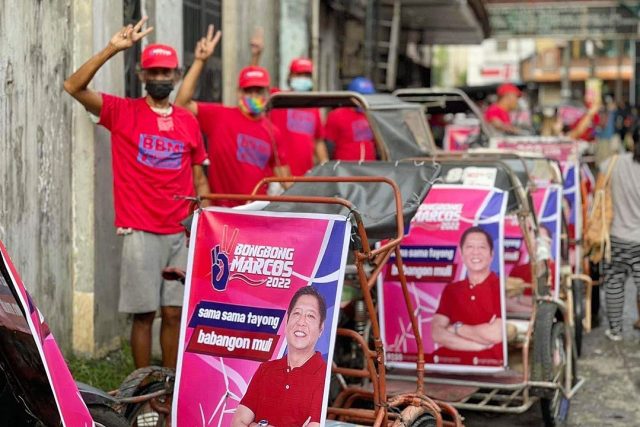
Another of Marcos Jr.’s campaign slogans is similarly if only indirectly critical of the regime of his Vice-Presidential running mate’s own father. His “together we can rise again” (sama-sama tayong babangon muli) slogan is based on the premise that the entire nation is prostrate, down and nearly out, and needs rescuing from — what else? — the current administration.

Together with Mr. Duterte’s less than charitable assessment of Marcos Jr.’s character and leadership qualities, these departures from the regime’s view of things help explain the former’s refusal to explicitly endorse his candidacy despite his alliance with Sara Duterte.

But what are we to make of all this? Does it mean that a Marcos II administration will not be halfway as bad as many think it will be, given his disagreement with some of the dearest assumptions of the President he hopes to succeed?

Not necessarily. If there is anything the electorate should have learned by now, the candidates for office in this country, or at least most of them, will promise and say anything to get elected. Marcos is merely being realistic in his implied criticism of the current regime, the incompetence and corruption of which are far, far too much in evidence to be denied by anyone with an IQ higher than that of a door knob’s.

By doing so he is trying to cover all the bases, including tapping into the simmering though silent resentment that the regime’s failings have generated among an increasingly disaffected because long-suffering populace.

What matters more than the promises of candidates is their track record, their background, and the interests behind them as well as their own that they are likely to protect and advance once they are in office. Mr. Duterte’s own failure to make good on such of his 2016 promises as authentic change and an end to corruption and the drug problem is instructive. Promises can either be forgotten because insincerely made, or else prevented from fulfillment by unfavorable circumstances, by sheer incompetence, lack of will, or other factors.

But we can assume in Marcos Jr.’s case that his promised support for the NTF-ELCAC is the one thing he is likely to be true to if he wins power, given what he has learned from his father’s military-dependent rule and his own awareness of how crucial military support can be to the survival of any regime.

Mr. Duterte and company may detest his take on the present state of the country they have been running into the ground since 2016. What Marcos Jr. is doing is just tactics. He may not even be aware of the implicit messages in his slogans. But they could resonate enough among his supporters and those critical of the Duterte regime to drive a wedge into the Marcos/Duterte/Estrada/Macapagal-Arroyo Axis.


Luis V. Teodoro is on Facebook and Twitter (@luisteodoro).

www.luisteodoro.com

Economic stagnation, de-industrialization, and lockdown in the Philippines

The Philippines’ GDP growth of 5.6% in 2021 looks good considering that we experienced a deep contraction of -9.6% in 2020. But is this growth really good?

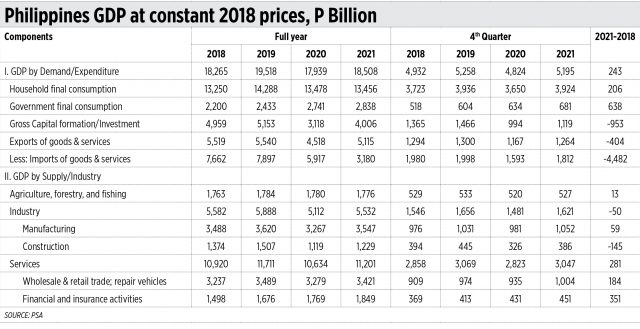
The quick answer is “No.” We look at actual values of production of goods and services, not just percentage changes, and data from the excel file of the Philippine Statistics Authority (PSA) show that 2021 GDP numbers are more comparable with 2018 than 2019 levels.

One, GDP size in 2021 of P18.5 trillion is way below the 2019 level of P19.5 trillion, and slightly higher than the 2018 level of P18.3 trillion. That is nearly three years of production backwardness despite the Philippine population expanding by about 4.5 million people in those three years.

Two, household consumption, which comprises about 73% of total GDP, has expanded only by P206 billion from 2018 to 2021. Consumer confidence remains weak and muted.

Three, government consumption, which comprise about 13% of GDP, has expanded by P638 billion or three times the GDP level. Government was giving out more subsidies, paying in full the salaries, allowances, and bonuses of government personnel while joblessness in the private sector is high.

Four, capital formation or investments, which comprise about 25% of GDP, has declined big time, by nearly P1 trillion. Many businesses went bankrupt, many planned investments did not push through.

Five, imports of goods and services declined big time at nearly P4.5 trillion.

Six, in the GDP by supply or industry contributions, agriculture and fishery, which comprise about 10% of GDP, has flat output from 2018-2021.

Seven, considering the industry sector that comprises 30% of GDP, we have de-industrialized by P50 billion the past three years. While there was a modest increase in manufacturing output, construction output has declined by P145 billion.

Eight, the services sector that comprises the remaining 60% of GDP has increased by only P281 billion; banking, insurance and e-money services have increased by P351 billion.

The continued economic stagnation and business uncertainties were created by the government’s indefinite lockdown policy, exacerbated by its vaccine discrimination and segregation policy, a soft or implicit kind of mandatory vaccination.

Indefinite lockdown and vax discrimination do not work in reducing COVID-19 cases and deaths as shown by the record-high level of cases in late December to January 2022. Lockdowns and vax discrimination only work at reducing economic activities and people’s livelihood.

The IATF (Inter-Agency Task Force for the Management of Emerging Infectious Diseases) should lift all lockdowns, or at least reduce the mobility Alert Levels 2 and 3 to Level 1. Starting Feb. 1, next week.


Bienvenido S. Oplas, Jr. is the president of Minimal Government Thinkers.

minimalgovernment@gmail.com

Mandatory vaccination: Mad, bad, and just plain wrong

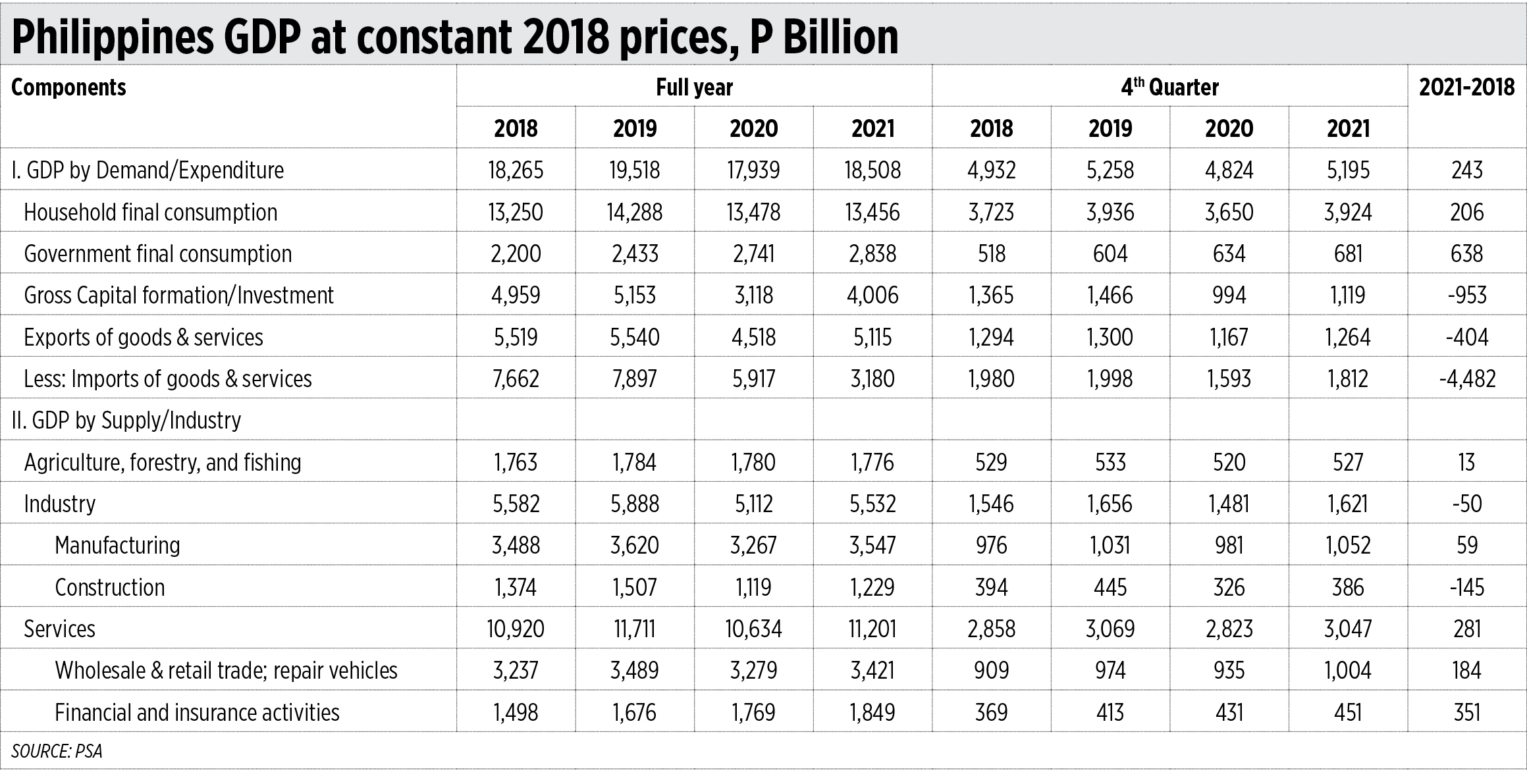
A MEMBER of Gising Maharlika Freedom fighters is doused with water by firemen during their protest at Liwasang Bonifacio in Manila last Jan. 11. The group calls to stop mandatory vaccination by the government as it affects their livelihood and mobility. — PHILIPPINE STAR/MICHAEL VARCAS

Early this week, a national official argued for the constitutionality of mandatory vaccination by referring to a provision of the 1917 Administrative Code, as well as a 1936 Supreme Court ruling. But as is usual with arguments in support of mandatory vaccination, they are just ghastly and appallingly wrong.

The Supreme Court case in question was People vs. Abad Lopez (G.R. No. L-42199), involving a physician who certified his children as “vaccinated” and thus (he argued) no longer in need of vaccination, basing his contention on Section 1054 of the 1917 Administrative Code. The crucial provisions of the said Code for this case are as follows:

“Sec. 2694. Failure of person in charge of child to present same for vaccination. — Any parent, guardian, or other person, having charge of any child over one month old who shall fail to present the same for vaccination, as required by law, or who shall fail to return any such child to the vaccinating officer for vaccination of the effect of the operation, or for later vaccination, as the case may be, shall be fined P10 for each offenses.”

“Sec. 1054. Persons liable to vaccination. — Every person in the Philippine Islands shall submit to vaccination when thereunto lawfully required, unless he shall furnish satisfactory evidence either by a certificate from a physician or vaccinator, or otherwise, to effect that he is immune from the disease of smallpox. Such vaccination shall be performed gratis.”

The 7-4 decision (as there were 11 members of the Court at that time) led to the upholding of the conviction of Dr. Jose Abad Lopez, with the ponente (Justice John Adley Hull) making a reference to the US Supreme Court case of Jacobsen vs. Massachusetts.

But the crucial thing here is that by simply making a general reliance on Jacobsen, the Court fallaciously assumed that “the right of the State to compel compulsory vaccination is well established” and thus the constitutionality of the abovementioned provisions of the Administrative Code was “not put in question in these proceedings.”

The issue instead was simply the proper interpretation of the aforementioned two 1917 Administrative Code provisions, for which Justice Claro Recto’s dissent was the correct one: If a person “can produce such certificate, his obligation to present himself for vaccination ends.”

In any event, would the provision mandating vaccination against smallpox be constitutional? Perhaps. But saying so will not justify or make proper any present vaccination mandate against COVID-19.

Note that the Jacobsen case did not actually involve mandatory vaccination (as one can get out of the vaccination merely by paying a $5 fine). And both Abad Lopez and Jacobsen cases involved smallpox, which was a disease with a case fatality rate of 30%. Smallpox killed 500 million people in the last 100 years. This despite there being a vaccine (invented in 1796). Incidentally, the 1918-1919 Spanish Flu pandemic killed 50 million worldwide and has a case fatality rate (cfr) of 2.5%. COVID-19 (the supposed deadliest virus of all time, as COVID narcissists say) is being shown to have a cfr from between 0.9 – 2% (Philippine cfr hovers around 1.5% to 1.8%). To equate COVID with smallpox is plain ridiculous.

And even then, the 1917 Administrative Code does not really absolutely compel people to be vaccinated. A person can choose to be unvaccinated if one can “furnish satisfactory evidence either by a certificate from a physician or vaccinator, or otherwise, to the effect that he is immune from the disease of smallpox.” Otherwise, like in the Jacobsen case, one need only pay a fine (in this case, P10).

And an important point was made in the Abad Lopez case, and that is that questions like these are “for the legislature … to determine.” Thus, by extension, not the IATF (Inter-Agency Task Force for the Management of Emerging Infectious Diseases) or MMDA (Metro Manila Development Authority). And note that the 1917 Administrative Code was replaced by the 1987 Administrative Code, which removed and thus contains NO provision on mandatory vaccination. Statutory construction indicates this as legislative rejection of mandatory vaccination.

This rejection is supported by the fact that NO law exists requiring mandatory vaccination. The now expired Bayanihan Acts I and II, particularly the latter (RA 11494), even punishes acts of discrimination done against any person in relation to COVID measures. Any person (public or private) that discriminates can be imprisoned for six months and fined P100,000.

Neither RA 11332 (“Mandatory Reporting of Notifiable Diseases and Health Events of Public Health Concern Act”) nor the Local Government Code authorizes the IATF or any government body to enforce mandatory vaccination.

RA 11525 (“COVID-19 Vaccination Program Act of 2021”), Sec. 12, also makes clear that vaccination cards cannot be made a requirement for government or business transactions and declares that vaccinated individuals shall “not be considered immune from COVID-19.”

As things stand, by dint of present constitutional and international law jurisprudence, Philippine legislation, and the science surrounding COVID-19, mandatory vaccination is completely unjustified, totally unreasonable, and downright wrong.


Jemy Gatdula is a senior fellow of the Philippine Council for Foreign Relations and a Philippine Judicial Academy law lecturer for constitutional philosophy and jurisprudence

https://www.facebook.com/jigatdula/

Twitter@jemygatdula

China struggles to find zero-COVID policy off-ramp

REUTERS

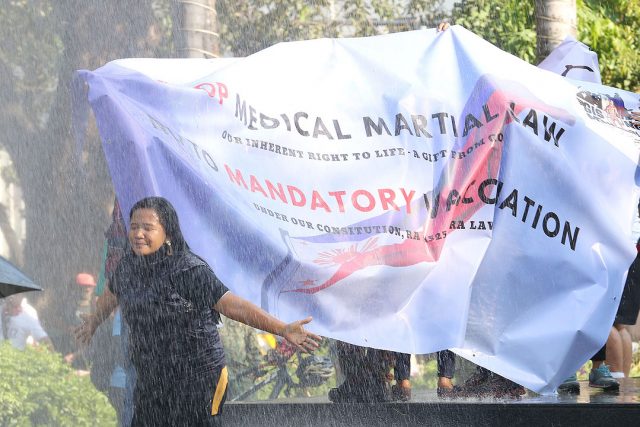
SHANGHAI — China’s “zero-COVID” stance has put it at odds with the rest of the world and is exacting a mounting economic toll, but an exit strategy remains elusive as authorities worry about the ability of the healthcare system to cope and adapt to new strains.

Chinese medical experts believed last year that higher vaccination rates would eventually allow China to relax tough rules on movement and testing as infection rates slow elsewhere.

The emergence of the highly transmissible Omicron variant dashed those hopes.

While some analysts have branded China’s approach as “unsustainable”, many local health experts — and some from overseas — say the country has no choice but to continue given its less developed health system.

Some even argue China’s economy could even emerge stronger than ever if it keeps Omicron at bay.

“For a large country with a population of 1.4 billion, it must be said that the cost effectiveness of our country’s prevention and control has been extremely high,” said Liang Wannian, head of the expert epidemic prevention group at China’s National Health Commission, at a Saturday briefing.

Kristalina Georgieva, managing director of the International Monetary Fund, called on China last week to “reassess” its approach, saying it had now become a “burden” on both the Chinese and global economies.

But China is concerned the cost of lowering its defenses could prove even higher, especially with a healthcare system that has lagged its broader development.

“With a large population and high density the government is rightly concerned about impacts for the spread of the virus,” said Jaya Dantas, professor of international health at the Curtin School of Population Health in Perth, Australia.

China had 4.7 million registered nurses at the end of 2020, or 3.35 per 1,000 people, official data showed. The United States has around 3 million — around 9 per 1,000.

China is also wary of the risk of new variants, especially as it refuses to import foreign vaccines. Studies suggest China’s vaccines are less effective against Omicron and it has not yet rolled out its own mRNA version.

Wu Zunyou, chief epidemiologist at the Chinese Center For Disease Control and Prevention, warned the “insidious” Omicron could still lead to a rise in the absolute number of deaths even if it was proven to be less deadly, and China must remain patient.

“China’s medical capacity and standards are not as good as Britain or the United States, but the results of China’s coronavirus prevention and control are far, far superior,” he said in a weekend interview with the Beijing News.

‘PREMATURE OPTIMISM’
China has stepped up its health warnings, urging citizens to ignore claims that Omicron is no more serious than the ‘flu and to stay vigilant.

On Wednesday, the Global Times, published by the official People’s Daily, also lashed out at overseas media for “mocking” China’s policies, saying they saved lives.

Foreign criticism was “based on unfounded or premature optimism regarding the end of the pandemic”, it added.

Experts in China and overseas have also cast doubt on the hope that Omicron represents the final stage of the pandemic.

“SARS-CoV-2 will not magically turn into a malaria-like endemic infection where levels stay constant for long periods,” said Raina MacIntyre, head of the Biosecurity Research Programme at the University of New South Wales’ Kirby Institute.

“It will keep causing epidemic waves, driven by waning vaccine immunity, new variants that escape vaccine protection, unvaccinated pockets, births and migration,” she told Reuters.

END-GAME
China’s economy is expected to slow as a result of COVID related supply disruptions, while lockdowns to douse domestic outbreaks weigh on travel and consumption.

Hong Kong’s “zero-COVID” approach has put the Chinese-controlled city out of step with other global finance centers and is battering its economy.

Still, China’s economy has remained resilient, with GDP growth at 8.1% last year, far exceeding expectations.

Ms. MacIntyre of the Kirby Institute said it wasn’t a “binary choice” between opening up and remaining isolated, adding there was “no need to surrender to the virus, as Australia is doing at the moment.”

China could still emerge from the crisis in the strongest position, especially if COVID leads to widespread cognitive impairment, organ damage and other long-term conditions in other countries, she said.

“If China keeps the virus largely under control, their population will be fit and healthy into the future, while the United States and Europe will be groaning under an unprecedented burden of chronic disease.” — Reuters

N.Korea fires 2 missiles in latest testing frenzy

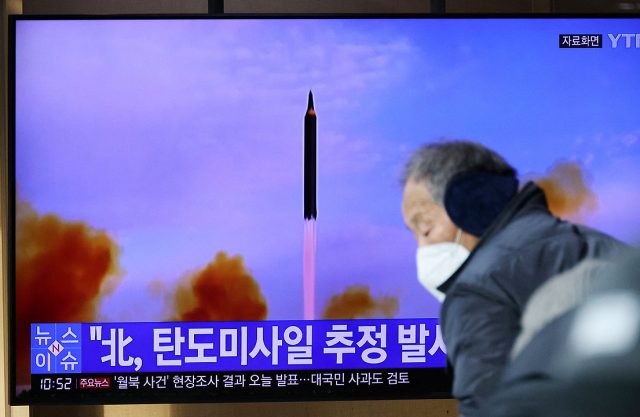
PEOPLE watch a TV broadcasting file footage of a news report on North Korea firing a ballistic missile off its east coast, in Seoul, South Korea, Jan. 5. — REUTERS

SEOUL — Nuclear-armed North Korea fired what appeared to be two short-range ballistic missiles into the sea off its east coast on Thursday, South Korea’s military said, in the sixth round of missile tests this month.

It is among the most missiles ever launched by North Korea in a month, analysts said, as it began 2022 with a display of a dizzying array of new and operational weapons.

South Korea’s Joint Chiefs of Staff (JCS)said it had detected the launch of what it presumed were two ballistic missiles at about 8 a.m. from near Hamhung, on North Korea’s east coast. They traveled for about 190 km to a maximum altitude of 20 km, JCS said.

The suspected missiles appeared to have landed outside Japan’s exclusive economic zone, Japanese Defense Minister Nobuo Kishi told reporters.

Japanese Prime Minister Fumio Kishida said the government was gathering details on the launches but any tests of ballistic missiles were “deeply regrettable” and violated U.N. Security Council resolutions.

The US government condemned the missile tests, a Department of State spokesperson said in a written statement, calling the launches a violation of multiple U.N. Security Council resolutions.

North Korea said this month it would bolster its defenses against the United States and consider resuming “all temporally suspended activities”, an apparent reference to a self-imposed moratorium on tests of nuclear weapons and long-range missiles.

On Tuesday, North Korea fired two cruise missiles into the sea off its east coast, South Korea’s military said, amid rising tension over its series of weapons tests.

Earlier in the month, North Korea tested tactical guided missiles, two “hypersonic missiles” capable of high speed and maneuvering after lift-off, and a railway-borne missile system.

“The (Kim Jong Un) regime is developing an impressive diversity of offensive weapons despite limited resources and serious economic challenges,” said Leif-Eric Easley, an international affairs professor at Ewha University in Seoul.

Certain tests aim to develop new capabilities, especially for evading missile defenses, while other launches are intended to demonstrate the readiness and versatility of missile forces that North Korea has already deployed, he added.

“Some observers have suggested that the Kim regime’s frequent launches are a cry for attention, but Pyongyang is running hard in what it perceives as an arms race with Seoul,” Easley said.

In a speech to the U.N.-sponsored Conference on Disarmament on Tuesday, North Korea’s Ambassador to the United Nations in Geneva, Han Tae Song, accused the United States of staging hundreds of “joint war drills” while shipping high-tech offensive military equipment into South Korea and nuclear strategic weapons into the region.

“(This) is seriously threatening the security of our state,” Han said.

The series of missile tests has drawn condemnation from governments in the United States and Japan and sparked meetings of the United Nations Security Council, which has sanctioned North Korea for violating resolutions that ban ballistic missile tests.

US President Joseph R. Biden’s administration sanctioned several North Korean and Russian individuals and entities this month on accusations they were helping North Korea’s weapons programs, but China and Russia delayed a U.S. bid to impose U.N. sanctions on five North Koreans.

On Wednesday, US Deputy Assistant Secretary of State for Japan and Korea Mark Lambert said that Washington has “no reservations” about talking with North Korea and is willing to meet anywhere and talk about anything.

“We have to have a serious discussion about the denuclearization of North Korea, and if North Korea is willing to do that, all sorts of promising things can happen,” he said during a webinar hosted by the Washington-based Center for Strategic and International Studies.

North Korea has defended its missile tests as its sovereign right for self-defense, and said the US sanctions proved that even as Washington proposes talks, it maintains a “hostile” policy toward Pyongyang.

“The recent test-firing of new types of weapons was part of activities for carrying out a medium- and long-term plan for development of national science,” Han said in his speech on Tuesday. “And it does not pose any threat or damage to the security of neighboring countries and the region.” — Reuters

Healthy gut bacteria may protect during COVID

THE BACTERIA living in your small intestine may contribute to the risk for long coronavirus disease 2019 (COVID-19) after infection with SARS-CoV-2, new findings suggest.

Researchers analyzed the “gut microbiome” in 116 COVID-19 patients in Hong Kong in 2020, when regulations required that every infected person be hospitalized. More than 80% were mildly or moderately ill, but more than 75% had at least one persistent symptom.

After six months, the most common symptoms were fatigue (reported by 31%), poor memory (28%), hair loss (22%), anxiety (21%) and sleep disturbances (21%), according to a report published on Tuesday in Gut.

Analyses of stool samples obtained at hospital admission and over the succeeding months showed long COVID patients “had a less diverse and less abundant microbiome,” said Siew C. Ng of The Chinese University of Hong Kong. “Patients who didn’t develop long COVID had a gut microbiome similar to that of people without COVID-19.”

Lack of “friendly” immunity-boosting Bifidobacteria species was strongly associated with persistent respiratory symptoms, Ms. Ng noted.

While the study cannot prove that healthy gut organisms prevent long COVID, the findings suggest “maintaining a healthy and balanced gut microbiota via diet, avoidance of antibiotics if possible, exercise and supplementing with depleted bacteria species including Bifidobacteria” might be helpful, she said. — Reuters

‘Ina ng Isport’ on Philippine Sports Commission’s Rise Up! Shape Up! on Jan. 29

THE Philippine Sports Commission (PSC) will feature Gintong Gawad 2021 “Ina ng Isport” awardee Norma Alamara in the upcoming webisode of PSC’s Rise Up! Shape Up! on Jan. 29.

The “Ina ng Isport” award is conferred to a mother who prides herself in having the greatest number of children in the national pool whose collective performance tops the number of accumulated medals in national and international competitions is a source of pride.

Ms. Alamara is a proud single mother from Davao City who raised five athletic champions — a testament to her gentle yet mighty strength as a mother. Her five sons, Ali, Frazier, Dexter, Mummar, and Norton have shown sports excellence and were part of the national swimming and water polo teams that participated at the Southeast Asian Games from 2002 to 2017.

Gintong Gawad is a national awards platform to celebrate and pay tribute to groundbreaking, inspiring, notable, timeless, outstanding contributions to the promotion and development of women and sports at the grassroots level.

Aside from “Ina ng Isport,” Gintong Gawad also presented awards for the Babaeng Atleta, Modelo ng Kabataan; Babaeng Atletang may Kapansanan, Modelo ng Kabataan; Babaeng Tagasanay ng Isport; Babaeng Lider ng Isport sa Komunidad; Kaagapay ng Isports sa Komunidad; Produktong Pang-Isport na Natatangi at Makabago; at Proyektong Isport Pang-Kababaihan.