Home Blog Page 6871

MNRC revises microfinance NGO accreditation guidelines

THE Microfinance NGO Regulatory Council (MNRC) is looking to revise its guidelines for the accreditation of microfinance nongovernment organizations (MF-NGO) for 2022 to 2025.

“In view of the impending expiration of [MNRC] Certificates of Accreditation issued in March 2019, the council has been hard at work in revising the MNRC accreditation requirements of microfinance NGOs, along with parameters to assess the applicants’ financial performance, social performance and good governance,” the MNRC said.

The draft circular streamlines requirements and guidelines set under MNRC Memorandum Circulars (MC) numbers 1, Series of 2018, and 1, 2, and 4 Series of 2018.

The MNRC is calling on all MF-NGOs, their clients, and other stakeholders to comment, suggest revisions, and state the estimated cost implications for the MF-NGO on the proposed guidelines for accreditation, which cover the 2022 to 2025 period.

Under the draft, MF-NGOs are now required to maintain a minimum fund balance of P1 million “at all times.”

To be accredited, entities must have product manuals, program objectives to “reach the poor,” at least 2,500 active microfinance clients, two full-time account officers for microfinance operations, and its total microfinance loans should be at least 65% of its assets.

Upon dissolution of the MF-NGO, its net assets must be distributed to an NGO with the same purpose or the state for public purposes, or whatever may be determined by a court.

The MNRC said that these entities’ articles of incorporation must also state that “no part of the property or income shall inure to the benefit of any member, officer, organizer, or any individual person,” and trustees will also not receive compensation or remuneration. Administrative expenses should also not go beyond 30% of total expenses for the taxable year.

MF-NGOs are required to submit their sworn application, certificate of registration from the Bureau of Internal Revenue, Certificate of No Derogatory Information issued by the Securities and Exchange Commission in the last six months, accomplished MNRC Performance Standards Report Card, latest audited financial statements, among others, via the MNRC’s Google Form.

Meanwhile, requirements for “spin-off microfinance NGOs” or newly-registered MF-NGOs stemming from old entities, will still be based on the MNRC MC No. 2, Series of 2017.

Spin-off microfinance NGOs will need to submit audited financial statements and microfinance operations reports covering the last three years of the old entity, and proof that both the spin-off and the old entity have the same officers or trustees, among others.

“MNRC shall conduct an assessment of the operations of accredited MF-NGOs once every three years, before renewal of accreditation or re-accreditation, using the MNRC Performance Standards covering microfinance operations of the preceding and current year (if applicable),” the MNRC said.

Accredited MF-NGOs may be placed under probation, suspension, or face the revocation of their accreditation if these fail to meet the requirements stated in the new circular.

As the MNRC Certificates of Accreditation issued on or before March 2019 are expected to expire soon, the council is directing those reapplying for accreditation to submit applications before end-January 2022. — K.C.G. Valmonte

Film fest centers on the youth’s stories of climate change

FILMS convey stories and information that can change a person’s perspective and attitude towards various topics. While they are also entertaining, a story told through the lens of the youth can also provide a different angle.

It is this focus on the youth that the Climate Change Commission (CCC), in collaboration with the Oscar M. Lopez Center, launched the Klima Film Festival (KFF) for a second year this November.

The project, which began in 2020, aims to tell stories of the effects of climate change through films written and produced by young Filipinos.

“The Klima Film Festival is our creative platform to raise awareness on the problem of climate change. Together with Oscar Lopez center, the Climate Change Commission launched KFF last year despite the unprecedented challenges of the pandemic,” said Emmanuel M. De Guzman, Climate Change Commission Vice-Chairperson and Executive Director Secretary, in a recorded message during the online press launch on Oct. 29 via Zoom and streamed through Facebook.

“The decision to embark on KFF despite the odds, just shows how much importance we are giving to the involvement of our youth in the fight against climate change. And the outcome was very encouraging,” Mr. De Guzman said.

This year’s KFF carries the theme “Adapting for A Sustainable Future: Stepping Up Local Climate Action in a Post-Pandemic World,” highlighting local climate action and proactive measures.

USAID’s 2017 Climate Change Risk profile of the Philippines states that the country is “highly vulnerable to the impacts of climate change,” which include sea level rise, increased frequency of extreme weather events, and rising temperatures and extreme rainfall. It is projected that there will be an increase in temperature by 2050, wetter and drier seasons, an increase in extreme weather incidents and hazards, and raise in sea levels by 2100. (https://www.climatelinks.org/resources/climate-risk-profile-philippines)

Representatives of the KFF Core Team said that this year’s film festival theme focuses on climate change action in the Philippines.

“We wanted to also focus on the local climate action in the Philippines. Especially, now that we are experiencing a pandemic, we feel that climate change has been set on the sidelines. But of course, climate change is not on vacation,” said Ludwig O. Federigan, head of the CCC Information and Knowledge Management Division of this year’s theme.

“We want to generate local climate adaptation stories as viewed by the young Filipino filmmakers, especially because the stories about adapting and building resilience to the impacts of climate change is something that’s very important for everyone to know,” said Perpi A. Tiongson, associate director at the Oscar M. Lopez Center.

The film festival is open to filmmakers between the ages of 16 and 25. Participating teams may have a maximum of 10 members.

The participants are required to participate in the film festival’s general assembly and Climate Film Labs, a workshop facilitated by science and film mentors to help them develop science-based storytelling and understand the technicalities in filmmaking. The labs will be conducted via Zoom.

All teams are required to submit a detailed film concept/synopsis after completing the general assembly as a pre-requisite to the Climate Film Lab (all entries must be submitted to klimafilmfest2021@gmail.com). The entries may be in any Philippine language with English subtitles. All entries can be shot and edited using any device with a resolution of at least 1080p. The film’s running time must be between seven and 10 minutes, including the title cards and the credits. From all the entries, 10 finalists will be selected.

The winning films will receive cash prizes, trophies, plaques, and certificates during the awarding ceremony. The Best Film will win P70,000, while the first runner-up and second runner-up will win P50,000 and P30,000 respectively. The other seven finalists will receive P10,000 each.

All entries must be submitted to klimafilmfest2021@gmail.com with the subject format, “KFF 2021 Entry | Team ID Number.” For more details and schedules, visit https://climate.gov.ph/events/klima-film-festival/kff-2021  or https://www.facebook.com/CCCPhl. Michelle Anne P. Soliman

BSP operations vs counterfeiters lead to seizure of over 500 fake banknotes

THE CENTRAL BANK’S enforcement operations led to the confiscation of over 500 counterfeit notes valued at P480,000.

THE BANGKO SENTRAL ng Pilipinas (BSP) implemented seven enforcement operations in the first nine months against currency counterfeiters.

This led to the seizure of more than 500 pieces of counterfeit Philippine banknotes with a notional value of more than P480,000, it said in a statement on Monday.

More than 200 pieces of fake foreign currency money were also seized, the BSP added.

Through the operations, 16 suspects were arrested. Investigations found that 14 of them were members of crime syndicates.

Cases have been filed against the suspects by the BSP’s Payments and Currency Investigation Group, which carried out the operations.

“The BSP continues to protect and promote the integrity of the Philippine banknotes and coins through sustained efforts against the counterfeiting of currency,” it said.

Under Republic Act No. 10951, those found guilty of counterfeiting money face imprisonment of at least 12 years and one day and a fine not exceeding P2 million.

The BSP has conducted more than 100 operations in the last 10 years where 176 suspects were caught. Through these operations, they were able to confiscate more than 12,000 pieces of counterfeit Philippine banknotes with a notional value of P7.69 million.

In the same period, the BSP also seized 14,300 fake dollar bills with a notional value of P92.59 million, alongside other counterfeit foreign currencies.

Majority or 127 of the 176 arrested suspects during these operations were part of syndicates.

Anti-counterfeiting operations conducted by the BSP have resulted in the filing of 161 criminal cases in court.

Out of these cases, 63 have been concluded, while 98 are still ongoing. Of the concluded cases, 62 resulted in a conviction. This translates to a 98.41% conviction rate from 2010 to 2021.

In October, the BSP, together with other law enforcement agencies, seized P50 million worth of coins in Quezon City. Following the incident, the central bank stressed its call for a measure that would criminalize coin hoarding. — L.W.T. Noble

Metro Pacific starts installation of RFID stickers for CCLEX

CEBU-CORDOVA LINK EXPRESSWAY (CCLEX) — CCLEX.COM.PH

THE Cebu Cordova Link Expressway Corp. (CCLEC), the private company behind the Cebu-Cordova Link Expressway (CCLEX), has started inviting motorists to have their vehicles installed with radio-frequency identification (RFID) stickers in preparation for the opening of the project in the first quarter of 2022.

“The P30-billion toll bridge, which will be substantially completed by the end of 2021, will use an all-electronic toll collection system when it opens in the first quarter of 2022 to provide motorists safe and seamless travel,” the company said on its website.

CCLEC is a subsidiary of Metro Pacific Tollways Corp. (MPTC), the tollways arm of Metro Pacific Investments Corp. (MPIC). The toll bridge project is being undertaken in partnership with the City of Cebu and the Municipality of Cordova.

“People can now register online for the installation of the RFID stickers that they will need in order to use the CCLEX, the first toll expressway in this part of the country,” CCLEC and MPTC said in a statement on Monday.

A bridge connection ceremony was held on Friday last week led by MPTC Chairman Manuel V. Pangilinan and key Cebu government officials.

“We are happy to bring to Cebuanos this contactless and cashless payment through RFID when using our expressway as part of our vision to modernize the country’s transport sector and as part of our commitment to nation-building,” Mr. Pangilinan said.

The toll bridge, which is seen to increase economic activities in Cebu and throughout the Visayas region, is the “longest and tallest” bridge in the Philippines, spanning 8.9 kilometers, CCLEC said.

As of September, construction progress of the project was at 86%, it noted.

MPIC is one of three key Philippine units of First Pacific, the others being Philex Mining Corp. and PLDT, Inc. Hastings Holdings, Inc., a unit of PLDT Beneficial Trust Fund subsidiary MediaQuest Holdings, Inc., has a majority stake in BusinessWorld through the Philippine Star Group, which it controls. — Arjay L. Balinbin

The future of the film festival

ASIDE from its obvious effects on healthcare systems, the COVID-19 pandemic (coronavirus disease 2019) also has put many industries in a state of flux and grappling with new realities and new demands, and film festivals are no exceptions.

In a recent panel discussion, which was part of the recently opened Tokyo International Film Festival (TIFF), a film critic, a producer, and several directors of international film festivals talked about the future of the film industry and film festivals in an age of streaming and closed cinemas.

“Just before the pandemic, [the film industry] was basically doing good, worldwide. It was expanding — there were more films being produced than ever, seen in different ways under different platforms,” said Jean-Michel Frodon, film critic and film historian, during the discussion broadcasted on the TIFF YouTube Channel on Oct. 31. “[The industry] is a dynamic body, it was something energetic… [therefore] we can use other platforms like Netflix, we should use other platforms… I believe [streaming] is important for the future of cinema. There can be many kinds of platforms which can work with festivals.”

Unlike Mr. Frodon’s view of treating streaming services as allies instead of enemies of cinema and film festivals, Carlo Chatrian, the artistic director of the Berlin International Film Festival, has a less optimistic opinion.

“When you are going online, you are doing a different festival,” he said, pointing out that programming is different for physical film festivals and online film festivals. “Film festivals are a place to discover films but also to share thoughts and emotions with other people,” he said, adding that the charm of festivals is watching films inside a cinema and conversing with other people in person.

The argument about streaming services and film festivals is not new. The Cannes Film Festival and streaming giant Netflix have been feuding since 2017, ever since the festival mandated that competition films must have a theatrical release, something Netflix railed against, leading it to pull its films out of competition.

In July, Thierry Fremaux, the artistic director of Cannes, criticized film festivals like Venice that allow Netflix to compete for awards despite its movies having an online-only release. He said these festivals are “[opening] their doors a bit too widely, perhaps, to people who we’re not sure about. We’re not absolutely sure that they really want the cinema to survive,” he said in a Quartz article.

The role of streaming services and how they can coexist with film festivals may still be an open question, but for Lorna Tee, producer and art curator, the fact that film festivals had to go online due to the pandemic “brought us to look into the agendas of film festivals.”

Film festivals like Sundance and Rotterdam went online, a move which provided access to more people than what they usually would have. Sundance, in particular, held online screenings and drive-in screenings across 24 states in the United States when previously the festival was mostly contained to the city in Utah.

“That created an outreach to audiences that wouldn’t necessarily be able to attend a film festival,” she added,

At length, with the panel holding different views on the state of cinema, Mr. Frodon pointed out that while he personally has no answer to the question of how the industry will change from now on, it all goes back to the basic idea of film festivals: “to bring films to a local audience but to also help films leave [their cities],” and go seek a larger audience.

(Also in the panel were Christian Jeune, director of the film department/deputy general delegate at the Cannes Film Festival, and Christian Boyer, artistic director of the Tribeca Film Festival.)

OPENING A HYBRID TOKYO INTERNATIONAL FILM FESTIVAL
Much like other film festivals, the Tokyo International Film Festival, one of the premier festivals in Asia, had to adjust and introduce hybrid programming that combines physical screenings and online events.

The film festival, which is running until Nov. 8, will be screening 126 films physically at its new venues in the Yurakucho-Hibiya-Ginza area of Tokyo instead of its longstanding Roppongi venues.

Aside from the change in venue, the festival also introduced its new programming director, Shozo Ichiyama who reorganized various sections and clarified selection policies for the festival.

Four Filipino films are included in the festival — Mikhail Red’s Arisaka and Brillante Ma. Mendoza’s Resbak are competing in the Main Competition Section, while another Mendoza film, Gensan Punch, will be featured in the Gala Selection. Daniel R. Palacio’s The Brokers is competing in the Asian Futures Section. (Read more: https://www.bworldonline.com/red-mendoza-compete-in-the-34th-tokyo-intl-film-fest/)

For more information about the festival, visit https://2021.tiff-jp.net. — ZBC

Ringgit seen to weather storm from Fed taper

CURRENCY TRADERS are gearing up for an action-packed week as the Federal Reserve moves toward tapering its debt purchases. But the Malaysian ringgit is looking surprisingly calm.

The currency looks set to weather any volatility fueled by a withdrawal of US stimulus as Malaysia’s economy rebounds amid an easing of virus-related curbs. Rising stock inflows and a sizable trade surplus will also provide a buffer.

The ringgit has bounced back from a one-year low as traders bet that a resumption in travel and business activity will haul the economy out of its worst slump since 1998. A policy review on Wednesday will be in focus, with the currency likely to get a boost if Bank Negara Malaysia delivers an upbeat assessment of the growth prospects.

The ringgit has climbed more than 2% in the past three months even as traders ramped up bets for the Fed to tighten policy. It rose 0.2% to 4.1403 per dollar on Friday.

Stock inflows have been a key pillar of support for the currency, with global funds scooping up about $400 million of local equities in October, the biggest monthly purchase since early 2018.

Standard Chartered Plc expects the ringgit to end the year at 4.15 as strong domestic fundamentals counter global risks.

“The improvement in Malaysia’s terms of trade driven by higher energy prices will offset other external headwinds like China’s growth and higher developed-market yield,” said Divya Devesh, head of ASEAN and South Asia FX research at Standard Chartered Bank in Singapore.

The trade surplus has widened to 26.1 billion ringgit ($6.3 billion) in September from the year’s low of 13.75 billion ringgit reached in May. Robust demand for the nation’s electronics and petroleum products has helped to boost the excess.

Malaysia’s economic growth is expected to accelerate to 5.5%-6.5% in 2022 from an estimated 3%-4% this year, Finance Minister Zafrul Abdul Aziz said on Friday. A resumption of activities and increased global demand, coupled with higher commodity prices, will support the expansion, he said.

SUBDUED VOLATILITY
Technicals indicate that the Malaysian currency has room to appreciate. The dollar-ringgit pair fell 1.1% in October, with the 50-day moving average capping its upside, and now looks on track to test support at its September low of 4.13.

A gauge of the pair’s one-week implied volatility is trading at around 6.01 vol versus the year’s high of 7.42, suggesting that traders aren’t bracing for excessive swings in the aftermath of the Fed’s Nov. 3 rate decision.

The ringgit slid over 7% from May through August 2013 after the Fed announced that it was planning to wind down its bond-buying program. — Bloomberg

QCinema presents new Asian Shorts Program

WITH less than a month to go before its 2021 edition, QCinema International Film Festival has announced the movies to be shown under its new Asian Shorts program for its hybrid festival.

Showcasing fresh new voices from Southeast Asia, the Asian Shorts line-up features recent titles that have competed in major festivals abroad. It shines a spotlight on emerging Asian names in the festival circuit, including two Filipino shorts, for their Philippine premieres.

Dear to Me by Monica Vanesa Tedja won a Special Mention award at this year’s Locarno Open Door Shorts. Tackling themes of repression and myth, the film centers on a vacationing young man in a remote Indonesian island who secretly hopes to discover a reincarnated deer as he ponders finding his soulmate.

Sunrise in My Mind is about a young beauty salon employee who gives into her restrained interest with a delivery man who spends his evenings driving through Phnom Penh’s streets by motorbike. Danech San’s second short had its world premiere at Busan and had its European premiere at the 2021 Berlin Critics’ Week.

New Abnormal is a reflection on human life during the COVID-19 pandemic in Thailand and follows different characters from various scenarios who share the same awkward situation. Sorayos Prapapan’s new short is a follow-up to his previous festival favorite, Death of the Sound Man.

Live In Cloud-Cuckoo Land depicts the love story of a woman who works at a wedding dress shop and a local busker. Vietnamese co-directors Vu Minh Nghia and Pham Hoàng Minh Thy show colorful slices of life, including a wedding, a traffic jam, a theft, a miraculous incarnation, and a love story.

New Abnormal and Live In Cloud-Cuckoo Land were selected to compete at the Orizzonti Short Films Competition in the 2021 Venice Film Festival.

Elijah Canlas headlines How to Die Young in Manila where he trails a group of hustlers in the streets of Manila, thinking one of them may be his hook-up for the night. Petersen Vargas’ return to short filmmaking was an official selection in Busan last year.

Winner of a number of awards including the Silver Bear at this year’s Berlinale, Rafael Manuel’s Filipiñana is about Isabel, the new employee in an exclusive golf club who’s looking to subvert the system.

QCinema will be held from Nov. 26 to Dec. 5, with screenings are at Gateway Cineplex 10. Streaming is via KTX.ph.

AllDay shares to benefit from recovery in demand

AllDay Marts, Inc. is anticipated to make a strong market debut as it stands to benefit from the recovery in consumer demand, given the upcoming holidays as well as the national elections, on top of its already well-received initial offer period.

The Villar-led firm conducted its offer period last week, which saw “overwhelming demand” from small investors. The company set its offer price to 60 centavos each, 25% lower than the 80-centavo price ceiling it set.

“The discounted IPO (initial public offering) price could provide potential upside opportunities amid further measures to reopen the economy amid the significant reduction in new COVID-19 (coronavirus disease 2019) cases,” Rizal Commercial Banking Corp. (RCBC) Chief Economist Michael L. Ricafort said in a Viber message on Monday, adding that the progress in the country’s vaccination program is also a factor.

“The price action would also be a function of the country’s recovery story as may be enhanced by the upcoming Christmas season and election spending, both of which could boost consumer spending, which accounts for about 70% of the economy and boost the sales and earnings of retailers as well,” he added.

Mr. Ricafort said retailers could benefit from the resumption of in-person classes, as well as the recovery in the tourism industry.

Pent-up demand from investors not being able to get an allocation from AllDay’s offer period could also affect issue’s price on its listing day.

“Investors who haven’t been allocated enough shares during the offer period may try to buy AllDay shares in the open market instead,” Timson Securities, Inc. Trader Darren Blaine T. Pangan said in a separate Viber message last week.

Mr. Pangan said investors should also monitor if the issue will reflect the benchmark Philippine Stock Exchange index’ downtrend last week.

“We’ll have to observe how traders participate in the stock’s listing day on [Wednesday], given the current market conditions especially after the index dropped over 3% [last] week,” Mr. Pangan said. 

Week on week, the benchmark Philippine Stock Exchange index lost 234.91 points to close at 7,054.70 on Friday, down by 3.22% from its 7,289.61 finish on Oct. 22.

Analysts said investor sentiment was dampened after the government kept Metro Manila under Alert Level 3 instead of easing restrictions to allow for a further reopening of the economy.

AllDay will make its market debut on Nov. 3 under the ticker symbol “ALLDY.” The Villar-led grocery operator offered 6.857 billion shares with an overallotment option of only up to 685.71 million shares for 60 centavos apiece.

However, the offer was said to have received an oversubscription of nearly 1.11 billion common shares, prompting a refund process for some investors who were not given a share allocation.

“The overwhelming demand from the local small investors (LSIs) who participated in [the company’s] initial public offering and subscribed to the company’s common shares resulted in the total demand for the offer shares exceeding the maximum allocation of 685,715,000 common shares with an oversubscription of 1,107,444,000 common shares (or 1.62x),” PNB Capital and Investment Corp. said in a letter to the exchange on Oct. 28.

“Due to the oversubscription, a total of 1,781 investors will be receiving funds for the excess amount subscribed and paid for,” it added.

AllDay conducted the P4.53-billion IPO for debt repayment, capital expenditure, and store network expansion. According to its final prospectus dated Oct. 12, the company aims to retire debt amounting to P3.149 billion, which was said to be incurred to fund the capital expenditures and working capital of AllDay’s existing 33 stores.

“We believe that pursuing this strategy will increase the overall shareholder value of the company as this will decrease our financing cost by as much as P206.39 million per annum,” the company said.

“Any balance of the net proceeds will allow us to partly fund our store network expansion,” it added.

The company aims to expand to 45 stores from its current 33 stores by next year. By the end of 2026, AllDay aims to have a store network with 100 branches.

AllDay’s 33 stores are located across 25 cities and municipalities in the country. The company has an e-commerce platform to reach more consumers, which is also backed by its “dark store concept” servicing as “last-mile fulfillment centers for www.allday.com.ph.” — K.C.G. Valmonte

No Christmas crush? Mall crowds unlikely to hit pre-pandemic level in Q4

PHILIPPINE STAR/ MICHAEL VARCAS

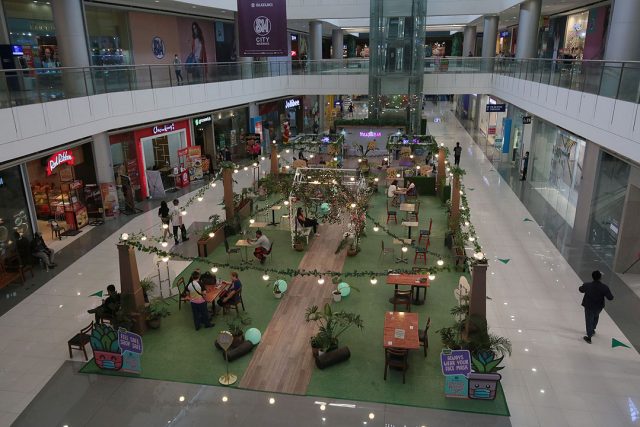
SHOPPING MALLS in the Philippines are unlikely to see foot traffic return to pre-pandemic levels this year, even with the holiday rush and the easing of lockdown restrictions.

“The fourth quarter is perennially a strong period for retail as spending is usually fueled by employees’ holiday bonuses and increased remittances from Filipinos working abroad. We do not see consumer traffic reverting to pre-pandemic level in the next six to 12 months as Filipinos’ propensity to spend is still lukewarm and the quarantine situation in Metro Manila remains volatile,” Colliers Philippines said in a third quarter retail report.

Mobility restrictions have eased in Metro Manila although it remains under Alert Level 3 until Nov. 14, which means malls and restaurants have to operate at limited capacities.

Colliers Philippines Associate Director Joey Roi H. Bondoc expressed optimism the relaxation of lockdowns will spur more Filipinos to go to the malls and spend.

“Revenge shopping and dining should anchor mall operations’ rebound,” he added.

Revenge shopping refers to a trend first seen in countries that have emerged from lockdowns, wherein consumers make up for lost time by spending and going out more.

“The improving inoculation program should improve business and consumer confidence and this should play a crucial role in raising consumer confidence, mall traffic, and retail rents,” Mr. Bondoc said.

According to the Johns Hopkins University Coronavirus Resource Center, the Philippines has fully vaccinated 26.8 million out of its 110 million population as vaccine supply constraints eased.

The number of coronavirus disease 2019 (COVID-19) cases have also continued to decline.

NEW SPACES, HIGH VACANCY
Developers appear to be anticipating a rebound in retail demand starting next year.

Colliers said around 137,000 square meters (sq.m.) of new leasable space is expected to be delivered within the fourth quarter, with the opening of the SM City Grand Central in Caloocan and Ayala Triangle Retail in Makati.

Another 300,900 sq.m. will be completed through 2024, including the Opus Mall, Mitsukoshi Mall, One Ayala Retail, SM Mall of Asia Expansion, Greenhills Center Expansion and the 50,000 sq.m.- expansion of Trinoma Mall.

However, retail vacancy currently remains in double-digits. As of the third quarter, retail vacancy stood at 14.8% in the third quarter, and is expected to continue to rise to 17% next year.

If realized, Colliers said the 17% vacancy projection would be the highest since the 17.3% seen in the fourth quarter of 2002.

“Among the factors that will likely to influence physical mall space absorption beyond 2021 are the growing propensity of Filipinos to shop online as well as rising inflation concerns. The volatile lockdown situation in Metro Manila is also likely to impact retailers’ decision to reopen as well as consumers’ willingness to go out and spend,” Colliers said.

Retail rents have fallen at a slower pace to 5% this year, from 10% in 2020. Colliers said it expects rents to begin to recover next year.

The rising vacancies and drop in rents in malls “should provide an opportunity for retailers to lock in space and haggle for lower lease rates in prime locations,” it added.

At the same time, mall operators should be more cautious of new supply over the next two years, Colliers said.

“Developers should factor in the projected recovery in consumer spending and easing of quarantine restrictions, as well as economic factors such as inflation and OFW remittances… Developers should also assess the viable sizes of new malls,” it said.

Developers also should reconsider their plans and look into building neighborhood malls with less than 50,000 sq.m., Colliers said. — Cathy Rose A. Garcia

Lenders drive higher consumer spending in India with easy credit

SOME OF India’s top lenders and shadow finance companies are helping fuel demand among consumers wanting to splurge on everything from clothes to two-wheelers and homes, offering hopes of a consumption-driven recovery in Asia’s third-largest economy.

Businesses are expecting sales during Diwali — the Hindu festival of lights — will pick up to levels seen before the pandemic struck early last year. That is in part because financiers, sitting on a huge pile of excess cash, are eager to lend with outstanding consumer durable loans already at its highest in more than three years. Borrowers want to take advantage of record low interest rates, an improving labor market as lockdowns ease and a better economic outlook as vaccinations gather pace.

HDFC Bank’s retail loans surged 12.9% in the three months ended September from a year earlier, the lender’s first double-digit growth in such loans since the onslaught of the pandemic. The country’s third-largest private lender, Axis Bank’s retail loans rose by 16%, the fastest pace in five quarters, and India’s top consumer lender Bajaj Finance’s assets increased by a record.

“We expect economic activity to recover further, driven by festive season, pick up in vaccination and the likely increase in government spending,” Srinivasan Vaidyanathan, chief financial officer at HDFC Bank said at a recent earnings call. Spending by the government on better health services, roads and infrastructure is crucial as it lifts growth and incomes, economists say.

Vaidyanathan added that loans to the retail sector were going up. For the country’s largest private lender that’s a shift in strategy after it had pulled back on retail lending last year.

Overall, personal loans offered by banks grew 12.1% in September as compared with 8.4% a year earlier, driven by consumer durables, housing, vehicle loans and borrowings against gold jewelry, according to the Reserve Bank of India.

And it’s not only banks, but also some shadow lenders — a sector hobbled by a damaging default in 2018 — that are keen to jump in by offering loans for as little as 10,000 rupees ($134).

Mumbai-based Mehul Kumar, a 24-year old Youtuber decided to buy a sports bike recently availing a loan of 1.3 million rupees. “Interest rates are low, banks are keen to lend during Diwali and the winter season is great for biking. I got my loan approved in just 24 hours,” he said over the phone.

‘FEAST’ TIMES
Indian lenders have used the pandemic to shore up their capital base, which is now allowing them to increase lending, especially to the household sector. Private-sector banks which have been at the forefront of stepping up consumer loans, raised 536 billion rupees of equity money in the last financial year while their state-run peers raised 120 billion rupees in capital.

“Growth is looking better at this time across a wider set of segments, recoveries are in control,” said Dipak Gupta, joint managing director at Kotak Mahindra Bank Ltd. “All of that gives a comforting feeling to take the foot off the brake and start moving it to the accelerator.”

According to Rajeev Jain, managing director at Bajaj Finance Ltd., there has been a strong revival in growth in recent months, compared to when the second wave was at its peak — a period he described as a “famine.”

“We live in some famine and feast times,” Jain added. In the absence of another wave “we are quite confident about the second half of the year on growth.” — Bloomberg

Locking guests inside Disneyland shows China’s extreme tactics vs COVID-19

REUTERS
Visitors are seen at Shanghai Disney Resort in China May 10, 2020. — REUTERS/ALY SONG/FILE PHOTO

WHILE THOUSANDS of visitors to Shanghai Disneyland on Sunday were queuing for roller coasters and watching fireworks above the fairytale castle, staff quietly sealed the amusement park. People in Hazmat suits streamed in through the gates, preparing to test everyone for coronavirus disease 2019 (COVID-19) before they could leave for the day.

Nearly 34,000 people at Disneyland underwent testing, which ended close to midnight, long after the festivities at the park are usually finished. Ferried home on 220 special buses, all were found Monday to be negative but are still required to isolate at home for two days, and be re-tested for the coronavirus in two weeks.

The shutdown of one of Walt Disney Co.’s most lucrative parks came after a positive case in a woman who traveled to Shanghai from nearby Hangzhou over the weekend. While officials are yet to confirm whether she visited Disneyland, her infection sparked an aggressive contract tracing effort across China, which eventually ensnared the park-goers, their families and Disneyland staff.

To people in parts of the world where COVID is already endemic, the reaction may seem extreme, but it’s emblematic of China’s increasingly hardcore approach to keeping the pathogen out at any cost.

Since containing its initial outbreak in Wuhan last April, China has sought to not just quell the virus but eliminate it. To do that it’s deployed a raft of measures from border curbs and compulsory quarantines, to localized lockdowns and mass testing, aimed at hunting out cases before an outbreak takes root — and quashing them. It was a strategy used successfully in other parts of the Asia-Pacific region, from Singapore and Taiwan to Australia and New Zealand, before the Delta variant made it almost impossible to execute.

China and its territory Hong Kong are now the last real COVID Zero proponents left as other places look to open their borders and live with the virus. But instead of slowly easing toward reopening, too, China is doubling down, even as waves of the more contagious Delta come more frequently and with the current resurgence — totaling some 480 cases — spreading to more than half of the country’s provinces.

As the threat has become more persistent, so has the intensity of China’s curbs, which are becoming as disruptive to people’s lives as they are effective in controlling the virus’s spread.

While snap lockdowns and ad-hoc internal travel restrictions are increasingly being deployed — weighing on spending and consumer demand — some officials are going even further in their efforts to keep out COVID.

A small county in eastern China’s Jiangxi province turned all its traffic lights to red after one case was detected, breaking the province’s 610-day COVID-free track record. The move, which local authorities said was an emergency measure aimed at reducing mobility, was decried on Chinese social media, where dissent is typically censored. It was soon repealed and the lights resumed, local media reported.

In Beijing, the escalating restrictions are having farcical consequences. Some residents who leave the capital have reported not being able to come back because they are recorded as recently being in the city, parts of which are currently classed as high risk because of a small outbreak. Stranded at airports and train stations around China, many have taken to social media to ask for help and to criticize the rules.

Perhaps nowhere is the full force — and increasing absurdity — of China’s devotion to COVID Zero evident than in the small southeastern city of Ruili, on the remote border with Myanmar. People there have been locked down four times in the past seven months alone. The 268,000 residents are largely barred from leaving as the virus keeps creeping over from Myanmar, where it is rampant.

The city’s former deputy mayor made a plea last week for more support from Beijing, saying it can’t control the virus alone and the constant restrictions were killing small businesses. Local media over the weekend reported about a baby who had been tested as many as 74 times for COVID since September last year, with mass testing of entire cities and populations a key part of China’s toolkit.

With a key import conference where President Xi Jinping is set to speak starting this weekend in Shanghai, and the Winter Olympics taking place near Beijing in less than 100 days, China is unlikely to change tactics any time soon — even as the rest of the world opens up. The approach also extends to Xi, who hasn’t left the country since the pandemic began, opting out of attending the Group of 20 nations meeting in person this past weekend in Rome, and climate talks now starting in Scotland.

Zeng Guang, the former chief scientist of epidemiology at China’s Center for Disease Control and Prevention, told local media in August that the country’s devotion to the elimination strategy was partially to do with inadequate vaccination and the need for “updated” COVID shots. So far, the country has fully vaccinated more than 75% of its 1.4 billion people with homegrown inoculations, and is doling out boosters to adults.

The shots, most from Sinovac Biotech Ltd. and the state-backed Sinopharm, use more traditional inactivated vaccine technology, which has proven less effective at stopping transmission and infection than the mRNA inoculations in use in the US and other parts of the West. Chinese company Shanghai Fosun Pharmaceutical Group Co. has the right to sell the Pfizer, Inc.-BioNTech SE vaccine on the mainland, but the US-funded shot is yet to get the regulatory green light.

“As the international situation changes, China will definitely change,” Zeng said. “When the dividend on COVID Zero no longer exists, we won’t do it.” — Bloomberg

SEC warns public vs seven entities’ unlicensed investment schemes

THE Securities and Exchange Commission (SEC) has issued advisories against seven entities to warn the public about their unlicensed investment programs.

Ascend Intelligence Company, PHMALL.APP, and “A” Plus Investment, LLC exhibit Ponzi-like investment schemes, the commission said. Ponzi schemes are programs wherein the “monies from new investors are used in paying ‘fake profits’ to prior investors and is designed mainly to favor its top recruiters and prior risk-takers.”

The three entities are not registered with the SEC as a corporation or as a partnership and also lack the required license to solicit investments from the public.

“The offering and selling of securities in the form of investment contracts using the ‘Ponzi scheme,’ which is fraudulent and unsustainable, is not a registrable security,” the SEC said.

“The commission will not issue a license to sell securities to the public to persons or entities that are engaged in this business or scheme,” it added.

Ascend Intelligence, which also goes by Ascend Intelligent, AI Company, and ascend-intelligence.com, offers investment packages hinged on crypto-currency trading via its “AI Robot,” promising a 100% profit in 40 days, a direct referral bonus of as much as 20%, and a one percent indirect referral bonus.

Meanwhile, PHMall or PHMALL.APP offers six “VIP plans” where investors can allegedly earn from P320 up to P240,000 monthly, depending on the plan they get. Investors may also “earn” 10% from direct order rebates and five percent from direct order rebates, as well as “invitation rewards” from P100 to as much as P200,000, among its other programs.

“A” Plus Investment or A+, A-Plus, A-Plus Mall also offers three “VIP Level” packages, which range from P800 to P35,000. Investors may also earn via referral bonuses or through “invitation rewards.”

Meanwhile, the SEC also warned against a new investment program led by a certain Danea Ruby Cardones Solmayor.

The commission said Ms. Solmayor “lured [her] victims with great [returns] of investment evidenced by written investment contracts.” She owns a Department of Trade and Industry-registered business called Danea Clothing Wholesaling. However, Ms. Solmayor is not registered with the SEC, nor does she have the license to solicit investments from the public.

The regulator also flagged Infinite Profit Asia Ltd. for its investment program, which promises a daily income of as much as eight percent. It is allegedly involved in cryptocurrency trading. It is not registered with the SEC and it also lacks the license needed to collect investments from the public.

On the other hand, unregistered Digicoin Markets International PH offers investment plans ranging from P1,000 to up to P1 million. It promises a daily interest of five, six, or 7% for 30 days, on top of possible earning opportunities via referrals. It is also not licensed to conduct investment solicitations, the SEC said.

“Further, Digicoin Markets or Digicoin Markets International PH is also not a registered Virtual Asset Service Provider (VASP) with the Bangko Sentral ng Pilipinas and does not have a corresponding Certificate of Authority as a Money Service Business as required under Circular No. 1108, Series of 2021, or the Guidelines for Virtual Asset Providers,” the SEC said.

The commission is also warning the public against MCM Royalty Legacy International, Inc.’s investment programs. While it is registered with the SEC, it doesn’t have a license to solicit investments.

MCM Royalty Legacy is said to be led by Mary Chiles Talamayan Mendoza and James Catimbag Sabenecio. Ms. Mendoza has been linked to other SEC-flagged entities such as Yeheey iTraffic System, Inc., Pays Up Online Marketing Business, and Pays-UpGen Marketing Business Unlimited.

The SEC said those involved in the unlicensed investment activities of entities may be prosecuted and held criminally liable and may also be subjected to a monetary fine of up to P5 million or a penalty of up to 21 years of imprisonment under the Securities Regulation Code.

As of October, the commission has issued 100 advisories against investment schemes offered by unregistered firms or entities without a secondary license from the SEC.

Last year, the SEC published over 120 warnings, more than double the 50 advisories issued in 2019. — Keren Concepcion G. Valmonte