Home Blog Page 6867

Philippines’ richest man set to see his supermarket IPO sizzle

AllDay Marts Inc., a supermarket chain founded by the richest person in the Philippines, is poised to jump in its trading debut thanks to heavy retail investor interest.

AllDay’s offer was about four times oversubscribed, with the company and billionaire Manuel Villar raising a combined P4.52 billion ($89 million) by selling 7.52 billion shares at 60 centavos each. Trading is scheduled to begin Wednesday in Manila.

“The interest from retail investors is quite strong,” said Andrei Soriano, an analyst at AP Securities Inc. “We got a lot of inquiries and many of our clients subscribed to the IPO. They expect this will be another MerryMart.”

Its peer MerryMart Consumer Corp. surged by the 50% daily limit from its IPO price in each of its first three trading days in June 2020. Shares have tripled since they listed, though off their January peak.

AllDay is debuting at a time when the Philippine IPO market is booming. Six deals have raised a record $2.33 billion this year, Bloomberg-compiled data show.

Villar, whose fortune is $7.3 billion according to the Bloomberg Billionaires Index, is a draw for investors, say analysts, as is AllDay’s low nominal IPO price. The firm should be able to meet its target of tripling its stores in five years, they say, as Villar can provide locations through his Vista Land & Lifescapes Inc., a builder of residential, office and retail developments in 147 cities and towns nationwide.

AllDay’s IPO price of 60 centavos is “reasonable” relative to MerryMart, which priced its float at 200 times forward earnings and had just seven outlets when it went public, said AP Securities’ Soriano. AllDay, which already has 33 stores, has a multiple of 31.1 times its 2022 earnings at the offer price.

The supermarket group targets the “affluent mid-premium segment,” where its market share has widened to 9.5% in 2020 from 6.9% in 2019, according to a COL Financial Group Inc. report. It plans to use 20% of the net proceeds from the sale of new shares to expand.

AllDay will use the remaining proceeds from the new shares to pay down debt, helping save P206 million in annual financing costs, according to its prospectus.

The reopening of the Philippines’ pandemic-hit economy and increased campaign spending ahead of the May 2022 presidential and national elections are also favorable for AllDay.

“Reopening means more employment and consumer spending while the elections will help boost spending capacity of households,” said Manny Cruz, a strategist at Papa Securities. – Bloomberg

Globe shows support for global and national mental health celebrations

COVID-19 has had a significant impact on the mental health of Filipinos across different groups all over the archipelago. From frontline workers, parents balancing work and family, children trying to cope with online learning, people living alone, those with pre-existing mental health conditions—the pandemic has adversely affected the lives of many.

Thus, as the Philippines and the world celebrate mental health this month, Globe shows its support through various initiatives that help raise awareness on mental health and well-being. This is the company’s way of showing Filipinos that they are not alone in this fight.

“Today there are many people who are experiencing mental health issues due to the pandemic. And just like how we need to take care of our body, we also need to take care of our emotional and psychological well-being. We are trying to reach out to as many people as we can to remind them that there are existing support platforms they can reach out to,” said Yoly Crisanto, Globe Chief Sustainability Officer and SVP for Corporate Communications.

Through its #PlantHappinessPH mental health campaign, which went live last September 27, Globe encouraged everyone to find joy in simple pleasures. The campaign has, so far, received more than 1,400 video entries from people from all walks of life and has already amassed a whopping 264.9 million views on TikTok.

With a musical score of “Better Days 2.0,” performed by renowned Filipino artist Quest, #PlantHappinessPH put the spotlight on dancing and planting as a way to relieve people of both stress and anxiety during these difficult times. It sought to spread joy and happiness to show hope, no matter how challenging these days may be.

Globe also took part in the National Mental Health Week and the Philippine Mental Health Association’s (PMHA) “Light Up Blue for Mental Health!” By lighting its corporate headquarters lobby chandelier, Globe was able to provide support for the initiative. The activity reminded people that they are never alone in their mental health journey and that stories of hope and courage come from all corners of the world.

Meanwhile, KonsultaMD, a joint venture of Globe’s 917Ventures and Salud Interactiva, brought together some of the country’s most popular artists for a concert entitled “Be Kind to Your Mind” last October 9.

The artist lineup included actress and singer Nadine Lustre, indie rapper, singer-songwriter Curtismith, folk-pop band Ben&Ben, and two of the nation’s hottest DJs—Nix Damn P and Marvelous. The event was the culmination of KonsultaMD’s month-long “Be Kind To Your Mind” campaign, which sought to spread awareness about the importance of mental health among Filipinos.

As part of the campaign, customers can get a free one-month health plan with 24/7 unlimited access to KonsultaMD’s licensed mental health professionals until Oct 31. To avail of the promo, download the KonsultaMD app and use the voucher code BEKINDTOYOURMIND.

Earlier, Globe also collaborated with the DepEd Disaster Risk Reduction Management Services (DepEd-DRRMS) and the Bureau of Human Resource and Organizational Development-Employee Welfare Division (BHROD-EWD) to back the well-being of teachers through the TAYO Naman! (Tulong, Alaga, Yakap at Oras para sa mga Tagapagtaguyod ng Edukasyon) program. TAYO Naman! is an online Mental Health and Psychosocial Support (MHPSS) initiative for all education advocates, including teachers, non-teaching personnel, and parents, under Globe’s Global Filipino Teachers Program.

Globe is also working with numerous organizations to encourage people suffering from mental health issues to reach out and get help through free emotional crisis hotlines. This includes lifelines like the HOPELINE, which offers free mental health support, 24 hours a day, seven days a week. People in mental distress can contact the hotline through 2919 (toll-free for all Globe and TM subscribers), (02) 804-HOPE (4673), or 0917 558 HOPE (4673).

HOPELINE is also included in the telehealth service integrator HealthNow app. Globe and TM subscribers may quickly call HOPELINE for FREE anytime they want to talk to someone.

World Mental Health Day is a project of the World Health Organization. It is celebrated every October 10 to raise awareness of mental health issues worldwide and mobilize efforts in support of mental health. The day also provides an opportunity for all stakeholders working on mental health issues to talk about their work and what needs to be done to make mental health care a reality for people worldwide.

Globe strongly supports the United Nations Sustainable Development Goals, particularly UN SDG No. 3, on providing good health and well-being, and SDG No. 9, which highlights the roles of infrastructure and innovation as crucial drivers of economic growth and development. Globe is committed to upholding the United Nations Global Compact principles and contributing to 10 UN SDGs.

Learn more by visiting www.globe.com.ph/about-us/sustainability.html.


Spotlight is BusinessWorld’s sponsored section that allows advertisers to amplify their brand and connect with BusinessWorld’s audience by enabling them to publish their stories directly on the BusinessWorld Web site. For more information, send an email to online@bworldonline.com.

Join us on Viber to get more updates from BusinessWorld: https://bit.ly/3hv6bLA.

Beauty is always enlightened with the new vivo Y15 Series selfie phone

The newest entrant to the Y series keeps your beauty in focus

Young and young-at-hearts can fill the humdrum of every day with picture-perfect moments as vivo, a leading global smartphone brand, continues to bank on its consumers’ demand to provide quality and stylish phones at an affordable price.

The vivo Y series, the brand’s best-selling product segment in the country, comes with the latest update with the upcoming release of the new vivo Y15 Series.

This hip and stylish smartphone gives a bang for the buck with its vibrant colorways and compelling features. At a budget-friendly price range of P5,000 to P7,500, users can have a reliable device to attend to their day-to-day tasks — from social media activities, gaming, online video calls, and other creative pursuits.

Beauty enlightened

Dimly-lit selfies? We don’t know her. The vivo Y15 Series integrates an 8MP Night Selfie camera. This feature ensures that all images taken are focused on the subject to capture an enlightened beauty against a bokeh or haloing backdrop. Additionally, it also comes with a Selfie Soft Light Band that supports photos taken in dark environments. This one provides a real-time preview of fill light effects and automatic adaptation, so users can be assured that they get the best lighting every time.

Beauty in power

Aside from its fashionable hardware design and modern camera features, the vivo Y15 Series also supports a user’s daily journey with its built-in powerful technology.

A single full charge of the Y15 Series can provide up to 18 hours of HD movie streaming or 7 hours of intensive game playing. With this, people can pursue their gaming or film-buff hobbies anytime, anywhere. It also has the groundbreaking 5V1A Reverse Charging technology. This feature means that the smartphone can also be used to charge other devices — doubling as a device of its own as well as a backup power bank.

With all these technologies fused in the new vivo Y15 Series, lovers of fun and creative pursuits can take advantage of a smartphone that enlightens beauty at a value-for-money price. Watch out for its upcoming release on vivo Philippines’ official Facebook, Twitter, and Instagram, and www.vivoglobal.ph.


Spotlight is BusinessWorld’s sponsored section that allows advertisers to amplify their brand and connect with BusinessWorld’s audience by enabling them to publish their stories directly on the BusinessWorld Web site. For more information, send an email to online@bworldonline.com.

Join us on Viber to get more updates from BusinessWorld: https://bit.ly/3hv6bLA.

TnT back as PBA champion

The TnT Tropang Giga are the 2021 PBA Philippine Cup champions. -- PBA Images

By Michael Angelo S. Murillo

The TnT Tropang Giga are back as Philippine Basketball Association champions after closing out the Magnolia Pambansang Manok Hotshots, 94-79, in Game Five of their best-of-seven Philippine Cup finals series on Friday at the Don Honorio Ventura State University Gym in Bacolor, Pampanga.

TnT won the series, 4-1, and marked its return to the PBA summit for the first time since 2015.

Rookie Mikey Williams led the way for the Tropang Giga, which controlled the game from late in the opening quarter all the way to the end. He finished with 24 points.

Magnolia tried to fashion out a comeback but just could not generate the needed wave to do so.

Roger Pogoy had 19 points for TnT, whose coach Chot Reyes is a champion anew in his first season back as coach in the PBA.

Jayson Castro had 10 points.

For Magnolia it was Ian Sangalang who showed the way with 18 markers.

TnT was last champion in 2015 with the Commissioner’s Cup.

The latest title was the sixth All-Filipino championship by the Tropang Giga in franchise history and eighth overall in the PBA.

Oil prices kept inflation above target in October — BSP

Oil prices have soared as the economic recovery from the pandemic has pushed energy usage higher. -- Photo by Michael Varcas, The Philippine Star

By Jenina P. Ibañez, Reporter 

Inflation in October likely exceeded the central bank’s annual target largely due to domestic oil price pressures, Bangko Sentral ng Pilipinas (BSP) Governor Benjamin E. Diokno said on Friday. 

Inflation will likely settle within the 4.5%-5.3% range, breaching the 2-4% BSP target for the year, he said in a Viber message to reporters. Inflation went up 2.5% in October last year. 

Headline inflation was at 4.8% in September 2021, slowing from the year-on-year rate of 4.9% in August. 

Mr. Diokno said higher Meralco electricity rates, increased prices of fish and fruits, and the depreciation of the peso added to the upward inflationary pressure. 

“These could be partially offset by the continued decline in rice and meat prices, reflecting continued arrival of pork imports,” he said. 

Earlier this week, pump prices of gasoline rose by P1.15, diesel by P0.45, and kerosene by P0.55 per liter, reflecting the continued surge in global oil prices.  

As of Thursday’s market close, Brent crude was steady at $82.36 a barrel. Reuters reported that crude oil was on track for its “first weekly fall in eight weeks after US oil stocks rose more than expected and Iran flagged it was resuming talks with Western powers which could lead to an end to sanctions.” 

Meralco power rates went up by P0.0283 to P9.1374 per kilowatt-hour (kWh) in October. 

The Department of Agriculture on Tuesday said imported pork will be distributed to areas where prices are high, expanding beyond the capital region and its neighboring provinces. 

The minimum access volume quota for pork imports has been expanded while tariff rates were temporarily lowered to address low pork supplies and rising prices due to the African Swine Fever outbreak. 

Mr. Diokno earlier this month said that recent elevated inflation is still “transitory,” and that tightening monetary policy too early may cause more harm to the economy’s recovery. 

“Moving forward, the BSP will continue to closely monitor emerging price developments to help ensure that its primary mandate of price stability conducive to balanced and sustainable economic growth is achieved,” Mr. Diokno said on Friday. 

The central bank in its September policy review kept rates steady, citing the need to support recovery even as it raised its inflation forecast for the year to 4.4%. 

NG debt hits P11.9 trillion as of end-September

REUTERS

By Jenina P. Ibañez, Reporter  

The national government’s outstanding debt rose to P11.9 trillion as of the end of September as the peso depreciated against the US dollar, preliminary data from the Bureau of the Treasury (BTr) showed. 

The end-September debt level was 27.2% higher than last year’s figure, and was 2.41% higher than a month earlier. 

This was “due to net issuance of both domestic and external debt and peso depreciation against the US Dollar,” BTr said in its report on Friday. 

Government debt rose by 21.7% since the start of the year, or P2.12 trillion over nine months. 

Broken down, 70.4% of the debt came from domestic borrowing, while the rest were sourced overseas. 

Domestic debt at the end of September increased by 2% to P8.39 trillion from August. Domestic debt stock grew 30.3% year on year. 

Outstanding government securities was up 2.2% to P7.85 trillion. The government also has P540 billion from the Bangko Sentral ng Pilipinas (BSP) borrowed last year to continue funding the country’s pandemic response. 

External debt rose 3.10% to P3.529 trillion at the end of September from the end of August. 

“For September, the increment in external debt was due to the net availment of foreign loans amounting to P43.99 billion and the effect of local currency depreciation against the US Dollar amounting to P76.82 billion,” BTr said. 

“This more than offset the impact of third-currency fluctuations against the US Dollar amounting to P13.73 billion.” 

Foreign debt at the end of September went up 20.4% from a year earlier, and increased 13.8% since the start of the year. 

Foreign debt consisted of P1.54 trillion in loans and P2.0 trillion in government securities. 

Government securities included P1.6 trillion in dollar notes, P239 billion in euro bonds, P89 billion in yen paper, P20 billion in yuan notes and P86 billion in peso global bonds. 

The government’s total guaranteed debt went up 0.10% to P432.9 billion in September from a month earlier. 

“Net repayments on both domestic and external guarantees amounted to P2.56 billion for the month,” BTr said. 

“However, local-currency depreciation against the US dollar increased the value of external guarantees by P4.47 billion, offsetting repayments and third-currency depreciation which trimmed P1.27 billion.” 

Rizal Commercial Banking Corp. Chief Economist Michael L. Ricafort in an email said increased government spending, especially on infrastructure, also led to wider budget deficits and some corresponding pick up in outstanding government debt. 

Increased government spending on infrastructure and in preparation for the elections could help stimulate the economy and “would lead to wider budget deficits and, in turn, would require more government borrowings/debt to finance the said budget deficits,” he said. 

Bank lending growth fastest in 11 months

BW FILE PHOTO

By Jenina P. Ibañez, Reporter  

Bank lending rose 2.7% in September to mark the second straight month of growth, preliminary data from the Bangko Sentral ng Pilipinas (BSP) showed. 

Outstanding loans issued by big banks increased 2.7% to P9.25 trillion in September, after growing 1.3% year on year in August. It had previously declined for eight straight months. 

The growth in September is the fastest in 11 months, or since the 1.8% expansion in October 2020. 

Including reverse repurchase agreements, outstanding loans went up 2.7% to P9.54 billion year on year in September.   

Outstanding loans went up 0.6% month on month on a seasonally adjusted basis. 

“The observed increase in outstanding loans of U/KBs reflects the modest recovery in banks’ overall lending attitudes along with improved economic prospects owing to the gradual lifting of pandemic containment measures,” BSP Governor Benjamin E. Diokno said in the report released Friday. 

The government gradually loosened mobility curbs in Metro Manila in September, although the number of coronavirus disease 2019 (COVID-19 infections remained elevated.  

Loans for production activities rose by 4.4% in September from the 3.1% a month before. 

This was supported by expansions in credit disbursed for professional, scientific and technical services (92.7%), information and communications (26.6%), transportation and storage (9.5%), and human health and social work activities (9.2%). 

But loans for production activities was tempered by the decline other sectors, including those for administrative and support services (-23.1%), mining and quarrying (-19.8%), education (-17%), and agriculture, forestry and fishing (-11.9%). 

Consumer loans declined by 7.8% year on year in September compared to the 8.4% contraction in July. Credit to all retail segments fell, led by motor vehicle loans (-15.6%). 

Rizal Commercial Banking Corp. Chief Economist Michael L. Ricafort said the quicker pace of COVID-19 vaccinations somewhat improved business sentiment, which led to some uptick in loan or credit demand. 

“For the coming months, bank loans growth could continue to pick up as the country shifts towards smaller scale/granular lockdowns,” he said in an email, referring to the government’s move to implement targeted lockdowns in areas showing a spike in COVID-19 cases.  

Meanwhile, domestic liquidity continued to go up, according to BSP data released on Friday. M3, or the broadest measure of cash in an economy, expanded by 8.2% in September after a 6.9% increase in August. 

On a seasonally adjusted basis, M3 went up 1.1% month on month. 

Domestic claims increased 7.6% in September, faster than the 6.7% seen the previous month. 

Net claims on the central government expanded by 35.4% in September from the 23.5% in August. 

Claims on the private sector, driven by lending to nonfinancial private firms, went up 3.1% from 2.3% in the previous month. 

Net foreign assets (NFA) in peso terms grew 11.3% in September from 9.7% in August. 

“The expansion in the BSP’s NFA position reflected the increase in the country’s gross international reserves relative to the same period a year ago. Meanwhile, the NFA of banks grew as banks’ foreign assets rose on account of higher loans and deposits with nonresident banks,” Mr. Diokno said. 

According to Mr. Ricafort, M3 growth could improve further in the coming months due to increased investment banking transactions in the pipeline in November. 

“All of which could entail some foreign investment inflows and some local banks to invest/deploy some of their excess peso funds/liquidity from the central bank’s deposit facilities as they mature,” he said. 

PHL consumer spending to pick up in 2022 – Fitch Solutions

Household spending grew 7.2% year on year in the second quarter, as lockdowns eased. -- Photo by Michael Varcas, The Philippine Star

The improving employment rate and consumer sentiment in the Philippines could back a projected 5.1% household spending growth next year, Fitch Solutions Country Risk and Industry Research said. 

In a report released on Friday, Fitch Solutions said consumer spending could grow by a total of P11.1 trillion in 2022, accelerating from the estimated 3.5% growth this year. 

It noted third quarter consumer confidence index rose to -19.3 in the third quarter of 2021 from -30.9 in the preceding three months. The unemployment rate improved to 6.9% in July from 8.7% in April. 

Both indicators suggest “an improving economic and employment environment, which will bolster consumer confidence and spending,” Fitch Solutions said. 

Household consumption, which typically accounts for 70% of the country’s economy, declined by 8.3% in 2020. 

In the second quarter, household spending grew 7.2% year on year as lockdowns eased.  

“Over 2022, consumer spending growth will begin to moderate, as the Filipino consumer continues its recovery from the contraction in 2020,” Fitch Solutions said. 

The forecast for consumer spending is based on the Fitch Solutions’ unemployment rate estimate that it would average 8% over 2022, an improvement from 11% seen this year. 

“While this is still higher than the pre-pandemic environment (the unemployment rate averaged 5.1% over 2019), it indicates an improving economic and employment environment, which will bolster consumer confidence and spending,” the report said. 

“This better outlook stems from expectations that there will be more jobs, higher income, looser restrictions, and more businesses reopening.” 

Latest jobs data showed that unemployment went up to 8.1% after stricter lockdowns were reintroduced in August. 

Meanwhile, Fitch Solutions said it does not expect consumer outlook to be derailed by potentially higher inflation next year. 

It estimates 6.8% year on year real gross domestic product (GDP) growth in 2022 following its lowered 4.2% growth estimate for 2021. 

“Our Country Risk team expects household savings rates to remain elevated given the pandemic uncertainty and loss of income over past quarters, while the domestic employment situation is unlikely to improve markedly in the near term. As a result, the Philippines’ economy is expected to fully recover only in 2022, with more conventional growth patterns returning in 2023.” 

Consumer spending recovery hinges on the country’s vaccination drive, which still lags in Asia, Fitch Solutions said. It expects mobility restrictions to ease as more Filipinos receive the jab. 

Less than 25% of the Philippine population has been fully vaccinated against COVID-18, the Johns Hopkins University tracker showed. — Jenina P. Ibañez  

Metro Manila to remain under Alert Level 3 until Nov. 14

PHILSTAR

Public transport capacity increasing starting Nov. 4

Metro Manila will remain under Alert Level 3 until Nov. 14, the Palace said on Friday, even as coronavirus infections in the country continue to drop.

“This is to ensure that the opening of the economy is done gradually,” Palace spokesman Herminio L. Roque, Jr. Said at a televised news briefing.

The decision was made amid expectations in the private sector and the Interior and Local Government department that Metro Manila would be downgraded to Alert Level 2.

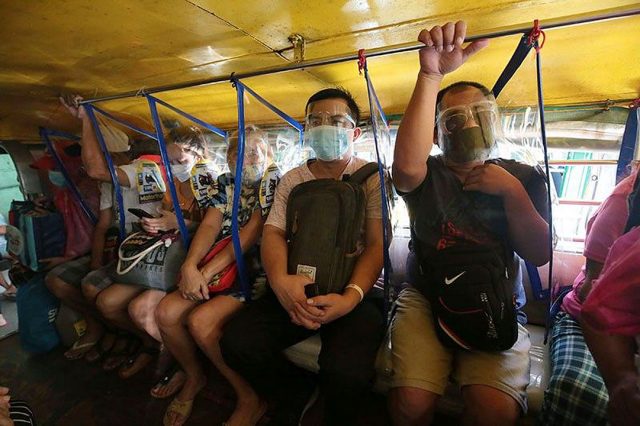
In a related development, Mr. Roque said the pandemic task force also approved the recommendation of the Transportation department to allow the gradual increase of passenger capacity in public transportation for road-based and rail transportation plying Metro Manila and its adjacent provinces from 70% to full capacity starting Nov. 4.

The government started enforcing granular lockdowns with five alert levels in the NCR after the country struggled to contain a fresh spike in infections triggered by the highly contagious Delta variant.

PUBLIC TRANSPORT TO INCREASE

In a related development, the Department of Transportation (DOTr) said it will gradually increase the passenger capacity of public transportation in Metro Manila starting next week.

“The [DOTr] will implement a gradual increase in passenger capacities for public road-based and rail transportation plying the National Capital Region (NCR) and Metro Manila Urban Transportation Integration Study Update and Capacity Enhancement Project area from 70% to full capacity beginning on [Nov. 4],” the department said in a statement on Friday.

Transportation Assistant Secretary Mark Steven C. Pastor said this development, along with the P1-billion cash aid from the government, would help public utility vehicle (PUV) drivers.

The government’s pandemic task force supported the department’s proposed plans to increase the capacity for public transportation in the areas covered by its NCR MUCEP study through a month-long pilot implementation.

Now under Alert Level 3, Metro Manila now has more businesses open. The department said this “resulted in greater demand for public transport.”

The increased vaccination rate in the NCR of 81.4% also prompted the increase in capacity for public utility vehicles (PUV), the department said.

“The DOTr, through its relevant attached agencies, will issue the necessary memoranda to execute the IATF approval on the gradual increase in passenger capacity in road and rail transportation, while implementing strictly health and safety protocols to help prevent the spread of COVID-19 (coronavirus disease 2019),” the department said.

4,043 NEW CASES

Philippine health authorities reported 4,043 new coronavirus cases on Friday, bringing the total since the pandemic started to nearly 2.8 million.

The death toll rose to 42,621 after 44 more patients died, while recoveries increased by 3,224 million to nearly 2.7 million, the Department of Health (DoH) said in a bulletin.

The agency said there were 50,630 active cases, 74.1% of which were mild, 10.71% were moderate, 6.5% were asymptomatic, 6.1% were severe, and 2.6% were critical.

The health agency said the intensive care unit occupancy rate in the entire Philippines and in Metro Manila was 50% and 41%, respectively.

The DoH said 30 duplicates were removed from the tally, 28 of which were reclassified as recoveries.

INVESTIGATIONAL DRUGS

Also Friday, Health Undersecretary Maria Rosario S. Vergeire said the government will soon allow hospitals to purchase COVID-19 investigational drugs that are already approved for urgent use in the country.

“We will release an administrative order for investigational drugs that we are using for COVID-19 because usually, it is the Department of Health that has an emergency use authorization for these drugs,” she said at a virtual news briefing.

“We are now delegating this authority to procure to hospitals so they can immediately use these investigational drugs,” she added. “We are just waiting for the order to be signed.”

Tocilizumab, Remdesivir, and Baricitinib are among the investigational drugs already being used in the country for coronavirus patients.

An additional supply of Tocilizumab might arrive in the country by the second week of November, Ms. Vergeire said.

Philippine drug regulators have already approved the “compassionate use” of Molnupiravir, the first oral antiviral drug for the treatment of coronavirus patients, for 31 hospitals. Earlier this week, local importer MedEthix, Inc. said the drug will be available in the country next month.

ALERT LEVEL 3 IN SELECT PROVINCES, CITIES

The alert level system, first tested in the capital region, will be expanded to more areas starting Nov. 1.

Other areas in Luzon, such as Bataan, Cavite, Laguna, and Rizal, will also be placed under Alert Level 3.

Iloilo City and Siquijor in central Philippines, and Lanao del Norte, Davao City, and Davao del Norte in Mindanao will also be placed under the same alert level.

Baguio City was included as an area for special monitoring and shall also be placed under Alert Level 3, the Palace said.

Angeles City, Bulacan, Nueva Ecija, Olongapo City, Pampanga, and Tarlac in Central Luzon will be placed under Alert Level 2, as will Batangas, Quezon Province, and Lucena City in Southern Tagalog.

Also under Alert Level 2 are Aklan, Antique, Capiz, Guimaras, Iloilo, Negros Occidental, Bohol, Cebu City, Lapu-Lapu City, Mandaue City, and Cebu Province in central Philippines.

Meanwhile, Aurora, Bacolod City, Negros Oriental, and Davao Occidental will be placed under Alert Level 4, the strictest level.

Mr. Roque said the country’s pandemic taskforce also approved the risk-level classifications for provinces, highly urbanized cities, and independent component cities that are not yet included in the expanded implementation of the Alert Level System.

Mountain Province, Catanduanes, and Zamboanga City will be placed under a modified enhanced community quarantine (the second strictest quarantine level) from Nov. 1 to Nov. 15.

Abra, Cagayan, Isabela, City of Santiago, Nueva Vizcaya, and Quirino under a general community quarantine (GCQ, second to the most lenient) with heightened restrictions from Nov.1 to Nov. 30.

Placed under GCQ for the whole month of November are Ifugao, Benguet, Apayao, Kalinga, Ilocos Sur, Dagupan City, Batanes, Occidental Mindoro, Oriental Mindoro, Puerto Princesa, Palawan, Albay, Naga City, Camarines Norte, Tacloban City, Zamboanga Sibugay, Zamboanga del Norte, Zamboanga del Sur, General Santos City, Sarangani, North Cotabato, South Cotabato, Agusan del Norte, Agusan del Sur, Surigao del Norte, Surigao del Sur, Butuan City, Dinagat Islands, Cotabato City, and Lanao del Sur.

All other areas not mentioned would be placed under a modified GCQ for the whole month of November. — Kyle Aristophere Atienza and Keren Concepcion G. Valmonte


Workers won’t get special pay on 3 holidays next year

President Rodrigo R. Duterte has signed a proclamation declaring fewer nonworking days in 2022 in an effort to minimize work disruption amid the pandemic.

Under the order, Nov. 2 (All Souls’ Day), Dec. 24 (Christmas Eve), and Dec. 31 (New Year’s Eve), which had been special nonworking days, will now be special working days.

“For the country to recover from the adverse economic impact of the COVID-19 pandemic, there is a need to encourage economic productivity by, among others, minimizing work disruption and commemorating some special holidays as special (working) days instead,” the proclamation said.

If an employee goes to work on a special nonworking holiday, the “no work, no pay” principle applies unless there is a company policy or collective bargaining agreement granting payment on a special day, according to a labor advisory released on Oct. 28.

For work done during the special nonworking holiday, a worker shall be paid an additional 30% of his/her basic wage on the first eight hours of work, it said.

But should a worker report for duty on a special working day, the employee is “entitled to receive only his/her daily wage and no premium is required since it is considered an ordinary working day,” the advisory said. — Kyle Aristophere Atienza

Duterte signs law postponing BARMM elections

@BANGSAMOROGOVT

Philippine President Rodrigo R. Duterte has officially postponed the first regular elections in the Bangsamoro region, according to the presidential palace.

He signed Republic Act (RA) No. 11593 which moves the date of the parliamentary and regional elections of the Bangsamoro Autonomous Region in Muslim Mindanao to May 2025, synchronized with the next mid-term elections.

With the transition period thus extended, the Bangsamoro Transition Authority (BTA) will continue to serve as the interim government of BARMM, according to the law.

The law authorizes the President to appoint 80 new members of the BTA once the term of its current members expires on June 30, 2022.

New members of the BTA will serve until June 30, 2025, the law said.

RA No. 15593 will take effect 15 days after its publication in the Official Gazette or a newspaper of general circulation.

The law would ensure the fulfillment of all agreements under the Comprehensive Agreement of the Bangsamoro (CAB) between the National Government and the Moro Islamic Liberation Front (MILF), Senator Francis Tolentino said in a statement.

“The approval is most welcome since a postponement is needed to achieve long and lasting peace in the region,” said Mr. Tolentino, who chairs the Senate committee on Local Government. — Kyle Aristophere Atienza

Comelec releases tentative list of candidates for 2022 May elections, sets absentee voting rules

THE COMMISSION on Elections (Comelec) on Friday released its tentative list for the 2022 national and local elections.

The list for national positions posted on the poll body’s official website included 97 presidential candidates, 28 vice-presidential candidates, and 174 senatorial candidates.

It also released the list for local aspirants.

“Aspirants whose names appear on the tentative list of candidates released by the Comelec have until Nov. 8 to submit their requests for correction of typographical errors in their listed names,” said Comelec Spokesperson James B. Jimenez via Twitter on Friday.

The final list of candidates will be released by December, Mr. Jimenez said last Sunday, after aspirants deemed as nuisance candidates are removed.

The current list is based on the initial evaluation of the Certificates of Nomination, Certificates of Candidacy, and the Certificates of Nomination and Acceptance, as written on the Comelec’s website.

“The contents of the list, particularly the names of the aspirants or candidates, political parties, as well as the name to appear on the ballot are subject to change as a result of any further evaluation and or resolution of the Commission En Banc in relation thereto,” it added.

RESOLUTION ON LOCAL ABSENTEE VOTING

Meanwhile, the poll body issued a resolution on local absentee voting (LAV), setting March 7, 2022 as the deadline for applications.

The LAV application is open to government officials and employees, members of the Armed Forces of the Philippines and the Philippine National Police, and media practitioners.

Under Resolution No. 10695, applicants for LAV must prove that they will be working on the actual election day, May 9.

If approved, the local absentee voters will be the first to cast ballots for the May 2022 elections, as absentee voting is scheduled on April 27 to 29 from 8 a.m. to 5 p.m.

They will use manual ballots and can only vote for national candidates, including President, Vice-President, Senators, and Party-list.

The Commission on Elections also specified guidelines on the strict implementation of health protocols amid the coronavirus pandemic. — Alyssa Nicole O. Tan