Home Blog Page 6755

Nickel Asia net income surges in Jan.-Sept.

NICKEL Asia Corp. (NAC) posted a 168% increase in its net income attributable to the equity holders of the parent company to P6.17 billion in the first nine months of the year on the back of higher ore sales and ore prices.

The listed mining firm said in a stock exchange disclosure on Thursday that its total revenues for the January to September period increased 39% to P21.06 billion compared to P15.11 billion last year.

Of the company’s revenues, the sale of ore and limestone contributed P20.03 billion, followed by services and other revenue at P663.27 million, and sale of power at P371.63 million.

In the nine-month period, NAC sold 14.4 million wet metric tons (WMT) of nickel ore at an average realized price of $27.96 per WMT, improving from the 14 million WMT at $20.10 per WMT logged a year ago.

Broken down, NAC exported 8.73 million WMT of saprolite and limonite ore to Japan and China at an average price of $38.69 per WMT during the period, higher than the 7.5 million WMT at $30.53 per WMT in 2020.

The company also delivered 5.68 million WMT of limonite ore to its Coral Bay and Taganito high-pressure acid leach (HPAL) plants at an average price of $8.20 per pound of payable nickel for the period compared to the 6.52 million WMT at $5.97 per pound recorded last year.

Meanwhile, the company’s operating expenses in the nine-month period also increased 20.7% to P4.85 billion from P4.02 billion a year ago.

NAC President and Chief Executive Officer Martin Antonio G. Zamora said the electric vehicle industry remains the main driver of nickel demand over the long-term period.

“Chinese stainless-steel production was up 12% year on year and nickel ore prices as well as London Metal Exchange nickel price have continued its upward momentum, despite the slowdown in Chinese gross domestic product growth,” Mr. Zamora said.

In a separate disclosure on Thursday, NAC said its board of directors approved the creation of a nonstock, nonprofit foundation called NAC Foundation, which will be in charge of corporate social responsibility initiatives. It has an initial funding of P20 million.

On Thursday, shares of NAC rose 2.37% or 13 centavos to end at P5.61 apiece. — Revin Mikhael D. Ochave


PBA joins East Asia Super League

With teams from China, S. Korea, Japan, and Taiwan

By Nelson T. Beltran, Philippine Star Sports Editor

AFTER some period of hemming and hawing, the Philippine Basketball Association (PBA) signed up with the East Asia Super League (EASL) in the end, making it a pioneer member of the regional loop where top PBA ball clubs slug it out with counterparts from China, South Korea, Japan, and Taiwan.

After four test tourneys in Japan and in Macau, the EASL has set a first full-fledged season, featuring a home-and-away format touching off next year.

The PBA board has approved its EASL participation coming with a PBA representation in the EASL board.

“We’re to field two teams. It will be determined by drawing lots among the top four (in a certain PBA tourney that serves as the qualifier),” said PBA chairman Ricky Vargas.

The PBA first joined the EASL in the second edition of its Super 8 in Macau in 2018, with the NLEX Road Warriors and the Blackwater Elite competing with the Guangzhou Long Lions, the Xinjiang Flying Tigers, the Seoul Samsung Thunder, the Incheon Electroland Elephants, the Rizing Zephyr Fukuoka and the Formosa Dreams. NLEX finished fourth behind Guangzhou, Seoul and Incheon.

In 2019, EASL rebranded from its initial name Asia League and drew the participation of Blackwater, the TnT KaTropa and the San Miguel Beermen in its Terrific 12 edition. San Miguel entered the semis but lost a nail-biter against the Zhejiang Lions, 91-89.

Emerging as champs in the league’s four preseason tourneys were the Chiba Jets of Japan in 2017, Guangzhou in the 2018 Super 8, the Ryukyu Golden Kings of Japan in the 2018 Terrific 12 and the Liaoning Flying Leopards in the 2019 Terrific 12.

The league has been idle the last two years due to pandemic, but chief executive officer Matt Beyer and chief finance officer Henry Kerins, both Hong Kong-based, have been continuing work to firm up the planned official launch and drum up interest for the FIBA-sanctioned regional loop.

SECOND CONFERENCE
Meanwhile, the PBA board convenes in a meeting today to draw options for a tournament format and venue in anticipation of all eventualities for Season 46 second conference set to start late this month.

The main issue is the format that would fit the pandemic protocols imposed by the government.

The league chairman said a possibility is a home-venue-home setup if the current quarantine status in the National Capital Region eases down to Alert Level 2.

Mr. Vargas said they will lay down options for a possible extension of the current alert level or in case it shoots up.

But the league is all set for the second conference that will bring back imports with a height limit of 6-foot-6. TnT chases a season double with McKenzie Moore as reinforcement.

The problem with generic employer e-mail addresses

Is it advisable to answer job advertisements from a company that has no professional business e-mail address and website? BusinessWorld is publishing a lot of these ads that are too small to be noticed and read. What do you think? — Suspicious Susie.

Many decades back, dynamite was used to clear farmland for development. A salesman for explosive products was known for his extreme attitude on safety. Since he had covered the same area for 30 years, he knew most of his customers on a first-name basis.

One day, he met a new customer, a man who had just bought a farm and needed explosives to flatten the field. The new customer asked if he could be billed for the explosives later. “Well,” the salesman asked, “have you ever used dynamite before?” The new customer replied in the negative. “Then I’m afraid, I’ll have to ask for cash in advance.”

Even today, we must be extremely careful with our dealings, including job opportunities. Better to be safe than sorry. Also, you can’t argue against having a professional e-mail address and website that tells you many things about an employer’s brand.

Having a professional e-mail address costs about $3 a month in many cases. It should cost less if you have hundreds of employees working for your organization. An employer must spend something to promote a business name and protect its reputation, including the people behind it.

CALCULATED RISK
Your response to such ads also depends on your personal circumstances. If you’re unemployed and with no other options, you may answer those ads with a sense of calculated risk. Let me give you an example: Before the pandemic, my youngest son applied for work with a small lending company without a website. He sent his curriculum vitae to a generic e-mail address listed in the job ad.

He was accepted after only two interviews, which I found unusual.

The job offer was conditional on the submission of basic pre-employment documents and the payment of a fee to cover his medical examination. That’s a red flag. He asked the human resource (HR) manager about the company and the people behind it. He then asked, “Sir, if you don’t mind, isn’t your business required to have a license by the central bank?”

The HR manager gave an evasive answer. That’s another red flag. After several days, my son received a call that the job offer was withdrawn and gave a vague explanation. The employer’s actions confirmed my suspicions that it was one of those fly-by-night companies.

I’m not saying we should be suspicious of all employers with generic e-mail addresses. Far from that. I myself use a generic e-mail address as an alternative to my office e-mail. You must take extra steps to discover more about that company before it’s too late. On the other hand, organizations with expensive-looking e-mail addresses and fancy-looking websites don’t necessarily tell us they’re legitimate and trustworthy.

But why waste time on organizations that are unmindful of their reputation? Focus your attention on major employers. It can be a challenge to be accepted by those companies, but the experience of going through their interview process might help you gain confidence when you undergo the same process with other employers.

THE PATH FORWARD
It’s a good idea to know about a prospective employer, not only for purposes of acing the job interview but to clarify the reasons for the vacancy and why the company is resorting to an external hire instead of promoting people from within.

The more interested you are in the inner workings of a prospective employer, the better you will understand if it is a good fit with your career aspirations. It can be discouraging to prepare for an interview and a complicated story from an employer. That’s why it is essential for anyone to have a sense of clarity on the path forward at the close of an interview process.

Your inquisitive mind could be a double-edged sword to a prospective employer who may think of you as the best fit for any organization that believes in an industrial democratic system. Or you could be considered a nuisance applicant who could rock management’s boat. Whatever you decide, it’s better to shake things up and know how the dice will roll for the sake of your future.


Have a chat with Rey Elbo via Facebook, LinkedIn or Twitter or send your workplace questions to elbonomics@gmail.com or via https://reyelbo.consulting

How PSEi member stocks performed — November 4, 2021

Here’s a quick glance at how PSEi stocks fared on Thursday, November 4, 2021.


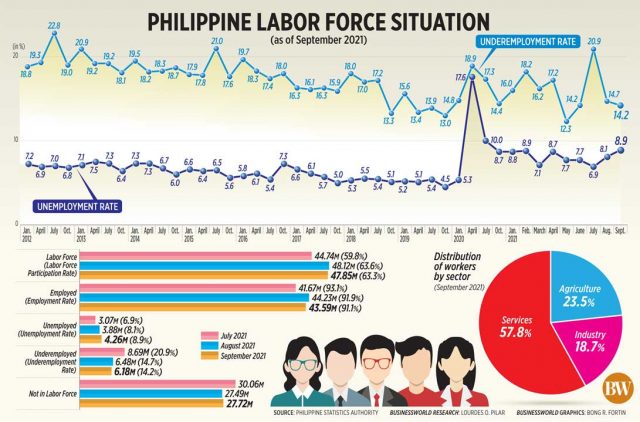
Philippine labor force situation (Sept. 2021)

THE UNEMPLOYMENT RATE rose to 8.9% in September, as bad weather left nearly 900,000 without work in the farm sector and strict lockdowns claimed over 340,000 factory jobs, the Philippine Statistics Authority (PSA) reported on Thursday. Read the full story.

Philippine labor force situation (Sept. 2021)

PHL AirAsia sees tourism starting to recover as flights resume to key destinations

REUTERS

PHILIPPINES AIRASIA, Inc. said Thursday that the return of more destinations to its network has been driven by their opening for leisure travel, signaling the beginnings of a “recovery” for the tourism industry.

“Aside from Caticlan (Boracay), Bohol and Cebu, leisure travelers may now also fly to Puerto Princesa, Iloilo Province, Bacolod, Davao and Tacloban to enjoy their much missed getaways,” Philippines AirAsia said in a statement.

Such destinations now only require vaccination cards in lieu of a coronavirus test or a medical certificate.

“Reopening of leisure travel for most parts of the country signals recovery for the tourism industry,” the low-cost airline said.

It also said that the easing of restrictions provides a “welcome boost to end the year on an encouraging note.”

In its analysis published on Oct. 19, the Center for Asia Pacific Aviation said, citing International Air Transport Association projections for next year, that “‘Within-Asia’ traffic… is forecast to be still nearly 90% below 2019 levels for the full year 2022.”

“Before the coronavirus pandemic, the Asia Pacific region accounted for about a third of global RPKs (revenue passenger kilometers). But in 2022, the region will now remain approximately three-quarters below Europe and North America,” it added.

AirAsia said it logged a 50% increase in seats sold in October.

Load factor for the same month also grew 76%, with Boracay, Cebu, Tacloban, Bohol and Iloilo as the leading destinations.

“The spike in forward bookings is also seen to increase further with the recent decision of the Department of Tourism’s to fully subsidize the RT-PCR (reverse transcription-polymerase chain reaction) test for qualified local tourists,” the airline said.

The airline said last month that it was hoping to rehire laid-off workers in the Philippines by the second quarter of 2022.

The airline also plans to reopen some of its regional routes, including Hong Kong, Singapore, Taiwan, Thailand, and Malaysia. — Arjay L. Balinbin

Prices for some Christmas Eve dinner foods expected to rise 4-8%

PHILSTAR

THE PRICE of some foods typically consumed on Christmas Eve may rise between 4% and 8%, according to the Philippine Amalgamated Supermarkets Association (Pagasa).

Pagasa President Steven T. Cua said in a television interview Thursday that selected foods for Christmas Eve dinner, known as “Noche Buena” could see price increases of up to P2 depending on the size of the product.

“We have to plan what we need to buy so that we can meet our budget. Always have a list of things to buy. Consumers can stick to a budget,” Mr. Cua said.

According to Mr. Cua, price increases for such foods will need to be carefully managed because they will affect the entire supply chain. In terms of volume, however, he expects supply to be sufficient because of weak demand.

“As long as people have money, either from ayuda (cash aid), remittances, or 13th month pay, they will buy groceries and Noche Buena items,” Mr. Cua said.

The Department of Trade and Industry (DTI) has said that only four of 11 Noche Buena product categories that it tracks are covered by active price hike petitions, including ham, tomato sauce, pasta, and cream.

The DTI said no such applications were submitted for fruit cocktail, cheese, sandwich spread, mayonnaise, the variety of Edam cheese known as keso de bola, spaghetti, and macaroni. — Revin Mikhael D. Ochave 

DoF’s Dominguez proposes climate financing via multiple channels

REUTERS

FINANCE Secretary Carlos G. Dominguez III said climate financing should be done through grants, investment, and subsidies to improve vulnerable communities’ ability to adapt to climate risks.

Mr. Dominguez, who represented the Philippines at the 26th United Nations Climate Change Conference (COP26) in Glasgow, said that climate financing should be done through this three-point “blended approach.”

He had been pushing for more climate financing from wealthy economies that have not offered enough to help developing nations reduce their carbon footprints as they transition to clean energy.

Such countries bear the most responsibility for their historic emissions, he said in the lead up to the conference.

In a statement issued by the Department of Finance (DoF) Thursday, Mr. Dominguez said: “Grants should come in the form of educational or technical assistance programs to help people conceive and execute localized projects on the ground.”

Investment should focus on projects that create business opportunities and jobs that lead to energy self-reliance, he added.

Subsidies must address the financial costs communities take on to transition to climate-resilient economies as they start moving away from power plants that use fossil fuel.

“This blended approach should be at the heart of climate finance. Given that such funds come from investors and taxpayers, accountability and transparency must be ensured,” Mr. Dominguez said at the 4th High-Level Ministerial Dialogue on Long-Term Finance.

“Beneficiary countries need to constantly assure their donors and taxpayers and investors that their money is being used prudently.”

The dialogue tackled the progress made by countries to come up with a financial system to support climate resilience. Representatives from the UK, Uruguay, the NatWest group, and the Organisation for Economic Cooperation and Development also joined the meeting.

The Philippines has committed to reduce greenhouse gas emissions by 75% from 2020 to 2030. Of the 75% target, just 2.71% can be achieved with internal resources, while the remaining 72.29% is conditional on international assistance. — Jenina P. Ibañez

OceanaGold starts processing at Didipio mine

OCEANAGOLD.COM

CANADIAN-AUSTRALIAN mining firm OceanaGold Corp. said it started mineral processing at its Didipio gold and copper mine project in Nueva Vizcaya and Quirino provinces, a few months after securing a contract renewal from the government.

Scott Sullivan, OceanaGold chief operating officer, said the start of milling is two weeks ahead of schedule, following the completion of plant upgrades and maintenance activities, while the start of mining activity was one month earlier than planned.

“Following the confirmation of the Didipio Mine Financial or Technical Assistance Agreement (FTAA) renewal, Didipio is producing gold and copper again, which will be an important source of free cash flow generation for the company and a significant contributor of socio-economic benefits for the region and country,” Mr. Sullivan said in a statement Thursday.

“As the underground mining operations continue to ramp up over the course of the next eight to nine months, the primary ore feed will be sourced from low-grade stockpiles, of which the company has approximately 23 million tons of ore on surface,” he added.

According to OceanaGold, the Didipio process plant is estimated to hit throughput at a pace of 3.5 million tons per annum over the next few weeks.

It added that for the rest of 2021, the company expects to produce between 7,000 and 12,000 ounces of gold and 1,000 tons of copper with estimated all-in costs of between $100 and $150 per ounce on a by-product basis.

OceanaGold said it continues to ramp up operations to full production to rates of 10,000 ounces of gold and 1,000 tons of copper a month, while it managing risks from the coronavirus disease 2019 (COVID-19) pandemic.

In July, OceanaGold said it obtained a renewal of its FTAA for another 25 years, applied retroactively from June 19, 2019.

Modifications to the FTAA include a listing requirement of at least 10% of OceanaGold Philippines, Inc. shares on the Philippine Stock Exchange within the next three years, augmenting the percentage of gross revenue allotted for community development, and the transfer of its main office to a host province within the next two years.

The Mines and Geosciences Bureau has called the reopening of the Didipio mine an important boost to the national economy, along with the issuance of Executive Order No. 130, which lifted the ban on new mineral agreements. — Revin Mikhael D. Ochave 

Business group backs education oversight bill

PHILSTAR

AN INDUSTRY association backing education reform said Congress and Malacañang must prioritize a bill that proposes to grant legislators oversight over education, which was among the sectors hardest hit by the COVID-19 (coronavirus disease 2019) pandemic.

The Philippine Business for Education (PBEd) urged President Rodrigo R. Duterte Thursday to certify as urgent House Bill 10308 or the proposed Congressional Oversight Committee on Education Act, which is awaiting second reading.

PBEd Chairman Ramon R. del Rosario, Jr. said that while there are positive developments in the industry such as the pilot reopening of schools on Nov. 15, the committee is needed to drive quality reforms in education.

“Let us call for an independent assessment (mechanism) for learning so that we can better diagnose our weaknesses and come up with targeted solutions,” he said in a news conference.

PBEd warned earlier this year that the education sector is “in a serious crisis” featuring declining access and quality, citing the findings of the Programme for International Student Assessment in 2018, which concluded that 72% of 15-year-olds in the Philippines are low achievers in Reading, Math, and Science.

The measure, if signed, would lead to the formation of a Congressional oversight committee tasked with reviewing, assessing, and recommending courses of action to education agencies such as the Department of Education and the Commission on Higher Education for three years.

The Senate also has a counterpart bill pending at the committee level.

A similar group was formed in 1990 known as the Congressional Commission on Education, which recommended alternative learning modes, promotion of Filipino as a mode of instruction, and additional funding for basic education programs, among others.

PBEd also called for amendments to the measure to include education stakeholders along with the private sector in the composition of the proposed committee.

“Proper representation… ensures that practical and theoretical expertise from the ground is heard. It also facilitates the implementation of reforms because the recipients are involved not just in the discussions, but in the outcomes,” Mr. Del Rosario said.

Pasig City Rep. Roman T. Romulo, chairman of the House Committee on Basic Education and Culture, said that he was open to the suggestion as it would further discussions on the education sector despite the upcoming elections.  

“While politicians are busy with elections, maybe our private partners will be able to proceed with this bill so that the next administration has something to consider because there must be many things that are reviewed to see how it is working,” he said.

However, he said that there should be a mechanism for determining which representatives from the private sector are selected for the committee. He expressed confidence that the bill will be passed by the House before the year ends. Russell Louis C. Ku

Energy dep’t signals continued coal, petroleum reliance

PEXELS-PIXABAY

THE DEPARTMENT of Energy (DoE) said Thursday that it considers coal and petroleum resources to be key to meeting the country’s power needs.

“While we issued a moratorium on coal projects, we still consider coal and oil energy resources vital to the country’s quest for power,” Energy Secretary Alfonso G. Cusi said at a virtual briefing Thursday.

He described Philippines as an “energy-hungry nation” which has yet to attain energy security.

“We do, however, take into consideration the environmental issues surrounding these (coal and petroleum) projects and we are encouraging hybridization of conventional energy plants to balance their effect on the environment,” Mr. Cusi said.

He added that the country is keen on ramp up production of petroleum products and coal.

Last year, power plants running on fossil fuels accounted for 78.8% of aggregate electricity output, according to the Philippine Energy Plan. Coal facilities and oil-based power plants produced 58.2 terawatt-hours (TWh) and 2.5 TWh, respectively.

During the briefing, Mr. Cusi also reiterated the department’s plans to establish the Philippines as a destination for investment in natural gas.

“We see natural gas as the fuel of the future. We hope that the facilities being put up in the country right now will help us attain energy security and that we can still make the Philippines the next LNG (liquified natural gas) hub of our region, given our strategic location,” he said.

At present, the country only has one indigenous gas field — the Malampaya project — which is set to be commercially depleted by 2027.

The offshore field produces power for five gas-fed plants on Luzon, which service 20% of national demand. — Angelica Y. Yang

First Philec expects ‘green’ transformers to launch as scheduled

FIRSTPHILEC.COM

MANUFACTURER First Philec, Inc. said the launch of its so-called green transformer is on track for a fourth-quarter release, with plans for it to be sold in overseas markets.

“Definitely, we are ready to launch it by fourth quarter,” First Philec President Ariel C. Ong said at a virtual briefing Thursday.
“We are actually in the final stages of our plans to enter an international market,” Mr. Ong said.

First Philec is a unit of First Philippine Holdings Corp.
Distribution utility Manila Electric Co. (Meralco) will be the first recipient of the transformers.

“They’re very open to sustainability solutions so we’re going to give them a few samples to evaluate,” Mr. Ong said of Meralco.

The company has said that its new transformer is made of 100% recyclable and biodegradable materials. The transformer features insulating coolant made from natural ester, a vegetable-based and non-polluting oil product sourced from sustainably-grown crops.

First Philec said its new product aims to reduce system losses and improve distribution efficiency, benefitting power providers and their customers.

The company gave no details on product pricing.

First Philec has installed over 250,000 transformers in the Philippines. It claims to be the largest manufacturer of amorphous or energy-efficient transformers in Southeast Asia. — Angelica Y. Yang