Home Blog Page 6727

InLife captures the good in life on its 111th year

It is often said that one’s true character is revealed during difficult times – when there are challenges, or during moments of struggle and unease.

To the Filipino, these are the moments where he emerges triumphant. These are the times when he sees the silver lining in the situation and choose to focus on the good that life has to offer.

For our 111th anniversary celebrations, InLife launched a nationwide video and photo competition where entrants were asked to highlight the good in life, as expressed through Filipino values.

What came out from the entries are a surprising array of heart-tugging and astoundingly inspiring stories and images that focus on the family, the love for others, and service towards our fellow Filipino.

Inspiring short films

Padyak

The grand prize went to Crismel Gida who gave us a moving short film called Padyak. It is a story about resilience and the will to thrive amidst adversities.

The film offers us a glimpse of the Filipino’s innate longing to make something out of himself in any situation, confident in his ability and guided by his faith in the Lord.

Ang palabas na ito ay isa lamang halimbawa pero nangyayari talaga sa totoong buhay. Ito ay angkop kahit ano mang estado. Ginawa ko ang munting palabas na ito para ipakita sa mga tao na kahit ano pang problema ang dumating sa buhay mo ay kaya mong solusyunan,” Crismel said about his short film.

Mga Mata ng Pag-asa

Adjudged 2nd best short film was Ninoy Tuyay’s entry that tackles the theme of being strong for one’s family. “Mga Mata ng Pag-asa” narrates a father’s concerns going through the pandemic and the uncertainties that it brings.

Yet looking at the situation through the eyes of the child, perspectives change. Ultimately, this short film teaches the viewers that the values that we hold dear will get us through difficult times, for one’s family and for others.

Nawa’y mahanap natin ang inspirasyon araw-araw sa ating mga puso, at makita ang pag-asa, na maganda ang buhay,” said Nino.

A new reality

It may seem trivial, but the short film “A new reality” presents another perspective in looking at the pandemic: the youth’s detachment from social engagements.

As the third-place winner, “A new reality”, which was created by Angelo Christian Crisostomo, tells a story about being stuck in one’s home and the ways that the youth of today do to cope with the situation.

“This short film is based on my experience. May pandemic, bawal lumabas, mahirap siya lalo na sa mental health,” explained Angelo who further shared that the youth are also suffering from the disconnect that the lockdowns imposed.

Touching stills

Some of the most dramatic depictions of the good in life were captured in the photography submissions.

Of these, there is none like Danny’ Victoriano’s winning piece, Frontliner Hero, where a medical worker is perceived to happily render service behind a protective mask. The second prize went to Don Gapasin’s ecstatic image of a boy, enjoying a plentiful harvest in the countryside. The third best photograph went to Froi Rivera’s “Cat-Pamilya”, a unique take on what it means to be family that transcends the human experience.

The Good In Life

InLife’s video and photo competitions garnered hundreds of entries from all over the country, each one of them offering a different vista of what consists the good in life.

Although perspectives might differ from one another, what is clear is that no matter the human condition, life can be fulfilling even during difficult moments.

Our grand winners just proved it!


Spotlight is BusinessWorld’s sponsored section that allows advertisers to amplify their brand and connect with BusinessWorld’s audience by enabling them to publish their stories directly on the BusinessWorld Web site. For more information, send an email to online@bworldonline.com.

Join us on Viber to get more updates from BusinessWorld: https://bit.ly/3hv6bLA.

DoF backs move to import more pork until end-2022 

PHILIPPINE STAR/ MICHAEL VARCAS

FINANCE SECRETARY Carlos G. Dominguez III on Monday said he is backing a proposal to extend the validity of an executive order that will increase pork import volumes until end-2022.

The government, through Executive Order (EO) 133 in May, raised the minimum access volume (MAV) for pork imports to 254,210 metric tons (MT) this year from the previous 54,210 MT to address the spike in pork prices.

However, Mr. Dominguez said he is “not entirely” satisfied with the implementation of such measures.

“I understand there were regulations imposed by the Department of Agriculture limiting the access of imported pork to certain markets,” Mr. Dominguez said in a Viber message to reporters.

The National Economic and Development Authority (NEDA) earlier said it was considering extending the EO 133 until end of 2022, amid low utilization of the MAV and continued high pork prices.

Asked if he supports the NEDA’s proposal, Mr. Dominguez replied: “Yes, I am.”

According to the Customs data, the government lost P3.67 billion in foregone revenues from pork imports from April 9 to Dec. 10. This as the government implemented EO 128 and 134, which reduced the tariff rates on pork imports covered by the MAV, since April.  EO 134 will expire in May 2022.

In an economic bulletin on Monday, Department of Finance (DoF) Undersecretary and Chief Economist Gil S. Beltran said the government should adopt “more liberal” import measures for meat and fish products to ease inflation worries amid the holiday season.

Inflation eased to 4.2% in November, from 4.6% in October. However, the print was still beyond the 2-4% target range set by the Bangko Sentral ng Pilipinas (BSP).

“But the high month-on-month inflation for meat and fish reminds authorities to adopt more liberal import measures to meet the peak demand during the holiday season,” he said.

Month on month, the general price index rose by 0.69% due to food. Meat prices quickened by 2.41% month on month as pork supply remained low despite higher demand. Fish prices increased by 2.06% as supply dropped amid the closed fishing season.

Socioeconomic Planning Secretary Karl Kendrick T. Chua last week flagged the low utilization of the expanded pork MAV and slow release of frozen pork inventory.

“The uptick in prices in November shows that we need to further ease administrative requirements for the unloading and distribution of stocks to encourage more importation and help bring back pork prices to their pre-African Swine Fever level,” Mr. Chua earlier said. — LWTN

PHL secures $250-M loan to buy vaccines

PHILIPPINE STAR/ MICHAEL VARCAS

THE PHILIPPINES secured a fresh $250-million loan from the Asian Development Bank (ADB), which will be used to buy more coronavirus disease 2019 (COVID-19) vaccines next year.

In a statement on Monday, the multilateral lender said it approved the loan that would help the Philippine government acquire 40 million COVID-19 vaccine doses for eligible children and booster shots for adults.

“ADB is supporting the government’s drive to provide vaccines to protect its citizens and save lives, especially with the emergence of new COVID-19 variants. Vaccination will allow the health system to better manage the effects of the virus and will help sustain economic recovery. It is key to the country’s full recovery from the pandemic,” ADB Principal Social Sector Specialist for Southeast Asia Sakiko Tanaka said in a statement.

The vaccine procurement project will be co-financed by the Asian Infrastructure Investment Bank (AIIB), which will also give a $250-million loan for vaccine procurement. The ADB and AIIB will directly pay the vaccine manufacturers for the doses that will be ordered by the Health department.

The ADB loan comes after the Philippines secured a new $600-million loan from the World Bank (WB) over the weekend. The WB loan will support the Philippine government’s reform programs, including the amendments to the Retail Trade Liberalization Act.

These loans will add to the government’s pandemic-related foreign borrowings that reached $23.4 billion as of Dec. 7, Finance Secretary Carlos G. Dominguez III earlier said.

Most of the foreign loans were used for COVID-19 response and recovery projects, including vaccine procurement.

The National Government’s outstanding debt, both domestic and external, widened to P11.97 trillion as of end-October. This is 19.38% higher than a year earlier.

Latest data from the Department of Health showed 37.431 million Filipinos are fully vaccinated against COVID-19. Data from the Johns Hopkins University showed 36.59% of the population has already been fully vaccinated.

The government hopes to fully vaccinate at least 54 million Filipinos by the end of 2021.

In March, the ADB also helped the Philippines purchase 85.6 million doses of COVID-19 vaccines through bilateral agreements. As of Dec. 2, 81% of the supply has been delivered.

In November, the ADB approved a $600-million loan to support the implementation of the country’s universal healthcare reform program. — L.W.T.Noble

Vehicle sales surpass 2020’s total as of Nov.

PHILIPPINE STAR/ MICHAEL VARCAS
Traffic is seen along Commonwealth Avenue in Quezon City, Dec. 1. — PHILIPPINE STAR/ MICHAEL VARCAS

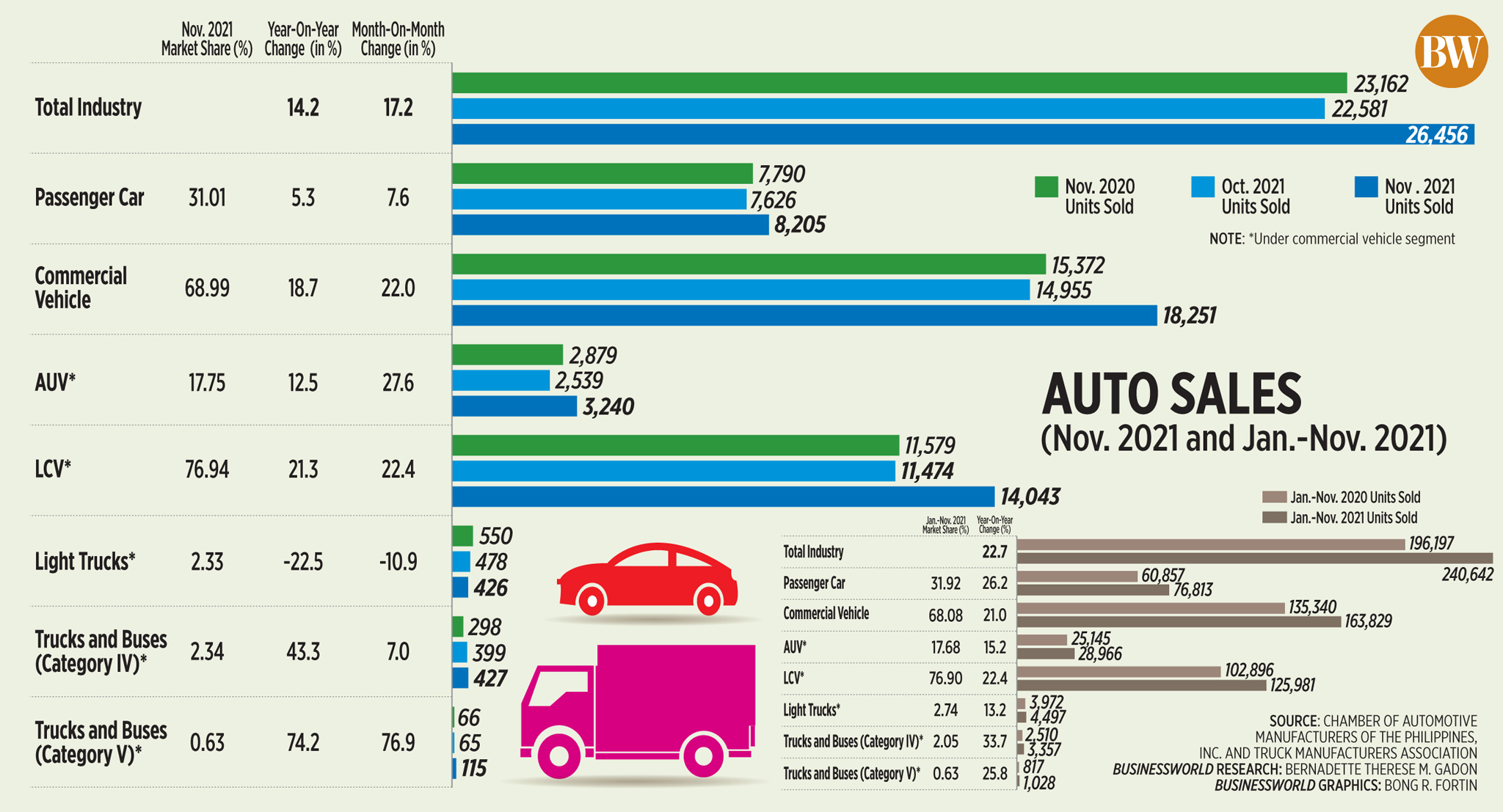
CAR AND TRUCK manufacturers reported their sales grew by double digits in November, allowing the industry to exceed last year’s total sales as demand picked up amid the further easing of lockdown restrictions.

In a joint report by the Chamber of Automotive Manufacturers of the Philippines, Inc. (CAMPI) and Truck Manufacturers Association (TMA) released on Monday, vehicle sales in November jumped by 14% to 26,456 units, an improvement from 23,162 units reported in the same month last year. 

This was also a 17.2% rise from October’s vehicle sales which stood at 22,581.

Auto Sales

CAMPI President Rommel R. Gutierrez said the 17.2% month-on-month growth in sales is the highest monthly performance so far in 2021.

CAMPI and TMA members have already surpassed last year’s sales total as of November, he added.

In the first 11 months, the industry sold 240,642 units, up by 22.7% from the 196,197 units sold during the same period last year. In 2020, total industry sales plunged by 40% year on year to 223,793 units due to the pandemic-induced lockdowns.

“Surpassing our last year’s sales performance gives the industry a renewed hope that recovery is underway as restrictions started easing, and economic activities have resumed at improved levels,” Mr. Gutierrez said in a statement.

The government relaxed mobility restrictions as the number of coronavirus disease 2019 (COVID-19) cases declined. The National Capital Region and most areas in the country were placed under Alert Level 2 starting in November.

“However, the industry remains cautious and on guard at the same time on the uncertainties brought by the COVID-19 mutations, which hopefully will not undermine our recovery,” Mr. Gutierrez said.

In November alone, passenger car sales grew 5.3% year on year to 8,205 units and by 7.59% month on month.

This brought 11-month sales of passenger cars to 76,813 units, up 26% year on year.

The report also showed 18,251 commercial vehicles were sold in November, rising by 18.7% from the 15,372 units sold in the same month a year ago. Asian utility vehicles, light commercial vehicles, trucks, and buses all recorded double-digit sales increases.

Only light truck sales reported a decline. Sales of light trucks contracted by 22.5% year on year to 426 units, which was also 11% lower from October sales.

For the first 11 months of the year, commercial vehicle sales stood at 163,829 units, 21% higher than the same period in 2020.

Year to date, Toyota Motors Philippines Corp. (TMP) still had the largest market share at 48.27%, after selling 116,165 units.

Mitsubishi Motors Corp.’s market share stood at 13.91%, with 33,483 units sold.

Ford Motor Company ranked third in terms of market share with 7.5%, after selling 18,154 units.

“The paradigm shift to online sales and marketing methods and activities will definitely continue. This has become a viable strategy for the automotive industry to meet the needs of our stakeholders,” Mr. Gutierrez said. — RMDO

Gov’t seeks bidders for P74-B Davao bus system

FREEPIK

By Arjay L. Balinbin, Senior Reporter

THE GOVERNMENT is now seeking bidders for the design-and-build contracts for a P73.93-billion bus system project in Davao City.

In its invitation for bids, the Department of Transportation (DoTr) said the Philippine government has applied for financing from the Asian Development Bank (ADB) for the Davao Public Transport Modernization Project, which is also known as the Davao High Priority Bus System Project. 

ADB said the project intends to introduce a modern bus system in Davao City to replace the current public utility jeepneys. The project will include new buses, optimized bus routes, bus stops, bus depots or terminals, and improved roads.

The DoTr is seeking bidders for three contract packages, including a contract that covers the construction of Buhangin Depot, Calinan Depot, and Calinan Driving School.

The second contract is for the Toril Depot and Terminal, Bunawan Terminal, and Calinan Terminal, while the third contract covers the civil works along bus routes, including bus stops, bus lanes, and other pedestrian improvement works.

It will be an open competitive bidding, and will follow ADB’s “Single-Stage: One-Envelope” procedure. This means that bidders will submit bids in one envelope containing both the price proposal and the technical proposal. The envelopes will be opened in public at the date and time advised.

After evaluation and approval, the contract will be awarded to the bidder whose bid has been determined to be “the lowest evaluated substantially responsive bid,” the multilateral lender says on its website.

In a phone message to BusinessWorld, Transportation Assistant Secretary Goddes Hope O. Libiran said the civil works alone will cost P19.71 billion, while the bus fleet, both diesel and electric, will cost P21.17 billion.

The deadline for the submission of bids is Jan. 6, 2022, the DoTr said.

“Bidders may bid for a single contract only or for any combination of contracts. In case the bidder would wish to submit bids for more than one contract, such bids should be submitted independently and not combined into a single bid,” it added.

The DoTr will look at and compare bids for each contract separately or “multiple contracts combined” to arrive at the “least-cost combinations.”

The department said it will also consider the discounts offered by bidders for the award of multiple contracts.

Key qualifications for the bidders include an average annual construction turnover of more than $109 million for the first contract, $101 million for the second contract, and $119 million for the third contract.

Bidders must prove that they have minimum available finances of $14 million for the first contract, $13 million for the second contract, $15 million for the third contract.

They should also prove that in the past 10 years, they have “successfully or substantially (80%)” completed at least one similar project that is at least one kilometer and a project of more than $71 million for the third contract.

Bidders should also be able to furnish a bank security of $820,000 for the first contract, $760,000 for the second contract, and $890,000 for the third contract.

They likewise need to demonstrate that they have adequate equipment and staff.

Interested parties will pay a non-refundable fee of P75,000 for each set of bid documents.

The ADB said the project will also include a traffic management system, which will prioritize bus transport, and social development program for affected people, as well as introduce performance-based contracts with bus operators.

Telcos ramping up investments in cybersecurity

BW FILE PHOTO

By Arjay L. Balinbin, Senior Reporter

THE PLDT group and Globe Telecom, Inc. on Monday said investments in their cybersecurity capabilities have been increasing, as they continue to work to protect their customers from online threats.

“Our spending has already been more than P2 billion, closing to P3 billion,” Angel T. Redoble, first vice-president and chief information security officer of PLDT Group, ePLDT, and Smart Communications, Inc., said at a virtual round table discussion.

“Definitely, it’s not a ‘one-time, big-time’ thing. When I started in the last quarter of 2018, the board approved a three-year strategy that we started to implement in 2019,” he added.

PLDT group’s cybersecurity implementation is based on strategy, innovation, and direction of its top management team.

“For every strategy, there is a corresponding budget. What is very important here is that the president and chief executive manager in the top management team is very supportive of [the] budget that we have asked for, and that is based on strategy and based on year-on-year goals and objectives that we are trying to achieve,” Mr. Redoble noted.

In a separate virtual briefing, Globe Chief Information Security Officer Anton Reynaldo M. Bonifacio said: “Investments have been already… almost $80 million since 2015.”

“We continue to invest in that space… We have been investing this much without any promise of ROI (return on investment),” he added.

Globe and Smart have both intensified their awareness campaigns to help their subscribers protect themselves from cyberattacks.

Concerns about cybersecurity and data privacy have increased due to a rise in Short Message Service (SMS)-based phishing attacks or smishing.

Smishing attacks use text messages to trick mobile phone users into visiting malicious websites.

“The WhatsApp online messaging platform was… compromised this year, an incident where around two billion users were affected by the data breach. However, these are all just possibilities, as data can come from multiple sources virtually,” PLDT’s Mr. Redoble said in a recent statement.

PLDT and Smart recently reported that the number of blocked attempts made by users to the websites designed to lead them to fraudulent job hiring schemes had declined to only 8,902 on Dec. 5 from 21,112 on Dec. 3.

Meanwhile, Globe has said it managed to deactivate 5,670 confirmed spam numbers and block close to 71 million spam messages this year alone.

Last year, internet security company Kaspersky said companies in Southeast Asian countries, including the Philippines, were starting to prioritize investing in their cybersecurity capabilities, with many of them planning to raise their IT security budgets over the next three years.

“It is encouraging to see that local companies are starting to prioritize IT security. In fact, our research showed that, on average, businesses in the region are currently spending $14.4 million (P720 million) to build their cybersecurity capabilities,” Kaspersky General Manager for Southeast Asia Yeo Siang Tiong said in a statement.

Hastings Holdings, Inc., a unit of PLDT Beneficial Trust Fund subsidiary MediaQuest Holdings, Inc., has a majority stake in BusinessWorld through the Philippine Star Group, which it controls.

Punching above its weight

SCENES from the film Gensan Punch

THE PREMISE of Gensan Punch sounds unlikely: a disabled Japanese man dreams of becoming a professional boxer, and goes to General Santos City to follow his dream. And yet, it is a true story. And has been made into an HBO Asia Original film which has won an award.

Inspired by the true story of boxer Naozumi Tsuchiyama, Gensan Punch premieres exclusively on HBO GO on Dec. 16.

Directed by Brillante Mendoza and written by Honee Alipio, the film follows a Japanese man who lost his leg but who dreams of becoming a boxer. In pursuit of this dream, he goes to the Philippines to train and become a professional boxer at the Gensan Quarter of General Santos City. The film tackles the issue of discrimination towards the disabled in the competitive sport.

In October, the film won the Kim Jiseok Award at the 26th Busan International Film Festival, sharing the award with The Rapist by Aparna Sen from India. The award is given to films reflecting the contemporary standing of Asian cinema.

During an online press conference with media from Asia on Dec. 10, the film’s director Mr. Mendoza said that he had to familiarize himself with both Japanese culture and the sport of boxing for the film.

“What was most memorable to me is meeting the Filipino boxers in Gensan. Because I only see sports from outside the arena. You don’t know anything about their lives,” Mr. Mendoza said.

Lead actor Itokazu Shogen, who plays the role of Naozumi Tsuchiyama, said that he trained like an athlete for the role and spoke to an amputee.

“For this film, I just want to dedicate to myself to do boxing. I trained five or six times a week because that is how I show the respect to the boxers,” Mr. Shogen said. “I wasn’t a boxer before I started this film. I don’t have a prosthetic, but I tried to study about them, and I try to understand them to play this role.”

“I was introduced to a lady who has a leg amputation. I tried to talk to her as much as we could and she sent me the video [that] demonstrated [how] she treats prosthetic leg and [how she copes with] some troubles,” he said.

In the film, Mr. Mendoza brings the audience into the lives of athletes who struggle but continue to strive not only for themselves but also their families.

“We cannot have everything, but there are small things that are priceless. There are things that are priceless that we sometimes, we tend to overlook,” Mr. Mendoza said.

Gensan Punch was filmed in both the Philippines and Japan. Also in the cast are Ronnie Lazaro, Kaho Minami, Beauty Gonzales, and Vince Rillon.

Gensan Punch can be downloaded or streamed  on HBO GO starting Dec. 16. Michelle Anne P. Soliman

Razon’s Prime Infra injects P2 billion into solar projects

RAZON-LED Prime Infrastructure Holdings, Inc. (Prime Infra) is investing an additional P2 billion into projects with Solar Philippines Power Project Holdings, Inc. (Solar Philippines), it said on Monday.

Prime Infra, which is headed by tycoon Enrique K. Razon, Jr., said it recently concluded an agreement with Solar Philippines to acquire a 50% stake in the latter’s subsidiary Solar Philippines Tanauan Corp., which involves the P2-billion investment and management control, it said in a statement.

The subsidiary is the corporate vehicle of its solar farms in Tanauan, Batangas and Maragondon, Cavite with a combined capacity of 140 megawatts (MW).

This marks Prime Infra’s second investment in Solar Philippines projects following its P1.5-billion injection into Solar Philippines Tarlac Corp. in 2020 for its 200-MW farm in Concepcion, Tarlac.

“[This] brings the total investment of Prime Infra in projects with Solar Philippines to P3.5 billion, a testament to Prime Infra’s commitment to sustainability and growing its partnership with Solar Philippines,” Prime Infra said.

It said the three projects will create over 2,000 jobs during construction and over 100 jobs during operations.

“When completed, these will be able to power over 200,000 homes. This is equivalent to the displacement of over 240,000 tons of coal per year or 6 million tons of coal for its 25-year economic life,” it added.

Prime Infra specializes in investment, development, and operation of critical infrastructure in emerging markets.

Meanwhile, Leviste-led Solar Philippines, the largest solar company in the country, has over 300 MW of generating capacity and 10,000 hectares of land area in Batangas, Tarlac, and Nueva Ecija which they are eyeing to develop into solar energy zones. — MCL

There is no successor to Succession

HBO series Succession — HBO.COM/SUCCESSION

By Jennifer Saba, Reuters Breakingviews

Television Review
Succession
HBO

SUCCESSION does not have a successor. The HBO series about a fictional mogul and his adult children scheming to replace him is so captivating because it draws on real-life dynasties like Rupert Murdoch’s family. But the personalities that make the show gripping are becoming a relic of the past. The sprawling media businesses created by ruthless, larger-than-life men are being dismantled. It’s hard to imagine today’s tech tycoons providing the same kind of compelling viewing.

Succession, which wraps up its third season on Sunday, revolves around the mythical company Waystar Royco. Logan Roy, played by Brian Cox, is a cutthroat titan in his twilight years who built the conglomerate that operates a powerful cable news network, newspapers, theme parks, and a cruise line. The first season unfolds with the family gathering to celebrate Roy’s birthday. He falls ill and is rushed to the hospital. He recovers, but the central question of who will take his place at Waystar threads the premise for the entire series.

The joy of Succession is its cast of loathsome backstabbers, who plot and conspire inside a world of luxurious Manhattan apartments, five-star hotels, private jets, and Tuscan villas, while skewering each other with withering dialogue. When Roy’s disapproving brother finds out about a journalism school named after Logan, he asks: “What’s next, the Jack the Ripper women’s health clinic?”

Roy’s offspring are equally despicable. Shiv (Sarah Snook) is preening and manipulative and always trying to win her father’s approval. Roman (Kieran Culkin) carelessly texts inappropriate pictures of himself to the company’s long-suffering interim chief executive. Kendall (Jeremy Strong) is so self-absorbed he believes he can tempt shareholders into open warfare against his dad. “We are going to leapfrog Amazon,” he proclaims as he tries to convince his siblings to take his side. The hapless Connor (Alan Ruck) is making a quixotic run for the White House.

Some of the events and characters evoke the career of Sumner Redstone, the architect of Viacom, who died last year. But the parallels with the Murdochs are impossible to overlook. The family that controls Fox and News Corp. have fought for power for decades. In 2015, Mr. Murdoch welcomed back his son Lachlan to Fox and elevated him to co-chair, above his brother James, who was CEO. It set in motion a series of events including a sale of the company’s entertainment and international assets to Walt Disney for $71 billion. James cashed out, broke with the company, and has been taking thinly veiled potshots at the family, including its role in enabling the divisive Fox News network, ever since.

Like Roy, Mr. Murdoch is still clinging to power. He’s chair of both Fox and News Corp., but the companies he controls no longer dominate the media scene. With a combined market value of little more than $30 billion, they’re dwarfed by the likes of Netflix, the $270 billion streaming juggernaut. When Mr. Murdoch dies, his four adult children will be in charge in what could be a potentially messy and nasty struggle. But the companies are more likely to be takeover targets than predators.

Succession also demonstrates how Silicon Valley has replaced media companies in terms of financial potency and influence. In a desperate attempt to stay relevant, the Roy family courts Lukas Matsson, the founder of a streaming company, GoJo, played by Alexander Skarsgard. “Success doesn’t interest me anymore,” he declares. “It’s too easy.”

Yet while the introverted Matsson may have the upper hand in the digital age, it’s hard to envisage his character inspiring a series like Succession. The same is true in real life. Modern media leaders like Disney’s Bob Chapek and Comcast’s Brian Roberts are too buttoned down to animate sharp satire. Tech billionaires like Alphabet’s Sergey Brin and Larry Page appear to lack the lust for power that makes characters like Mr. Murdoch so controversial and fascinating. Perhaps in four decades’ time Mark Zuckerberg’s then-adult children will spark a new drama by fighting their aging father for control of Meta Platforms. Until then, Succession marks the end of the family line.

The author is a Reuters Breakingviews columnist. The opinions expressed are her own.

ICTSI’s Madagascar concession extended

LISTED port operator International Container Terminal Services, Inc. (ICTSI) announced on Monday that its subsidiary, Madagascar International Container Terminal Services Ltd., recently signed an extension to its concession agreement with the Société de Gestion du Port Autonome de Toamasina (SPAT).

Madagascar International operates the port of Toamasina in Madagascar. It has held the concession since 2005.

The two companies “extended the original concession agreement, which was to end in October 2025, by 15 years to 2040,” ICTSI said in a disclosure to the stock exchange.

The Port of Toamasina serves as Madagascar’s primary maritime gateway.

“Throughout its tenure MICTSL (Madagascar International Container Terminal Services Ltd.), working in conjunction with SPAT, has consistently added capacity and streamlined services in line with the needs of Madagascar’s diverse import and export community,” ICTSI said.

“The concession extension complements the $639-million port expansion project now underway in Toamasina — with $411 million provided by the Japan International Cooperation Agency and $227 million by the government of Madagascar,” it added.

The project, ICTSI noted, ensures the long-term availability of modern port capacity.

“When ICTSI, working with SPAT, first established a container terminal operation in Toamasina, it quickly became widely recognized as a center of excellence in the region,” ICTSI Senior Vice-President Hans-Ole Madsen said.

“Today, in this new phase of development, we aim to maintain this momentum, drawing on our industry expertise, new technology, attention to sustainability and applying the principles of good corporate citizenship,” he added.

For the first nine months, ICTSI’s total revenues hit $1.37 billion, a 24% increase from $1.1 billion previously.

Its net income attributable to equity holders for the January to September period was $316.4 million, 73% higher than the $182.6 million earned in the same period a year ago.

Its capital expenditures, excluding capitalized borrowing costs, for the first nine months reached $104 million. The company’s total budget for the year is about $250 million.

ICTSI shares closed 0.96% lower at P195.50 apiece on Monday. — Arjay L. Balinbin

Return-to-office plans turn ‘shybrid’ with ongoing delays

THE Empire State Building rises above Manhattan in front of the Brooklyn and Manhattan bridges as seen from an apartment in the Central Park Tower building in New York, U.S. Sept. 17, 2019. — REUTERS/LUCAS JACKSON

A NEW wave of COVID uncertainty has again put millions of US workers in limbo about when — or if —  they need to return to the office.

Lyft, Inc. employees who were supposed to be back at their desks in February now won’t be required to show up until 2023. Ford Motor Co. pushed back a January return to date to March, while Google and Uber Technologies, Inc. shelved their plans indefinitely to see how the omicron variant plays out. Jefferies Financial Group, Inc. this week told its staff to go back to remote work after offices had reached 60% attendance.

The latest bout of COVID whiplash means that many white-collar Americans will be approaching two full years of remote work with no certainty about how long it will last. All the while, the chasm grows between executives who want to eventually get people back at their desks and their workers’ reluctance to comply. And while post-pandemic work models are clear for companies such as Goldman Sachs Group, Inc. (most people should be back in the office) and Twitter, Inc. (most people can be fully remote), many other firms are still formulating a strategy.

“We coined this term ‘shybrid,’” said Paul McKinlay, vice-president of communications and remote working at printing company Cimpress and its unit Vista, which both opted to go with a permanent remote-first model in August 2020. “It’s the failure of companies to accept that they have, in many cases, lost the right to demand in-person attendance at a piece of real estate on any kind of regular basis. It’s about continually pushing back return dates without declaring on a future model and leaving people in this limbo.”

Almost half of human-resources leaders are looking to reduce office space as they develop future hybrid models, yet close to a quarter said they expect staff to fully return to an in-office setting, an August survey by Grant Thornton found. Only 11% of the more than 500 HR executives polled said they plan to go fully remote. At the same time, only 17% of non-executive workers want to return fully to the office and many are open to new jobs to maintain flexibility, according to a Future Forum Pulse survey of more than 10,000 workers in the US, Australia, France, Germany, Japan and the UK in late July and early August.

“There are two conflicting forces that are at play,” said Tim Glowa, Grant Thornton’s principal for human capital services. “Many times it might be a leader/CEO/president who likes to be in the office, has always kind of grown up in the office — probably still wearing suits and probably wants everyone back in the office. And there’s a huge voice from employees saying that they want more flexibility in both where or when they work.”

Deciding early and definitively has been a huge plus for Cimpress and Vista (previously Vistaprint), said Mr. McKinlay, who notes that prior to the pandemic the company was “remote averse.”  About three-quarters of new hires say they picked the printing company specifically because of its remote-work focus, he said.

The company’s Boston-area office has shrunk to about 70,000 square feet of collaborative meeting spaces and shared desks, down from the previous 300,000-square-foot traditional office layout. The same scenario is playing out among smaller offices in places such as New York, London, and Melbourne, Australia, Mr. McKinlay said. Employees who had worked from just nine US states now work remotely in 30.

“I feel so sorry for team members who work for amazing brands, love their teams, and are doing work at what they consider the pinnacle of their careers, and yet they’ve got this thing hanging over their head, which is, ‘All the benefits that you gained during remote work, we’re going to take those away at some point,’” Mr. McKinlay said. — Bloomberg

West Side Story falls flat at box office with disappointing $10-million debut

Rachel Zegler in West Side Story (2021) — IMDB.COM

LOS ANGELES —  Audiences didn’t open their wallets to see the infamous rivalry between the Sharks and the Jets play out on the big screen.

West Side Story, Steven Spielberg’s remake of the classic musical, fell flat in its box office debut, collecting a paltry $10.5 million from 2,820 theaters. That’s cause for concern because Disney and 20th Century Studios spent $100 million to revive the Shakespearean love story for modern times and stand to lose millions, unless West Side Story endures at the box office through the holidays and Oscar season.

It may be possible to attract moviegoers between Christmas and New Years, but it’s a bad start for one of the most critically acclaimed films of the year — and one that opened exclusively in theaters. Though every new movie musical has struggled to entice audiences in COVID times, it’s worrisome for both theater operators and traditional studios that West Side Story — one of the most beloved stories in musical theater history and under the direction of Hollywood’s most commercially successful filmmaker — sold fewer tickets than In the Heights ($11.5 million debut), a lesser known song-and-dance property that premiered simultaneously on HBO Max. West Side Story at least earned more than Universal’s Dear Evan Hansen adaptation, which premiered to $7.4 million in September while playing exclusively in theaters. But that’s not exactly a high bar considering Dear Evan Hansen was skewered by critics. However, In the Heights and Dear Evan Hansen cost far less to make than West Side Story.

“In the past, we’ve seen musicals connect with critics and audiences and go on a run,” says David A. Gross, who runs the movie consulting firm Franchise Entertainment Research. For example, Chicago opened to $10.8 million in 2003 and ultimately earned $170 million, while more recently, The Greatest Showman debuted to $8.8 million and kept chugging along until revenues hit $170 million.

“But that was then, and this is now. Moviegoing conditions remain impaired,” Mr. Gross says. “If West Side Story is going to be profitable, it will need to connect internationally as well as domestically.”

After October set pandemic box office records, thanks to Venom: Let There Be Carnage and No Time to Die, movie theater attendance has taken a downturn. That will change next week when Sony’s comic book sequel Spider-Man: No Way Home hits cinemas. What remains clear, however, is that older audiences haven’t been eager to return to the movies. Most of the tentpoles that have been commercially successful have been catered to younger males.

West Side Story looks like a blockbuster compared to this weekend’s other new nationwide release, STX’s athletic drama National Champions, which went almost entirely unseen despite playing on more than 1,000 screens. The film, starring Stephan James and J.K. Simmons, flopped in its debut, bringing in $300,000 from 1,197 theaters — an embarrassing result even by COVID-19 standards. — Reuters