MarCoPay, a fintech app targeting Filipino seafarers, has launched an e-market feature with HMO (health maintenance organization), insurance, and loan products.
“Seafarers are an essential part of the global economy and supply chain… We are trying to solve [their] pain points,” said Toshiaki Fujioka, president and CEO ofBangko Sentral ng Pilipinas-licensed MarCoPay Inc. (MCP), at an April 6 press briefing.
MarCoPay’s e-market has home and auto loan products through its partner, Bank of the Philippine Islands (BPI). It also has home and car insurance products through BPI MS Insurance (a joint venture of BPI and the Mitsui Sumitomo Insurance Co.), and prepaid HMO products through PhilCare.
Within the app is a quote calculator for auto and home loans, and a premium calculator for home and family insurance. An application can be completed — and its status subsequently monitored — also within the app.
Its other features include salary loans, e-money transfers, and foreign exchange converters.
The company listened to over 3,000 seafarers, their dependents, as well as their manning agencies to help create the app’s features, said Izumi Yamashita, general manager of MCP Innovations, Inc.
“This was created for seafarers with seafarers,” she said at the briefer. “We are on the ground, so we are confident that we provide the best solutions for [them].”
One of the app’s over 7,00 registered users is chief mate Calenn F. Cabading, who has been seafaring since 2011. Sending money back home is a common challenge among seafarers, he said.
“A crew member would save money onboard, and then wait for a crew change schedule before they are able to send money,” he told the audience of the April 6 event. “[Other times], they would need to trust someone else to send money [on their behalf].”
Sending money in the past was akin to sending physical letters that take months to arrive, he added.
“Now we have ease-of-use and secure transactions, whether on land or onboard,” said Mr. Cabiling.
“We don’t want them to work all their lives, and then lose all they worked hard for when tragedy strikes,” she added. “We also [emphasize preparing for] their retirement and their children’s education.”
In the pipeline for the app – which launched on August 2021 – is a prepaid Visa card for purchases, as well as an expansion of its target market.
“We are focused on seafarers in the Philippines, but are planning to enhance our coverage to non-Filipino seafarers and also OFWs (overseas Filipino workers),” said Mr. Fujioka. – Patricia B. Mirasol
Investment and insurance are considered great and time-tested ways to grow money and, more importantly, to financially secure one’s future.
With many instruments and products consumers can choose from, how do we find the investment plan or insurance policy that will help meet our financial goals and assist us in financially securing our future?
This April 6 (Wednesday) at 11:00 a.m., join BusinessWorld Insights, AIA Philippines, and financial experts in a discussion on how making your money work and finding the best plan for you.
Watch it LIVE and FREE on BusinessWorld’s and The Philippine STAR’s Facebook pages.
This session of #BUSINESSWORLDINSIGHTS is supported by the British Chamber of Commerce of the Philippines, Management Association of the Philippines, Philippine Chamber of Commerce and Industry and The Philippine STAR.
Army soldier figurines are displayed in front of the Ukrainian and Russian flag colors background in this illustration taken, Feb. 13, 2022. — REUTERS/DADO RUVIC/ILLUSTRATION
LVIV, Ukraine – The United States and its allies on Wednesday prepared new sanctions on Moscow over civilian killings which President Volodymyr Zelenskiy described as “war crimes”, as heavy fighting and Russian airstrikes pounded the besieged port of Mariupol.
The southern city of Mariupol has been under attack by Russian forces and constantly bombarded since the early days of the invasion almost six weeks ago, trapping tens of thousands of residents without food, water or power.
“The humanitarian situation in the city is worsening,” British military intelligence said on Wednesday.
“Most of the 160,000 remaining residents have no light, communication, medicine, heat or water. Russian forces have prevented humanitarian access, likely to pressure defenders to surrender.” Reuters could not immediately verify the report.
Western sanctions over Russia’s Feb. 24 invasion of Ukraine, the biggest assault on a European nation since World War Two, gained new impetus this week after dead civilians shot at close range were discovered in the northern town of Bucha, seized back from Russian forces.
Moscow denied targeting civilians in Bucha and described evidence presented as a “monstrous forgery” staged by the West to discredit it. Read full story
New sanctions set to be unveiled Wednesday are in part a response to Bucha, the White House said.
The measures, coordinated between Washington, Group of Seven advanced economies and the European Union, will target Russian banks and officials and ban new investment in Russia, the White House said. Read full story
Proposed EU sanctions, which the bloc’s 27 member states must approve, would ban buying Russian coal and prevent Russian ships from entering EU ports.
EU executive Ursula von der Leyen said the bloc was working on banning oil imports, as well. Europe, which obtains about a third of its natural gas from Russia, has been wary of the economic impact a total ban on Russian energy would bring. Read full story
But signalling strengthening EU resolve, Germany’s foreign minister said the coal ban was the first step toward an embargo on all Russian fossil fuel imports. Ukraine says banning Russian gas is vital to securing a deal to end the war in peace talks.
After an impassioned address to the UN Security Council on Tuesday, Zelenskiy said new sanctions “against Russia must be commensurate with the gravity of the occupiers’ war crimes,” calling it a “crucial moment” for Western leaders.
New Zealand said on Wednesday it would impose a 35% tariff on all imports from Russia and extend export bans on industrial products connected to strategic Russian industries.
“The images and reports emerging of atrocities committed against civilians in Bucha and other regions of Ukraine is abhorrent and reprehensible, and New Zealand continues to respond to (Russian President Vladimir) Putin’s mindless acts of aggression,” Foreign Minister Nanaia Mahuta said in a statement.
The United States has agreed to provide an additional $100 million in assistance to Ukraine, including Javelin anti-armour systems, the Pentagon said on Tuesday.
U.S. chipmaker Intel Corp INTC.O said it had suspended business operations in Russia, joining a slew of companies to exit the country. Read full story
In the small Russian city of Kaluga thousands of auto workers have been furloughed and food prices are soaring as Western sanctions hit its flagship foreign carmakers. Read full story
BUCHA BURIAL
Ukrainian officials say between 150 and 300 bodies might be in a mass grave by a church in Bucha, north of the capital Kyiv.
Satellite images taken weeks ago show bodies of civilians on a street in the town, a private U.S. company said, undercutting Russia’s claims that Ukrainian forces caused the deaths or that the scene was staged. Read full story
Reuters reporters saw at least four victims shot through the head in Bucha, one with their hands tied behind their back.
Residents have recounted cases of several others slain, some shot through their eyes and one apparently beaten to death and mutilated.
On Tuesday, Ukrainian Serhii Lahovskyi buried the corpse of a childhood friend who had been shot through the mouth at very close range after disappearing when Russian troops occupied the town. Read full story
Lahovskyi and others grabbed shovels and dug a shallow grave on a grass verge. They used a carpet to carry the remains, placing him in a ditch before covering him with wooden boards and shovelling earth on top.
“Why did these animals shoot him so?” Lahovskyi said, sobbing. “This is not Russia, this is a monster.”
Reuters could not independently verify the details of Lahovskyi’s account or who was responsible for the killings in Bucha.
Since launching its invasion Russia has failed to capture a single major city in what it calls a “special military operation” aimed at demilitarizing and “denazifying” Ukraine.
The Kremlin’s position is rejected by Ukraine and the West as a pretext for an unprovoked invasion that has uprooted a quarter of the country’s population. – Reuters
WASHINGTON – The U.S. State Department has approved the potential sale to Taiwan of equipment, training and other items to support the Patriot Air Defense System in a deal valued at up to $95 million, the Pentagon said on Tuesday.
Chinese-claimed Taiwan has complained of increased military pressure by Beijing to try and force the democratically ruled island to accept its sovereignty.
The package would include training, planning, fielding, deployment, operation, maintenance and sustainment of the Patriot Air Defense System and associated equipment, the Pentagon said, in a notification to Congress.
“This proposed sale serves U.S. national, economic, and security interests by supporting the recipient’s continuing efforts to modernize its armed forces and to maintain a credible defensive capability,” it said.
“The proposed sale will help to sustain the recipient’s missile density and ensure readiness for air operations. The recipient will use this capability as a deterrent to regional threats and to strengthen homeland defense.”
The United States is bound by law to provide Taiwan with the means to defend itself, despite the absence of formal diplomatic ties and the anger such weapons sales always generate in Beijing.
Taiwan’s presidential office noted this was the third arms sale announced since President Joe Biden took office, and showed the “rock solid” nature of their relationship.
“Taiwan will continue to demonstrate its determination to defend itself, and continue to deepen cooperative partnerships with the United States and other like-minded countries,” spokesperson Xavier Chang said in a statement.
Despite approval by the State Department, the notification does not indicate that a contract has been signed or that negotiations have concluded.
The Pentagon said Raytheon RTX.N was the prime contractor for the possible sale.
Taiwan’s Defense Ministry said it expected the deal to “become effective” within the month.
The United States is Taiwan’s main international arms supplier. – Reuters
WASHINGTON – U.S. Treasury Secretary Janet Yellen will press multilateral development banks to channel positive net financing flows to countries hit with food insecurity prompted by the Ukraine war, she said in congressional testimony released on Tuesday.
Yellen, in prepared remarks to the House of Representatives Financial Services Committee for a hearing on Wednesday, said she will ask institutions including the World Bank and the African Development Bank to expand ways to address food security, “including long-term investments in agricultural productivity and agricultural infrastructure.”
The international financial institutions, including the International Monetary Fund, will play a critical role in addressing spillovers from the Ukraine conflict that are heightening economic vulnerabilities in many countries battered by the COVID-19 pandemic, she said.
“The IMF, World Bank, and EBRD (European Bank for Reconstruction and Development) will be critical partners in rebuilding Ukraine, alongside bilateral donors, and they also will provide vital support to neighboring countries welcoming refugees,” Yellen said.
The IMF has provided $1.4 billion in rapid financing for Ukraine, while the World Bank has provided $490 million in rapid financing for Ukraine, part of a $3 billion package of support planned in coming months. The EBRD has proved an initial 2 billion-euro package for Ukraine.
Yellen said this assistance has given Ukraine fiscal space to pay salaries for soldiers, doctors, nurses and civilian government employees while meeting its external debt obligation.
“These are admirable acts of credibility by a government under siege,” she said.
Yellen added that the multilateral development banks should promote energy efficiency and capital investments to help governments diversify away from fossil-fuel-based energy sources including Russia.
She said the Biden administration was seeking congressional authorization to provide financing to bolster IMF lending facilities for poor and vulnerable countries — the Poverty Reduction and Growth Trust and the new IMF Resilience and Sustainability Trust. – Reuters
WarnerMedia CEO Jason Kilar said the future of Hollywood is in the blockchain as he prepares to leave the media company that he helped lead into the streaming era.
Mr. Kilar said he saw new opportunities at the intersection of storytelling and technology although he declined to discuss his next pursuit.
The veteran tech executive said he had no plans to retire after announcing his departure from AT&T Inc T.N unit WarnerMedia ahead of its merger with Discovery Inc DISCA.O in a deal expected to close this month. Read full story
Mr. Kilar‘s career has straddled Hollywood and Silicon Valley, and he sees blockchain, the digital ledgers that keep track of transactions across computer networks, as transforming the entertainment business, especially as the process of acquiring unique digital collectibles such as Non Fungible Tokens becomes simpler.
“I think that’s going to be a potential wave that’s going to be coming to Hollywood, in the same way that the DVD wave came to Hollywood in the ’90s,” Mr. Kilar told Reuters in an interview after he announced his departure to staff on Tuesday.
“Obviously, that changed the economic fortunes of a lot of these companies, WarnerMedia included.”
The blockchain may also open up new forms of financing, Kilar said.
STREAMING WAR
Mr. Kilar has a long track record of pushing technology and change in entertainment.
The former Amazon.com AMZN.O executive was recruited to lead Hulu, because he did not rely on a set of assumptions about the way television should work, according to executives who were involved in the creation of Hulu.
Within two months of Hulu’s launch in March 2008, the site, once dubbed by critics in the blogosphere as ClownCo, surged in popularity.
Mr. Kilar left Hulu in 2013, following disagreements with the company’s owners, the former News Corp NWSA.O, NBCUniversal and the Walt Disney Co DIS.N, which had pushed for more advertising and an end to the free version of the service.
Mr. Kilar launched his own subscription video service for social media content, Vessel, which was subsequently sold in 2016 to Verizon, and four years later he joined WarnerMedia, just as the COVID-19 pandemic was spreading.
That experience led him to changes which threaten to reshape Hollywood. Faced with closed movie theatres and surging competition online, Kilar shattered the traditional release “windows” for films, which have always brought movies into homes after lengthy showings in theatres.
Mr. Kilar premiered new films in theatres and on the HBO Max streaming service on the same day, during the pandemic. The experiment began with the premiere of “Wonder Woman 1984″ on Christmas Day 2020, and continued through 2021.
The move provided a steady flow of new entertainment to the service at a time when the pandemic had disrupted production schedules throughout the industry. It also helped the fledgling HBO Max, and the HBO cable TV network, to add 73.8 million subscribers.
“History has shown that incumbents tend to fight trends that challenge established ways,” to their detriment, Mr. Kilar wrote in a 2011 blog post. – Reuters
SAN FRANCISCO/NEW YORK – Did Elon Musk break securities laws again?
Former securities officials and professors said Musk may have missed a key disclosure deadline when he bought 9% of Twitter. And Securities and Exchange Commission regulators could use any shortfall to try to punish Musk more for other lapses, some believe.
Musk on Monday disclosed that he bought a 9.2% stake in Twitter Inc TWTR.N, making him the micro-blogging site’s largest shareholder and triggering a rise of more than 27% in the company’s shares. The filing said March 14, 2022 is the date of the event that requires the statement.
U.S. securities law requires disclosure within 10 days of acquiring 5% of a company, which in Musk‘s case would be March 24. A late report could lead to per-violation civil penalty of up to $207,183, when adjusted for inflation, according to Urska Velikonja, a law professor at Georgetown University Law Center.
That’s a financial slap on the wrist for Musk, the world’s richest person with $302 billion net worth, according to Forbes, but the regulator could look into market manipulation allegations regarding the Twitter stock buy and seek harsher sanctions in an ongoing investigation regarding his Tesla stock sales, experts say.
“This is not really a gray area. He acquired it and didn’t file within 10 days. It’s a violation. And so this is a slam dunk case from the SEC perspective,” Adam C. Pritchard, a law professor at University of Michigan Law School, said.
The SEC is also investigating Musk‘s Nov. 6, 2021, tweet asking his followers whether he should sell 10% of his Tesla stake. The regulator reached a 2018 deal for Musk to get preapproval on some of his tweets, following a Musk tweet that he had “funding secured” to take Tesla private. The SEC said that defrauded investors.
The SEC said last month it has told Musk’s and Tesla’s counsel that staff are conducting an investigation relating to potential federal securities law violations.
Pritchard said the SEC could “tell a court that he’s a recidivist violator of the securities laws and that he needs to be dealt with harshly.”
SEC and Tesla did not respond to Reuters’ requests for comments.
Musk also made market-moving comments about Twitter, after his purchase, without disclosing his stake.
On March 25, Musk tweeted a poll: “Free speech is essential to a functioning democracy. Do you believe Twitter rigorously adheres to this principle?”
A day later, Musk, a prolific user of Twitter himself, said that he was giving “serious thought” to building a new social media platform.
“Musk is taking real risks here,” said Velikonja. Musk was playing a game with the SEC officials, saying “‘Stop me if you can, but you can’t,” she said, adding, “I do suspect the SEC is going to look long and hard into whether they can bring manipulation charges, along with the failure to file.”
Musk has been critical of the social media platform and its policies of late, accusing the company of failing to adhere to free speech principles.
“Arguably, his social media posts about potential alternatives to Twitter can be seen, in light of his previously undisclosed stake, as a form of market manipulation to affect the share price, but proving that seems difficult,” Howard Fischer, a former SEC council and a partner at law firm Moses & Singer, said.
“The fact that the revelation of his stake caused a price rise that resulted in Musk‘s stake increasing in value is something that the SEC might look into.”
Twitter stocks have surged since mid-March when Musk purchased his stake. Musk‘s stake, valued at around $2.4 billion at the closing price of March 14, jumped to $3.7 billion as of Monday’s closing price.
“The SEC certainly would look at if anyone who knew about the acquisition of these shares trading in advance of the filing. I really think that would be the focus rather than the tardiness,” Jacob Frenkel, a former SEC enforcement attorney and government investigations and securities enforcement practice chair for law firm Dickinson Wright. – Reuters
PLDT Inc., the Philippines’ biggest telecommunications and digital services provider by market value, has picked Edgepoint Infrastructure and edotco Group Sdn. as the preferred bidders for its local towers, people familiar with the matter said.
Edgepoint, backed by DigitalBridge and Abu Dhabi Investment Authority, is in exclusive talks with PLDT for a portfolio of about 3,000 towers in the greater Manila area, according to the people. Malaysia’s telecommunications tower firm Edotco has entered into exclusive discussions for another 3,000 towers outside of Manila, said the people, asking not to be identified because the matter is private.
The two deals could be valued at about $1.5 billion and agreements could be reached as soon as in the coming days, the people said.
Talks could still fall apart and no final decision has been made, the people said. Other bidders including private equity firms and industry players remain interested in the assets, the people said. Representatives for Edgepoint and DigitalBridge declined to comment, while representatives for Edotco and PLDT didn’t immediately respond to requests for comment.
PLDT has been working with an adviser to find a buyer for its phone towers in the Philippines, Bloomberg News reported last year. A transaction would involve PLDT selling the towers and then leasing them back, people familiar with the matter said at the time.
PLDT, which has a market value of about P392 billion ($7.6 billion), counts Japan’s Nippon Telegraph & Telephone Corp. and Hong Kong-based investment firm First Pacific Co. among its major shareholders, according to data compiled by Bloomberg. — Bloomberg
The past two years, highlighted by the coronavirus disease 2019 (COVID-19) pandemic, further stressed the value of having resilient healthcare, as well as the advantage of cooperation among organizations, sectors, and even nations. Between India and the Philippines, for instance, great opportunities abound to optimize their long-running ties by cooperating to improve each other’s healthcare and medical services.
Such opportunities were explored during the India-Philippines Business Conference on Healthcare and Medical Cooperation, held for the first time as a hybrid event last March 23. Organized by the Indian Embassy, Manila and BusinessWorld, as a special edition of BusinessWorld Insights, the conference was attended by Philippine and Indian business leaders and representatives in the healthcare and medical fields online and on-site, at Shangri-la at the Fort, Bonifacio Global City, Taguig.
In his opening remarks, Amb. Shambhu S. Kumaran, Ambassador of India to the Philippines, highlighted that the “deep-seated vulnerability” of the two countries in terms of supply chains, exposed by the pandemic, requires building partnerships grounded on trust, especially as there are untapped capabilities seen on both sides.
“As two democracies, we recognize that our people need accessible healthcare. They need affordable healthcare, and they need healthcare to be available. This is only possible if we look at the value of partnerships looking beyond the immediate value to the transaction, to society,” Mr. Kumaran said.
Philippine Ambassador to India Ramon S. Bagatsing Jr., meanwhile, encouraged Indian investors to invest in the Philippines as immense opportunities emerge and several incentives await them. “It is to be expected that in light of the current pandemic, Philippine health expenditure will continue to rise due to cost expansion and spending on health services by government and private entities, which in turn opens a window of opportunity for local and international pharmaceutical companies to [meet] these gaps,” he said.
Karthik Rajagopal, a co-chair at the Federation of Indian Chambers of Commerce and Industry, highlighted that the two countries have a big potential to collaborate in health technology; while Arun Kumar Garodia, senior vice-chairman of India’s Engineering Export Promotion Council, noted that the Philippines is an important market for medical devices, which he noted has become “a sunrise sector” in India.
The discussions that followed delved deeper into engagement opportunities in healthcare services, pharmaceuticals, and medical devices.
During the session on healthcare services, Dr. Karan Thakur, vice-president for public affairs at integrated healthcare provider Apollo Hospitals Group, shared that they look forward to bringing its expertise in medical technology, mobile health technologies, and clinical care to the Philippines.
Also, Vikram Vuppala, founder and CEO of NephroPlus, India’s largest dialysis network, shared that they would like to improve access to dialysis in the Philippines, as their company did within India. “What my team tells me is the dialysis capacity is a little bit lopsided when you compare it to the size of the population. Our vision in the Philippines is to address that lopsided supply and demand..,” he said.
Christian S. Argos, president and CEO of Maxicare Healthcare Corp., also noted that health technology is a striking opportunity for cooperation as such services are seen to support the medical community in allocating limited resources. Rafael Jaime Recio, head of corporate strategy and development at AC Health, observed that the emergence and acceptance of new healthcare delivery models provide ample opportunities for cooperation.
Within pharmaceuticals, M V Ramana, CEO for Branded Markets (India and Emerging Markets) at multinational Dr. Reddy’s Laboratories, finds opportunities in localizing the production of pharmaceuticals to achieve self-sufficiency. To make this much possible, however, approval process can be accelerated to make partnership with Indian companies more convenient, as Lakshminarayana Neti, chief operating officer for operations planning at India-based Biological E. Ltd., stressed.
“If the countries can mutually respect each other’s regulators, and then if they can accelerate the pathways for approvals, that would help us to serve the market of the Philippines,” he said.
Higinio P. Porte, Jr., senior vice-president and chief manufacturing officer at Pascual Laboratories, Inc., and Christopher M. Bamba, business development director of Lloyd Laboratories, Inc., both highlighted the Philippines’ capability in research and development, and technology transfer in partnering with Indian companies within the field.
Medical devices, for Association of Indian Medical Device Industry founder and forum coordinator Rajiv Nath, is the “next big story” in India after IT and pharmaceuticals. But for the country’s numerous manufacturers to fruitfully collaborate in the Philippines, Mr. Nath continued, easier and more affordable registrations are needed.
“We think that there can be a mutual recognition agreement between the Indian and the Philippine governments whereby…certification for medical devices…can be used to fast-track their registration process,” he explained. “We also seek that there would be an MoU whereby registration cost could possibly we lowered for India companies coming into the Philippines.”
Among the medical devices companies becoming a part of this “next big story” are BPL Medical Technologies, whose products range from imaging to home care, and Remidio Innovative Solutions, which builds smart medical devices to improve eye-care access. These were represented by CEO Praveen Nagpal and Vice-President Bhargav Sosale, respectively, during the forum.
Spotlight is BusinessWorld’s sponsored section that allows advertisers to amplify their brand and connect with BusinessWorld’s audience by enabling them to publish their stories directly on the BusinessWorld Web site. For more information, send an email to online@bworldonline.com.
Spotlight is BusinessWorld’s sponsored section that allows advertisers to amplify their brand and connect with BusinessWorld’s audience by enabling them to publish their stories directly on the BusinessWorld Web site. For more information, send an email to online@bworldonline.com.
Motorcycle riders are seen at a gas station in Marikina, March 14. — PHILIPPINE STAR/ WALTER BOLLOZOS
By Bernadette Therese M. Gadon, Researcher
PHILIPPINE INFLATION climbed to a six-month high in March as food, utilities, and transport costs rose due to the spike in global oil prices after Russia’s invasion of Ukraine.
Preliminary data from the Philippine Statistics Authority (PSA) showed annual headline inflation accelerated to 4% last month from 3% in February, but slightly slower than the 4.1% print in March last year.
The March inflation was fastest since the 4.2% inflation in September 2021. It matched the 4% print in October last year and the 4% median in a BusinessWorld poll conducted last week.
It was also near the upper end of the 3.3-4.1% forecast range of the Bangko Sentral ng Pilipinas (BSP) for March.
Inflation, meanwhile, picked up by 0.9% on a monthly basis.
For the first quarter, inflation settled at 3.4%, within the 2-4% central bank’s inflation target band for 2022 but below the full-year forecast of 4.3%.
The central bank said the average inflation this year could breach the upper end of its target band due to surge in global crude oil prices.
However, it projects that inflation will decline and settle within the target band at 3.6% by next year.
“Inflation expectations have likewise risen, but continue to be anchored to the 2-4% target band,” BSP Governor Benjamin E. Diokno said in a Viber message to reporters.
The BSP chief noted Russia’s invasion of Ukraine is now a “significant headwind” to the global economic recovery.
“The Russia-Ukraine conflict could affect the Philippines through slower world GDP (gross domestic product) growth, higher crude oil prices, higher world non-oil prices, and potential second-round effects on inflation through transport fares, wages, and food prices,” he said.
“Under these circumstances, the BSP will closely monitor the emerging risks to the outlook for inflation and growth, and remain vigilant against possible second-round effects from supply-side pressures or any shifts in the public’s inflation expectation,” Mr. Diokno said.
Global crude oil prices have surged above $100 a barrel since Russia invaded Ukraine in late February due to supply concerns. Russia is the world’s second-largest exporter of crude oil.
Since the start of the year, local prices of gasoline, diesel, and kerosene posted a net increase of P16, P26, and P24.10 per liter, respectively.
PSA data showed inflation of heavily weighted food and non-alcoholic beverages picked up to 2.6% in March from 1.2% in February.
Housing, water, electricity, gas, and other fuels rose to 6.2% from 4.8%, while transport quickened to 10.3% from 8.8%.
The PSA also reported electricity and liquified petroleum gas (LPG) prices rose 18% and 26.5%, respectively, in March, from 13.5% and 17.6% in February, respectively.
Meanwhile, the inflation as experienced by the bottom 30% income households — at constant 2012 prices — quickened to 3.3% last month from 2.7% in February, but lower than 5.5% in March 2021.
Year to date, inflation as experienced by poor households settled at 3%.
The statistics agency targets to release the 2018-based inflation data for the bottom 30% by December 2022, as soon as it finishes conducting its commodity and outlet survey, National Statistician Claire Dennis S. Mapa said at a press briefing on Tuesday.
The nationwide commodity and outlet survey provides the basis for the identification of the market basket at different income levels — upper 70% and bottom 30%. It was last conducted in 2008.
The National Economic and Development Authority, for its part, said the government has taken steps to address the inflationary pressures brought by the Russia-Ukraine conflict.
“We have been proactively monitoring the impact of the Russia-Ukraine conflict,” Socioeconomic Planning Secretary Karl Kendrick T. Chua said in a statement.
Analysts said that March marks the start of a steady increase in consumer prices in the coming months.
Security Bank Corp. Chief Economist Robert Dan J. Roces said in an e-mail interview that the continued rise in fuel prices may spill over to fares and wages.
“Based on the current trajectory, headline inflation may exceed the central bank’s target band beginning this second quarter — which is likely the peak quarter — before tempering and remaining near the 4.0% area for the balance of the year,” Mr. Roces said.
“As there is scope for oil prices to continue to remain elevated with more forthcoming sanctions against Russia, this points to upside risks to the inflation outlook, which we currently see averaging 4.2% for the year,” he added.
China Banking Corp. Chief Economist Domini S. Velasquez said oil prices have been increasing even before the geopolitical tension between Russia and Ukraine.
“We suspect higher input costs, such as that of elevated fuel prices, have already trickled to food inflation, such as in the prices of meat, fish, and vegetables,” she said in a Viber message.
“Continued elevated global commodity prices, worsening of supply chain bottlenecks due to lockdowns in China, secondary round effects of fuel prices on food products and manufactured goods will push up inflation next month,” she added.
In a press release, Bank of the Philippine Islands said: “Upside risks to inflation continue to build up and most likely we have not seen the peak yet.” — with inputs fromLuz Wendy T. Noble
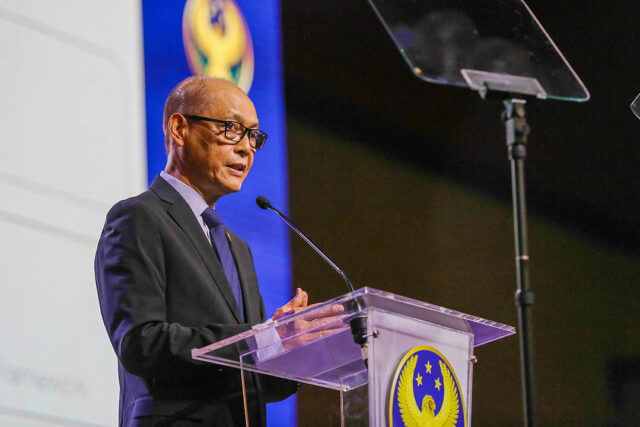
BANGKO SENTRAL NG PILIPINAS GOVERNOR BENJAMIN E. DIOKNO — PHILIPPINE STAR/ GEREMY PINTOLO
Bangko Sentral ng Pilipinas (BSP) Governor Benjamin E. Diokno gives a speech at the Philippine Economic Briefing at the Philippine International Convention Center, Pasay City, April 5. — PHILIPPINE STAR/ GEREMY PINTOLO
By Luz Wendy T. Noble, Reporter
THE PHILIPPINE central bank is ready to take preemptive action if inflation expectations are at risk of being “disanchored,” its governor said on Tuesday.
“We are prepared to take preemptive action as needed if inflation expectations become at risk or disanchored,” Bangko Sentral ng Pilipinas (BSP) Governor Benjamin E. Diokno said at the Philippine Economic Briefing held in Pasay City on Tuesday.
He said they continue to be patient and will consider a rate hike adjustment by the second half of 2022.
Mr. Diokno said March consumer price index (CPI) data suggest that inflation will likely be elevated in the coming months.
Inflation jumped to 4% in March, near the upper end of the BSP’s projected range of 3.3-4.1% for the month and still within the 2-4% target band for the year.
“This means that the BSP must be prepared to take action to prevent price pressures from broadening and becoming more entrenched which could translate to second-round effects,” Mr. Diokno said.
In March, the BSP kept rates at record lows as it cited the need to keep supporting the economy at a time of increased uncertainties to the growth and inflation outlook. At the same time, it acknowledged that economic recovery has already gained traction.
The Monetary Board now expects inflation to breach the target at 4.3% for 2022 from 3.7% previously, citing the surge in oil and commodity prices due to the Russia-Ukraine war.
“Now, on the timing of the disengagement strategy, I think we are still on track despite the Russia-Ukraine crisis. We’re still looking at the second half of the year for our normalization [of rates] strategy,” he said.
Mr. Diokno said their eventual normalization of policy setting will be supported by firmer signs of a “durable economic recovery.”
The key policy rate is currently at a record low of 2%, and Mr. Diokno has earlier said this could reach 2.75% by 2023.
For UnionBank of the Philippines, Inc. Chief Economist Ruben Carlo O. Asuncion, a preemptive rate hike from the central bank could do “more good than harm.”
“I believe that it would be good for monetary policy to anticipate right away and hike rates, albeit gradually, to help tame the actual rise in prices,” Mr. Asuncion said in a Viber message.
Meanwhile, Security Bank Corp. Chief Economist Robert Dan J. Roces said non-monetary policy measures like fuel subsidies and wider food imports are crucial to respond to inflationary pressures.
“However, we think the BSP may also be standing ready to raise the benchmark rate earlier than planned as a form of preemptive strike to further moderate inflation should price pressures start to become too compelling to ignore,” he said.
The Monetary Board will have its next policy review on May 19. Its first policy-setting meeting in the second half is on June 23.
Meanwhile, Mr. Diokno said they have extended another P300-billion zero-interest loan to the National Government.
“They recently renewed it and it will be paid by June 12. So, by the time the new administration takes over, there will be no more advances from the central bank,” he said.
A decision on future direct advances will be made by the next administration.
This is the sixth time the BSP extended direct advances to the National Government since the pandemic. It is lower than the P540 billion which was extended thrice in 2021, reflecting the gradual withdrawal of the BSP’s budgetary support to the National Government.
Under Republic Act (RA) No. 11494 or the Bayanihan to Recover as One Act, the BSP is allowed to lend the National Government an equivalent of 30% of its average revenue or P850 billion. This is higher than the cap set at 20% of its average annual revenue provided by RA 7653 or The New Central Bank Act.
Mr. Diokno also said they have significantly reduced their purchase of government securities.
“It’s been declining significantly. Right now, we almost don’t trade anymore. There are days when we don’t buy it,” he told reporters in mixed Filipino and English.