Home Blog Page 6526

Solon asks local governments to ease COVID booster shot procedures

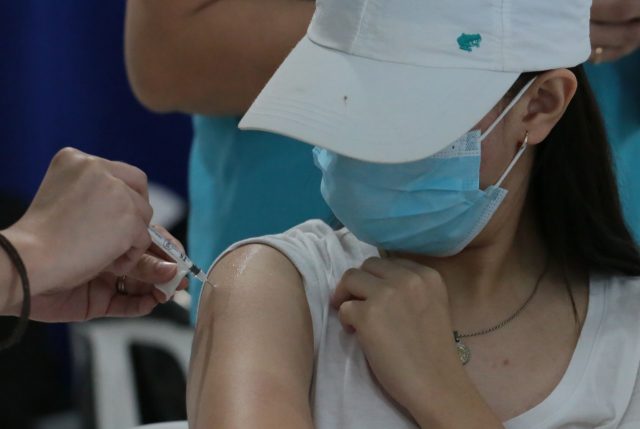
A PARTY-LIST representative called on local governments to ease procedures for getting a vaccine booster shot against the coronavirus to encourage more people to get the third jab.

“The vaccination system is seriously flawed. That is partly why we have fallen behind on the vax targets,” BHW Party-list Rep. Angelica Natasha Co said in a statement on Monday.

She cited in particular the requirement for vaccinated persons to register again for the top-up shot.

She said residents of local governments that have online vaccine registration systems should not have to sign up again.

Requiring them to do so would be following a “backward system,” Ms. Co said.

The lawmaker also proposed that local governments set up walk-in sites or dedicated lanes for those getting a booster against the coronavirus disease 2019 (COVID-19). Jaspearl Emerald G. Tan

Climate change: Research and initiatives

VECTORJUICE-FREEPIK

Climate change is again at the limelight as global leaders and stakeholders from about 200 countries gathered to tackle the issue of climate change for the 26th Conference of the Parties (COP26) in early November in Glas-gow, Scotland.

The two-week conference, marked by intense negotiations, saw all countries agreeing to accelerate action against climate change and commit to tougher climate pledges. The deals though still fall short of the ambi-tious target of limiting warming to 1.5°C as set forth in the Paris Agreement in 2015.

While much, much more remains to be done, there has been some progress. Negotiators were able to finally strike an agreement on the common rules on carbon markets. Some 104 countries committed to reduce methane emis-sions by 30% between 2020 and 2030, while 110 nations pledged $19 billion to address deforestation. Countries also committed to accelerate efforts towards the phase-down of unabated coal power and inefficient fossil fuel subsidies. Further, the US and China, which are among the world’s biggest emitters, have issued a joint declaration on enhancing climate action in the 2020s. There were calls to return in 2022 with tougher climate pledges to cut greenhouse gas emissions and provide a loss and damage facility for countries most vulnerable to climate change.

On Nov. 13, COP26 concluded with all the countries agreeing to the Glasgow Climate Pact. The final Glasgow Climate Pact keeps 1.5°C alive and includes: an ask to phase down unabated coal power, the first ever COP cover decision to con-tain Loss and Damage, an ask to phase out inefficient fossil subsidies, countries agreeing to revisit their 2030 NDCs in 2022. — Twitter/COP26

Note: NDCs — Nationally Determined Contributions

Climate change is indeed a real challenge facing the world right now even as it continues to grapple with the COVID-19 pandemic. As a result of peoples’ and countries’ unmindful actions and inadequate mitigation efforts, climate change has manifested itself through extreme weather conditions, such as severe droughts, strong storms, deadly heat waves, raging forest fires, intense floods, terrible hurricanes, and frightening rise in sea water lev-els.

A new study published in Nature in early October provides evidence that human-induced climate change is now occurring in 80% of the world’s land area, affecting about 85% of the world’s population. The comprehensive research, which assembled data from over 100,000 impact studies examining detectable environmental signals of human-induced climate change, found that there is growing evidence on how climate change is impacting socie-ties and ecosystems.

Conducted by Mercator Research Institute on Global Commons and Climate Change in Berlin, the study noted that the world is getting hotter and hotter in a consistent way.

A crucial element in the fight against climate change is the removal of greenhouse gases (GHG), which are responsible for the warming of the earth’s atmosphere. These GHGs include water vapor, carbon dioxide, methane, nitrous oxide, ozone, and man-made chemicals, such as chlorofluorocarbons (CFCs).

A study by Aalto University revealed that “rapid, out-of-control growth of greenhouse gas emissions may, by the end of the century, lead to more than a third of current global food production falling into conditions in which no food is produced today — that is, out of safe climatic space,” as explained by Matti Kummu, professor of global water and food issues. Published in Science Daily in May 2021, the study defined safe climatic space as “those areas where 95% of crop production currently takes place, thanks to a combination of three climate factors, rainfall, temperature and aridity.” However, if emissions are reduced collectively so that warming is kept within 1.5 to 2°C, “only a fraction of food production would face as-of-yet unseen conditions,” the study cited.

Further, the study showed that food production in South and Southeast Asia as well as the Sahel region of Africa will be threatened by changes in rainfall, aridity and warming climate as these areas “lack the capacity to adapt to changing conditions.”

It also assessed the impact of climate change on 27 of the most important food crops and seven different kinds of livestock in 177 countries and found that “the entire food production would remain in the safe climatic space in the future” in 52 countries including Finland and most of Europe.

Some “20% of the world’s crop production and 18% of livestock production under threat are located in countries with low resilience to adapt to changes.”

If carbon dioxide emissions are kept under control, the world’s largest climatic zone — the boreal forest, which spans northern North America, Russia, and Europe, would contract to only 14.8 million square kilometers (sq.km.) by 2100 from 18 million sq.km. today. Failure to cut emissions would leave only roughly 8 million sq.km. of the vast forest. A dramatic reduction is seen in North America with only a third of the area projected to remain in 2090 from about 6.7 million sq.km. in 2000.

A way to tackle climate change is to target net zero. This means balancing the amount of GHG produced with the amount removed from the atmosphere. Net zero is achieved when the amount produced is no more than the amount removed.

An article from McKinsey and Co., published on Oct. 27, tackled the nine requirements to solve the net-zero equation. It noted that while there are extensive commitments from government, private and social sectors towards transitioning to a net-zero world within three decades or sooner, translating commitment to action is constrained by several factors. These include the substantial additional spending required on physical assets (both capital expend-itures and consumer spend on durable goods) for the transition, the call for collective and global action which entail hard choices, the need for urgent action now to prevent “unrelenting accumulation and compounding of physical risks in the future” and the need to change long-established business practices and lifestyles.

The article discussed the criticality of an orderly transition considering “the central role of energy in all economic activity and the profound consequences that disruptions to energy markets can entail.” The transition entails re-shaping energy- and land-use systems, the most important systems supporting life and well-being. Disturbances to these systems, no matter how small, “could affect daily lives, from raising producer and consumer costs to impairing energy access, and could lead to delays and public backlash.”

The article explained that in order to achieve a net-zero transition, nine key requirements need to be met, which are grouped into three categories: Physical building blocks, encompassing (1) technological innovation, (2) ability to create at-scale supply chains and support infrastructure, and (3) availability of necessary natural resources; Economic and societal adjustments, comprising (4) effective capital reallocation and financing structures, (5) management of demand shifts and near-term unit cost increases, and (6) compensating mechanisms to address socioeconomic impacts; and, Governance, institutions, and commitment, consisting of (7) governing standards, tracking and market mechanisms, and effective institutions, (8) commitment by, and collaboration among, public-, private-, and social-sector leaders globally, and (9) support from citizens and consumers. These requirements are “interdependent” and need to be addressed with “singular resolve, unity and ingenuity.”

In the Philippines, a study entitled “Climate Change and Food Security Analysis (CCFSA) in the Philippines” analyzed the interconnectedness of climate change and food security in the country, with emphasis on the threats and opportunities in relation to food, nutrition, and livelihood in the rural and urban areas. Conducted by the Alliance of Biodiversity International and CIAT and the World Food Program, it showed that agriculture bore the brunt of past climate change damage, accounting for over 60% of total damage. Agriculture provides employment to some 10 million people. Coastal communities dependent on fisheries and aquaculture, especially in the Visayas and Mindanao, inland rice production areas in Mindanao, and pasture and livestock livelihoods are particularly vulnerable to climate change.

The study also came up with: a.) the first-ever Philippine livelihood zone map; b.) crop suitability models; c.) multi-hazard risk maps; and d.) climate change impact scenarios for 2030, 2050, 2070, and 2090, also a first for the country. The study was launched in early November, coinciding with the last day of COP26.

The Philippines ranked 2nd among 135 countries in the world as most affected by climate change based on the 2020 Global Climate Risk Index. An average of 20 typhoons enter the Philippine Area of Responsibility, with some eight to nine crossing the country.

In early November, the Department of Agriculture (DA) – Philippine Council for Agriculture and Fisheries organized the Committee on Climate Change, Environment, and Natural Resources in support of the One DA Agenda and as part of its role to promote and facilitate broad-based participatory development mechanisms and processes. Through the initiative, it hopes to be able to foster discussions and actions towards climate change adaptation and mitiga-tion among various stakeholders.

The research and initiatives that have been cited do not even scratch the surface of the numerous others that have been done or are being done not just in the country but all over the world. The results are mostly meant to provide inputs for planning and decision making, and to spur multi-sectoral and even individual actions to mitigate the effects of climate change.

The sad reality is that developed nations are the main contributors to climate change but developing countries are the ones most affected by its consequences. Admittedly, the major work lies in the hands of various governments worldwide. Country commitments have been made in COP26. Hopefully, those commitments will be followed through.

But as individuals, people can also do their fair share through the way they live — use of more energy efficient appliances/gadgets, eating less meat, reducing food and water wastage, green commuting through walking, biking, car sharing, etc., and many more.

Addressing climate change is daunting. It is not the job of just one individual, one community, one government, one country. Everyone has a stake. Collectively, as countries and as peoples, what we do and do not do now will spell the difference, especially in the lives of the future generations.

This article reflects the personal opinion of the author and does not reflect the official stand of the Management Association of the Philippines or MAP.

PROF. ROLANDO “ROLLY” T. DY, Ph.D, is co-vice-chair of the MAP Agribusiness Committee and the executive director of the Center for Food and Agri Business of the University of Asia and the Pacific (UA&P). map@map.org.ph rdyster@gmail.com.


Another 191 Filipinos repatriated from Macau

ANOTHER 191 Filipinos were repatriated from Macau last week, bringing the total to 5,152 since the start of the pandemic in March last year, the Department of Foreign Affairs reported on Monday.

The 26th repatriation flight arrived last Thursday, it said.

Among those in the flight were a 44-year-old male with a medical condition and a 75-year old lady whose case was endorsed to the Philippine Consulate in Macau by immigration authorities.

“We are very happy that you will all be able to spend your Christmas with your families,” Philippine Consul General to Macau SAR Porfirio M. Mayo, Jr., who led the team assisting passengers on the flight, said in a statement in Filipino. — Alyssa Nicole O. Tan

Executed twice over

In response to the public furor caused by the replacement of the portraits of World War II heroes Jose Abad Santos, Vicente Lim, and Josefa Llanes Escoda by the Philippine Eagle in the upcoming P1,000 polymer banknotes, Bangko Sentral ng Pilipinas (BSP) Governor Benjamin Diokno explained that redesigning the bill is part of its direction to shift from cotton and abaca to plastic synthetic material. They also decided to change the design to fauna and flora because that is the trend in other countries. “The eagle symbolizes the whole country,” Diokno noted.

The governor further clarified why the BSP shifted from the use of paper to polymer in making bills. He said polymer is safer amid the COVID-19 pandemic. It is also more cost-effective because polymer’s lifespan can be five times longer than paper and it is environment friendly.

“It was not an attempt to revise history. You cannot change a country’s history. The heroes will be heroes whether they are in bank notes or not,” Diokno said to allay the fears of certain civil society groups who suspect the change is part of a cunning scheme to remove the portraits of Benigno Aquino, Jr. and Corazon Aquino from the P500 bill given the attempt of a certain sector to revise history and the current dispensation’s disposition to allow it.

But if the BSP is just following the trend in other countries to change the designs of bank notes to flora and fauna, why are the other bank notes not going to be changed as well? And why feature the Philippine Eagle, an en-dangered species, when the national animal is the carabao?

And if the shift from paper bills to polymer bills is to make bank notes safer, more cost efficient, and environment friendly, why not convert the lower denomination bank notes like the P20, P50, or even the P100 bills which deteriorate faster due to their high rate of circulation?

The heroism of Jose Abad Santos, Vicente Lim, and Josefa Llanes Escoda have something in common. The three played key roles in the Philippine resistance to the Japanese occupation. All three were executed by the Jap-anese military.

JOSE ABAD SANTOS

Abad Santos was an Associate Justice of the Supreme Court when World War II broke out. President Manuel L. Quezon named him Chief Justice on Dec. 24, 1941.

When the Japanese Imperial Army looked like it would gain control of much of the country, US military adviser to the Philippines General Douglas MacArthur advised Mr. Quezon to establish a government in exile in the United States. Quezon asked Abad Santos to leave with him. But the latter decided to stay in the country to carry on with his work. Quezon then designated him Acting President, with full authority to act in the name of and on behalf of the President of the Philippines. But on April 11, 1942, he and his son Jose Junior were captured by the Japanese. When he refused to cooperate with the Japanese occupation government, he was condemned to be executed. When Abad Santos told his son, Jose Junior, on May 2, 1942, that he was to be executed that afternoon, the son broke down and wept. The father reproached his son, but gently said: “Do not cry, Pepito. Show these people that you are brave. It is an honor to die for one’s country. Not everybody has that chance.”

I remember Senator Jose W. Diokno saying many years ago, in observance of the martyrdom of Jose Abad Santos, that Abad Santos’ sacrifice was greater than that of many who also gave up their lives for the country as Abad Santos did not know if his son would come out of the Japanese barracks alive to tell the Filipino people of his father’s choice to die rather than cooperate with the occupation government.

VICENTE LIM

In August 1941, as the threat of war became more imminent, President Quezon put General Vicente Lim, the first Filipino to enter and graduate from the United States Military Academy in West Point (Class of 1914), in com-mand of the 41st Infantry Division of the Philippine Army.

Because the US and Philippine Army units meant to repulse the Japanese landings on our shores were overwhelmed by the initial Japanese onslaught, the commander of the US and Philippine Armed Forces in Luzon or-dered, on Dec. 24, 1941, all unit commanders to withdraw their forces to the Bataan Peninsula.

Lim’s 41st Infantry Division took a defensive position in the town of Abucay. From Jan. 8 to 26, 1942, the Japanese tried to break the 41st Division line but failed. Lim wrote to his wife: “I sincerely give the credit to my officers and enlisted men. They are the ones who did it all. Mine is only to inspire and to lead them. When history is written I will give them all the credit. Their satisfaction is mine to share.”

Four months of fierce fighting the Japanese, the elements, hunger, and disease decimated the defenders of Bataan. On April 9, 1942, all Filipino and American forces on Bataan were ordered to surrender.

Upon his release, Lim went to live in Manila. He was sent feelers to head the puppet Philippine Constabulary. Determined not to have anything to do with the Japanese occupation government, he feigned illness and had himself confined at the Philippine General Hospital. There he continued to resist the Japanese by funding various guerrilla activities.

His involvement in the resistance movement made him a target of the Kempeitai, the Japanese Military Police. In June 1944, Lim was captured. He was imprisoned in Fort Santiago where he was tortured. Eventually, he was transferred to the old Bilibid Prison. Nothing was heard about him again.

In 1994, a US Army intelligence agent stationed in the Philippines at the outbreak of World War II told the family that General Lim, together with some 50 or so guerrillas, were taken to the Chinese Cemetery where they were all beheaded.

JOSEFA LLANES ESCODA

Josefa and her husband Antonio were visiting the General Federation of Women’s Clubs and the Girl Scouts chapters in the US and Europe when Germany invaded Poland in September 1939. Foreseeing the war eventually ex-tending to Asia, the couple cut short their trip. Upon their return to the Philippines, Josefa began rallying the 800 National Federation of Women’s Clubs (NFWC) chapters across the country to educate women on how to gather information, conduct orderly evacuations, set up emergency first aid centers, grow and preserve food in homes, and make bundles for emergency.

Following the fall of Bataan, the Escoda couple joined a group of doctors leaving for San Fernando, Pampanga where the survivors of the Death March were to be transported to Camp O’Donnell in Capas, Tarlac. They came back with lists of names of prisoners, addresses of relatives, and notes.

Josefa mobilized the NFWC staff to make the connections between prisoners and their families in Manila. The Escodas even opened a coffee shop on the road leading to the prison camp in Cabanatuan where hundreds of American soldiers were held so they could gather information from the conversations of Japanese soldiers taking their break in the shop.

In January 1944, the Escodas began to get word that their activities had become the focus of undercover agents working for the Japanese and that the Kempeitai were on their trail. In June, Antonio was captured in Batan-gas. He was beheaded in November 1944.

Sensing the imminence of her own capture, Josefa left this message with someone: “If you survive, tell the people that the women of the Philippines did their part in making the ember sparks of truth and liberty alive till the last moment.” In August 1944, Japanese soldiers arrested Josefa. She was believed to have been executed in the Chinese cemetery in February 1945.

It will be recalled that in 2018 the Women’s group Gabriela strongly condemned the removal of the statue of the Comfort Woman (as sex slaves of the Japanese soldiers in World War II were called). The statue, the group said in a statement, “supposedly serves as a reminder to future generations of Japan’s atrocities and abuses against Filipino women during the Second World War. With the statue’s removal, Japan once again succeeded in im-posing its revisionist take on WWII on the puppet Duterte regime,” Gabriela added.

Could the removal of the portraits of Jose Abad Santos, Vicente Lim, and Josefa Llanes Escoda from the P1,000 bank note be part of the conditions for Japan’s support of the country’s infrastructure program worth trillions of US dollars? If it is, it can be considered the second “execution” of the three but this time with the cooperation of Philippine officials.


OSCAR P. LAGMAN, JR. is a retired corporate executive, business consultant, and management professor. He has been a politicized citizen since his college days in the late 1950s.

Seven trends in COVID cases, vaccination, and causes of death

In discussing the chart accompanying this piece, here is the data on vaccination rates as a percentage of population, as of Dec. 18: 81-84% for Denmark, Canada, Spain, South Korea; 72-79% for France, Germany, Italy, the Netherlands, Norway, the UK, the US, and Vietnam; Switzerland 68%, Poland 57%, Indonesia 55%, and the Philippines 51%. (Source: https://ourworldindata.org/covid-vaccinations)

One, high vaccination rate countries continue to have a high if not a record-high number of COVID cases. Record highs recently were experienced by the UK, Germany, France, Italy, the Netherlands, Denmark, Switzer-land, Norway, South Korea, and Vietnam.

Two, some low vaccination rate countries experience declining cases. Indonesia and the Philippines are clear example.

Three, a vaccination plateau continues in many of these countries. Vaccination rates as of Oct. 31: 76%-81% for Canada, Denmark, France, Italy, the Netherlands, Norway, South Korea, Spain; the UK 73%, the US 67%, Switzerland 66%, Poland 54%, Vietnam 53%, Indonesia 43%, the Philippines 30%.

So, Spain and South Korea have marginally increased their vaccination rates from 80-81% on Oct. 31 to 83-84% on Dec. 18; Italy and Norway from 77% on Oct. 31 to 78-79% on Dec. 18; the UK and the Netherlands from 73% and 76% on Oct. 31 to 75% and 77% on Dec. 18.

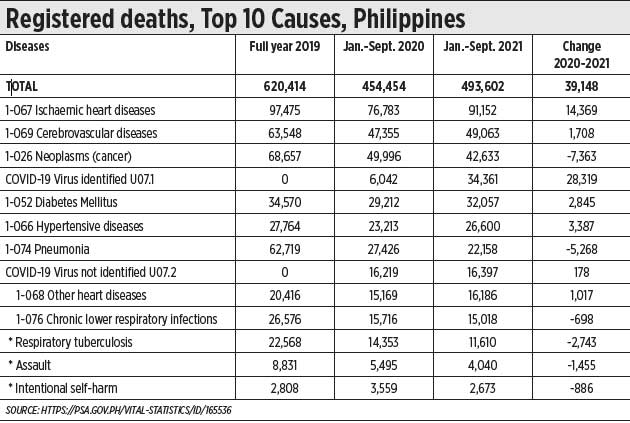
Last Saturday, Dec. 18, the Philippine Statistics Authority (PSA) released the “Causes of Deaths in the Philippines (Preliminary): January to September 2021.” I include in the table in this piece the full year results from 2019 to give some additional perspective, then I computed the change from 2020 to 2021.

Four, there was a big increase of 39,100 deaths from ischemic heart diseases (heart attacks, etc.) in the first nine months of 2021 compared to the same period in 2020. There was also an increase of 4,400 deaths from hy-pertensive and other heart diseases.

Five, there was a big increase of 28,500 deaths from COVID, over the same months in 2021 and 2020.

Six, there was a big decline of 15,400 deaths from neoplasms/cancer, pneumonia, and tuberculosis. These could be instances of people with cancer and tuberculosis who got COVID and were counted as COVID deaths.

Seven, deaths from assault and suicides (intentional self-harm) declined. These could be due to closed bars and reduced gathering of people. Good thing that suicides have declined this year. The increase in heart diseases could be related to rising cases of myocarditis post-vaccination. In the Open VAERS, COVID Vaccine Adverse Event Reports (https://openvaers.com/covid-data), there were 965,841 re-ports through Dec. 10. According to these reports, there were 20,244 deaths, 106,129 hospitalizations, 35,529 severe allergic reactions, 33,675 permanently disabled, 19,039 myocarditis/pericarditis, 10,229 heart attacks. Meanwhile, COVID Call to Humanity (CCH, https://covidcalltohumanity.org/) put out a full-page ad in the Philippine Daily Inquirer on Dec. 1, an “Open Letter to the Filipino People: An Appeal to Common Sense Regarding Forced Vaccinations.”

They highlighted some facts that “All the COVID-19 vaccines currently being administered by the Philippine government are still experimental in nature, (RA 11525, Section 2c) have not yet completed Stage III clinical trials… Based on official WHO statistics, the COVID-19 vaccines have generated more than 2.5 million reports of adverse drug reactions (ADRs) worldwide within this past year. (WHO VigiAccess database, vigiaccess.org).” Then the Concerned Doctors and Citizens of the Philippines (CDC Ph, https://cdcph.org/) put out its own full-page ad in the same paper on Dec. 10, International Human Rights Day, “Every Life Matters: An Open Letter to the Filipino People Regarding the Medical, Ethical, Legal and Economic Issues of Mandatory Vaccination.”

They pointed out, among others, that “The International Covenant on Civil and Political Rights (ICCPR) must be upheld. The Philippines is a signatory… provides for, among others, the right to life (Article 6), the right to freely consent to medical experimentation (Article 7), and the right to thought, conscience and religion (Article 18). These rights cannot be derogated from even ‘in time of public emergency which threatens the life of the nation.’ (Article 4)… intended to prevent a repeat of the horrors of the Holocaust and the flagrant human rights violations by Nazi and Fascist countries during World War II, all ostensibly committed in the name of public welfare.”

CDC Ph then made these calls, “Revoke IATF Resolution No. 148-B for being unreasonable, oppressive, discriminatory, and confiscatory of people’s lives, liberty, and property without due process of law. Categorically declare the COVID-19 vaccination to be voluntary, and to order all public and private sector agencies and offices to ensure free and informed choice in the implementation of the vaccination program…”

There has been a significant rise in number of total deaths this year as vaccinations rolled out. The huge vaccine procurements (P70 billion plus P12.5 billion for logistics, storage and transportation in 2021, a planned P61-billion procurement in 2022, logistics not included yet) contributed to huge jump in government borrowings (P73 billion/month in 2019, P208 billion/month in 2020, P247 billion/month until October 2021). There has been reduced mobility of people, work and business as vaccine discrimination continues. There is an absence of data and studies of the long-term health effect of vaccines. There is the entry of the more infectious but mild variant Omicron that contributes to natural infection leading to natural immunity.

These are among the reasons why the seemingly blind pursuit to mass vaccination and implicit vax mandate via discrimination should pause.

Merry Christmas, dear readers.


BIENVENIDO S. OPLAS, JR. is the president of Minimal Government Thinkers. minimalgovernment@gmail.com

Can you trust your suppliers after a lousy 2021?

By Anjani Trivedi

THE SUPPLY CHAIN CRUNCH has turned the once-staid world of manufacturing and industrials upside down. The imbalance is so severe that consumers are feeling the pain, as prices of raw materials and goods are thrown out of whack. Debates about inflationary pressures are raging. What more could go wrong? Well, a lot. Especially if the grease that makes the wheels turn starts drying out. That lubricant is trust.

So far, the world has had to deal with the supply and demand imbalance of physical goods. It has been painful, no doubt. But as that’s persisted, with few long-term solutions in sight, the assurances that keep businesses go-ing have also started running low. This matters because trust plays an unquantifiable but critical role in the codependency between manufacturers and several tiers of suppliers.

Without it, the commitment on receipt and delivery of products, parts, and payments weakens. That uncertainty cripples businesses, raises costs, and decreases productivity and efficiency. Around one-third of alliances fail due to “a lack of trust among trading partners,” a study on designing and managing supply chains from the 1990s showed. In supply chain literature, trust is broadly defined as a “firm’s belief that another company will perform actions that will result in positive outcomes for the firm” and that the other business won’t take “unexpected actions that result in negative” results. Measuring it is challenging, but there are proxies, such as surveys of business sentiment, managers, and suppliers.

The trouble right now is everything is a moving target. Firms aren’t actively taking actions to hurt other companies but are protecting themselves from the constantly evolving shortages and glitches. The supply chain uncer-tainties are dynamic, Chief Executive Officer Mark Smucker of food-products maker J.M. Smucker Co. said in a recent earnings call. Challenges, he said, can “change week to week, month to month; it could be an ingredient or a packaging component; at one point, it could be some isolated labor challenges in a particular geography.” Smucker concluded that this dynamic would continue for the foreseeable future. These uncertainties are forcing businesses to change their behaviors along with production. For instance, executives at heavy machinery maker Caterpillar, Inc. described a workaround: The company has “proactively redi-rected components and altered our assembly processes as much as possible to keep output flowing.” Inventory grew by about $1 billion in the third quarter compared with the previous period, over a half of which was an in-crease in production inventory.

Another unknown is that the supply base is mostly in Asia, and largely concentrated in China, while demand is predominantly in the US. The regions’ pandemic-era strategies — Zero COVID versus living with COVID — are increas-ingly divergent, leading to distinct differences in how their economies are functioning. Choices made in China and other parts of Asia that remain heavily restricted can inject uncertainty elsewhere. Domestic lockdowns are often imposed suddenly, which forces companies to alter course quickly. The case of Toyota Motor Corp. shows how to do this well. After years of making their system natural disaster-proof and mastering the art of just-in-time manufacturing, the company started holding more inventory early in the pandemic. It has maintained clear communication and information exchanges with suppliers through its “rescue” system. Toyota has also engaged with dealers in real time, adjusting supply of its cars in parts the US. This has helped ward off severe issues that other automakers have faced.

Toyota, though, is largely an outlier. For most, these changes tend to constrain business and muddy the picture for orders. Despite high demand, manufacturers’ sentiment is deteriorating, as in the case of large Japanese companies. This leads to lower future capital spending. The uncertainty creates issues for balance sheets. Suppliers often engage in short-term financing and the protracted pressures we’re seeing affect repayment, delivery, and credit availability that lands them in a painful cycle. Taken together, these snafus start looking like all the trappings of relationships with a trust deficit. As one study put it, “A lack of trust among trading partners often creates a condition where every transaction has to be scrutinized and verified.” That increases costs to unacceptably high levels, and productivity, efficiency, and effectiveness are lost. The “cornerstones of supply chain goals” are compromised.

It’s worth wondering whether, if everything eventually snaps back into place — with timely supplies and production lines back on like clockwork — the trust would return. Perhaps. But the issue is, even if the supply chain snarls ease, companies will still have to figure out how to navigate a new normal. Manufacturers probably have a new perspective about how their customers and suppliers behave after watching them manage through deeply stressful times. That stands to change relationships for better — or worse. One way to alleviate the pressures, experts say, is by pushing managers to get more deeply involved in relationships with suppliers, and making a habit of communicating and exchanging information — kind of like Toyota did. The sooner companies start acknowledging a growing trust gap, the quicker they’ll start to find solutions. Until then, supply chains will remain strained. — BLOOMBERG OPINION

Europe braces for more COVID restrictions as US holds off

People walk past a government health campaign advertisement encouraging people to take a coronavirus disease (COVID-19) vaccine booster dose, at a bus stop in London, Britain, Dec. 17, 2021. REUTERS

Europe’s biggest countries are weighing more curbs to fight a surge in coronavirus disease 2019 (COVID-19) infections, while President Joseph Biden’s chief medical adviser said the prospect of further lockdowns in the US are unlikely even as the omicron variant has now reached almost every state.

From a new lockdown in the Netherlands to travel restrictions targeted by several countries at the UK, Europe faces a critical week of decisions that could disrupt the Christmas and New Year’s holidays. In the US, Mr. Biden is planning to warn the nation on Tuesday of the perils of remaining unvaccinated.

The spread of the highly-transmissible Omicron strain risks slamming populations already weary of restrictions. It also comes at a time some countries, like Germany and Austria, were just getting their latest waves under control.

European nations have taken a varied approach to counter the winter COVID wave, but most have emphasized the importance of accelerating vaccination and booster campaigns. Much of their efforts are focused on not repeating the experience of the UK, where total COVID infections rose by about 50% in a week to touch a record 93,000 on Friday.

In New York City, Mayor Bill de Blasio called on the federal government to step up supplies of tests and treatments to the city amid a spike in infections. New York state broke a record for new infections for a third straight day.

Debate continues to rage over whether the omicron variant produces milder illness than previous strains.

UNITED STATES

An effective shutdown of the US is probably unnecessary as COVID surges again, though hospitals will be tested by the expected rush of Omicron cases, according to Anthony Fauci, who leads the National Institute of Allergy and Infectious Diseases.

With colder weather and holiday travel and gatherings, stresses on the medical system will be particularly acute in regions of the country with low levels of vaccination, Mr. Fauci told CNN’s “State of the Union.” He urged the public to get vaccines and boosters, noting that about 50 million people are eligible to get shots and haven’t.

In his address to the people on Tuesday, President Biden will announce new steps to help communities in need of assistance, while also issuing a stark warning of what the winter will look like for Americans that choose to remain unvaccinated, according to a White House official.

UNITED KINGDOM

Health Minister Sajid Javid Sunday declined to rule out pre-Christmas restrictions but said any new measures would have to be voted on by parliament. That would require members to be recalled during the holiday recess. Prime Minister Boris Johnson would likely face further rebellion within his ranks after 100 of his Conservative allies voted last week against much milder measures than the tougher curbs now being considered.

UK advisers have told the government that new measures are needed within days to protect the health care system.

A key minister, Lord David Frost, quit over the weekend, and warned Mr. Johnson in his resignation letter “not be tempted by the kind of coercive measures we have seen elsewhere.”

“There are no guarantees in this pandemic,” Mr. Javid said when asked whether he would rule out a so-called circuit-breaker lockdown. “At this point, we just have to keep everything under review.”

London Mayor Sadiq Khan Saturday declared a “major incident” due to a rapid spread of the Omicron variant across the city, giving him more powers to fight the virus and seek government support. With so many people now staying home, the country has entered what some call a “stealth lockdown” that’s left retail, hospitality and travel reeling.

NETHERLANDS

The Dutch already made their move: the nation returned to a strict lockdown on Sunday. That means schools and non-essential shops are closed, and fewer visitors will be allowed in households. The steps come as the government said the rise of Omicron will likely overburden its health care system in January. The new restrictions will remain in place until at least Jan. 14.

GERMANY

That’s a scenario Germany is trying to avoid, as its health care system continues to struggle with a virus wave that peaked in late November. Hospital demand isn’t expected to subside much for a month or more. The country joined Cyprus and France in imposing stricter rules for travelers from Britain, who’ll have to undergo a mandatory 14-day quarantine upon arrival, upending holiday plans. France temporarily banned entry for many Britons last week, and Cyprus will require visitors from the UK ages 12 or above, regardless of vaccination status, to self-isolate. Germany’s new government is also mulling a vaccine mandate.

FRANCE

As well as imposing a ban on UK arrivals, France is curbing outdoor revelry on New Year’s Eve to try to limit the spread and protect its hospitals. The government is also turning up the pressure on people to get vaccinated, and from January only immunized people will be able to get a “health pass” that gives access to bars, restaurants, medical facilities and cultural venues.

SPAIN

Spain will convene an online emergency meeting on Wednesday to analyze the evolution of the pandemic and discuss adopting new measures. Some regions are already requiring proof of vaccination to enter restaurants and bars, but have refrained from more aggressive steps that could put a drag on an economy heavily reliant on services and tourism.

ITALY

On Thursday, Italy’s government will also hold an emergency meeting and may look at options such as requiring masks outdoors, shortening the validity of vaccine certificates, and possibly requiring inoculated people as well as the unvaccinated to take COVID tests to access large events, according to people familiar with the matter.

SWITZERLAND

A vaccine laggard, with less than 68% fully inoculated, Switzerland will exclude the unvaccinated from large parts of public life, such as restaurants, museums and gyms. The Swiss government also reintroduced a work-from-home requirement. The measures are in place until Jan. 24.

AUSTRIA

Austria was in lockdown when Omicron hit, after a low vaccine rate fed a surge in delta cases that swamped the country’s health care system. The general lockdown was lifted earlier this month in time for the holidays. The unvaccinated have also been offered a respite, but after the New Year will once again only be allowed to leave their homes to go to work, do essential shopping, or exercise. The country also mandated vaccines from February. Austria’s daily cases have fallen more than 75% from their peak, and vaccinations have advanced steadily in the past month.- —Bloomberg

China says Taiwan is a ‘wanderer’ that will eventually come home

lisanto-unsplash

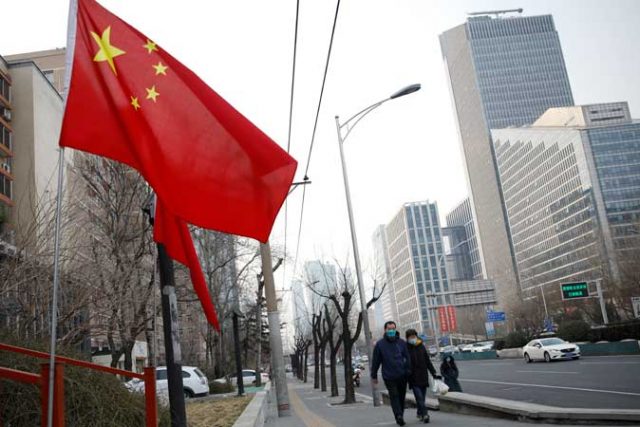
BEIJING — Taiwan is a “wanderer” that will eventually come home and not a chess piece to be played with, the Chinese government’s top diplomat said on Monday, reaffirming Beijing’s determination to bring the island under its control.

China claims democratically governed Taiwan as its own territory, and has in the past two years stepped up military and diplomatic pressure to assert its sovereignty claims, to anger in Taipei and deep concern in Washington.

Speaking in Beijing, State Councillor and Foreign Minister Wang Yi said the cause of current tensions was the Taiwan government’s attempts to “rely on the United States for independence” and the United States and other countries trying to “use Taiwan to control China.”

“It is these perverse actions that have changed the status quo and undermined the peace in the Taiwan Strait, violating the consensus of the international community and the basic norms of international relations,” said Mr. Wang, a former head of China’s Taiwan Affairs Office.

To respond to this, China had taken “forceful countermeasures” to “shock the arrogance” of those who seek Taiwan’s formal independence, he said.

“Taiwan is a wanderer who will eventually come home, not a chess piece to be used by others. China must and will be reunified.”

China has been particularly angered by support for Taiwan from the United States, the island’s most important international backer and arms supplier despite the absence of formal diplomatic ties.

Taiwan’s government has repeatedly denounced China’s pressure, saying only Taiwan’s people have the right to decide their future and that they will not give in to threats.

The defeated Republic of China government fled to Taiwan in 1949 after losing a civil war with the Communists, who established the People’s Republic of China. — Reuters

China’s Kaisa says bondholders have not asked for accelerated repayments yet

REUTERS

Kaisa Group said on Monday it has not received any notice from bondholders to accelerate repayments yet as the embattled Chinese property developer has not repaid a $400 million offshore bond.  

The firm said it also did not pay the coupon totaling $105 million for notes due in 2023, 2025, and 2026, with the grace period for the first two already expired.  

The non-payment on the $400 million maturity on Dec. 7 triggered cross-default provision on all its $12 billion offshore bonds and prompted a downgrade to “restricted default” by Fitch Ratings.  

Kaisa is the second-largest dollar bond issuer among China’s property developers after China Evergrande Group, which has more than $300 billion in liabilities.  

The fate of Kaisa, Evergrande, and other indebted Chinese property companies has gripped financial markets in recent months amid fears of knock-on effects, with Beijing repeatedly seeking to reassure investors.  

Shares of Kaisa tumbled 8.7% to HK$0.84 in the early session on resumed trading, a record low, after a suspension since Dec. 8.  

Kaisa said it was still in talks with bondholders over a debt restructuring deal and it had hired Houlihan Lokey as its financial adviser and Sidley Austin as a legal adviser.  

Kaisa was in talks with Lazard, the adviser of a group of offshore bondholders, to sign a non-disclosure agreement (NDA), Reuters has reported, laying the groundwork for further discussions on forbearance and financing solutions.  

The group planned to use up to $1 billion in order to buy bad loans from the Chinese developer’s onshore creditors, sources said last week.  

In the Monday filing, the developer added after significant decline in sales in October and November, it expects the confidence of potential property purchasers to remain subdued in December. — Reuters

Laptops, dogs top online searches among Filipino shoppers — iPrice

UNSPLASH

Laptops, smartphones, and tablets were among the most popular items among online shoppers in the Philippines this year, according to a study by Southeast Asian meta-search website iPrice, as pandemic restrictions kept people at home.  

Many potentially purchased these items to “enhance their work- or study-from-home experience,” the e-commerce aggregator said in the report.  

This was also the case in neighboring countries Malaysia and Singapore, where extended lockdowns were put in place throughout 2021.   

In the Philippines, the top five most browsed items included refrigerators and bicycles as well, reflecting how people adjusted differently to sedentary lifestyles — by stocking up on food or by finding ways to stay active. 

Cakes also ranked high for Filipinos, according to iPrice, with bakeshop Red Ribbon being a widely searched brand. The meta-search website added that desserts were popular due to the need to celebrate “vital moments such as birthdays, anniversaries, holidays, and other significant events while at home.”  

Across Southeast Asia, iPrice also found that there was a 57% increase in searches for romantic gifts in January 2021, compared to the same period in 2020. For those without partners, the search for pets doubled year-on-year, with Filipinos looking for dogs in particular, around five times more than cats.  

On a serious note, the e-commerce aggregator previously detected a 59% increase in Filipinos’ searches for mental health services in the first five months of 2021 compared to the same period in 2020.   

There was a similar surge in Indonesia and Malaysia, showing that despite the availability of retail therapy, Southeast Asian consumers still suffered mental health issues over the pandemic. — Brontë H. Lacsamana

New US push for vaccines, boosters to stem ‘raging’ Omicron

US Army photo by Spc. Richard Barnes/DVIDS

WASHINGTON — US health officials urged Americans on Sunday to get booster shots, wear masks and be careful if they travel over the winter holidays, as the Omicron variant raged across the world and was set to take over as the dominant strain in the United States.  

The government is gearing up for the next phase of battle in a two-year fight against a virus that has killed 800,000 people in the United States and disrupted every aspect of daily life.  

Two US senators, Democrats Elizabeth Warren and Cory Booker, said on Sunday they tested positive for coronavirus disease 2019 (COVID-19) but were experiencing only mild symptoms.  

Ms. Warren, 72, said on Twitter she was “grateful for the protection provided against serious illness that comes from being vaccinated and boosted,” and urged other Americans to do the same.  

Dr. Francis Collins, director of the National Institutes of Health, told CBS’ Face the Nation that the number of Omicron cases will rise steeply in the next two weeks.  

“A big message for today is if you’ve had vaccines and a booster, you’re very well protected against Omicron causing you severe disease. So, anybody listening to this who’s in that 60% of Americans who are eligible for a booster but haven’t yet gotten one: This is the week to do it. Do not wait,” he said.  

Omicron is multiplying rapidly, making COVID-19 vaccinations and booster shots more crucial than ever, chief White House medical adviser Dr. Anthony Fauci said on Sunday. Currently, 27% of U.S. residents have not gotten even a single dose of vaccine, according to the Centers for Disease Control and Prevention.  

“It is just, you know, raging through the world,” Mr. Fauci, director of the National Institute of Allergy and Infectious Diseases, said on NBC’s Meet the Press 

Omicron has been found in 43 out of 50 US states and around 90 countries so far.  

‘WAR FOOTING’  

New York state recorded 22,478 positive COVID-19 cases on Saturday, Governor Kathy Hochul tweeted on Sunday, marking the state’s third daily record in new positive cases in three days.  

More than half of the state’s new cases recorded on Saturday were in New York City, where Mayor Bill de Blasio called for the country to “go on a war footing” to fight the Omicron variant with more vaccinations. He said the city would spend $10 million on an advertising campaign to promote booster shots.  

The number of cases is doubling in 1.5 to three days in areas with community transmission, the World Health Organization said on Saturday.  

In certain regions of the United States, 50% of the COVID-19 tests genetically sequenced detected the Omicron variant, Mr. Fauci told CNN, “which means it’s going to take over.”  

The virus is forcing sports leagues to reschedule games and entertainment venues to cancel shows. The National Basketball Association postponed five additional games on Sunday.  

The National Hockey League said it agreed with its players association to continue its 2021–22 regular-season schedule, as nearly all players and staff are vaccinated, but would temporarily shut down individual teams on a case-by-case basis. It also postponed cross-border games involving Canadian and US-based teams through Thursday.  

In a reminder of the pandemic’s early spread on cruise ships, about four dozen guests and crew members aboard Royal Caribbean’s Symphony of the Seas ship, which docked in Miami on Saturday, tested positive for COVID-19, NBC News reported, citing a statement from the company.  

Colorado Governor Jared Polis told NBC he was considering changing the definition of fully vaccinated in his state to three shots from two. “I wish they’d stop talking about it as a booster. It really is a three-dose vaccine,” he said.  

BOOSTERS, TESTING, SURGE TEAMS  

President Joseph R. Biden, Jr., plans to give a speech on Tuesday about the rising COVID-19 cases, hammering home his message to unvaccinated Americans to get a shot and for those who are vaccinated to get a booster.  

Part of Mr. Biden’s strategy is to focus on increased testing, Mr. Fauci told CNN’s State of the Union 

“We really need to flood the system with testing. We need to have tests available for anyone who wants them,” he said.  

Hospitals in some parts of the country are already becoming strained by COVID-19 patients and things are likely to get worse, the health officials said.  

“The government is prepared now to start sending out surge teams as needed to places that are really hit hard and the president’s going to have more to say about that in a speech on Tuesday,” Collins said.  

Neither Messrs. Fauci nor Collins urged vaccinated Americans to cancel travel plans — just to wear a mask at all times in airports, on planes, trains and buses.  

“I’m not going to say you shouldn’t travel, but you should do so very carefully,” Mr. Collins said. — Doina Chiacu and David Brunnstrom/Reuters 

Digital farming solutions app helps farmers identify pests

An agritech app that uses photo recognition to identify weeds, pests, leaf damage, and disease can help Filipino farmers increase crop productivity. However, its effectiveness hinges on connectivity, which can be poor in rural areas. 

Launched in the Philippines this December by global chemical crop protection supplier BASF, the Xarvio Scouting app has identified farming problems and provided sustainable operational solutions for five million people across 120 countries.  

“Many farmers in the Philippines are looking for new ways to improve crop health and yield, while at the same time lowering inputs and supporting sustainability,” said Manolo A. Sambrano, head of BASF Agricultural Solutions in the Philippines. “Xarvio Scouting provides farmers with a free, convenient, and proven way to achieve these goals.”  

Farmers upload pictures of their crops — such as rice, corn, potatoes, or tomatoes — to the app, which then analyzes the images and flags them for risks.  

The free app “can identify pests and diseases and see solutions initially unknown to the users,” said Mycah A. Figueroa, marketing manager of BASF Agricultural Solutions in the Philippines.  

“Farmers can identify more than 300 weeds and assess the different types of weeds, and recognize more than 1,110 different disease and pest damages and nutrient deficiencies,” said Andrew A. Achille, commercial lead for Xarvio in Asia Pacific and Africa, at the app’s pre-launch in November.  

Available in English, Tagalog, and Cebuano, the app has been downloaded close to 40,000 times as of this writing. — Brontë H. Lacsamana