Home Blog Page 6501

Liverpool edges closer to City, Chelsea back to winning ways

LONDON — Liverpool took advantage of Manchester City’s dropped points with a 3-1 victory at Crystal Palace on Sunday, taking a small bite out of City’s commanding lead of the Premier League.

It was far from vintage form for Liverpool who led 2-0 after a dominant first half but needed a late penalty by Fabinho to quell a stirring Palace fightback at Selhurst Park.

Third-placed Chelsea got back to winning ways with a 2-0 home victory over Tottenham Hotspur at Stamford Bridge with an exquisite strike by Hakim Ziyech setting them on their way to a first victory in five league games.

Manchester City were denied a 13th successive league win on Saturday in a 1-1 draw at Southampton and now lead Liverpool by nine points having played a game more.

Chelsea is 10 behind City but have played a game more.

Arsenal missed an opportunity to move into the top four as they drew 0-0 at home to bottom club Burnley.

Leicester City drew 1-1 at home to Brighton and Hove Albion — Danny Welbeck’s late equalizer earning ninth-placed Brighton a 12th draw of the season.

Goals by Virgil van Dijk and Alex Oxlade-Chamberlain put Liverpool in charge at Selhurst Park.

But Palace grew in belief after the break and when Odsonne Edouard tapped in after 55 minutes they looked capable of salvaging something until a controversial late penalty awarded when Diogo Jota collided with Palace keeper Vicente Guaita.

“A big three points today for us, really big,” Liverpool manager Jürgen Klopp said, although he played down the significance of the win in the title race.

“The distance is too far to talk about it but we don’t have to. We just need to win football matches. Each Premier League game is difficult like we saw today,” Klopp said.

Chelsea recorded a third win this month against Tottenham, including two in the League Cup semifinal, to get back on track after a worrying slump in league form.

They were far too good for the visitors but had to wait until Ziyech’s superb curled effort two minutes after the restart to go ahead. Thiago Silva made it 2-0 shortly after and Chelsea could have won by more.

Harry Kane did have a first-half goal disallowed for Tottenham but they surrendered their unbeaten league record under Antonio Conte in rather tame fashion.

“We were working extremely hard for it and it was a tough match,” said Chelsea manager Thomas Tuchel, who was celebrating one year in charge of the club. “The effort was outstanding and it was a deserved win.

“It is so hard to create chances against them but we were relentless and kept on believing.”

While Tottenham has slipped to seventh with 36 points, they have games in hand over all the teams battling for fourth spot.

Arsenal edged above them on goal difference but were disappointing as they could find now way past Burnley.

“To win this match, you need to have a different level of quality,” said manager Mikel Arteta, whose side were booed off at the end and have endured a disappointing January.

The Premier League now takes a two-week winter break with the focus switching to the transfer window that closes on Jan. 31. Action resumes on Feb. 5. — Reuters

Hudson Swafford breaks from pack late to win The American Express

HUDSON Swafford went eagle-birdie at the 16th and 17th holes to cap a busy final round and win The American Express on Sunday in La Quinta, CA.

Swafford’s eagle, nine birdies and three bogeys added up to an 8-under 64 that catapulted him to victory after starting the day three strokes off the leaders. At 23-under 265, Swafford beat Tom Hoge (68 Sunday) by two shots.

Brian Harman also shot a 64 earlier in the day to set the clubhouse lead at 20 under. He tied for third with Lanto Griffin (67) and Lee Hodges (70).

It marks the third Professional Golfers’ Association (PGA) Tour win of Swafford’s career, and the second to come at the PGA West Stadium Course. Swafford won this event in 2017 when it was called the CareerBuilder Challenge.

“This was definitely a special one,” Swafford said. “A third win, and about a month ago my father passed away and his birthday was this week, so I know he was following and watching and to get it done, it was awesome.”

Swafford, Harman and Italy’s Francesco Molinari were tied for the lead at 20 under — with five others one shot back — when Swafford played No. 16, a par 5. He had 198 yards to the flag for his second shot and got a 7-iron to nestle up 8 feet from the hole.

“I knew if I missed it a little bit it was going to come up just short, just where you wanted to be, and if I hit it good and hit it solid, then I was going to have a really good chance at eagle,” Swafford said. “It was one of the best 7-irons I’ve ever hit.”

He sank the short eagle putt to take the solo lead, then made a 19-foot birdie putt from the fringe at the par-3 17th to move out of reach for good.

Hoge came up shy of earning his first win on tour but still played well. He had five birdies against one bogey, with four of his birdies coming on the back nine.

“It was nice to make a few putts coming in on, what was it, 12 and 17 was a nice one to make,” Hoge said. “So I’ll take some positives going forward and hopefully keep playing well next week at Torrey (Pines).”

Harman sank eight birdies and avoided carding a bogey for his 64.

“It’s been kind of a trying year,” Harman said. “I had a really bad fall, kind of banged my thumb up last year and didn’t play as well as I wanted to in the fall, didn’t play good and I’ve been working real hard at home and it’s been going alright. It’s just nice to come out and play some good golf. It’s been awhile since I’ve played some good golf.”

Molinari (68), Will Zalatoris (67) and Denny McCarthy (67) tied for sixth at 19 under. Patrick Cantlay, who opened the tournament with a 62, settled for ninth at 18 under after shooting 68 on Sunday.

Hodges and Frenchman Paul Barjon shared the 54-hole lead, but Hodges posted a quiet 70 and Barjon fell out of contention with a 1-over 73. Barjon landed alone in 10th at 17 under.

The entire field played the Stadium Course for the final round after playing one round each at La Quinta Country Club, the PGA West Nicklaus Tournament Course and the Stadium Course over the first three days. — Reuters

Peso up as 2021 growth seen to hit gov’t target

BW FILE PHOTO

THE PESO rebounded versus the greenback on Monday on expectations of within-target economic growth last year and the continued progress in the country’s vaccination drive.

The local unit ended trading at P51.29 per dollar on Monday, gaining eight centavos from its P51.37 close on Friday, based on data from the Bankers Association of the Philippines.

The peso opened Monday’s session stronger at P51.30 versus the dollar. Its weakest showing was at P51.35, while its intraday best was at P51.25 against the greenback.

Dollars exchanged declined to $827.5 million on Monday from $993.2 million on Friday.

A trader in an e-mail said the peso closed stronger on expectations that economic growth likely fell within the government’s target last year.

A BusinessWorld poll of 18 analysts yielded a median estimate of 6.5% for the fourth-quarter gross domestic product (GDP) growth. If realized, this would bring full-year 2021 expansion to 5.3%, which is within the government’s downward-revised 5-5.5% target.

Analysts said growth in the last three months of 2021 was likely backed by the further easing of restrictions, which allowed more businesses to increase their capacity.

The Philippine Statistics Authority will release the full-year 2021 and fourth-quarter GDP data on Jan. 27.

The continued rise in the country’s vaccination rate also boosted sentiment, Rizal Commercial Banking Corp. Chief Economist Michael L. Ricafort said in a Viber message.

Data from the Department of Health showed more than 57.2 million individuals have been fully vaccinated as of Jan. 23. This represents 52.97% of the population, based on data from the Johns Hopkins University.

For Tuesday, Mr. Ricafort gave a forecast range of P51.20 to P51.35, while the trader expects the local unit to move within P51.20 to P51.45 per dollar. — LWTN

PSEi drops as investors make bets ahead of data

PHILIPPINE STAR/KRIZ JOHN ROSALES

PHILIPPINE stocks dropped on Monday as investors made bets ahead of economic data to be released this week and the US central bank’s policy meeting.

The 30-member Philippine Stock Exchange index (PSEi) declined by 40.88 points or 0.56% to end at 7,252.64 on Monday, while the broader all shares index fell 21.89 points or 0.56% to finish at 3,847.51.

“Philippines shares closed in the red as many [are] beginning to make bets ahead of a busy week on the economic calendar,” Regina Capital Development Corp. Head of Sales Luis A. Limlingan said in a Viber message.

The Philippine Statistics Authority is set to release the fourth quarter and full-year 2021 gross domestic product report as well as latest trade data on Thursday, Jan. 27.

“The US Federal Reserve’s meeting on Tuesday and Wednesday, however, will likely set the tone for how markets are going to fare throughout the week, with investors awaiting any new clues on how much the central bank will raise interest rates this year and when it will start,” Mr. Limlingan said.

Timson Securities, Inc. Trader Darren Blaine T. Pangan said some markets in the region also traded lower as investors chose to wait for the result of the US central bank’s monetary policy review.

Asian shares slipped on Monday as investors braced for a Federal Reserve meeting at which it is expected to confirm it will soon start draining the massive lake of liquidity that has supercharged growth stocks in recent years, Reuters reported.

MSCI’s broadest index of Asia-Pacific shares outside Japan eased 0.7% and Japan’s Nikkei 0.1%. Chinese blue chips added 0.4%, perhaps aided by the recent easing in policy by Beijing.

The Fed is widely expected to raise rates three times this year starting as early as March, median forecasts from a Reuters poll showed. Almost half expect the central bank to hike rates at least four times.

Juanis G. Barredo, chief technical analyst at COL Financial Group, Inc., said in a Viber message that Figaro Coffee Group, Inc.’s market debut also affected sentiment.

All sectoral indices ended in the red. Financials decreased 21.13 points or 1.27% to 1,637.81; mining and oil tumbled 128.63 points or 1.22% to 10,402.25; holding firms lost 48.81 points or 0.67% to end at 7,141.33; services retreated 11.17 points or 0.56% to 1,961.94; industrials gave up 34.38 points or 0.33% to close at 10,381.77; and property slid 0.65 point or 0.02% to 3,177.80.

Value turnover rose to P6.05 billion with 1.96 billion issues traded on Monday, from the P5.52 billion with 2.15 billion shares that switched hands on Friday.

Decliners beat advancers, 127 against 62, while 48 names closed unchanged.

Foreigners turned buyers on Monday with P117.84 million in net purchases versus the P210.76 million in net outflows logged on Friday. — MCL with Reuters

Malaysia’s mangrove-planting fishermen stumble at nature finance hurdle

Bernard Dupont/CC BY-SA 2.0/Wikimedia Commons

SUNGAI ACHEH, Malaysia —  Walking across a swamp, retired fisherman Ilias Shafie and a small group of villagers plant mangrove saplings on Malaysia’s west coast, one tree at a time. 

They have put in some 400,000 mangrove trees since a restoration initiative started two decades ago, in what was initially a bid to increase the catch of local fishermen. 

Now their work has taken on extra significance as alarm grows over global warming and nature loss, with mangroves regarded as a key weapon in the fight against climate change. 

But the surge of international concern has yet to help this community win the global finance required to expand its project, highlighting the barriers often faced by groups on the ground seeking to tap into growing funding flows for nature protection. 

“Mangroves are important to us fishermen — we need them because this is the breeding ground of fish,” said Ilias, 70, recalling how dwindling mangrove forests affected his catch and livelihood, which prompted him to launch the initiative. 

Mangroves make up less than 1% of tropical forests worldwide but are crucial in the fight against climate change because they are more effective than most other forests at absorbing and storing planet-heating carbon. 

Mangrove ecosystems also protect coastal communities from storm surges, reduce flooding and help shore up food security. 

Despite their benefits, they are in decline, with the world’s mangrove area decreasing by just over 1 million hectares between 1990 and 2020, although the rate of loss has slowed in recent years, says the UN Food and Agriculture Organization. 

CHALLENGES
In Malaysia, mangroves are often cleared to make way for infrastructure development and farming, while they are also under threat from industrial pollution and over-harvesting — including in northern Penang state, where Ilias lives. 

As fish catches dwindled for him and other fishermen in the late 1990s, Ilias mobilized his peers to join him in restoring the fast-vanishing mangrove forests through the Penang Inshore Fishermen Welfare Association (PIFWA), which he leads. 

Their small initiative has won recognition — to date about 30 local companies have sponsored their tree-planting as part of corporate social responsibility projects. 

PIFWA charges the companies a small fee of 8 ringgit ($2) per tree planted, while participating fishermen are compensated with allowances for their time and labor. 

Now, Ilias is hoping to access larger sums of global funding to plant more trees, but he is struggling with challenges — from ways to access available money and scale up the project to other issues like language barriers and a lack of technical expertise. 

He cited an example from an international donor that wanted the group to innovate with new ideas and expand the tree-planting project after an initial round of funding. 

“We did not have the capacity to deliver other things, like turning this into an eco-tourism site or getting more youths involved,” he said, adding they did not receive further support as a result. 

“We are nervous — we are fishermen and we can’t commit to something we’re not confident in delivering,” he told the Thomson Reuters Foundation on a break from planting mangrove saplings. 

His frustration shows the practical difficulties of channeling financing to rehabilitate nature where it is needed, even as more countries and donors invest in so-called “nature-based solutions,” from reforestation to wetland expansion. 

NEW PLEDGES
Over the last decade, less than 1% of international climate finance has gone to indigenous and local communities to manage forests that absorb planet-heating carbon emissions and are rich in biodiversity, according to a recent report from green groups

Nature protection remains underfunded worldwide, with the UN urging a four-fold increase in annual investment to $536 billion by 2050, to tackle the triple threat of climate change, biodiversity, and land degradation. 

Lately, there has been a rise in pledges, including at November’s UN COP26 climate summit, where about $19 billion was promised in public and private funding to protect and restore forests. 

This month, a new global fund was launched by the Rights and Resources Initiative and Campaign for Nature to help indigenous and local groups conserving forests and other ecosystems on the ground access international finance more easily. 

Environmentalist Meena Raman said making more small grants available to communities and partnering with local non-profits to overcome language and knowledge barriers would channel money to places that have missed out in the past. 

“Nature provides them with jobs, and they protect the ecosystem… It’s about sustainable livelihoods and sustaining nature [at the same time],” said Ms. Raman, president of Friends of the Earth Malaysia, a conservation group. 

BOOST FOR WOMEN
Back in Sungai Acheh, a sleepy village with wooden fishing boats along the river, women said they had also gained from the mangrove-planting initiative. 

A group of them has learned from mangrove-dwelling communities in Indonesia how to turn some of the tree species into tea, juice and jam, selling the products for 6–8 ringgit each to boost their household income. 

“It has not only helped my husband to increase his fishing catch, but I have benefited from it too,” said Siti Hajar Abdul Aziz, 36, a mother of five. 

More coastal communities like hers would gain from protecting nature and improving their livelihoods, if they get financial support to champion similar initiatives, she added. 

Siti Hajar hopes one day to find ways to expand sales of her mangrove products by selling them in places like supermarkets. 

“Before this I was just sitting at home — I have learned so much since I started doing this,” she said. — Beh Lih Yi/Thomson Reuters Foundation

Most Filipinos want a hybrid or remote workplace — HR study

STOCK PHOTO | Image by Yasmina H from Unsplash

A hybrid or remote work setup is the next preferred evolution of the workplace, according to the 2022 survey “Going Hybrid: The Future of Work” conducted by Sprout Solutions, a local Software as a Service (SaaS) company. 

Out of 8,184 employees surveyed, 91% said they wanted a hybrid or remote workplace. Of the remote employees, over 70% love their current remote setup but only around 43% feel engaged. 

“The sentiments of employees stem from a love of work and the flexibility to work on one’s own terms, but feel that there is a lack of support to make it sustainable in the long term,” said Arlene De Castro, chief people and customer officer of Sprout Solutions, in a statement released on Friday.

The survey also found that 80% of human resources (HR) administrators and managers preferred hybrid or remote as well, but 64.6% admitted needing help to understand how to make the setup work. 

“HR teams need to reevaluate and redefine current roles rather than to simply cherry-pick which roles can be done remotely,” said Ms. De Castro. 

Without an environment where teams can have conversations or hang out during breaks, engaging with others now requires focused effort. Failure to meet these needs can lead to isolation, unhappiness, and diminishing passion towards goals of those in a work from home (WFH) arrangement, she added. 

To combat this, the workplace of the post-pandemic era will have to adapt with hybrid, flexible personnel policies tailored to the organization’s needs, according to company leaders in the Philippines in a webinar held by BusinessWorld.  

HOW TO BRIDGE GAPS
As for the 9% of employees and 20% of HR admin and managers who want to return to a work-from-office (WFO) setup, the survey found that 95% would like to feel safer in the office space.  

To do this, companies can look into proper compensation and benefits like free personal protective equipment (PPEs), transportation allowance, hazard pay, free parking, and coronavirus testing. Even with the hybrid model, gaps must be addressed to maintain and boost productivity in the future, Sprout Solutions said in its statement. 

It also detailed the types of hybrid work setups that companies can look into: 

  • Remote Hybrid – remote employees report to a physical office only when necessary 
  • In-Person Hybrid – employees work at a physical office but have the option to work remotely 
  • Mixed Hybrid – employees can split into a fully remote and in-office workspace 
  • Split Hybrid – operating on a shifting schedule, such as WFO on Mondays, Wednesdays, and Fridays, and WFH on Tuesdays and Thursdays. 

Ms. De Castro added that the future of work will need flexibility, collaboration, and engagement among all parties involved. Embracing technology will also help. 

“With the right remote work tech stack, admins and managers can track employee productivity and performance better. The type, amount, and category that companies will use will depend on their size, industry, and budget,” she said.  

“A successful remote work setup should consider having communication, remote collaboration, cloud storage, remote work management, and workflow management tools at their disposal.” — Brontë H. Lacsamana

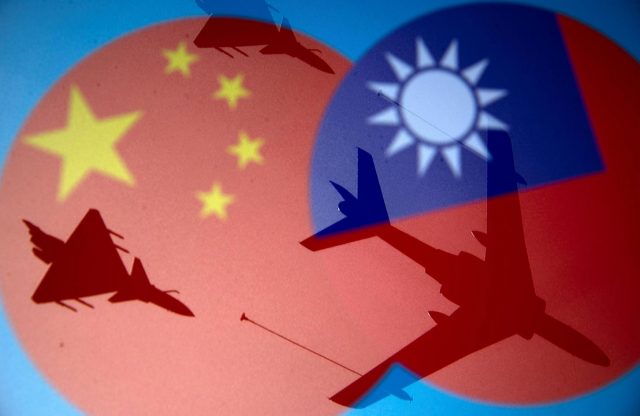
Taiwan reports new large-scale Chinese air force incursion

REUTERS

TAIPEI — Taiwan on Sunday reported the largest incursion since October by China’s air force in its air defense zone, with the island’s defense ministry saying Taiwanese fighters scrambled to warn away 39 aircraft in the latest uptick in tensions. 

Taiwan, which China claims as its own territory, has complained for more than a year of repeated missions by China’s air force near the democratically governed island, often in the southwestern part of its air defense identification zone, or ADIZ, close to the Taiwan-controlled Pratas Islands. 

Taiwan calls China’s repeated nearby military activities “gray zone” warfare, designed to both wear out Taiwan’s forces by making them repeatedly scramble, and also to test Taiwan’s responses. 

The latest Chinese mission included 34 fighters plus four electronic warfare aircraft and a single bomber, the Taiwan ministry said. 

The aircraft flew in an area to the northeast of the Pratas, according to a map the ministry provided. 

Taiwan sent combat aircraft to warn away the Chinese aircraft, while missile systems were deployed to monitor them, the ministry said. 

There was no immediate comment from China, which has in the past said such moves were drills aimed at protecting the country’s sovereignty. 

While it was not clear what might have prompted China to carry out such a large-scale mission, US and Japanese naval forces have been carrying out exercises in the Philippine Sea, a vast area that includes waters to the east of Taiwan. 

The US Pacific Fleet said on Sunday those exercises included two carrier strike groups who were “conducting training to preserve and protect a free and open Indo Pacific.” 

China has stepped up pressure on Taiwan to accept its sovereignty claims. Taiwan’s government says it wants peace but will defend itself if attacked. 

Taiwan reported 148 Chinese air force planes in the southern and southwestern part of its air defense zone over a four-day period beginning on Oct. 1, the same day China marked a key patriotic holiday, National Day. 

Taiwan has reported almost daily Chinese air force forays into the same air space since then, but the number of planes on Sunday was the largest on a single day since the October incursions. 

No shots have been fired and the Chinese aircraft have not been flying in Taiwan’s air space, but in its ADIZ, a broader area Taiwan monitors and patrols that acts to give it more time to respond to any threats. — Reuters

Rich countries’ access to foreign nurses during Omicron raises ethical concerns — group

PHILIPPINE STAR/ MICHAEL VARCAS

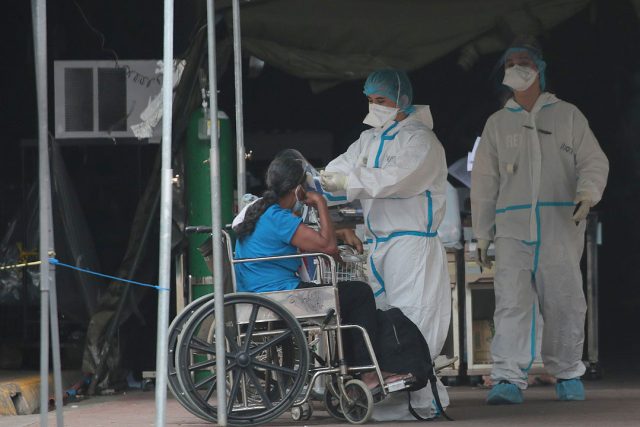
GENEVA — The Omicron-fueled wave of coronavirus disease 2019 (COVID-19) infections has led wealthy countries to intensify their recruitment of nurses from poorer parts of the world, worsening dire staffing shortages in overstretched workforces there, the International Council of Nurses (ICN) said. 

Sickness, burnout, and staff departures amid surging Omicron cases have driven absentee rates to levels not yet seen during the two-year pandemic, said Howard Catton, chief executive officer of the Geneva-based group that represents 27 million nurses and 130 national organizations. 

To plug the gap, Western countries have responded by hiring army personnel as well as volunteers and retirees but many have also stepped up international recruitment as part of a trend that is worsening health inequity, he continued. 

“We have absolutely seen an increase in international recruitment to places like the UK, Germany, Canada, and the United States,” Mr. Catton said in a Reuters interview based on a report he co-authored on COVID-19 and the global nursing force. 

“I really fear this ‘quick fix solution’ — it’s a bit similar to what we’ve been seeing with PPE [personal protective equipment] and vaccines where rich countries have used their economic might to buy and to hoard — if they do that with the nursing workforce it will just make the inequity even worse.” 

Even before the pandemic, there was a global shortage of 6 million nurses, with nearly 90% of those shortages in low and lower-middle-income countries, according to ICN data. 

Some of the recent recruits to rich countries have come from sub-Saharan Africa, including Nigeria, and parts of the Caribbean, Mr. Catton said, saying that nurses were often motivated by higher salaries and better terms than at home. 

The ICN report said this process was also being facilitated by giving nurses preferred immigration status. 

“The bottom line is that some people would look at this and say this is rich countries offloading the costs of educating new nurses and health workers,” he said. 

Even wealthy countries will struggle to cope with the “mountains of backlog of unmet care” when the pandemic winds down, Mr. Catton warned, calling for more investment and a ten-year plan to strengthen the workforce. 

“We need a coordinated, collaborative, concerted global effort which is underpinned by serious investment, not just warm words and platitudes and applause,” he said. — Emma Farge/Reuters

Hong Kong’s financial sector faces talent crunch as expats head for the exit

REUTERS

HONG KONG — Late last year, Tania Sibree quit her well-paid job as a financial services lawyer in Hong Kong and returned to Australia rather than live a moment longer with the city’s strict coronavirus restrictions.

Ms. Sibree, who said she had enjoyed the previous five years in Hong Kong, is one of hundreds — possibly thousands — of foreign expatriate professionals who have left or are planning to leave, threatening to dent the city’s standing as one of the world’s financial hubs.

“The hotel quarantine made it just so tough for people to travel and that was the big incentive to being in Hong Kong, it was close to home and my parents. But you cannot do that long in hotel quarantine with kids,” she said. “Everyone had been thinking the restrictions would be lifted, it would get better and it would not go on for so long.”

Hong Kong has only had about 13,000 coronavirus infections out of a population of 7.4 million, much lower than most places in the world. But the Chinese territory is following Beijing’s “zero-COVID” policy rather than adapting to life with the virus.

It has had stiff quarantines in place for two years, and last year introduced some of the strictest entry rules in the world, allowing only residents to return to the city and mandatory hotel quarantine of up to three weeks for arrivals from most countries, regardless of vaccination status, paid for by the travelers themselves.

However, “zero COVID” is no closer — 140 new infections were reported in Hong Kong on Sunday — and there are no signs of the government easing those restrictions. As a result, more expats are thinking of leaving, and global banks, asset managers, and corporate law firms are facing up to many of their staff exiting after annual bonuses are paid out in the first three months of the year, headhunters and industry executives told Reuters.

“The summer in Hong Kong will be the time when many people will throw in the towel and think to themselves ‘This is just untenable,’” one capital markets investment banker said, on the condition of anonymity. “As a banker right now you’re much better off being based in Singapore. You can travel, and once or twice a year you could bite the bullet and come to Hong Kong and do the quarantine if you need to.”

More than 40% of members recently surveyed by the American Chamber of Commerce in Hong Kong said they were more likely to leave Hong Kong, with most citing international travel restrictions as the leading factor.

“For the fastest growing sector of wealth and asset management there is a lack of trained supply of talent. If draconian travel restrictions continue for an undefined and lengthy period, the talent issue will become all the more serious,” said Tara Joseph, president of the chamber. “Many in the industry also expect that eventually many jobs in the sector will be taken up by mainland Chinese talent, leading to a big talent shift.”

Hong Kong’s government has played down any looming talent crunch. It said fighting the coronavirus was its top priority, for the good of the whole city, and that it was investing in talent to counter any loss of expertise or any damage to its status as a global financial hub.

“We believe that Hong Kong will continue to bring together talents from local and international sources,” a government spokesman said. “The government will continue to promote diversified development in the financial sector, foster local talents and attract foreign talents in various aspects to tie in with the long-term development of the Hong Kong economy.”

RUSH FOR THE DOORS

Hong Kong’s population declined 1.2% between mid-2020 and mid-2021, with more than 75,000 people leaving the city, according to Hong Kong’s Census and Statistics Department. Since September, Hong Kong has had five months of consecutive net outflow in travel, immigration department data shows.

Meanwhile, the total number of visa applicants from all countries under the “general employment policy” fell by a third last year to 10,073. Applicants for the financial services sector were down 23%.

“The proposition of bringing people into Hong Kong is not happening,” said John Mullally, regional director, southern China and Hong Kong financial services at headhunter Robert Walters.

“The only people willing to do it are the international or very senior executives or very young people without families,” he told Reuters. “When you look at the city, the financial services talent pool is definitely getting smaller.”

Rival Asian hub Singapore is the main beneficiary of that, said Christian Brun, chief executive of recruitment firm Wellesley.

“We will start to see more senior banking executives based in Singapore. Many people given the choice would now prefer to base themselves there,” he said. “We have seen that already with hedge funds and private equity and we will see it with banking too.”

Some financial industry executives and officials take a more sanguine view, saying Hong Kong will continue to be attractive for Chinese companies and wealthy individuals as long as its low tax rate, rule of law, and market freedom remain intact.

“Some of the kind of international vibe we have in the city will change. It will continue to boom, but it will be more with Chinese characteristics,” Kenneth Gaw, president of Gaw Capital Partners, said at a conference earlier this month.

The Hong Kong Monetary Authority, the city’s de facto central bank, said it was aware of pandemic-related challenges facing financial institutions, but said they should be “transitory” and that the fundamentals underpinning Hong Kong’s status as a global financial hub would remain strong.

Hong Kong’s Securities and Futures Commission said the number of licensed firms and individuals operating in the city had continued to grow through the end of last year, which it said underscored its attractiveness.

Nevertheless, many expats are not waiting to see how things unfold.

One financial analyst at a global research group who has called Hong Kong home for more than five years told Reuters he has been waiting for the city’s international borders to open so he can see his family and friends.

But with no sign of a change, he said he has decided to move back to the United States in the second quarter.

“Basically, we need to see our families and there is no end in sight to travel restrictions, no roadmap or plan,” he said. “Eventually you quit waiting and realize moving is the only option.” — Scott Murdoch and Kane Wu/Reuters


US opposes plans to strengthen World Health Organization

IMAGE VIA WHO/P. VIROT

BRUSSELS — The United States, the World Health Organization’s (WHO) top donor, is resisting proposals to make the agency more independent, four officials involved in the talks said, raising doubts about the Biden administration’s long-term support for the United Nations agency.

The proposal, made by the WHO’s working group on sustainable financing, would increase each member state’s standing annual contribution, according to a WHO document published online and dated Jan. 4.

The plan is part of a wider reform process galvanized by the coronavirus disease 2019 (COVID-19) pandemic, which has highlighted the limitations of the WHO’s power to intervene early in a crisis.

But the US government is opposing the reform because it has concerns about the WHO’s ability to confront future threats, including from China, US officials told Reuters.

It is pushing instead for the creation of a separate fund, directly controlled by donors, that would finance prevention and control of health emergencies.

Four European officials involved in the talks, who declined to be named because they were not authorized to speak to the media, confirmed the US opposition. The US government had no immediate comment.

The published proposal calls for member states’ mandatory contributions to rise gradually from 2024 so they would account for half the agency’s $2 billion core budget by 2028, compared to less than 20% now, the document said.

The WHO’s core budget is aimed at fighting pandemics and strengthening healthcare systems across the world. It also raises an additional $1 billion or so a year to tackle specific global challenges such as tropical diseases and influenza.

Supporters say that the current reliance on voluntary funding from member states and from charities such as the Bill and Melinda Gates Foundation forces the WHO to focus on priorities set by the funders, and makes it less able to criticize members when things go wrong.

An independent panel on pandemics that was appointed to advise on the WHO reform had called for a much bigger increase in mandatory fees, to 75% of the core budget, deeming the current system “a major risk to the integrity and independence” of the WHO.

LONG-STANDING SKEPTICISM

The WHO itself responded to a query by saying that “only flexible and predictable funds can enable WHO to fully implement the priorities of the Member States.”

Top European Union donors, including Germany, back the plan, along with most African, South Asian, South American, and Arab countries, three of the European officials said.

The proposal is to be discussed at the WHO’s executive board meeting next week but the divisions mean no agreement is expected, three of the officials said.

The WHO confirmed there was currently no consensus among member states, and said talks were likely to continue until the annual meeting in May of the World Health Assembly, the agency’s top decision-making body.

European donors in particular favor empowering, rather than weakening, multilateral organizations including the WHO.

One European official said the US plan “causes skepticism among many countries,” and said the creation of a new structure controlled by donors, rather than by the WHO, would weaken the agency’s ability to combat future pandemics.

Washington has been critical of the WHO for some time.

Former president Donald Trump pulled the United States out of the WHO after accusing it of defending China’s initial delays in sharing information when COVID-19 emerged there in 2019.

The Biden administration rejoined soon after taking office, but officials told Reuters they think the WHO needs significant reform, and raised concerns about its governance, structure, and ability to confront rising threats, not least from China.

One of the European officials said other big countries, including Japan and Brazil, were also hesitant about the published WHO proposal.

A Brazilian official with knowledge of the discussions said Brazil agreed that WHO funding needed to be looked at, but said it opposed the proposal to raise contributions as it had run up deficits tackling the virus and was now facing a fiscal crunch.

Instead, the official said the WHO needed to investigate other ways to raise funds, such as charging for its services, cutting costs, or relocating operations to cheaper countries.

“Raising contributions should be the last resort,” said the official, who was not authorized to speak publicly about the discussions.

Two of the European officials said China had not yet made its position clear, while a third official listed Beijing among the critics of the proposal.

The governments of Japan and China had no immediate comment. — Francesco Guarascio, Trevor Hunnicutt, and Stephanie Nebehay/Reuters

[B-SIDE Podcast] Broadband for a better future

Follow us on Spotify BusinessWorld B-Side

Digital infrastructure may not be a campaign talking point but it will be important for the next administration and the Philippines’ post-pandemic future.

“Whether you’re talking about agriculture or housing, all these will ultimately be driven by a broadband connection,” said Mario R. Domingo, founder of deep learning solutions company Neural Mechanics, Inc. and director of the Ateneo Institute for the Digital Enterprise. “In no uncertain terms, I want to make it clear that a national broadband network is the project of the national government because the moment you privatize it, it becomes a profitability play.”

In this B-Side episode, Mr. Domingo tells BusinessWorld reporter Patricia B. Mirasol about the relationship between the internet and nation-building.

TAKEAWAYS

The Philippines can take a page or two from its neighbors. 

Ambition-wise, the Philippines can take a page or two from neighboring countries such as China, which has a national policy that outlines leading the world in 10 high-end technology sectors, and Vietnam, which aims to make 30% of its GDP come from the digital sector by 2030

These goals, if reached, will benefit individuals, Mr. Domingo said. “You need to provide entrepreneurs the infrastructure. A guy from a sitio in Albay may have a mobile app idea, but not the connectivity to [test] it. If they have to rent an office in Bonifacio Global City to get good connectivity, you’re killing them already, because of how expensive it is there.” 

A policy has no teeth without implementation.

The Innovative Startup Act (RA 11337), which aims to strengthen, promote, and develop the Philippine startup ecosystem, is “best in class,” said Mr. Domingo.

However, policies — no matter how excellent — atrophy when not executed in a timely manner. “What’s the point of giving an entrepreneur a grant if… the procurement process to buy a P1 million server takes eight to ten months?” Mr. Domingo asked. “By the time you install your high-tech equipment, it’s already obsolete.” 

Virtual connections can follow the physical.

If a high-speed northern Luzon to southern Mindanao railway network is built, it can act as the spine of a national broadband network.

“The reason why it’s missing is because it’s daunting,” he said, adding that several administrations will have to commit to connecting the Philippine archipelago. “Infrastructure-building is a core scalable and sustainable activity for the Philippines as a sovereign nation.” 

Recorded remotely on Dec. 15, 2021. Produced by Paolo L. Lopez, Jino D. Nicolas and Sam L. Marcelo.

Follow us on Spotify BusinessWorld B-Side

Transporting the country forward

Metro Rail Transit Line 7 (MRT-7)

As one of the oldest government agencies in the Philippines, dating back to shortly after the foundation of the very country when it was established under the Malolos Constitution on January 21, 1899, the Department of Transportation’s (DoTr) history of public service is among the most storied.

From the American Colonization period, when the management of public property and revenue and the use of all public means of transportation were to be conducted by the US Army, to the Japanese Occupation when the exiled Commonwealth government of President Manuel Quezon reorganized and the Department of Public Works and Communication became the Department of National Defense, Public Works, Communications and Labor, the DoTr stood proud to be part of Philippine history.

Undoubtedly, the past two years add quite a lot more to the challenges the agency has faced.

“If we are to look back at 2020, we can say that it was indeed an epic disruptive year. We cannot talk about 2020 without the global crisis subject brought by what is probably the greatest challenge of our time — the coronavirus disease 2019 (COVID-19) pandemic,” Secretary Arthur Tugade said in the Department of Transportation 2020 annual report.

The DoTr is the primary policy, planning, programming, coordinating, implementing and administrative entity of the executive branch of the government on the promotion, development and regulation of a dependable and coordinated network of transportation systems, as well as in the fast, safe, efficient and reliable transportation services.

Mr. Tugade reiterated that the agency plays a crucial role in accelerating the country’s economic development, providing the backbone for growth and enhancing the country’s competitive edge by creating effective and efficient transportation infrastructure systems that narrow the geographical and physical divide, connecting the country, its islands, and its people to the rest of the world. A role made all the more difficult by the restrictions COVID-19 has brought with it.

DoTr Secretary Arthur P. Tugade

“With the emergence of the deadly disease, lockdowns and border closures were enforced in many countries resulting in the decline in passenger transport demand. The transportation sector has been one of the primary victims of COVID-19. From air, road, railways, to sea travels, all have been suffering from the outbreak’s disproportionate economic impacts. Consequently, the Philippine transportation sector was not spared,” Mr. Tugade said.

“With our mandate to develop efficient and reliable transport services and networks, the Department of Transportation (DoTr) is further challenged to up the ante by striking a balance between implementing an appropriate response plan for contingencies and upholding public welfare. We need to keep a core of the public transportation system operational while keeping the Filipino people safe. Thus, various initiatives have been implemented to surmount present challenges and help the country’s economy recover,” he added.

To address the country’s mobility needs amid the threat of COVID-19, the DoTr has taken initiatives to tap digitalization efforts that will help boost various transport infrastructure projects and programs in all sectors (Roads, Railways, Maritime. Airports and Aviation), across the country.

Under Secretary Tugade’s vision to digitally transform transportation, the DoTr has committed itself to promote and develop smart solutions that will help address mobility and connectivity.

In a recent Smart Mobility Forum, the DoTr reinforced its position, expressing that the current situation has made it even more imperative for the department to re-calibrate and re-strategize its ways of doing things to address the country’s mobility needs.

Secretary Tugade said that the department is gearing to a future wherein technological advancements will be highly optimized, where there is a gradual shift to the ‘new normal’. By promoting smart mobility through digitalization, the DoTr continues to support initiatives in the present as a long-term solution for the future, and in the process, allow commuters to regain confidence in commuting.

“It is in this premise that the DoTr is on a mission to revolutionize mobility to keep up with the changing times and shape the country’s transport system into one that is resilient and adaptable to the future,” Mr. Tugade said.

“And so, we have embraced digitalization and continue to harness best practices in technology in all of our four sectors, namely, the Aviation and Airports, Railways, Road, and Maritime sectors to deliver swift agency processes and limit human intervention for the safety of the people,” he added.

For its continuity plan for the future, the DoTr aims to keep developing mobility systems by engaging an asset build-up strategy through building much-needed infrastructures. Despite health and community restrictions, the “BUILD, BUILD, BUILD” program continues.

“Further, we will strive to demonstrate resilience in the face of COVID-19 by implementing stringent health and safety protocols in all public transport systems. Your DoTr also remains alert and active in response efforts on whatever challenges, calamities, and uncertainties we are facing and will be facing as a nation,” Mr. Tugade said.

“Respond. Recover. Thrive. These words will be our guiding principle moving forward. And we look ahead to a future that sees the Filipino people enjoying the comfortable life they deserve,” he shared. — Bjorn Biel M. Beltran