Home Blog Page 6384

Employers call for more ‘social dialogue’ to improve rural labor conditions

PHILSTAR

EMPLOYERS said increased engagement in the form of “social dialogue” between workers and management, with the possible involvement of the government, is needed to improve working conditions in the countryside.

“Social dialogue is not limited to negotiations or consultation. It also includes sharing of information,” Employers Confederation of the Philippines Director General Jose Roland A. Moya said at a virtual webinar earlier this week.

“It can be a tripartite process, wherein the actors are government representatives and employer’s and worker’s organizations. It can also include bipartite relations between trade unions and employer’s organizations to promote better living and working conditions and greater social justice,” he added.

Mr. Moya said that while tripartite engagement has been institutionalized, bipartite relations are less formalized and structured.

“Whether its tripartism, collective bargaining, labor-management or some other similar form of interaction, meaningful social dialogue is essential to enable employers and workers to… respond to competition, take advantage of opportunities, adapt to change and improve business performance.”

The International Labour Organization (ILO) has said that agriculture, fishing and mining are characterized by poverty and poor working conditions.

“It is usually linked with long working hours, low wages and other issues related to payment of wages, hazardous working environment, widespread informality, ambiguous employment relationships, non-standard forms of employment, among others,” the ILO said in a statement this week.

The ILO added that the government must promote responsible labor practices to achieve inclusive and sustainable business in the rural sectors.

“Globally, there is also a growing demand for businesses to ensure responsible business practices and due diligence within their supply or value chain. More and more countries are integrating labor provisions in trade policies and agreements, helping promote compliance to labor standards, including occupational safety and health (OSH) and gender equality,” Director of the ILO Country Office for the Philippines Khalid Hassan said. — Luisa Maria Jacinta C. Jocson

Chris Paul ejected, but Suns edge Rockets for 7th straight win

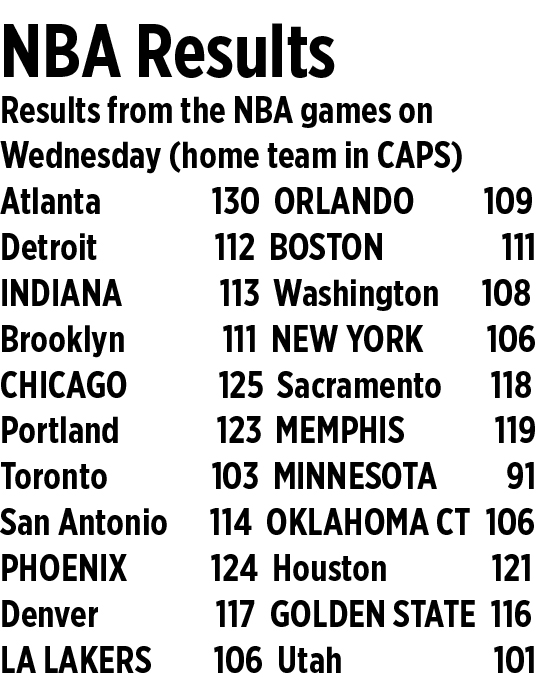
DEVIN Booker recorded 24 points and eight assists and the Phoenix Suns survived the ejection of Chris Paul to rally for a 124-121 victory over the visiting Houston Rockets on Wednesday night.

Deandre Ayton added 23 points and nine rebounds, Mikal Bridges registered 17 points and seven rebounds and Cameron Johnson added 14 points for the Suns, who won their seventh straight game and 18th of their past 19. Phoenix trailed the entire third quarter before using a strong fourth quarter to defeat the Rockets for the seventh consecutive time and head into the All-Star break with an NBA-best 48-10 record.

Paul was ejected after apparently inadvertently making contact with official J.T. Orr with 9:07 left in the third quarter. Paul had 11 points and six assists in 19 minutes prior to his ejection.

Houston’s Eric Gordon missed a 3-point attempt as time expired.

Dennis Schröder had 23 points and nine assists and Jae’Sean Tate added 22 points and 10 rebounds for Houston, which lost its sixth straight game and 10th of its past 11. Gordon scored 20 points, Alperen Sengun matched his career best of 19 points and collected a career-high 14 rebounds and Jalen Green scored 17 points for the Rockets.

Houston played without Christian Wood and Kevin Porter, Jr. due to illnesses.

Kenyon Martin Jr. tallied 11 points for the Rockets, who shot 43.3% from the field and were 13 of 44 from 3-point range.

Phoenix connected on 51.2 percent of its shots, including 7 of 24 from behind the arc.

Houston had led by 12 points late in the first half but trailed by eight before exploding with a 13-2 run to take a 114-111 lead with 1:56 left. Sengun’s basket tied it with 2:56 left and Green drained a tiebreaking 3-pointer.

Johnson connected on a 3-pointer with 1:47 left to tie it for the Suns and Bridges’ basket gave Phoenix a two-point lead with 1:10 to play. Bridges then scored on a putback to give the Suns a four-point edge with 31.5 seconds remaining.

The Rockets didn’t go away and Gordon drilled a 3-pointer with 4.6 seconds left to make it a one-point margin. Booker hit two free throws with 2.1 seconds remaining prior to Gordon’s game-ending miss.

Phoenix scored the first 12 points of the fourth quarter to turn a six-point deficit into a 101-95 lead with 8:42 remaining.

Johnson’s basket pushed Phoenix’s lead to 109-101 with 5:48 left.

Tate had 16 points and seven rebounds in the first half as the Rockets held a 67-59 lead at the break. — Reuters

Nestlé PHL calls for development of markets to spur waste material collection, recycling

BW FILE PHOTO

THE development of a market for waste recycling will help the Philippines achieve its environmental goals by offering rewards for the collection of materials currently deemed unrecyclable, the head of Nestlé Philippines, Inc. said.

The company’s Chairman and Chief Executive Officer, Kais Marzouki, said at a virtual forum organized by the Makati Business Club on Thursday that markets are essential, noting that materials that have recycling value routinely get collected and sent in for processing.

“Let the market forces solve the problem… here in the Philippines we have the palengkes (wet markets) that collect (waste materials). Why do palengkes collect plastic bottles? Because the plastic bottles have value. Somebody is happy to buy them back,” he said.

“When it comes to our plastic laminates and flexible plastic, nobody is collecting these because they have no value,” Mr. Marzouki added.

“The moment that you set up an industry that recycles packaging, for sure people will find value and will collect and bring it to the factory to get something in exchange for it and the industry will happily buy also recycled plastic,” Mr. Marzouki said.

He called on the government to lay the groundwork for such markets via legislation and financing to the point where “the whole system can start running on its own.”

Marc Schmidt, a Singapore-based Boston Consulting Group managing director and partner in the firm’s Energy and Industrial Goods practices, said companies can own the origins of the inputs and increase their environmental or societal value, or own the entire production cycle and usage end to end. — Revin Mikhael D. Ochave

No vax Novak

Novak Djokovic didn’t do himself any favors by doubling down on his refusal to get inoculated against the COVID-19 virus. To recall, his unvaccinated status led to his deportation from Australia last month, costing him the opportunity to defend his Australian Open title and handing the provisional lead in number of career Grand Slam victories to rival Rafael Nadal. Yet, it’s clear from his wide-ranging interview with BBC last Tuesday that he believes he’s in the right to keep refusing the vaccine.

In light of the development, not a few quarters have seen fit to cite the strength of Djokovic’s conviction. In truth, there is nothing courageous about what he insists on. The overwhelming preponderance of scientific fact on the benefits of inoculation, plus the untold risks he places others in by remaining unvaccinated, place him on shaky ground. It doesn’t matter if he has expressed willingness to forego the chance to claim more major championships. He’s a global citizen; he doesn’t live in a bubble.

Why Djokovic insists on staying unvaccinated, only he knows. At best, he’s being disingenuous when he says he’s not part of the anti-vax movement, and yet refuses to get jabbed. He’s also being duplicitous when he claims to acknowledge the science behind vaccination, and yet doesn’t want to touch it with the proverbial 10-foot pole. It wouldn’t be a problem if his stubbornness is costing no one but him. Unfortunately, all and sundry are affected.

Make no mistake. Djokovic deserves to tap his talents on the court, and fans deserve to see him at his finest. He’s World Number One for a reason. That said, no one deserves to be placed at risk as a result of his decision. And because he’s a household name, his voice carries not inconsiderable weight. Imagine if he uses it to do good. Instead, he’s exercising his right to be wrong. Which is just too bad. Saying the world is flat with confidence isn’t valorous. It’s just plain stupid. Enough said.


Anthony L. Cuaycong has been writing Courtside since BusinessWorld introduced a Sports section in 1994. He is a consultant on strategic planning, operations and Human Resources management, corporate communications, and business development.

Peso weakens vs dollar as central bank sees faster 2022, 2023 inflation

BW FILE PHOTO

THE PESO retreated versus the greenback on Thursday as the central bank warned of higher inflation this year and amid fresh signals from the US Federal Reserve.

The local unit closed at P51.33 per dollar on Thursday, depreciating by 4.5 centavos from its P51.285 finish on Wednesday, based on Bankers Association of the Philippines data.

The peso opened Thursday’s session at P51.27 against the dollar. Its weakest showing was at P51.36, while its intraday best was at P51.235 versus the greenback.

Dollars exchanged climbed to $824.4 million on Thursday from $596.1 million on Wednesday.

The peso weakened after the central bank said it now expects faster inflation for 2022 and 2023, Rizal Commercial Banking Corp. Chief Economist Michael L. Ricafort said in a Viber message.

The Bangko Sentral ng Pilipinas (BSP) kept benchmark interest rates steady at its meeting on Thursday to continue supporting the economy’s recovery, but signaled it is preparing an exit strategy to respond to inflation risks.

The BSP now expects a faster inflation rate of 3.7% for 2022 from its previous 3.4% estimate, still within the 2-4% target and slower than the 4.5% in 2021. The forecast for 2023 was likewise raised to 3.3% from 3.2% in the previous review.

“The higher inflation path in 2022 is attributed primarily to higher world non-oil prices, as well as global crude oil prices, that could affect domestic inflation,” BSP Department of Economic Research Managing Director Zeno Ronald R. Abenoja said.

Meanwhile, a trader in an e-mail said the market also factored in statements from the Fed on its planned rate hikes in the minutes of its latest meeting.

Fed officials last month agreed that, with inflation tightening its grip on the economy and employment strong, it was time to raise interest rates, but also that any decisions would depend on a meeting-by-meeting analysis of inflation and other data, according to the minutes of the Jan. 25-26 policy meeting, Reuters reported.

The account of the two-day session showed the US central bank readying for a fight against the fastest pace of price increases since the 1980s, with officials saying that while they still expected inflation to ease through the year, they would be ready to hike rates fast if it does not.

“Most participants noted that, if inflation does not move down as they expect, it would be appropriate for the (Federal Open Market) Committee to remove policy accommodation at a faster pace than they currently anticipate,” the minutes stated.

As it stood, Fed officials said the strength of the economy and the high current pace of inflation would warrant raising rates quicker than the once-per-quarter pace seen during the tightening cycle that began in 2015 — a statement some analysts said perhaps points to rate hikes at every meeting this year.

For Friday, Mr. Ricafort gave a forecast range of P51.20 to P51.35 per dollar, while the trader expects the local unit to move within P51.25 to P51.50. — LWTN with Reuters

PSE index inches lower ahead of BSP decision

BW FILE PHOTO

SHARES went down on Thursday as investors pocketed their gains ahead of the Philippine central bank’s policy decision.

The Philippine Stock Exchange index (PSEi) dropped 13.89 points or 0.18% to end at 7,438.93. Meanwhile, the broader all shares index inched up 3.77 points or 0.09% to close at 3,934.31.

First Metro Investment Corp. Head of Research Cristina S. Ulang said investors were in a wait-and-see mood ahead of the Bangko Sentral ng Pilipinas’ (BSP) latest policy decision.

“While policy rates are anticipated to remain unchanged, investors are watching out for clues on the BSP’s policy direction this year in light of the expected continuation of our economic recovery and the hawkish outlook of the Federal Reserve,” Philstocks Financial, Inc. Senior Research Analyst Japhet O. Tantiangco said in a Viber message.

Hours after the market closed, the BSP announced it is keeping benchmark interest rates steady to support the economy’s recovery.

Fed officials last month agreed that, with inflation tightening its grip on the economy and employment strong, it was time to raise interest rates, but also that any decisions would depend on a meeting-by-meeting analysis of inflation and other data, according to the minutes of the Jan. 25-26 policy meeting, Reuters reported.

The account of the two-day session showed the US central bank readying for a fight against the fastest pace of price increases since the 1980s, with officials saying that while they still expected inflation to ease through the year, they would be ready to hike rates fast if it does not.

Meanwhile, AAA Southeast Equities, Inc. William M. Cabangon said Metro Pacific Investments Corp. (MPIC), which rose 5.15%, was as big gainer following the company’s announcement that it will initiate a P5-billion share buyback program.

Sectoral indices were mixed on Thursday. Property went down 21.66 points or 0.62% to 3,463.32; holding firms dropped 10.46 points or 0.14% to 7,090.84; and financials slipped 0.81 point or 0.04% to 1,737.05.

On the other hand, services rose 5.97 points or 0.30% to 1,956.35; industrials advanced 26.51 points or 0.25% to 10,615.16; and mining and oil increased 24.14 points or 0.21% to 11,383.43.

Value turnover fell to P6.82 billion with 911.04 million issues traded on Thursday from the P9.53 billion with 1.16 billion shares switching hands on Wednesday.

Advancers beat decliners, 107 versus 77, while 56 names closed unchanged.

Foreigners turned sellers with P279.27 million net outflows recorded on Thursday versus the P893.43 million in net purchases on Wednesday.

MPIC is one of three key Philippine units of First Pacific, the others being Philex Mining Corp. and PLDT, Inc.

Hastings Holdings, Inc., a unit of PLDT Beneficial Trust Fund subsidiary MediaQuest Holdings, Inc., has a majority stake in BusinessWorld through the Philippine Star Group, which it controls. — MCL with Reuters

UK pledges $34M to enhance security in Indo-Pacific

UK PRIME MINISTER Boris Johnson. — Reuters

SYDNEY — Britain committed 25 million pounds ($34 million) to strengthen security in the Indo-Pacific as part of a pact with Australia, and leaders of both countries expressed “grave concerns” about China’s policies in its far western region of Xinjiang. 

In a video call on Thursday, British Prime Minister Boris Johnson and his Australian counterpart Scott Morrison also called for peace and stability across the Taiwan Strait and warned Russia against invading Ukraine. 

“They agreed the need for de-escalation and underscored that any further Russian incursion in Ukraine would be a massive strategic mistake and have a stark humanitarian cost,” the leaders said in a joint statement after their meeting. 

The funds pledged to the Indo-Pacific security agreement would strengthen regional resilience in areas including cyberspace, state threats, and maritime security, Messrs. Morrison and Johnson said. 

The bilateral talks come just a week after the so-called Quad group of Australia, the United States, Japan, and India pledged to deepen cooperation to ensure the Indo-Pacific region was free from “coercion”, a thinly veiled swipe at China’s economic and military expansion. 

Messrs. Johnson and Morrison expressed “grave concerns about credible reports of human rights violations in Xinjiang, and called on China to protect the rights, freedoms and high degree of autonomy for Hong Kong.” 

The United States accuses China of genocide in its treatment of minority Muslim Uyghurs in Xinjiang and abuse including forced and prison labour. China denies the accusations. 

China imposed a sweeping national security law on Hong Kong in 2020, a move critics said undercut the greater freedoms promised under the “one country, two systems” framework agreed when the former British colony returned to Chinese rule in 1997. 

Messrs. Morrison and Johnson also stressed “the importance of peace and stability across the Taiwan Strait, and expressed support for Taiwan’s meaningful participation in international organizations.” 

China claims Taiwan as its own territory. Taiwan has complained about frequent incursions by China’s air force into its air defense zone, part of what Taipei says is a pattern of harassment by Beijing. 

Taiwan’s Foreign Ministry expressed its thanks for the support, saying they would continue to deepen cooperation with fellow democracies like Britain and Australia. 

The British and Australian leaders also stressed the importance of maritime rights and freedoms in the South China Sea, saying they were strongly opposed “to any unilateral actions that could escalate tensions and undermine regional stability and the international rules-based order, including militarization, coercion, and intimidation.” — Reuters

US sanctions on Russian banks are the West’s most potent economic threat

US PRESIDENT Joseph R. Biden and Russia’s President Vladimir Putin — REUTERS

LONDON — For NATO members, the most powerful measure against Russia were it to invade Ukraine would be US sanctions cutting off Russian state banks from the dollar according to Russian executives, bankers, and former senior US sanctions officials. 

The United States has warned that Russia could invade as early as this week. Moscow denies it has such plans but says the West needs to take its concerns about NATO expansion seriously. 

Washington, and its allies in Europe, are finalizing an extensive package of sanctions if Russia were to launch an invasion according to US and European officials. 

The US package would expand a technology export ban to include any goods made with US components or software, as well as proposed sanctions against specific Russian billionaires. But sanctions experts say more than any other measure, aggressive action against Russia’s state banks would hit its economy the hardest. 

“Banking sanctions are the most impactful measure the US can carry out in the short term,” said Brian O’Toole, a former senior advisor to the director of the Office of Foreign Assets Control or OFAC in the US Treasury Department, which designs and manages the implementation of sanctions. 

Proposed sanctions against Russian banks would bar them from making any transactions in US dollars, essentially freezing any dollar-denominated assets or liabilities held by the banks at home and abroad. 

Russian Finance Minister Anton Siluanov on Wednesday said sanctions against Russian banks would be “unpleasant” and lead to a spike in volatility, but said the state would make sure that all deposits with banks and all transactions, including in foreign currencies, were secured. Russia’s abundant hard currency reserves — now at $635 billion — would help shield against the potential blow, he said. 

When asked about possible sanctions on Russian state banks, Kremlin spokesman Dmitry Peskov told Reuters that Russia was “preparing for unpredictable actions” from the United States “by hedging against any risks.” 

He said: “We could get the impression that all this information noise and all these claims that Russia is about to attack Ukraine are being made to further contain Russia and to create a reason to impose further sanctions — and so they are speaking about these hellish sanctions.” 

Elina Ribakova, deputy chief economist at the Institute of International Finance in Washington said even though Russia has enough reserves, the potential measures “could cause a run on deposits. It will definitely have a strong impact on the domestic financial system. It will raise the risk of financial instability including a widening of spreads and a sell-off of the rouble.” 

US sanctions far outweigh the power of any other jurisdiction because the White House can potentially impose secondary sanctions on any foreign banks continuing to deal with these institutions, said Mr. O’Toole and Tom Keatinge, finance and security expert at the Royal United Services Institute, a London-based think tank. The White House did not answer requests for comment about secondary sanctions. 

Shares in banking giant Sberbank and smaller rival VTB have both fallen in the past week on the prospect of sanctions, although recovered some losses after Russia said on Tuesday that some troops stationed near borders with Ukraine were returning to base after completing drills 

Sberbank holds nearly half of Russia’s 21 trillion roubles in deposits and together with state lenders VTB, Gazprombank, and Rosselkhozbank accounts for nearly 60% of the nation’s banking assets. 

GOING IN HEAVY
Sberbank, VTB and the Russian Central Bank declined to comment. Gazprombank and Rosselkhozbank did not respond to requests for comment. 

“Taking out Sberbank would have massive ramifications,” Mr. O’Toole added. 

The nature of the sanctions would likely hinge on the scale of a Russian invasion. 

A Russian invasion limited to an incursion into the rebel-held Donbass region of east Ukraine for example, might mean the United States staggered its targeting of the Russian state banks in order to maintain further deterrence, potentially keeping Sberbank until last, said Daniel Fried, a former State Department coordinator for sanctions policy in the Obama administration. 

But “if the Kremlin goes in big, so could we, and we might go in heavy in any case,” Mr. Fried said. 

Sanctions on banks would be partly aimed at forcing Russia’s central bank to dig into its hard currency reserves in order to bail out the banks and keep them afloat, Messrs. O’Toole and Fried both said. The central bank declined to comment on hard currency reserves and sanctions. 

Russia has some defenses to withstand a US-led attack on its financial stability. The hard currency reserves, high oil prices and a low debt to GDP ratio of 18% in 2021 place it in a good position to weather a further tightening of existing sanctions, said Chris Weafer, director of MacroAdvisory, a Moscow-based consultancy. 

In addition, Russian state banks curtailed their exposure to Western markets when the United States and EU imposed limited sanctions on VTB and Sberbank in retaliation for Russia’s 2014 annexation of Crimea, which restricted their ability to raise debt. 

Today, the proposed state bank sanctions would include a system of waivers, licenses, and wind-down periods to ensure payments for dollar-denominated commodity contracts and debt payments could be made, the sanctions experts said. 

Russian officials have largely focused on threats to cut off Russia from the SWIFT financial messaging system in case of war. 

But US and European officials said last week this measure was now off the table due to concerns from European lenders that it could mean billions of dollars in outstanding loans they have in Russia would not be repaid. 

DOLLARS THE KEY
Sberbank chief executive German Gref has previously brushed off reports that US sanctions could prevent Moscow from converting roubles into dollars on the grounds that he believed it was “impossible to execute.” 

Two senior Russian bankers interviewed by Reuters said they expected any targeted bank to escape the worst of the impact by converting their dollar holdings into euros. 

Former senior US sanctions officials, however, said this confidence was misplaced as the dollars would still have to ultimately go through a US clearing bank in order to convert them. 

“Anything that is denominated in dollars has to clear through the US and once you do that it’s stuck,” said Mr. O’Toole. 

These sanctions, he said, could also lead to freezes on dollar accounts held abroad by the Russian state banks in correspondent accounts, set up to handle funds on behalf of another bank. 

Igor Yurgens, vice president of the Russian Union of Industrialists and Entrepreneurs, a powerful lobby group for Russian business, told Reuters the Russian central bank had been working on a programme for correspondent accounts with China through which to convert cash that might help mitigate the impact of sanctions. 

“Everything would be difficult, but it won’t collapse,” he said. The Russian authorities “have conducted technological stress tests and consider they will muddle through for a while.” 

Sergey Aleksashenko, a former deputy Russian central bank chairman now living in exile in the United States, said he believed the West’s sanctions threats were no more than an escalating virtual, or information, war between Russia and the West. 

In this standoff, “Putin’s weapon is (the movement of) tanks and the West’s is talk of sanctions. All of this is part of a great game,” he said. 

But one of Russia’s top 50 billionaires interviewed by Reuters warned that the political maneuvering between Moscow and Washington could end up in conflict and economic reprisals. “Everyone has been playing a virtual game…But then all these virtual events can become facts in life.” 

“Sanctions will lead to serious economic consequences,” he said. — Catherine Belton/Reuters

US retail sales race to record high; economy shows strength ahead of rate hikes

Ford Motor Company

WASHINGTON — US retail sales increased by the most in 10 months in January, lifting the level of sales to a record high amid a surge in purchases of motor vehicles and other goods, but higher prices could limit the boost to economic growth this quarter. 

The report from the Commerce Department on Wednesday showed underlying strength in the economy ahead of anticipated interest rate increases from the Federal Reserve starting in March, although retail sales in December were much weaker than initially estimated. 

“The strong rebound in January retail sales, though partly in response to last year’s weak finish and inflated by higher prices, suggests consumers still have plenty in the tank to propel the expansion forward this year,” said Sal Guatieri, a senior economist at BMO Capital Markets in Toronto. “Rate hikes won’t cool their jets for a while, making the Fed’s job of driving down inflation that much harder.” 

Retail sales surged 3.8% last month, the largest rise since last March. That raised sales to their highest level since the government started tracking the series in 1992. 

Data for December was revised down to show sales declining 2.5% instead of 1.9% as previously reported. Economists polled by Reuters had forecast retail sales would rise 2.0%, with estimates ranging from as low as 0.7% to as high as 4.4%. 

Retail sales increased despite consumer sentiment sagging to a decade low in recent months. Spending is being supported by massive savings, high household wealth and a tightening labor market, though inflation is eroding wage gains. 

The broad increase in sales was led by motor vehicles. 

Auto sales typically fall in January after the holiday promotional season. Given the ongoing scarcity of motor vehicles because of a global shortage of semiconductors, the drop last month was probably smaller than had been expected by the seasonal factors, the model used by the government to iron out seasonal fluctuations in data. 

That likely resulted in the seasonal factors being more generous than in previous years. Unadjusted auto sales were the highest for the month of January going back to 1992. 

Economists expect this boost to fade in March. Auto sales could also fall, with a separate report from the Fed on Wednesday showing motor vehicle production declined in January for a second straight month. That curbed overall growth in manufacturing output to 0.2% last month. 

“Despite some caveats to the retail sales report, at least we can be assured that consumers are not pulling back their crucial support for the economy even though they are experiencing a marked decline in confidence if not being downright depressed about what the future holds,” said Christopher Rupkey, chief economist at FWDBONDS in New York. 

Stocks on Wall Street fell as investors worried the strong retail sales could give the US central bank ammunition to aggressively tighten monetary policy. 

Financial markets are pricing in nearly even odds of a 50-basis-point interest rate increase next month. Economists expect as many as seven rate hikes this year. 

Minutes of the Fed’s Jan. 25–26 meeting published on Wednesday showed decisions to raise rates would depend on a meeting-by-meeting analysis of data. 

The dollar slipped against a basket of currencies while US Treasury prices were mixed. 

BROAD GAINS
Retail sales last month were also lifted by higher prices because of shortages amid strained supply chains. They are mostly made up of goods and are not adjusted for inflation. 

Economists estimated that retail sales rose about 2.8% in January when adjusted for inflation, which put them back in line with their pre-pandemic trend. 

Receipts at auto dealerships snapped back 5.7% after dropping 1.6% in December. Sales at electronics and appliance stores increased 1.9%. Building materials stores sales surged 4.1%. There were also gains in receipts at food and beverage stores as well as clothing retailers. 

But sales at sporting goods, hobby, musical instrument, and book stores fell 3.0%, suggesting consumers were cutting back on discretionary spending likely because of inflation. Sales at service stations fell 1.3% amid lower gasoline prices. 

Receipts at restaurants and bars dropped 0.9% as COVID-19 infections, driven by the Omicron variant, reduced mobility. Restaurants and bars are the only services category in the retail sales report. Online retail store sales surged 14.5%. 

Excluding automobiles, gasoline, building materials and food services, retail sales soared 4.8% in January. Data for December was revised lower to show these so-called core retail sales falling 4.0% instead of 3.1% as previously reported. 

Core retail sales correspond most closely with the consumer spending component of gross domestic product. 

Economists estimated that inflation-adjusted core retail sales rose 2.7% last month. The so-called real core retail sales are what matter in the measurement of consumer spending growth. 

January’s solid real core retail sales suggested that consumer spending this quarter would probably not be as weak as economists had expected. Real consumer spending declined 1.0% in December, which had set consumption on a slower growth path. 

“The recent volatility in the data makes it hard to detect the underlying trend, but the recent momentum for consumer spending now looks stronger than we were anticipating,” said Daniel Silver, an economist at JPMorgan in New York. 

Growth estimates for consumer spending are mostly below a 2.0% annualized rate. Consumer spending, which accounts for more than two-thirds of US economic activity, increased at a 3.3% pace in the fourth quarter. 

Economists at Goldman Sachs raised their first-quarter GDP growth estimate by 1.5 percentage points to a 2.0% rate. The economy grew at a 6.9% pace in the fourth quarter. Growth in 2021 was the strongest since 1984. — Lucia Mutikani/Reuters

Sports and lifestyle brand PUMA opens online store to PH market

Global Sports Brand PUMA has expanded its presence in South East Asia and opened its online store PUMA.com for customers in the Philippines.

By opening PUMA.com in the Philippines, the sports company offers all of its products to online shopping fans in the Southeast Asian market.

“eCommerce is simply the easiest way to connect with PUMA fans all around the world. With the launch of this site, PUMA can finally offer interactive online shopping experiences in SEA too. We are very excited about the launch, and we look forward to introducing more exciting concepts and offerings in the Philippines market,” says Sanjay Roy, General Manager of PUMA SEA.

The products are locally picked, packed and shipped directly to customers. Another bonus is that the logistics in this area will open in Spring 2022 and will create hundreds of direct and indirect employments. From cart to checkout to enjoying PUMA products at home is now only a click away in the Philippines.

“Filipinos are such proud, big fans of sports, especially basketball, we even play in slippers on the street! Sport means a lot to our people. Knowing that everyone can order their favorite PUMA products at any time and anywhere soon is pure joy,” said PUMA Philippines Country Manager, Paolo Misa.

To launch PUMA.com, PUMA brought its brand ambassador, LaMelo Ball, to the Philippines fans. Featured at the Tenement Court is LaMelo’s mural, handpicked by LaMelo himself from a mural design competition held in the Philippines. This artwork submitted by winner, William Pototoy, takes inspirations from LaMelo’s “Not from Here” concept.

Stay tuned on ph.PUMA.com for more exclusive seasonal drops featuring key products from highly anticipated collaborations and collections.


Spotlight is BusinessWorld’s sponsored section that allows advertisers to amplify their brand and connect with BusinessWorld’s audience by enabling them to publish their stories directly on the BusinessWorld Web site. For more information, send an email to online@bworldonline.com.

Join us on Viber to get more updates from BusinessWorld: https://bit.ly/3hv6bLA.

‘This isKwela’ for all: Globe launches online education community page

In line with its goal to help bring inclusive, accessible and safe learning solutions for Filipinos, Globe has launched a new online education community that aims to spark meaningful and inspiring conversations to elevate learning across digital platforms.

Globe is encouraging people of all ages to be part of its “This isKwela” Facebook Community, a hub that supports learning across different life stages and provides a new online space for members to meet new friends, learn new information, sharpen skills, and share knowledge.

The community is beneficial to many, from students wanting to supplement formal schooling to professionals seeking information for work. It also helps those in need of upskilling, even the elderly who want to learn more about digital technology and applications.

Experts on key subjects are available to assist community members. They are Angelo Sicat, a teacher and creator of practical and easy-to-digest English language learning topics on TikTok; Immanuel Maglasang, the man behind online channel Science Kwela; Cipriano Romeral, Jr., a math expert who has conducted lectures for the Licensure Examination for Teachers (LET); and Teacher Maureen Madiano, a licensed teacher and content creator who teaches basic English and Filipino lessons on different social media platforms.

“With more people joining and participating in online communities, Globe aims to build an inclusive social hub that serves as an alternative learning community for anyone who wants to do lifelong learning,” said Yoly Crisanto, Globe’s Chief Sustainability Officer and SVP for Corporate Communications.

Globe believes that This isKwela is timely as more people are embracing “new normal” learning via digital platforms, such as online classes, e-libraries and webinars, among others.

This isKwela is part of GoLearn, a unified initiative aimed at helping the country achieve 21st century learning. GoLearn aims to open doors to a brighter future by promoting continuous learning and further bridging digital gaps in the Philippine education landscape via access to connectivity, learning platforms, and other solutions. Those interested to learn more can join the online community by visiting https://www.facebook.com/groups/thisiskwela/?ref=share .

Globe strongly supports the United Nations Sustainable Development Goals, particularly UN SDG No. 4, which ensures inclusive and equitable quality education and promotes lifelong learning opportunities for all. The company is committed to upholding the United Nations Global Compact principles and 10 UN SDGs.

To learn more about Globe, visit www.globe.com.ph.


Spotlight is BusinessWorld’s sponsored section that allows advertisers to amplify their brand and connect with BusinessWorld’s audience by enabling them to publish their stories directly on the BusinessWorld Web site. For more information, send an email to online@bworldonline.com.

Join us on Viber to get more updates from BusinessWorld: https://bit.ly/3hv6bLA.

Lower testing rates likely reason for falling COVID-19 case reports — WHO

UNSPLASH

A drop in coronavirus disease 2019 (COVID-19) testing rates is likely contributing to a decline in reported cases even as deaths are rising, the World Health Organization’s (WHO) technical lead on COVID-19 Maria Van Kerkhove said on Wednesday. 

“The bigger concern right now, I think, is the still increasing number of deaths,” Ms. Van Kerkhove said during a virtual panel discussion livestreamed on Twitter, Facebook, and YouTube. 

“In the last week alone, almost 75,000 people died reported to us and we know that that is an underestimate,” she said. 

The countries claiming that their transmission has dropped from two to six weeks ago have likely seen a drop in testing rates, said WHO’s emergencies chief Mike Ryan. 

The WHO earlier this week urged governments to improve vaccination rates and rapid testing as infections have risen from the Omicron variant of the coronavirus, especially in east Europe. 

Several countries have announced plans to relax COVID-19 restrictions in coming weeks if daily infection numbers kept falling. 

Now is not the time for countries to change isolation requirements for people who test positive in rapid antigen or PCR tests, Mr. Ryan added. — Reuters