Home Blog Page 627

With diplomatic tour de force, China’s Xi shows he’s ‘totally in charge’

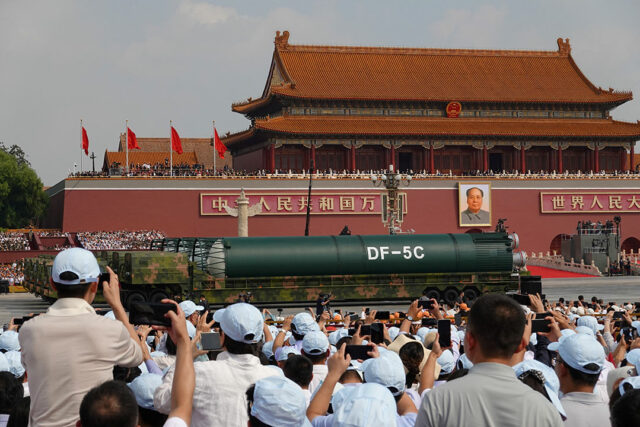
THE DF-5C liquid-fueled intercontinental strategic nuclear missiles are displayed during a military parade to mark the 80th anniversary of the end of World War II in Beijing, China, Sept. 3. — REUTERS/GO NAKAMURA

HONG KONG/BEIJING – When Chinese leader Xi Jinping organized his first parade to mark the anniversary of the end of World War Two, in 2015, he placed his two predecessors by his side in a show of respect and continuity of leadership.

Ten years on and having eliminated domestic opposition as he serves an unprecedented third term as president, Xi was flanked on Wednesday at the 80th anniversary parade by Russia’s Vladimir Putin and North Korea’s Kim Jong Un.

Chinese Communist Party leaders were interspersed among overseas guests.

The parade followed Xi’s high-profile summit with Indian Prime Minister Narendra Modi at a weekend meeting of the Shanghai Cooperation Organization (SCO) in Tianjin, and the Chinese leader’s rare visit to Tibet last month.

This display of diplomatic clout, stamina and geopolitical ambition has helped quell concerns among some China observers about the 72-year-old president’s vitality, linked to sporadic absences and – so far unknown – succession plans. It has also helped divert domestic attention from slowing growth, experts say.

Longevity was on the leaders’ minds as they walked up to the rostrum at Beijing’s Tiananmen Square – Xi and Putin were caught in a hot mic moment discussing organ transplants and the possibility that humans could live to 150 years old.

“This week of triumphant diplomacy for Xi shows that he remains totally in charge of the elite politics of the Communist Party,” said Neil Thomas of the Asia Society, a New York-based think tank. Unable to get the same legitimacy from economic growth as his predecessors, Xi has turned toward nationalism “to try and make up for it”, Thomas said.

“It’s a way to divert attention from economic challenges and to make his citizens proud to be Chinese, even if it’s harder to feel that from the day-to-day experiences of unemployment, falling house prices and stagnant wages.”

Xi underscored his elder statesman image with fashion choices: a grey suit in the style of those worn by Mao Zedong, matching his greying hair, in contrast to the black suits of his counterparts and his own black attire from a decade earlier.

His number two, Premier Li Qiang, whose role has diminished at home, was charged with relatively minor meetings with leaders of Malaysia and Uzbekistan. High-profile engagements with Kim, Modi, Turkish President Tayyip Erdogan and several others fell to Cai Qi, who heads the party’s Central Secretariat, responsible for its sprawling administration.

In response to a Reuters request for comment, China’s foreign ministry referred to news conference transcripts related to the recent diplomatic events, showcasing China’s partnerships with developing nations and positioning Beijing as committed to peaceful development and international cooperation.

Many countries that sent their leaders to China in the past week have been hit by U.S. President Donald Trump’s trade tariffs this year, including India, which remains a significant buyer of Russian oil, hit by sanctions over Putin’s invasion of Ukraine.

In one of the most memorable moments in the flurry of diplomatic encounters, Modi and Putin walked over for a chat with Xi while holding hands, underscoring personal tensions between Trump and Modi, as well as Washington’s failure to draw historically non-aligned India in to counter Russia and China.

“Ultimately one of the biggest driving factors of the SCO show of solidarity has been US policy,” said Even Pay, a director at strategic advisory firm Trivium China.

Trump, who called the military parade “beautiful” and “very, very impressive”, made a barbed post on social media saying China was working with Putin and Kim to “conspire against The United States of America”.

The Kremlin responded that they were not conspiring and suggested Trump’s remarks were ironic.

HIT BY TRUMP, WELCOMED BY XI
Analysts say Xi’s whirlwind of activity underscores China’s ambition in presenting itself as a reliable partner to developing nations on the global stage, offering advantages like investment opportunities and even a new development bank – a major step forward for the SCO, which has expanded markedly over past decades to also include India, Pakistan and Iran.

“China’s message as a more reliable, stable alternative to the United States is resonating with large swathes of the world, particularly across Asia, which sees the United States as an increasingly belligerent force in world affairs,” said Eric Olander, editor-in-chief of the China-Global South Project, a research agency.

“A lot of developing countries and middle-power states may still be a bit ambivalent about what China’s proposing with its new governance and development initiatives, but at least what China is talking about is forward-looking, which is crucial for economies with large populations of young people looking for better employment opportunities,” Olander said.

Xi faces considerable challenges in managing this large and often fractious coalition as he eyes a potential fourth term of office in 2027 to further cement his legacy as the most powerful Chinese leader since Mao.

Entrenched Chinese foreign policy positions, including territorial disputes and industrial subsidies that have flooded foreign markets with cheap exports, will likely remain friction points, experts say, while India’s deep distrust of China will not dissipate because of one brief meeting.

“It’s not necessarily a big-picture shift towards a more China-led international order,” said the Asia Society’s Thomas. — Reuters

Health experts, LGUs, and advocates push for stronger investments in healthcare at UCHP Policy Forum

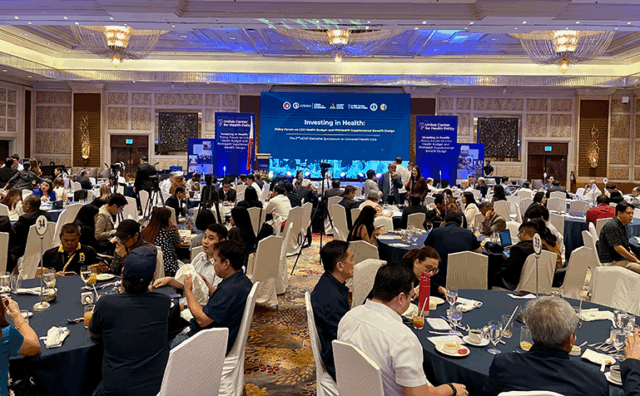
The Unilab Center for Health and Policy (UCHP) gathered experts, elected officials, and health advocates in a conference centered on “Investing in Health: Policy Forum on LGU Health Budget and PhilHealth Benefit Design Stakeholder Validation” last Sept. 3 at the Makati Shangri-La.

Filling in for the Department of Budget and Management (DBM) Secretary Amenah F. Pangandaman, who was supposed to deliver the keynote address, was DBM Undersecretary Margaux Marie V. Salcedo, who covered various topics in her speech, including the government’s commitment to universal health care, the promised zero-balance billing, and stronger support for hospitals, facilities, and healthcare workers.

“We are very grateful for these policy forums that serve as a platform to foster collaborative discussions addressing crucial health policy issues. Together, we can determine how to move closer to achieving universal health care for all,” she said.

USec. Salcedo also called on LGUs to align local health plans, mobilize resources, and partner with national agencies to ensure inclusive, equitable, and sustainable health services for all Filipinos.

“So, as you can see, the national government is doing its best to make quality health care inclusive, equitable, and affordable for all Filipinos, but we also need our LGUs to carry this mission forward by taking decisive steps in strategic planning, fund mobilization, and collaborative partnerships,” she encouraged.

Dr. Maria Eufemia C. Yap

In her presentation, Dr. Maria Eufemia C. Yap from the Ateneo Policy Center spoke on “Maximizing Local Government Fiscal Performance of Health Budget,” detailing how budgets from certain LGUs are spent, where they came from, and how they can be used more effectively.

Dr. Yap cited examples from five archetype cities with typical patterns that other local government units can recognize and learn from, namely: Odiongan City in Romblon; Quezon City; the province of Antique and the municipality of Belison; and Isabela City, Basilan.

“The goal is to go beyond budget allocation and examine why execution remains a challenge. We are trying to identify root causes and trying to develop some solutions that hopefully will enable our LGUs to maximize resources for health,” she said.

Complementing this perspective, Dr. Hilton Lam, director of the Institute of Health Policy and Development Studies, along with his team, presented findings, “Stakeholder Validation: PhilHealth Benefits Enhancement: Assessing Supplemental Insurance Coverage,” and gave emphasis on the benefits of offering Filipinos medical savings accounts.

“Studies have shown that medical savings accounts in other countries have been very successful because they change the health-seeking behavior. It changes the risky behavior of these people, because once they know that this pot of money can eventually be used it for something else,” Dr. Lam explained.

PhilHealth President and CEO Dr. Edwin M. Mercado, meanwhile, outlined the state insurer’s role in fund procurement and efficient utilization at the local level during his presentation at the forum.

“We are hoping that everybody increases and improves the delivery of healthcare, and hopefully, in the long term, we save economically,” he said.

Panel Discussions

During the policy forum’s first panel discussion, representatives from local government units, along with executives from nongovernment organizations, expounded on the topic “Powering Local Health: Strategies to Optimize LGU Health Investments.”

Members of the panel include formerly Philippine Vice-President and currently Naga City Mayor Maria Leonor “Leni” G. Robredo, Catanduanes Governor Patrick Alain Azanza, Zuellig Family Foundation Executive Director Austere Panadero, People’s Budget Coalition Lead Covenor Kenneth Isaiah Abante, Isabela City, Basilan Health Officer Dr. Mohrein Ismael IV, Odiongan Medical Officer Dr. Francis Lianne Ramos, and Union of Local Authorities of the Philippines Project Development Manager Lawrence John Paulo L. Trinidad.

Mr. Azanza pointed to systemic leakages: “Corruption really remains to be an open faucet that depletes all the resources meant for the island. We also have a healthcare system that has more job orders than healthcare workers.”

Similarly, Mr. Trinidad emphasized collaboration: “We try our best to advocate on how the national government can supplement local government funds. We are very happy that PhilHealth is continuing with several programs.”

For the second panel discussion, a panel on “PhilHealth Reimagined: A Multi-Stakeholder Roadmap to Benefit Enhancement” featured representatives from the Department of Health, Cancer Coalition Philippines, ICanServe Foundation, Maxicare, and the Ateneo School of Medicine and Public Health.

Among the panelists are: Department of Health Regional Director Dr. Lester M. Tan, Cancer Warriors Foundation CEO Carmen Auste, ICanServe Foundation Founding President Kara Magsanoc-Alikpala, Maxicare Healthcare Foundation Medical Director Arturo Libao, Employers Confederation of the Philippines Governor Arturo C. Guerrero, and Dr. Cenon Alfonso, from the Ateneo de Manila School of Medicine and Public Health.

Maxicare’s Dr. Libao called for a broader approach: “We must veer away from the usual typical consultations, diagnostic tests, and physical examinations. We must be able to understand what [patients] actually want.”

Ateneo’s Dr. Alfonso added: “We teach our students the excellence of the science of medicine, but at the same time, to open their minds and think systemically.”

To close the program, UCHP Advisory Council Chair and former Department of Health Secretary Enrique Ona gave a synthesis of the discussions and a message for fellow practitioners.

“We must strengthen our LGU capacities and keep the Filipino people at the center of every policy that we make for universal health care,” Dr. Ona concluded.


Spotlight is BusinessWorld’s sponsored section that allows advertisers to amplify their brand and connect with BusinessWorld’s audience by publishing their stories on the BusinessWorld Web site. For more information, send an email to online@bworldonline.com.

Join us on Viber at https://bit.ly/3hv6bLA to get more updates and subscribe to BusinessWorld’s titles and get exclusive content through www.bworld-x.com.

Wildfires are fueling air pollution, UN weather body says

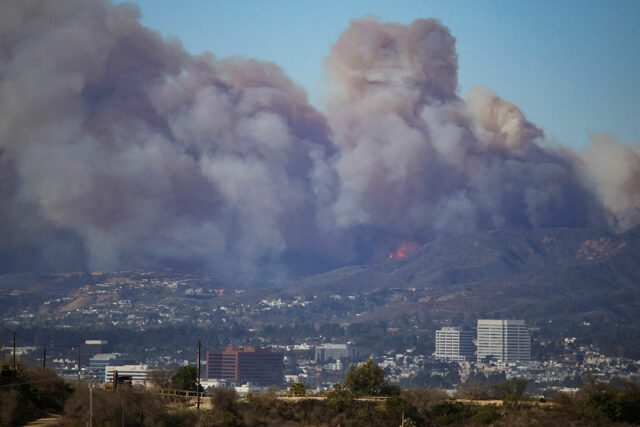
SMOKE rises from a wildfire burning near Pacific Palisades on the west side of Los Angeles during a weather driven windstorm, in Los Angeles, California, Jan. 7, 2025. — REUTERS

GENEVA – Wildfires likely to have been made more frequent by climate change made significant contributions to air pollution last year, according to a report by the World Meteorological Organization (WMO) on Friday.

The World Health Organization says ambient air pollution causes 4.5 million premature deaths a year, and the WMO report for 2024 pointed to pollution hotspots in places that experienced intense fires such as the Amazon basin, Canada, Siberia and central Africa.

As global warming driven mostly by fossil fuel emissions alters weather patterns, wildfires have become more frequent and extensive around the globe, adding to the airborne particles also produced by the burning of coal, oil, gas and wood as well as transport and farming.

“Wildfires are a big contributor to particle pollution and the problem is expected to increase as the climate warms, posing growing risks for infrastructure and ecosystems and human health,” the WMO said in a statement.

Deputy Secretary-General Ko Barrett added: “Climate change and air quality cannot be addressed in isolation. They must be tackled together in order to protect our planet, our communities, and our economies.”

Though the WMO report covers 2024, the WMO also said record wildfires in southern Europe this year had contributed to pollution across the continent.

However, there were some positive signs, with particle pollution in Eastern China falling thanks to reduction efforts. — Reuters

Trump to impose tariffs on semiconductor imports from firms not moving production to US

Semiconductor chips are seen on a circuit board of a computer in this illustration picture taken on Feb. 25, 2022. — REUTERS/FLORENCE LO/ILLUSTRATION

WASHINGTON – President Donald Trump said on Thursday his administration would impose tariffs on semiconductor imports from companies not shifting production to the U.S., speaking ahead of a dinner with major technology company CEOs.

Since returning to office in January, Trump’s threat of tariffs has alienated trading partners, stirred volatility in financial markets and fueled global economic uncertainty.

“Yeah, I have discussed it with the people here. Chips and semiconductors – we will be putting tariffs on companies that aren’t coming in. We will be putting a tariff very shortly,” Trump said without giving an exact time or rate.

“We will be putting a very substantial tariff, not that high, but fairly substantial tariff with the understanding that if they come into the country, if they are coming in, building, planning to come in, there will not be a tariff,” Trump told reporters.

Trump has made tariffs a pillar of US foreign policy, using them to exert political pressure and renegotiate trade deals and extract concessions from countries and companies that export goods to the U.S.

“If they are not coming in, there is a tariff,” Trump said in his comments on semiconductors.

“Like, I would say (Apple CEO) Tim Cook would be in pretty good shape,” he added, as Cook sat across the table.

iPhone maker Apple recently raised its total domestic investment commitment in the US to $600 billion over the next four years as tech leaders have warmed up to Trump in his second term.

Trump said last month that the United States would impose a tariff of about 100% on imports of semiconductors but it will not apply to companies that are manufacturing in the U.S. or have committed to do so.

Taiwanese chip giant and South Korea’s Samsung Electronics and SK Hynix have announced investments in chip manufacturing in the United States.

Trump has faced legal pushback in his use of tariffs. His administration has asked the US Supreme Court to swiftly hear a bid to preserve his sweeping tariffs pursued under a 1977 law meant for emergencies after a lower court invalidated most of the levies that have been central to his economic and trade agenda. — Reuters

After Armani: what becomes of the fashion empire he built?

DESIGNER Giorgio Armani appears on the runway at the end of the Giorgio Armani Fall-Winter 2025/2026 menswear collection during Milan Fashion Week in Milan, Italy on Jan. 20. — REUTERS FILE PHOTO/ALESSANDRO GAROFALO

What becomes of the fashion empire he built?

MILAN — Designer Giorgio Armani established one of the world’s best-known fashion brands over the past five decades, and his death inevitably raises questions about the future of an Italian company whose independence he cherished.

Armani, who helped to put Italy at the forefront of global fashion and dressed Hollywood stars, has died at the age of 91, the company that he founded and led for five decades said on Thursday.

“With infinite sorrow, the Armani Group announces the passing of its creator, founder, and tireless driving force: Giorgio Armani,” the fashion house, which has remained proudly independent for 50 years, said in a statement.

“We, the employees and the family members, who have always worked alongside Mr. Armani, commit to protecting what he built and to carrying his company forward in his memory, with respect, responsibility, and love,” it added.

The designer had been unwell for some time and was forced to drop out of his group’s shows at Milan’s Men’s Fashion Week in June, the first time he had missed one of his catwalk events.

Armani was the sole major shareholder of the company he set up with his late partner Sergio Galeotti in the 1970s and over which he maintained a tight rein — of both the creative and managerial aspects — until the very end.

He has left behind no children to inherit the business, which generated relatively stable revenue of €2.3 billion ($2.7 billion) in 2024, but whose profits had shrunk amid a broad industry recession.

Despite the slowdown, the company remains extremely attractive, say industry experts like Mario Ortelli, managing partner of luxury advisor firm Ortelli&Co.

“Could Giorgio Armani be an interesting target? The answer is absolutely yes — it’s one of the most recognized brands in the world, with a stylistic vision that is clearly and uniquely defined,” said Ortelli, adding however that a deal in the mid-term would be unlikely.

Over the years, the maker of popular unstructured suits received several approaches, including one in 2021 from John Elkann, scion of Italy’s Agnelli family, and another from luxury brand Gucci, when Maurizio Gucci was still at the helm.

Armani, who industry insiders say was particularly wary of French rivals, repeatedly ruled out any potential deal that would have diluted his control and refused to list his group on the stock market.

He put in place measures to ensure continuity and independence for his business, which he ran with trusted family members and a network of long-time colleagues.

He is survived by a younger sister, Rosanna, two nieces, Silvana and Roberta, and a nephew, Andrea Camerana, with the nieces and nephew all occupying important roles in the group. His right-hand man Pantaleo Dell’Orco is also regarded as a member of the family, and all five of them are possible heirs.

More clarity on his plans may emerge in the coming weeks, when Armani’s will is opened.

SECURING HIS LEGACY THROUGH A FOUNDATION
Giorgio Armani started to think of a plan to guarantee a smooth succession and to retain the company’s independence more than a decade ago, which led him to set up a foundation in 2016.

Its stated aim was to “safeguard the governance” of the Armani Group’s assets and ensure they remained consistent with principles that were “particularly important” to him.

The designer told Italian daily Corriere della Sera in 2017 that such a mechanism was needed to help his heirs to get along and to avoid the group being bought by others or broken up.

The foundation currently holds a symbolic 0.1% stake in the Milan-based group but after his death it was expected to get a bigger share, alongside the other heirs, he said in the same interview.

He also said that three nominees he had designated would run the foundation.

Armani also drafted new company bylaws due to take effect upon his death that outline future governing principles for those who inherit the group.

The bylaws call for a “cautious approach to acquisitions” and divide the company’s share capital into several categories with different voting rights and powers. It is not clear from the document how the different blocs of shares will be distributed.

They also state that any potential stock market listing would require backing from the majority of directors and could take place only “after the fifth year following the entry into force of this statute.”

SMALL BUT BEAUTIFUL
Commenting on past financial results, Armani underlined his determination to continue to develop a business which is relatively small in scale compared with the French giant LVMH and other rivals such as Gucci-owner Kering and Italian luxury house Prada.

“I chose in any case to invest in projects of great symbolic and practical significance, which are fundamental to the future of the company,” he said in the results statement in July.

These investments included the renovation of flagship stores like its Madison Avenue building in New York and Emporio Armani in Milan, as well as spending on the new Palazzo Armani in Paris and taking e-commerce management in house.

Europe generates almost half of the Armani Group’s revenue, a far higher proportion than for other luxury brands, with the Americas and Asia Pacific accounting for around one fifth each.

The group had €570 million in net cash at the end of 2024 after stepping up investments.

ARMANI LIEUTENANTS COULD STEP UP
In his last interview with the Financial Times, Giorgio Armani said he wanted a gradual handover to his closest collaborators and family.

“My plans for succession consist of a gradual transition of the responsibilities that I have always handled to those closest to me… such as Leo Dell’Orco, the members of my family and the entire working team,” he told the FT’s How To Spend It supplement.

At a managerial level, the group will need to fill the chairman and CEO roles that were held by Giorgio Armani himself, with long-term veterans like Giuseppe Marsocci and Daniele Ballestrazzi among possible options.

Picking the right creative structure may be trickier.

Armani’s niece Silvana worked alongside her uncle in designing the women’s collections, while Dell’Orco collaborated with him on the men’s collections.

“Will the company have a single creative director? Or will there be multiple creative leads or line-specific directors? This is something Giorgio Armani has probably outlined in the guidelines that the foundation will implement,” said Ortelli.

ATTENTION TO DETAIL
Known as “Re Giorgio” — King Giorgio in his native Italian — the designer famously oversaw every detail of his collection and all aspects of his business, from advertising to fixing models’ hair as they headed out on to the runway.

The company had been planning an exhibition and other events during Milan Fashion Week this month to honor the 50th anniversary of the company Armani founded with his romantic partner Sergio Galeotti in 1975.

Armani’s minimalist style, particularly for jackets, was an instant success in the United States in the late 1970s and 1980s, particularly among women, who found in his aesthetic a perfect balance of elegance and strength in what was back then still a masculine-led working world.

“His clients usually continued wearing his style for decades. They married into his philosophy, especially professional women,” said Virginia Hill, a dress and fashion historian based in Italy.

REACTIONS, MEMORIES, TRIBUTES
Actress Julia Roberts, who famously wore an Armani men’s suit for the 1990 Golden Globes, posted a picture of herself with the designer on Instagram with a broken heart emoji. “A true friend. A legend,” she wrote.

“He treated everyone as equals and felt at ease among young people. He’d invite us to birthday parties and dinners at his villa in Broni (northern Italy), groups of us: tailors, mailmen, sales assistants,” said Mauro Barbieri, who worked as a warehouse man for Armani in Milan for 32 years.

“He would laugh with us and was really down to earth,” Barbieri told Reuters.

A good friend of the designer, film director Martin Scorsese, said in a statement: “Giorgio was more than a clothing designer. He was a real artist, and a great one — people use the term ‘timeless’ quite often, but in his case it happens to be true. There’s nothing hip or tied to the moment in Giorgio’s designs. They’re genuinely elegant, inside and out, and they aren’t meant to be gazed at on a runway. They’re for people to wear, to enhance their own individual sense of natural elegance.”

An outpouring of praise from his fellow designers was released with the news of his passing.

Fashion designer Valentino Garavani said, “I mourn someone I have always considered a friend, never a rival. And I can only bow to his immense talent, the changes he brought to fashion, and above all to his unwavering loyalty to one style: his own.” Meanwhile, Donatella Versace said, “The world has lost a giant today. He made history and will be remembered forever.” Prada designer Raf Simons called him “a visionary.” Designer Diane Von Furstenberg: “Goodbye and rest in peace caro Giorgio! You have touched so many people with your elegance and will continue to inspire for ever.”

Rivals in the fashion business also chimed in. The French luxury group LVMH pointed out that, “He was the last of the post-war, golden generation of fashion designers who shaped, year after year, the paragons of highest elegance. His legacy will live in the hearts and imaginations of current and future designers for a long time.” The conglomerate’s chairman and CEO Bernard Arnault released his own statement: “He created a unique style, combining light and shadow, that he developed into a large and successful entrepreneurial journey and extended Italian elegance to a global scale. He was also a true friend and admirer of France.”

Kering chairman and CEO Francois-Henri Pinault called Armani “a visionary and remarkable entrepreneur” who “redefined elegance with rigor and independence that marked our era. An undisputed master of Italian couture” who “will continue to inspire entire generations.”

The Prada Group’s Miuccia Prada and Patrizio Bertelli called him “an undisputed protagonist of Italian and international fashion. His enduring contribution will remain forever in the history of fashion and in the memory of all who admired him,” while Ferrari and Stellantis Chairman John Elkann pointed out that he “was a great entrepreneur, a sensitive and refined man of culture, and above all, a mentor and friend to me.”

Fashion House Ferragamo Chairman Leonardo Ferragamo called him “The undisputed master of fashion and a symbol of pure Italian elegance,” and Ermenegildo Zegna Chairman and CEO Gildo Zegna thanked Armani “for his enduring inspiration, for his singular vision of beauty, and for bringing the spirit and culture of Made in Italy to the world.”

Aside from Julia Roberts, other actors also wrote of the man whose work went beyond fabric and sequins. Cate Blanchett said he “leaves a void that is impossible to fill. Not just in the worlds of fashion, art, cinema, theater, architecture and design, but in the hearts of millions of people whose lives he influenced.” Michelle Pfeiffer described him as “kind, generous and loyal. A true pioneer of elegance.”

A funeral chamber will be opened on Saturday and Sunday in Milan, the city he made his home, to allow well-wishers to pay their respects. His funeral will be held on Monday in private. — Reuters


Trump signs order cutting US tariffs on Japanese cars to 15%

REUTERS

WASHINGTON/TOKYO – US President Donald Trump signed an order on Thursday to implement the lower tariffs on Japanese automobile imports and other products that were announced in July.

Formalizing the agreement between the US and a key Asian ally comes after months of negotiations, reduces uncertainty for the massive Japanese auto sector and confirms an agreement for $550 billion of Japanese investment in US projects.

The lower tariffs on Japanese autos are set to take effect seven days after publication of the order. Some of the tariff relief is retroactive to August 7.

Trump’s order also means a reduced US tariff rate on Japanese cars, from the current 27.5% to 15%, is set to take effect by the end of this month, Reuters reported earlier, citing a Japanese government source.

Trump’s levies on global shipments have hit Japanese carmakers hard. Last month, Toyota said it expected a hit of nearly $10 billion from Trump’s tariffs on cars imported into the United States.

“Finally,” Ryosei Akazawa, Japan’s top trade negotiator, posted to X, in a nod to the months-long trade talks that had frustrated lawmakers in Tokyo. Thursday marked his 10th trip to the US for the negotiations.

Toyota praised Trump’s efforts to reach a trade deal with Japan. “While nearly 80% of the vehicles Toyota sells in the US are made in North America, this framework provides much needed clarity,” the company said in a statement.

Trump’s order says Japan is “working toward an expedited implementation of a 75% increase of United States rice procurements… and purchases of United States agricultural goods, including corn, soybeans, fertilizer, bioethanol (including for sustainable aviation fuel)” and other US products totaling $8 billion per year.

As part of the deal, Japan will buy 100 Boeing planes and hike defense spending with US firms to $17 billion annually, from $14 billion, the White House said in July.

Japan said in July the share of US rice imports may increase under its existing framework but that the agreement did “not sacrifice” Japanese agriculture.

Trump’s order Thursday also reiterates the Japanese government has agreed to invest $550 billion in the United States in projects that will be selected by the US government.

Two-way trade between the two countries reached nearly $230 billion in 2024, with Japan running a trade surplus of nearly $70 billion.

The United States in July agreed to lower tariffs on imports of Japanese automobiles but the timing remains unclear as Trump had yet to sign an executive order.

Japan has said the trade deal ensures the US’s fifth-largest trading partner will always receive the lowest tariff rate on chips and pharmaceuticals of all the pacts negotiated by Washington. It also includes no tariffs on commercial airplanes and parts.

The executive order is also expected to include provisions that the 15% levy agreed in July would not be stacked on Japanese imports that are subject to higher tariffs, while items previously subject to less than 15% tariffs would be adjusted to 15%, the source said.

The investment package, which will come in the form of equity, loans and guarantees from Japan’s government-owned banks, was agreed as part of the July trade deal.

The European Union secured a 15% baseline tariff as part of a framework trade deal with the US in July, averting looming new tariffs on chips and pharmaceuticals.

Last week, the European Commission proposed removing duties on imported US industrial goods in return for reduced US tariffs on European cars, a key part of the trade agreement the EU and the United States. One automaker official told Reuters that as of Thursday, European car imports to the United States are still facing 27.5% tariffs. — Reuters

Philippine inflation quickens to 1.5% in August

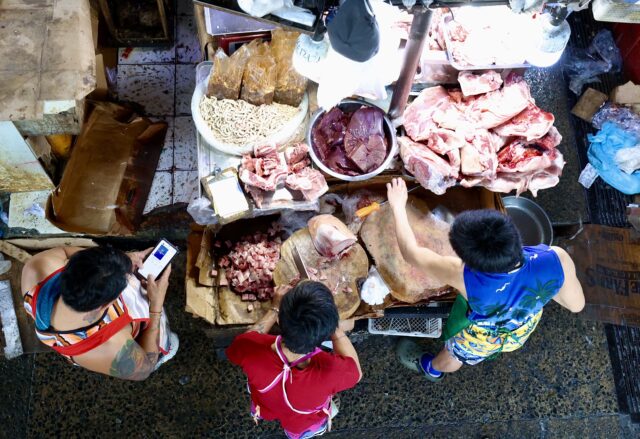
Vendors sell pork inside the Balintawak Coverleaf Market in Quezon City. Photo by Miguel de Guzman, The Philippine Star

By Katherine K. Chan, Reporter

HEADLINE INFLATION picked up to 1.5% in August, as bad weather drove up prices of food, particularly vegetables and fish, the Philippine Statistics Authority (PSA) reported on Friday.

The latest consumer price index (CPI) was faster than the 0.9% in July but slower than the 3.3% logged a year ago.

The August print fell within the central bank’s 1%-1.8% forecast for the month but was slightly higher than the 1.3% median estimate in a BusinessWorld poll of 16 analysts conducted last week.

Inflation rates in the Philippines

August also marked the sixth month in a row that inflation settled below the Bangko Sentral ng Pilipinas’ (BSP) 2-4% target range.

For the first eight months, headline inflation averaged 1.7%, on par with the BSP’s 1.7% target for 2025.

Meanwhile, core inflation, which excludes volatile prices of food and fuel, quickened to 2.7% in August from 2.3% in July and 2.6% last year. This was the highest core inflation reading this year.

Core inflation averaged 2.4% in the January-August period, slower than the 3.2% a year ago.

The heavily weighted food and nonalcoholic beverage index was the primary driver of faster inflation during the month, National Statistician Claire Dennis S. Mapa said. The index saw a 0.9% annual increase in August, reversing the 0.2% decline in July.

In particular, food inflation picked up to an annual 0.6% from 0.5% decline in July but slower than the 4.2% in the same period last year.

Inflation in vegetables, tubers, plantains, cooking bananas and pulses contributed most to food inflation last month, accelerating to 10% from a 4.7% decline in July. Mr. Mapa singled out squash as one of the vegetables that saw a price spike.

Quicker inflation was also seen in fish, such as roundscad, and other seafood at 9.5% from 6.3% previously.

“This was driven by slow import arrivals, adverse weather, and above-normal rainfall that disrupted fishing activities in key areas,” the Department of Economy, Planning, and Development (DEPDev) said.

Tropical storms Crising, Dante and Emong, and the southwest monsoon brought heavy rains and flooding in late July until early August, left P4.86 billion worth of agricultural damage.

RICE PRICES
On the other hand, rice prices continued to fall year on year for the eighth month in a row. Rice inflation declined at a faster clip to -17% in August, from -15.9% in July.

“We continuously see that it will remain negative, but this might be the lowest point (this year)… (Rice inflation) will still be negative, but not more than -17%,” Mr. Mapa said.

Rice inflation has been decelerating since the start of the year on the back of the government’s measures to curb rising prices of the staple grain, including lowering rice tariffs to 15% from 35%.

Data from the Department of Agriculture (DA) showed the average price of local regular milled rice dropped by 19.3% year on year to P38.18 per kilogram in the last week of August from P47.32. Well-milled rice likewise fell by 14.3% to P43.52 per kilo from P50.78, while special rice slipped by 5.2% to P56.99 per kilo from P60.1.

Meat inflation slowed to 7.1% in August from 8.8%.

Mr. Mapa said the slower annual decline in transport prices was another reason for the higher inflation in August.

Transport inflation slowed to -0.3% in August, from -2% in July.

Gasoline inflation also fell to -6.1% from a 10% decline in July, while diesel inflation also slowed to -0.8% from -5.6%.

As of Aug. 26, pump price adjustments stood at a net increase of P0.70 per liter for gasoline, P0.50 a liter for kerosene, and P0.30 for diesel.

Mr. Mapa also said that higher fares fueled faster inflation for passenger transport by sea to 64.4% in August from 5.2% in July.

Inflation in the National Capital Region (NCR) quickened to 2.9% in August, from 1.7% in July and 2.3% in the same month in 2024.

Outside NCR, inflation picked up to 1.1% month on month in August from 0.7% but eased from 3.6% in August last year.

Central Visayas recorded the highest inflation rate at 3%, while the Bangsamoro Autonomous Region in Muslim Mindanao experienced the most decrease in prices, with deflation at 1.3%.

Inflation for the bottom 30% of income households stood at -0.6% in August, slightly improving from the -0.8% decline in July.

In the eight months to August, inflation for the bottom 30% averaged 0.4%, easing from the 4.9% a year ago.

LA NINA
“While inflation remains broadly manageable, the recent figures highlight how adverse weather conditions directly impact prices,” DEPDev Secretary Arsenio M. Balisacan said in a statement.

Mr. Balisacan said La Niña conditions, which may develop from September to December, could cause more floods and crop damage.

“In anticipation of these weather shocks, we must ramp up preparatory activities and proactively ensure sufficient food supply to protect Filipino consumers from price volatility,” he said.

In line with the anticipated La Niña by September, the state weather bureau projected that seven to 15 tropical cyclones will hit the country starting this month until February 2026.

“While prices are expected to normalize over time, the potential emergence of La Niña – especially if it brings about stronger and more frequent typhoons – could keep vegetable prices elevated for a longer period,” Chinabank Research said in a note.

OUTLOOK
In a statement, the central bank said inflation expectations “remain firmly anchored to the target.”

“For 2026 and 2027, inflation is expected to trend higher but will remain firmly within the 3.0% + 1.0 ppt (percentage point) target,” it said.

The BSP noted that potential electricity rate adjustments and higher rice tariffs might add inflationary pressures in the coming months.

“The Monetary Board observed that domestic demand has held firm. However, the impact of US policies on global trade and investment continues to weigh on global economic activity. This could temper the outlook for the Philippine economy,” it said.

Aris D. Dacanay, HSBC economist for ASEAN (Association of Southeast Asian Nations), said he does not think the strong inflation momentum seen in August will last.

“Once supply conditions for food stabilize, the momentum seen in both headline and core CPI will likely wane,” he said in a note.

“Base effects will likely fade in the months ahead, leading to headline CPI accelerating year-on-year.”

HSBC forecasts inflation to average below 3% in 2026.

John Paolo R. Rivera, senior research fellow at the Philippine Institute for Development Studies, said attaining the BSP’s 1.7% full-year target will require minimal supply-side shocks going forward.

“Government interventions in rice importation, oil price stabilization, and tariff management will be crucial,” he said in a Viber message. “Any delay in these will raise the risk of missing the target.”

Rizal Commercial Banking Corp. Chief Economist Michael L. Ricafort said inflation in the coming months may return to within the BSP’s 2-4% target band.

“For the coming months, it is possible for inflation to pick up and sustain at 2% levels from September to December, or well within the BSP inflation target range of 2-4%, that could justify further BSP rate cut/s that would match any future Fed rate cuts,” he said.

Mr. Dacanay said the BSP will still likely cut its policy rate by 25 basis points to 4.75% by the end of the year.

Last week, the Monetary Board trimmed the target reverse repurchase rate by 25 bps (bps) to 5%.

BSP Governor Eli M. Remolona, Jr. said the latest cut puts the policy rate at a “sweet spot” in terms of both inflation and output, signaling that the central bank is nearing the end of its rate-cut cycle.

However, he said one last reduction could be possible this year if economic conditions warrant more support.

Chinese navy says it conducted ‘routine patrol’ in South China Sea

REUTERS

BEIJING – China’s navy conducted a “routine patrol” in the South China Sea on September 3, a spokesperson for its Southern Theatre Command said on Thursday, while accusing the Philippines of “undermining regional peace and stability” through joint patrols with other countries.

The statement came as the Philippines concluded on Wednesday joint maritime exercises with Australia, Canada, and the United States in the South China Sea.

The drills featured anti-submarine warfare exercises, logistics operations, and personnel exchanges, highlighting interoperability and coordination among the four nations.

Philippines’ Armed Forces Chief General Romeo Brawner said in a statement that the maritime activity “reaffirms our collective resolve to protect our seas and uphold rules-based international order.”

A spokesperson for the Philippine Navy said two Chinese navy vessels were observed following the international group, but were not conducting synchronized movement that would indicate a patrol.

“Such messages are part of their malign influence operations to justify their illegal presence in the country’s exclusive economic zone,” said Rear Admiral Roy Trinidad. — Reuters

Italian fashion designer Giorgio Armani dies at 91

GIORGIO ARMANI — EN.WIKIPEDIA.ORG

MILAN – Designer Giorgio Armani, who helped to put Italy at the forefront of global fashion and dressed Hollywood stars, has died at the age of 91, the company that he founded and led for five decades said on Thursday.

Armani combined the flair of a designer with business acumen as he directed a company generating some 2.3 billion euros ($2.7 billion) in annual turnover.

“With infinite sorrow, the Armani Group announces the passing of its creator, founder, and tireless driving force: Giorgio Armani,” the fashion house, which has remained proudly independent for 50 years, said in a statement.

“We, the employees and the family members, who have always worked alongside Mr. Armani, commit to protecting what he built and to carrying his company forward in his memory, with respect, responsibility, and love,” it added.

The designer had been unwell for some time and was forced to drop out of his group’s shows at Milan’s Men’s Fashion Week in June, the first time he had missed one of his catwalk events.

Actress Julia Roberts, who famously wore an Armani men’s suit for the 1990 Golden Globes, posted a picture of herself with the designer on Instagram with a broken heart emoji. “A true friend. A legend,” she wrote.

Armani remained the sole owner of his company and worked with a tight-knit group of long-time colleagues and members of his family.

“He treated everyone as equals and felt at ease among young people. He’d invite us to birthday parties and dinners at his villa in Broni (northern Italy), groups of us: tailors, mailmen, sales assistants,” said Mauro Barbieri, who worked as a warehouse man for Armani in Milan for 32 years.

“He would laugh with us and was really down to earth,” Barbieri told Reuters.
A funeral chamber will be opened on Saturday and Sunday in Milan, the city he made his home, to allow well-wishers to pay their respects. His funeral will be held on Monday in private.

ATTENTION TO DETAIL
Known as “Re Giorgio” – King Giorgio in his native Italian – the designer famously oversaw every detail of his collection and all aspects of his business, from advertising to fixing models’ hair as they headed out on to the runway.

The company had been planning an exhibition and other events during Milan Fashion Week this month to honour the 50th anniversary of the company Armani founded with his romantic partner Sergio Galeotti in 1975.

Family members, including nieces Silvana and Roberta as well as his nephew, Andrea Camerana, and his right-hand man Pantaleo Dell’Orco are expected to run the company from now but his death raises inevitable questions about its future.

Armani’s minimalist style, particularly for jackets, was an instant success in the United States in the late 1970s and 1980s, particularly among women, who found in his aesthetic a perfect balance of elegance and strength in what was back then still a masculine-led working world.

“His clients usually continued wearing his style for decades. They married into his philosophy, especially professional women,” said Virginia Hill, a dress and fashion historian based in Italy. — Reuters

Squeezed French millennials blame boomers in backlash over soaring deficit

A PROTESTER holds a French national flag as people gather to protest against the French far-right Rassemblement National (National Rally - RN) party, at the Place de la Republique following partial results in the first round of the early 2024 legislative elections, in Paris, France, June 30, 2024. — REUTERS

PARIS – A viral French X account has tapped into rising generational tensions in France, where squeezed millennials rallying under the slogan “Nicolas foots the bill” say that better-off baby boomers should do more to fix the country’s huge deficit.

With the government facing collapse over how to plug the euro zone’s biggest deficit, younger workers are increasingly accusing the boomer generation, those born between 1945 and 1964, of saddling France with unsustainable debt.

The creator of the “NicolasQuiPaie” X account, which has drawn over 74,000 followers, told Reuters he launched the movement to defend his generation, arguing politicians tend to cater to pensioners who vote more reliably.

“They have so much voting power that no effort is ever demanded of them. So politicians keep squeezing workers,” he said in a written interview, asking to remain anonymous to protect his career.

French pensioners retire early, and their generous pensions have risen with inflation, unlike wages, helping to shield them from cost-of-living crises. As they live longer, they are straining a post-war pension system that is struggling to keep pace with modern demographics. Meanwhile, their once-affordable homes are increasingly inaccessible for first-time buyers.

On social media, the hashtag #NicolasQuiPaie has gone viral, with thousands identifying with “Nicolas,” a fictional millennial – people born in the 1980s and 90s – whose taxes they say disproportionately fund France’s generous welfare state.

While the left has largely dismissed #NicolasQuiPaie, politicians from the right and far right have sought to court the movement, hoping to marshal the grassroots anger at a time when every vote counts in France’s deeply polarised parliament.

“There’s a form of hypocrisy because those who want to take advantage of the movement are those who have constantly defended pensioners,” Maxime Sbaihi, a demographics expert, told Reuters, adding that people over 50 now account for a majority of voters.

A self-styled libertarian and “minarchist,” a proponent of minimal state intervention, the creator of the X account told Reuters he comes from a middle-class background.

His memes often show a burned-out, 30-year-old Nicolas in a work shirt paying to sustain the lifestyle of 70-year-old “Bernard and Chantal” sipping cocktails on a chaise longue. He says clashes with older users have been “very tense.”

“Even when you raise the issue of pension-funding calmly and factually, there’s a wave of hatred toward young people,” he said, adding he had received insults like “slacker” or replies such as “do you want to euthanasia us?”

His portrayal of “Nicolas” also funding a fictional “Karmic” – a typically North African name – has sparked accusations of xenophobia and far-right leanings, which he denied.

He says the movement has no formal structure, doesn’t feel represented by any existing party, but hopes to exert pressure on governments and influence parties ahead of elections.

“It’s up to them to get off the beaten track and bring concrete solutions to the economic and security problems we’re going through,” he said.

NON-PARTISAN, BUT POLITICALLY COURTED
Some older French rejected being blamed for France’s woes.

“We don’t have a boomer problem, we have a budget problem,” said Patrick Sorel, 67, as he walked in Paris with his baguette under his arm. “We paid for Nicolas’ education and Nicolas’ studies. Politicians need the courage to ask everyone to contribute.”

Yet some politicians – including several boomers high up in the government – have shown a degree of sympathy for the concerns of “Nicolas”.

Conservative Interior Minister Bruno Retailleau said “there’ll be a revolt” if employed people like “Nicolas” are the only ones asked to contribute to cutting the deficit, while centrist Prime Minister François Bayrou, who looks certain to lose his job in a parliamentary confidence vote on September 8, recently criticized “boomers who think everything is fine”.

According to an Elabe opinion poll published on Thursday, a majority of the under-35 agree with Bayrou, while 84% of the over-50 reject this view.

Bayrou, 74, had proposed not indexing pensions to inflation in next year’s budget to help reduce the deficit, prompting an outcry across party lines.

Economists say millennials have a point.

Sbaihi said that while generational inequality is widespread in developed countries, it’s especially stark in France.

The pension system relies on intergenerational transfers, meaning today’s workers don’t save for their own pension but fund retirees directly via mandatory levies on their payslips. With longer lifespans, millennials now support an unprecedentedly large cohort of aging boomers.

“No country has ever treated pensioners better than today’s France,” Sbaihi said. “The baby-boom generation lived through a golden age, but doesn’t quite grasp the impact of its demographic weight.” — Reuters

Metro Manila, nearby provinces suspend Friday classes amid monsoon rains

STUDENTS in Manila braved the rains after classes were suspended later on Tuesday. — PHILIPPINE STAR/EDD GUMBAN

Several areas in the National Capital Region and Luzon have suspended classes on Friday due to heavy rainfall brought by the southwest monsoon.

Classes at all levels, both private and public, are suspended in several cities in Metro Manila, including Caloocan City, Las Piñas City, Malabon City, and Marikina City.

Areas of Parañaque City, San Juan City, Valenzuela City, and Pasay City have suspended classes, while in Pasig City and Pateros, the suspension is only up to Senior High School.

Other areas in Luzon have also announced class suspensions at all levels, both private and public, including Cainta, Rizal; Bamban, Tarlac; Santiago, Isabela; Morong, Bataan; and Hermosa, Bataan (up to Senior High School).

In Bulacan, several areas have also suspended classes at all levels, including Baliwag City, Bocaue, Bulakan, Calumpit, Malolos, Norzagaray, and Pandi, as well as Santa Maria and Hagonoy (up to Senior High School).

Meanwhile, in Pampanga, the areas of Arayat, Sta. Ana, Macabebe, Masantol, and Candaba (up to High School only) have suspended classes at all levels, both public and private.

Classes were also suspended in some areas in Zambales, including Olongapo City, Subic, Castillejos, San Antonio, Cabangan, as well as San Narciso and San Felipe (up to Senior High School only.

The state weather bureau said the southwest monsoon will bring cloudy skies with scattered rains over Luzon and the western section of Visayas today (Sept. 5). — Edg Adrian A. Eva

NG outstanding debt surges to record P17.56 trillion as of end-July

BW FILE PHOTO

THE NATIONAL GOVERNMENT’S (NG) outstanding debt ballooned to a record P17.56 trillion at the end of July, breaching its full-year projection for 2025, data from the Bureau of the Treasury (BTr) showed.

The latest data from the BTr showed outstanding debt surged by 11.9% from P15.69 trillion in July 2024.

This was already 1.15% higher than the P17.36-trillion projected debt by end-2025.

Gov’t debt reaches P17.56 trillion at end-July 2025

Despite surpassing the 2025 projection, the Treasury said the debt stock is expected to decline by yearend as the government pays off P814.2 billion in domestic bonds by December and as “fundraising activities wind down.”

Month on month, NG debt inched up by 1.7% from P17.27 trillion in June, the BTr said.

NG debt is the total amount owed by the Philippine government to creditors such as international financial institutions, development partner-countries, banks, global bondholders and other investors.

“To mitigate exposure to foreign exchange risk, the government continued to favor domestic borrowings to deepen the local capital market, attaining a financing blend comprised of 76% domestic financing and 24% external borrowing in the first seven months of the year,” the Treasury said.

“As a result, the domestic component of the debt stock improved to 68.9% at the end of July from 68.1% at the end of 2024.”

Domestic borrowings increased by 12.6% to P12.11 trillion as of end-July from P10.75 trillion in the same month last year.

This was already 0.52% higher than the P12.04-trillion year-end domestic debt projection.

Month on month, domestic borrowings slightly went up by 1.3% from P11.95 trillion at end-June.

Domestic borrowings were made up mostly of government securities.

On the other hand, external debt rose by 10.5% to P5.46 trillion as of end-July from P4.94 trillion a year ago. This also exceeded the P5.32-trillion external debt projection this year by 2.63%.

Month on month, external debt inched up by 2.6% from P5.32 trillion at end-June.

Foreign debt was composed mainly of P2.79 trillion in global bonds and P2.67 trillion in loans.

External debt securities were made up of P2.37 trillion in US dollar bonds, P252.46 billion in euro bonds, P58.5 billion in Japanese yen bonds, P58.19 billion in Islamic certificates and P54.77 billion in peso global bonds.

As of end-July, the NG-guaranteed obligations rose by 2.4% to P352.97 billion from P344.79 billion a year ago.

Month on month, it also edged higher by 2.3% from the end-June level of P345.11 billion.

“The Marcos, Jr. administration remains steadfast in its commitment to prudent debt management by leveraging strong investor confidence in peso-denominated securities while ensuring that borrowings are at the lowest possible cost and support fiscal sustainability, inclusive growth, and a stronger Philippine economy,” the Treasury said.

Rizal Commercial Banking Corp. Chief Economist Michael L. Ricafort said debt rose as the government ramped up borrowings to plug the widening budget gap.

From January-to-July period, the fiscal deficit widened by 22.04% to P784.4 billion amid faster state disbursements. This was on track to hit the revised P1.56-trillion full-year deficit ceiling, the BTr said.

“(The debt) could possibly breach above P18 trillion by end-2025 at the rate of the year-to-date increase if not curbed through narrower budget deficits in the coming months,” Mr. Ricafort said.

However, he noted that this could be partially offset by the settlement of large maturing NG obligations, particularly in August and September.

“This (rising debt) is concerning but not entirely unexpected given sustained borrowing needs, a weaker Philippine peso, and spending demands tied to infrastructure, subsidies, and tariff-related buffers,” Philippine Institute for Development Studies Senior Research Fellow John Paolo R. Rivera said in a Viber message.

Mr. Rivera said it will be likely that the NG debt level will exceed the year-end projection if current trends persist, such as “modest revenue growth” and “large spending needs such as flood control, defense, and infrastructure projects.”

Earlier, the Finance department projected outstanding debt to reach P19.1 trillion by 2026, rising to P20.5 trillion by 2027, P21.9 trillion by 2028, and P23.4 trillion by 2029. By 2030, outstanding debt is expected to reach P24.7 trillion.

At the end of the second quarter, NG debt as a share of gross domestic product surged to 63.1%, the highest since 2005. This is above the 60% debt-to-GDP threshold considered by multilateral lenders to be manageable for developing economies. 

The DoF expects the debt-to-GDP ratio to ease to 61.3% by end-2025 and eventually fall to 58% by 2030. — Aubrey Rose A. Inosante