Home Blog Page 6203

The Catholic Bishops should speak out

PRESIDENTIAL aspirant Ferdinand “Bongbong” Marcos, Jr. addressed his supporters during the UNITEAM rally in Koronadal City, South Cotabato on March 27. — PHILIPPINE STAR/KRIZ JOHN ROSALES

In 1995, just four years after he returned from his exile in Hawaii, Bongbong Marcos ran for senator. That was the first time he ran for a national position. The veterans of the People Power uprising in 1986 waged a vigorous campaign against his election to the Senate.

He garnered 8,168,788 votes or 31.7% of the votes cast that year. He fell short by 531,492 votes to land one of the 12 Senate seats to be filled up. There were 15 other candidates who got more votes than him.

He retreated to Ilocos Norte, home province of the Marcoses. There he ran for and was elected governor of the province in 1998. He was re-elected twice. Having reached his term limit, he ran for and was elected representative of the 2nd District of the province in 2007.

Considering himself ripe for the Upper House of Congress in 2010, he ran again for senator. By then, many of those who joined or supported the People Power uprising in 1986 had passed on. Also, people who were too young to know what life was like during Marcos’ military rule and those born in the 1990s had become voters.

No aggressive anti-Bongbong campaign was waged. The remnants of the anti-Marcos forces that foiled Bongbong’s previous senatorial bid devoted their time and effort to Noynoy Aquino’s campaign for the presidency. Thus, Bongbong got 13,169,634 votes or 34.5%, good enough to win him a Senate seat.

In the Senate he gained the reputation of being among the laziest members. He was absent 67 times. He was also among the senators who were frequently late. Of the bills he filed, only one was enacted into law. It was the insignificant law that sought the postponement of the 2013 Sangguniang Kabataan elections.

Just the same, he felt he had become vice-presidential timber in 2016. So, he launched his candidacy for the vice-presidency. The Liberal Party put up the unpretentious representative of the 3rd District of Camarines Sur, Leni Robredo, as its vice-presidential candidate.

Leni bested Bongbong. She garnered 14,418,817 votes or 35.1%. Bongbong got 14,155,314 or 34.5%. In the three elections where Bongbong ran for national office, he got no more than 35% of the votes of the electorate.

Bongbong became a private citizen after June 30, 2016 when his term as senator ended. He had not done anything between that time and 2021 to have raised his political stock or gained the admiration, gratitude, or goodwill of the electorate. He did not champion any worthy cause or add his voice to any advocacy or visit any disaster area to extend help or at least comfort the afflicted.

He spent much of his time attending to his protest against the election of Leni as Vice-President. His political standing must have even suffered when his electoral protest was dismissed unanimously by the members of the Supreme Court.

That is why I am amazed at Bongbong getting a rating of more than 50% in the on-going surveys on preference of presidential candidates. The Pulse Asia survey conducted from Jan. 19 to 24 had him as the preferred presidential candidate of 60% of the respondents. Leni was the choice of only 16%. The SWS survey done from Jan. 28 to 31 showed Bongbong the preferred candidate of 50%, Robredo of 19%. In the Pulse Asia survey of Feb. 18 to 23, Bongbong again got a rating of 60%.

Following the release of the results of the surveys done in January, TV talk show host Karen Davila asked professional campaign strategist Alan German what was working for Bongbong for him to rate so much higher than the other presidential candidates. German said Bongbong has the edge in every one of the M’s in the campaign mixture of Man, Messaging, Machinery, and Money.

German explained that Bongbong evokes memory of his father and his message of “Babangon muli” instills nostalgia of the Golden Era of booming economy, golden infrastructure, discipline and order the habit of the day. On the day Pulse Asia released the results of its February survey, its president, Ronald Holmes, told ANC newscaster Ron Cruz that Bongbong’s campaign message could account for his high rating.

That brings to mind the Catholic Bishops Conference of the Philippines (CBCP) pastoral letter of Feb. 25. The letter warned the electorate of the “radical distortions in the history of Martial Law and the EDSA People Power Revolution.”

Said the letter: “We are appalled by the blatant and subtle distortion, manipulation, cover-up, repression and abuse of the truth, like: historical revisionism — the distortion of history or its denial; the proliferation of fake news and false stories; disinformation — the seeding of false information and narratives in order to influence the opinion of the people, to hide the truth, to malign and blackmail people. There are troll farms which sow the virus of lies.

“Many of us, Bishops, were witnesses of the injustice and cruelty of Martial Law. And up until now, the human rights abuses, the victims, the corruption, the grave debt and economic downturn of the country due to dictatorship are all well-documented.

“We are alarmed by this distortion of the truth of history and the attempt to delete or destroy our collective memory through the seeding of lies and false narratives. This is dangerous, for it poisons our collective consciousness and destroys the moral foundations of our institutions.

“An election or any process that is not based on truth is but a deception and cannot be trusted. Thus, and also in view of the coming elections, we call on you, Brothers and Sisters — especially the Youth, to examine carefully what is happening in our quest for a true and just society.”

If the Bishops do not want an administration elected on the basis of lies, then they should belie the claim that the Marcos years were the Golden Age of booming economy, golden infrastructure, and discipline and order.

An army of trolls has flooded social media with fake news, false stories, and disinformation. As the youth did not experience life under Martial Law, they believe what they read on social media.

The Bishops say many of them were witnesses to the injustices and cruelty of Martial Law. If so, then they should tell the youth the true story of Martial Law. They should cite instances of injustices and cruelty complete with the sordid details.

The folks in the countryside and those belonging to the low socio-economic strata are too busy earning a living and putting food on the table for their family. They are not inclined to find out for themselves what really happened during the Marcos years. Neither are they competent to determine if the candidate’s character is suitable for the position he or she seeks or is capable of fulfilling his or her campaign promises.

Their incompetence is sharply reflected by the high rankings of unsavory characters in the surveys on senatorial candidates. The bishops should go to these uninformed people and tell them the truth.

Archbishop emeritus Antonio Ledesma, S.J. says that religious leaders cannot be neutral when the issues involve a moral dimension. The candidacy of Marcos Jr. has raised a number of such issues. The Catholic bishops should therefore speak openly and forcefully against the candidacy of Bongbong Marcos.


Oscar P. Lagman, Jr. is a retired corporate executive, business consultant, and management professor. He has been a politicized citizen since his college days in the late 1950s.

Criminal liability for other violations of provisions not specifically separate from administrative liability

PRESSFOTO-FREEPIK

A second paragraph was introduced under Section 170 of the Revised Corporation Code (RCC) providing that “Liability for any of the foregoing offenses shall be separate from any other administrative, civil, or criminal liability under this Code and other laws.” It clearly expresses the Legislative intent that any conviction under Section 170 for violations of the provisions of the Code not specifically penalized therein shall be without prejudice to the imposition of administrative sanctions by the Securities and Exchange Commission (SEC) pursuant to Section 158 of the Code, or to “any other … civil, or criminal liability under this Code and other laws.”

It is would be reasonable to assume that the legislative intent in adding the last paragraph in Section 170 was to avoid application of the Ient doctrine from the main phrase “Violations of any of the other provisions of this Code … not otherwise specifically penalized therein” that when the Code provides for the imposition of an administrative sanction or civil liability (e.g., the provision of Section 30 of the RCC that imposes solidary liability to a director or trustees who violates his duty of diligence), that constitutes a violation that is already penalized, and no longer can be criminally sanctioned under Section 170 of the Code. Such a legislative attempt is faulty, for the following reasons:

Firstly, the part of the clause that provides that liability under Section 170 shall be separate from “any other … criminal liability under this Code,” contradicts very essence of the criminal offense sought to be punished under the main provision of Section 170, which is to impose criminal penalty for any violation of the Code which is not “specifically [criminally] penalized therein (i.e., the RCC).” Therefore, if the Code already provides a “criminal liability” for an offense, how can it still be separately punished under Section 170 thereof?

Secondly, it is difficult to construe that the last paragraph of Section 170 can overcome previous sections where the Code itself limits the imposition of administrative sanctions for violation of a particular provision as to make it fall within the main provision of Section 170.

To illustrate, as Section 27 provides that SEC’s removal of a disqualified director or trustee “shall be without prejudice to other sanctions that the [SEC] may impose on the board of directors or trustees who, with knowledge of the disqualification, failed to remove such director or trustee,” we doubt whether the members of the board may still be criminally penalized under the broad provisions of Section 170 of the RCC.

Since Section 73 provides that “Any stockholder who shall abuse the rights granted under this section shall be penalized under Section 158 of this Code, without prejudice to the provisions of” the Intellectual Property Code and the Data Privacy Act, we doubt whether a shareholder or member who abuses his right of inspection and/or reproduction of corporate records could be held liable under the broad provisions of Section 170 of the RCC, since Section 73 embodies by its language a clear legislative intent to limit the sanctions to those provided therein. In any event, the very description of “abuse of the rights of inspection and/or reproduction of corporate records” is overly broad as not to define a definite criminal offense.

Finally, it is unfortunate that such legislative intent was expressed under Section 170 of the RCC, and not provided its own section as to encompass the whole criminal penalty system of Code. This unfortunate construction can be appreciated from the fact that since the provision appear as the last paragraph under Section 170 defining “Other Violations of the [Revised Corporation] Code,” it may be construed to mean that when it comes to violations which are specifically punished by the RCC, no administrative sanction may be imposed, unless the particular penalizing provision allows the imposition thereof separate and apart from the criminal penalties imposed.

OVERLY BROAD LANGUAGE
Section 170’s language remains vague, if not overly broad, as amounting to denial of due process.

It can never be over-emphasized that the essential language of the Section 144 of the old Corporation Code has been carried over into Section 170 which essentially punishes any violation of the provision of the RCC “not otherwise specifically penalized therein.” The language has already been ruled by the Supreme Court in Ient v. Tullett Prebon as overly-broad as to deny an accused the rudiments of due process that requires that the accused must be properly informed of what acts constitute a criminal offense.

It is our position that even the new paragraph introduced in Section 170 that “Liability for any of the foregoing offenses shall be separate from any other administrative, civil, or criminal liability under this Code and other laws,” could not legalize criminal conviction for any violation of RCC which are not specifically punished therein, since the particular offense of “violation of any provision of this Code … not otherwise specifically penalized therein,” provides a vague language which are inconsistent with rights of the accused under due process clause.

Firstly, when it is clear that Congress intends to criminally punish a particular violation of the RCC, it has set out and expanded in specific sections what violations would constitute criminal offenses.

To illustrate, the very same provisions covering the fiduciary duties of directors, trustees, and officers under Sections 31 to 34 of the old Corporation Code have been retained as Sections 30 to 33 of the RCC, without any indication that they could be punished as criminal offenses. Certainly, when Congress promulgated Rep. Act No. 11232, it was fully aware of the doctrine laid down in Ient v. Tullett Prebon that the essence of those sections is to “provide for civil or pecuniary liabilities for the acts covered therein … [and] that the lack of specific language imposing criminal liability in [what are now Sections 30 and 33 of the RCC] shows legislative intent to limit the consequences of their violation to the civil liabilities mentioned therein. Had it been the intention of the drafters of the law to define [what are now Sections 30 and 33] as offenses, they could have easily included similar language as that found in Section 74 [on denial of the right of inspection].”

Secondly, there are violations of the RCC that are clearly administrative infractions in character, rather than constituting criminal offenses.

To illustrate, in the registration and use of the corporate name of a One Person Corporation (OPC), it is required under Sections 14 and 120 of the RCC that the same shall be qualified by the letters “OPC.” Certainly, when a One Person Corporation fails to use such letters in the use of its corporate name, it would not constitute a criminal offense punishable under Section 170 of the RCC. Compare such legislative intent in the case of the keeping and updating of the Minutes Book required under Section 127 of the RCCP, the failure of which is expressly penalized under Section 161 of the RCC. More importantly, the grant to the SEC of the powers to cite in contempt or to impose administrative sanctions for any violation of the RCC shows that certain violations thereof would constitute only administrative infractions rather than criminal offenses, unless the Code provides otherwise in each particular provision.

In essence, the central language used in Section 170 to define “violations of any provision of this Code … not otherwise specifically penalized therein,” which has been interpreted under Section 144 of the RCC as being overly-broad and vague as to trigger the application of the constitutional right of the accused to the due process clause in criminal proceedings, remains the primary obstacle in obtaining a criminal conviction under Section 170 of the Revised Penal Code.

LIMITED AREAS WHERE SECTION 170 MAY SUSTAIN A CONVICTION
In spite of the views expressed above, we posit that there is a limited area within the structure of the RCC where conviction under Section 170 can be obtained, i.e., where the legislative intent to penalize an act deemed to be mandatory in character and therefore within the coverage of Section 170 of the RCC.

This legal position is best illustrated in the area relating to the reporting of the compensation of directors or trustees covered under Sections 29, 49, and 177 of the RCC, which provide that:

SECTION 29: Corporations vested public interest shall submit to their shareholders and the SEC, an annual report of the total compensation of each of their directors or trustees;

SECTION 49: At each regular meeting of shareholders or members, the Board shall endeavor to present to shareholders or members “(i) A director or trustee compensation report prepared in accordance with this Code and the rules of the [SEC] may prescribe; and,

SECTION 177: “Corporations vested with public interests must also submit the following [to the SEC]:

“(1) A director or trustee compensation report; and,

“(2) A director or trustee appraisal or performance report and the standards or criteria used to assess each director or trustee.”

The obligation to make an annual report on directors’ or trustees’ individual compensation under Sections 29 and 49 has two aspects: first, reporting to the shareholders or members; and second, reporting to the SEC. In turn, Section 177 covers the same reporting obligation as it pertains only to the SEC. The annual reporting of the directors’ or trustees’ individual compensation is clearly an important and obligatory obligation on the part of corporations and their governing boards, since it is specifically covered in three sections of the RCC.

Section 161 of the RCC under the aegis of “Duty to Maintain Records, to Allows Their Inspection or Reproduction” criminally penalizes the unjustified failure or refusal by the corporation, or by those responsible for keeping and maintaining corporate records to comply with Section 171 of the Code. It would be reasonable to conclude that both aspects of the obligation to make an annual disclosure of directors’ or trustees’ compensation are mandatory and non-compliance therewith shall be subject to criminal punishment — that of annual reporting to the SEC is covered by Section 16; and those of annually reporting to shareholders or members could reasonably be covered by Section 170, which provides a criminal penalty for any violation of the provision of the RCC “not otherwise specifically penalized therein.”

This article reflects the personal opinion of the author and does not reflect the official stand of the Management Association of the Philippines or MAP.


Atty. Cesar L. Villanueva is co-chair for Governance of the MAP ESG Committee, chair of the Institute of Corporate Directors, the first chair of the Governance Commission for GOCCs, a former dean of the Ateneo Law School, and founding partner of Villanueva Gabionza & Dy Law Offices.

map@map.org.ph

cvillanueva@vgslaw.com

The effects of Biden and sanctions on energy and commodity prices

US President Joe Biden has already been in the White House for 14 months, and Russia’s invasion of Ukraine and the US-led economic sanctions against it have just marked one month, and things are worsening. Here are 10 emerging trends, global and national.

BIDEN’S EFFECT ON FOSSIL FUEL PRICES AND SUPPLY
One: Biden and the US Democrat Party campaigned, among other issues, for a war on fossil fuels. And on Day 1 of his administration, Jan. 20, 2021, he announced a halt to oil-gas drilling in federal lands, and the killing of the Keystone XL pipeline that would bring some 800,000 barrels per day of Canada crude oil to the US. See these reports:

1. “In intimate moment, Biden vows to ‘end fossil fuel’,” AP News, Sept. 7, 2019 (“I guarantee you. We’re going to end fossil fuel.”)

2. “Keystone XL pipeline halted as Biden revokes permit,” AP News, Jan. 21, 2021

3. “Biden administration pauses federal drilling program in climate push,” Reuters, Jan. 22, 2021.

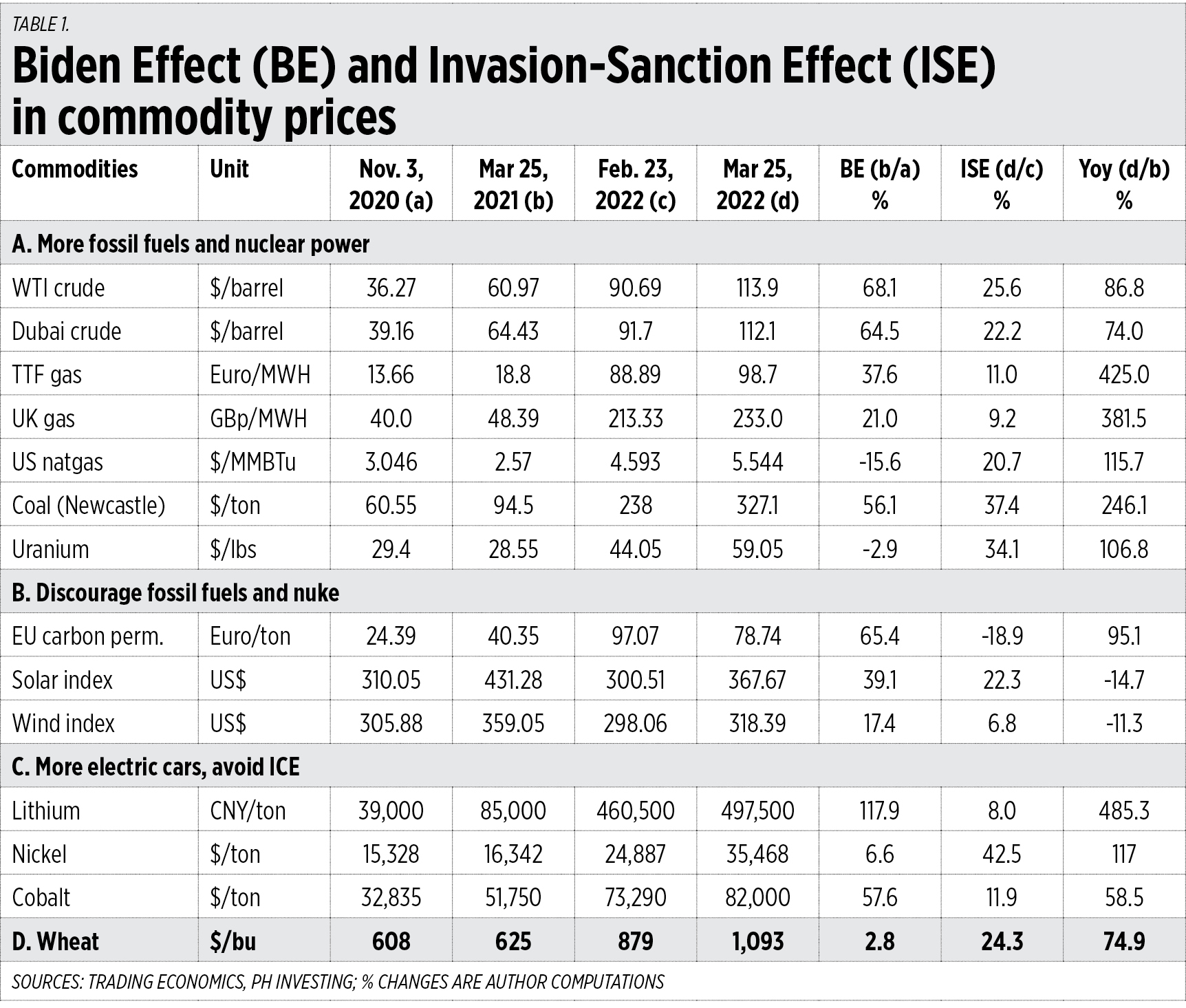
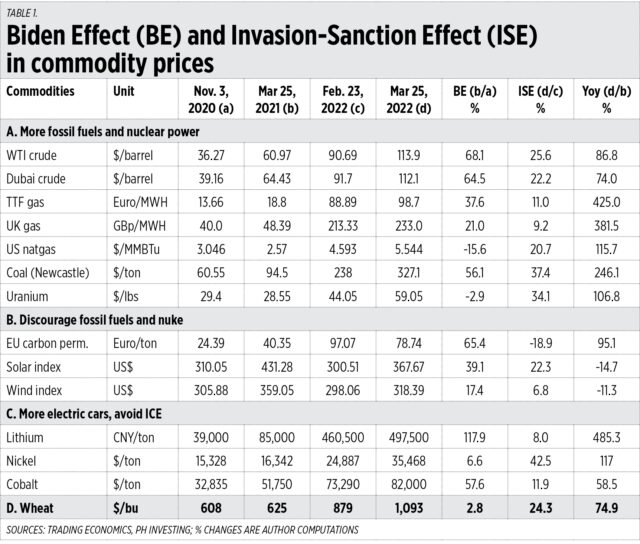
In Table 1, the reference points are last week’s trading day March 25; then the day before the invasion, Feb. 23; then the year ago or year-on-year from March 25, 2021; and Nov. 3, 2020, the US Presidential election day.

Two: World oil, coal and gas prices started rising after the Nov. 3, 2020 elections when it became apparent that Biden and his anti-fossil fuel policies would be implemented. WTI and Dubai oil jumped 68% and 64% from Nov. 3, 2020 to March 25, 2021. Coal jumped 56%, TTF gas and UK gas rose 38% and 21%, and EU carbon permits rose 65%.

Since a war on fossil fuel also means a war on internal combustion engines (ICE) that use gasoline or diesel, it signaled a rise in prices of metals largely used in electric car batteries like lithium and cobalt, which rose 118% and 58% over the same period.

Three: World prices of fossil fuels and uranium continued rising until pre-invasion day while the solar and wind index declined. The planet experienced a generally calm, less windy 2021 and the wind farms of many countries, especially Europe, produced little energy so they endured high gas-oil-coal prices to keep the lights on and avoid blackouts.

RUSSIA INVASION AND SANCTIONS EFFECT
Four: The invasion on Feb. 24 quickly pushed upwards the prices of many commodities, especially oil and gas because Russia is the number one source of these energy products for many countries in Europe. The percent changes in prices from Feb. 23 to March 25 were: 26% and 22% for WTI and Dubai crude, 37% for coal, and 34% for uranium. Nickel prices jumped 42% while wheat rose 24%, sending alarms calls of “food shortages” in many countries.

Five: The year-on-year (March 25, 2021 to March 25, 2022) percent change in prices were generally brutal for Europe gas at 425%, from €18.8/MWH to €98.7/MWH. The price of UK gas has risen 382%, US natgas 116%, coal 246%, uranium 107%. The price of lithium has risen 485% and nickel 117% (Table 1).

The main target of the US-led sanctions is Russia, to impoverish it quick, but the law of unintended consequences when things are politicized always kicks in and the rest of the world is adversely affected.

MORE FOSSIL FUELS MEAN CHEAPER ELECTRICITY
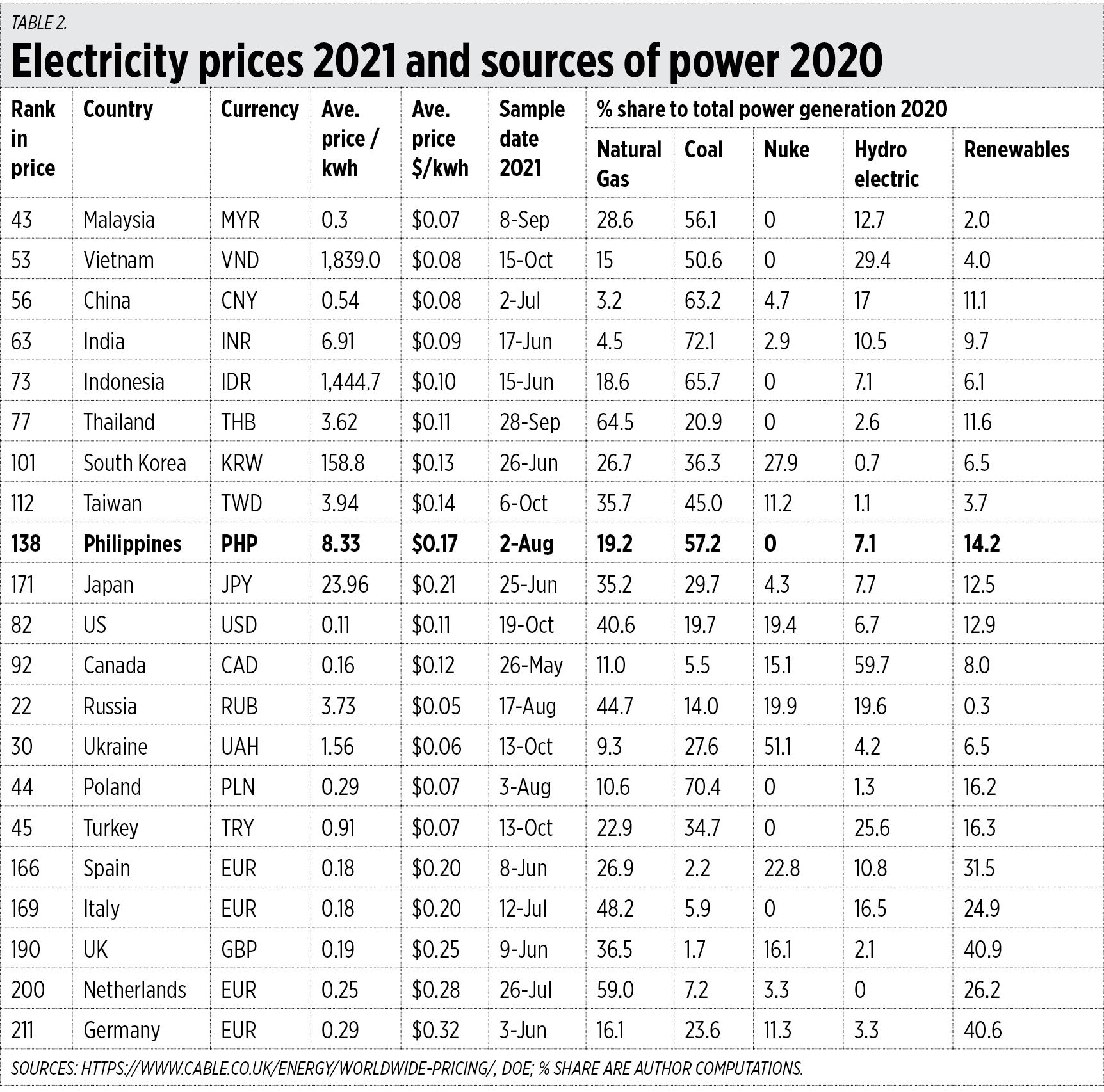
Six: Data until 2020-2021 show that when countries use more fossil fuels and nuclear for power generation, they have cheaper electricity prices. When they use more intermittent renewables like solar and wind, they have expensive electricity prices.

In Asia, Malaysia and Vietnam, renewables only have a 2-4% share to total generation and they have cheap electricity prices of only 7-8 US¢/kwh. The Philippines and Japan, with renewables having a 12-14% share, have electricity prices of 17-21US¢/kwh.

In Europe, Russia and Ukraine have the cheapest electricity prices of only 5-6US¢/kwh, their renewables’ share is only 0.3-6%, while their gas+coal+nuke power share is 79-88% of power generation. The UK and Germany have high power prices and their renewables’ share is 41% of total generation (Table 2).

Seven: Since the Philippines was already bullied by the environmental, social and governance (ESG) lobby to stop building new coal plants, it should consider turning to nuclear power, particularly small modular reactors, for islands like Palawan, Mindoro, Masbate, Bohol.

TOKYO AND METRO MANILA NEAR BLACKOUT
Eight: Tokyo nearly experienced a blackout on March 22. The temperature dropped and demand for electricity rose while some power plants were out. The Japan electricity network sent extra power to Tokyo. Japan has suffered from thin reserves for several years now as they retire many coal and nuclear plants while joining the ESG bandwagon of more intermittent power sources.

Japan introduced a feed-in tariff (FIT) program in 2012 to boost solar power. Many backup and reserve thermal power plants became more expensive to operate as intermittents were given priority in grid dispatch. And Japan’s power reserves become even thinner.

Nine: Metro Manila still experienced yellow-red alerts yearly even during the two years of COVID-19 lockdown (2020-2021), until this year. Last Saturday we experienced this: “Luzon grid placed on yellow alert after seven-plant outage” (BusinessWorld, March 27).

The Philippines implemented the FIT provision (guaranteed high price for 20 years) in 2012 and many solar-wind plants were built. Since they have priority dispatch in the grid, they also displace some reliable thermal plants. This is often praised as “merit order effect” that results in lower prices in the Wholesale Electricity Spot Market (WESM). This is fiction because the frequent displacement of dispatchable thermal plants in the grid means some or many of them will be gone soon, like what happened in Japan. And when some big plants go offline due to natural calamities or unscheduled shutdowns, reserves are thin and blackouts will be the result. The most expensive energy is one that is not there, absent, zero. Then people will use more candles and have more fires. Or use expensive gensets and diesel and create more air pollution.

THE NATIONAL MONOPOLY PROBLEM
Ten: Then there is the continuing problem that is the only remaining national monopoly in the country, the National Grid Corp. of the Philippines (NGCP). In last Saturday’s yellow alerts, five power plants, with a combined capacity of 1,193 MW, had a “forced outage due to undisclosed reason” simultaneously at 6:17 p.m. It does not look like a generation problem but a transmission problem because they went out all at the same time, on the same day.

About late January this year, the NGCP announced that it will get more firm contracts for ancillary services (AS) to augment reserves. It was good news — thank you NGCP. The bad news is that nothing seems to have happened after that, and so we are back to having yellow-red alerts in the next two to three months.

We should have less politics in energy policy. There should be no favoritism in energy technology, and no priority dispatch. Companies should bid based on the lowest price at the most stable supply for the consumers. And no more monopoly please, especially in the nationwide transmission system.


Bienvenido S. Oplas, Jr. is the president of Minimal Government Thinkers.

minimalgovernment@gmail.com

Fighting Putin comes before climate change

RUSSIAN PRESIDENT VLADIMIR PUTIN — KREMLIN.RU/

ON THE DAY Russia launched its all-out attack on Ukraine, Svitlana Krakovska was holed up in her home city of Kyiv, working feverishly to finish a report. As leader of the Ukrainian delegation to the Intergovernmental Panel on Climate Change (IPCC), she and scientists around the world were dotting the i’s and crossing the t’s of their sixth assessment of global warming and its threats to humanity.

But then Russian artillery started exploding all around her, and Krakovska and her team members had to scurry to the nearest bomb shelters.

The IPCC report was released a few days later nonetheless. In normal times, these tomes make headlines all over the world. This one would have set records, because it’s the most dismal read yet in a genre that was plenty dire already. Humanity, it suggests, will probably miss its goals of limiting the rise in global temperatures and enter an age of calamities. But, of course, these aren’t normal times, and the message was muffled in a news cycle dominated by shooting and dying.

Add this to the list of atrocities committed by Russian President Vladimir Putin. He’s not only violated a free country, killed and terrorized innocent people, and broken all norms of civilization. He’s also distracted the world from what should be a common quest to save our climate. Politicians who previously talked about little besides Green Deals are now focused entirely on resisting Putin’s onslaught.

There’s another connection between his war and global warming. It’s one that Krakovska, a mother of four who’s chosen to stay in Kyiv, has emphasized in her sporadic Zoom calls with the outside world. Putin rules over a petrostate that hawks the very fossil fuels causing climate change. By paying for his oil, coal, and gas, the world has in effect been funding his war machine and aggression.

That’s why energy has also become a military and strategic weapon for both sides. Putin could cut off the oil, coal, and gas fueling the economies of Europe. The West, for its part, is trying to wean itself from Putin’s hydrocarbons to make him go bankrupt as soon as possible.

The most visible effect of this clash is the soaring cost of all fossil fuels. Rising heating bills and pump prices will hit the poor hardest. In the worst case, this could lead to mass protests — like the yellow-vest riots of 2018 in France, but bigger, and in more places. Many countries must fear for their social peace.

So there’s really no alternative to temporarily pausing Green Deals and other projects meant to save us in the longer term. The need for physical security currently trumps everything else. To survive now and get through the next winter or two — however long Putin stays at large — we must replace one kind of fossil fuel — his — with all the others.

For Europe, which gets about 40% of its natural gas from Russia, that means frantically buying more liquefied natural gas (LNG) from places like the US or Qatar, while simultaneously building the ports and terminals that can welcome the ships. Where possible, it’ll also mean extending the life of nuclear power plants due to be phased out — as Belgium is considering, but Germany stubbornly isn’t yet.

But even as we manage the acute emergency, we must also prepare to exit from it. Yes, we can talk now about temporary rebates for gasoline or heating oil to the poor. But our goal must be to return as soon as possible to letting carbon become gradually more expensive over time — via cap-and-trade systems and such — so that people get used to consuming less of it.

And we must bid farewell to some dearly held assumptions. One, especially in Germany, is that natural gas can be a “bridge” from even dirtier coal-fired electricity to the cleaner, greener solar and wind sort. Owing to geopolitics, that gas bridge has in effect collapsed.

The new reality is that we have to go all the way to universal electrification even faster, powered by 100% renewable energy with green hydrogen filling the gaps. Countries that have so far dabbled in building out photovoltaics, wind farms, smart grids and other parts of the puzzle must double down as though life depended on it. It probably does.

The only glimmer of hope is that Putin may have inadvertently simplified the politics of such a global quest. Convincing voters requires communicating the need for sacrifice — from sleeping colder in the winters to flying less and paying more when you do. But now politicians can make that case in two ways — as necessary to fight both Russian aggression and climate change. Those on the front lines of both struggles, like Svitlana Krakovska, remind us that they’re equally urgent.

BLOOMBERG OPINION

Biden says he is not calling for regime change in Russia

REUTERS

WASHINGTON — US President Joseph R. Biden clarified on Sunday that the United States does not have a policy of regime change in Russia, after his declaration that Russian President Vladimir Putin “cannot remain in power.”

Mr. Biden’s comments in Poland on Saturday also included calling Mr. Putin a “butcher” and appeared to be a sharp escalation of the US approach to Moscow over its invasion of Ukraine.

Top American diplomats on Sunday had played down his declaration, and Mr. Biden, asked by a reporter as he departed a church service in Washington if he was calling for regime change in Russia, gave a one-word reply: “No.”

Julianne Smith, the US ambassador to NATO, earlier sought to contextualize Mr. Biden’s remarks, saying they followed a day of speaking with Ukrainian refugees in Warsaw. Russia’s month-old invasion has driven a quarter of Ukraine’s population of 44 million from their homes.

“In the moment, I think that was a principled human reaction to the stories that he had heard that day,” Ms. Smith told CNN’s “State of the Union” program before adding: “The US does not have a policy of regime change in Russia. Full stop.”

US Secretary of State Antony Blinken told a news conference in Jerusalem that Mr. Biden was making the point that Mr. Putin couldn’t be empowered to wage war. But Mr. Blinken said any decision on Russia’s future leadership would be “up to the Russian people.”

Republicans flatly said Mr. Biden’s remarks amounted to an unfortunate blunder.

Senator James Risch, the top Republican on the US Senate Foreign Relations Committee, called Mr. Biden’s remarks a “horrendous gaffe” and said he wished the president would have stayed on script.

“Most people who don’t deal in the lane of foreign relations don’t realize those nine words that he uttered would cause the kind of eruption that they did,” he told CNN.

“It’s going to cause a huge problem,” he said, referring to Mr. Biden’s statement in Warsaw: “For God’s sake, this man cannot remain in power.”

Senator Rob Portman, who is also on the committee, lamented the public misstep in wartime.

“It plays into the hands of the Russian propagandists and plays into the hands of Vladimir Putin. So it was a mistake,” Mr. Portman told NBC’s Meet the Press program.

UKRAINIAN RESISTANCE
The United States has sought to strike a balance during the conflict in Ukraine to avoid a direct military confrontation with Russia, speeding weapons deliveries to Kyiv to help its military fight but ruling out sending troops into the country or imposing a no-fly zone.

That support has bolstered fiercer-than-expected Ukrainian resistance, and Russia has failed to seize any major Ukrainian city after more than four weeks of fighting.

Ukrainian President Volodymyr Zelensky urged the West to give Ukraine tanks, planes and missiles to help fend off Russian forces.

The conflict has killed thousands of people, sent nearly 3.8 million abroad and driven more than half of Ukraine’s children from their homes, according to the United Nations.

Moscow says the goals for what Mr. Putin calls a “special military operation” include demilitarizing and “denazifying” its neighbor. Ukraine and its Western allies call this a pretext for an unprovoked invasion. — Reuters

China’s economy faces fresh blow from COVID lockdown in Shanghai

REUTERS
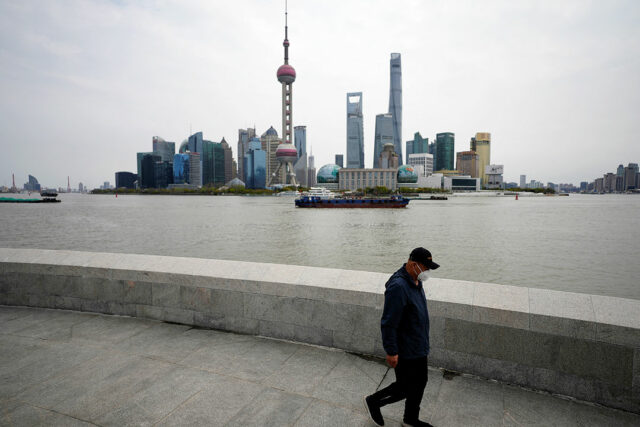
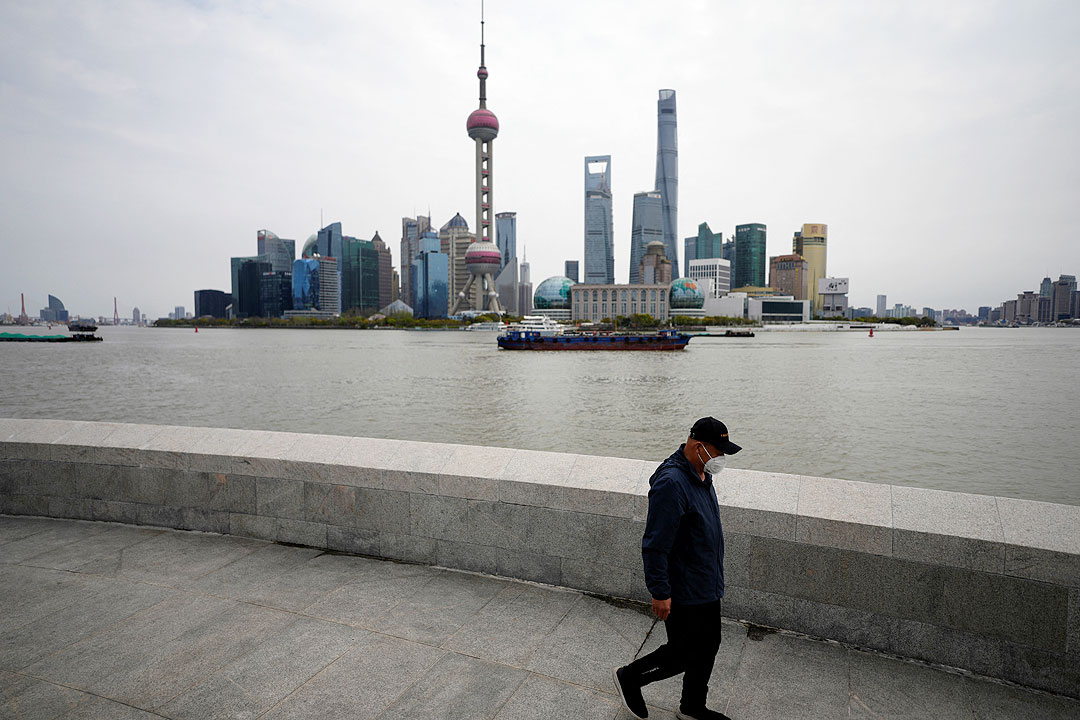
A MAN walks past Lujiazui financial district, seen across the Huangpu river, amid the lockdown in Pudong area to contain the spread of the coronavirus disease 2019 (COVID-19) in Shanghai, China on March 28. — REUTERS

SHANGHAI’s sweeping, two-phase lockdown will likely deal a heavy blow to businesses reliant on consumer spending, though economists say the city’s industrial sector can largely withstand the disruption, mitigating threats to the global supply chain.

The staggered eight-day lockdown in Shanghai — a city of 25 million people — and lingering effects from the measure may shave up to 0.4 percentage point from China’s economic growth in the first and second quarter, compared to a year ago, according to estimates by Liu Peiqian, China economist at NatWest Group Plc.

The restrictions targeting half of the city at a time will bar the city’s residents from leaving home, an attempt to curb China’s worst COVID outbreak since Wuhan in early 2020. That will likely hurt employment in the services industry and weigh on small businesses the most. 

“COVID suppresses people’s confidence and expectations for spending,” said Bruce Pang, head of macro and strategy research at China Renaissance Securities Hong Kong. He also pointed to impacts on industries that rely on in-person and social gatherings, especially catering.

Liu, whose forecast for gross domestic product (GDP) growth in the first quarter is 4.7%, said the “gradual recovery” of the services and consumption sectors could take eight weeks. As a major financial and trade hub, Shanghai contributes 3.8% to the country’s GDP. It’s also the second-richest city, trailing only Beijing, according to the latest available figures from the National Bureau of Statistics.

The impact on the supply chain will likely be temporary as long as the lockdown doesn’t last longer than three weeks, according to Raymond Yeung, chief economist for Greater China at Australia & New Zealand Banking Group Ltd.

He said a so-called closed loop system tested in Shenzhen — where factory workers are living in dorms, working in a bubble separate from the general public — has lessened the impact on the economy. The southern technology hub of Shenzhen resumed normal operations Sunday, about two weeks after the government placed its 17.5 million residents under lockdown.

“Similar to Shenzhen, Shanghai is the economic powerhouse of the country,” Mr. Yeung said. “The scale is obviously larger but the action is swift, hoping to minimize the economic impact as soon as possible.”

The Shanghai port, the world’s largest, is still operating around the clock, according to local media reports. Chinese chipmaker Semiconductor Manufacturing International Corp is maintaining normal production at its facility in the city, and is complying with Covid prevention measures.

Tesla, Inc., meanwhile, suspended production Monday, Bloomberg News reported. The American carmaker hasn’t yet informed employees whether that halt will be extended.

Larry Hu, an economist at Macquarie Capital Ltd., said policy makers will have “no choice but to step up stimulus in the coming months” in order to meet a GDP growth target of about 5.5% this year.

“We maintain our annual GDP forecast of 5%, as more policy easing would come through,” he said, predicting a benchmark interest rate cut in April, as well as more support for infrastructure and property sectors. — Bloomberg

Apple to cut iPhone, AirPods output – Nikkei

REUTERS

APPLE, INC. is planning to cut the output of its iPhone and AirPods devices as the Ukraine crisis and looming inflation start to weigh on demand for consumer electronics, the Nikkei reported on Monday, citing sources.

The company plans to make about 20% fewer iPhone SEs next quarter, or lower production orders by about 2 million to 3 million units than originally planned, due to weaker-than-expected demand, Nikkei said.

The US tech giant also reduced orders for its AirPods wireless headphones by more than 10 million units for all of 2022, as it scales back the level of inventories due to lukewarm demand, the newspaper said.

Earlier this month, Apple unveiled 5G connectivity to its iPhone SE, its low-cost model aimed mostly at buyers in emerging markets.

Counterpoint Research said the earlier 4G iPhone SE accounted for 12% of total iPhone sales from its launch in the second quarter of 2020 until the end of 2021, with Japan being the biggest market after the United States.

The company also asked suppliers to make a couple of million fewer units of the entire iPhone 13 range than previously planned, but said this adjustment was based on seasonal demand, according to the report.

Apple did not immediately respond to a Reuters request for comment. — Reuters

NK to keep developing ‘formidable’ striking capabilities

KCNA VIA REUTERS

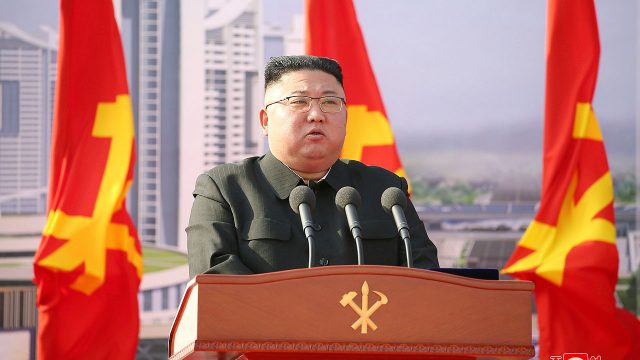
SEOUL — North Korea (NK) will continue to develop “formidable striking capabilities” that cannot be bartered or sold for anything, leader Kim Jong Un said, according to state media on Monday, as he visited workers involved with the country’s biggest missile test.

Mr. Kim was meeting with officials, scientists, technicians and workers who contributed to a missile launch on Thursday, which North Korea said was its largest intercontinental ballistic missile (ICBM), state news agency KCNA reported.

“Only when one is equipped with the formidable striking capabilities, overwhelming military power that cannot be stopped by anyone, one can prevent a war, guarantee the security of the country and contain and put under control all threats and blackmails by the imperialists,” Mr. Kim said, according to the report.

While personally overseeing the test on Thursday, Mr. Kim said the new ICBM was to help deter any military moves by the United States, which remains technically at war with the North after the 1950-1953 Korean War ended in an armistice rather than a peace agreement.

Washington has sought to pressure Pyongyang into surrendering or reducing its arsenal of nuclear weapons and ICBMs, which may be able to strike targets in the United States.

But Mr. Kim said his self-defense force “cannot be bartered nor be bought with anything” and will be held firm without the slightest vacillation despite harsh trials and difficulties.

North Korea will continue to build a “more perfect and stronger strategic force,” Mr. Kim said, referring to the country’s nuclear force.

The United States said on Friday it will push United Nations sanctions on North Korea to be strengthened over “increasingly dangerous provocations,” but China and Russia signaled opposition and instead argued for such measures to be eased.

North Korea said Thursday’s missile was the Hwasong-17, and Japan and South Korea confirmed that flight data showed the launch flew higher and longer than any previous North Korean test.

But analysts said that state media coverage appeared to be trying to pass off footage from a previous launch, and South Korea’s Yonhap news agency reported on Sunday that intelligence officials in Seoul and Washington believe the North actually tested an older and slightly smaller Hwasong-15 ICBM. — Reuters

Ukraine insists on territorial integrity as talks loom

REUTERS

LVIV, Ukraine — With peace talks between Russia and Ukraine set to take place in Turkey this week, Ukrainian President Volodymyr Zelenskyy has insisted on the territorial integrity of his country after earlier suggesting he was ready for a compromise. 

Mr. Zelenskyy said in a video address to the Ukrainian people late on Sunday that in talks due to take place in Istanbul his government would prioritize the “territorial integrity” of Ukraine. 

But in comments made to Russian journalists earlier in the day, Mr. Zelenskyy adopted a different tone, saying Ukraine was willing to assume neutral status and compromise over the status of the eastern Donbas region as part of a peace deal. 

In the video call that the Kremlin preemptively warned Russian media not to report, Mr. Zelenskyy said any agreement must be guaranteed by third parties and put to a referendum. 

“Security guarantees and neutrality, non-nuclear status of our state. We are ready to go for it,” he added, speaking in Russian. 

Even with talks looming, Ukraine’s head of military intelligence, Kyrylo Budanov, said Russian President Vladimir Putin was aiming to seize the eastern part of Ukraine. 

“In fact, it is an attempt to create North and South Korea in Ukraine,” he said, referring to the division of Korea after World War Two. 

Mr. Zelenskyy has urged the West to give Ukraine tanks, planes, and missiles to help fend off Russian forces. 

In a call with Mr. Putin on Sunday, Turkish President Tayyip Erdogan agreed to host the talks and called for a ceasefire and better humanitarian conditions, his office said. Ukrainian and Russian negotiators confirmed that in-person talks would take place. 

Top American officials sought on Sunday to clarify that the United States does not have a policy of regime change in Russia, after President Joseph R. Biden, Jr., said at the end of a speech in Poland on Saturday that Putin “cannot remain in power.” 

US Secretary of State Antony Blinken said Biden had simply meant Mr. Putin could not be “empowered to wage war” against Ukraine or anywhere else. 

After more than four weeks of conflict, Russia has failed to seize any major Ukrainian city and signaled on Friday it was scaling back its ambitions to focus on securing the Donbas region, where Russian-backed separatists have been fighting the Ukrainian army for the past eight years. 

REFERENDUM IDEA DISMISSED
A local leader in the self-proclaimed Luhansk People’s Republic said on Sunday the region could soon hold a referendum on joining Russia, just as happened in Crimea after Russia seized the Ukrainian peninsula in 2014. 

Crimeans voted overwhelmingly to break with Ukraine and join Russia — a vote that much of the world refused to recognize. 

Mr. Budanov predicted Ukraine’s army would repel Russian forces by launching a guerrilla warfare offensive. 

“Then there will be one relevant scenario left for the Russians, how to survive,” he said. 

Ukraine’s foreign ministry spokesperson also dismissed talk of any referendum in eastern Ukraine. 

“All fake referendums in the temporarily occupied territories are null and void and will have no legal validity,” Oleg Nikolenko told Reuters. 

Moscow says the goals for what Putin calls a “special military operation” include demilitarizing and “denazifying” its neighbor. Ukraine and its Western allies call this a pretext for unprovoked invasion. 

Ukraine has described previous negotiations, some of which have taken place in Russian ally Belarus, as “very difficult.” 

The invasion has devastated several Ukrainian cities, caused a major humanitarian crisis and displaced an estimated 10 million people, nearly a quarter of Ukraine’s population. 

In his Sunday blessing, Pope Francis called for an end to the “cruel and senseless” conflict. 

HUMANITARIAN CORRIDORS
Russia has continued to move additional military units to the Ukraine border and is launching missile and air strikes on Ukrainian forces and military infrastructure, including in the city of Kharkiv, the Ukrainian military said on Sunday night. 

Ukraine’s General Staff said on Monday Kyiv defense forces were holding back Russian troops trying to break through from the northeast and northwest and take over key roads and settlements. In the south of the country, Ukrainian forces were focused on defending Krivy Rih, Zaporizhzhia, and Mykolayiv. 

It said that Ukraine had downed four Russian aircraft, one helicopter, two drones and two cruise missiles over the past 24 hours. 

Ukraine raised concerns about the safety of the Russian-occupied defunct nuclear power plant at Chernobyl, the site of the world’s worst civil nuclear accident in 1986. 

Russian forces have created a risk of damaging the containment vessel constructed around the station’s wrecked fourth reactor, said Ukrainian Deputy Prime Minister Iryna Vereshchuk. She urged the United Nations to dispatch a mission to assess the risks. 

The mayor of Slavutych, the town created and built to house the plant’s staff in the aftermath of the 1986 accident, said early on Monday that Russian forces that took over the town at the weekend had now left. 

Yuri Fomichev said in an online video post that the troops “completed the work they had set out to do” and were gone. He originally said three people had been killed in clashes. 

The United Nations has confirmed 1,119 civilian deaths and 1,790 injuries across Ukraine but says the real toll is likely to be higher. Ukraine said on Sunday 139 children had been killed and more than 205 wounded so far in the conflict. — Reuters

[B-SIDE Podcast] Ready for the rain?

Each year, the Philippines is hit by an average of 20 typhoons, which are growing progressively more destructive.  

A report released by Fitch Ratings in November 2021 said that the country is one of the most exposed to climate change physical risks, particularly floods and storms.  

In addition, the Department of Finance reported that climate-related hazards have cost the country $10 billion in losses and damage over the past decade. 

In this B-Side episode, Rick Holland, Grundfos senior regional sales director for Asia Pacific, talks to BusinessWorld reporter Alyssa Nicole O. Tan about key solutions in mitigating flooding caused by extreme weather events amid worsening climate change. Headquartered in Denmark, Grundfos manufactures pumps for flood control, irrigation, and sewage, among others. 

“You cannot just take one approach to everything,” said Mr. Holland, noting that a community’s geography, economic status, and density should be considered when thinking of long-term solutions.  

TAKEAWAYS

To prevent flooding, fix the trash problem. 

“We end up with quite a lot of trash in the waterways from various causes and… it tends to clog up the canals and block up the pump stations sometimes, so that does have an impact on how to handle current flood waters,” said Mr. Holland. 

The combination of rising sea levels, climate change events, and land subsidence already makes Manila particularly flood-prone — mountains of trash exacerbate the problem. 

“I think development planning and infrastructure planning will form a key part of the strategy,” he added. 

Flood solutions are unique to each community.

Mr. Holland noted that the real challenge with floods in Manila is that each community and micro-area is unique.  

Low-lying areas close to Manila Bay will need solutions that can handle seawater applications and still run reliably. 

Meanwhile, areas with informal settlements need technology partners who can provide materials that can remove high volumes of trash efficiently. 

“All of these things require a degree of consideration to tailor the solution for the best outcome in a particular community,” he said. 

New flood mitigation solutions must work well with other existing flood prevention strategies. 

While the systems built by Grundfos within the flood station infrastructure are designed to operate independently, its success in a community is tied to many things operating in tandem.

“The development that happens in that community will either assist run-off and flood mitigation or make it worse,” Mr. Holland said.

Flood water drained into the pumping stations have to be clean and free-flowing to enable the pump station to operate.

“One of the big challenges for flood infrastructure projects is [that] there are always factors that will determine the success of a project, and they really all need to work in tandem to be successful,” he said. 

Big picture: climate change has to be addressed. 

“Climate change is bringing more extreme rainfall and rising sea levels, and these directly impact on the severity and the frequency of flooding, and also inundation from the sea for low-level communities,” Mr. Holland said.

“If we don’t take action to reduce the degree that climate change is going to happen then it may well end up in a situation where it’s not possible to be resilient, or not possible to mitigate the impacts as they become more severe,” he added. 

Recorded remotely in February 2022. Produced by Earl R. Lagundino, Jino D. Nicolas, and Sam L. Marcelo.

Impermanence nation: Canada’s growing reliance on temporary residents to meet labor needs

PRAVEEN KUMAR NANDAGIRI-UNSPLASH

TORONTO — Canada is increasingly relying on temporary residents to meet its labor force needs, according to a Reuters analysis of official data, but this phenomenon makes workers vulnerable and fails to provide wage growth or stability to businesses, warn workers, advocates, economists and industry groups. 

Temporary residents come to Canada on time-limited visas, some of them tied to specific employers, after which they are expected to return to their countries of origin. While there are ways to become permanent residents, and many come intending to do so, there are often significant hurdles to achieving this. 

Offering temporary visas is seen as an easy fix for tight job markets and may allow politicians to avoid the potential political fallout of large numbers of new permanent residents, analysts say. 

But this trend can depress labor standards, which employers might otherwise boost to entice hires. People with permanent resident status are better positioned to demand better working conditions, economists say. 

Wage suppression can reduce the overall population’s spending power and hurt economic growth, said economist Armine Yalnizyan, Atkinson Fellow on the Future of Workers. 

University of Waterloo economist Mikal Skuterud argues that to promote economic equality it may make more sense to prioritize the immigration of higher-skilled people, who will exert downward pressure on the highest salaries while employers of lower-paid workers raise wages to woo employees. 

Temporary residents — who often come from Asia, Latin America and the Caribbean — say their precarious immigration status leaves them open to exploitation. 

The programs are an “essential tool” for Canada’s economy, its immigration minister told Reuters, but he sees room for broader pathways to permanency. 

The number of people living and working in Canada on a temporary basis has grown faster than the annual number of new permanent residents in the past decade, according to Reuters analysis of federal immigration data. 

In 2020 temporary residents were more than triple the number of new permanent residents; last year, when Canada set a permanent resident record, it had more than twice as many temporary ones. 

This growth has been fueled in part by international students, whose ranks more than doubled in a decade. The number of people in Canada on post-graduate work permits, meanwhile, almost quintupled between 2012 and 2021. 

Many international students can work, subject to different limitations, but Canada’s immigration department said it doesn’t know how many do. 

PATH TO PERMANENT RESIDENCY
Kathleen Sullivan, chief executive officer of Food and Beverage Canada, said some of her members, strapped for labor, are racing to bring in temporary foreign workers for the first time. 

But they would prefer stability, she said. 

“If I have a permanent job, I want a permanent employee — I’m investing in training, I’m investing in them,” she said. 

Canada’s immigration system prioritizes high-skilled jobs but its labor market needs people doing lower-skilled work, too. Canada’s job vacancy rate in the fourth quarter of 2021 was 5.3%, and was highest in accommodation and food services, at 10.8%. That sector also had the lowest average hourly wages, according to Statistics Canada, at C$15.50 ($12.37) late last year. 

Temporary foreign workers saved Louis Bontorin’s family bakery, he said. But his goal is to make them permanent. Of the 60 temporary workers they brought over in five years, he figures all but five are in Canada to stay. 

It would make a big difference for people to have permanent residency on arrival, he said. “It really changes the dynamic of how they sort of plan with their family,” he said. 

Last year, Canada announced a limited plan to make 90,000 temporary residents permanent. So far, it has given 23,880 permanent residency; the immigration department said more applications are being processed. 

Canada’s Immigration, Refugees and Citizenship Minister Sean Fraser said in a January interview it may be time to establish a path to permanent residency. 

“Certain temporary programs can develop into a tool to solve permanent and persistent gaps in the labor force. I think there is a better answer.” — Anna Mehler Paperny/Reuters

India’s largest multiplex operators to merge, creating cinema giant

Image via pvrcinemas.com

NEW DELHI — India’s two largest multiplex firms said on Sunday they would merge to create a giant cinema operator with more than 1,500 screens across 109 cities as the entertainment industry recovers from the coronavirus disease 2019 (COVID-19) pandemic. 

PVR and INOX Leisure said the merger, which is subject to regulatory approvals, would help both companies improve efficiency, reach newer markets, and optimize cost. 

“The film exhibition sector has been one of the worst impacted sectors on account of the pandemic and creating scale to achieve efficiencies is critical for the long-term survival of the business and fight the onslaught of digital OTT platforms,” PVR Chairman Ajay Bijli said in a press release. 

Over-the-top, or OTT, platforms such Netflix, Amazon’s Prime Video, and Disney have made deep inroads in India, where the pandemic ravaged a film industry known for song-and-dance spectacles watched by millions. 

PVR is India’s largest multiplex chain with more than 850 screens, followed by INOX Leisure with about 650 screens. 

The merger follows a two-year period when most theaters were shut due to COVID-19 restrictions. — Reuters