Home Blog Page 6173

Things to do before going beyond the minimum wage

I’m the human resource (HR) manager of a factory with around 250 directly-hired minimum wage earners. Our attrition rate is 30%, which keeps us busy recruiting, onboarding and training on a daily basis. I’m planning to recommend to top management to increase wages to help address the high turnover rate. What are your thoughts on this? — Blue Lagoon.

Prejudice is a great time saver. It allows opinions to form without having to know the facts. So where are your facts and figures? “In God we trust, but everyone else must bring data,” according to pioneering American management consultant W. Edwards Deming (1900-1993). What’s your basis for proposing a salary increase? Do you have enough evidence to convince management about your recommendation? Have you performed objective exit interviews or conducted an employee morale survey to prove your contention that wages are an issue?

If you have nothing to back it up, then making such a recommendation might leave you on thin ice.

The strategy for employee retention must be accompanied by serious thought. Begin with a proactive two-way communication process, led by qualified line executives. Even if HR mandates regular dialogue, the result may not be effective if your supervisors and managers are not qualified. Even if they’re qualified, they may be reluctant to do it.

We can’t discount the fact that line executives are the first line of defense for management. They should be the ones to know the issues and solve them before they can be escalated to HR and top management. They must constantly have their finger on the pulse of workplace relations. They know which workers are habitually tardy or absent, which are some of the most common manifestations of low morale.

Paying the minimum wage and statutory benefits to people is more than an economic discussion. There’s more to it than meets the eye.

ROADMAP
The effect of salary on employee loyalty and motivation is one of the most studied subjects in HR. Even in the absence of a study, many of us might be tempted to default to the conclusion that wages are the main reason for people leaving. I can’t blame you for thinking that or for wanting to go beyond minimum wage.

You’ll need a careful and exhaustive study before increasing wages. Some principles to remember are that money should be tied to worker qualifications and consistent high performance, in alignment with organizational goals. Try resolving your issues using the following roadmap:

One, establish a two-way employee communication process. This includes annual employee opinion surveys, periodic engagement dialogues by line executives and their workers, town hall meetings by the chief executive officer, labor-management cooperation schemes, and many more. Of all these, I’m biased in favor of the survey because it documents the opinions of all workers, and not just the complaints of few disgruntled individuals who may have already resigned, or are well on their way to doing so.

Two, focus and solve the most common employee gripes. The survey can give you an idea on which issues should be priorities. Complaints could include poor supervision, inadequate facilities, unsafe work conditions, unclear job expectations, unreasonable production targets, unfair labor practices, and others. Of course, salary and benefits could well be the reason for your high turnover rate. Whatever other issues may emerge, there is no getting around establishing a reasonable pay structure.

Three, define the most important jobs in the organization. A clear job description is a must for setting recruiting plans, evaluating job processes, managing performance and determining training needs. Job descriptions come in many shapes and sizes depending on the nature of the business. For a factory worker, a simple and clearly-worded job description will suffice, while the job description for supervisors and managers, must necessarily cover more bases.

Last, benchmark the salaries of key jobs with the pay scale in other companies. The ideal approach is to compare your salary practices with competitors. If you’re encountering difficulty securing cooperation from your rivals, then another approach is to benchmark with other companies located within the same locality or geographical area, such as fellow locators in export processing zones. If workers leave your factory, it’s likely that they will join your competitors or companies within the same area. 

PAY PHILOSOPHY
Pricing jobs that are over and beyond the minimum wage rates is complex, but we can’t deny its importance in attracting and retaining workers. You must gather data to help you understand worker motivations, which may not be limited to achieving a pay scale that’s more than the minimum wage.

Developing an objective and competitive pay philosophy is needed to reduce attrition, but is not the end-all as workers could be leaving for other reasons.

If you conduct a thorough study that supports increasing pay of the minimum-wage earners over and above what the government requires, it would be easy to start the process of proposing higher wages. Remember that completing the roadmap that I’ve recommended above takes time.

Whatever you’re planning, feel the pulse of your top management before doing anything. Otherwise, all of your plans may be all for nothing.


Have a chat with Rey Elbo via Facebook, LinkedIn or Twitter or send your workplace questions to elbonomics@gmail.com or via https://reyelbo.consulting


POC suspends athletics, tennis groups for 90 days

POC President Abraham Tolentino — POC PHOTO RELEASE

THE Philippine Olympic Committee (POC) cracked the whip on the Philippine Athletics Track and Field Association (PATAFA) and Philippine Tennis Association (PHILTA) by suspending the two for 90 days due to separate reasons.

POC President Abraham Tolentino cited noncompliance of the International Tennis Federation (ITF) order to amend its charter and hold new elections as reason for banning PHILTA, which was serving a two-year ban by the ITF in 2020.

For PATAFA, the congressman from Tagaytay said the former allegedly failed to serve its purposed as a national sports association, which was supposed to have “the dedication and commitment toward the development of the sport, promoting the ideals of the Olympic movement and the spirit of sportsmanship.”

“Our constitution states that POC may suspend for any reason. However, it’s transparent that PATAFA has deliberately and intentionally disregarded our basic principles of promoting sports and development,” said Mr. Tolentino.

The PhilCycling chief also cited the non-endorsement of Asian pole-vault record-holder Ernest John “EJ” Obiena to the World Indoor Championship slated for Friday in Belgrade, Serbia and the Hanoi Southeast Asian (SEA) Games set on May 12 to 23 was the last straw.

“Unfortunately, the non-endorsement of EJ has created a national issue. EJ Obiena, under our International Olympic Committee Charter, has two reasons to be endorsed — sports merit and inspiration to the youth,” he said.

“Patafa prioritized its pride, and it saddens [me] to look closely on a chance slowly gripping away. They have withheld an opportunity of the Filipino people to have another world record.

“The time is clearly now for EJ who is mentally and physically prepared. We are in a reachable milestone within our grasp,” he added.

The suspension will be effective for 90 days and will be ratified by the POC General Assembly during its regular meeting on March 30.

If ratified, Patafa will not have any authority over the national athletics team to the SEA Games, which would allow Mr. Obiena a chance to compete and defend his gold medal in Hanoi.

But Mr. Tolentino said both suspensions could be dismissed sooner than their terms.

“If PHILTA complies with the ITF order, and the ITF accepts PHILTA’s compliance, the suspension of the tennis association will be lifted immediately,” said Mr. Tolentino.

For the PATAFA, it is much simpler.

“If the PSC’s mediation effort over Patafa and EJ [Obiena] is completed and ironed out, its suspension will also be lifted,” said Mr. Tolentino.

Nine members of the board voted for the suspension, while two — Charlie Ho (netball) and Cynthia Carrion-Norton (gymnastics) abstained. POC Chairman Steve Hontiveros and International Olympic Committee Representative to the Philippines Mikee Cojuangco-Jaworski were absent from the special board meeting.

The suspensions will give the POC direct supervision over PHILTA and Patafa’s national athletes — including Mr. Obiena — coaches and sporting officials, while financial matters will be under the control of the Philippine Sports Commission (PSC). — Joey Villar

Concerns and commitment of finance industry leaders

SIXTEEN former presidents of the Financial Executives Institute of the Philippines (FINEX) have issued a joint statement of concern and commitment titled “We Choose Not To Be Silent.” Together they constitute 42% of the 39 living past presidents of the country’s premier finance organization.

“Financial executives serve as the conscience of their respective organizations. As Filipinos, we believe it is our duty to speak up,” they declared. Among the issues they are gravely concerned about are the perceived lack of transparency in the award of government assets and contracts to allied parties; the ballooning of the national debt; the unmitigated unemployment rate; delayed access to critical social and health services; the appointment of certain individuals to critical positions at the Commission on Elections, the Supreme Court, and the Commission on Audit; the compromise of our sovereignty by the defeatist attitude and non-enforcement of the Philippines’ rights to its exclusive economic zone; as well as the proliferation of disinformation and fake news that twist facts and glorify an infamous chapter of our history, referring to the martial law era.

Faced with the gravity of these concerns that curtail the country’s ability to achieve its full economic potential, the 16 FINEX leaders have endorsed the candidacies of Vice President Ma. Leonor “Leni” Robredo and Senator Francis “Kiko” Pangilinan for the presidency and vice presidency. This came after evaluating them as having the best qualities of leadership to lead our country — character, competence, compassion, and commitment.

“We see in them what we expect of ourselves as finance professionals: to uphold high integrity; to stand for truth and probity; to maintain transparency and stewardship; to demonstrate utmost competence; and to drive and achieve excellence,” they stated.

The 16 signatories, whose terms as FINEX President collectively spanned four decades, are as follows: Arsenio M. Bartolome III (1981), Santiago F. Dumlao, Jr. (1989), Edwin V. Fernandez (1991), Dennis D. Decena (1994), Victor Y. Lim, Jr. (1995), Baltazar N. Endriga (1997), Edwin B. Villanueva (1998), Josue A. Camba, Jr. (1999), Edgardo L. Limon (2003), Franklin F. Ysaac (2004), Abelardo V. Cortez (2007), Roberto T. Borromeo (2009), Ronnie B. Alcantara (2011), Ramon G. Opulencia (2012), Judith V. Lopez (2013), and Jose Jerome R. Pascual III (2020).

UPAA NAMES ALUMNI AWARDEES
For its 108th year, the University of the Philippines Alumni Association (UPAA) recently announced its Distinguished Alumni Awardees for 2021. Heading the elite group of graduates from the country’s foremost state university is National Artist Raymundo “Ryan” Cayabyab, who has been named as the year’s UPAA Most Distinguished Alumnus.

Lifetime distinguished achievement awards were given to nurse Phoebe Cabotaje-Andes, architect Antonio A. Turalba, retired Supreme Court justice Francis H. Jardeleza, and Dr. Reynaldo L. Villareal. Twenty-five other distinguished alumni received awards in different service categories.

Conceived in 1933, the UPAA Awards are based on the concept that “when the prestige of the alumni increases, the prestige of the institution is thereby increased.”


J. Albert Gamboa is the chief finance officer of Asian Center for Legal Excellence and chairman of the FINEX Media Affairs Committee. The opinion expressed herein does not necessarily reflect the views of these institutions and BusinessWorld. #FinexPhils www.finex.org.ph

CTA dismisses funeral service company’s appeal in tax case vs BIR

THE Court of Tax Appeals (CTA) has denied the appeal of Ortiz Memorial Chapel, Inc. to set aside the tax assessment issued by the Bureau of Internal Revenue (BIR), which found the company liable for deficiency taxes amounting to P6.9 million for the taxable year 2011.

In a 19-page resolution released on March 10, the tax court’s second division ruled that the petition filed was “premature” and that it had no jurisdiction over the case.

It added that the company did not state the nature of the protest, whether it was appealing for reconsideration or investigation, and did not state the date of the tax assessment.

“When a taxpayer files a petition for review before the Court of Tax Appeals without validly contesting the assessment with the Commissioner of Internal Revenue, the petition is premature and the Court of Tax of Appeals has no jurisdiction,” the appellate court said, citing jurisprudence promulgated last year.

The court reiterated that the protest must not only be filed within the prescribed 30-day time period but should also “in such form and manner as may be prescribed by implementing rules and regulations.”

The petitioner is a domestic company based in Tuguegarao City in Cagayan, primarily engaged in the general business of funeral services.

The company argued that it was not liable for the deficiency income assessment because it was never final, executory, and demandable.

On the other hand, the BIR commissioner claimed that the court had no jurisdiction over the petition and that the necessary procedural requirements were duly complied with.

“In order for the court or an adjudicative body to have authority to dispose of the case on the merits, it must acquire, among others, jurisdiction over the subject matter,” the court said. “Thus, when a court has no jurisdiction over the subject matter, the only power it has is to dismiss the actions.” — John Victor D. Ordoñez

Entertainment News (03/18/22)

Docu on Antique’s marine treasures

IN 2021, Studio H2O organized an expedition team composed of marine researchers, scientists, and underwater cinematographers to conduct a scientific survey of the reefs in Antique, particularly around the coastal areas of Pandan Bay and Libertad. It also held a freediving workshop for fisherfolk with the intention of teaching them how to survey, protect, and do an inventory of their own marine areas. Their activities were documented in Antique: Where the Mountains Meet the Sea, produced by Studio H2O. The 20-minute documentary, which captures the underwater beauty of the province, will air on the Discovery Channel on March 23, 6:15 p.m., with replays on March 24, at 8:15 a.m. and 11:25 a.m.

Search on for Bida Star Singer

ABS-CBN’s online talent competition, Bida Star Singer, has begun its search for the next online singing sensation. The show is hosted by Karina Bautista, Aljon Mendoza, and Anji Salvacion. The winner will receive an ABS-CBN management and recording contract, a trophy, and P50,000. Filipino citizens aged 18 years old and above can audition until March 18 by visiting forms.abs-cbn/bidastarsinger.

Jeric Gonzales releases new single

ACTOR Jeric Gonzales bares his heart in his latest single under GMA Music, “Hihintayin Kita.” The track, written Louie Ignacio who also directed the music video, tackles how unconditional love overpowers the hardships of waiting. The song was also the theme song for Broken Blooms, the only Filipino film selected to screen at the 41st Oporto International Film Festival in Portugal. “Hihintayin Kita” is available for streaming on various digital platforms worldwide.

The Clash winners sign with GMA

THE CLASH Season 4 champion Mariane Osabel and finalist Vilmark Viray signed contracts with GMA Music on March 3 in a virtual signing ceremony. Ms. Osabel won Season 4 of GMA Network’s singing competition with her rendition of the pop-ballad song Bakit Mahal Pa Rin Kita,” which is now available for streaming worldwide under the album The Clash 4 Finalists Sing Originals. Mr. Viray’s recording of “Umuwi Ka Na” is also available for streaming on digital platforms worldwide under the same album.

Issa Rodriguez releases single

ISSA Rodriguez’s latest single, “Silong,” featuring Kyle Juliano, is about the longing for someone who has left. The song is a follow-up to her five-track Ready EP released February of last year. “Silong” is available to stream on digital platforms.

Rex Orange County releases new single,”

ENGLISH singer Rex Orange County’s new single, “Open a Window,” features Tyler, The Creator. The track is the third offering from his new album WHO CARES? This is the first time the two performers have collaborated since Tyler’s 2017 album Flower Boy. “Open a Window” is laid-back with jazzy keys and drums that flow freely behind Rex Orange County’s vocals. The singer has also announced a North American tour before hitting the UK and Ireland in July and August for a four-date string of shows. Tickets are on sale at https://www.rexorangecounty.com/live/. “Open a Window” and WHO CARES? are available on digital platforms.

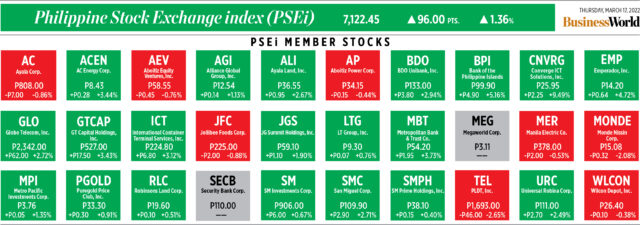
How PSEi member stocks performed — March 17, 2022

Here’s a quick glance at how PSEi stocks fared on Thursday, March 17, 2022.


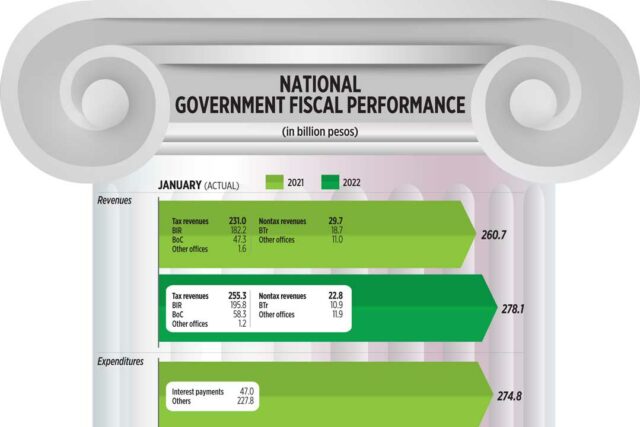
National government fiscal performance

THE National Government’s budget deficit widened to P23.4 billion in January, as spending increased due to the release of tax allotments to local government units (LGUs). Read the full story.

National government fiscal performance

Peso strengthens versus dollar as Russia-Ukraine talks show progress

THE PESO strengthened versus the greenback on Thursday amid some progress in diplomatic talks between Russia and Ukraine.

The local unit closed at P52.14 per dollar on Thursday, stronger by 17 centavos from its P52.31 finish on Wednesday, data from the Bankers Association of the Philippines showed.

The peso opened Thursday’s session at P52.18 a dollar. Its weakest showing was at P52.22, while its intraday best was at P52.10 against the greenback.

Dollars traded declined to $998.2 million on Thursday from $1.046 billion on Wednesday.

A trader said the peso’s appreciation was supported by positive market sentiment as they welcomed progress in the ongoing talks between Moscow and Kyiv.

Ukrainian President Volodymyr Zelensky said their negotiations have become more realistic since the war started three weeks ago, Reuters reported.

Meanwhile, Russian President Vladimir Putin said they are ready to discuss a neutral status with Ukraine.

Rizal Commercial Banking Corp. Chief Economist Michael L. Ricafort in a Viber message said relatively lower oil prices also brought relief to investors and caused the peso to appreciate.

The peace talks between Moscow and Kyiv caused some decline in global oil prices. Brent declined by $1.89 or 1.9% to settle at $98.02 per barrel on Wednesday, while the US West Texas Intermediate crude was down by $1.40 or 1.5% at $95.04.

The dollar index, which tracks the currency against six major peers, was slightly weaker at 98.476 after declining 0.47% on Wednesday.

For Friday, Mr. Ricafort gave a forecast range of P52.05 to P52.25, while the trader expects the local unit to move within P52.10 to P52.25 per dollar. — L.W.T. Noble with Reuters

Shares extend climb on positive economic outlook

BW FILE PHOTO

STOCKS went up on Thursday as the government said they remain bullish that they can reach this year’s economic growth goal despite the inflation risks caused by the Russia-Ukraine war and following the US Federal Reserve’s rate hike.

The benchmark Philippine Stock Exchange index (PSEi) climbed by 96 points or 1.36% to close at 7,122.45 on Thursday, while the broader all shares went up by 46.28 points or 1.24% to 3,759.96.

“[T]he National Economic and Development Authority (NEDA) said the country is still on track to reach its economic growth target this year despite the impact of Russia’s invasion of Ukraine on prices,” Regina Capital Development Corp. Head of Sales Luis A. Limlingan said in a Viber message.

“Philippines shares continued to rebound after the Fed raised its benchmark interest rates by 0.25% for the first time since 2018. The central bank hinted at six more rate hikes this year as it forecasted a consensus funds rate of 1.9% by end of year,” Mr. Limlingan added.

The NEDA is confident the Philippines could still reach its economic growth target this year, despite the impact of Russia’s invasion of Ukraine on prices, Socioeconomic Planning Secretary Karl Kendrick T. Chua said at a Tuesday briefing.

Meanwhile, the Fed on Wednesday raised interest rates for the first time since 2018 and laid out an aggressive plan to push borrowing costs to restrictive levels next year in a pivot from battling the coronavirus pandemic to countering the economic risks posed by excessive inflation and the war in Ukraine, Reuters reported.

The US central bank’s Federal Open Market Committee kicked off the move to tighten monetary policy with a quarter-percentage-point increase in the target federal funds rate, lifting that key benchmark from the current near-zero level in a step that will ripple through a variety of other rates charged to consumers and businesses.

“[The PSEi] was up most likely due to strong performance of the US market last night and Asian markets today. Also, commodity prices are correcting after climbing significantly last week,” COL Financial Group First Vice-President April Lynn C. Lee-Tan said in a Viber message on Thursday.

Majority of the PSE’s sectoral indices ended in the green except for mining and oil, which fell by 157.19 points or 1.30% to 11,916.61.

Meanwhile, financials climbed 55.01 points or 3.39% to 1,677.86; services rose by 34.93 points or 1.90% to 1,870.38; property increased by 43.67 points or 1.31% to 3,369.19; holding firms improved by 43.10 points or 0.63% to 6,809.39; and industrials gained 49.99 points or 0.52% to 9,647.92.

Value turnover decreased to P7.50 billion with 1.43 billion shares changing hands from the P7.76 billion with 1.32 billion issues seen the previous trading day.

Advancers outnumbered decliners, 123 versus 62, while 49 names closed unchanged.

Net foreign buying increased to P158.04 million on Thursday from P23.87 million on Wednesday. — L.M.J.C. Jocson with Reuters

DoF, NEDA object to single national minimum wage

PHILIPPINE STAR/ MICHAEL VARCAS

THE Department of Finance (DoF) and National Economic and Development Authority (NEDA) on Thursday turned down the proposal to institutionalize uniform wage across regions since it will worsen inequality.

“As I mentioned earlier, the DoF will still submit our official position on the proposed measure,” DoF Legislative Liaison Specialist Jeanne S. Guinto said in a livestreamed hearing of the House Committee on Labor and Employment. “We just (want) to initially manifest that we pose an objection to the proposed measures as this may cause high inflation on top of the ongoing fuel crisis.

“We also have concerns on some of the provisions of the bill like aligning the minimum wage of those in the provinces with that in the city. We think that it may not be an effective measure as the cost of living in the provinces is different from that of the city,” she added. 

NEDA Director Reynaldo R. Cancio said the economic planning agency supports raising wages but opposes a uniform national minimum wage, which it said will drive away businesses.

“We share the objective of raising the living standards for workers and their families, but we are unable to support proposals to have a uniform minimum wage across regions as this erode the ability of other regions to attract industries and enterprises and worsen the inequality across regions,” Mr. Cancio said.

He also expressed support for maintaining the tripartite wage mechanism to set each region’s minimum wage. — Jaspearl Emerald G. Tan

DTI says few manufacturers are seeking higher prices; SRP adjustment under study

ONLY limited numbers of manufacturers are seeking permission to raise prices of basic goods, the Department of Trade and Industry (DTI) said, with adjustments to the suggested retail price (SRP) list under consideration.

Trade Assistant Secretary Ann Claire C. Cabochan said in a Laging Handa briefing on Thursday that the department is weighing the impact on the broader economy before acting.  

Pinag-aaralan natin, kasi kapag nagbibigay tayo ng SRP bulletin na may price adjustment, alam naman natin ’yung magiging epekto din niyan kasi tataas pa ’yung presyo (It’s being studied, because if we allow an SRP adjustment, we all know that the impact would be higher prices)” Ms. Cabochan said.

Hindi naman lahat ay humihingi din ng increase as of this time, may ilan-ilan po. Titignan natin kung justified ’yung increase (Not all are asking to increase prices — it’s only a limited number. We will see if the reason for their requests is justified) and if it is, then that is the time (the) DTI will make adjustments,” she added.  

The SRP list was last updated by the DTI on Jan. 27, with 73 out of 216 stock keeping units authorized to raise prices due to the higher production costs.

The Philippine Amalgamated Supermarkets Association has estimated that the prices of basic necessities have increased by 3% to 6% while non-essential items have seen their prices increase between 8% and 15% in reaction to rising fuel prices.  

Ms. Cabochan said that the DTI sees no reason to order a price freeze with commodity prices rising due to the Russian invasion of Ukraine.

She said Republic Act No. 7581 or the Price Act authorizes a price freeze after the declaration of a state of emergency.

“As of this time and sinabi na ito ni (Trade) Secretary Ramon M. Lopez, na hindi pa natin nakikita ’yung (Secretary Lopez has said that he does not as yet see) circumstances that will give rise to a declaration of state of emergency,” Ms. Cabochan said.  

“Under a price freeze, the affected products are only basic necessities listed in the Price Act. The price freeze does not include prime commodities,” Ms. Cabochan added.

According to the DTI website, basic necessities include rice, corn, cooking oil, fresh milk, fresh eggs, and fresh fruit. These products will be covered by any price freeze.

Prime commodities include flour, onion, garlic, processed and canned pork, processed and canned beef and poultry meat, and fertilizer.

Since the beginning of 2022, the prices of gasoline, diesel, and kerosene have increased by P20.35 per liter, P30.65 per liter, and P24.90 per liter, respectively. — Revin Mikhael D. Ochave

Hog, rice industries say lowered tariffs produced no benefits, cut gov’t revenue

PHILSTAR FILE PHOTO

PORK PRODUCERS and rice farmers said lower tariffs for pork and rice failed to benefit consumers and producers, with retail prices remaining high.

“What we have heard from the National Economic and Development Authority (NEDA) is that lowering the tariff will benefit consumers. What we observed is that consumers didn’t benefit from it at all. There really are no savings. Our request is to help protect local producers. Imported manufactured goods competing with locally produced goods should, by law, face higher tariffs,” National Federation of Hog Farmers, Inc. President Chester Warren Y. Tan said at a virtual hearing called by the Tariff Commission.

The government sought to liberalize imports of these commodities via lower tariffs in response to an inflation crisis in 2021.

In May 2021, President Rodrigo R. Duterte signed Executive Order (EO) No. 134 and 135, lowering the tariffs on pork and rice imports from non-ASEAN countries from 50% to 35%.

A previous inflation crisis in 2018 led to the initial liberalization of the rice market, via the passage of the Rice Tariffication Law, or Republic Act 11203, the next year.

Mr. Tan said the hog sector would prefer to revert to the original tariff scheme.

Samahang Industriya ng Agrikultura Chairman Rosendo O. So said that the current tariff arrangement has caused the government to forego revenue it would have earned under the old tariff scheme.

“If the tariff of pork was not lower, the government should have collected around P22 billion on the imports of 2021. Because of the lowering of tariffs, we only collected around P10 billion. The government lost around P12 billion… Lowering tariffs did not help improve the retail price,” he added.

“Hog farmers… had to stop repopulation efforts (because of the imports). We are already telling the government, if there are many imports incoming, you will lose hog raisers,” he added.

The hog industry is still seeking to bounce back from the African Swine Fever outbreak, which thinned the Philippine herd and caused many growers to exit the business.

Federation of Free Farmers (FFF) National Manager Raul Q. Montemayor said that the reduction in tariffs on rice imports from non-ASEAN countries had no impact on overall prices and also resulted in foregone tariff revenue that could have been used to help rice farmers.

“There was no increase in rice supply from non-ASEAN sources despite cost advantages of some non-ASEAN exporters. There was a large number of supplier countries, but volumes were negligible,” he said.

“We hope the tariff outside ASEAN be made higher… Imports are not the solution, local produce is more dependable if only the government supported it,” Mr. So added.

In a statement, the FFF said that imports from non-ASEAN sources amounted to only 1.78% of total imports in 2021, down from 2.36% in the previous year, even though rice from India and Pakistan are competitive against their ASEAN counterparts.

“At the same time, importers opted to bring in expensive grades of rice instead of the regular rice commonly purchased by poor consumers. As what happened with the Rice Tariffication Law or RTL, the benefits of lower tariffs were captured either by importers or rich consumers,” the FFF added.

Mr. Montemayor urged the government to return the tariff to 50% and focus efforts on supporting farmers.

“We should encourage local production and incentivize farmers through input support and assurance of stable prices. We should also intensify the accumulation of buffer stocks,” he added.

NEDA told the commission that lower tariffs were intended to increase supply and bring down prices.

“There are several objectives that went into this. One is to increase supply, which we achieved. We really expected to bring down prices, but true enough, it did not happen. But what did happen, which is very crucial, is the stabilization of prices. If we did not have this additional supply, we may have had rocketing prices, in those periods where production was still not coming out. The inflation rate of meat has really come down,” NEDA Undersecretary Mercedita A. Sombilla said.

“When we are able to contain the rise of inflation, that affects the purchasing power of consumers, and that alone helps them. We shouldn’t say that consumers did not benefit from this. They probably did not benefit much from lowering meat prices, but they benefitted from preventing inflation rates going up,” she added.

The Tariff Commission is hearing a proposal to extend the effectivity of the EO beyond its scheduled expiry on May 15, 2022. — Luisa Maria Jacinta C. Jocson