
How PSEi member stocks performed — March 29, 2022
Here’s a quick glance at how PSEi stocks fared on Tuesday, March 29, 2022.
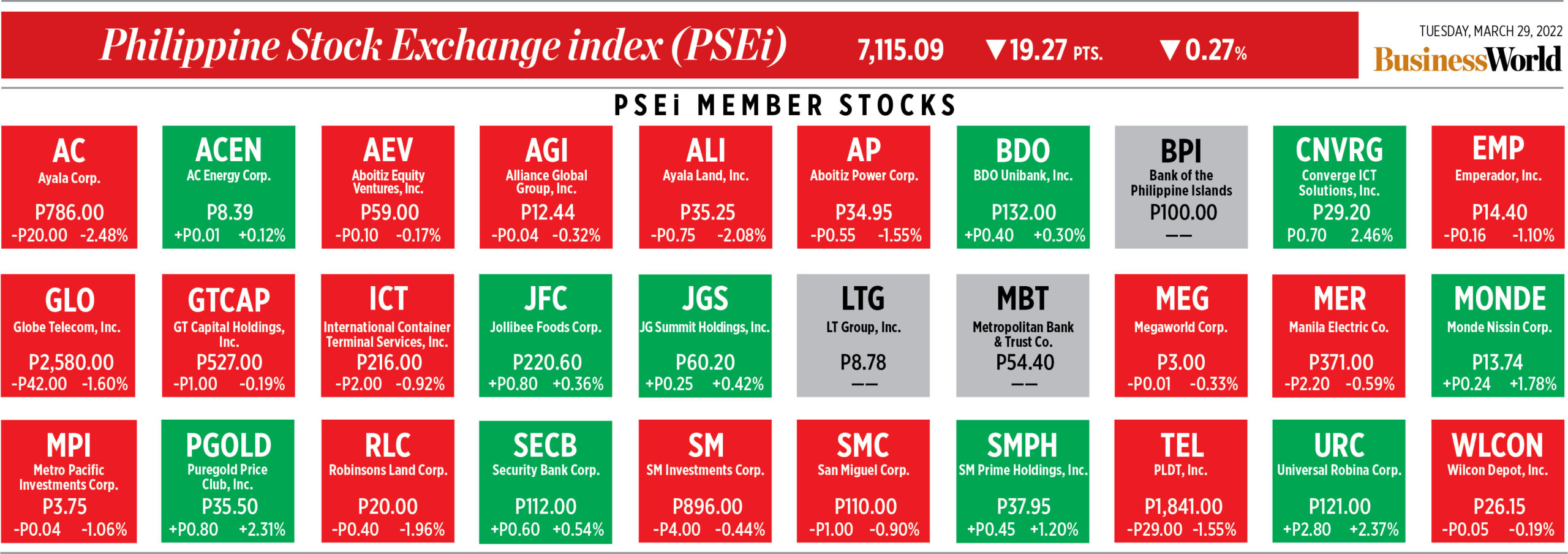

Here’s a quick glance at how PSEi stocks fared on Tuesday, March 29, 2022.


THE PESO strengthened versus the greenback on Tuesday amid upbeat sentiment ahead of a personal negotiation between Russian and Ukrainian officials in Turkey and as oil prices fell.
The local unit closed at P52.075 per dollar on Tuesday, stronger by 5.5 centavos from its P52.13 finish on Monday, based on Bankers Association of the Philippines data.
The peso opened Tuesday’s session at P52.07 versus the dollar. Its weakest showing was at P52.13, while its intraday best was at P51.99 against the greenback
Dollars traded increased to $1.047 billion on Tuesday from $778.55 million on Monday.
The peso was stronger on the back of positive sentiment ahead of a planned ceasefire talk between Russia and Ukraine, a trader said in an e-mail.
Kremlin spokesperson Dmitry Peskov said discussions between Kiev and Moscow could start this Tuesday in Turkey after negotiators arrived on Monday, Reuters reported. Mr. Peskov has said they have yet to reach major progress so far from the previous talks.
The in-person discussion was agreed upon by Russian President Vladimir Putin and his Turkish counterpart Recep Tayyup Erdogan on Sunday.
Meanwhile, Rizal Commercial Banking Corp. Chief Economist Michael L. Ricafort in a Viber message said the peso strengthened following the decline in global oil prices.
Oil prices dropped by about 7% on Monday due to fears of the possible decline in demand as Shanghai, a major Chinese financial hub, locked down to curb the rise in infections.
Brent crude futures declined by $8.17 or 6.8% to settle at $112.48 a barrel. Meanwhile, the US West Texas Intermediate crude futures fell $7.94 or about 7%, to end at $105.96 a barrel.
For Wednesday, both Mr. Ricafort and the trader gave a forecast range of P51.95 to P52.15. — L.W.T. Noble with Reuters

STOCKS slid on Tuesday as investors pocketed gains from the market’s five-day rally and amid bets of bigger rate hikes from the US central bank as inflation risks grow due to the continuing Russia-Ukraine war.
The benchmark Philippine Stock Exchange index (PSEi) dropped by 19.27 points or 0.27% to close at 7,115.09 on Tuesday, while the broader all shares fell by 11.52 points or 0.30% to 3,770.53.
“The bourse pulled back as investors booked gains out of its preceding five-day rally. This, as many investors stayed out of the market due to lingering risks, primarily on inflation, and lack of a strong catalyst,” Philstocks Financial, Inc. Senior Research Analyst Japhet Louis O. Tantiangco said in a Viber message.
“Philippine shares closed just slightly down as investors entered a busy week rife with key economic data that could position the Federal Reserve to act more aggressively on plans to raise interest rates. Aside from keeping up to date with the Ukraine war developments, investors anticipate the release of consumer confidence and home price data on Tuesday, ahead of Friday’s monthly jobs report,” Regina Capital Development Corp. Head of Sales Luis A. Limlingan said in a Viber message.
The US central bank must move “expeditiously” to bring too-high inflation to heel, US Federal Reserve Chair Jerome H. Powell said last week, adding that it could use bigger-than-usual interest rate hikes if needed to do so, Reuters reported.
The US consumer price index was at 7.9% year on year in February, the fastest in four decades. Inflation risks have been growing due to the ongoing war between Russia and Ukraine, which has caused prices of oil and other commodities to spike.
Australia, Britain, Canada and the United States have imposed outright bans on Russian oil purchases following Moscow’s invasion of Ukraine, but the European Union remains divided.
Back home, most sectoral indices closed lower. Mining and oil declined by 509.18 points or 3.98% to 12,260.05; holding firms lost 48.24 points or 0.70% to 6,768.12; services dropped by 9.37 points or 0.48% to 1,913.72; and property went down by 7.16 points or 0.21% to 3,321.60.
Meanwhile, industrials added 44.29 points or 0.45% to 9,692.64 and financials gained 4.43 points or 0.26% to end at 1,677.78.
As for the PSE’s thematic indices, the MidCap index improved by 0.39 point or 0.03% to close at 1,195.49, while the Dividend Yield index retreated by 19.54 points or 1.14% to 1,688.46.
Value turnover decreased to P4.87 billion with 788.02 million shares changing hands from the P5.19 billion or 768.14 million issues seen on Monday.
Decliners outnumbered advancers, 92 versus 82, while 57 names closed unchanged.
Foreigners turned sellers with P214.40 million in net outflows from the P185.89 million in net purchases seen the previous trading day. — LMJCJ with Reuters

AGRICULTURE Secretary William D. Dar said the industry will require a budget of P250 billion in 2023 if the Philippines is to develop crops that make it less vulnerable to volatile commodity prices.
“We need that if we want this country to… start building the commodity industries that we have (a comparative advantage) and start transforming those commodity industries that aren’t as competitive, but should be over time,” Mr. Dar said in a virtual briefing.
The department’s 2022 budget is P85.5 billion.
Mr. Dar said the Russia-Ukraine war has disrupted the global supply chain for food, sending commodity prices upward.
“The crisis situation calls for much more support in terms of elevating local food production… there is not a lot of fertilizer, feed, and corn supply. All over the world everyone is affected, especially those who import these supplies,” Mr. Dar said.
“Let’s have the feed millers adapt to the situation. If at the end of the day, they are unable to buy components for feed, they have to source locally available raw materials,” he added.
Mr. Dar said local government units can do their part by maintaining stocks of rice, engaging in milling and storage, and providing their constituents with reasonably-priced quality rice.
“We will enjoin the top 20 rice-producing provinces to (help) increase the government’s rice stocks to 30 days, from the current eight to nine days’ supply,” Mr. Dar said separately in a statement. — Luisa Maria Jacinta C. Jocson

THE Department of Information and Communications Technology (DICT) said it needs to invest about P50 billion over the next three years to develop digital infrastructure.
“Our estimate is about P50 billion over three years. Most of the budget will go to the National Fiber Backbone (program) and the Accelerated Fiber Build through the regional and provincial rings,” Acting Secretary Emmanuel Rey R. Caintic said.
“We are very optimistic that they will give us that budget. We have been advocating, evangelizing, and promoting this digital infrastructure for the past two to three years. I believe they have come to realize, especially with the pandemic, that all the more this digital infrastructure is the way to go and it is the right investment to be done by the government,” he added.
He said new entrants in the telecommunications industry are also needed to raise the quality of services, particularly with the amendment of the Public Service Act (PSA) to allow 100% foreign ownership in telecommunications companies.
“We need new players, foreign direct investment (FDI) in the telecommunications and internet markets so that they will become competitive. Investment is needed (to improve services). New players will help create the competition needed to deliver better services,” Mr. Caintic said.
Mr. Caintic said the department is facing challenges in setting up common cell towers to improve internet coverage.
“Right now, after two years, only 2,000 have been built and we still have a long way to go. We need about 50,000 towers,” Mr. Caintic said.
On March 21, President Rodrigo R. Duterte signed Republic Act No. 11659, which amended the 85-year-old PSA. The amended law now allows sectors such as telecommunications, domestic shipping, railways and subways, airlines, expressways and tollways, and airports to be fully owned by foreigners.
These sectors were previously covered by the 40% foreign ownership cap for public utilities as set by the 1987 Constitution. — Revin Mikhael D. Ochave

COMPANIES in the Asia-Pacific need to participate in the trade restrictions against Russia to hasten the end of the war in Ukraine, a US Commerce department official said.
Deputy Assistant Secretary for Export Administration Matthew Borman said in a conference call that Russia’s invasion represented a breach of international law, and the international community, including individual companies, must respond accordingly.
“We’re certainly looking (at) all companies all over the world, particularly in Asia, to make sure they do their due diligence so that any transactions that they’re contemplating undertaking with Russia are consistent with our requirements,” he said.
“Export controls are only effective because of the work the (US) administration did to secure the coordination of our allies across the world,” he added, noting that the US government is currently engaged in more than 50 working-level discussions with partner nations.
Mr. Borman said the US is contemplating more sanctions on trade with Russia by restricting more categories beyond the initial round, which took some Russian banks off the SWIFT system, a tool institutions use to identify and communicate with other institutions worldwide to facilitate transferring funds. The US also stopped buying Russian oil, which accounted for 3% of its oil imports.
The US, he added, plans to approach countries that have the capacity to produce, test, and package electronics, as well as those that have a significant aerospace industry, including maintenance and repair facilities.
Russia’s ambassador to the Philippines Marat Pavlov has said that Moscow expects bilateral cooperation with the Philippines to continue as sanctions tighten against Moscow.
President Rodrigo R. Duterte has said that he considers Russian President Vladimir Putin a personal friend, and promised to remain neutral, calling the war “not our battle to fight.”
When asked about the long-term effects the war may have on the world economy, Mr. Borman said much will depend on Russia’s response.
“In many respects, in the sectors we’ve been talking about, Russia is not that significant a player so there’s not, generally speaking, a market impact, and I think countries are generally appalled, frankly, about what Russia has done and the impact its actions have had on the rule of law,” he said.
“The impact may not be as much as some might think because it’s really (about) upholding the rule of law, which is the basis for the global economy,” he added.
Bangko Sentral ng Pilipinas (BSP) Governor Benjamin E. Diokno has said that the Philippines has limited exposure to Russia or Ukraine, potentially limiting the impact on the domestic local economy.
He said exports to Russia and Ukraine totaled $120 million and $5 million last year, calling these totals “negligible.”
According to BSP data, cash remittances from Filipinos in Russia and Ukraine in 2021 amounted to $2.261 million and $121,000. Inflows from Europe overall were worth $3.745 billion while the global total was $31.417 billion.
However, Mr. Diokno acknowledged that the war could dampen global growth by driving up commodity prices. Russia is a major exporter of crude oil, metals, wheat and fertilizer. Meanwhile, Ukraine’s top exports include corn, wheat and some metals.
“The United States is grateful for the partnerships we have with the government and companies in the Asia-Pacific region and we hope to continue to grow our coalition,” Mr. Borman said, noting that Washington is willing to work with any government in Asia to explain its policy in more detail.
China has declined condemn the invasion of Ukraine and has not imposed any sanctions on Russia, according to the BBC.
Allies like Australia, Japan, South Korea and Taiwan have imposed sanctions, with Tokyo and Seoul also blocking some Russian banks from SWIFT. — Alyssa Nicole O. Tan
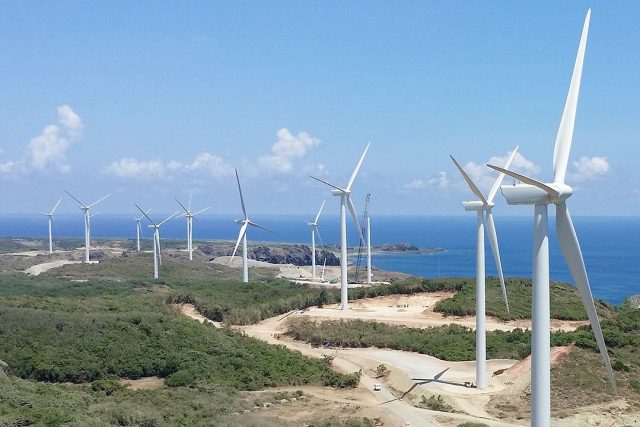
VOLATILE fuel prices in the wake of the Russian invasion of Ukraine will hasten the transition to renewable energy, industry representatives and analysts told BusinessWorld.
“Oil price hikes and volatility will definitely add more pressure to increase renewable energy (RE) deployment especially for the Small Power Utilities Group (SPUG) which rely heavily on diesel. The ridiculously high price of oil for power — in some cases over P100 per kilowatt-hour — is subsidized by the average Filipino consumer as well, which does contribute to our high electricity prices,” Verne Energy Solutions Chief Executive Johnny A. Altomonte said via chat message.
SPUG is a unit of the National Power Corp. that oversees the provision of power to remote, off-grid communities.
The transition will be hastened by the imminent rise in power prices, with the impact of the Russia-Ukraine war on fuel prices expected to start showing up in power bills by May, Manila Electric Co. (Meralco) has said.
“In the past weeks, world crude oil prices have been increasing (and) this will eventually be reflected in the cost of Malampaya natural gas and thereafter, on the generation cost,” Meralco Vice-President and Head of Utility Economics Larry S. Fernandez said during a March 10 briefing.
“For now, we won’t feel it as Malampaya prices are being updated quarterly, and will next be updated in April, to be reflected in the May generation charge.”
Lawyer and energy and environmental policy expert Antonio M. La Viña said the spike in fuel prices will accelerate clean-energy adoption as conventional fuel products and power generated from fossil fuels become unaffordable.
In 2020, the Philippines’ power generation mix was 57% from coal-fired facilities, 21% from renewable energy, 19% from natural gas, and 2% from oil.
ATN Holdings, Inc. said recently that it is developing a 1.4-megawatt (MW) solar power plant to supply its crusher plant and electric trucks used in its mining operations.
“ATN Solar will accelerate its renewable energy adoption through its ‘alignment with the low-carbon economy transformation blueprint’ for timely energy conservation and energy efficiency at a time when commodities are at an all-time high,” the company said in a disclosure to the exchange last week.
Last week, MSpectrum, Inc.’s President and Chief Executive Ferdinand O. Geluz noted that hardware chain Wilcon Depot, Inc. has started switching to solar power at its branches.
So far, Wilcon has installed solar power at more than 30 of its stores, having tapped MSpectrum, a unit of Manila Electric Co., to install capacity of 1,306.46 MW across its network.
“Not only does (solar power) reduce (the company’s) carbon footprint, it also reduces energy costs, which drives operational efficiencies,” Mr. Geluz said on March 22.
Ayala Group’s listed energy unit AC Energy Corp. has said that it has registered its first batch of customers participating in the government’s Green Energy Option Program (GEOP).
“Renewables are even more sensible at this time when fossil fuel prices are skyrocketing and to preserve our planet for the next generation,” ACEN Executive Director and Head of Commercial Operations Roman Miguel G. De Jesus said in a statement.
GEOP is a Department of Energy (DoE) program for power users that consumes at least 100 kilowatts. GEOP allows these users to source their power from accredited renewable energy suppliers.
The government has set a target of a 35% renewable energy share in the power mix by 2030.
Center for Energy, Ecology, and Development Executive Director Gerry C. Arances said that the government needs to ensure the transition happens promptly, including providing financing.
“The government needs to hasten the implementation of all RE mechanisms (which will) encourage the expansion and establishment of more financing (channels) such as the Development Bank of the Philippines’ merchant solar financing facility,” Mr. Arances said in a Viber message on Monday.
He also said that the government, including local government units, must also ensure the adoption of solar power in all its government buildings.
“Ridiculously high oil prices today can definitely be a turning point for renewables… Dependence on dirty energy (highlights the vulnerability of) a country relying on fossil fuels… to global shocks,” he said.
“A swift transition to 100% renewable energy is the only viable way forward, but having sufficient policy and financial leadership and support to get there is an altogether different matter,” he added.
Since the start of the year, fuel prices have risen P18.30 per liter for gasoline, P27.85 per liter for diesel and P25.75 per liter for kerosene.
DoE Oil Industry Management Bureau Director Rino E. Abad said on Monday that fuel prices “will continue to be volatile in the next weeks.”
“Prices are very unstable now as trade is easily affected by (events like the attack on the Saudi Aramco petroleum storage facility (in Jeddah) and the lockdowns in China,” he said via Viber on Monday. — Marielle C. Lucenio

HERMINIO L. ROQUE, JR., the former Palace spokesman who is running for a Senate seat, said on Tuesday that if elected, he will seek to pass legislation that would make more permanent an unemployment-aid program that was rolled out during the pandemic.
I will file a bill that would institutionalize TUPAD (Tulong Panghanapbuhay sa Ating Disadvantaged/Displaced Workers) so that it will become permanent like the 4Ps,” he said in Filipino in a statement.
TUPAD is an assistance package run by the Department of Labor and Employment, seeking to employ displaced workers in community projects.
The 4Ps (the Pantawid Pamilyang Pilipino Program) are a cash-transfer program for poor families that agree to meet key developmental milestones related to women’s health and child schooling, among others.
He said the micro-, small-, and medium-sized enterprise sector needs a specialized agency to support it with microfinance and other programs.
Mr. Roque also ran for the Senate in 2019 but withdrew for health reasons.
Before becoming the President’s spokesman, he served in the House of Representatives.
He is currently on the slate of Senate candidates endorsed by the Partido Federal ng Pilipinas, whose Presidential candidate is former Senator Ferdinand R. Marcos, Jr. — Jaspearl Emerald G. Tan

USERS of digital payment channels rose to 84% in 2021 from 79% a year earlier, according to a study conducted by Visa, Inc.
Visa’s Consumer Payment Attitudes Study found that in the Philippines, 84% of respondents said they used cashless methods to carry out their transactions last year, Visa Country Manager for the Philippines and Guam Dan Wolbert said.
“It’s no longer just a card or an online credential, we’re seeing contactless, we’re seeing QR, we’re seeing other payment methods to become firmly established,” Mr. Wolbert said in a virtual briefing on Tuesday.
The survey found that in the Philippines, the preferred cashless channel was the mobile wallet (64%), followed by online card payments (52%), card payments at physical stores (44%), and QR-based payments (31%).
Visa said the pandemic has encouraged many users to try online payments for the first time.
“We’re encouraged by the continued adoption of these payment methods and expect that to accelerate as more and more cash usage declines,” he said.
Cash was still identified by 94% as their primary payment method last year, down from 96% in 2020.
“We’re working quite closely with all the stakeholders in the ecosystem, including the central bank, on the Digital Payments Roadmap, as well as many different areas focusing on expanding acceptance, financial literacy, consumer education to really drive and increase digital payments usage here in the Philippines,” Mr. Wolbert said.
In 2020, digital payments accounted for 20.1% of all transactions in the Philippines. By 2023, the Bangko Sentral ng Pilipinas is targeting a digital payments share of 50% en route to transforming the Philippines into a cash-lite economy. — Luz Wendy T. Noble

THE Asian Development Bank (ADB) and the Department of Labor and Employment (DoLE) plan to offer a program aiding women who lost their jobs during the pandemic.
ADB Country Director for the Philippines Kelly Bird said on Tuesday at a webinar on COVID-19’s impact on gender equality that the program may receive approval later this year, and hopes to address vulnerable women displaced from the jobs market, particularly those who are 25-50 years old.
Programs to be offered include skills training, livelihood grants, and childcare assistance, Mr. Bird said.
Vulnerable women in remote areas will also be given food vouchers, he added.
The pandemic saw over 3 million women moving from conventional employment to the informal sector, or to self-employed status, Mr. Bird added.
“In the Philippines’ case, what we’ve seen from the pandemic is that women had much larger increases in unemployment compared to men.” Mr. Bird said. “Traditionally when you look at the unemployed figures, women account for about 30%, but that is currently now 40% or closer to 50% of total unemployment.”
“So far, the pandemic has exposed the gaps in social protection around food insecurity, particularly for vulnerable women in remote areas,” he added.
Mr. Bird said food insecurity, domestic violence, and child abuse, are all connected, based on anecdotal evidence.
He said that the Philippines was “quite advanced” in terms of their targeting poor families via the Pantawid Pamilyang Pilipino Program (4Ps).
The program, run by the Department of Social Welfare and Development, serves around 15 million people. Families receive cash assistance if they agree to meet developmental milestones for child education and women’s health.
Mr. Bird said “one of the weaknesses of the program is that it did not account for other families that did not fall under the program.”
The ADB, in partnership with the Department of Trade and Industry is also currently piloting a program known as “SkillsUpNet,” to address the need for reskilling or upskilling individuals for the job market.
Grants of between $20,000 and $80,000 will be provided to enterprises that retrain their workers, subject to certain conditions. These conditions are: 10% of trainees must be jobseekers, with at least 30% of trainees for construction jobs to be female. In agriculture, tourism, and information technology, the quota for trainees is at least 50% female.
Elsewhere in Asia and Oceania, the pandemic has also affected health and access to services, while adding to women’s burdens in performing unpaid household work, the United Nations said at the webinar.
United Nations Women Regional Office for Asia and the Pacific Statistics Specialist Cecilia Tinonin and Regional Advisor on Gender Statistics Sara Duerto Valero said the agency conducted a phone survey in late 2021 covering Indonesia, Kiribati, Pakistan, Papa New Guinea, Samoa, the Solomon Islands, and Tonga.
The study found that women spent more time during the pandemic performing unpaid care and domestic work to a greater extent than men, and that on average, women experienced the effects of food shortages more so than men.
The survey turned up much misinformation on pregnancy, which kept women from getting vaccines, Ms. Valero said.
Social protection and financial remittances are the most common form of support in these countries, but had limited reach. The male-female gap in receiving such support was widest in Pakistan. — Tobias Jared Tomas

PORTO, Portugal — North Macedonia’s surprise win away to Italy in their World Cup playoff semi-final last week set up an unexpected clash against Portugal with the country’s Prime Minister (PM) offering the squad €500,000 ($549,300.00) if they reach the 2022 tournament.
The result shocked the soccer world and derailed a possible clash between the last two European champions Italy and Portugal, who both surprisingly missed out on automatically qualifying from the group stage for the World Cup in Qatar.
After the playoff draw, the headlines were all about the expected drama of one of the two soccer powers missing out on the finals with so many top players in their squads and how a likely playoff showdown between them would be full of drama.
But North Macedonia did not follow the script and knocked four-time World Cup winner Italy out of contention.
Portugal meanwhile survived late drama in their playoff semifinal as they beat Turkey (3-1) after visiting striker Burak Yilmaz missed a penalty five minutes from the end that could have forced extra time at Porto’s sold-out Dragao stadium.
Italy did not have such luck in Palermo, losing 1-0 after an added time Aleksandar Trajkovski goal silenced the crowd at the Renzo Barbera stadium who watched in disbelief as the opposing bench ran onto the pitch to celebrate victory with the players.
North Macedonia, who featured at Euro 2020 in their first appearance at a major tournament since the break up of Yugoslavia three decades ago, will now face Cristiano Ronaldo’s Portugal in another packed stadium in Porto on Tuesday.
The 50,000 tickets for Tuesday’s game at the Dragao stadium were sold out in a few hours amid huge expectation from local fans as Portugal bid for a place at the global tournament.
Prime Minister Dimitar Kovacevski, who last year went to the Vatican to ask Pope Francis to pray for the team, went onto their plane on Sunday to wish the squad goodbye before they left for Porto and promised to reward them if they reach the finals.
BIGGEST ALLY
Macedonia coach Blagoja Milevski’s biggest ally as they prepare to face Portugal will probably be the fact that their opponents have no idea what approach his team will take.
“To be honest, we don’t really know what to expect next Tuesday,” Portugal midfielder Bernardo Silva told a news conference on Sunday, explaining that they were surprised at how differently Macedonia played in their previous matches.
Milevski explained their approach before the Italy clash, telling reporters: “Every game is unique, so anything can happen. I don’t have any specific pattern I like to follow.
“Of course, we are not at the same level as Italy yet, but we’re not here as a fluke and we expect to put in a great performance. I want my players to go out there and enjoy themselves.”
And they did just that as they produced an upset for the ages that surprised the Portuguese as much as Italy.
“I won’t lie, we were all expecting it was going to be Italy (in the playoff final),” Portugal midfielder Joao Moutinho told a news conference on Saturday.
Portugal coach Fernando Santos is very much aware of the quality of their opponents, pointing out that North Macedonia won four of their last five World Cup qualifiers on the road.
“They won in Germany and in Italy. To say they are weaker is the wrong way of approaching this game,” Santos said on Monday.
“We’ll face North Macedonia with the same mentality as we would have against Italy. I know it’s the game of their lives, but it’s also ours too. We can’t afford missing the World Cup.” — Reuters

TOP SEED Daniil Medvedev moved a step closer to reclaiming the world number one ranking as he beat Spaniard Pedro Martinez (6-3, 6-4) on Monday to reach the last 16 at the Miami Open, while Naomi Osaka cruised into the quarterfinals of the women’s draw.
Medvedev, who can replace Novak Djokovic in the rankings if he reaches the Miami semifinals, fired down 14 aces and broke Martinez three times to secure victory in 84 minutes.
“I just felt like I had to be more consistent, and the more consistent one today would win,” Medvedev said.
“I managed to just make a few less errors at important moments, serve even better, and it was a small margin but I managed to win and I’m really happy.”
Up next for the Russian, who lost the number one ranking after a surprise third-round loss at Indian Wells, will be American Jenson Brooksby, a 6-3, 5-7, 6-4 winner over Spain’s Roberto Bautista Agut.
Spanish 14th seed Carlos Alcaraz will meet Stefanos Tsitsipas after both enjoyed straight-set wins over Marin Cilic and Alex de Minaur respectively.
The 18-year-old Alcaraz beat Tsitsipas in their only previous meeting, a five-set thriller at last year’s US Open.
“He is a great player,” the Greek third seed said of Alcaraz.
“For me, it will be a great challenge, the ones that I like.”
Indian Wells champion Taylor Fritz dispatched fellow American Tommy Paul 7-6(2), 6-4 and will meet Serbian Miomir Kecmanovic, a 7-6(4), 6-3 winner over Sebastian Korda.
Fritz said it is all about managing expectations.
“I didn’t really think about winning Indian Wells until I had match point in the final,” he said.
“So I’m approaching this one the same way. I don’t expect to win the tournament, but I take it one match at a time, and you never know.”
OSAKA SERVES UP WIN
Japan’s Osaka reached the quarterfinals for a second consecutive year with a 6-3, 6-4 win over American Alison Riske, recovering after falling behind 2-0 in the second set.
After the match the unseeded Osaka said she was in a different state of mind than last year when arriving at the Miami Open after winning the Australian Open.
“It’s really funny for me because last year I made it to the (Miami) quarters too, but it was after I won Australia and I wasn’t that grateful, I kind of expected to win,” said Osaka.
“But I’m in the same position this year and I am so like, this is really like one of the funnest times of my life.”
Standing between the four-times Grand Slam champion and a first Miami semifinal will be Australian Open finalist Danielle Collins, who beat Tunisian eighth seed Ons Jabeur (6-2, 6-4).
Poland’s new world number one Iga Świątek eased past 14th seed Coco Gauff (6-3, 6-1) and will next face Petra Kvitova after the Czech defeated Veronika Kudermatova (7-6(5), 6-4) to reach the quarters.
Spanish fifth seed Paula Badosa beat 16-year-old wild card Linda Fruhvirtova (6-2, 6-3) and will next meet Jessica Pegula, who reached the Miami quarterfinals for the first time after Anhelina Kalinina retired while trailing 6-0.
Badosa, who won the Sydney title this year and reached the semis at Indian Wells, told reporters it had been a tough day.
“I didn’t wake up feeling well so I didn’t know if I’d be able to finish the match,” she said. “I always say I want to be a fighter no matter what so that’s what I did. I kept fighting and I don’t really know how I won.” — Reuters
