Home Blog Page 6037

Fil-Am diver Ariana Drake suits up for PHL in Hanoi SEAG

FIL-AM diver Ariana Drake badly wanted to suit up for the Philippines that she asked her Chinese coach Wei Wei to contact compatriot Xiao Feng Cui, the country’s diving coach, and tell him her intention to don the national team colors.

The Philippine Swimming, Inc. (PSI) gladly accepted her with open arms.

Now, the 17-year-old Drake would have a chance to prove herself worthy of the trust as she seeks a medal finish as the country’s lone bet in the sport in the Hanoi Southeast Asian Games (SEAG) starting on Sunday at the My Dinh Aquiatics Center.

“Ariana Drake is a young, up and coming diver. It’s her first SEA Games and we hope she is able to adjust seamlessly,” said PSI president Lailani Velasco. “Of course, our goal is to land in the podium, but we also want to manage our expectations.”

The California native will compete in the women’s 1-meter springboard unfurling at 9 a.m. on Sunday and the women’s 3m springboard on Tuesday with hopes of snatching a medal.

To make sure she gets the feel of the competition, Ms. Drake, who started and joined competitive gymnastics for eight years before switching to diving four years ago, was the first Philippine bet to arrive in the Vietnam capital as she planed in last April 29 straight from the United States.

But whether or not she brings home a medal, she could use the precious experience she gets here as a springboard to bigger successes in future meets including next year’s edition of this biennial meet in Phnom Penh, Cambodia. — Joey Villar

Islam, democracy, and women empowerment

THIS year’s commemoration of Eid’l Fitr or Feast of Ramadan coincided with World Press Freedom Day on May 3. Muslims worldwide observe this religious holiday to mark the end of Ramadan’s month-long, dawn-to-sunset fasting. It became a national holiday in the Philippines starting 2002.

On the other hand, World Press Freedom Day acts as a reminder to governments about the need to respect their commitment to one of democracy’s pillars — freedom of the press. It was the United Nations General Assembly that declared on May 3, 1993 and every year thereafter that the right to freedom of expression must be upheld in keeping with the 1948 Universal Declaration of Human Rights.

The convergence of these religious and secular concepts may be found in the Philippine Center for Islam and Democracy (PCID), established in 2002 amid the global and domestic challenges confronting Filipino Muslims. At that time, the US and its allies were waging a “war on terror” — with the Philippines being tagged as the next front after Afghanistan. This new front was centered naturally in Mindanao mainly because of the Abu Sayyaf, a renegade band of fighters with alleged ties to al-Qaeda.

As a result, the “war on terror” fanned a growing global debate that Islam is incompatible with democracy, which threatened to undermine the democratic space in Muslim societies. This debate accompanied the rise in radical movements among Islamist organizations, culminating in the fatal attacks on the World Trade Center in New York City on Sept. 11, 2001.

Thus, the PCID was founded by three Filipino Muslim intellectuals who saw the need to articulate the voice of the Bangsamoro: Amina Rasul, who served in the Cabinet of President Fidel Ramos; Abrahan Iribani, previously the spokesperson of the Moro National Liberation Front; and Nasser Marohomsalic, a former Human Rights commissioner. Its members consist of prominent leaders and thinkers from government, business, academe, military, and other sectors, with representation from Mindanao’s major tribes.

Believing that democracy is enshrined in Islam, they recognized that the current elements of the continuing struggle for genuine self-determination are hallmarks of a functioning democracy for Filipino Muslims. These elements include just peace, human rights, credible elections, capable autonomous governance, and equitable development.

PCID treasurer and board of convenors member Yusuf Ledesma said the organization has been focusing recently on empowering women in war zones through a podcast series titled “She Talks Peace” hosted by Ms. Rasul. In partnership with Women and Gender Institute, PCID capacitates female participants on governance, economic empowerment, political participation, peace-building, and rights-based approaches to community development.

Mr. Ledesma said: “Women have quite a lot of power in the Bangsamoro community. They are often the business people in the Greenhills area.” He recognizes the empowerment of Bangsamoro women practicing their professions, including his own lawyer and some of the provincial leaders in the Bangsamoro Autonomous Region in Muslim Mindanao (BARMM).

It is not surprising then that BARMM Chief Minister Al Haj Murad Ebrahim has endorsed Vice-President Leni Robredo as the presidential candidate and standard-bearer of the United Bangsamoro Justice Party (UBJP), the political party of the Moro Islamic Liberation Front (MILF). The UBJP’s endorsement is historically significant because this is the first time it ever declared support for a presidentiable.

According to Mr. Ebrahim, the UBJP decided to throw its support behind Ms. Robredo, because of the “compatibility of principles, goals, and values.” Concurrently the MILF chairman, he stated: “The political participation of the MILF in the 2022 elections through the UBJP ushers in a new brand of politics among which is our incoming President Leni Robredo.”

Ms. Robredo’s rival for the presidency, former Senator Ferdinand Marcos, Jr., is considered a “mortal enemy of the Muslims” based on the statements of Noroddin Pananggilan, a member of the MILF’s armed component known as the Bangsamoro Islamic Armed Forces (BIAF). “We can never forget the massacres. If Marcos wins, Bangsamoro loses,” he lamented.

BIAF commanders issued a manifesto last April 25 that sums up the sentiment of Moro fighters: “The Marcos years were bloody and brutal to the Muslims and indigenous peoples of Mindanao, as Marcos Jr.’s father waged a merciless war of genocide against our people, killing thousands. The sins of the father are not the sins of the son. But the son who does not see wrong in what the father did eventually copies and becomes what the father was.”

I hope the majority of Filipino voters will realize this when they go to their election precincts on May 9. Vote wisely for our nation’s future!


J. Albert Gamboa is the chief finance officer of Asian Center for Legal Excellence and chairman of the FINEX Media Affairs Committee. The opinion expressed herein does not necessarily reflect the views of these institutions and BusinessWorld. #FinexPhils www.finex.org.ph

Headline inflation rates in the Philippines

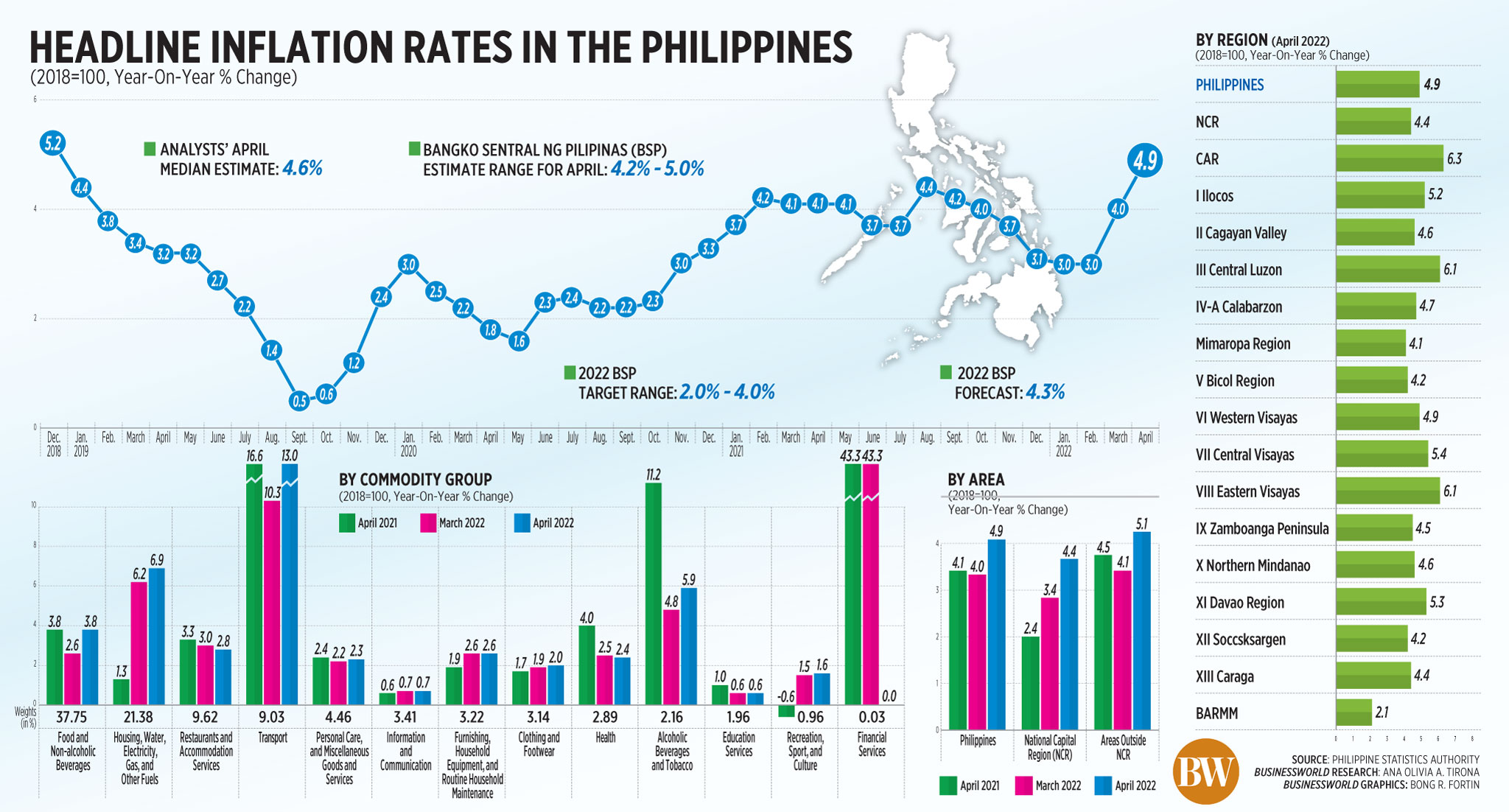
PHILIPPINE INFLATION surged to an annual 4.9% in April, the highest in more than three years as soaring food and energy prices continued to hurt consumers. Read the full story.

Headline inflation rates in the Philippines

Manufacturing Purchasing Managers’ Index of Select ASEAN Economies (April 2022)

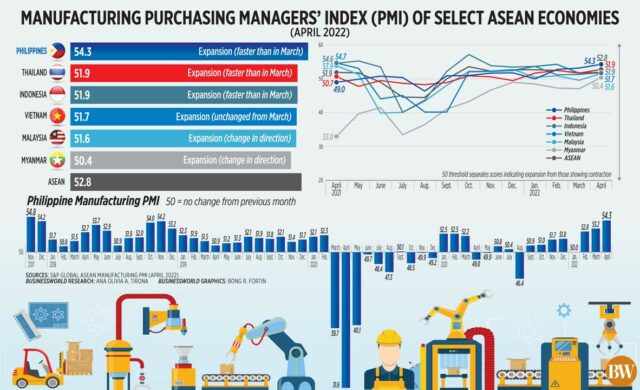
THE PHILIPPINE manufacturing sector in April posted its best performance in over four years, reflecting the significant improvement in business conditions as pandemic restrictions eased. Read the full story.

Manufacturing Purchasing Managers’ Index of Select ASEAN Economies (April 2022)

How PSEi member stocks performed — May 5, 2022

Here’s a quick glance at how PSEi stocks fared on Thursday, May 5, 2022.


National government outstanding debt

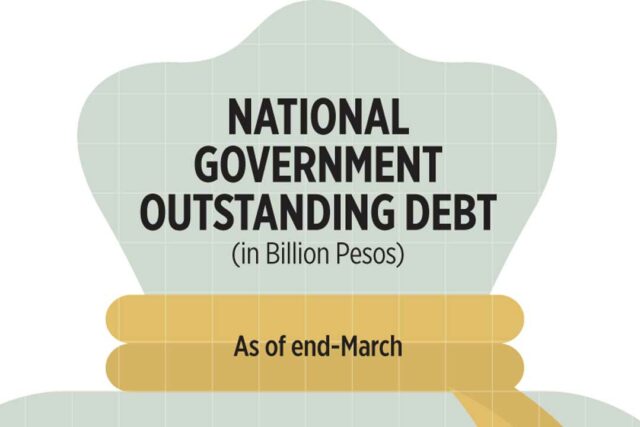
THE NATIONAL GOVERNMENT’S (NG) outstanding debt rose to a record P12.68 trillion as of end-March, as domestic and offshore borrowings increased, the Bureau of the Treasury (BTr) said on Thursday. Read the full story.

National government outstanding debt

Peso climbs vs dollar on BSP rate hike bets

BW FILE PHOTO

THE PESO strengthened against the dollar on Thursday as faster April inflation raised bets that the local central bank would hike borrowing costs earlier than planned and after the widely expected 50-basis-point hike from the US Federal Reserve.

The local unit closed at P52.385 per dollar on Thursday, appreciating by 11.5 centavos from its P52.50 finish on Wednesday, data from the Bankers Association of the Philippines showed.

The peso opened Thursday’s session at P52.38 versus the dollar. Its weakest showing was at P52.425, while its intraday best was at P52.23 against the greenback.

Dollars exchanged fell to $907.5 million on Thursday from $1.339 billion on Wednesday.

“The peso strengthened after the stronger-than-expected Philippine inflation report bolstered expectations of a Bangko Sentral ng Pilipinas (BSP) rate hike within the quarter,” a trader said in an e-mail.

The Philippine Statistics Authority reported on Thursday that April inflation was at 4.9%, higher than the 4.1% in the same month in 2021 and faster than the 4% print in March.

BSP Governor Benjamin E. Diokno said in an interview with Bloomberg TV last week that the central bank may consider hiking key interest rates at its June 23 meeting.

Rizal Commercial Banking Corp. Chief Economist Michael L. Ricafort said in a Viber message that the peso strengthened after the Fed hiked rates as expected.

He added that the peso was also stronger ahead of trade, import, export, and employment data due to be released on Friday.

The Fed on Wednesday raised its benchmark overnight interest rate by half a percentage point, the biggest jump in 22 years, Reuters reported. US Fed Chair Jerome H. Powell said policy makers were ready to approve half-percentage-point rate hikes at upcoming policy meetings in June and July.

In a news conference after the release of the Fed’s policy statement, Mr. Powell explicitly ruled out raising rates by three-quarters of a percentage point in a coming meeting, a comment that triggered a stock market rally.

The Fed also said it would start next month to reduce the roughly $9-trillion stash of assets accumulated during its efforts to fight the economic impact of the coronavirus pandemic as another lever to bring inflation under control.

For Friday, Mr. Ricafort and the trader said they expect the peso to move from P52.25 to P52.45 against the dollar. — T.J. Tomas with Reuters

PHL shares rally on Fed rate hike, policy signals

REUTERS

SHARES rallied on Thursday following the US Federal Reserve’s policy decision and the release of Philippine April inflation data.

The benchmark Philippine Stock Exchange index (PSEi) gained by 66.19 points or 0.97% to close at 6,868.92 on Thursday, while the broader all shares index improved by 48.17 points or 1.33% to 3,663.16.

“Local and regional equities went on a relief rally as the Fed announced a widely anticipated 50-basis-point (bp) rate hike during its policy setting meeting yesterday. The Wednesday moves also came on the back of Fed Chair Jerome Powell’s statement ruling out a 75-bp rate hike in future meetings, arguing for the possibility of a soft or ‘soft-ish’ landing,” Regina Capital Development Corp. Head of Sales Luis A. Limlingan said in a Viber message.

“The market finished higher as investors digested the recently released US Federal Reserve interest rate decision. Locally, market participants may be assessing the inflation report for the month of April,” Timson Securities, Inc. Trader Darren Blaine T. Pangan added in a Viber message.

The Fed on Wednesday raised its benchmark overnight interest rate by half a percentage point, the biggest jump in 22 years, Reuters reported. Fed Chair Jerome Powell said policy makers were ready to approve half-percentage-point rate hikes at upcoming policy meetings in June and July.

In a news conference after the release of the Fed’s policy statement, Mr. Powell explicitly ruled out raising rates by three-quarters of a percentage point in a coming meeting, a comment that triggered a stock market rally.

The Fed also said it would start next month to reduce the roughly $9-trillion stash of assets accumulated during its efforts to fight the economic impact of the coronavirus pandemic as another lever to bring inflation under control.

Back home, the Philippine Statistics Authority reported on Thursday that April inflation was at 4.9%, higher than the 4.1% in the same month in 2021 and faster than the 4% print in March.

All sectoral indices ended in the green on Thursday. Mining and oil surged by 508.99 points or 4.52% to 11,769.57; services went up by 31.72 points or 1.69% to 1,907.91; property added 36.90 points or 1.18% to 3,161.91; holding firms rose by 60.44 points or 0.95% to 6,395.99; industrials increased by 80.71 points or 0.85% to 9,484.16; and financials gained 12.52 points or 0.77% to 1,629.43.

The MidCap index went up by 28.72 points or 2.61% to 1,129.39 and the Dividend Yield index advanced by 24.46 points or 1.53% to 1,619.64.

Advancers overwhelmed decliners, 140 versus 59, while 37 names ended unchanged.

Value turnover decreased to P5.68 billion with 1.06 billion shares changing hands on Thursday from the P6.92 billion with 631.99 million issues seen the previous day.

Foreigners turned buyers with P135.15 million in net purchases from the P2.43 billion in net outflows seen on Wednesday. — Luisa Maria Jacinta C. Jocson with Reuters

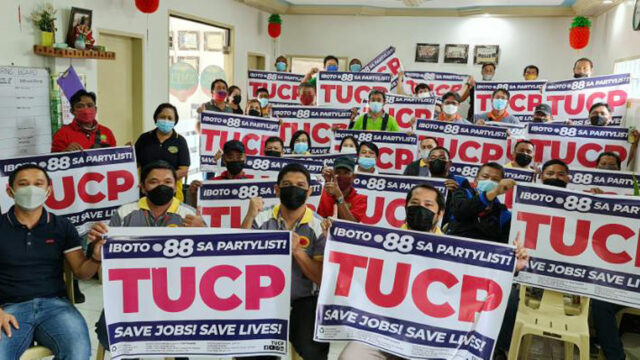
TUCP petitions for P420 hike in Ilocos region minimum wage

TUCP FB PAGE

THE Trade Union Congress of the Philippines (TUCP) said on Thursday that it filed a petition seeking a P420 increase in the minimum wage for Ilocos Region, in line with other petitions it filed with other boards.

In a statement, the TUCP said the current P340 minimum wage in the Ilocos Region is “far below the needed daily income for a family of five to survive in the face of rising prices of basic goods and services.”

“The regional wage board must set the new daily minimum wage in Region 1 at P760 so that our minimum wage earners and their families can survive and live decently,” it said.

The TUCP said that take-home pay in the region for minimum wage earners gives them “only P12.44” to spend per meal per person.

“Minimum wage earners and their families are already suffering from hunger and malnutrition,” it said.

The TUCP said the administration must not pass the responsibility of issuing a new wage order to the next government.

“Please do not pass the buck to the next administration,” it said. “Cut down the bureaucratic procedures and endless hearings and just issue a wage order that will save our minimum wage earners and their families from continuing hunger and malnutrition.”

Meanwhile, the TUCP said the Department of Labor and Employment’s (DoLE) proposal to provide a P5,000 to P8,000 wage subsidy for three months or until the time a wage order is given is an attempt by the agency “to raise false hopes instead of fast-tracking the grant of wage increases to help our minimum wage earners.”

“DoLE is just playing our poor workers and their families.” — Kyle Aristophere T. Atienza

No intent to squeeze out PUV operators in PSA amendments — Poe

By Arjay L. Balinbin, Senior Reporter

AMENDMENTS to the Public Service Act (PSA) were not specifically designed to force small-scale transport operators out of the industry, the author of the amendments said.

Senator Mary Grace Natividad S. Poe-Llamanzares, primary author and sponsor of the measure, said that “framers of the new Public Service Act… did not, in any way, intend to exclude natural persons from operating or managing” PUVs.

In a statement issued to BusinessWorld, Ms. Poe cited legal interpretations that took into account “The spirit rather than the letter of the law.”

“A statute must be read according to its spirit or intent, for what is within the spirit is within the statute although it is not within its letter, and that which is within the letter but not within the spirit is not within the statute,” she said.

Ms. Poe was queried about her views on the amendments in the wake of a newspaper column raising the possibility that operator licensing for public utility vehicles such as jeepneys, UV Express, mini buses, taxis, and tricycles could be closed to individuals.

In an April 26 BusinessWorld column, Mervin Kenneth C. Ignacio, an associate of the Corporate & Special Projects Department of the Angara Abello Concepcion Regala & Cruz Law Offices, said that the amended PSA, or Republic Act No. 11659, which opened some public services to full foreign ownership, also removed any reference to individuals being granted operating licenses.

He noted that under the amended Section 16 of the PSA, “individuals may no longer be granted a franchise for the operation, maintenance, or control” of Public Utility Vehicles (PUVs).

The old provision recognized “citizens of the Philippines” as eligible to hold operating permits for public services, including public utilities.

“A lot of (the) individual franchise holders are either the drivers themselves or operators of only a small number of vehicles. Further, with respect to public utility tricycles, unless they are operated by cooperatives, they are most likely operated by individuals,” Mr. Ignacio said.

He asked whether Congress intended to corporatize the operation, maintenance, and control of all PUVs.

In her statement, Ms. Poe said: “Even from a cursory reading of the law’s provisions, it is evident that certificates can be granted to natural persons, not only juridical persons. For one, measures were taken to protect the local tsuper and manongs, specifically by including PUVs under public utility,” she added.

Under the amended PSA, a service classified as a public utility remains subject to the 60-40 ownership restriction in favor of Filipino nationals.

“Further, the intent to not conflate the liberalization aspect with the franchise requirement is very clear from both the deliberations and the resulting statute,” Ms. Poe said.

“Congress took pains to expressly legislate under RA 11659, Section 4, amending Section 13 of the old PSA that ‘all public services, including those classified as public utilities, shall continue to be regulated and supervised by the relevant administrative agencies under existing laws,’” she added.

She said the PSA and its amendments “never excluded natural persons from the franchise requirement.”

Citing Section 13 of the original PSA, which the amendments do not repeal, she noted that the term “public service” covers “every person that now or hereafter may own, operate, manage, or control…”

“Section 13(c) states that ‘person’ includes ‘… every individual, … and whatever other persons or entities that may own or possess or operate public services,’” Ms. Poe said.

“That natural persons may still be granted franchises is evident in the criteria laid down by Congress under Sec. 13 (e) (1). The person or juridical entity regularly supplies and transmits and distributes to the public through a network a commodity or service of public consequence.”

“When read in conjunction with the amended Section 16(a), the proviso restricting grant of franchises and certificates to operate, manage, or control a public service to corporations organized in the Philippines should be read as a restriction upon grants to juridical persons, and not upon grants to natural persons.”

Asked to comment, Terry L. Ridon, convenor of infrastructure and investment think tank InfraWatchPH, said: “This is cute table-top legal analysis from big law firms, but certainly, the legislature did not intend to cover jeepneys, mini-buses and tricycles within the ambit of amendments of the Public Service Act.”

He said that Congress did not concern itself with putting small transport operators out of work especially during a pandemic.

“Although proponents of jeepney modernization may use this as a basis to remove individual operators from its franchise list, we are looking forward that the executive’s implementing rules will make clarifications on this specific matter,” he added.

Transport expert Rene S. Santiago said in a phone message: “I do not think that exclusion of natural persons was intentional, on the part of the authors of the bill.”

“SMEs (small- and medium-sized enterprises) are the dominant organization form for jeepneys and buses. Notwithstanding the order of DoTr (Department of Transportation) and LTFRB (Land Transportation Franchising and Regulatory Board), under the PUVM (Public Utility Vehicle Modernization Program), to vanish individual ownership,” he added.

“The IRR (implementing rules and regulations), which has not been issued yet, should address the transition and possible confusion or ambiguity.”

At the same time, he noted that the revised Corporation Code now allows for one-person corporations.

Ms. Poe said: “We must always be guided by the intent of Sec. 16(a) which was to ensure that regulatory bodies would be better able to exercise jurisdiction over foreign-owned public services. This is not an issue with Filipino individuals.”

“As a final note, we must also remember that the issue of PUV fleet consolidation or corporatization is entirely separate from the PSA Amendments. This is a PUV Modernization issue for which the Senate Committee on Public Services continues to consult all stakeholders for a winning middle ground.”

She added that the PSA amendments “must be read as a whole and not piecemeal lest we run the risk of conjuring from thin air the problems that the PSA amendments sought to resolve in the first place.”

“The Philippine Senate and Congress passed the new Public Service Act in order to energize our industries. As such, the law should be read and interpreted to fulfill that mandate.”

Mar S. Valbuena, president of the transport group Samahang Manibela Mananakay at Nagkaisang Terminal ng Transportasyon, said in a phone interview that all stakeholders should be consulted before drafting the IRR to clarify these matters.

Dapat magkaroon ng public consultation, wala munang IRR. Dapat i-clarify. Bago pa magkaroon nyan, yung mga stakeholders sana ay na-consult na. ’Yun ang makakabuti, kasi hindi naman sila ang nasa ground,” he said.

Nagkakaroon lang ng consultations kapag nagra-rally na kami or nagrereklamo na kami.”

No disruption seen to SpaceX investment after administration steps down, DTI says

REUTERS

SPACE EXPLORATION Technologies Corp.’s (SpaceX) decision to invest in the Philippines will not be affected by the upcoming change in government, according to the Department of Trade and Industry (DTI), which noted that the entry of Elon Musk-controlled company is governed by an executive order (EO) liberalizing the industry.

“Satellite services have been opened up by EO 127. Before this EO was issued, there was a franchise requirement for satellite services. But now, (the industry) has also been liberalized. There is no need for a franchise anymore,” Trade Secretary Ramon M. Lopez said in a television interview on Thursday.

EO 127 was signed by President Rodrigo R. Duterte on March 10, 2021.

“The change in administration will not affect the (entry) of SpaceX,” Mr. Lopez said. 

The Philippine general election will take place on May 9.

Mr. Lopez said SpaceX has yet to disclose its intended pricing for its satellite internet services, though he expects its price structure to be competitive.

“SpaceX will benefit areas that are not reached by existing telecommunication providers. The company will just install a dish and the service will be available,” Mr. Lopez said.  

The DTI has said that SpaceX is hoping to install the first of three planned gateways before the end of President Rodrigo R. Duterte’s term on June 30.

SpaceX provides internet service through low earth orbit satellite constellation Starlink. — Revin Mikhael D. Ochave

Canada-ASEAN trade deal touted as gateway to North American markets 

ASEAN

THE proposed Association of Southeast Asian Nations (ASEAN)-Canada free trade agreement (ACANFTA) holds the potential to broaden Philippine goods’ access to North American markets, the Department of Trade and Industry (DTI) said.

Trade Assistant Secretary Allan B. Gepty said at a Tariff Commission virtual public consultation for the ACANFTA on Thursday that the Philippines lacks its own bilateral access to North America.

“Unlike other ASEAN member states who have existing FTAs with North American countries either bilaterally or through the Comprehensive and Progressive Agreement for Trans-Pacific Partnership (CPTPP), the Philippines has none that accords us with preferential treatment. Through ACANFTA, the Philippines will not only access Canadian markets, but also indirectly access lucrative markets of other countries in North America,” Mr. Gepty said.  

Mr. Gepty said ACANFTA holds the potential to grow Philippine service exports to Canada, which is a net importer of services from the Philippines.

He said participation in the trade deal will open doors to products like desiccated coconut and processed food, while allowing the Philippines improved access to the fertilizer raw material potassium chloride, of which Canada is a major producer.

“I would say that… if you want to venture into the production of fertilizer, then Canada can be a good source of raw materials. We hope that we can encourage more investment in the production of fertilizer in the country to support our farmers,” Mr. Gepty said.

According to the DTI, Canada is the 18th largest trading partner of the Philippines, with two-way shipments valued at $918.7 million, equivalent to 0.59% of the Philippines’ overall trade.

Philippine exports to Canada in 2020 amounted to $390.4 million, while imports were valued at $528.3 million.

In November, trade ministers of the ASEAN and Canada launched ACANFTA negotiations.

According to a feasibility study from 2018, the Philippines is projected to raise by 2.63% its gross domestic product (GDP), equivalent to $7.4 billion, after joining ACANFTA.

The study also projected ASEAN GDP to rise by 1.6% while Canada’s GDP will increase by 0.3% after signing up for ACANFTA. — Revin Mikhael D. Ochave