Home Blog Page 5887

On the way towards a financially inclusive country

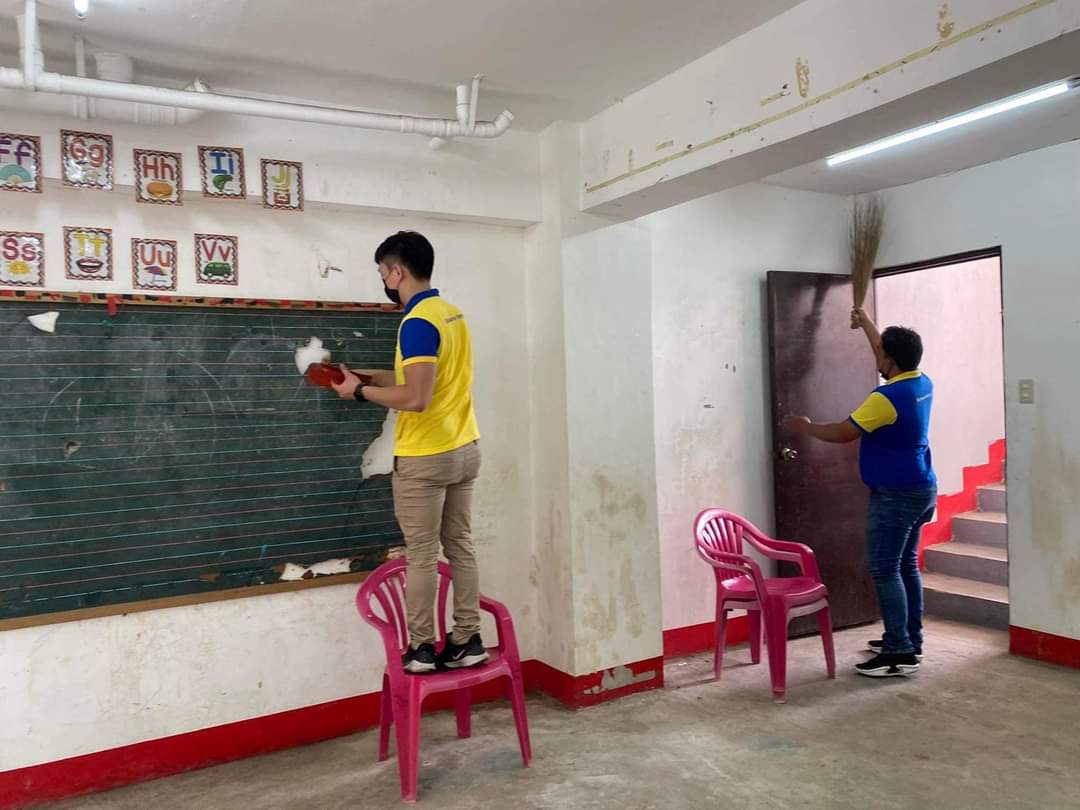
BDONB SLG Account Officers joined the Brigada Eskwela Regional kick-off in Region 12 at Malaya Elementary School, in Banga, South Cotabato.

Financial inclusion has been one of the Philippine government’s biggest goals towards the development of the country. Access to financial services is hugely important for the welfare and stability of every household and business. The Bangko Sentral ng Pilipinas (BSP) pointed out evidence that indicate that even access to the most basic financial services such as savings, payments and credit make a positive difference in people’s lives.

“Rather than being an end in itself, financial inclusion is a means to achieve broader aspirations. Its goal is not merely providing universal access to financial services, but ensuring that these services truly enhance the financial health of their users,” the BSP noted in the National Strategy for Financial Inclusion 2022-2028.
“Financial health is the ability of an individual to meet financial obligations, absorb and recover from financial shocks, reach long-term goals, and develop a sense of control of their finances. For enterprises, access to appropriate financing and financial services can facilitate business growth and livelihood opportunities for many Filipinos.”

In pursuit of this goal, the Philippine financial system as a whole has made great strides in reaching out to unserved and underserved areas and communities in the country to promote inclusion. This has been particularly evident in the wake of the COVID-19 pandemic, which saw the meteoric rise in the use of digital financial platforms and e-wallets.

SLG Account Officer heading to Blakol Elementary School.

Yet, the mission is far from over. According to the BSP’s Financial Inclusion Dashboard as of the third quarter of 2021, as much as 15.5% of the country’s cities and municipalities still do not have a banking presence, while an estimated 47% of adults do not have an account at a formal financial institution.

The challenge is compounded by many Filipinos’ misconceptions about formal financial institutions. BDO Network Bank (BDONB), the rural bank subsidiary of BDO Unibank, the largest bank in the Philippines in terms of assets, shared that many Filipinos believe that banks are completely inaccessible in remote provinces, or do not have suitable products for those markets.

SLG Account Officers of Region 5 riding a motorboat to the next island destination with underserved schools.

“The common misconceptions that hinder Filipinos from accessing the formal financial system are the same reasons they turn to informal lending sources,” the lender said.

“BDO Network Bank now has over 400 branches, mostly located in the countryside and sales teams that reach out to clients, primarily serving the banking needs of the unserved and underserved markets in rural areas.”

To serve those needs, BDONB offers loan products like salary loans or their Kabuhayan/MSME loans. Salary loans are personal loans specifically designed for government employees who may use the loan proceeds for various purposes like the purchase of real estate; house construction or improvement; education; capital for small business; acquisition of laptop or vehicles, among others. The payment for this is through salary deduction.

BDONB Sales Teams heading to Poh Elementary School in Baganga.

Meanwhile, the Kabuhayan/MSME Loans are business loans for MSMEs designed to help them grow and expand their businesses. Kabuhayan/MSME loans can be used for working capital purposes or fixed asset acquisition. Documentary requirements for Kabuhayan/MSME loan are even made simpler compared to traditional commercial loans.

The common belief that obtaining such loans is a tedious process that requires strict legal, documentary and collateral requirements is also untrue. BDONB said that documentary and collateral requirements for loans are prescribed primarily by the banking regulator, in this case the BSP, but these have been gradually relaxed over time to help improve financial inclusion.

“BDONB salary loans and MSME loans require minimal and uncomplicated documents (e.g., the employee’s pay slip for salary loans, or the firm’s proof of sales for MSME loans) and can be availed of on an unsecured basis,” the bank said.

Once secured, Filipinos also need not fear high interest rates for such loans. ”Banks actually charge lower interest rates than what alternative sources can offer. Institutions like pawnshops, finance companies, fintechs and informal money lenders on average charge higher effective interest rates on loans compared to banks,” BDONB said.

What’s more, despite rising interest rates, BDONB has maintained the interest rates on its salary loans and Kabuhayan/MSME loans to keep them affordable to their target markets.

“Loans for the underserved are less sensitive to rates; access is more important,” the bank added.

Through such efforts does BDONB aim to bring the full range of financial services to the country’s unserved and underserved communities. And it would seem that many Filipinos welcome the efforts. In terms of growth rates, the MSME loans and salary loans in particular have posted the highest expansion rates in 2021, growing by 34.5% and 21.5% respectively.

As with the sudden widespread adoption of digital financial platforms, it is only a matter of time until a tipping point is reached with regards to Filipinos’ misgivings about the credit from the formal financial system. Perhaps in a few more years, every Filipino can enjoy the multitude of opportunities universal access to financial services can provide.


Spotlight is BusinessWorld’s sponsored section that allows advertisers to amplify their brand and connect with BusinessWorld’s audience by enabling them to publish their stories directly on the BusinessWorld Web site. For more information, send an email to online@bworldonline.com.

Join us on Viber to get more updates from BusinessWorld: https://bit.ly/3hv6bLA.

Revised BOT rules out by end-Sept.

PHILIPPINE STAR/ MICHAEL VARCAS

By Diego Gabriel C. Robles

AMENDMENTS to the controversial implementing rules and regulations (IRR) of the Build-Operate-Transfer (BOT) Law are expected to be released before the end of September, Finance Secretary Benjamin E. Diokno said.

“I’m not at liberty to divulge [yet] but there’s a committee and we plan to do this within the first 100 days of the president…  Maybe not later than the end of September, including the publication,” Mr. Diokno told BusinessWorld on the sidelines of the Development Budget Coordination Committee (DBCC) briefing at the House of Representatives on Friday.

President Ferdinand R. Marcos, Jr. took his oath of office on June 30. In his first State of the Nation Address (SONA) on July 25, he cited the amendments to the BOT Law as a priority legislation.

“Specifically, the amendments seek to address the ambiguities in the existing law; address the bottlenecks and challenges affecting the implementation of the PPP (public-private partnership) program; and foster a more competitive and enabling environment for PPPs,” Mr. Marcos had said.

Amid fiscal constraints brought on by increased borrowings during the pandemic, the Marcos administration is looking to attract more investments in infrastructure through PPPs.

Socioeconomic Planning Secretary Arsenio M. Balisacan earlier this month said Mr. Marcos already directed the National Economic and Development Authority (NEDA) to review certain provisions of the BOT IRR, albeit still waiting for an executive order.

Mr. Balisacan had hinted the discussions revolved around the Material Adverse Government Action (MAGA) clause and arbitration issues.

“We have received several private sector stakeholders’ comments expressing their concerns over specific provisions of the IRR. Of course, careful review of the rules requires that we perform a balancing act: encouraging private investment to promote job creation, technological innovation, and product competition while protecting the public interest,” Mr. Balisacan said then.

Since it took effect in April, business groups have criticized the BOT IRR, saying it compels private proponents to shoulder more risk while relieving the government of responsibility for delayed deliverables.

In a joint letter to Mr. Marcos dated Aug. 12, 2022, the Foundation for Economic Freedom (FEF), the Makati Business Club (MBC), and the Management Association of the Philippines (MAP) called the revised IRR “anti-market” and “unfair to the private sector,” citing Section 12.22 of the BOT IRR and the MAGA as their primary concerns.

“Leaving the 2022 BOT IRR as it is may lessen private sector interest in infrastructure, make bids less competitive, and ultimately make infrastructure more expensive for citizens,” the groups said in a joint statement.

According to Section 12.22 of the BOT Law’s revised IRR, the government cannot be taken to court for an impartial arbitration forum.

“Rather than rejecting arbitration, the government should accept it as an apolitical mode of dispute resolution that should free government and local courts from populist pressures. Such pressures may lead to expedient short-term benefits that hurt the country’s long-term reputation as an investment destination and as a partner,” the FEF said in a separate statement.

On the other hand, the BOT IRR defines MAGA as “any act of the Executive branch, which the project proponent had no knowledge of, or could not reasonably be expected to have had knowledge of, prior to the effectivity of the contract; and that occurs after the effectivity of the contract, that: specifically discriminates against the project proponent; and has a material adverse effect on the ability of the project proponent to comply with any of its obligations under the contract.”

“The less clear the terms of the Partnership, the more it encourages politically connected groups to capture regulatory agencies and change terms after awards. Such behavior cannot be in the national interest,” the FEF added.

The FEF also opposed the removal of the parametric formula because it can make long-term projects “non-bankable” as such formulas are an objective means of setting rates and returns.

“Reasonable people might disagree on what might constitute a ‘fair’ formula, but even an overly generous formula will translate into more attractive terms from the private sector, if the competitiveness of the process is protected,” the FEF said.

The business groups said that they are willing to participate in infrastructure development provided that the IRR is revised.

Salary hike for gov’t employees eyed in 2024

PHILIPPINE STAR/KRIZ JOHN ROSALES

THE MARCOS administration may consider another round of annual salary increases for government employees starting 2024 as the scope of the Salary Standardization Law (SSL) is only until 2023, the economic managers said.

“The national budget proposal for next year includes an appropriation for a study on the need and level of the next round of salary increases in 2024 onward,” Finance Secretary Benjamin E. Diokno told reporters on Friday.

Budget Secretary Amenah F. Pangandaman said the Governance Commission for Government-Owned and Controlled Corporations has been given a budget to conduct a study for the next SSL.

“The budget for the study of the next salary standardization will amount to P49.5 million,” she said during the Development Budget Coordination Committee’s (DBCC) briefing for the House Committee on Appropriations on Friday.

Of the proposed P5.268-trillion national expenditure plan for 2023, P1.631 trillion or 31% of the total is earmarked for personnel services. This is 16.1% higher than this year’s allocation for personnel services.

Mr. Diokno said that part of the study would assess the sustainability of further salary hikes amid the tighter fiscal space and plans to rightsize the bureaucracy.

Ms. Pangandaman told lawmakers that the government can renew the individual contracts of an estimated 150,000 contract of service (COS) and job order (JO) workers in the National Government, and even engage new services under similar contracts, until Dec. 31, 2022.

“Since said deadline is already approaching, the DBM conducted focus group discussions this month with departments and agencies to check their readiness regarding the implementation of said government contracts starting 2023,” Ms. Pangandaman said.

“However, all of them are requesting extension on the engagement of COS and JO for about two [to] three years in order for them to have ample time to absorb their existing qualified JO and COS as necessary. The DBM will have a meeting with the office of the chair of the CoA (Commission on Audit) regarding said proposal of the different departments and agencies,” she added.

At the same briefing, ACT Teachers Party-list Rep. Francisca “France” L. Castro expressed support for the salary increase, citing how the purchasing power of Filipinos is being eroded due to faster inflation.

Inflation quickened to 6.4% in July, the fourth consecutive month it exceeded the central bank’s 2-4% target band. The seven-month average stood at 4.7%, reflecting the impact of soaring transport, fuel, and food expenses.

Rizal Commercial Banking Corp. Chief Economist Michael L. Ricafort also cited inflation as a probable reason for the proposed adjustment, while noting the hike in daily minimum wage hikes in various regions this year.

“The adjustments, just like in recent years, are also partly meant to attract more talent, in view of more competitive salaries in the private sector and also versus much higher salaries abroad for some workers who are attracted from the government,” Mr. Ricafort added in a Viber message.

Mr. Ricafort said the government should also consider the limited funds, especially with the debt incurred during the pandemic.

“Government service is an important part of nation building. As far as proper compensation, people in government should be top of mind in terms of keeping up with high inflation and its effects. Note, however, that higher salaries mean more costs and subsequent critical fiscal decisions have to be made,” said UnionBank of the Philippines, Inc. Chief Economist Ruben Carlo O. Asuncion in a Viber message.

The SSL was signed by then President Rodrigo R. Duterte in 2019, the fifth law to date which implemented an increase in the annual salary of government workers.

The law’s implementation schedule is Jan. 1 of every year until 2023, covering all personnel, whether they are “regular, casual, or contractual; appointive or elective; and on full-time or part-time basis.” 

The increase applies to government personnel in the Executive, Legislative, and Judicial branches; local government units (LGUs); and as well as certain constitutional commissions and government-owned and -controlled corporations (GOCCs).

Those excluded from the increase are military personnel; GOCCs covered by a Compensation and Position Classification system; and job-order or contract workers. — Diego Gabriel C. Robles

Big banks’ asset growth returns to pre-pandemic level in second quarter

BW FILE PHOTO

By Abigail Marie P. Yraola, Researcher

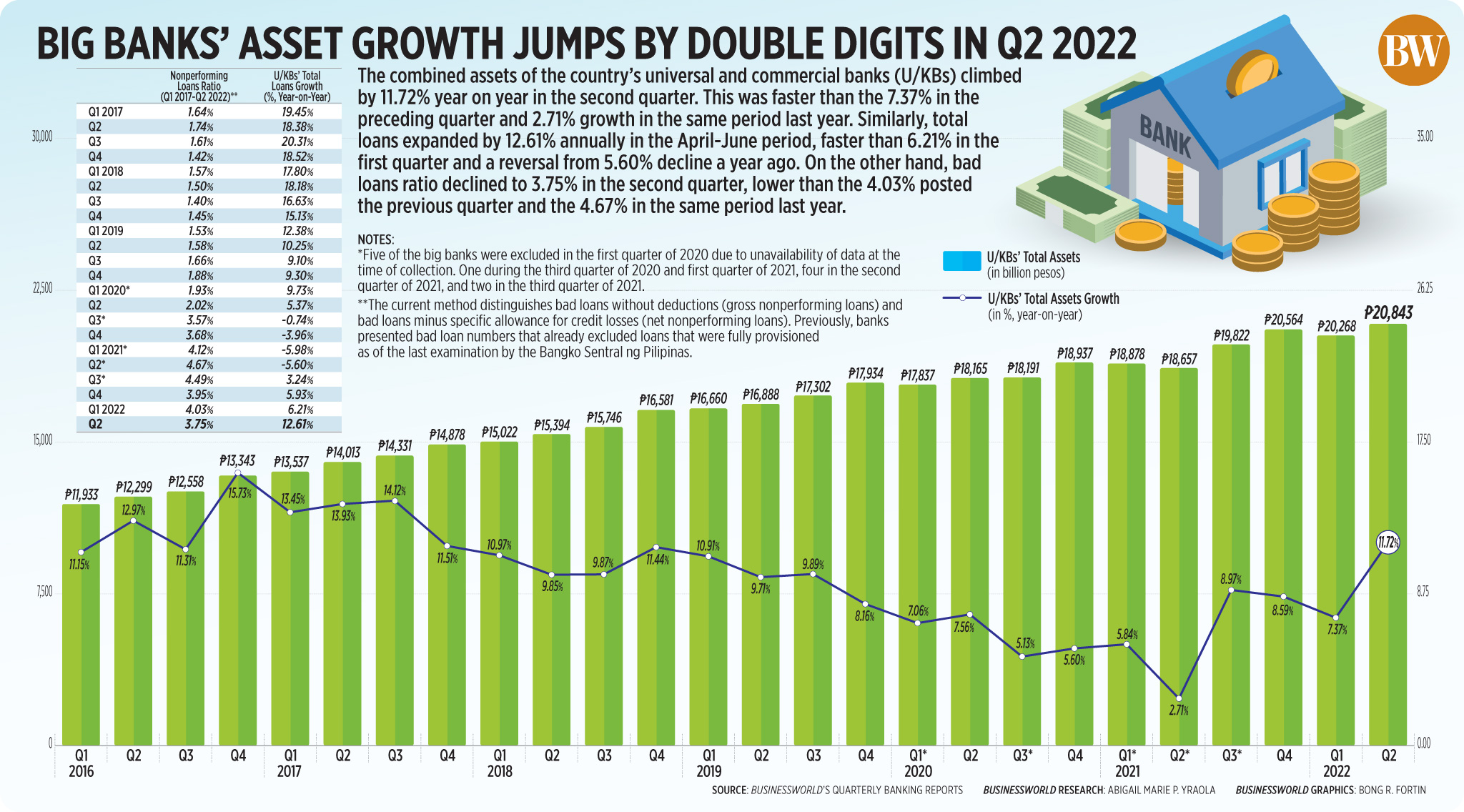
THE COMBINED ASSETS of the Philippines’ largest banks grew by double digits annually in the second quarter, a pace not seen since before the pandemic, due to an increase in total loans.

The latest edition of BusinessWorld’s Quarterly Banking Report showed the total assets of the 45 universal and commercial banks (U/KBs) in the country jumped by 11.7% year on year to P20.84 trillion in the April to June period.

This was higher than the P20.27 trillion seen in the first quarter of 2022 and the P18.66 trillion recorded in same period in 2021.

Big banks’ asset growth jumps by double digits in Q2 2022

The latest asset growth was the fastest in 19 quarters or since the 14.1% growth in the third quarter of 2017.

The big banks’ combined loans, which account for bulk of their total assets, rose by 12.6% year on year to P10.39 trillion in the second quarter, faster than the 6.2% growth seen in the preceding quarter.

This was a turnaround from the 5.6% year-on-year decline in April-June period last year.

The latest reading marked the quickest loan expansion in 14 quarters, or since the 15.1.% recorded in the last quarter of 2018.

The median return on equity (RoE), which is an indicator of profitability, rose to 5.56% in the second quarter, higher than the 3.96% in the first quarter and the 2.77% RoE in the same period a year ago.

The RoE, or the ratio of net profit to average capital, measures the amount that shareholders make on their investments in a company.

Meanwhile, bad loans, also known as nonperforming loans (NPLs), reached P356.75 billion in the second quarter, lower by 9.6% from P394.63 billion in the first quarter and down by 8.3% from P389.16 billion in the same period a year ago.

This brought the NPL ratio — the share of soured loans to the total loan portfolio — to 3.75% in the April to June period, improving from 4.03% in the preceding quarter and from 4.67% in the second quarter of 2021.

Loans are considered to be nonperforming if any principal and/or interest are left unpaid for more than 90 days from the contractual due date or accrued interests for more than 90 days have been capitalized, refinanced, or delayed by agreement.

The U/KBs’ nonperforming asset (NPA) ratio — the NPLs and foreclosed properties in proportion to total assets — stood at 1.17%, lower than the previous quarter’s 1.31% and the 1.46% in the second quarter last year.

Relative to total assets, foreclosed real and other properties stood at 0.28%, inching up from 0.26% in the preceding quarter and the second quarter of 2021.

Total loan loss reserves stood at P366.14 billion during the April to June period, higher than the previous quarter’s P363.56 billion and P338.54 billion a year ago.

The big banks’ median capital adequacy ratio — the lenders’ ability to absorb losses from risk-weighted assets — eased to 20.91%. This was lower than 21.73% in the first quarter and 22.34% in the second quarter of 2021.

Still, the ratio remained well above the regulatory minimum of 10% set by the Bangko Sentral ng Pilipinas as well as the international minimum standard of 8%.

BDO Unibank, Inc. remained the largest bank in terms of total assets with P3.75 trillion in the second quarter. It was followed by Land Bank of the Philippines (LANDBANK) with P2.82 trillion, and Metropolitan Bank & Trust Co. (Metrobank) with P2.71 trillion.

The merger of the United Coconut Planters Bank and LANDBANK became effective on March 1.

BDO also led the banks with P2.37 trillion worth of loans issued, followed by Bank of the Philippine Islands (BPI) with P1.55 trillion and Metrobank with P1.25 trillion.

In terms of deposits, BDO also ranked first with P2.96 trillion, followed by LANDBANK with P2.47 trillion and Metrobank with P2.06 trillion.

Among banks with assets of at least P100 billion, Rizal Commercial Banking Corp. recorded the fastest year-on-year growth with 22.47%. This was followed by UnionBank of the Philippines (19.25%), and China Banking Corp. (19.18%).

Meanwhile, Bank of Commerce was the most aggressive lender in the second quarter with an annual increase of 47.41%, followed by LANDBANK’s 29.10% and The Hongkong & Shanghai Banking Corp. Ltd.’s 26.66%.

BusinessWorld Research has been tracking the financial performance of the country’s biggest banks on a quarterly basis since the late 1980s using banks’ published statements of condition.

PCCI says Speaker vows to pass at least 5 bills in their wish list

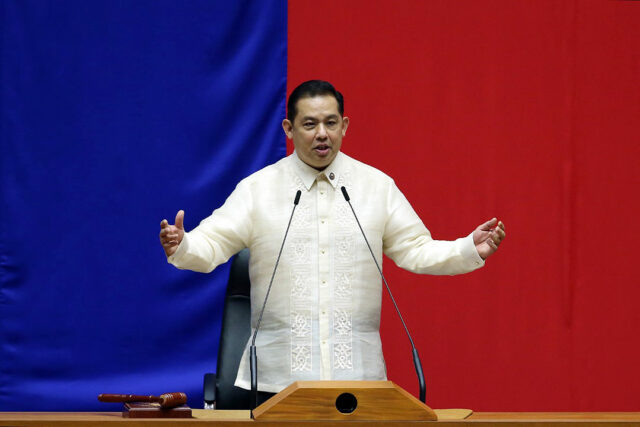
House Speaker Ferdinand Martin G. Romualdez — PHILIPPINE STAR/KRIZ JOHN ROSALES

THE PHILIPPINE CHAMBER of Commerce and Industry (PCCI) on Monday said House Speaker Ferdinand Martin G. Romualdez has committed to having at least five measures in the business group’s wish list enacted in the next three years.

In a statement, the PCCI said its officials met with Mr. Romualdez on Aug. 4 to discuss the business group’s legislative agenda composed of 16 measures.

“Mr. Romualdez committed to have 5-10 of the measures enacted within the next three years. He assured PCCI that the business sector will be consulted in crafting laws related to trade and commerce, vowing to hear all relevant stakeholders before passing any legislation,” the PCCI said.

PCCI President George T. Barcelon said the business group is ready to work with the government on reform measures “to boost and strengthen the country’s economic, social and health sectors.”

The PCCI’s wish list includes Package 3 (Property Valuation and Assessment) and Package 4 (Passive Income and Financial Intermediary Taxation Act) of the Comprehensive Tax Reform Program, and the Capital Market Development Act, which the group says would strengthen fiscal sustainability.

Also included in the PCCI’s legislative agenda are the Successful Farmers Development Act amending the Comprehensive Agrarian Reform Law, Tree-Growing Act, and the amendment or repeal of the Salt Iodization Nationwide (ASIN) Act.

In addition, the PCCI called for the passage of the amendment of the Magna Carta for MSMEs Act, Philippine Warehouse Receipts Act, Open Access in Data Transmission Act, Better Internet Act, Rural Wired Development Act, Satellite-based Technologies Promotion Act, and Philippine Spectrum Management Act.

The business group also pushed for the passage of the International Maritime Trade Act, as well as amendments to the Philippine Ports Authority Act, Philippine Qualification Act and the Dual Training System Act.

Among the PCCI’s proposed measures, only the Package 3 and 4 of the CTRP were included in the priority measures announced by President Ferdinand R. Marcos, Jr. during his State of the Nation Address on July 25.

The House Committee on Ways and Means passed Package 4 of the CTRP on Aug. 24.

“As the 19th Congress convenes its regular sessions, the PCCI is counting on the House of Representatives to pursue the enactment of business-friendly measures crucial to recovery efforts, jobs creation and the long-term progress of the economy,” the group said. — Revin Mikhael D. Ochave

Haus Talk sets 2026 completion for P3.8-B project

HAUS TALK, Inc. expects revenues of P3.8 billion from a mixed-use property project in a 12-hectare land in Laguna that it targets to complete by the end of 2026.

“It’s a mix of townhouses, duplexes and single attached units. There will also be an area for commercial [purposes] that will serve the unit owners,” President Maria Rachel D. Madlambayan said in a text message on Monday.

She said the project is categorized under the government’s economic housing program with a price ceiling of P2.5 million for the basic unit.

“This will be different from our other projects because we will be using a new construction technology,” she said.

Haus Talk said land-banking remains a top priority to sustain its expansion plans for the next three to five years, it said in a press release last week.

The company bought the 12-hectare or 120,000-square-meter (sq.m.) property in Biñan, Laguna using internally generated funds, which it solely allotted for the development of the mixed economic and residential complex.

The proposed project will start initial work in September and will be launched before the year ends.

“We will be introducing green architecture and new construction technology for this project with partners that cannot be disclosed at this time just yet,” Ms. Madlambayan said.

It plans to allot 60% or 72,000 sq.m. to property buyers. Units in the project will have an average lot area of 50 sq.m., which will bring around 1,440 units.

The average selling price per unit is P2.5 million, translating to around P3.6 billion in revenues for the company.

Meanwhile, Haus Talk said in a press release that its board of directors approved an annual payout dividend ratio of at least 20% of its recurring net income for the preceding fiscal year.

“This will give investors additional income during favorable periods,” the company said.

In the first six months, the company’s net income rose to P85.21 million, more than five times last year’s P16.09 million, while its topline reached P385.72 million, more than four times last year’s P88. 77 million.

Haus Talk, a homegrown and family-run residential property provider, is the first firm to list on the small, medium and emerging board of the Philippine Stock Exchange this year.

On Friday, shares in Haus Talk climbed by 1.06% or P0.01 to 95 centavos apiece. — Justine Irish D. Tabile

DMCI Power to explore hybrid systems to power off-grid areas

DMCI Power Corp. (DPC), the power generation arm of DMCI Holdings, Inc., is looking at the use of hybrid systems to help reduce fuel importation, a company official said last week.

“In a recent discussion initiated by the [Department of Energy’s] Renewable Energy Management Bureau, the agency and DPC agreed to explore the possibility of using hybrid fuel (biomass and coal) in Masbate,” Antonino E. Gatdula, Jr., president of DPC, said in an e-mail.

Mr. Gatdula said that if its plan is proven effective, the company will replicate the planned hybrid system in its other service areas.

Based on DPC’s website, the company operates in three provinces, namely: Masbate, Palawan, and Mindoro. It also ventured into power generation in the province of Sultan Kudarat in 2016.

On Aug. 10, Energy Secretary Raphael P.M. Lotilla said at a Senate energy committee hearing that his department was looking into hybrid systems as a long-term solution to address the country’s dependence on imported fuel.

Apart from DPC’s plan to explore hybrid fuel for Masbate, the company is also planning to develop a multi-technology power plant complex in the province.

Mr. Gatdula said the complex would use solar and diesel power to support the initiative for hybrid systems.

He said DPC uses indigenous fuel to operate its off-grid thermal power plant on the island of Masbate, which he claims to “lower” the universal charge for missionary electrification, a subsidy being paid by consumers.

“The savings translate to roughly P50 million to P70 million per month, depending on the price movement of petroleum and petroleum-based fuels in the world market,” he added. — Ashley Erika O. Jose

RLC to seek sustainability certificates for new offices

ROBINSONS Land Corp. (RLC) has committed to ensuring that all of its future offices in the National Capital Region (NCR) will be environment-friendly and will have sustainability certifications.

“We actually said that all of our future buildings in NCR will be environment-friendly and built under the same ESG (environmental, social, and governance) standards. All these buildings will be certified,” RLC President and Chief Executive Officer Frederick D. Go told reporters on the sidelines of the property developer’s bond listing ceremony on Friday.

As part of its efforts to infuse sustainability in its buildings, RLC rolled out solar rooftops, recyclable water systems, environment-friendly equipment, solutions and systems, solid waste management, and bicycle-friendly facilities.

Mr. Go said that RLC buildings will seek to be certified not only with Leadership in Energy and Environmental Design (LEED) but also with other sustainability certifications such as Building for Ecologically Responsive Design Excellence (BERDE).

Meanwhile, Mr. Go said that RLC has committed to infuse its office portfolio in its real estate investment trust (REIT) arm, RL Commercial REIT, Inc. (RCR).

“What RLC has committed is that our office portfolio is basically committed to RCR,” he said.

“We did say that it is our intention to infuse projects every year. So there will be an asset scheduled for infusion next year that we haven’t decided which one,” he added.

RLC is yet to make a decision on whether it will also be infusing its mall portfolio in RCR.

“Malls are definitely a REIT-able asset but we have not given it thought yet, I think the right timing for putting malls into REIT is still probably two years away. I don’t think now is the time to think about it,” Mr. Go said.

RLC is hopeful that foot traffic in its mall and hotel segment will be back to pre-pandemic levels by the end of the year.

“We are hopeful that we will be back to pre-pandemic levels by the end of the year and of course, we can only be hopeful. We can never be sure,” Mr. Go said. “[But] as long as there are no lockdowns, it will just keep getting better.” — Justine Irish D. Tabile

Century Pacific eyes solar power for other manufacturing plants

YUE CHAN-UNSPLASH

CENTURY Pacific Food, Inc. is planning to add solar facilities in its other manufacturing plants after it has completed the commissioning of a 5.2-megawatt solar photovoltaic (PV) facility last year.

“Yes, we are looking for opportunities to go solar or use renewable sources in other manufacturing plants,” Dappy Tecson of Century Pacific’s investor relations team told Businessworld through e-mail on Aug. 25.

Ms. Tecson said that Century Pacific’s solar facility supplies up to 15% of the company’s power requirements in its tuna and coconut manufacturing hubs in General Santos City.

According to the company’s website, the commissioning of the solar PV plant was completed in June 2021. Previously, the company used clean energy sourced from a hydroelectric power plant through the grid.

In terms of carbon footprint reduction, Ms. Tecson noted that the solar PV plant has helped the company in reducing its carbon footprint by 10% in 2021. She said: “apart from solar, our coconut division is also targeting to be carbon neutral by 2028.”

In Century Pacific’s disclosure on Aug. 22, the company said that it aims to minimize its ecological impact via its commitment to plastic neutrality.

Ms. Tecson said that Century Pacific will also explore other strategies as part of its sustainability commitment such as turning waste into energy, which she said will lessen the firm’s coal usage.

In the second quarter, Century Pacific’s attributable net income increased by 7.7% to P1.54 billion from P1.43 billion in the same period last year. Year to date, the company’s net profit increased by 8.5% to P2.95 billion from P2.72 billion in 2021. — Ashley Erika O. Jose

Why foreign banks exit the Philippines

ANDREA DE SANTIS-UNSPLASH

By Abigail Marie P. Yraola, Researcher

MORE than two years since the coronavirus pandemic struck, the country’s banking system has not been left unscathed. Amid the geopolitical uncertainties, surging commodity prices, and rising interest rates, a couple of foreign banks opted to leave the country.

In April last year, Citigroup, Inc. announced it will sell its consumer banking business in the Philippines as well as other Asia-Pacific markets, but will retain its corporate banking presence.

The Manila branch of Dutch bank ING Bank N.V. also made a similar announcement in June this year, saying it will leave the Philippine retail banking market amid uncertain global conditions that affected its operations. However, it will keep its wholesale banking unit and global shared services operations in the country.

John Paolo R. Rivera, Asian Institute of Management economist, said that foreign retail banks exiting the country is most likely a strategic decision.

“There are more productive (profit-generating) ventures that these banks can take using the resources allocated for Philippine operations by simply leaving. These ventures can cover the costs of leaving and its accompanying opportunity costs,” Mr. Rivera said in an e-mail.

These exits mean less competition, more mergers and acquisition of operations, change in user experience for clients who are left behind and who choose to stay, he said.

“There will be less exposure of the Philippine banking sector to changes in foreign banks downside risks, more transactions and opportunities for market growth for locally based banks,” Mr. Rivera said.

UNIONBANK BUYS CITI’S RETAIL ARM
The global banking giant came to an agreement to sell its consumer banking arm to UnionBank of the Philippines. The acquisition will cover Citi’s local credit card, unsecured lending, deposit, and investment businesses, as well as Citicorp Financial Services and Insurance Brokerage Philippines, Inc.

The Philippine Competition Commission approved the P55-billion takeover in April this year, while the Bangko Sentral ng Pilipinas gave its green light in July.

Beginning Aug. 1, Citi said that it successfully completed its sale of its consumer business to UnionBank.

This transaction is expected to result in capital benefit of approximately $700 million for Citi.

The largest foreign bank in the Philippines, Citi has set up its bank in the country way back in 1902. Its corporate and investment banking platform helped propel growth for institutional clients in the country and across the globe.

Citi is recognized as the pioneer in business process outsourcing (BPO), providing customer sales and service, and other client-based support services to various Citi operations.

“We now rank in the top three in terms of credit card spending or usage. More importantly, it has provided us with one of the most diversified loan portfolios in the banking industry,” UnionBank of the Philippines Senior Vice-President and Head of Corporate Planning and Investor Relations Carlo I. Eñanosa said in an e-mail.

Consumer-to-total loans portfolio of the bank increased to 49%, more than double the industry average, he said. Mr. Eñanosa added that the acquired consumer portfolio is very profitable and further improves our net interest margin.

“We will also increase our retail customer base by almost one million new-to-bank customers, which are mostly in the middle- to upper-income segment and expect to generate additional value from the synergies across the merged consumer business,” Mr. Eñanosa said.

He also highlighted that this meant continuity of business operations and deeper leadership bench within the organization.

For Mr. Rivera, this shows a greater market for UnionBank and opportunities to leverage on what Citi has left behind.

The total assets that will contribute to UnionBank is close to a hundred billion pesos, Mr. Eñanosa said. This will consist of P65 billion of net loans, largely in credit cards, about P30 billion of cash, as well as other assets like the real estate property that houses their operations.

“With the Citi consumer business, our recurring income will increase in a major way. Our current net interest margin is at 4.7% and this will increase to 5.5% because of the Citi consumer banking business,” Mr. Eñanosa said.

Central banks around the world, including the Philippines, continued tightening their policy rates to temper rising inflation. Should this continue, Mr. Eñanosa said, this could impact the consumers except for products where there is a rate cap.

“Having said that, we think that the rate cycle might be approaching its peak,” Mr. Eñanosa said.

“There are other factors that banks consider in their pricing — such as competitive landscape, regulations, and market liquidity. It does not mean that as rates rise, we automatically pass the same level of increase to the consumers,” he added.

Credit rating agency Fitch Ratings said in a report rising interest rates will put more pressure on consumers and small businesses.

In its report “Impact of Rising Interest Rates on APAC Banks,” Fitch Ratings said that most banks will benefit from higher interest rates and that lending rates are likely to adjust more quickly than deposit rates.

“In the most competitive markets, such as Indonesia, the Philippines, and Taiwan, banks will have a weaker scope to pass on higher rates to borrowers, limiting the upside,” it said.

Moving further, UnionBank recently launched UnionDigital Bank, Inc. which is among the six digital banks that has been given digital banking licenses by the central bank alongside Overseas Filipino Bank, Tonik Digital Bank, UNO Digital Bank, GOtyme Bank and Maya Bank, Inc. As per BSP’s regulation, digital banks in the country must have a minimum capitalization of P1 billion.

The launch of UnionDigital completes its strategy of becoming a Great Retail Bank, said Mr. Eñanosa.

“A large universal bank would probably have less than 10 million customers on average and most banks are servicing the same customers. So, there is a large segment that remains to be unbanked or underserved. With UnionDigital, we will be able to extend financial services to this segment because digital has no boundaries in terms of reach,” Mr. Eñanosa added.

UnionDigital provides ease in opening accounts and facilitating financial transactions. Its cost to serve its customer is lower compared with a universal bank. UnionDigital has no branch legacy cost, no relationship managers, lower reserve requirements, and lower license cost per account.

“This means that it is now viable for us to cast a wider net in serving the Filipino consumers. Not to mention that it is 100% owned by UnionBank which means it addresses the level of trust which is sometimes a concern of customers in choosing a bank,” added Mr. Eñanosa

ING BANK MANILA’S EXIT
On June 24, the Dutch banking giant ING Bank announced that it will exit the Philippine retail banking market before the year ends. Still, it will continue to invest in its wholesale banking business and global shared services operations in the Philippines.

In a statement, ING Bank said its exit is due to uncertain global macro situation in the last few years leading the bank not to expand the activities to other countries, which meant that the retail operations in the Philippines had to be re-assessed for its scalability as a standalone business.

The bank assured its retail customers that there is no change to their accounts. They can continue to access their funds and accounts anytime and their money remains safe and secure, the bank said.

This exit from the Philippine banking market also mirrored the same move ING made in European countries such as France, Austria, and Czech Republic in 2021.

ING was the first bank to go fully digital in the Philippines. It was also popular among savers due to its high-interest savings accounts.

Since 1990, ING Bank has been servicing corporate and institutional clients in the country. Its retail banking has begun operations in late 2018 which served more than 380,000 customers with savings accounts, current accounts, and consumer lending.

Since its launch, the bank has performed well, demonstrating good progress, commercial momentum, and growth potential. Currently, the bank has around 120 employees in both wholesale and retail banking.

ING is a Dutch member of the Inter-Alpha Group of Banks which is a cooperative consortium of 11 prominent European banks. They operate in more than 40 countries with its corporate headquarters in Amsterdam.

It also began its ING Business Shared Services, Inc. in 2013 which supports its banking operations across the world.

AIM’s Mr. Rivera assessed that the Dutch financial giant leaving the retail banking market is “strategic move in order for them to be able to harness their full revenue and profit potentials.”

“I believe ING will not leave their customers hanging behind. They are an established bank with a reputable track record. There are post departure systems in place to ensure consumer welfare,” he added.

UnionBank’s Mr. Eñanosa said the Philippine banking sector will benefit from the unique position in terms of growth prospects given the country’s demographics.

“Our country is composed of a young population at the beginning of their credit cycle and we have a large population that remains to be unbanked,” Mr. Eñanosa said.

“Our regulators also continue to support digitalization to promote financial inclusion and to accelerate distribution of financial services to the consumers.” he added.

Supermarkets: Lift use of SRP bulletin until year-end 

THE use of the suggested retail price (SRP) bulletin issued by the Department of Trade and Industry (DTI) should be lifted until year-end, according to a supermarket industry group.

Steven T. Cua, Philippine Amalgamated Supermarkets Association president, told BusinessWorld Live on One News Channel aired Monday that the group has been suggesting that the SRP is not needed unless there is a calamity or a state of national emergency.

“Maybe this is as good a time for the DTI to lift the use of the SRP until the end of the year and see what happens. If retailers, distributors, or manufacturers abuse this, I think it is the fall of these sectors and the retailers because people will not buy their products,” Mr. Cua said.

“We have always been suggesting that there is no need for SRP unless there’s a calamity or a state of national emergency. That is what the SRP is supposed to be for because it is a price-regulating mechanism. Let the manufacturers find the right place for their products, to be able to position their products and brands well,” he added.

On Aug. 12, the DTI issued a new SRP bulletin that reflected price increases for 67 out of 218 stock-keeping units (SKUs) under its jurisdiction on the back of higher production costs. The price increases vary from 3.29% to 10%.

Some of the basic necessities and prime commodities that were priced higher include canned sardines, coffee, noodles, bottled water, processed milk, detergent soap, candle, and condiments.

“Amid these adjustments, the DTI remains steadfast in its commitment [to] ensuring that consumers have access to reasonably priced goods in the market, hence increases were kept to a minimum,” Trade Undersecretary Ruth B. Castelo said in a previous statement.

Based on Republic Act No. 7581 or the Price Act, the DTI monitors the prices and supply of products such as canned fish and other marine products, processed milk, coffee, bread, salt, laundry soap, detergent, candles, flour, processed and canned pork, processed and canned beef, and poultry meat, noodles, vinegar, patis, soy sauce, toilet paper, soap, and school supplies.

“The main function of the SRP Bulletin is to inform and guide retailers and consumers, protect them from deceitful or unconscionable transactions, and give consumers the freedom to choose the product they prefer at a price they can afford,” Trade Secretary Alfredo E. Pascual said in a previous statement.

Meanwhile, Mr. Cua said that the group had been advised by a leading salt manufacturer of a price increase.

“We’ve been advised by one manufacturer at least — a leading local brand — which said that prices will go up by 33%. So far, we have not ordered yet. Our supermarkets have not really seen the price increases,” he said.

“Salt sales are not that strong in supermarkets. The sales are stronger in wet markets. But at the supermarket, sometimes people forget to buy salt,” he added. — Revin Mikhael D. Ochave

How can un(der)served Filipinos leverage debt

ANDRE TAISSIN-UNSPLASH

By Ana Olivia A. Tirona, Researcher

KAMILA O. PARAS, a 59-year-old local government unit employee, was one of the few Filipinos that got cold feet when it comes to credit.

About five years ago, Mrs. Paras was looking into buying a house and lot with her 61-year-old spouse but could not swallow the “hard pill” that is called credit score. The couple wanted to purchase their own home after years of renting, but the hardships of requirements and settlements overwhelmed the couple.

They were asked about their credit score after finding the perfect house. However, neither of them felt confident of their credit score.

“I think my credit card somehow helps me, which I only got later on in life. But I don’t use it often like some people do. I’ve had experiences where I didn’t pay on time. Sometimes I don’t push through with the purchase because it is quite expensive to pay off later,” Mrs. Paras said in an interview.

“The thought of utang to a bank is just scary. So, I don’t know how my credit is looking,” she said.

“It’s such a worry to take out loans, and so that time was a rough one for us. A lot needs to be considered. Borrowing rates and having steady income. We didn’t push through with that one house anymore, it just seemed like a lot of work and just the thought of credit score kind of discouraged us,” Mrs. Paras added.

With that in mind, how can the underserved and unserved Filipinos navigate through credit gain opportunities and leverage debt without fear?

UNDERSTANDING THE UN(DER)SERVED
In Bangko Sentral ng Pilipinas’ (BSP) National Strategy for Financial Inclusion 2022-2028, the underserved and unserved segments of the country are part of the financially excluded people that the central bank wishes to address in their seven-year plan.

The BSP identified that the underserved and unserved are senior citizens, migrant workers, persons with disabilities, indigenous peoples, forcibly displaced persons, those who are excluded due to religious beliefs. Most notably, those who are also financially excluded are those in agriculture, micro, small, and medium enterprises (MSMEs), startups, and informal workers.

In the 2021 Financial Inclusion Survey (FIS), the share of adults that hold a formal credit climbed to 25% from 19% in 2019. However, banks are still the least preferred source of formal credit but remain to be the main source of formal savings at 31% and second spot in account penetration at 23%.

Furthermore, the survey showed that half of the Filipinos believe that borrowing from formal institutions was challenging. Sadly, the common perception shows that the bigger the borrowing need is, the more reluctant they are.

It is vital for the BSP to continue to expand its financial inclusion for credit opportunities. Examples of their initiatives are to promote the use of alternative data (ex. data retrieved from social media, mobile data, utilities data, behavioral data, online transactions, geolocation data, and browser data, among others, usually not collected by the financial institutions, etc.,) and developing a better framework for harnessing data for credit evaluation for those in agriculture and MSMEs.

In a study by information solutions agency TransUnion titled “Empowering Credit Inclusion: A Deeper Perspective on Credit Underserved and Unserved Consumers” released last June 14, the results of the surveys aimed to shed light on the credit situation of the target segment.

The study described underserved as those that “have minimal credit participation, limited to a single type of credit product and no more than two open accounts of that type, and have been active in the credit market for at least two years. Furthermore, the unserved are consumers that have no history of an “open traditional credit product.”

Before diving into possible credit gain opportunities for Filipino consumers, what is credit and credit score?

In simpler terms, credit is  when a consumer buys a specific good or service without immediate payment. But will pay the lender — such as a bank — what is due at a later time.

Meanwhile, a credit score is a report of how well a borrower has been paying off their debt. Having good credit score will allow you to have more access to loans and financial services.

For consumers like Mrs. Paras and her husband, their journey with credit is unstable because they feel that debt equals bad. And so, when the time came for them to report a credit score, they felt discouraged.

In a written response to BusinessWorld, TransUnion Philippines Regional President and Chief Executive Officer Pia L. Arellano describes credit as an aid to help Filipino consumers access financial products and services.

“Good credit is essential, as it will allow Filipinos access to loans and credit cards to help them achieve their financial goals. Aside from this, Filipino consumers can also use credit for online shopping, protection for purchases, extra financial security, and even for maintaining their very own business,” Ms. Arellano said.

“Whether people realize it or not, credit score really does play a large part when it comes to your own personal finance. Credit scores are the lender’s basis for deciding whether you’re a good risk. They look into these as proof of how likely you are to pay back your debt,” Ms. Arellano added.

TransUnion’s study on credit, which surveyed 11,100 adults (ages 18 years and older), showed that unserved and underserved Filipinos “expect their need for credit” to increase in the next three to five years.

The most common reason why the surveyed population did not want credit or to have more credit is they “don’t want to go into debt.” About 40% of the underserved Filipinos surveyed said they are worried about not having control of finances. As such, 32% of the underserved explained how they would take advantage of credit if only it had lower weekly and monthly payments.

Likewise, when the opportunity arises for these consumers, they reject the credit offer because of high interest rates.

In truth, there is potential for these consumers. If only lenders would become more accommodative.

FINDING WAYS TO LEVERAGE DEBT
BDO Unibank, Inc.’s (BDO) primary goal for the unserved and underserved segments of the population is to have more access to credit.

In a written response to BusinessWorld, BDO assures that consumers can take advantage of debt in many ways:

• Augment cash to fund basic needs, spend for renovation or repair of house or vehicles; pay for unforeseen expenses; or fund working capital to start or expand a business.

• Manage cash flows for things like school tuition fee payments.

• Purchase of big-ticket items sooner such as house and lot or a vehicle.

• Pay off debts with new funds (refinancing) at terms that may be more favorable for them (e.g., longer payment terms or installment schemes).

To date, BDO offers loans such as for personal, auto, home, and MSMEs.

In fact, BDO Network Bank, Inc. (BDO NB) — a subsidiary of BDO — operates as a rural bank which targets consumers in far-flung areas of the Philippines.

“To serve the banking needs of the un(der)served markets especially in the rural areas, our rural bank subsidiary, BDO NB offers Salary Loans and Kabuhayan Loans,” the bank said.

BDO NB’s Salary Loan are categorized as personal loans which can be used for various needs. This offer entails a more convenient way of paying off debt through salary deductions.

Similarly, the Kabuhayan Loan is catered to MSMEs to give financial support to those expanding and growing their businesses. Specifically, this can be used for purposes such as working capital or fixed asset acquisition.

However, affordability may still come at a cost.

“The bank may face potential decline in asset quality or rise in nonperforming loans (NPL) on unsecured loans,” BDO said.

But a “robust credit process, constant account monitoring, and site-visit to clientele’s place of business” could ensure the bank’s corporate standard.

EASY, BREAZY, CREDIT
For people like Mrs. Paras that are struggling with credit, leveraging debt should be easy, affordable, and convenient.

Despite financial uncertainty and rising global prices, banks like BDO assure its consumers that access to credit is “more important to the un(der)served than rates.”

On the other hand, TransUnion also calls for better financial inclusion and financial literacy.

“Lenders can play a critical role in helping more consumers become actively engaged in the credit system and promoting greater financial inclusion. With this, it can be said that the consumer experience plays a large factor in the reasons why unserved and underserved consumers are hesitant or less likely to take up a credit offer,” Ms. Arellano said.

“It is important for banks and financial companies alike to develop and offer credit products and services that are more tailored to their lifestyles,” she added.

There will always be factors to be weighed in by both the borrower and lender just as long as access is not limited to those who are financially sound.

“Maybe in the long-term, we can finally present a good credit score to buy our dream house. If not, that’s fine,” Mrs. Paras said. “Wherever it’s simple and hopefully affordable, I’ll choose that.”