A SECTION of skin tissue, harvested from a lesion on the skin of a monkey, that had been infected with monkeypox virus. — CENTERS FOR DISEASE CONTROL AND PREVENTION
The Massachusetts Department of Public Health on Wednesday said it had confirmed a single case of monkeypox virus infection in a man who had recently traveled to Canada.
The US Centers for Disease Control and Prevention (CDC) said its labs confirmed the infection to be monkeypox on Wednesday afternoon.
The state agency said it was working with CDC and relevant local boards of health to carry out contact tracing, adding that “the case poses no risk to the public, and the individual is hospitalized and in good condition.”
The Public Health Agency of Canada late on Wednesday issued a statement saying it is aware of the monkeypox cases in Europe and is closely monitoring the current situation, adding no cases have been reported at this time.
Monkeypox, which mostly occurs in west and central Africa, is a rare viral infection similar to human smallpox, though milder. It was first recorded in the Democratic Republic of Congo in the 1970s. The number of cases in West Africa has increased in the last decade.
Symptoms include fever, headaches and skin rashes starting on the face and spreading to the rest of the body.
The Massachusetts agency said the virus does not spread easily between people, but transmission can occur through contact with body fluids, monkeypox sores, items such as bedding or clothing that have been contaminated with fluids or sores, or through respiratory droplets following prolonged face-to-face contact.
It said no monkeypox cases had previously been identified in the United States this year. Texas and Maryland each reported a case in 2021 in people with recent travel to Nigeria.
The CDC also said it is tracking multiple clusters of monkeypox reported in several countries including Portugal, Spain, and the United Kingdom, within the past two weeks.
Earlier on Wednesday, Portuguese authorities said they had identified five cases of the infection and Spain’s health services said they were testing 23 potential cases after Britain put Europe on alert for the virus.
European health authorities are monitoring any outbreak of the disease since Britain reported its first case on May 7 and has found six more in the country since then. — Reuters
A patient whose skin displayed a number of lesions due to what had been an active case of monkeypox. — CENTERS FOR DISEASE CONTROL AND PREVENTION
LONDON — A handful of cases of monkeypox have now been reported or are suspected in the United Kingdom, Portugal, and Spain.
The outbreaks are raising alarm because the disease mostly occurs in west and central Africa, and only very occasionally spreads elsewhere.
Here’s what scientists know so far.
‘HIGHLY UNUSUAL’
Monkeypox is a virus that causes fever symptoms as well as a distinctive bumpy rash. It is usually mild, although there are two main strains: the Congo strain, which is more severe — with up to 10% mortality — and the West African strain, which has a fatality rate of more like 1% of cases. The UK cases have been reported as the West African strain.
“Historically, there have been very few cases exported. It has only happened eight times in the past before this year,” said Jimmy Whitworth, a professor of international public health at the London School of Hygiene and Tropical Medicine, who said it was “highly unusual.”
Portugal has logged five confirmed cases, and Spain is testing 23 potential cases. Neither country has reported cases before.
TRANSMISSION
The virus spreads through close contact, both in spillovers from animal hosts and, less commonly, between humans. It was first found in monkeys in 1958, hence the name, although rodents are now seen as the main source of transmission.
Transmission this time is puzzling experts, because a number of the cases in the United Kingdom – nine as of May 18 – have no known connection with each other. Only the first case reported on May 6 had recently traveled to Nigeria.
As such, experts have warned of wider transmission if cases have gone unreported.
The UK Health Security Agency’s alert also highlighted that the recent cases were predominantly among men who self-identified as gay, bisexual or men who have sex with men, and advised those groups to be alert.
Scientists will now sequence the virus to see if they are linked, the World Health Organization (WHO) said this week.
WHY NOW?
One likely scenario behind the increase in cases is increased travel as coronavirus disease 2019 (COVID-19) restrictions are lifted.
“My working theory would be that there’s a lot of it about in west and central Africa, travel has resumed, and that’s why we are seeing more cases,” said Mr. Whitworth.
Monkeypox puts virologists on the alert because it is in the smallpox family, although it causes less serious illness.
Smallpox was eradicated by vaccination in 1980, and the shot has been phased out. But it also protects against monkeypox, and so the winding down of vaccination campaigns has led to a jump in monkeypox cases, according to Anne Rimoin, an epidemiology professor at the University of California, Los Angeles.
But experts urged people not to panic.
“This isn’t going to cause a nationwide epidemic like COVID did, but it’s a serious outbreak of a serious disease — and we should take it seriously,” said Mr. Whitworth. — Reuters
The world’s oceans grew to their warmest and most acidic levels on record last year, the World Meteorological Organization (WMO) said on Wednesday, as United Nations (UN) officials warned that war in Ukraine threatened global climate commitments.
Oceans saw the most striking extremes as the WMO detailed a range of turmoil wrought by climate change in its annual “State of the Global Climate” report. It said melting ice sheets had helped push sea levels to new heights in 2021.
“Our climate is changing before our eyes. The heat trapped by human-induced greenhouse gases will warm the planet for many generations to come,” said WMO Secretary-General Petteri Taalas in a statement.
The report follows the latest UN climate assessment, which warned that humanity must drastically cut its greenhouse gas emissions or face increasingly catastrophic changes to the world’s climate.
Mr. Taalas told reporters there was scant airtime for climate challenges as other crises, such as the coronavirus disease 2019 (COVID-19) pandemic and war in Ukraine, grabbed headlines.
Selwin Hart, UN Secretary-General Antonio Guterres’s special adviser on climate action, criticized countries reneging on climate commitments due to the conflict, which has pushed up energy prices and prompted European nations to seek to replace Russia as an energy supplier.
DANGEROUS INCREASE
“We are … seeing many choices being made by many major economies which, quite frankly, have the potential to lock in a high-carbon, high-polluting future and will place our climate goals at risk,” Mr. Hart told reporters.
On Tuesday, global equity index giant MSCI warned that the world faces a dangerous increase in greenhouse gases if Russian gas is replaced with coal.
The WMO report said levels of climate-warming carbon dioxide and methane in the atmosphere in 2021 surpassed previous records.
Globally, the average temperature last year was 1.11 degrees Celsius above the preindustrial average — as the world edges closer to the 1.5C threshold beyond which the effects of warming are expected to become drastic.
“It is just a matter of time before we see another warmest year on record,” Mr. Taalas said.
Oceans bear much of the brunt of the warming and emissions. The bodies of water absorb around 90% of the Earth’s accumulated heat and 23% of the carbon dioxide emissions from human activity.
The ocean has warmed markedly faster in the last 20 years, hitting a new high in 2021, and is expected to become even warmer, the report said. That change would likely take centuries or millennia to reverse, it noted.
The ocean is also now its most acidic in at least 26,000 years as it absorbs and reacts with more carbon dioxide in the atmosphere.
Sea level has risen 4.5 cm (1.8 inches) in the last decade, with the annual increase from 2013 to 2021 more than double what it was from 1993 to 2002.
The WMO also listed individual extreme heatwaves, wildfires, floods and other climate-linked disasters around the world, noting reports of more than $100 billion in damages. — Reuters
BRUSSELS — The European Commission on Wednesday unveiled a 210 billion euro plan for Europe to end its reliance on Russian fossil fuels by 2027, and to use the pivot away from Moscow to quicken its transition to green energy.
The invasion of Ukraine by Russia, Europe’s top gas supplier, has prompted the European Union (EU) to rethink its energy policies amid sharpened concerns of supply shocks. Russia supplies 40% of the bloc’s gas and 27% of its imported oil, and EU countries are struggling to agree to sanctions on the latter.
To wean countries off those fuels, Brussels proposed a three-pronged plan: a switch to import more non-Russian gas, a faster rollout of renewable energy, and more effort to save energy.
The measures include a mix of EU laws, non-binding schemes, and recommendations to governments in the EU’s 27 member countries, who are largely in charge of their national energy policies.
Taken together, Brussels expects them to require 210 billion euros in extra investments by 2027 and 300 billion euros by 2030 on top of those already needed to meet the bloc’s 2030 climate target. Ultimately, it said the investments would slash Europe’s fossil fuel import bill.
“RePowerEU will help us to save more energy, to accelerate the phasing out of fossil fuels and, most importantly, to kickstart investments on a new scale,” Commission president Ursula von der Leyen said, referring to the package.
Those investments include 86 billion euros for renewable energy and 27 billion for hydrogen infrastructure, 29 billion euros for power grids and 56 billion euros for energy savings and heat pumps.
The Commission said some investments in fossil fuel infrastructure would be required — 10 billion euros for a dozen gas and liquefied natural gas projects, and up to 2 billion euros for oil, targeting land-locked Central and Eastern European countries that lack access to non-Russian supply.
Campaigners said those investments risked locking the EU into long-term reliance on CO2-emitting gas, fueling climate change and high energy prices. The Commission said new gas infrastructure should be able to switch to carry renewable hydrogen in future.
Brussels wants countries to finance the measures using the EU’s coronavirus disease 2019 (COVID-19) recovery fund, which contains more than 200 billion euros of unspent loans. The Commission will also sell extra carbon market permits from a reserve over the next few years to raise 20 billion euros. Some analysts warned that could dampen carbon prices, undermining the price signal to shift to low-carbon energy.
To spearhead the plans, the Commission proposed a higher legally-binding target to get 45% of EU energy from renewable sources by 2030, replacing its current 40% proposal.
That would see the EU more than double its renewable energy capacity to 1,236 gigawatts (GW) by 2030, and be aided by a law allowing simpler one-year permits for wind and solar projects. The EU also proposed phasing in obligations for countries to fit new buildings with solar panels.
Another target would cut EU energy consumption 13% by 2030 against expected levels, replacing its current 9% proposal. The EU is negotiating laws to renovate buildings faster to use less energy, and said voluntary actions such as turning down thermostats could cut gas and oil demand by 5%.
The legally-binding targets require approval from EU countries and lawmakers.
The EU plan includes a short-term dash for non-Russian gas supplies to replace the 155 billion cubic meters Europe buys from Moscow each year. Europe’s gas demand is expected to drop 30% by 2030 to meet climate targets, but for now countries rely on the fuel to heat homes, power industry and produce electricity.
The EU aims to have a memorandum of understanding with Egypt and Israel by summer on supplying LNG, and aims to boost supply from countries including Canada and Algeria. Brussels will also launch a scheme for countries to jointly buy gas to attempt to negotiate better contract terms. — Reuters
TOKYO — Japanese conglomerate Sony Group Corp. said it is well-positioned to play a leading role in the metaverse, or immersive virtual worlds, which commentators speculate will massively disrupt industries and establish new powerhouses.
The metaverse is a vague term encapsulating the idea that consumers will spend more time in online simulated environments. While the concept is evolving, it has become a buzzword in briefings and a driver of industry dealmaking.
“The metaverse is at the same time a social space and live network space where games, music, movies and anime intersect,” Chief Executive Kenichiro Yoshida said at a strategy briefing on Wednesday, pointing to the use of free-to-play battle royale title Fortnite from Epic Games as an online social space.
Sony’s game, music and movie units contributed two-thirds of operating income in the year ended March, underscoring the group’s transformation from consumer electronics maker into a metaverse-ready entertainment juggernaut under Mr. Yoshida and predecessor Kazuo Hirai.
The firm is a gaming gatekeeper with its PlayStation 5 console, however observers point to the risk presented by the growth of cross-platform, cloud-based titles and their potential to reduce the influence of proprietary platforms.
Sony has been adjusting its approach, enabling cross-play in Fortnite in 2018. This week, Epic said in-game “V-Bucks” currency purchased on PlayStation would be usable on other platforms.
“PlayStation has played a huge role in the social gaming revolution that’s nurturing the growth of the metaverse as a new entertainment medium,” Epic’s CEO Tim Sweeney said on Twitter.
Sony has also taken steps to expand beyond its focus on single-player titles such as Spider-Man: Miles Morales, with a deal announced in January to buy Bungie, the developer of online multiplayer shooter Destiny.
“We believe it will be a catalyst to enhance our live service game capabilities… (It) represents a major step forward in becoming multi-platform,” Mr. Yoshida said.
Sony already licenses its content to other platforms, profiting from the value to streamers of content such as popular US sitcom Seinfeld. Though the firm owns the Crunchyroll anime streaming service, it has not pushed as aggressively into operating its own video platforms as rivals such as Walt Disney Co with its Disney+ service.
Beyond the metaverse, Mr. Yoshida also staked out Sony’s claim in mobility, with the conglomerate developing an electric vehicle with Honda Motor Co Ltd.
Sony created a new lifestyle in 1979 with the launch of the Walkman, Mr. Yoshida said.
“We are aiming to turn the mobility space into a new entertainment space… We believe mobility will be the next megatrend,” he said. — Reuters
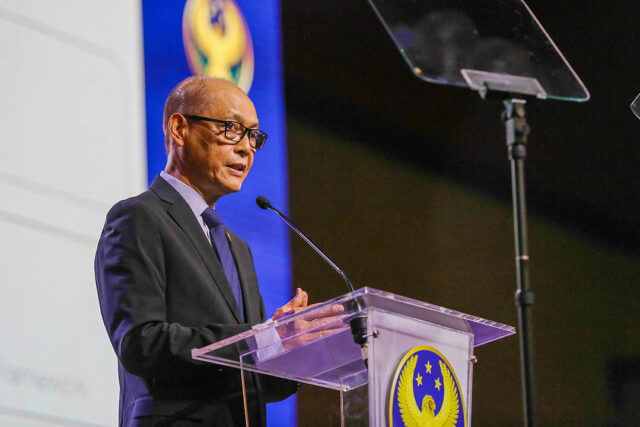
BANGKO SENTRAL NG PILIPINAS GOVERNOR BENJAMIN E. DIOKNO — PHILIPPINE STAR/ GEREMY PINTOLO
BANGKO SENTRAL ng Pilipinas (BSP) Governor Benjamin E. Diokno on Wednesday said the space for keeping an accommodative policy is shrinking, amid rising inflation risks and the economy’s return to pre-pandemic level in the first quarter.
“The space for maintaining an accommodative policy stance has considerably narrowed given how the April 2022 inflation of 4.9% settled near the higher end of the BSP’s forecast range of 4.2% to 5% [for the month],” he said at an online briefing.
Mr. Diokno said the better-than-expected 8.3% gross domestic product (GDP) growth in the first quarter, and ongoing downside risks “strengthen the case for a withdrawal of monetary policy accommodation.”
“While the BSP stands ready to deal with these risks to inflation and economic growth, any adjustments in the monetary policy stance will be done in a timely manner so as not to disrupt the growth momentum while preventing price pressures from becoming entrenched,” he said.
The BSP chief’s more hawkish signals on policy came a day before the third rate-setting meeting of the Monetary Board for the year.
Eight out of 17 analysts in a BusinessWorld poll last week expect the central bank to begin itstightening cycle by raising interest rates by 25 basis points (bps) today in order to address rising inflationary pressures.
A rate hike on Thursday will be the BSP’s first since 2018.
Mr. Diokno said second-round effects are “starting to manifest.”
The recent approval of wage hikes in the National Capital Region and Western Visayas may signal further increases in other regions. Wage petitions have been put on hold since the pandemic began in 2020.
The Labor department said the recently approved wage hikes in Metro Manila and Western Visayas will take effect on June 3.
Inflation in recent months quickened mainly due to the impact of the war in Ukraine on oil and other commodity prices. Gasoline, diesel, and kerosene prices have increased by P21.60, P31.40, and P27.65 per liter since the start of the year.
“With energy and transport-related items directly accounting for about 14% of the consumer price index basket, a sustained increase in domestic oil prices may result in a disanchoring of inflation expectations,” Mr. Diokno said.
Mr. Diokno said supply issues continue to be the main factor behind faster inflation in recent months, which he said is still best addressed by interventions from the National Government.
“Fiscal authorities will need to support the most vulnerable sectors, to help offset rising living costs,” he said.“Monetary authorities will need to carefully monitor the pass-through of rising international prices to domestic inflation, to calibrate appropriate responses.”
At its previous policy review in March, the BSP raised its inflation forecast to 4.3% and 3.6% for 2022 and 2023, respectively.
“Upside risks [for inflation] over the near term continue to emanate from the shortage in domestic food supply as well as from the potential impact of higher oil prices on transport fares,” he said.
The BSP slashed interest rates by a cumulative 200 basis points in 2020 to help revive an economy that had plunged into recession due to prolonged and stringent coronavirus disease 2019 (COVID-19) lockdowns.
It has kept rates at a record low of 2% since November 2020. — L.W.T. Noble with inputsfromReuters
A NEW MINIMUM WAGE in the National Capital Region (NCR)and Western Visayas will be implemented next month, the Labor department said on Wednesday, adding that workers in three other regions will soon see higher take-home pay.
The P33 wage hike in Metro Manila and the P55-P100 increase in Western Visayas will take effect on June 3 after their separate wage orders were affirmed by the National Wages and Productivity Commission (NWPC), the Department of Labor and Employment (DoLE) said in a statement.
DoLE said the wage boards in Ilocos, Cagayan Valley, and Caraga have also issued orders increasing minimum wages in these regions.
The Ilocos Region’s wage board approved hikes ranging from P60-P90, bringing the minimum wage rate in the region to P372-P400 from P282-P340 previously.
The wage board in Ilocos also issued an order “granting P500 and P1,500 monthly wage increases for domestic workers in cities and first-class municipalities and for other municipalities, respectively, bringing the new monthly wage rate to P5,000,” DoLE said.
The labor agency said after the implementation of the P50-P75 wage hikes in Cagayan Valley, which will be implemented in two to three tranches, the minimum wage rate in the region will range from P400-P420 from P345-P370 previously.
DoLE said the minimum wage in Caraga Region in southern Philippines will be raised to P350 after its wage board “integrated the P15 cost of living allowance to the P305 basic salary under the previous wage order and granted a P30-wage increase.”
“The new daily minimum wage rate of P350 shall take effect upon the effectivity of the wage order for private establishments and their workers in Butuan City and the provinces of Agusan del Norte, Agusan del Sur, and Surigao del Sur,” DoLE said.
“However, for private establishments and their workers in the provinces of Dinagat Islands and Surigao del Norte, including Siargao Islands, the wage increase of P20 shall take effect upon the effectivity of the wage order and another P10 shall take effect on Sept. 1, 2022,” it added.
DoLE said the new wage orders will be submitted to the NWPC for review and shall take effect fifteen days after publication in a newspaper of regional circulation.
The agency said retail and service establishments regularly employing not more than 10 workers and establishments affected by natural calamities and/or human-induced disasters, including the pandemic, may apply for exemption from compliance with the issued wage orders. — Kyle Aristophere T. Atienza
A WOMAN in a remote meeting via videoconference works from her living room. — REUTERS
Many workers who were used to remote work arrangements during the pandemic are balking at return-to-office orders. — MATHIEU THOMASSET /HANS LUCAS VIA REUTERS CONNECT
By Revin Mikhael D. Ochave, Reporter
JOHN GABRIEL GALANG-PILAPIL, 22, finally returned to his office on March 6 after working from home for the past two years amid a coronavirus pandemic.
Now, he’s considering quitting his job, noting that he has to endure heavy traffic again on his way to work.
“The transition to working back on-site was really hard,” the working student said in a Facebook Messenger chat. “I’ve been used to working alone in a quiet space at my house. Now, I easily lose focus because of the noise from my colleagues.”
The drive to get people back into offices is clashing with employees who have embraced remote work as the new normal. Some have quit their jobs after their bosses required them to go back to the office.
While companies from Google to Ford Motor Co. and Citigroup, Inc. have promised greater flexibility, many other companies have praised the importance of being inside offices.
There are companies that say remote work diminishes collaboration and company culture.
But legions of workers think that if anything, the past two years have proven that much work can be done from anywhere, without the lengthy commutes on crowded trains or buses.
The government has advocated the return of employees, including business process outsourcing (BPO) workers, to on-site work to support economic recovery. People tend to spend more when outside their homes, which effectively sustains other businesses near offices.
The Fiscal Incentives Review Board (FIRB) has rejected a Philippine Economic Zone Authority (PEZA) proposal to extend an order allowing IT-BPO companies to continue their work-from-home arrangements while keeping their tax perks.
Under the order that expired on March 31, registered IT-BPO companies were allowed to adopt work-from-home setups for 90% of their workforce while enjoying tax incentives.
The state board denied PEZA’s proposal, saying the work-from-home arrangement is a “time-bound measure” and that workers should return to the office amid decreasing infections and the improved vaccinate rate.
Nine of 10 employees preferred a hybrid or remote work setup, according to a survey of 8,184 workers by Sprout Solutions in January.
“The sentiments of employees stem from a love of work and the flexibility to work on one’s own terms, but feel that there is a lack of support to make it sustainable in the long term,” Sprout Solutions Chief People and Customer Officer Arlene de Castro said.
A December study by the Institute for Labor Studies (ILS) of the Philippine Labor department showed that only 62 of 275 companies surveyed said more than half of their employees could work remotely.
“The number of employees eligible for work-from-home and telecommuting ranges from 13,676 to 16,852 or 16% to 18% of the total workforce covered in the survey,” it said.
Work-from-home arrangements allow employees to have work-life balance and flexibility, Rene E. Ofreneo, a professor emeritus at the UP School of Labor and Industrial Relations, said by telephone.
“Work-life balance is very important,” he said. “The traffic already returned and is again a problem for workers. It also affects productivity.”
‘IRONIC’ One ace that employees have is a two-year track record of working remotely without a drop in productivity; many have even reported the opposite.
Working from home let them cut out the commute, be their best both at home and at work, have more time for their children and cut concerns about coronavirus exposure.
The government should consult workers instead of forcing them to go to the office, Mr. Ofreneo said. “The PEZA, Department of Trade and Industry and Department of Finance together with the workers should find the correct approach.”
“It’s ironic,” the labor expert said. “They have been talking about global competitiveness. Part of being globally competitive is that you are very flexible and agile. Working from home is part of the adjustments to the global challenges of staying in business and being competitive.”
Sergio R. Ortiz-Luis, Jr., president of the Employers Confederation of the Philippines, said the government should improve mass transportation to help employees returning to the office.
“We need to improve mass transportation and improve the traffic situation.”
He also said the decision to allow remote work is a company prerogative, adding that some industries could benefit from it.
“It is the decision of the company,” he said. “If the company is fine with on-site work, they can do that. While some employees would like to work from home, they are not the ones paying the salaries. It’s the company.”
Mr. Ofreneo said the government should support remote work setups.
“Not only will working from home stay, it’s about to expand because of how advanced the world is now,” he said. “As long as we have good internet connection, the business system and work arrangements will continue to evolve.”
Mr. Pilapil, the call center agent, said he needs to be able to work from home so he could continue studying.
“Otherwise, I will struggle balancing my time and budget,” he said. “Now, I’m too tired to study after commuting from work.”
LOCAL BUSINESS GROUPS and foreign chambers once again pressed the outgoing 18th Congress to pass the last set of economic reform bills in its remaining session days.
In a joint statement issued on Wednesday, thirteen business groups and foreign chambers said they sent letters to Congress leaders to urge them to pass six measures that have been approved at the House of Representatives, and are still pending at the Senate.
“(We are) calling on Congress to pass additional achievable reforms in the remaining session days of the 18th Congress,” they said.
The 18th Congress will resume session on May 23, before its sine die adjournment on June 3.
The business groups’ list of key measures includes last two packages of the Comprehensive Tax Reform Program that is being pushed by the Duterte administration. Package 3 is the Property Valuation and Assessment Reform, while Package 4 is the Passive Income and Financial Intermediary Taxation, which seeks to simplify the taxation of passive income and financial instruments.
Other measures include the Ease of Paying Taxes bill, which aims to simplify and modernize tax compliance; Open Access in Data Transmission, which hopes to promote fair and open competition by lowering barriers to entry for the telecommunications industry; the Philippine Creative Industries Development Act, which would provide support for the creative sector; and the Promotion of Digital Payments Act.
Based on the Senate website, the Open Access in Data Transmission bill and the Promotion of Digital Payments are pending in the committee level while the Philippine Creative Industries bill is being consolidated in the committee.
Foreign chambers and business groups said they are also looking forward to the ratification of the reconciled version of the Philippine Transportation Safety Board Creation and the Rural Agricultural and Fisheries Development Financing System Act.
The Bicameral Conference Committee is currently deliberating on these two measures.
The business groups said they “strongly encourage” the Senate to ratify the Regional Comprehensive Economic Partnership (RCEP) trade agreement.
The Philippines is unable to participate in the key regional trade deal as the Senate has yet to give its concurrence on the RCEP.
RCEP, which entered into force on Jan. 1, is a trade agreement that involves countries such as Australia, China, Japan, South Korea, New Zealand and the 10 members of the Association of Southeast Asian Nations (ASEAN). It is touted as the world’s biggest trade deal as the trade deal represents 30% of the global gross domestic product.
Sought for comment, Senate President Vicente C. Sotto III said in a Viber message it is not possible to pass these bills given the tight schedule.
“In six session days including the national canvass? Unless any of those bills are in the advance stage, not possible,” Mr. Sotto said.
The 19th Congress will open its first regular session on July 25.
The signatories to the joint statement include the American Chamber of Commerce of the Philippines; Australian-New Zealand Chamber of Commerce of the Philippines; Bankers Association of the Philippines; Canadian Chamber of Commerce of the Philippines; European Chamber of Commerce of the Philippines; Financial Executives Institute of the Philippines; IT and Business Process Association of the Philippines; Japanese Chamber of Commerce and Industry of the Philippines, Inc.; Korean Chamber of Commerce of the Philippines, Inc.; Makati Business Club; Management Association of the Philippines; Philippine Association of Multinational Companies Regional Headquarters, Inc.; and Semiconductor and Electronics Industries in the Philippines Foundation, Inc. — R.M.D. Ochave
FOR the third straight year, Okada Manila was awarded the Five-Star Award by the Forbes Travel Guide (FTG).
Forbes Travel Guide, which evaluates service, has over 900 stringent items on their list, 75% of which focus on the guest experience and the rest on the facility.
“Travel has come back strongly, and the resilient hospitality industry is creatively rallying to accommodate the increased occupancy demand for most regions,” Hermann Elger, CEO of Forbes Travel Guide, said in a statement. “While the industry faces some lingering issues, the 2022 award winners proved ready for those challenges and more, demonstrating the best that luxury hospitality has to offer.”
“Forbes sends over mystery guests and without our knowledge, they test the rooms, eat in the restaurants, try out the spas, swim in the pools, and test each and every facility offered,” Okada SVP for Hotel Operations Ivaylo S. Ivanov said in a speech during a press event on April 26.
“We take every comment, good or bad, to heart, and use it to improve our service. Most of all, we thank our dear team members,” he said.
BUFFET RESTAURANT Alongside the announcement of the Forbes Travel Guide Award, Okada Manila said it will be opening a new Filipino buffet restaurant at the Coral Wing.
This restaurant will also serve as the breakfast restaurant of the wing’s guests. Located at the poolside, the restaurant’s name has not been pinned down — it’s working name for now is Sinag. There is also a cocktail bar named Luna.
The permanent names will be announced before the official opening on July 1.
Aside from its proximity to the pool, the restaurant’s location also has a good view of the Manila Bay sunset.
Okada Manila’s Vice President for F&B Andreas Balla admits that it was challenging to cope with the quick changes in coronavirus disease 2019 (COVID-19) lockdown restrictions.
“Some guests are still reluctant with the buffet style, but I think everything returned quickly to a new normal,” Mr. Ballad told BusinessWorld.
The idea for a Filipino buffet restaurant had been in the works since before the pandemic.
“[The lockdown] gave us more time to think about what we actually want to do. The concept is still the same. It will be the hotel’s breakfast [buffet] of the Coral Wing. For the rest of the time, it will be a Filipino restaurant,” Mr. Balla said.
The restaurant can accommodate 250 guests.
“I look forward to having many Filipino feasts for lunch on a busy Saturday or Sunday,” Mr. Balla said.
For executive chef Gene del Prado, it has always been his dream to open a Filipino restaurant.
“’Yung mga cooks noon, tuturuan kang proper cooking of native dishes [na] hangang ngayon ginagamit ko pa rin (The cooks I knew before would teach me the proper cooking of native dishes which I apply until now),” Mr. Del Prado, who has four decades of experience in the industry, said.
To come up with the menu, Mr. Del Prado and his fellow chefs went out to dine in famous Filipino restaurants in Quezon City, Makati, Pasay City, and Tagaytay.
“The food is almost the same,” Mr. Del Prado and his team observed. “But even if they serve the same food, puno pa rin ’yung restaurant (the restaurant is still full),” he said. “Ang labanan sa ganoong pagkain ay consistency and quality (The competition with that kind of food is in consistency and quality).”
In the days leading to the restaurant’s opening, Mr. Del Prado is focused on training his staff.
“Bihira tayo makapunta sa restaurant na gusto mong balik-balikan, ’yun ang gusto kong mangyari (We seldom find a restaurant we want to revisit, that’s what I want to happen here),” he said. — Michelle Anne P. Soliman
LOPEZ-LED First Gen Corp. has allocated $550 million, or around P29 billion, for capital spending this year, with its renewable energy subsidiary cornering nearly half of the budget followed by its liquefied natural gas (LNG) terminal project.
“In 2022, we’re expecting to spend $550 million in capital expenditures (capex), mainly driven by EDC (Energy Development Corp.), the First Gen LNG terminal project and the Aya project,” said Emmanuel Antonio P. Singson, the listed company’s chief financial officer and treasurer.
“EDC will continue to have high capex this year, and is planning to spend approximately $266 million to fund its growth initiatives, drilling programs and upgrades,” he told stockholders during their virtual annual meeting on Wednesday.
Mr. Singson, who is also senior vice-president at First Gen, said 50% of the budget is allocated for EDC’s growth projects, specifically the 3.6-megawatt (MW) Mindanao 3 binary project, the 29-MW Palayan Bayan binary project, [the] 20-MW Tanawon plant, and energy storage. He also said part of the funds will go to a silica extraction project and wind energy projects.
First Gen’s LNG terminal project has a $135-million capex this year as it completes construction. The facility is expected to be ready to commercially operate in the fourth quarter of 2022.
“For the project Aya, we expect to spend $70 million this year as we continue development work for the project,” Mr. Singson said, referring to the pumped-storage facility.
“For the natural gas platform, $50 million of capex is allotted for pre-development work on Santa Maria,” he added, referring to a proposed power plant, while $30 million is set aside for the maintenance of existing gas-fired power plants.
Based on data from the Department of Energy, the Santa Maria natural gas-fired combined cycle has an installed rated capacity of 1,260 MW under First Gen EcoPower Solutions, Inc. It is located in Brgy. Santa Rita, Batangas City.
Mr. Singson also disclosed First Gen’s expected capex next year.
“In 2023, we’re expecting a lower capital expenditure of $260M, mainly driven by EDC and project Aya,” he said.
“EDC will continue to have capex and is planning to spend approximately $141 million to fund its drilling programs, growth initiatives including Palayan Bayan, Tanawon and innovation growth projects,” he said.
The Palayan Bayan binary plant will produce power using residual brine from an existing steam field.
“Meanwhile, First Gen LNG terminal project will have a capex of $25 million in January 2023 for payment of transactions that closed in 2022,” Mr. Singson said.
He said the company expects to spend $90 million in 2023 for the 100-MW pumped-storage hydropower project Aya in Nueva Ecija for the beginning of its construction work.
In May last year, First Gen said it was expecting to spend around $530 million for 2021’s capex projects, primarily driven by EDC, the LNG terminal project, and the Aya pumped-storage project.
On Monday, First Gen reported a recurring net income of $59 million for the first quarter, down 24.4% from $78 million in the previous year, as its natural gas and geothermal energy platforms recorded lower operating profit.
The company said it generated more power in the first quarter compared with the same period last year, but its 97-MW Avion gas-fired power plant and EDC were hit by unscheduled shutdowns.
First Gen has 3,495 MW of installed capacity in its portfolio, which it said accounts for 19% of the country’s gross power generation.
On Wednesday, shares in First Gen closed unchanged at P20 each. — Victor V. Saulon
CHATEAU Lagrange and Chateau Kirwan (the 2nd and 3rd bottles from the left) are great Grand Cru bargains.
CHATEAU Lagrange and Chateau Kirwan (the 2nd and 3rd bottles from the left) are great Grand Cru bargains.
WHEN it comes to wines, no other wine region has more pedigree and reach than Bordeaux. But like everything else, not all Bordeaux are created equal. In fact, to me there are as many ordinary to bad Bordeaux as there are good ones.
That is why we must take our hats off to the French for creating the Grand Cru classification system of Bordeaux in 1855 that allowed us consumers to get a list of chateau names and labels to choose from. This was initiated by Napoleon III, the first president of France from 1848 to 1852 who then became the French emperor from 1852 to 1870. All the 61 properties known for their red wines in the 1855 Grand Cru Classification, apart from Chateau Haut-Brion, were from the Medoc part of Bordeaux.
A similar classification with 27 properties was also created for the sweet white wine regions of Sauternes and Barsac, with Chateau d’Yquem as its only first growth.
Subsequently, other Bordeaux sub-regions also had their own hierarchical classifications, like the 1953/1959 Graves Classification (later known as Pessac-Leognan classification) and the more controversial and supposedly every decade-changing St. Emilion Classification that started in 1955, but had changes in 1969, 1986, 1996, 2006, 2012 and is due for an update soon.
REVISITING BORDEAUX Bordeaux is the largest French wine region, with some 120,000 hectares of vineyards and around 7,000 wineries at present, but this number of wineries has steadily been going down over the years because of consolidation. Bordeaux alone has 60 appellations (AOCs), from the most generic Bordeaux AOC to the larger Medoc and St. Emilion AOCs, and to the smaller commune ones like Pomerol AOC.
Bordeaux is a red wine dominant region, with wine production at around 90% red against only 10% white. The region also makes some sparkling wines under the Cremant de Bordeaux, an AOC created in 1990.
Bordeaux, while still the largest wine producer in France, has however seen production numbers go down mainly due to nature and weather issues like frost, drought, hail, and even mildew. The recently concluded 2021 vintage saw Bordeaux production at just over 4 million hectoliters (hl), which is some 25%+ below average yields a decade ago of 5.5 million hl. But there have been some more glaring declines, like in 2013 from severe heat, and in 2017 from extreme frost — with both vintages falling below 4 million hl. Industry stalwart Yann Schyler (of negociant Schroder & Schyler, established in 1739) recently informed me that many chateaux are losing the equivalent of one harvest in every four years due to these lower yields.
In terms of consumption, more than half or around 55% of all Bordeaux production is still consumed domestically. Those being exported are mostly the commercial brands, either the Grand Cru brands, or familiar retail shelf Bordeaux names like Mouton Cadet, Alexis Lichine, Calvet, Maison Castel and the like that are from huge wine conglomerates. Most generic Bordeaux AOC wines in local supermarkets are priced above P500/bottle but below P1,000, except for the premium-priced Mouton Cadet, which is piggybacking on the Mouton-Rothschild Grand Cru status.
FOCUSING ON MEDOC Medoc is the Bordeaux region most associated with the left bank, as it is located to the left of the Gironde Estuary. But Medoc is both a Bordeaux sub-region and an appellation.
Within the Medoc sub-region are eight appellations or AOCs, namely: Medoc, Haut-Medoc, St. Estephe, Pauillac, St. Julien, Moulis, Listrac-Medoc, and Margaux. These were the AOCs of the 60 Grand Cru Classé wines that were assigned to five growth levels, with first growth as highest and fifth growth as lowest, as listed in the sacred 1855 Bordeaux Classification, excluding Chateau Haut-Brion, which is from Passac-Leognan.
Chateau Haut-Brion is like the lone guest entry, but it is still one of only five prestigious first growths in the company of Chateau Lafite, Chateau Latour, Chateau Margaux, and Chateau Mouton-Rothschild (a late promotion from second growth in 1973).
The Medoc sub-region is roughly 15,000 hectares, while the Medoc AOC is around 4,700 hectares, or 31.5% of the total Medoc sub-region size. Pauillac and Margaux are the two most popular AOCs in Medoc. Cabernet Sauvignon is the most dominant grape varietal planted in this region, followed by Merlot, Cabernet Franc, Petite Verdot and very little Malbec.
The Grand Cru wines represent approximately 23% of the entire wine production in the Medoc sub-region. Most of these Grand Cru wines are sold on a trading setup referred to as La Place de Bordeaux where wine merchants, known as negociants, buy from wine producers via a broker, called a courtier. Then these negociants sell the Grand Cru wines all over the world.
THE SURE BETS IN BORDEAUX While several things have changed — including ownership, weather, wine technology and several other factors over the last 165+ years — the 1855 Medoc classification still stands out today as perhaps the most respected and credible wine quality classification ever created.
And with Medoc being the home of some of best wines ever made on the planet (the Lafites, Latours, etc.), this is the Bordeaux region I gravitate to for a sure bet wine to indulge in. I am not saying at all that none-Grand Cru Medoc wines nor the Cru Bourgeois wines in Medoc are dull and ordinary, even if my personal experience kind of suggests that — it is just impossible and unethical to generalize. I am just taking the risk factor out.
Grand Cru wines sound so intimidating and expensive, but reality is not all Grand Cru wines are out of reach, and in fact, several of these Grand Cru labels are much lower in price than the cult wines from Napa Valley, Italian super Tuscans, and even top wines from Australia and Chile — yet none of these other wines have the heritage, legacy and prestige of the Medoc Grand Cru wines.
We actually can have a bit of Grand Cru wine without breaking the bank, and below is the list of wines I highly recommend because of my actual experience drinking them. I listed the vintages of these wines I have tasted. These are great bargains now but for how long, it is hard to say. For one, a label can experience newfound glory and a price increase may follow soon, just on principle of supply and demand.
BARGAIN GRAND CRU WINES TO SPLURGE ON There are several bargains if I was to base on international market prices, but I will only recommend those I have personally tasted as mentioned. So, excluded from my recommendations because I have yet to try a single bottle of them are Chateau Dauzac and Chateau Ferriere, both 3rd growths from Margaux; Chateau La Lagune, a 3rd growth from Haut-Medoc; and Chateau Lafon-Rochet and Chateau Cos Labory, a 4th and 5th growth from St. Estephe respectively.
These wines cost, I estimate, between P3,000/bottle to just a little above P5,000 for recent releases (10 years old or less). I included vintages I tasted from each Chateau since the 2000 vintage.
Below are my 10 Grand Cru Chateaux label recommendations.
FROM THE HAUT-MEDOC AOC 1. Chateau de Camensac (5th growth) — The vineyards are located near boundary of the Saint-Julien-Beychevelle appellation, so it only got a Haut-Médoc appellation. Since 2005 it has belonged to the Merlaut family, affiliated with the Taillan Group. A favorite go-to wine of mine because it is reasonably priced even in on-premise outlets, especially when I travel to Hong Kong, Singapore, or Malaysia. I’ve had the 2002, 2004, 2005, 2008, 2010, 2016, 2017. The 2005 was the one vintage I remembered because of its black currant and juicy features.
2. Chateau Cantemerle (5th growth) — Since the 1980s it has been under French insurance group Les Mutuelles d’Assurance du Bâtiment et des Travaux Public. I’ve tried the 2004, 2009 and 2015 vintages. From the Margaux AOC.
3. Chateau Kirwan (3rd growth) — Owned since 1925 by the négociant company, Schröder and Schÿler. I’ve had the 2000, 2005, 2008, 2009, 2010, 2011, 2015, 2016, 2017, and 2018 vintages. The consistency of quality of the different vintages is incredible despite the diverse weather conditions, but standouts are the 2000, 2009, and 2016.
4. Chateau Du Tertre (5th growth) — While homophonous with the name of our outgoing president, Chateau du Tertre is from the Margaux region, not Davao. Since 1995, the property has been under Eric and Louise Albada Jelgersma, owners of the neighboring estate, Château Giscours. I’ve had the 2006 and 2009 courtesy of a Wine Story event I attended. From the Pauillac AOC.
5. Chateau Lynch-Moussas (5th growth) — Since 1919 it has been owned by the Castéja family, who also owns Chateau Batailley and the negociant company Borie-Manoux. I just recently discovered this label and have had the 2016 and 2017 vintages.
6. Chateau Puy-Ducasse (5th growth) — It has been owned since 2004 by the Crédit Agricole Group, a French international banking group and the world’s largest cooperative financial institution. I have tried the 2016 and 2017 vintages.
7. Chateau Haut-Bages-Liberal (5th growth) — It has been owned since 1983 by the Taillan Group (Merlaut family as with Camensac) and managed by Claire Villars-Lurton. I have tasted the 2016 and 2017, and the 2016 vintage is drinking extremely well now. From St. Julien AOC.
8. Chateau Langoa-Barton (3rd growth) — This is the first of the two Bordeaux wine estates bought by Irishman Hugh Barton in the 1820s, the other being Léoville-Barton, a 2nd Classified Growth. Both chateaux have remained with the Barton family, now under the leadership of Anthony Barton. I have tried the 2008, 2012, and 2014. The 2014 was super nice, powerful, and will be a beauty for years to come.
9. Chateau Lagrange (3rd growth) — It has been under Japanese liquor giant Suntory since 1983. I have tasted the 2000, 2011, 2013, and 2015. The 2000 was superb.
10. Chateau Branaire-Ducru (4th growth) — The Maroteaux family bought the property in 1988 and has invested considerably in the vineyard and winery since. Once more I had these wines courtesy of Wine Story — the 2004, 2007, and 2000. The 2004 was very memorable, with both lovely floral and fruit power.
In case these Grand Cru wines are still a bit too expensive, each of these estates has a second label or second wine — Chateau Kirwan, for instance, has one called Charnes de Kirwan, while Chateau du Tertre has a second label known as Les Hauts du Tertre, and so on. These second labels are typically priced 30-40% below their Grand Cru wine counterparts, but still are part of the terroir of the first wine. I personally believe even these second wines are safer bets than non-Grand Cru Medoc wines.
Bargain hunters should be looking for good recent vintages, and Bordeaux has been blessed since the start of the new millennium. Look for under-the-radar vintages like 2014, 2017, and even 2019.
Do you have your own favorite Grand Cru Medoc wines you feel are reasonably priced? Let me know …..
The author is the only Filipino member of the UK-based Circle of Wine Writers. For comments, inquiries, wine event coverage, wine consultancy, and other wine related concerns, e-mail the author at wineprotege@gmail.com, or check his wine training website at https://thewinetrainingcamp.wordpress.com/services/










 The drive to get people back into o