
How PSEi member stocks performed — July 6, 2022
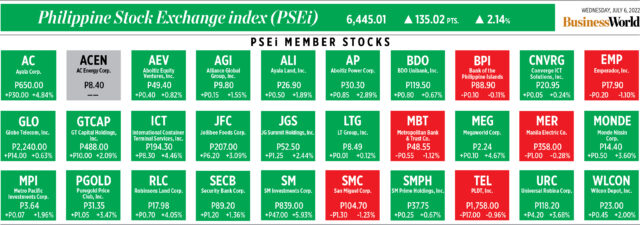
Here’s a quick glance at how PSEi stocks fared on Wednesday, July 6, 2022.


Here’s a quick glance at how PSEi stocks fared on Wednesday, July 6, 2022.

President Ferdinand R. Marcos, Jr. has agreed to a proposal by health authorities to consider one as having been fully vaccinated only if they have been injected with at least one booster shot, according to local state media.
“The move was also in preparation for the impending full implementation of face-to-face classes this year,” the Philippine News Agency said in a report.
Health Undersecretary Maria Rosario S. Vergeire asked the president to redefine the term “fully vaccinated” to encourage people to get a booster shot, it said.
Meanwhile, Mr. Marcos met with health officials to discuss the government’s pandemic situation, according to the Department of Health (DoH). They also talked about vaccination efforts.
DoH said Ms. Vergeire had recommended to improve the country’s response to the health crisis, which forced the Duterte government to enforce stringent lockdowns that were opposed by businesses.
Mr. Marcos has yet to name his health chief, as well as the heads of Energy, Environment, and Science and Technology departments.
His Finance chief Benjamin E. Diokno said the government would no longer enforce general lockdowns under the Marcos administration.
“I think no country now — except maybe China — will go into general lockdowns,” he told a news briefing. “We have to live with the virus.” — Kyle Aristophere T. Atienza
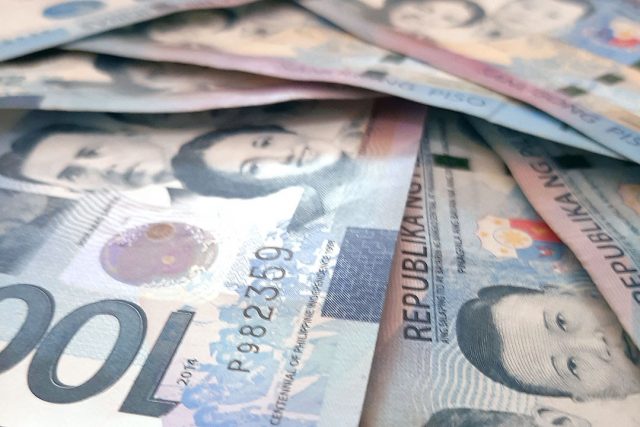
THE PESO ended weaker against the dollar on Wednesday as expectations of more monetary tightening from the US Federal Reserve amid rising inflation made the market more risk averse.
The local unit closed at P55.67 versus the dollar on Wednesday, sinking by 44 centavos from its Tuesday finish of P55.23, data from the Bankers Association of the Philippines’ website showed.
This was the local unit’s worst close in nearly 17 years or since it ended at P55.71 against the dollar on Oct. 20, 2005.
The peso opened Wednesday’s session at P55.42 against the dollar, which was also its intraday best. Its weakest showing for the day was at P55.72 versus the greenback.
Dollars exchanged went down to $1.245 billion on Wednesday from $1.285 billion on Tuesday.
“The peso exchange rate weaker versus the US dollar for the second straight day… amid a stronger US dollar versus major global currencies partly brought about by some risk aversion emanating from possible US economic slowdown or even recession amid more aggressive Fed rate hikes/monetary tightening in an effort to clamp down elevated US CPI (consumer price index) towards the long-term target of 2%, from the new 40-year high of 8.6% in May 2022,” Rizal Commercial Banking Corp. Chief Economist Michael L. Ricafort said.
Still, the peso was supported by lower global oil prices, gains in the local stock market, as well as hawkish signals from the Bangko Sentral ng Pilipinas chief on more rate hikes to curb rising inflation, Mr. Ricafort said.
A trader said the peso closed lower due to broad dollar strength amid fears of a recession in the US.
“All eyes will be on FOMC (Federal Open Market Committee) later,” the trader said, referring to the release of the minutes of the Fed’s June meeting overnight.
The dollar stood tall on Wednesday, holding at a 20-year peak against the euro and multi-month highs against other major peers as higher gas prices and political uncertainty renewed recession fears and sent investors scrambling to the safe-haven currency, Reuters reported.
For Thursday, Mr. Ricafort gave a forecast range of P55.50 to P55.75, while the trader said the peso could move from P55.50 to P55.80 against the dollar. — with a report from DGCR
STOCKS continued to rise on Wednesday following a decline in global oil prices, which could ease inflation concerns, and lower US yields.
The benchmark Philippine Stock Exchange index (PSEi) rose by 135.02 points or 2.14% to close at 6,445.01 on Wednesday, while the broader all shares index went up by 44.20 points or 1.30% to 3,442.90.
“The decline in international oil prices lifted investors’ sentiment since it is seen to help in bringing down the country’s inflation if sustained,” Philstocks Financial, Inc. Senior Research Analyst Japhet Louis O. Tantiangco said in a Viber message.
“Also boosting local sentiment, oil prices fell yesterday as speculations grew that an economic slowdown will cut demand for petroleum products,” Regina Capital Development Corp. Head of Sales Luis A. Limlingan said in a Viber message.
“Philippine shares broke past the 6,400 mark, with falling bond yields giving a boost to growth stocks, and ahead of a slew of economic reports. The market moves also came on the back of the public’s recession worries after the benchmark 10-year US Treasury yield fell below the two-year yield,” Mr. Limlingan added.
Brent crude futures have slid this month on worries that a global slowdown will sap demand. Prices slumped 9.5% to a 2-1/2-month low of $101.10 on Tuesday, before bouncing slightly to $103.86 a barrel in the Asia session on Wednesday, Reuters reported.
Meanwhile, the two-year US Treasury yield has dropped below the 10-year yield, a reliable market signal of a recession capping growth in the medium term.
Yields on two-year Treasuries rose as high as 2.95%, while the 10-year stood at 2.94%. The two-year and five-year parts of the curve also inverted for the first time since February 2020.
The inversions suggest that while investors expect higher short-term rates, they may be growing nervous about the US Federal Reserve’s ability to control inflation without hurting growth.
Back home, majority of the sectoral indices ended in the green except mining and oil, which slid by 160.64 points or 1.42% to 11,143.41.
On the other hand, holding firms climbed by 219.40 points or 3.74% to 6,072.39; industrials gained 201.47 points or 2.18% to end at 9,433.85; services went up by 28.28 points or 1.69% to 1,698.47; property increased by 37.30 points or 1.28% to 2,947.91; and financials added 0.38 point or 0.02% to close at 1,510.96.
Value turnover increased to P5.32 billion on Wednesday with 915.72 million issues switching hands from the P3.98 billion with 509.22 million shares seen on Tuesday.
Advancers outnumbered decliners, 114 versus 71, while 47 names closed unchanged.
Foreigners turned buyers with net purchases worth P93.22 million recorded on Wednesday from the P146.06 million in net selling seen the previous trading day.
Mr. Limlingan said investors will monitor the Fed minutes to be released overnight, as well as US data on mortgages and manufacturing. — J.I.DP. Tabile with Reuters

CHINESE State Councilor and Foreign Minister Wang Yi on Wednesday said he expects relations between China and the Philippines to reach a “golden era” under the Marcos administration.
“I’m confident that with both sides working together, we can surely open up a new golden era for the bilateral relationship,” he said in Chinese during a meeting with Philippine envoys in Pasay City near the capital, a voice recording of which was sent to reporters by the Department of Foreign Affairs (DFA).
The Chinese state councilor was the first foreign counterpart to be received by newly appointed Foreign Affairs Secretary Enrique A. Manalo, who used to be the country’s permanent representative to the United Nations, when he arrived in the Philippines on Wednesday.
Mr. Wang said he appreciates Philippine President Ferdinand R. Marcos, Jr., who called China the country’s “strongest partner.”
“He hopes to deepen and build an even stronger relationship with China, so we are ready to work towards that same direction with the Philippines and to plan for our cooperation moving forward, in all areas of our comprehensive strategic partnership,” he said.
Mr. Marcos has called China the Philippines’ strongest partner in pandemic recovery efforts. In an earlier event, he said the Philippine-China relationship is “very important” and “advantageous to both countries.”
As the political, economic and sociocultural landscapes shift, regional security has become more complex, Mr. Manalo said at the meeting. “We also find ourselves rebuilding after the pandemic, which has ravaged our economies as well as our efforts to reach development goals.”
He added that he expects exchanges with China to benefit both nations, noting that China has been a good friend and close partner of the Philippines in recovery efforts.
“We have stood shoulder to shoulder in times of great difficulty, helping one another so that we may both bring progress to our respective nations,” he said.
“Given the current circumstances, in particular as you have mentioned, the uncertain, unstable and complex regional and international dynamics, it is even more important for China and the Philippines, as two close neighbors, to join hands to further enhance mutual trust, expand mutually beneficial cooperation,” Mr. Wang said.
“This will not only serve the common interest of the two countries and the two peoples, but will also be an important contribution to the peace and stability of our region,” he added.
He noted that under the leadership of former President Rodrigo R. Duterte, Philippine-China relations overcame all sorts of difficulties, achieved a turnaround and grew stronger.
‘GOOD PARTNERS’
Mr. Duterte led a pivot away from the United States toward China when he became president in 2016 by seeking closer trade investment ties with its neighbor.
The cooperation, which Mr. Wang said has become more dynamic, brought tangible benefits to both the Chinese and Filipino people.
“I hope that our two sides can work together to add new relevance to this relationship of comprehensive strategic cooperation in the new era and build this relationship into one that is capitalized by good neighbors, good relatives and good partners,” he said.
Mr. Marcos on Tuesday said he would meet with Mr. Wang to discuss ways to strengthen ties with China and find ways to resolve their sea dispute. “Let’s do other things too that will normalize our relationship,” he added.
Mr. Manalo and Mr. Wang witnessed the signing of a memorandum of understanding to promote cooperation between the Stock Exchanges of the Philippines and China, the DFA tweeted separately.
Philippine Stock Exchange President and Chief Executive Officer Ramon S. Monzon and Deng Jun, country head of Bank of China’s Manila branch, signed the deal that seeks to promote bilateral investment and trade through capital market linkages between the two nations.
The South China Sea, a key global shipping route, is subject to overlapping territorial claims involving China, Brunei, Malaysia, the Philippines, Taiwan and Vietnam.
The Philippines in May filed a diplomatic protest against China for its unilateral imposition of a three-and-half-month fishing ban in some areas of the South China Sea.
The Philippines has “sovereignty, sovereign rights and jurisdiction” over the disputed areas of the waterway, the DFA said in a diplomatic note dated May 30, citing the country’s 2016 arbitral award by a United Nations (UN)-backed tribunal that invalidated China’s claim to more than 80% of the sea.
China has ignored the ruling.
The fishing ban is expected to last until Aug. 16.
DFA had also summoned a senior Chinese Embassy official as it accused Beijing of harassing a research vessel near the Second Thomas Shoal in the South China Sea.
The shoal, which the Philippines calls Ayungin, forms part of its exclusive economic zone and continental shelf, DFA said. — Alyssa Nicole O. Tan

THE PHILIPPINES’ anti-graft court has convicted a retired general of bribery and facilitating money laundering after he amassed at least P303 million from illegal commissions, gifts and other schemes during his military tenure.
In an eight-page decision dated July 5, the Sandiganbayan Second Division ruled ex-military Major General Carlos F. Garcia’s crimes had resulted in an undue advantage at the expense of the Filipino people.
It added that the former military official had made “malicious and felonious” transactions with several banks.
Mr. Garcia was initially charged with plunder and money laundering but had entered a plea bargain deal for the lesser offenses of direct bribery and facilitating money laundering in 2010.
As part of the deal, he would surrender P135.43 million worth of cash and real estate properties that he and his family owned to the government.
In its ruling, the anti-graft court sentenced him to as long as 14 years in prison and fined him more than P400 million for both crimes.
Under the country’s law penalizing plunder, a public official who is found guilty of acquiring ill-gotten wealth of at least P50 million may face life imprisonment and permanent disqualification from holding public office.
In 2013, The Office of the Solicitor General appealed the plea bargain.
The Supreme Court last year lifted a temporary restraining order on the retired major general’s case, as it ruled the chief government lawyer had no personality to meddle in the plunder lawsuit.
It said the Sandiganbayan did not abuse its discretion in approving the plea deal because the government prosecutors had failed to prove Mr. Garcia’s guilt for plunder and money laundering beyond reasonable doubt.
The High Court added that the plea deal was “purely upon the discretion of the prosecutor, while its approval is subject to the judicial discretion of the court trying the facts.“ — John Victor D. Ordoñez

PRESIDENT Ferdinand R. Marcos, Jr. has declared July 9 as a regular holiday in observance of Eid’l Adha or the Muslim Feast of Sacrifice, according to his office.
The National Commission on Muslim Filipinos recommended the holiday, the president said in Proclamation No. 2, which was signed on July 5.
“The observance of Eid’l Adha shall be subject to the public health measures of the National Government,” Mr. Marcos said in the proclamation.
Muslims make up about 6.01% of the Philippines’ total population, according to a 2017 report by the local statistics agency. — Kyle Aristophere T. Atienza

THE CHILD Rights Network (CRN) has called for government action on the alleged sexual abuse, harassment, and other forms of violence suffered by students at the Philippine High School for the Arts (PHSA) in Los Baños, Laguna.
The group cited an in-depth feature article published by VICE World News at the end of June which revealed the government’s alleged “slapdash approach” in addressing the issue, “enabling the continuation of these horrid abuses.”
“The reported crimes against children are crimes of power, with power relations between teachers and house parents in the boarding school tilted against their victims,” CRN, an alliance of organizations and agencies pushing for children’s rights legislation in the Philippines, said in a statement on Wednesday.
The state-owned PHSA has called VICE’s portrayal “unfair,” and denied accusations that it is a “haven for abuse.”
“PHSA, just like any other institution, is not perfect,” it said in a statement posted on its Facebook page on Wednesday. “But please be assured all our school personnel are working hand-in-hand towards providing our students a safe learning environment, whether online or in Makiling.”
The institution’s management said they sympathized with their alumni who reported the past abuses and have informed them to file formal complaints with the proper forum and the school’s designated committees.
CRN said a national review of procedures on child protection in educational institutions is needed to know if this issue also persists in other schools across the country, and what immediate actions can be taken.
“No renowned artist can and should hide under the shadow of artistic pursuits to justify sexual abuse, harassment, and toxic treatment of their students,” it said.
“Schools should be safe spaces, not places where abuse and harassment thrive,” it added. — Alyssa Nicole O. Tan
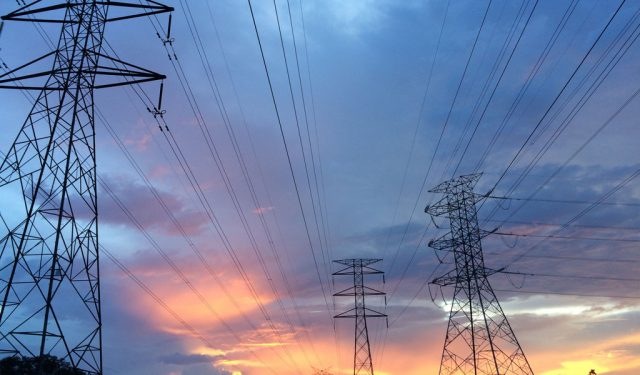
THE National Grid Corp. of the Philippines (NGCP) said an unscheduled power interruption completely blacked out the islands of Panay and Guimaras beginning early Wednesday.
The NGCP said in an advisory sent via Viber that the power interruption affected all distribution utilities in Panay and Guimaras starting 6:56 a.m. No further details were provided.
The outage in the Western Visayas comes on the heels of a three-day blackout in Occidental Mindoro starting June 25. The blackout was attributed to Occidental Mindoro Consolidated Power Corp.’s (OMCPC) decision to stop supplying electricity to Occidental Mindoro Electric Cooperative, Inc. (OMECO) after the expiration of their power supply agreement (PSA).
Senator Sherwin T. Gatchalian called for a Senate investigation after the Mindoro outage.
Mr. Gatchalian said in a statement that he plans to “file a resolution to have the Senate direct the appropriate committee to conduct an inquiry in aid of legislation on the matter, highlighting the need for a supply reliability and power quality and to protect consumers from losses attributed to power outages.”
Power supply resumed on Monday after Energy Regulatory Commission provisionally approved a new PSA for OMECO and OMCPC.
Mr. Gatchalian said that if issues are not addressed, provinces like Occidental Mindoro will be left behind.
“Kung hindi sapat ang mga umiiral na batas para tugunan ang problema sa suplay at kalidad ng kuryente sa Occidental Mindoro o kahit saan pa mang lugar o probinsiya, maaari tayong magbalangkas ng mga bagong batas o reporma sa mga kasalukuyang batas (If the prevailing laws are not sufficient to address problems of power supply and quality in Occidental Mindoro or in any other places, we may draft new laws or reform current laws),” Mr. Gatchalian added.
OMECO’s Occidental Mindoro franchise services 240,887 households. — Justine Irish D. Tabile

THE yellow corn industry is in need of technology upgrades in order to bridge the supply-demand gap, according to a roadmap for the industry issued by the Department of Agriculture (DA).
“Bridging the current 40% supply gap will need yield-increasing technologies particularly among small growers, adequate post harvest machinery and facilities, streamlined marketing systems, enhanced support services, and enabling policy environment,” according to the plan.
Yellow corn is mainly used for animal feed, and has a follow-on effect on meat and poultry prices if corn is expensive.
“The domestic corn sector has grown four-fold since the mid-1990s serving the markets for feed, food, other industries, as well as home consumption. In 2020, the country achieved only 57% sufficiency in yellow corn for feed use; thus, is a net importer of yellow corn, feed wheat, and soya meal from Indonesia, Myanmar, the United States, and Ukraine, among others,” according to the report.
To increase the harvest, the DA said the government must invest in technology upgrades, postharvest infrastructure and information and R&D support systems. It must also intervene to head off market inefficiencies in the corn market.
The roadmap contemplates the expansion of corn farming in Cagayan, Isabela, Tarlac, Quezon, Rizal, Occidental Mindoro, Zamboanga Sibugay, Misamis Oriental, Sarangani and Agusan del Sur.
According to the report, corn is the number two Philippine staple and accounts for 9.67% of the land planted to crops.
“It is widely grown by small farmers in resource-poor environments; thus, contributing to food and nutrient security, and (is critical for) community resilience. With such significance and value to offer to the country, the corn sector remains a strategic commodity that requires a detailed roadmap and plan to fully realize the potential benefits the sector has to offer,” the DA said.
Former Agriculture Secretary William D. Dar said policymakers must consider the forces driving performance in the corn industry.
“The corn industry has been challenged not only by natural causes but by a host of factors such as low farm technology adoption, poor or absence of mechanization and postharvest facilities, failings in market and support services, and inadequacies in governance,” he added. — Luisa Maria Jacinta C. Jocson
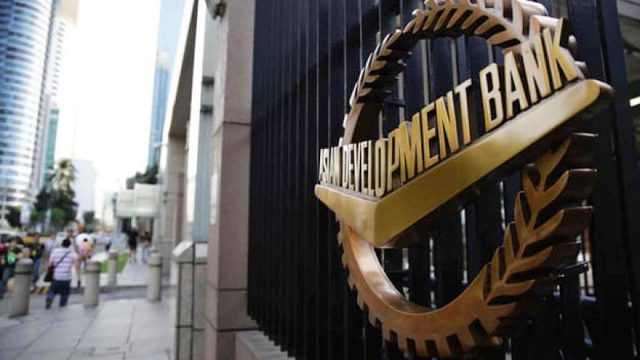
THE Asian Development Bank (ADB) said the Philippines must ensure that its recovery is sufficiently green in light of the challenges posed by climate change and declining biodiversity.
The ADB, in a statement, noted that the Philippines is considered one of the top five countries most impacted by climate change, making the sustainability of its post-pandemic recovery measures crucial.
Specifically, the ADB cited issues with Philippine reefs, heavy reliance on marine ecosystems, and the large populations of smallholder fishermen depending on these resources for livelihood and sustenance.
The ADB took note of action taken by the Philippines to address such concerns, including a 2020 moratorium on the development of new coal-fired power plants, and a plan to incentivize private sector investment in renewables such as large-scale geothermal projects.
The ADB also noted the Philippines’ work with the bank on a catalytic financing mechanism under the Green Climate Fund (GCF) to facilitate recovery from the pandemic.
The government’s commitment to fast-tracking its transition to renewable energy from coal is reflected in its target to increase renewables’ share of the energy mix to at least 30% by 2030, the ADB said.
And while some Philippine industries like food processing and construction have specific initiatives, the country still does not have an integrated circular economy plan governing the re-use of minerals, fossil fuels, metals, and biomass.
“While several countries in the region have begun to support a green recovery, more needs to be done. We must encourage additional green stimulus, design carbon pricing schemes, reduce dependence on fossil-fuel intensive power, and attract private sector investors to large-scale renewable energy, sustainable transport, and clean urban projects,” ADB Director General for Southeast Asia Ramesh Subramaniam said in a webinar.
The ADB supports a green-recovery approach for Cambodia, Indonesia, Myanmar, Thailand, and the Philippines.
It estimates that if climate change issues are not addressed, it could cost ASEAN economies an estimated 11% of their combined GDP by 2100.
The ADB identified five focus areas with potential for effecting a green recovery: productive and regenerative agriculture, healthy and productive oceans, sustainable urban development and transport, circular economy models, and renewable and efficient energy.
The ADB said that “if leveraged fully, the five green growth opportunities would require approximately $172 billion in capital investment and can create 30 million jobs in Southeast Asia by 2030.” — Justine Irish D. Tabile

THE PHILIPPINES is exploring collaboration with Italy in strategic minerals required by the electric vehicle industry, the Department of Trade and Industry said.
Trade Secretary Alfredo E. Pascual said in a speech delivered at the Association of Southeast Asian Nations (ASEAN)-Italy economic dialogue on Wednesday that the Philippines can be Italy’s source of “green” metals such as nickel, cobalt, and copper.
“Our country can be Italy’s strategic partner in supplying critical minerals needed for Italian electric vehicles (EVs) and battery production,” Mr. Pascual said.
“We have nickel, cobalt, and copper in abundance. The Philippines is also a dominant supplier of nickel ore, not only in Asia but in the world. It accounts for 31% of global exports. But, of course, we now want to have greater value addition locally for our mineral resources,” he added.
Mr. Pascual said Italian EV manufacturers can take advantage of the zero tariffs on imported EVs in the Philippines. The Tariff Commission recommended zero tariffs to encourage greater take up of EVs.
He added that the Philippines is opening up its EV market to develop an ecosystem that can support local production.
“Our Tariff Commission has recommended eliminating tariffs on EVs. Approval of this recommendation will put Italian EV makers on a level playing field alongside our free trade agreement partners,” Mr. Pascual said.
Mr. Pascual also said that the Philippines can collaborate with Italy on energy technology, specifically “digitally supported grids for dealing with intermittent power. We need such solutions for our small island grids, our off-grid communities, and our priorities on a national scale.”
“In the case of the Philippines, we are on the verge of massive adoption of renewables for energy security. But renewable energy is characterized by an intermittent power supply. Thus, our legacy baseload grid needs to adapt to more intermittent power sources,” he added.
Mr. Pascual said that Italy and ASEAN can collaborate on manufacturing, and also encourage smart farming and agricultural technology to boost food security.
“With Agriculture 4.0 also taking root in Southeast Asia, Italy and ASEAN may work together to promote smart farming and agricultural technology that can contribute to onshore food security,” Mr. Pascual said.
“ASEAN and Italy may also consider collaboration in aerospace parts manufacturing; aircraft maintenance, repair, and overhaul; and aerospace research and development,” he added. — Revin Mikhael D. Ochave
