Home Blog Page 5627

This small business incorporates sustainable practices in its everyday operations; why can’t we?  

Sustainability has become a buzzword for every big business in the Philippines and the world. But for growing companies, incorporating sustainable practices to protect the environment can seem daunting.

But for Green Fit Friend (GFF) personal care founder April Sarah Peoro, or Ara, as she is fondly called, sustainability should be a part of everyone’s agenda – even for small businesses.

Creating a sustainable business model was Peoro’s priority when she transformed her GFF advocacy-based blog into a business.

“The Philippines is the third largest contributor of plastic wastes into the ocean, and by 2050 there could be more plastic than fish in the sea. And it hit home, and I thought about the future of my nieces and the next generation. What will be left for them?” Ara says.

Championing sustainability  

Ara’s passion for the environment and a healthy lifestyle started when her brother introduced her to the University of the Philippines (UP) Mountaineers, shortly after quitting her job as a flight attendant.

“He told me maybe I could find myself in the mountains—true enough, I found myself falling in love with the beauty of our mountains and islands,” she adds. “I’ve seen numerous places around the world only to find out that the Philippines is the center of rich biodiversity. It ignited my desire to protect it somehow.”

Aside from shifting to a more sustainable lifestyle, she also decided to champion her cause through a blog and eventually a YouTube channel. Through GFF, Ara shared her mindful living adventures around the country.

Ara then launched GFF Eco-friendly Personal Care and Sustainable Alternatives, combining her passion for healthy living and environmental protection as the pillars of building her personal care startup. She first created handmade and plastic-free soaps, shampoo, and conditioner bars for herself and her family, but it quickly turned into an enterprise.

Using natural, sustainable, and locally-sourced raw materials, Ara’s line of premium, eco-personal care products speak for themselves. Her brand has grown through social media, bazaar pop-ups, and the help of good old mom-and-pop shops that carry her product.

More than a brand, but a movement

A portion of every GFF purchase goes to reforestation projects and different advocacy organizations tackling environmental conservation or helping the most vulnerable communities concerning the climate crisis.

“Now that we have traction from the market, every purchase reminds us of our advocacy. It reaffirms our mission of reducing plastic usage and waste and creating more alternatives that are safe for the environment and our clients,” she says.

Ara is one of 15 Filipino entrepreneurs featured in Maya Business’ newest series, “Scale Up: The Show,” where dreamers compete for a prize of seed capital of up to P150,000 in each episode. Five winners from the series will then compete for the grand prize of P500,000.

Her passion for the environment captured the attention of business moguls and judges, including Maya Chief Marketing Officer Pepe Torres, Tiny Buds co-founder Lorin Tan, and Boozy PH CEO Miguel Guerrero.

“We love meetings Filipino dreamers like Ara, who have advocacies tied to their fresh business ideas,” Torres says. “Expanding and scaling up their brand is one of the biggest challenges for small business owners, and Maya is excited to provide them with the right tools to achieve their dreams.”

As the all-in-one growth partner of enterprises in the Philippines, Maya Business provides entrepreneurs like Ara with convenient digital payment solutions and banking services under one integrated platform.

MSMEs using Shopify can avail of the Maya Checkout Plugin for seamless payment acceptance of credit, debit, prepaid cards, and e-wallets. They can also accept cashless payments in-store from users of Maya and other financial institutions via Maya QR, enabled by QR Ph. For employee payroll and supplier payments, they can use Maya Disbursements.

Catch “Scale Up: the Show” on the One News Facebook and Youtube page and get inspired by the modern entrepreneurs’ passion, hard work, and possibilities with Maya Business.


Spotlight is BusinessWorld’s sponsored section that allows advertisers to amplify their brand and connect with BusinessWorld’s audience by enabling them to publish their stories directly on the BusinessWorld Web site. For more information, send an email to online@bworldonline.com.

Join us on Viber to get more updates from BusinessWorld: https://bit.ly/3hv6bLA.

Flash mobs and YouTubers boost India anti-coal mining protests

 – Vaibhav Bemetariha’s wedding card was a conversation starter.

The 38-year-old’s friends and family were intrigued by his decision to print “save Hasdeo” in support of a protest to protect a major forest in his state from coal mining.

“Even my wife had questions,” said the newlywed Bemetariha, who lives in Raipur, the capital of eastern Chhattisgarh state – home to one of India‘s largest coal reserves.

“I have promised to take her to the forest (Hasdeo Arand) to show her why protecting it matters so much and cutting (trees) to meet power needs is not necessary,” he said by phone.

“It is our personal contribution to a fight that the adivasis (tribes) have fought alone so far.”

Hasdeo Arand, one of central India‘s largest intact forests and the site of the country’s longest anticoal protests by indigenous communities, is gaining growing support from people such as Bemetariha in cities and towns across Chhattisgarh.

In April, news of local authorities felling hundreds of trees in the area sparked outrage, with on-the-ground protests and the hashtag #SaveHasdeo trending on Twitter. YouTubers, artists and even students have backed the movement publicly.

The surge in solidarity comes on the heels of India‘s worst power crisis in more than six years, as a summer heatwave drove up demand for power and spurred the government to announce the opening of new and closed coal mines to bridge the energy gap.

The Hasdeo Arand coalfield, spread over 1,878 square km (725 square miles) in Korba, Surguja and Surajpur districts, has 23 new coal blocks, of which seven have so far been given approval to open by the federal government, Chhattisgarh state has said.

The forest, meanwhile, is home to indigenous people such as India‘s largest Gond tribe. It has rich biodiversity with an elephant corridor and the Hasdeo river cutting through it.

Opening up coal mines in the area will not only lead to the loss of thousands of hectares of forest land, but also affect the flow of the river, cause pollution and displace many villagers, according to antimining activists.

Vijendra Aznabi, an active supporter of the Adivasi Van Adhikar Manch, an indigenous peoples’ forest rights alliance, said the issue was the hot topic at the recent Hareli festival in Chhattisgarh, which celebrates farming and the environment.

“(Instead of a) generic celebration of nature, this time it was a specific discussion on saving the forest,” he said.

Flash mobs were organised, there are songs being written and constant social media campaigns to support the adivasis,” he added. “Nobody wants the forest cut and mining to happen.”


‘SURGE OF SUPPORT’

Student Lakshya Madhukar’s grandfather was a mining engineer and his mother grew up in Korba, a Chhattisgarh mining hub.

The 16-year-old, a self-described “nature lover”, won a recent school competition on protecting the environment by focusing on the struggle of indigenous people in Hasdeo Arand.

“My mother’s family comes from a village in Korba, where mining was – and is – a way of life,” Madhukar said by phone.

“But we also know of the impact of mining. And Hasdeo Arand is in the news so much now, we wanted to make our art and theatre play relevant,” he said, referring to the competition.

Like Madhukar, many people in Raipur were moved by a 300-km (186 mile) walk by 250 villagers from their homes to the state capital to protest against new mining in the region last year.

“The long march was an eye-opener for many,” said Alok Shukla of the non-profit Chhattisgarh Bachao Andolan, which supports the communities in Hasdeo Arand.

“The protesting communities were tired and often wondered how long they would have to fight. But this surge of support has strengthened their resolve and given a boost to their movement,” he said, adding that there had been an increase in news reports and television debates on the issue since the march.

The protesters have been demanding the cancellation of all coal mining projects in Hasdeo Arand, stating that permissions were granted illegally and mining would cause irreparable damage.

Last month, the state’s legislative assembly passed a resolution asking the federal government to cancel all coal block allocations in the area, citing the elephant corridor.

Protesters and non-profits said they believed their movement was partly responsible, but did not think mining permissions would end up being scrapped given the growing demand for energy and pressure from companies. The protests will go on, they said.


ART AND YOUTUBE

When artist Pramod Sahu, known for his rangolis (traditional patterns drawn on the ground), decided to support the Hasdeo movement, his neighbourhood was facing long power outages.

Coal accounts for more than 70% of India‘s electricity output, but Sahu said he did not buy the argument that thermal coal power is the only way to meet rising energy needs.

In his depiction of the problem, the artist portrayed the Hasdeo Arand forest as the lungs of the state being sold to mining firms by the government.

“It was symbolic of what most people believe,” Sahu said.

In Bilaspur town, about 170 km from Hasdeo Arand, groundwater has significantly depleted, forcing residents to buy water delivered by tankers and sparking their own protest to support the communities who are resisting the opening of mines.

YouTuber Deepak Patel, 31, who highlights tourist destinations across Chhattisgarh, decided to use his channel to talk to his tens of thousands of subscribers about the issue.

His main motivation is the fact that the Hasdeo river is a key source of water for Bilaspur, where he lives.

Bhanumati Kalluri of the Dhaatri Resource Centre, which works with women in mining areas, said there was a surge in support for communities impacted by various types of mining.

“These haven’t become anti-fossil fuel movements yet, but urban Indians battling air pollution and water scarcity are worried about the indirect impacts of mining on their lives,” she said.

“It is also fuelling conversation on green energy options.”

In Raipur, the newly-married Bemetariha said an encounter he had with one of the women who walked to raise awareness about the threat of coal mining to Hasdeo Arand had deeply moved him.

“She said that she was willing to be buried on that land but would not give up an inch of the forest. That is how much saving this forest mattered to her and now it matters to me also.” – Reuters

New breed of video sites thrive on misinformation and hate

STOCK PHOTO | Image by Chen from Pixabay

A day after a mass shooting in Buffalo, New York last May, the video-sharing website BitChute was amplifying a far-right conspiracy theory that the massacre was a so-called false flag operation, meant to discredit gun-loving Americans.

Three of the top 15 videos on the site that day blamed U.S. federal agents instead of the true culprit: a white-supremacist teenager who had vowed to “kill as many blacks as possible” before shooting 13 people, killing 10. Other popular videos uploaded by BitChute users falsely claimed COVID-19 vaccines caused cancers that “literally eat you” and spread the debunked claim that Microsoft founder Bill Gates caused a global baby-formula shortage.

BitChute has boomed as YouTube, Twitter and Facebook tighten rules to combat misinformation and hate speech. An upstart BitChute rival, Odysee, has also taken off. Both promote themselves as free-speech havens, and they’re at the forefront of a fast-growing alternative media system that delivers once-fringe ideas to millions of people worldwide.

Searching the two sites on major news topics plunges viewers into a labyrinth of outlandish conspiracy theories, racist abuse and graphic violence. As their viewership has surged since 2019, they have cultivated a devoted audience of mostly younger men, according to data from digital intelligence firm Similarweb SMWB.N.

Online misinformation, though usually legal, triggers real-world harm. U.S. election workers have faced a wave of death threats and harassment inspired by former President Donald Trump’s false claims that the 2020 election was rigged, which also fueled the deadly Jan. 6, 2021 U.S. Capitol riot. Reuters interviews with a dozen people accused of terrorizing election workers revealed that some had acted on bogus information they found on BitChute and almost all had consumed content on sites popular among the far-right.

BitChute and Odysee both host hundreds of videos inspired by the QAnon conspiracy theory, whose supporters have been arrested for threatening politicians, abducting children and blocking a bridge near Arizona’s Hoover Dam with an armored truck full of guns and ammunition.

“Platforms such as BitChute and Odysee have had a seismic impact on the disinformation landscape,” said Joe Ondrak of Logically, a British firm that works with governments and other organizations to reduce the harm of misinformation. The sites, he said, had become the “first port of call” for conspiracists to publish videos.

BitChute and Odysee say they comply with the law by, for example, removing terrorism-related material, and that they have rules banning racist content or incitement of violence. At the same time, the companies defended the rights of extremists to express themselves on their sites and downplayed the importance of their content.

“Bitchute’s North Star is free speech, which is the cornerstone of a free and democratic society,” BitChute said in a statement to Reuters. Odysee said that right-wing and conspiracy content didn’t define the platform, which it said is focusing on generating science- and technology-related videos.

Despite the platforms’ rules, their users routinely publish overtly racist videos and post comments that call for violence, a Reuters review of the sites found. BitChute and Odysee didn’t respond to questions about content that appeared to violate the sites’ guidelines.

All social media platforms publish standards saying they don’t accept extreme or hateful content, said Callum Hood of the Center for Countering Digital Hate in London. “The real test is: Do they live up to those standards? With BitChute and Odysee, the answer is an emphatic no.”

Some academics who have researched BitChute and Odysee say their relaxed content-moderation practices result in sites that are dominated by incendiary content that most online publishers routinely reject. Benjamin Horne, a social scientist at the University of Tennessee, Knoxville, and two colleagues reviewed more than 440,000 BitChute videos and found that 12% of channels received more than 85% of the engagement. “Almost all of those channels contain far-right conspiracies or extreme hate speech,” their report concluded.

Reuters searches of the sites show that their most popular videos are often full of abusive content and misinformation that grossly distort news events.

The top BitChute and Odysee videos in searches for “Buffalo shooting” assert that the massacre never happened. Three of the top 10 on Odysee claimed that Black survivors and witnesses were actors. “It’s payday in the ghetto,” said one commentator. Another video defended the racist theory that motivated the shooter: that whites are being “replaced” by non-whites through migration and population growth. The only purely factual video among BitChute’s top 10 results attracted a slew of racist comments, with one viewer describing the shooter as a “patriot” and his victims as “dumb n‑‑‑‑‑s.”

Searching for “COVID” on BitChute one recent day produced a short film called Plandemic as the top result. Plandemic was banned by YouTube and Facebook for its potentially harmful misinformation, including the claim that wearing a facemask “literally activates your own virus” and makes you sick. At least seven of the top 10 “COVID” search results on Odysee also contained falsehoods – for example, that vaccines contain dangerous nanoparticles or have side-effects that are “like a nuclear bomb.”

It’s a similar story with a widely reported atrocity of the Russia-Ukraine war. Nine out of the top 10 search results on BitChute for “Bucha massacre” theorized that the killing by Russian soldiers of Ukrainian citizens was a hoax intended to escalate U.S. involvement in the war, or that it was the work of Ukrainian soldiers, British agents or “Nazis.”

Identical YouTube searches on these topics produced almost all factual reports from established news organizations. This is consistent with YouTube’s policy of prioritizing information from what it calls “authoritative sources” on sensitive topics or events.

BitChute and Odysee are hardly the only sites spreading misinformation. Social media giants such as Facebook and YouTube have also struggled to contain such content, but they have responded with more aggressive moderation policies and practices.

A more direct competitor to BitChute and Odysee is Rumble, a larger video-sharing site that attracts right-wing users. Rumble also touts itself as a free-speech champion and attracts thousands of videos promoting conspiracy theories. But Rumble has mainstream ambitions and better financial backing, and the company moderates its content enough to make it palatable to app stores run by Apple AAPL.O and Google GOOGL.O – a key growth driver for any digital business.

Founded in 2013 by Chris Pavlovski, a Canadian entrepreneur, Rumble started as a clearing house for viral videos about children and animals. By 2020, Pavlovski was capitalizing on anti-Big Tech sentiment to attract prominent right-wing commentators, and the following year won financial backing from billionaire Peter Thiel, a Republican kingmaker. Thiel didn’t reply to a request for comment.

Today, Rumble offers a mix of pets and politics, with one foot in the febrile, pro-Trump world where the 2020 election was stolen and climate change doesn’t exist. Rumble said in a statement that the platform offered a “wide variety” of information, including a channel featuring Reuters content. A Reuters spokesperson said Rumble is a customer that pays to publish Reuters content.

Rumble said its audience is growing rapidly because it trusts adults “to make up their own minds after hearing all sides.” But the platform does limit some extreme speech. Search for the N-word on Rumble, for instance, and you get a message: “No videos found.”

The same search on BitChute and Odysee returns hundreds of racist videos. BitChute co-founder and Chief Executive Ray Vahey and Odysee co-founder Jeremy Kauffman are self-styled libertarians who see their creations as safe zones for free speech – no matter how false or repellent.

The onslaught of vile content attracted by that philosophy caused one of BitChute’s three founders to quit and got the platform banned from mainstream app stores. Odysee has managed to stay in the Apple app store, but only by blocking searches for COVID-19 in its app.

Apple said in a statement that it only permits COVID-19 information in apps from governments and other “recognized entities.” The company did not answer questions about whether the extremists and white supremacists on Odysee are permitted under Apple guidelines, which ban offensive references to racial, religious and other groups.

Both BitChute and Odysee have struggled to find workable financial models in an increasingly crowded market, even as both quickly amassed huge audiences, attracting hundreds of millions of site visits annually.

Odysee’s story starts with a frisbee-playing American eccentric who sought to finance the site by inventing a new cryptocurrency. BitChute has roots in northern Thailand, where a reclusive British expat decided that something had to be done about internet censorship.


‘KILL ‘EM ALL’

Vahey, 45, is a software designer who lives in the sleepy suburbs of Chiang Mai. Before starting BitChute, Vahey created animated nursery rhymes for a YouTube channel called RockstarLittle. The songs, among them “Incy Wincy Spider” and “Twinkle Twinkle Little Star,” also appear on BitChute under its “Education” category, where they’re mixed with videos about chemtrails – the conspiracy theory that governments are secretly spraying toxins from aircraft – and security-camera footage of a hooded man shooting a Brazilian shop assistant in the head.

Vahey declined to be interviewed for this story but has detailed his vision in recorded talks with BitChute users posted to the site. In one recent talk, he recalled a “golden age” when the internet had fewer restrictions. “It seems like the more censorship has grown, the more society has been ripped apart,” he said.

Bit Chute Ltd was incorporated in Britain in 2017 by Vahey and two other Brits. Rich Jones, a software developer by training, is the company’s chief operations officer. He is 53, lives in England and, on his LinkedIn page, describes Vahey as “a former classmate and long-time friend.” Jones also declined to comment.

Andy Munarriz, a 53-year-old telecoms expert, is BitChute’s third co-founder. “Around this time YouTube, Facebook and others were removing contributors, and Ray felt free speech was under attack,” Munarriz told Reuters. Vahey started BitChute in his spare time, running it from his Chiang Mai home.

Vahey was shocked when his platform “took off like a rocket,” he recalled in an interview published on BitChute in December. “It was overwhelming. The next day, I had to scale up. And the next day, I had to scale up again.”

Horne, the BitChute researcher, said the platform owes its early success to the prominent U.S. conspiracy theorist Alex Jones. His Infowars show joined BitChute in late 2017 and gained popularity as YouTube and other platforms evicted Jones the following year.

Among other falsehoods, Jones championed the theory that the 2012 Sandy Hook school massacre was a hoax. Twenty children and six staff members were fatally shot; Jones claimed their families were actors and the shooting was a false-flag operation concocted by a government that wanted to seize citizens’ guns. Today, videos from a variety of content creators on BitChute and Odysee make strikingly similar claims about the Buffalo shooting.

A Texas jury recently ordered Jones to pay $50 million in damages to the parents of one child killed in the shooting. A spokesperson for Infowars and a lawyer for Jones did not respond to requests for comment.

Horne’s team collected and analyzed more than three million videos from 61,000 BitChute channels posted between June 2019 and December 2021, finding that almost all of the platform’s most popular videos were full of misinformation and hate speech. Horne said the researchers found a “recruitment video” for Atomwaffen Division, which the Southern Poverty Law Center describes as a “terroristic neo-Nazi organization.” Federal and state authorities have charged Atomwaffen members with crimes including murder.

Horne said he reported the video to the Federal Bureau of Investigation but didn’t hear back. The FBI declined to comment. The video is no longer available on BitChute, which didn’t respond to questions about what happened to it.

Experts say Atomwaffen Division disbanded in 2020. A former leader of the group, John Denton, pleaded guilty in 2020 for his part in a racially motivated campaign of harassment and was sentenced to 41 months in prison. Neither Denton nor his lawyer responded to requests for comment.

The comment sections beneath some of the BitChute videos that Horne’s team reviewed contained “high amounts of hate speech, most of it anti-Semitic,” Horne said. Reuters also found dozens of videos featuring white men fighting Black men, with comments extolling the violence: “N‑‑‑‑‑ stompin fuck yeah.” One video consisted of graphic footage of a man being burned to death. “They are the scum of the world,” commented one viewer, referring to Black people. “Kill ‘em all.”

In the December interview, Vahey said he often sees opinions he disagrees with on BitChute, but “that’s part of accepting what free speech is.” For Munarriz, one of the company’s co-founders, it was too much. He quit in January 2019, alarmed at BitChute’s direction.

“No matter what community guidelines you put in place, or how hard you police, objectionable content would still make its way onto the platform under the guise of ‘free speech,’” Munarriz told Reuters. “Why take on that fight? The intention of BitChute is not to be a destination for objectionable content, but in the real world that’s what happens.”

In theory, BitChute users can filter the content they see by choosing one of three “sensitivity” settings: “Normal,” “NSFW” (“not safe for work”) and “NSFL” (“not safe for life”). In practice, because BitChute’s uploaders choose these settings, even “Normal” videos can include disturbing footage of suicides and killings.

The Buffalo shooter livestreamed his rampage on Twitch, a platform owned by Amazon AMZN.O, which quickly removed it. But the gruesome footage was reposted on BitChute, where it stayed for days, before eventually being taken down for depicting what BitChute called “abhorrent violence” on a page explaining the removal.

BitChute didn’t respond to a request for comment on why the video wasn’t taken down sooner.

Since 2020, under rules enforced by the British media regulator Ofcom, BitChute must protect the public from “harmful content.” This means, primarily, content that would be deemed a criminal offense under laws relating to terrorism and child sexual abuse, or content that incites violence or hatred against particular groups. Ofcom can impose heavy fines or even suspend a platform.

Ofcom and BitChute told Reuters they had consulted with each other on content to ensure compliance – “while maintaining our free speech guidelines,” added BitChute. But that doesn’t mean BitChute has removed all potentially harmful content. Ofcom told Reuters that the regulations don’t require BitChute to proactively police itself; rather, BitChute only has to remove content that someone – for example, a user or advocacy group – has reported as a violation of its terms and conditions. Moreover, the regulations apply only to BitChute’s videos and not to its user comments.

A Reuters review of BitChute’s British site found myriad examples of content promoting hate and violence, including the videos of white men beating black men and the racial slurs in their comment sections.

Ofcom said it hadn’t launched any investigations or issued any fines under the 2020 regulations against BitChute or any other company.

BitChute issued a public report in June on how it had moderated tens of thousands of videos. Most were flagged for copyright issues; others promoted terrorism, violent extremism or incited hatred. BitChute said that, in most cases, it either removed the videos or restricted their distribution in certain countries.

Reuters found that some videos blocked by BitChute in Europe remain on BitChute in the United States, where free-speech protections for social media are especially robust. In addition to constitutional protections, Section 230 of the 1996 Communications Decency Act stipulates that social media firms cannot be held legally responsible for the content that users post on their platforms.

The BitChute content blocked in Britain, but still freely available in America, includes swastika-adorned videos that attacked Jews and Blacks, and adoring montages about Adolf Hitler with names such as, “We Need You Now – Happy Birthday Mein Fuhrer.”


‘A LIZARD PERSON’

BitChute’s online traffic grew 63% in 2021 over the previous year, to 514 million visits, according to Similarweb, the digital intelligence firm. For comparison, that’s more than double the online audience of MSNBC.com, the website of the cable news channel known for left-leaning opinion hosts.

But BitChute’s funding model appears fragile. In the December interview, Vahey said he had turned down investors because he refused to compromise on free speech. He said he mostly covered his monthly running costs of $50,000 through donations and subscriptions. The site also has some advertising.

BitChute’s closest rival, Odysee, attracted 292 million visits last year. But it has taken a different path to get there.

Odysee grew from a company called LBRY (pronounced “library”), co-founded in 2015 by Jeremy Kauffman, a U.S. tech entrepreneur and radical libertarian who financed LBRY by creating his own cryptocurrency. The company’s other founders did not respond to requests for comment.

Kauffman, 37, lives in New Hampshire, where he’s running a long-shot campaign for the U.S. Senate on the state’s Libertarian Party ticket in November’s midterm elections. His hardline version of the Party’s anti-government philosophy includes abolishing the Federal Reserve, the Internal Revenue Service and child-labor laws.

Kauffman promoted his Senate campaign with a bizarre video posted on Twitter in May. He addresses the camera in an ill-fitting crocodile costume and speaks as images flash on the screen of snarling aliens, Godzilla and President Joe Biden with a forked tongue. “I want to become a lizard person,” Kauffman says. “I would like to rule you.”

The act appeared to reference the lizard-people conspiracy theory, which holds that governing elites are really blood-sucking alien reptiles in human form.

Kauffman also posts provocative statements on Twitter. “Being unvaccinated and being Black are both choices,” he tweeted in August 2021, with a picture of a light-skinned Michael Jackson. He told Reuters the tweet was a joke.

“I think it’s funny,” said Kauffman, the sole occupant of LBRY’s plainly furnished headquarters in downtown Manchester, New Hampshire. “If you don’t think it’s funny,” he said, “you don’t have to look at it.”

In college at Rensselaer Polytechnic Institute in Troy, New York, Kauffman studied computer science and physics, and played competitive frisbee. He had little experience in publishing when, in 2015, he set up LBRY with four others, promising to bring “freedom back to the web,” according to an early investor pitch.

LBRY’s business model relied on sales of its own cryptocurrency, called LBC. Launched on the cusp of a crypto boom, the price jumped, pushing the company’s value to $1.2 billion.

But in March 2021, the Securities and Exchange Commission sued LBRY, alleging that selling a cryptocurrency to finance its operations amounted to an unregistered securities offering. Kauffman attacked the commission in tweets and interviews as “monsters,” and told Reuters he had spent $2 million on legal fees on a “Kafka-esque” fight. The Securities and Exchange Commission declined to comment on the case, which is still pending.

Even before the suit, demand for LBC was faltering. After its 2016 launch, the currency’s value swung up and down, reaching $1.29 in early 2018 before collapsing, according to CoinGecko, a website that tracks cryptocurrency values. It now trades at about two cents.

The company started a streaming platform in late 2019 called LBRY.TV. It courted creators who specialized in technology, cryptocurrencies or science, but also attracted conspiracy theorists and extremists seeking an alternative to YouTube. Paul Webb, a web developer who joined LBRY in 2017, said he raised objections when he found out the site featured videos of a leader of the Proud Boys, the far-right group whose current leader and four associates are now charged in connection with the Jan. 6 Capitol riot.

On a video call with Kauffman, Webb presented research on the Proud Boys by groups that track extremists. Webb said he argued that “we have a responsibility not to give people like that a platform.” Kauffman disagreed and said the controversy generated publicity for LBRY, according to Webb, who now works at a digital design agency based in Canada.

Asked about the exchange, Kauffman said: “Even morally questionable groups, such as Reuters journalists or the Proud Boys, should be allowed to speak to others that want to hear them.”

LBRY.TV was rebuilt and rebranded as a new website, Odysee, in late 2020. The following year, the operation was put into a new subsidiary of LBRY called Odysee Holdings Inc, with a new chief executive. Kauffman remains the CEO of LBRY, but Odysee is now run by Julian Chandra, both men said in interviews. Chandra had worked at the popular Chinese-owned short-video app TikTok before joining LBRY and taking over Odysee.

He told Reuters he wants to make Odysee a profitable platform that serves a bigger, more mainstream audience, moving beyond Kauffman’s libertarian politics and his original vision for the video-sharing site. Odysee is seeking to grow revenue through advertising and premium ad-free subscriptions.

Odysee’s traffic has grown exponentially. Like BitChute, it has fed off the turbulence surrounding COVID-19 lockdowns, mass vaccinations and Trump’s false claims about the U.S. election in November 2020. That month, Odysee’s visits doubled to about 6 million, according to Similarweb. In January 2021 – the month Trump supporters stormed the U.S. Capitol – it almost tripled again, to 17 million. By August, the total almost doubled again, to 33 million.

Odysee still bills itself as a bulwark for free speech. When YouTube last year removed several videos condemning alleged human rights abuses by China against Uyghur Muslims, Odysee provided an alternative home. It did the same for RT and Sputnik after YouTube and Facebook blocked the Russian propaganda channels in March. In a statement on Twitter, Odysee said: “We are not banning any news network. It’s a slippery slope.”

It remains a sanctuary for controversial figures. Megan Squire, a professor at Elon University in North Carolina who researches online extremism, has identified more than 100 channels on Odysee from right-wing extremists and conspiracy theorists.

Chandra acknowledged that such content existed on Odysee but said it didn’t define the platform. He said the company removes content that promotes terrorism, hatred or violence towards other groups.

Yet Odysee remains a home to neo-Nazis. Joseph Jordan, who produces videos under the pseudonym of “Eric Striker,” co-founded the white supremacist National Justice Party. In his videos on Odysee, he praises Hitler, denies the Holocaust happened and argues for policies protecting whites against Blacks. Jordan did not respond to a request for comment.

“You want me to delete this person because of what exactly? He hasn’t broken any laws,” Chandra said. “You don’t like a channel, don’t watch the channel. It’s very simple.” – Reuters


Ukraine’s capital bans Independence Day festivities, fearing Russian attack

JERNEJ FURMAN-FLICKER

 – Ukraine’s capital Kyiv banned public celebrations this week commemorating independence from Soviet rule, citing a heightened threat of attack as a U.S. official warned of Russian plans to strike Ukrainian infrastructure in the coming days.

Near frontlines in the south of the country, Ukraine said Russia fired rockets into several towns north and west of Europe’s largest nuclear power plant, captured by Russian forces shortly after they invaded Ukraine in February.

Artillery and rocket fire near the Zaporizhzhia nuclear reactor complex, on the south bank of the Dnipro River, has led to calls for the area to be demilitarized. Ukrainians living near the plant voiced fears shells could hit one of the plant’s six reactors, with potentially disastrous consequences.

“Of course, we are worried. … It’s like sitting on a powder keg,” said Alexander Lifirenko, a resident of the nearby town of Enerhodar, now under control of pro-Moscow forces. Read full story

Ukrainian President Volodymyr Zelenskiy has warned that Moscow could try “something particularly ugly” in the run-up to Wednesday‘s 31st independence anniversary, which also marks half a year since Russia invaded. Read full story

Warning of potential harm to civilians, a U.S. official told Reuters that Russia “is stepping up efforts to launch strikes against Ukraine’s civilian infrastructure and government facilities in the coming days.”

The official said the statement was based on downgraded U.S. intelligence. Read full story

Fearing renewed rocket attacks, authorities in Kyiv moved to ban public events related to the independence anniversary from Monday until Thursday. The capital is far from the front lines and has only rarely been hit by Russian missiles since Ukraine repelled a ground offensive to seize the capital in March.

Other jurisdictions also restricted public gatherings. In Kharkiv, a northeastern city that has come under frequent and deadly longer-range artillery and rocket fire, Mayor Ihor Terekhov announced an extension to an overnight curfew to run from 4 p.m. to 7 a.m. effective from Tuesday to Thursday.

In the port of Mykolaiv near Russian-held territory to the south, regional governor Vitaliy Kim said authorities planned a precautionary order for residents to work from home on Tuesday and Wednesday and urged people not to gather in large groups.


BRIDGE ATTACKED

Fears of intensified attacks rose after Russia’s Federal Security Service on Monday accused Ukrainian agents of killing Darya Dugina, daughter of a Russian ultra-nationalist ideologue, in a car bomb attack near Moscow that President Vladimir Putin called “evil”. Ukraine denies involvement. Read full story

The two sides have traded blame over frequent shelling at the Zaporizhzhia nuclear plant, where Kyiv accuses Moscow of basing troops and storing military hardware. Russia denies this and accuses Ukraine of targeting Zaporizhzhia with drones.

Overnight, Russian forces fired rockets into the nearby towns of Nikopol, Krivyi Rih and Synelnykovskyi, the area’s regional governor, Valentyn Reznichenko, wrote on Telegram.

Moscow requested a U.N. Security Council meeting be held on Tuesday to discuss the Zaporizhzhia plant, Russian state-owned news agency RIA reported, citing Deputy Ambassador to the U.N. Dmitry Polyanskiy. Read full story

To the south, renewed fighting and explosions were reported in Russian-occupied Kherson and in the Crimean peninsula, which Moscow annexed in 2014.

In Kherson, the sole bridge across the strategic Dnipro River was hit by high-precision HIMARS rockets supplied to Ukraine by the United States, injuring 15 people, a source in occupied Kherson’s emergency services told Russia’s Interfax news agency.

The bridge, a key crossing for Russian military transport in the region, has been repeatedly targeted by Ukrainian forces as they stage a counter-offensive to retake the Kherson region. A Kyiv interior ministry adviser said smoke was seen rising from the bridge.

Russian media reported explosions in the Crimean city of Sevastopol. The city’s Russian-appointed governor said an anti-air defense system had been triggered nearby. Crimea has been rocked by a series of explosions in recent weeks, including a blast at a munitions depot that Moscow blamed on saboteurs.

Reuters was not able to independently verify the battlefield reports of either side.


CIVILIAN TOLL

Russia launched on Feb. 24 what it calls a “special military operation” to demilitarize its smaller neighbor and protect Russian-speaking communities. Ukraine and its Western backers accuse Moscow of waging an imperial-style war of conquest.

The Office of the U.N. High Commissioner for Human Rights, citing its monitoring mission in Ukraine, said on Monday 5,587 civilians had been killed and 7,890 wounded between Feb. 24 and Aug. 21, mainly from artillery, rocket and missile attacks.

UNICEF, the U.N. children’s agency, said at least 972 children have been killed or injured over six months of war.

“The use of explosive weapons has caused most of the child casualties. These weapons do not discriminate between civilian and combatant, especially when used in populated areas as has been the case in Ukraine,” the agency’s executive director, Catherine Russell, said in a statement.

Separately, General Valeriy Zaluzhnyi – Kyiv’s army chief – provided what appeared to be the first public Ukrainian military death toll, saying nearly 9,000 soldiers had died in action.

Russia has not said how many of its soldiers have been killed. Ukraine’s General Staff have estimated the Russian military death toll at 45,400.

Reuters has been unable to verify military losses. – Reuters

Japan weighs lifting of pre-departure COVID tests for travellers – media

STOCK PHOTO

 – Japan may lift requirements for pre-departure COVID-19 tests for travelers entering the country, the Nikkei newspaper has reported.

Japan has some of the strictest pandemic border measures among major economies, requiring travelers to present a negative coronavirus test taken within 72 hours of departure.

The government may soon waive the tests for vaccinated passengers, with the change taking effect in a few weeks, Nikkei reported late Monday.

Chief Cabinet Secretary Hirokazu Matsuno declined to comment on Tuesday on the timing of any border easing, saying it would depend on COVID conditions in Japan and overseas.

“Along with taking every measure to prevent contagion, we’ll also promote economic activity – and with border control measures, we’ll relax them in stages while keeping these two things in balance,” Mr. Matsuno told reporters.

Representatives from Japan‘s foreign and health ministries did not immediately respond to requests for comment.

Prime Minister Fumio Kishida, who is recuperating from COVID at his home after testing positive on Sunday, said in May that he wanted to bring Japan‘s border measures more in line with those of other Group of Seven nations. Read full story

Japan in June opened up to tourists for the first time in two years, though visitors must get visas and stick to guided, package tours. Read full story

Domestic and foreign business groups have urged a greater relaxation of Japan‘s border controls, saying the measures risk causing the nation to fall behind economically.

The European Business Council in Japan said that it welcomed the lifting of COVID test requirements and discussions on lifting caps on inbound travelers, and that the easing would help make Japan a more attractive market.

“We would like to reiterate that the need for business people to have a visa before departing for Japan is still an obstacle,” EBC president Michael Mroczek said. “This in particular for businesses that have no presence in Japan.” – Reuters

AllHome Corp. releases notice to stockholders related to the amendment to the Articles of Incorporation of the Company


Spotlight is BusinessWorld’s sponsored section that allows advertisers to amplify their brand and connect with BusinessWorld’s audience by enabling them to publish their stories directly on the BusinessWorld Web site. For more information, send an email to online@bworldonline.com.

Join us on Viber to get more updates from BusinessWorld: https://bit.ly/3hv6bLA.

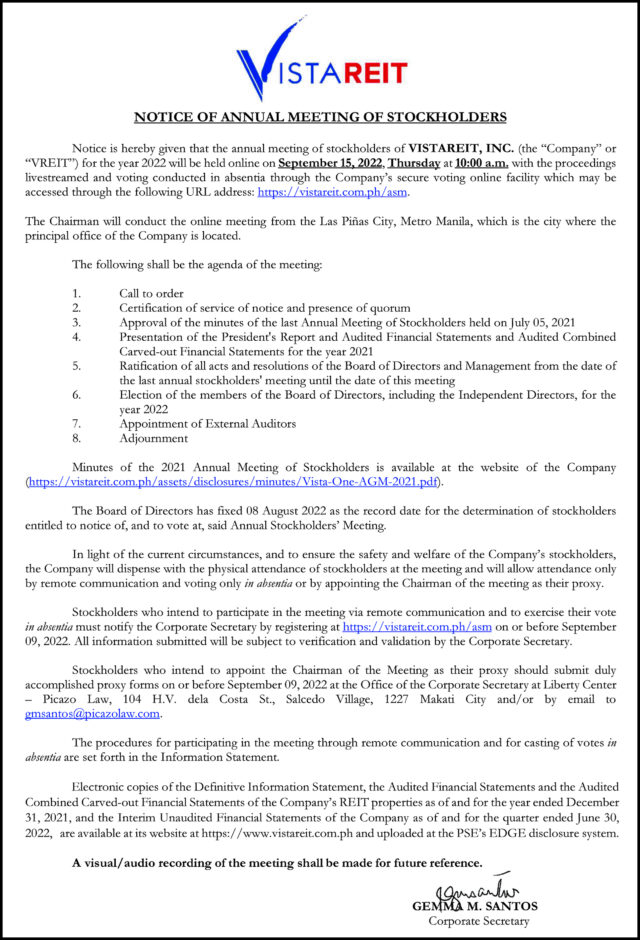
VistaREIT, Inc. to hold annual stockholders’ meeting on Sept. 15


Spotlight is BusinessWorld’s sponsored section that allows advertisers to amplify their brand and connect with BusinessWorld’s audience by enabling them to publish their stories directly on the BusinessWorld Web site. For more information, send an email to online@bworldonline.com.

Join us on Viber to get more updates from BusinessWorld: https://bit.ly/3hv6bLA.

Marcos proposes record P5.3-T budget

PHILIPPINE STAR/EDD GUMBAN

By Diego Gabriel C. Robles

THE MARCOS administration proposed to increase the allocations for education, health, agriculture, and infrastructure under the P5.268-trillion national budget for 2023, while lowering allotments for other priority sectors such as social protection.

The Department of Budget and Management (DBM) submitted to Congress on Monday the National Expenditure Program (NEP) for fiscal year 2023, which is the first full-year budget proposed by President Ferdinand R. Marcos, Jr.

The P5.268-trillion budget is 4.9% higher than this year’s budget, and equivalent to 22.2% of gross domestic product (GDP).

2023 Proposed National Government budget“This budget reflects the Agenda for Prosperity: economic transformation towards inclusivity and sustainability. As first budgets go, this proposed budget for next fiscal year represents a 75.5% growth from the P3.002-trillion budget in 2016,” Mr. Marcos said in his budget message.

The education sector, as mandated by the Constitution, received the biggest budget at P852.8 billion, an 8.2% increase from this year’s P788.5-billion allocation. This includes the funds allotted for the Department of Education (DepEd), State Universities and Colleges (SUC), Commission on Higher Education (CHED), and Technical Education and Skills Development Authority (TESDA).

The proposed DepEd budget is at P710.66 billion, up by 19.9% from the previous year. It is the second-highest budget among departments, following the Department of Public Works and Highways (DPWH).

“With the DepEd’s allocation, we hope to finally resume face-to-face classes to ensure holistic learning,” Budget Secretary Amenah F. Pangandaman said on Monday.

According to the DBM, P54.9 billion will go to education assistance and subsidies, while P47.4 billion will be earmarked for the Universal Access to Quality Tertiary Education Program.

Meanwhile, allocations for flexible learning options and basic education facilities were accorded P19.4 billion and P9.8 billion, respectively.

Ms. Pangandaman said the proposed budget of the agriculture sector stood at P184.1 billion, 39% up from P132.2 billion this year. Broken down, the Department of Agriculture will get a P102.16-billion budget, up 49% from a year ago, while the Department of Agrarian Reform will receive P15.85 billion, 58% higher than this year’s allocation.

Under the administration’s food security initiative, the National Rice Program will receive P30.5 billion. Irrigation services, as well as the construction and development of farm-to-market roads, will be given P29.5 billion and 13.1 billion, respectively.

“This is in line with the President’s directive that top priority must be given to the agriculture sector so as to invigorate and transform this sector from being an economic laggard to one of the main drivers for growth and employment,” DBM said in a statement, citing an anticipated global food crisis.

The health sector will see a 10.4% rise in next year’s budget to P296.3 billion. The Department of Health (DoH) will see 6.6% increase to P196.08 billion, while the Philippine Health Insurance Corp. will get a P100.23-billion budget.

“The Universal Health Care program will continuously be a budget priority to ensure accessible healthcare for Filipinos, especially those in the lower stratum of society,” Ms. Pangandaman said.

INFRASTRUCTURE
Under next year’s proposed budget, infrastructure spending is set at P1.196 trillion, 1.54% up from P1.178 trillion in the 2022 program.

The DPWH received the biggest budget among departments with P718.36 billion, but this is 8.6% lower than this year’s allocation.

On the other hand, the Department of Transportation (DoTr) saw a 122% increase in next year’s budget to P167.12 billion. This covers the augmented funding requirements for various foreign-assisted railway projects, according to the DBM.

“President Marcos earlier said that this administration shall continue to implement infrastructure projects and refocus to ‘Build, Better, More.’ These projects — subway, regional airports, railways and farm-to-market roads — will surely benefit the Filipino people,” Ms. Pangandaman said.

Under the infrastructure program, P140.4 billion will be allotted for the Network Development Program, P88.5 billion for the Asset Preservation Program, and P38 billion for the Bridge program.

This also includes funding for priority projects such as the North-South Commuter Railway, the Metro Manila Subway Phase 1, the Light Rail Transit Line 1 (LRT-1) Cavite Extension, the Philippine National Railways (PNR) South Long Haul, the Metro Rail Transit Line 3 (MRT-3) rehabilitation program, the Land Public Transportation program, the EDSA Busway project, the EDSA Greenways project, the Cebu BRT project, as well as the fuel subsidy program for public transport drivers.

Zyza Nadine Suzara, a public finance expert and executive director of I-Lead, said there needs to be a closer look into which departments received the “avalanche in funding.”

“The avalanche in funding will give us an indication of what the real priorities of the administration [are], and what the succeeding budgets of the Marcos administration will look like,” she said.

The Marcos administration earlier said it will allocate 5-6% of gross domestic product (GDP) annually for infrastructure.

BIGGER BUDGET
The Department of the Interior and Local Government (DILG) had the third highest budget with P253.05 billion, 1.4% higher than this year’s allocation.

In its efforts to help local governments, the administration proposed to allocate P28.9 billion for the Local Government Support Fund, composed of P13.9 billion for the Growth Equity Fund and P10 billion to support the Barangay Development Program of the National Task Force to End Local Communists Armed Conflict (NTF-ELCAC).

“Apart from National Government programs, funding support for local government units appears to be a priority for the administration,” Ms. Suzara said.

However, “the P10-billion proposed budget for the controversial NTF-ELCAC sticks out like a sore thumb in the 2023 National Expenditure program. This should likewise be watched closely,” she added.

The Department of National Defense will see a 9.2% increase in its budget to P240.7 billion.

However, the allocations for the Department of Social Welfare and Development slipped 3.8% to P197.03 billion next year.

This contains P115.6 billion for the Pantawid Pamilyang Pilipino Program (4Ps); P25.3 billion for the Social Pension for Indigent Senior Citizens; P19.9 billion for Protective Services for Individuals and Families in Difficult Circumstances; and P4.4 billion for the Sustainable Livelihood program.

The budget for the Department of Labor and Employment (DoLE) declined 48.3% to P26.23 billion next year.

Most of the DoLE’s proposed budget is for its Livelihood and Emergency Employment program, earmarked for P18.4 billion. This includes the Tulong Panghanapbuhay sa Ating Disadvantaged/Displaced Workers (TUPAD) with P14.9 billion and the DoLE Integrated Livelihood Program with P2.5 billion.

“At the national level, the 2023 National Expenditure Plan seems to contain a lot of the old existing programs of various departments and agencies. Based on the press conference, there are incremental adjustments in funding levels like the 4Ps program and those meant to support education, social services and public health. The public should scrutinize these allocations,” Ms. Suzara said.

Most of next year’s proposed budget will still go to social services at P2.071 trillion (39.31%) and economic services at P1.528 trillion (29.01%).

The rest of the proposed budget is allocated to general public services at P807.2 billion (15.32%); debt burden, including net lending, at P611 billion (11.59%); and defense at P250.7 billion (4.76%).

The revenue program for 2023 is at P3.63 trillion or equivalent to 15.3% of GDP. The rest of the proposed budget will be sourced from other nontax revenues, privatization, and deficit financing through debt.

The administration’s goal is to achieve 6.5-8% GDP growth next year until 2028, as well as reduce the poverty rate to a single digit by the end of its term.

CLOSE COORDINATION
“We look forward to a close coordination with [the] House of Representatives and the Senate. We expect that the budget will be forwarded to Malacañang by [the] first or second week of December,” Ms. Pangandaman said.

Leaders of the House of Representatives promised to finish the committee and plenary deliberations on the budget by Oct. 1, House Speaker Ferdinand Martin G. Romualdez said.

Congress is scheduled to go on its first recess on Oct. 1. Session will resume on Nov. 7.

“We will make sure that every centavo will be spent wisely to implement programs that would save lives, protect communities and make our economy strong and more agile,” Mr. Romualdez said during the submission of the NEP for fiscal year 2023 on Monday.

Marikina Rep. Stella A. Quimbo, senior vice-chairman of the Committee on Appropriations, said hearings with start on Aug. 26 with the Development Budget Coordination Committee (DBCC).

“(The budget hearings) will run all the way down to Sept. 16, and then by Sept. 21, we should be ready for plenary debates,” Ms. Quimbo said.

House Appropriations Committee Chairman and AKO-BICOL Party-list Rep. Elizaldy S. Co said pre-budget deliberations started last week so departments can address parochial concerns of lawmakers.

“Next year we plan to have it earlier, (We will) start around February and March to coordinate before the (NEP) is submitted to Congress,” Mr. Co said. “We want everyone in the Congress to be actively collaborating.”

Minority leader and Pantawid Pamilyang Pilipino Program Part-list Rep. Marcelino C. Libanan said that the minority will do its part in scrutinizing the budget during the plenary sessions.

“We will show the side of the minority, the voice of the people, but we will not be obstructionist but rather we’ll be a constructive minority because we are only one house,” Mr. Libanan said. — with Matthew Carl L. Montecillo

Consortium to sign contract for Sangley airport in Sept.

By Arjay L. Balinbin, Senior Reporter

A CONSORTIUM composed of Philippine, European and South Korean companies is set to be awarded the contract to develop the Sangley Point International Airport (SPIA) in September, according to the Cavite provincial government.

Cavite Governor Juanito Victor “Jonvic” C. Remulla, Jr. confirmed to BusinessWorld on Monday that no groups participated in the “competitive challenge” or Swiss challenge process for the SPIA project.

The SPIA Development Consortium had submitted an unsolicited proposal to develop the Sangley airport.

It is composed of the Virata-led Cavitex Holdings; Yuchengo-led House of Investments, Inc.; MacroAsia Corp., an aviation support services provider controlled by the family of billionaire Lucio C. Tan; Samsung C&T Corp., a South Korean construction and engineering company; Munich Airport International, a wholly owned subsidiary of Flughafen München GmbH; and Arup, a UK-based design company.

Cavite’s Public-Private Partnership (PPP) Selection Committee Chairman Renato A. Abutan informed Cavitex Holdings in an Aug. 18 letter that the province intends to award the contract to the SPIA Development Consortium on Sept. 14. The date is still tentatively scheduled.

Mr. Remulla sent a copy of the letter to BusinessWorld on Monday.

All unsolicited proposals are required to undergo a Swiss challenge, wherein other groups may submit counterbids.

As demand for air travel is expected to increase in the next 30 to 40 years, the province of Cavite has been pushing for the development of the SPIA as an alternative to the Ninoy Aquino International Airport in Pasay City, the Philippines’ primary gateway.

MacroAsia President and Chief Operating Officer Eduardo Luis T. Luy told reporters on Friday that there were no bids submitted during the Swiss challenge, saying this is a “good sign.”

“We (MacroAsia) are mostly going to be on the O&M (operations and maintenance) side, because previously we were supposed to be part of this project in a different way. Now that goal has kind of shifted, we will be participating more on the operations side of things,” he said on the sidelines of the formal opening of Lufthansa Technik Philippines, Inc.’s new hangar in Pasay City.

To recall, MacroAsia and its partner China Communications Construction Co. Ltd. had negotiated with Cavite for the project in 2020, but the province canceled its notice of selection and award in January 2021 due to the “various deficiencies in the submission of requirements to conclude the joint-venture agreement.”

Cavite City’s Sangley Point, located along a peninsula that juts out to Manila Bay, is currently operated by the National Government as a supplemental runway to NAIA. The airstrip was first built in 1951 by the US Navy.

BSP expected to hike rate to 4.5% by end-2022

PHILIPPINE STAR/EDD GUMBAN

THE BANGKO Sentral ng Pilipinas (BSP) is expected to remain hawkish for the rest of the year, bringing the policy rate to 4.5% by the end of the year, Fitch Solutions Country Risk & Research said.

“A combination of strong economic growth and an elevated inflationary backdrop will prompt the BSP to remain hawkish in our view,” Fitch Solutions said in an Aug. 19 note.

The BSP last week raised its benchmark policy rate by 50 basis points (bps), bringing it to 3.75%. Rates on the overnight deposit and lending facilities were also hiked by 50 bps to 3.25% and 4.25%, respectively.

“In the accompanying monetary policy statement, the Monetary Board deemed further monetary action to be necessary to anchor inflation expectations and to bring inflation back to its target of 2%-4% over the horizon. As such, we at Fitch Solutions now expect the BSP to hike its policy rate to 4.5% by end-2022, up from our previous forecast of 4.25%,” the think tank said.

Fitch Solutions maintained its average inflation forecast for the Philippines at 5.6% for 2022, slightly above the BSP’s revised 5.4% average inflation forecast.

Headline inflation accelerated to 6.4% year on year in July, the fastest in nearly four years and exceeded the central bank’s 2-4% target band for a fourth straight month. Inflation averaged 4.7% in the first seven months.

Elevated inflation will pave the way for more rate hikes by the BSP, it added.

“Against the backdrop of the ongoing Russia-Ukraine war and adverse weather conditions in several food-producing countries in the region, energy and food prices will continue to be a significant source of upward price pressure in the Philippines,” Fitch Solutions said.   

While oil prices have declined recently, the think tank said prices are still higher compared to the 2021 level.

“Our Oil & Gas team forecasts Brent crude oil to average $105 per barrel in 2022, compared to $70.95 per barrel in 2021,” it added.

The Philippine economy is expected to continue its recovery this year. Fitch Solutions earlier raised its gross domestic product (GDP) growth forecast for the Philippines to 6.6% from 6.1% previously.

“We believe that the Philippines’ economic resilience will also provide more room for the central bank to normalize its monetary policy,” it said.

“While we expect growth will likely slow in (second half of 2022) as a result of rising economic headwinds stemming from a softening global economic outlook, tightening monetary conditions, and elevated energy prices, the 2022 economic performance would still be stronger than the 5.6% recorded in 2021.”

The economy expanded by 7.4% in the second quarter, bringing first-half growth to 7.8%.

Tighter global monetary conditions in the coming months will likely exert more depreciatory pressures on the Philippine peso, Fitch Solutions said.

“The Philippine peso has come under significant depreciatory pressure as a result of tightening credit conditions globally. This will likely prompt the BSP to hike rates further in order to safeguard external stability,” it said.

The Philippine peso has depreciated by around 10% against the US dollar year to date.

The US Federal Reserve has hiked its fed fund rate by 225 bps since the start of the year to a target range of 2.25-2.50%. Fitch Solutions sees the Fed hiking by 75 bps more before yearend.

“If the BSP chooses to stand pat in subsequent meetings as the US Fed hikes, real interest rate differential could widen and trigger capital outflows, exacerbating downside volatility for the peso,” it added.

BSP Governor Felipe M. Medalla on Friday said they will respond to the US Federal Reserve’s policy tightening, but does not have to match the magnitude of its rate hikes.

“We will not match them (the Fed) point by point,” Mr. Medalla said, “If they do (raise rates by 75 basis points)… that needs a reaction.”

The Monetary Board is scheduled to meet on Sept. 22. — K.B.Ta-asan

DoTr urged to upgrade, privatize EDSA busway

PHILIPPINE STAR/ MIGUEL DE GUZMAN

THE DEPARTMENT of Transportation (DoTr) is being urged to consider the privatization of the bus system along Epifanio delos Santos Avenue (EDSA), as well as other urban rail systems to help ease the burden of commuters.

The Management Association of the Philippines (MAP) said the DoTr should look into the privatization of the EDSA busway and bus service, and urban commuter rail systems, consisting of the Metro Rail Transit Line 3 (MRT-3), Light Rail Transit Line 2 (LRT-2) and the Philippine National Railway (PNR) commuter lines under a “hybrid mode.”

Under the hybrid mode, the government will provide the infrastructure, while a private concessionaire will operate the service and maintain the facilities under an operate and maintenance (O&M) concession.

“MAP has offered to work with the DoTr and other private sector stakeholders in preparing the terms of reference for the bidding and award of the concessions to ensure a level playing field for all,” the business group said in a statement on Monday.

The recommendation was made by the MAP in a letter sent to Transportation Secretary Jaime J. Bautista.

Also, the MAP said DoTr should focus on a total system upgrade of the EDSA bus system, where commuters face long lines during rush hour.

“The upgrade will complete the EDSA busway, a work-in-progress, scale up its capacity and raise it to the level of global standards to optimize the system to achieve its full potential as a cost-effective, efficient, high-capacity urban mass public transport system commensurate to the high-commuter density of EDSA, and, as well, to ensure long-term sustainability to ably serve its role as the complementary mass transport to the MRT-3,” the business group said.

They asked the DoTr to augment vehicles in the EDSA Bus Carousel, PNR commuter lines, MRT-3 and LRT Lines 1 and 2, to improve the commuters’ experience.

“These lines should have the shortest waiting time (and therefore the shortest queues) for commuters during rush hours,” the MAP said.

Currently, commuters have to endure long lines at EDSA Bus Carousel stations due to the lack of buses. Long queues are also usually seen at the MRT and LRT stations during rush hour due to the volume of commuters.

To upgrade the EDSA busway, the MAP proposed increasing the capacity of station platforms, building more stations, and expediting the construction of donated busway station footbridges.

The DoTr should also address the chokepoints along the EDSA Bus Carousel, provide ease of bus-to-train connectivity, and establish similar busways in commuter-heavy areas in the National Capital Region, they said.

The MAP urged the DoTr to decongest the Ayala station and McKinley Road by providing an alternate route from Bonifacio Global City to the Buendia station, as well as introduce electric commuter buses.

The business group said President Ferdinand R. Marcos, Jr. should issue an executive order to “enjoin all relevant agencies to comply with the National Transport Plan (NTP) of 2017, particularly to prioritize people mobility through public transportation and active mobility, such as walking and biking, by prioritizing the allocation of road space for such purposes.”

“Currently, busway station platforms and sidewalks are very narrow and grossly inadequate as the space required for them were allocated instead to augment private vehicle lanes pursuant to misguided car-oriented road management policy,” the MAP said. — R.M.D.Ochave 

Here be dragons: Game of Thrones prequel takes flight today

THE PREQUEL to the events of Game of Thrones premieres and streams today on HBO GO. But fans of the first series should not expect rehash says the showrunner.

“There’s wish fulfillment for an audience of things they want to see. We’re not here to not give it to them. We’re here to give them the thing that they want —  just not the way that they’ve expected. We’re not trying to rehash the past. We’re trying to find something fresh and exciting,” showrunner Miguel Sapochnik said in a featurette video shown during the new series’ launch on Aug. 18 at the SM Mall of Asia Music Hall.

House of the Dragon is a 10-episode series based on George R.R. Martin’s 2018 novel, Fire & Blood. The series is set 200 years before the events of Game of Thrones, the medieval fantasy series that became a cultural phenomenon during its eight-season run.

The events happen in a period of history known as “The Dance of the Dragons,” a conflict that erupts between rival siblings Prince Aegon Targaryen and Princess Rhaenyra Targaryen over the right to sit on the Iron Throne after the demise of their father, Viserys I.

The showrunners are Ryan Condal and Mr. Sapochnik, who directed half-dozen Game of Thrones episodes. The Emmy-winning composer Ramin Djawadi also returns for musical scoring in the series.

“There was this once great day where there were dozens of Targaryen running around and a bunch of dragons and they ruled over Westeros. It was a time of peace and prosperity. And everybody knew that if you mess with the Targaryens, you would get the dragons, so nobody dared to overthrow them,” said Mr. Condal, who is also the show’s executive producer and writer, in the featurette.

“This period of Westeros was a very decadent time. And so, you get to see what the realm looks like before it descends into the detritus and post decadence and war that you see in the original series,” Mr. Condal added.

The first episode begins with King Viserys Targaryen deciding between his dutiful daughter, Princess Rhaenyra, or violent brother Prince Daemon as his successor on the throne.

“For me, the best fiction, the best drama is about characters. House of the Dragon is a story about very flawed human beings capable of love and hate, capable of doing good things, [and] capable of doing monstrous things,” said author Mr. Martin, who is also executive producer of the series.

The show stars Paddy Considine as King Viserys; Matt Smith as Prince Daemon; Emma D’Arcy as Princess Rhaenyra; Tom Glynn-Carney as Prince Aegon; Rhys Ifans as Otto Hightower, the Hand of the King; Olivia Cooke as Alicent Hightower, daughter of the Hand of the King; Steve Toussaint as Corlys Velaryon; and Eve Best as Princess Rhaenys Velaryon, wife to Lord Velaryon.
“I genuinely hope that audiences are open to watching a new chapter in the Game of Thrones saga,” Mr. Sapochnik said.

House of the Dragon streams on HBO Go. — Michelle Anne P. Soliman