Home Blog Page 5620

National Government fiscal performance

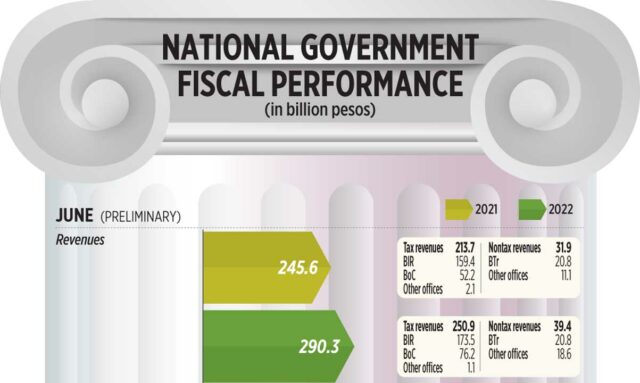
THE NATIONAL Government’s budget deficit widened in June, as revenues grew by double digits but was outpaced by faster spending for road and transport infrastructure projects, military modernization efforts, and social welfare programs. Read the full story.

National Government fiscal performance

Stocks inch higher on bets of aggressive Fed hike

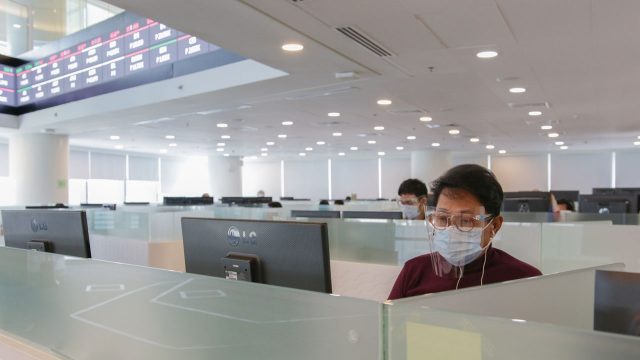
STOCKS eked out gains on Tuesday after President Ferdinand “Bongbong” R. Marcos, Jr.’s first State of the Nation Address and expectations of another aggressive rate hike by the US Federal Reserve.

The Philippine Stock Exchange index (PSEi) went up by 13.47 points or 0.21% to close at 6,223 on Tuesday, while the broader all shares index increased by 5.22 points or 0.15% to 3,364.99.

“Shares on the Philippine Stock Exchange traded in a narrow range after President Ferdinand Marcos, Jr.’s State of the Nation Address and ahead of what is likely to be another sharp US interest rate hike,” Globalinks Securities and Stocks, Inc. Head of Sales Trading Toby Allan C. Arce said in a Viber message.

Mr. Arce said that the President’s pledge to pursue “prudent” fiscal management and tax reforms gave local equities a boost.

“The Philippine stock exchange finished marginally higher with very light volume on Tuesday, as investors braced for the Fed’s crucial policy decision later this week and as they awaited more corporate earnings reports,” Timson Securities, Inc. Head of Online Trading Marc Kebinson L. Lood said in a Viber message.

Mr. Lood said “statements by Fed Chairman Jerome H. Powell after the announcements will be vital, as some investors fear that aggressive rate increases will push the US and global economies into recession.”

The Fed is holding its policy review on July 26-27. Markets are pricing in at least another 75-basis-point hike as inflation in the world’s largest economy continues to soar.

Investors also want to see if emerging risks to the economic outlook would cause the Fed to signal less aggressive rate increases in its coming meetings.

Back home, the majority of sectoral indices ended in the green on Tuesday except for property, which went down by 25.19 points or 0.89% to 2,795.87, and financials, which decreased by 0.04 point to 1,460.49.

Meanwhile, holding firms increased by 41.78 points or 0.71% to 5,912.45; services went up by 11.15 points or 0.69% to 1,626.77; industrials gained by 42.06 points or 0.45% to 9,358.98; and mining and oil inched up by 26.57 points or 0.23% to end Tuesday’s session at 11,281.96.

Advancers outnumbered decliners, 104 versus 74, while 47 names closed unchanged.

Value turnover declined further to P3.75 billion on Tuesday with 728.03 million shares changing hands from the P4.3 billion with 517.72 million issues seen the previous day.

Net foreign selling went down to P431.57 million from the P690.95 million seen on Monday.

Globalinks Securities’ Mr. Arce placed PSEi’s support from 6,150-6,000 and resistance between 6,450 and 6,500, while Timson Securities’ Mr. Lood put support at 5,900 and resistance at the 6,700 area. — Justine Irish D. Tabile

Peso surges as SONA boosts sentiment

BW FILE PHOTO

THE PESO surged and returned to the P55-per-dollar level on Tuesday as the legislative agenda unveiled in the first State of the Nation Address (SONA) of President Ferdinand “Bongbong” R. Marcos, Jr. boosted market sentiment.

The local unit closed at P55.30 per dollar on Tuesday, gaining 80 centavos from its P56.10 finish on Monday, based on Bankers Association of the Philippines data.

The peso opened Tuesday’s session stronger at P55.85 per dollar. Its weakest showing was at P55.88, while its intraday best was at P55.29 against the greenback.

Dollars exchanged surged to $1.43 billion on Tuesday from $722 million on Monday.

The peso appreciated after Mr. Marcos delivered his first SONA on Monday, Rizal Commercial Banking Corp. Chief Economist Michael L. Ricafort said in a Viber message.

In his speech, Mr. Marcos vowed to overhaul the tax system and outlined a 19-point legislative agenda designed to spur growth, bring down poverty and make the Philippines an investment destination as the economy continues to recover from the coronavirus pandemic.

The peso also continued to strengthen “as the global strong dollar theme continues to fade into the night,” ING Bank N.V.-Manila Senior Economist Nicholas Antonio T. Mapa said in an e-mail. “A short two weeks ago the Fed was primed to hike aggressively to tame red hot inflation, but fortunes have changed drastically, with investors now fearful of a potential recession.”

“A stark slowdown in growth would prompt a less hawkish central bank response, causing investors to reassess their projections for the Fed’s dot plot,” he added. 

The US Federal Reserve is expected to raise its benchmark overnight interest rate by three-quarters of a percentage point to a target range of 2.25% to 2.50% at the end of its July 26-27 meeting.

Mr. Mapa said the peso will likely trade sideways in the coming days “as investors now assess just how many rate hikes [Fed Chief Jerome H.] Powell has left in the tank and whether the BSP (Bangko Sentral ng Pilipinas) can steady sentiment while containing inflation expectations,” he added.

On Tuesday, BSP Governor Felipe M. Medalla said the central bank will likely hike borrowing costs by 25 or 50 basis points (bps) at their August meeting with the Fed expected to continue firing off big rate increases, although he ruled out another off-cycle move.

The BSP Monetary Board on July 14 raised its benchmark interest rates by an all-time high 75 bps in an off-cycle review. The surprise move came ahead of its regular policy meeting scheduled on Aug. 18, and follows two 25-bp rate hikes each in May and June.

For Wednesday, Mr. Ricafort sees the peso moving within P55 to P55.40 against the dollar. — K.B. Ta-asan

Gov’t planning more bridges across Pasig, Marikina rivers

PHILSTAR FILE PHOTO

THE Department of Public Works and Highways said the administration wants to build more bridges across the Marikina and Pasig rivers.

“We will continue with the construction of more bridges across the Marikina and Pasig rivers so that mobility will be enhanced… because there are just a few bridges connecting the north and south sectors, although the department has already built a few more,” Public Works Secretary Manuel M. Bonoan said on Tuesday at a briefing following the President’s State of the Nation Address (SONA).

He said there will be “five or six” more bridges “across the Pasig River.”

“There is an expressway that will be developed in the eastern corridor of Metro Manila that will go through Pasig, Cainta, all the way to Bulacan, and this is already being implemented,” he added.

Last year, San Miguel Corp. and the government broke ground on the 19.37-kilometer Pasig River Expressway project. The P95-billion project will link the eastern and western cities of Metro Manila and will connect to the Skyway system, integrating the elevated road network to link the north, south, east, and west corridors of the capital.

“We will continue to entice the private sector (via) public-private partnerships (PPP) for transport programs that are viable for the private sector,” Mr. Bonoan said.

At the same time, he noted that the South Luzon Expressway extension to Lucena “is now underway.”

“The other expressway that will be implemented is the Cavite-Laguna Expressway all the way to Tagaytay.”

Metro Pacific Tollways Corp. holds original proponent status for the Cavite-Tagaytay-Batangas Expressway project, a 50.43-kilometer tollway linking the Cavite-Laguna Expressway at Silang East Interchange to Tagaytay City and Nasugbu, Batangas.

In his first address to Congress on Monday, President Ferdinand R. Marcos, Jr. said his administration will “make it more convenient for travelers to go around the country, even to remote areas to help promote undiscovered tourist spots.”

“This program will be led by the Department of Tourism, together with the Department of Public Works and Highways,” he added.

The President promised to continue studying existing proposals, calling infrastructure development of primary importance.

“I will not suspend any of the ongoing projects as those have already been shown to be of benefit to the public that they serve,” Mr. Marcos said.

“Infrastructure development spending will be sustained at 5% to 6% of GDP (gross domestic product).”

Mr. Marcos also said PPPs hold “great potential” to implement infrastructure projects and encourage innovation.

MINDANAO RAIL BACK TO NEDA
Separately, the Transportation department will have to resubmit the proposed Mindanao railway project to the National Economic and Development Authority (NEDA) to review its financing, Transportation Undersecretary Cesar B. Chavez said at the post-SONA briefing.

“We will have to resubmit it to NEDA in the coming few weeks. This was approved in the past. The intention (now) is to continue it. Whether we’re (adopting) PPP or ODA (official development assistance), we will leave it to the Department of Finance, NEDA, and the economic team of the President,” he said.

Mr. Chavez announced recently that the government had cancelled its loan applications with China for the Calamba-Bicol, Clark-Subic, and Mindanao railway projects, as Beijing has been “unresponsive.”

Mr. Marcos has directed the Department of Transportation to go back to the negotiating table to secure loan agreements for the three railway projects.

In his SONA, Mr. Marcos said that outside the capital region, the government will prioritize the Mindanao railway project, the Panay railway project, and the Cebu railway project.

According to Mr. Chavez, the Panay railway project is not yet part of the transport masterplan.

“For the Cebuanos, good news, because in the masterplan of the Cebu transport for 2018-2019, (it is part of the) five railway projects identified,” he said. — Arjay L. Balinbin

No-lockdown policy outlined in SONA to aid frontline businesses

PHILIPPINE STAR/ MICHAEL VARCAS

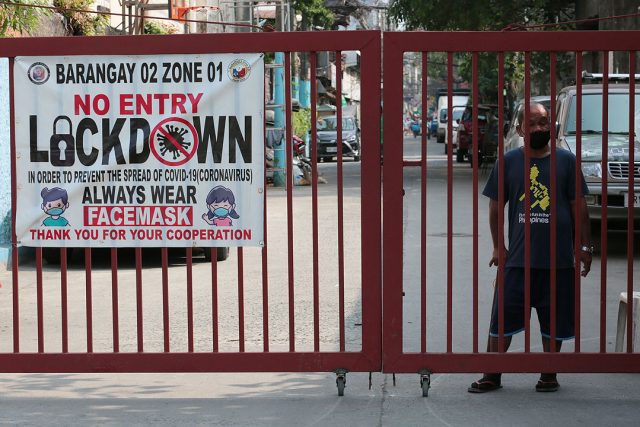
THE no-lockdown policy declared by President Ferdinand R. Marcos, Jr. during his State of the Nation Address (SONA) will help the restaurant industry and other frontline businesses, which oppose measures that cut down on foot traffic and mobility, the Department of Trade and Industry (DTI) said on Tuesday.

Trade Secretary Alfredo E. Pascual told reporters on the sidelines during the post-SONA economic briefing in Pasay City that restaurants will be more confident in doing business if a no-lockdown policy is observed.

“The businesses are always for no lockdown. Clearly, the reason why many frontline establishments collapsed is because there are no customers going to them… With no lockdown, the restaurants will be accessible to consumers,” Mr. Pascual said.

Mr. Marcos said in his SONA on July 25 that he will seek to balance the needs of public health and the economy over the remainder of the pandemic.

Sa ating sitwasyon ng pangkalusugan, nariyan pa rin ang banta ng COVID-19, lalo’t may mga nadidiskubreng bagong variants ng coronavirus. Pero hindi na natin kakayanin ang isa pang lockdown. Wala na tayong gagawing lockdown (Regarding public health, the dangers of COVID-19 remain, particularly with the emergence of new variants. But we will not be able to afford another lockdown. Lockdowns will not be resorted to),” Mr. Marcos said.

Mr. Marcos said the government is talking to drug manufacturers to bring down the cost of medicine, particularly for generic drugs.

Sinimulan ko na ang pakikipag-usap sa mga kumpanya ng gamot dito sa Pilipinas at sa ibang bansa. Hinihikayat natin na buksan nila ang merkado upang bumaba ang presyo ng gamot. Halimbawa, kung mas marami ang mas murang generic o hindi branded na gamot sa merkado, mas bababa rin ang presyo dahil sa kumpetisyon (We have begun talks with drugmakers. We are seeking to open our markets in a way that brings drug prices down. The government believes that more generic drugs will help make drugs cheaper because of competition),” Mr. Marcos said.

Ang DTI ay nakikipag-usap sa mga interesadong manufacturer ng generic drugs na papasok sa ating bansa (The DTI is negotiating with generics companies that are interested in manufacturing here),” he added.

Mr. Pascual confirmed that he has met with the Pharmaceutical and Healthcare Association of the Philippines (PHAP) and plans more meetings with the goal of expanding domestic production.

“I’ve met with the PHAP and we had a good exchange. I’m also going to meet another pharmaceutical company association consisting of domestic companies,” Mr. Pascual said.

“The thing here is how you convince consumers… that generics, especially from reliable producers or manufacturers, are as good as the branded alternative. It is in the advertising or promotion of their products,” Mr. Pascual said.

Separately, Mr. Marcos also said during the SONA that he directed the Philippine Competition Commission (PCC) to ensure an equal playing field among pharmaceutical companies.

Inuutusan ko naman ang PCC na pantay-pantay dapat at walang kartel sa hanay ng mga pharmaceutical companies. Dahil kapag bukas ang merkado, bababa ang presyo ng gamot para mapakinabangan ng ating mga mamamayan (I have ordered the PCC to ensure fair competition and deter cartel behavior among pharmaceutical companies. An open market will bring down drug prices to the benefit of consumers). This is one of the hard lessons that we learned when the pandemic struck, and therefore, we must act on that shortcoming,” Mr. Marcos said.

PCC Officer-in-Charge Chairperson Johannes R. Bernabe said in a statement on Tuesday that the commission has been monitoring potential anti-competitive practices, including cartel behavior, which may be taking place within the supply chain of pharmaceutical products.

“The PCC will pursue with even more resolve inquiry into the pharmaceutical sector, on top of its current efforts in this priority sector,” Mr. Bernabe said.

Tourism Secretary Ma. Esperanza Christina G. Frasco said in her post-SONA economic briefing that she is planning to offer incentives to encourage sustainable practices within the industry.

“It’s very important to incentivize sustainable tourism,” she said, adding that her department is planning to introduce “incentives for the private sector (for implementing) green policies… as well as… measures that promote environmental protection, energy-efficient usage, and the like,” Ms. Frasco said.

“On the part of the local government units… it’s very, very important to institutionalize zoning and land use regulations, in that we strictly implement the regulation of the development and the use of tourism destinations, to ensure that [its] use as a tourism destination lasts for the long term…,” Ms. Frasco said.  — Revin Mikhael D. Ochave

Farmers looking forward to gov’t support, value-chain streamlining after first SONA

OPS/MARCOS MEDIA TEAM

THE government’s focus on agriculture to address rising food costs heralds the distribution of financial assistance and subsidies, as signaled during President Ferdinand R. Marcos, Jr.’s first State of the Nation Address (SONA), farmers said.

“The President’s SONA underscored the problem of high food prices because the cost of producing them is increasing, compounded by the unnecessary layers in the value chain,” Samahang Industriya ng Agrikultura Executive Director Jayson H. Cainglet said in a Viber message.

“The challenge of our times is to locally produce more, and the SONA emphasized the government’s commitment to subsidize essential farm inputs — fertilizer, pesticide, feed and fuel. We also commend the marching orders to (expand) aquafarms, hog and poultry farms as the basis for increasing local production. It is by and large, a welcome start,” he added.

Federation of Free Farmers President Leonardo Q. Montemayor said that the immediate concern is to minimize supply disruptions.

“In the case of rice, our estimate is that we’re looking at a 10-15% drop in palay (unmilled rice),” he said in a phone interview.

Mr. Montemayor said that the President’s value-chain approach is useful in determining what interventions are needed, especially in terms of budgetary support.

“I hope he can scourge around for additional funds. Time is of the essence. What is critical is looking at agriculture as a whole system. It starts from pre-production, research and development, irrigation, production, mechanization, credit availability, all the way to harvesting, post-harvesting, milling, storage, even Kadiwa centers,” he added, referring to government-organized outlets where produce is sold at concessional prices.

He said there is a need to harmonize water policy to ensure agriculture’s water requirements are met.

“There are so many water agencies. Potable water in Metro Manila is always prioritized so irrigation becomes secondary. It’s important to synchronize these activities to come up with good water sources,” he added.

Mr. Montemayor also said there has to be a serious review of the Rice Tariffication Law, which was not mentioned during the SONA.

“Our first priority is productive capacity locally to provide our own food needs. Imports (should be) the last resort. Why is the first line of thinking lessening tariffs on imported food? It’s discouraging to farmers. Even if they apply these modern technologies, they are under the threat of lower palay (unmilled rice) prices,” he added.

Food advocacy group Tugon Kabuhayan said it supports the President’s proposals for financial and technical support for farmers and fisherfolk.

“We welcome the President’s initiative and clear vision to increase and support local production. We view the programs he mentioned as doable and timely especially the need to increase production of livestock, poultry and fish,” Tugon Kabuhayan co-convenor Asis G. Perez said in a statement. 

“A more pro-local producer policy would greatly help our goal of making fish cheaper and more accessible for everyone,” he added.

The Kilusang Magbubukid ng Pilipinas said that Mr. Marcos will likely continue the “pro-market policies and programs of former Secretary William D. Dar,” the President’s predecessor as Agriculture Secretary.

“Mr. Marcos did not mention the structural development of domestic agriculture that will foster job generation and overall industrialization… his plans on how to lower the cost of farm inputs are also lacking and only seem aspirational,” the group said in a statement.

Department of Agriculture (DA) Regional Executive Director Arnel V. de Mesa said during the post-SONA economic briefing on Tuesday that the government will be focusing on boosting production of key agri-commodities to help bring down food prices.

“These will be supported by the provision of credit and financial assistance,” he added.

By October, the DA will be launching the Masagana 150 and 200 programs, which aim to increase yields of inbred and hybrid rice, respectively.

“We are also focused on giving targeted interventions to farmers and fisherfolk. We will continue to digitize the sector starting with the registry system. We have more than 12 million farmers and fisherfolk. By digitalizing, we will be avoiding duplication in the interventions,” he said.

The DA will also be building border inspection facilities to prevent any further entry of animal transboundary diseases. These are due to be built in Subic, Batangas, Cebu, Davao and Manila.

Mr. De Mesa said the DA is also looking into strengthening distribution systems, establishing regional food hubs, and tapping renewable energy for irrigation. — Luisa Maria Jacinta C. Jocson

Marcos agrarian reform plan expected to unlock farm productivity

By Luisa Maria Jacinta C. Jocson, Reporter

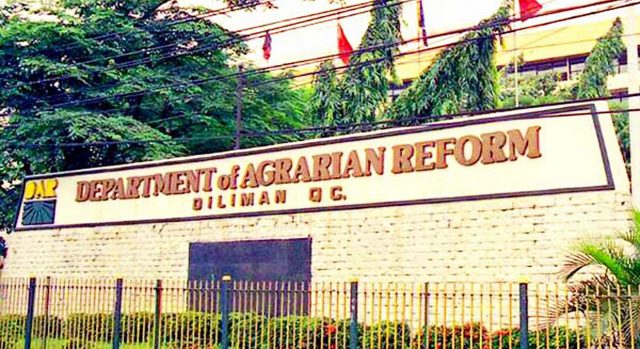
THE administration’s plan to provide relief on debt incurred by agrarian reform beneficiaries is expected to provide a boost to farm productivity, according to analysts.

“This is a step in the right direction because debt condonation will cause farmers to invest more in their land and expand the rural leasing market to promote land consolidation via lease because agrarian reform beneficiaries who have unpaid debts to the government cannot sell or lease their lands,” Foundation for Economic Freedom President Calixto V. Chikiamco said in a Viber message.

President Ferdinand R. Marcos, Jr. announced in his first State of the Nation Address on Monday that he intends to issue an executive order imposing a one-year moratorium on agrarian reform beneficiaries’ amortization and interest payments on land.

“Agrarian reform is not only about acquisition, but also about support services and distribution… the civil society organizations also support this because it will unburden the farmers of their dues and be able to focus on improving farm productivity,” he said.

“A moratorium will give the farmers the ability to channel their resources in developing their farms, maximizing their capacity to produce, and propel the growth of our economy,” he added.

Mr. Marcos also said that Congress must also pass a law that will emancipate agrarian reform beneficiaries (ARBs) from the agrarian reform debt burden, via amendments to Section 26 of Republic Act No. 6657.

“In this law, the loans of agrarian reform beneficiaries with unpaid amortization and interest shall be condoned,” he said.

“Agrarian reform beneficiaries who are still to receive their awarded land under the comprehensive agrarian reform program shall receive it without any obligation to pay any amortization,” he added.

The condonation plan covers over P58 billion in loans taken on by 654,000 ARBs and 1.18 million hectares of awarded land.

A total of 52,000 hectares of unused agricultural land owned by the government will also be distributed to landless war veterans; landless surviving spouses and orphans of war veterans; landless retirees of the Armed Forces of the Philippines and the Philippine National Police; and graduates of agriculture programs who are landless.

“The call of the times is for the infusion of fresh and new blood in the agricultural sector. We need a new breed of farmers equipped with modern agricultural technology able to engage in sustained scientific farming that will not only increase farm yields, but also resilience in the face of climate change,” Mr. Marcos added in his speech.

According to Mr. Chikiamco, debt condonation should be packaged with other reforms or amendments to the Comprehensive Agrarian Reform Law.

He said that the government should also convert all certificates of land ownership awards into simple titles and increase the land retention limit.

“Why do we need to increase the land retention limit from five hectares to 24 hectares?  Because 24 hectares is the minimum viable size for commercial farming or agribusiness. The optimal state is to also allow consolidation via ownership, rather than leasing alone. While leasing will lead to land consolidation, the downside is that (those leasing) will tend to over fertilize the land since they don’t own it. Overfertilization will lead to lower productivity of the land in the long term,” he added.

Mr. Chikiamco also proposed removing the requirement for Department of Agrarian Reform clearances on all agricultural land transfers as monitoring of land retention limits should be done by the Land Registration Authority, which has the necessary database to do so.

Federation of Free Farmers Leonardo Q. Montemayor said that Mr. Marcos’ agrarian reform proposals are a significant part of the administration’s approach to the agriculture industry.

“It shows in his thinking that the two go together. The problem is that our economists and intellectuals in the past years or so always see agrarian reform as contrary to agricultural growth and productivity. The President is saying he’s putting the two together,” he said in a phone interview.

Mr. Montemayor said that he hopes Mr. Marcos will extend debt condonation to future farmers as well.

“I hoped he (goes) all the way. Not just condone the past, but the current and future. Amortization payments should not be a bar to them getting the title. The impact on farmers is they will be (confident) knowing they can own the land they are tilling. If you are a tiller, you have a stronger motive to maximize work on the farm,” he added.

On the distribution of unused land, Mr. Montemayor said it was vital that support services are given to landowners.

“It’s not enough to give them just land. There have to be support services and financing to buy basic tools and equipment. They have to be supported, not just in giving them land but giving them assistance,” he added.

BoI approves P60-M Batangas hydroponic vegetable production project

REUTERS

THE Board of Investments (BoI) said it approved an application to register for incentives a project of Denso Philippines Corp. for a P60-million facility seeking to produce vegetables hydroponically in Ibaan, Batangas.

In a statement on Tuesday, the BoI said that Denso’s SMART Agriculture project will commence operations soon and will focus on the commercial production of microgreens, kale, arugula, herbs, and melons.

“The project’s target market will be hotels, restaurants, online markets, culinary schools, and other food-related businesses in central business district areas in the Philippines,” the BoI said.

The BoI said the hydroponic facility will tap Internet of Things technology to regulate nutrient dosing and monitoring, and will feature an integrated pest and disease management system and a climate-resilient greenhouse.

It added that the project, endorsed by the Department of Agriculture (DA), was in line with the objectives of the Agriculture, Fishery, and Forestry component of the 2022 Strategic Investment Priority Plan.

“Hydroponics are a soil-less farming system (using) mineral nutrient solutions through an inert medium such as perlite, gravel, mineral wool, expanded clay, or coconut husk. With this process, water remains in the system and is reused, which, in turn, can decrease carbon footprint,” the BoI said.

Ceferino S. Rodolfo, BoI managing head, said Denso’s project will help address food security concerns.

“These high-value crops will be significant in supporting urban areas and leveling up the country’s agriculture industry. This is only the beginning of more projects that will make food security happen in the Philippines,” Mr. Rodolfo said.

According to the BoI, the project can also help address the area’s low level of self-sufficiency in highland vegetables, with the DA forecasting a deficit of 51,116 metric tons in the Calabarzon region.

“By 2027, the global hydroponics market is expected to reach $13.4 billion, (with a) 19.2% compound annual growth rate during the forecast period of 2021–2027,” the BoI said.

“The project is aligned with the food security program being pushed by the DA. It can help achieve the DA’s vision of elevating the Filipino farmers by improving the agriculture industry, as it may contribute to the attainment of food security in urban areas in terms of ensuring a sufficient supply of fruits and vegetables and supporting green agriculture,” it added. — Revin Mikhael D. Ochave

Sustainable cities to require private sector investment, DENR says

DENR FACEBOOK PAGE

ENVIRONMENT Secretary Maria Antonia Y. Loyzaga said private sector investment will be required to make cities more sustainable and climate-resilient.

The private sector can have “an influence on how cities are shaped and the way investments are made in infrastructure,” she said at the post-State of the Nation Address economic briefing on Tuesday.

“The private sector through their programs and core business values, and environmental, social, and governance (ESG) programs need to keep in mind the risks we face,” she added.

The Department of Environment and Natural Resources (DENR), she said, recognizes the need for “resilience to keep our cities and communities safe, as well as the ecosystems that support them. Keep in mind that many major cities are coastal, or in fact, influenced or aided in development by river systems.”

She also cited the need for integrated water resource management.

“The way we need to approach this is to look at different sectors and look at the demand for the kind of sustainability we want to achieve. We need to reverse engineer, because many of our cities are water stressed,” she said.

“We know from hazards from the past but there is uncertainty in climate change. We must invest in the plausible, not just the possible, in building our cities. The preservation of the environment is the preservation of life. That is the mother statement of the DENR’s vision,” she added.

In his address to Congress on Monday, President Ferdinand R. Marcos, Jr. said that he instructed the DENR and the Department of Public Works and Highways to explore possible partnerships with the private sector to work on climate change and disaster preparedness.

“The Philippines has excellent laws on the environment, but we have to guarantee that these laws are properly enforced. And this will require a great deal of coordination and cooperation between concerned government agencies and private stakeholders,” he said.

“Companies who exploit our natural resources must follow the law. We all have the responsibility to preserve this Earth, for we are but custodians, and we will pass on this great treasure to future generations. If we cannot mitigate climate change, all our plans for the economy, all our plans for our future, will be for naught,” he added.

He also said that investing in technology that will boost capacity-building for natural disaster resiliency will be a priority.

“Geographically, we are a disaster-prone country… investment in science and technology is imperative to enable us to have accurate weather forecasts and on-time disaster alerts,” he said.

“Studies show that already many areas in the Philippines are at high risk from the rise in sea levels brought about by the increase in global temperature. We must adapt to this phenomenon with disaster-proof planning of our communities,” he added. — Luisa Maria Jacinta C. Jocson

DTI adopts international standards for electrical wiring

THE Department of Trade and Industry (DTI) said it recently adopted three international standards for electrical wiring which it said promote safer use of such products.

 In a statement on Tuesday, the DTI said the Bureau of Philippine Standards (BPS) recently adopted Philippine National Standards (PNS) UL 248-1:2021 — Low-Voltage Fuses — Part 1: General Requirements, PNS UL 248-6:2021 — Low-Voltage Fuses — Part 6: Class H Non-Renewable Fuses, and PNS UL 67:2021 —Panelboards.

 “Following the collaboration and licensing agreement between the DTI-BPS and the UL Standards and Engagement (ULSE) in November 2020, the DTI-BPS has recently adopted and promulgated three international standards on electrical wiring devices as PNS,” the DTI said.

 “The standards were the result of the collaboration of experts, both from the BPS/Technical Committee (TC) 10 and ULSE, on electrical wiring devices,” it added.

BPS Director Neil P. Catajay said the standards create common guidelines for electrical wiring and associated work practices which improve safety. — Revin Mikhael D. Ochave 

Analysts warn of instability sans anti-graft drive

OFFICE OF THE PRESS SECRETARY/ ROBINSON NIÑAL

By Kyle Aristophere T. Atienza, Reporter

THE MARCOS government’s failure to prioritize anti-corruption measures might lead to political instability that could derail the state’s economic recovery agenda, according to analysts.

“You can’t attract investments and business confidence without assurance of good governance,” Maria Ela L. Atienza, a political science professor at the University of the Philippines, said in a Facebook Messenger chat.

She said President Ferdinand R. Marcos, Jr. in his first address to Congress on Monday failed to discuss ways to strengthen the rule of law, ensure accountability and transparency and reform the country’s ailing justice system.

The president also did not discuss political reforms that can strengthen institutions and democratic processes, which are crucial to equitable growth, she added.

Mr. Marcos’ first State of the Nation Address (SONA) focused on the economy and failed to tackle a wide range of political and governance concerns, Sonny A. Africa, executive director of think tank Ibon Foundation, said in a Messenger chat.

“The SONA actually telegraphed our problem with how far we can expect the Marcos administration to deal with human rights, corruption, disinformation, political dynasties, electoral reform and other aspects of poor governance,” he said.

Mr. Marcos on Monday vowed to overhaul the tax system and unveiled a 19-point legislative agenda meant to spur growth and make the Philippines an investment destination amid a coronavirus pandemic.

Mr. Marcos started his speech with a promise to implement sound fiscal management and tax administration reforms to boost revenue collections.

The president should have promised the business community he would ensure state accountability and a fair investment climate, said Francisco A. Magno, who teaches political science and development studies at De La Salle University.

“Honest companies that would like to participate in government bidding procedures should be assuaged that there would a level business playing field where favoritism is not the name of the game,” he said in a Messenger chat.

While the president vowed to continue public investments in infrastructure, social development and health services, “he did not touch on the need to apply due diligence procedures in the awarding of contracts,” Mr. Magno said.

JUSTICE SYSTEM
“Corruption — whether done in secret or exposed by whistleblowers and legislative inquiries — will definitely dampen pandemic response and economic recovery issues,” Ms. Atienza said.

Mr. Marcos, 64, could not escape pressure to address corruption allegations against him and his family, she added. “It is difficult to lead by example when you and your family have unsettled issues.”

Ms. Atienza said potential corruption issues against the administration would likely be set aside if he has a strong backing from lawmakers, who can investigate just about anything “in aid of legislation.”

It would depend on how popular he remains and whether the super majority will remain loyal to him, she said.

Should Mr. Marcos eventually prioritize good governance and political reforms, “that would mean a major political shift is unfolding,” said Arjan P. Aguirre, who teaches political science at the Ateneo De Manila University.

He said the public should expect Mr. Marcos to consolidate his political base after the SONA “to make sure that their hold on power is stable and strong.”

“It will be personalistic and populist,” Mr. Aguirre said in a Messenger chat. “It is risky for it would mean that the alliances and alignments would change in the coming months.”

Former Senator Franklin M. Drilon also cited President Ferdinand R. Marcos, Jr.’s silence on his plans for the country’s justice system.

“I wish the president tackled the state of our justice system and the rule of law in his first State of the Nation Address,” Mr. Drilon, who is also a former Justice chief, said in a statement.

“He tackled everything from COVID-19 to our failing education system to our economic recovery. However, one critical ingredient is missing: the rule of law.”  

He said he hoped these issues would not be “swept under the rug,” adding that the Duterte government had also neglected these.

“I was hoping that there would have been a stronger statement in terms of good governance,” Management Association of the Philippines President Rogelio L. Singson told One News channel.

“If I’m a Cabinet member and I want to implement good governance principles, will my president be behind me if I go against contractors or politicians? That will always be a question behind a Cabinet member’s direction,” he added.

The Marcos administration is targeting 6.5-7.5% economic growth this year and 6.5-8% through 2028.

Mr. Marcos pledged to bring down the poverty rate to 9% by the end of his six-year term, and the ratio of the state’s budget deficit to economic output to 3%. The government also seeks to attain upper middle-income status by 2024. — with Alyssa Nicole O. Tan and Revin Mikhael D. Ochave


Forfeiture of four Marcos properties rejected by court

PRESIDENTIAL MUSEUM AND LIBRARY

THE PHILIPPINES’ anti-graft court has dismissed a government lawsuit seeking to recover at least four Marcos properties in the absence of sufficient evidence that these had been illegally obtained.

In a 12-page resolution dated July 22 and made public on Tuesday, the Sandiganbayan Fourth Division said the state had failed to prove its claims “through a preponderance of evidence.”

The court affirmed its December 2019 ruling that rejected the government’s forfeiture case covering the properties still within the Marcos family’s control, including a beach house, guest house and museum in Ilocos Norte province and a house in Manila.

The dismissal covers “properties that allegedly have not yet been recovered by the government,” according to a copy of the decision written by Justice Alex L. Quiroz uploaded on the court’s website.

The court on Dec. 29, 2019 dismissed the government’s forfeiture case against the estate of the late dictator Ferdinand E. Marcos and his family. On July 12 last year, it partially granted the state’s motion for reconsideration.

“The court resolved that a sweeping dismissal of the entire complaint on the ground of the best evidence rule (now original document rule) is not warranted, considering that many of the subject properties have long been recovered by the government,” it said in its latest ruling.

Instead, the anti-graft court ordered the government to submit a list of all the properties covered by the forfeiture lawsuit and their status.

Mr. Quiroz noted that the court had given the state the opportunity to submit further evidence, which it failed to do. In its compliance pleading dated April 25, 2022, the government said all documents and pieces of evidence had been presented during the trial.

Among the ill-gotten assets recovered by the government were shares in Philippine Long Distance Telephone Co. worth P25.2 billion, shares in Philippine Telecoms Investment Corp. worth P25.2 billion, several houses in Baguio City and 526 art pieces now under the custody of the Philippine central bank. — Norman P. Aquino, J.V.D. Ordoñez and K.A.T. Atienza