LONDON — Portrait pictures of a young Queen Elizabeth II taken at the beginning of her reign and the jewels she wore have gone on display at Buckingham Palace.
Tiaras, earrings and necklaces form part of The Queen’s Accession exhibition marking her record-breaking seven decades on the throne.
Ninety-six-year-old Elizabeth, Britain’s longest-reigning and currently the world’s oldest monarch, became queen on Feb. 6, 1952, on the death of her father King George VI.
The display is available to guests visiting the palace’s State Rooms, which are open to the public for the first time in three years. — Reuters
PILMICO Animal Nutrition Corp., the food and agribusiness subsidiary of the Aboitiz group, has launched its fourth breeder and nursery farm in Talugtug, Nueva Ecija to boost local swine production.
The farm is expected to have an additional capacity of 2,500 sow level, which can produce 4.7 million kilograms of pork meat annually.
“The past few years have been challenging for us in the swine industry mainly because of the impact of African Swine Fever (ASF),” said Pilmico First Vice-President William Paradies in a statement.
He said that in line with the company’s mission to feed humanity, “it is a big priority for us in Pilmico to contribute to the recovery of the industry by boosting the production capacity of local pork.”
The breeder and nursery farm is equipped with biosecurity measures and technologically advanced equipment in swine production.
Pilmico said that as the threat of COVID-19 and ASF continues, “the breeder and nursery farm was designed and constructed with heightened biosecurity measures. It is equipped with modern designs and the latest technology in swine production, following the high standards of a world-class facility.”
Mr. Paradies added that the firm is committed to supporting the government in uplifting the swine industry “so that together, we can serve more Filipinos with great quality pork.”
A portion of the farm’s output will be processed at Pilmico’s meat-cutting facility, Tarlac Meatmasters. — Luisa Maria Jacinta C. Jocson
UNIONBANK of the Philippines, Inc. (UnionBank) used the proceeds of its $150-million social bond issuance to help finance loans to small- and medium-sized businesses.
UnionBank submitted its 2021 Social Bond Allocation and Impact Report in a disclosure to the local bourse on Tuesday.
“The proceeds of the Social Bond shall be allocated exclusively to qualified Micro, Small and Medium Enterprises (MSME) loans, screened against the IFC (International Finance Corp.) eligibility criteria and exclusion list,” the bank said in the report.
“As of Dec. 31, 2021, the Social Bond Use of Proceeds Registry amounted to P7.793 billion, representing 103.225% allocation to the gross proceeds of the Social Bond,” UnionBank added.
The bank financed 3,751 MSME loans from the proceeds of the social bond, it said. Refinancing of outstanding loans made up 90.75% of the allocation, while 9.25% went to financing new loans.
With the use of proceeds being exclusively for MSME loans, 100% belong to the Employment Generation Social Project Category.
“In the Philippines, MSMEs accounted for over 90% of businesses and over 60% of jobs pre-COVID-19 (coronavirus disease 2019), but MSME loans only accounted for 6% of total bank loans in the country. This makes increasing access to MSME financing critical to fostering a resilient and inclusive [economy],” UnionBank said.
“MSMEs have also been disproportionately impacted by COVID-19 and the Social Bond has helped UnionBank boost financing for MSMEs primarily through its supply chain financing platform, enabled using digital technologies,” it added.
UnionBank issued $150 million or P7.55 billion in social bonds with IFC as sole investor on July 23, 2021. The deal was IFC’s first pandemic response social bond investment in Asia, which is expected to help create jobs in the MSME sector.
The dollar-denominated bonds have a seven-year tenor and were issued under the bank’s sustainable finance framework.
The bonds conform with International Capital Markets Association social bond principles and the ASEAN Social Bond Standards, as confirmed by a second-party opinion provided by research and ratings company Sustainalytics.
UnionBank recorded a lower net profit in the first three months of the year as trading gains normalized. Its net income dropped by 45% to P2.6 billion in the first quarter from P4.72 billion in the same period last year.
Shares in the Aboitiz-led bank declined by 25 centavos or 0.34% to close at P74 apiece on Tuesday. — KBT
Actual photo of Filinvest City, Alabang, Muntinlupa City, Metro Manila
Following Filinvest’s flagship development — Filinvest City in Alabang, its sustainability trademark continues in other townships
Sustainability can no longer be regarded as an additional feature; it is the path forward, especially for those who create, construct, and maintain developments — from the vast spaces right up to the single units.
Especially as the world recognizes that there is a more pressing need to reduce — if not totally eliminate — carbon emissions, green buildings and cities are one of the many investments that will pave the way for a better quality of life in the future.
With global and local recognition certifying its efforts in building a green central business district in Alabang, Muntinlupa, Filinvest City took the lead in creating greener and more livable cities in the country. Filinvest does not stop with this long-running development in South Metro Manila, however, as other Filinvest townships outside the metro start embracing the smart and sustainable practices that made Filinvest City a highly-recognized green city.
A benchmark for green cities
The 244-hectare (ha) Filinvest City is surrounded by green spaces and parks near almost all dwellings. The city has public parks and numerous pocket parks and tree-lined streets. Filinvest City is also notable for its connected streets, with paths allowing for convenient pedestrian movement — an indication of inclusivity on the road.
River Park, Filinvest City, Alabang
Filinvest City also adopts several technologies that make it possible for resources to be maximized within the township. With its District Cooling System, considered the largest in the Philippines, offices can save as much as 40% in energy costs. Filinvest City also has an expanded Sewage Treatment Plant for better health & sanitation in the community; and fully-integrated electric-powered 360 Eco-Loop vehicles for efficient public transport and, at the same time, reducing greenhouse gas emissions.
These people- and eco-friendly features in Filinvest City fit well with the manner it incorporates affordable and diverse housing; retail, dining, and entertainment spaces; as well as essential facilities like police stations, a fire station, and hospitals in a single community. On top of these, to ensure safety and connectivity, the city also provides free Wi-Fi for the community and strategically located CCTV cameras partnered with its 24/7 security team.
Testifying Filinvest City’s integration of sustainability are its Leadership in Energy and Environmental Design LEEDv4 Gold for Neighborhood Development (LEEDv4 ND) certification by the US Green Building Council in 2020 and, more recently, its 3-star Building for Ecologically Responsive Design Excellence (BERDE) Certification by the Philippine Green Building Council.
Filinvest City is the first Philippine CBD to be accorded with these certifications, which also affirm its commitment to building a greener city and to raising the benchmark for future sustainable developments in the Philippines.
“Developing prime communities that marry business and nature has always been in Filinvest townships’ DNA. This has taken shape in the form of Filinvest City,” Don Ubaldo, first vice-president for project development-townships of Filinvest Alabang, Inc., said.
Replicating the green
Following its flagship development in Alabang, Filinvest continues its embracement of sustainability in its other townships in the country.
Mimosa Plus Golf Course at Filinvest Mimosa Plus Leisure City in Clark, Pampanga
In Pampanga, Filinvest Mimosa+ Leisure City is naturally blessed with a backdrop of running mountains, abundant trees, sparkling lakes, and well-maintained landscape. The sprawling 201-ha property is widely known for its 128-ha golf course, a deluxe hotel, and residential villas. On top of these, the township seeks to further enhance its green spaces with the addition of safe and wide pedestrian paths, biking zones, and outdoor parks, the heart of which is the beautifully landscaped Acacia Park. The city also continues to be a thriving business and leisure destination that is patronized by both local and foreign visitors.
Filinvest New Clark City, future Echo-tec-ture hub in Central Luzon
Within the 9,450-ha New Clark City in Capas, Tarlac, Filinvest New Clark City is poised to be an eco-friendly, world-class metropolis as it is surrounded by scenic mountain views. The 288-ha development has a smart-planned ecosystem that combines innovation with sustainability. Envisioned to be a LEED-certified township, the city is planned to have mixed-use districts — industrial, residential, educational, and commercial — that aim to create a vibrant live-work-play-learn environment. One notable part of this township is the 120-ha Filinvest New Clark City Innovation Park, which is projected to be a pioneering logistics and light manufacturing hub and a key progress catalyst in the north of Metro Manila.
City di Mare, future corporate headquarters in SRP, Cebu City
Sitting on a prime location within the 300-ha South Road Properties in Cebu City, City di Mare begins reflecting Filinvest’s sustainability trademark outside Luzon. As it brings a vision of complete balanced living, the 58-ha community features self-contained green communities with spacious living areas, expansive greenery, and the essentials of modern living within a resident’s reach. The area’s eastern sea coast and scenic mountain views provide a beautiful backdrop for City di Mare, which is envisioned as the next premier residential, commercial, and economic center of Cebu City.
Greener opportunities
Altogether, these developments from Filinvest offer great opportunities for investors and businesses to join the growing push for building a green future.
With their affinity with green spaces, as well as their maximizing of building materials and energy sources, green cities contribute to better physical and mental well-being of pedestrians, employees, and especially residents who get immersed in nature while not having to leave the city.
“Being in close proximity to your residence, workplace, essential establishments, and transport hubs is a major consideration for residential hunters these days, as they want a community that won’t put them at risk for any health issues,” Mr. Ubaldo said.
Green open spaces also create a venue for the community to come together and engage — whether in sharing food, selling and exchanging items, celebrating and appreciating art, or even conversing over a cup of coffee. With such opportunities, green cities can create neighborhoods that make people feel at home even outside the walls of their residence.
In turn, green cities now have a greater possibility of boosting the value of properties as they have a better case of attracting businesses with a better look and character for themselves, as well as amiable work-life environments for tenants.
All these are compelling reasons for green cities as a sensible investment, especially now that people have a clearer view of what they actually need in a community. Sustainable property developments have recently seen higher market values as well. Filinvest City properties, for instance, have been enjoying increased asset values through the years, with an annual growth rate of over 22% over the last 10 years.
As a trailblazer in sustainable property development, Filinvest’s cities offer better choices for individuals and companies, as well as concrete resilience for businesses.
Spotlight is BusinessWorld’s sponsored section that allows advertisers to amplify their brand and connect with BusinessWorld’s audience by enabling them to publish their stories directly on the BusinessWorld Web site. For more information, send an email to online@bworldonline.com.
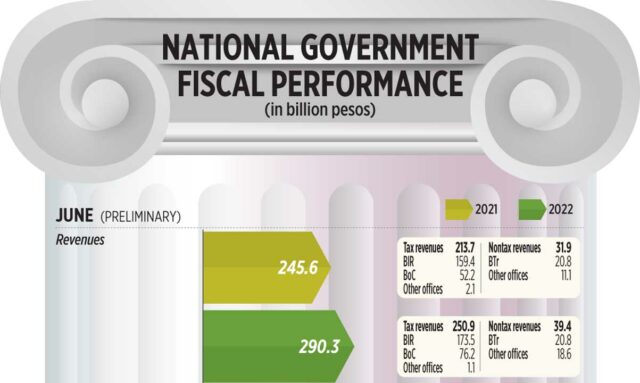
THE NATIONAL Government’s budget deficit widened in June, as revenues grew by double digits but was outpaced by faster spending for road and transport infrastructure projects, military modernization efforts, and social welfare programs. Read the full story.
STOCKS eked out gains on Tuesday after President Ferdinand “Bongbong” R. Marcos, Jr.’s first State of the Nation Address and expectations of another aggressive rate hike by the US Federal Reserve.
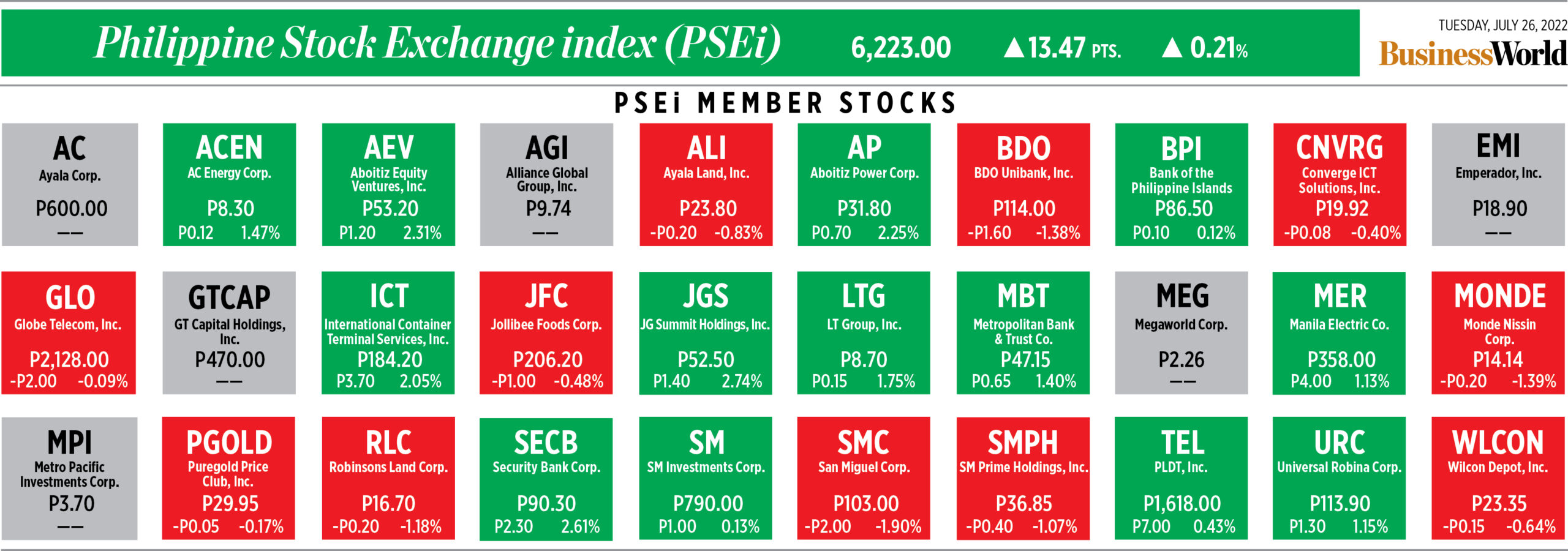
The Philippine Stock Exchange index (PSEi) went up by 13.47 points or 0.21% to close at 6,223 on Tuesday, while the broader all shares index increased by 5.22 points or 0.15% to 3,364.99.
“Shares on the Philippine Stock Exchange traded in a narrow range after President Ferdinand Marcos, Jr.’s State of the Nation Address and ahead of what is likely to be another sharp US interest rate hike,” Globalinks Securities and Stocks, Inc. Head of Sales Trading Toby Allan C. Arce said in a Viber message.
Mr. Arce said that the President’s pledge to pursue “prudent” fiscal management and tax reforms gave local equities a boost.
“The Philippine stock exchange finished marginally higher with very light volume on Tuesday, as investors braced for the Fed’s crucial policy decision later this week and as they awaited more corporate earnings reports,” Timson Securities, Inc. Head of Online Trading Marc Kebinson L. Lood said in a Viber message.
Mr. Lood said “statements by Fed Chairman Jerome H. Powell after the announcements will be vital, as some investors fear that aggressive rate increases will push the US and global economies into recession.”
The Fed is holding its policy review on July 26-27. Markets are pricing in at least another 75-basis-point hike as inflation in the world’s largest economy continues to soar.
Investors also want to see if emerging risks to the economic outlook would cause the Fed to signal less aggressive rate increases in its coming meetings.
Back home, the majority of sectoral indices ended in the green on Tuesday except for property, which went down by 25.19 points or 0.89% to 2,795.87, and financials, which decreased by 0.04 point to 1,460.49.
Meanwhile, holding firms increased by 41.78 points or 0.71% to 5,912.45; services went up by 11.15 points or 0.69% to 1,626.77; industrials gained by 42.06 points or 0.45% to 9,358.98; and mining and oil inched up by 26.57 points or 0.23% to end Tuesday’s session at 11,281.96.
Advancers outnumbered decliners, 104 versus 74, while 47 names closed unchanged.
Value turnover declined further to P3.75 billion on Tuesday with 728.03 million shares changing hands from the P4.3 billion with 517.72 million issues seen the previous day.
Net foreign selling went down to P431.57 million from the P690.95 million seen on Monday.
Globalinks Securities’ Mr. Arce placed PSEi’s support from 6,150-6,000 and resistance between 6,450 and 6,500, while Timson Securities’ Mr. Lood put support at 5,900 and resistance at the 6,700 area. — Justine Irish D. Tabile
THE PESO surged and returned to the P55-per-dollar level on Tuesday as the legislative agenda unveiled in the first State of the Nation Address (SONA) of President Ferdinand “Bongbong” R. Marcos, Jr. boosted market sentiment.
The local unit closed at P55.30 per dollar on Tuesday, gaining 80 centavos from its P56.10 finish on Monday, based on Bankers Association of the Philippines data.
The peso opened Tuesday’s session stronger at P55.85 per dollar. Its weakest showing was at P55.88, while its intraday best was at P55.29 against the greenback.
Dollars exchanged surged to $1.43 billion on Tuesday from $722 million on Monday.
The peso appreciated after Mr. Marcos delivered his first SONA on Monday, Rizal Commercial Banking Corp. Chief Economist Michael L. Ricafort said in a Viber message.
In his speech, Mr. Marcos vowed to overhaul the tax system and outlined a 19-point legislative agenda designed to spur growth, bring down poverty and make the Philippines an investment destination as the economy continues to recover from the coronavirus pandemic.
The peso also continued to strengthen “as the global strong dollar theme continues to fade into the night,” ING Bank N.V.-Manila Senior Economist Nicholas Antonio T. Mapa said in an e-mail. “A short two weeks ago the Fed was primed to hike aggressively to tame red hot inflation, but fortunes have changed drastically, with investors now fearful of a potential recession.”
“A stark slowdown in growth would prompt a less hawkish central bank response, causing investors to reassess their projections for the Fed’s dot plot,” he added.
The US Federal Reserve is expected to raise its benchmark overnight interest rate by three-quarters of a percentage point to a target range of 2.25% to 2.50% at the end of its July 26-27 meeting.
Mr. Mapa said the peso will likely trade sideways in the coming days “as investors now assess just how many rate hikes [Fed Chief Jerome H.] Powell has left in the tank and whether the BSP (Bangko Sentral ng Pilipinas) can steady sentiment while containing inflation expectations,” he added.
On Tuesday, BSP Governor Felipe M. Medalla said the central bank will likely hike borrowing costs by 25 or 50 basis points (bps) at their August meeting with the Fed expected to continue firing off big rate increases, although he ruled out another off-cycle move.
The BSP Monetary Board on July 14 raised its benchmark interest rates by an all-time high 75 bps in an off-cycle review. The surprise move came ahead of its regular policy meeting scheduled on Aug. 18, and follows two 25-bp rate hikes each in May and June.
For Wednesday, Mr. Ricafort sees the peso moving within P55 to P55.40 against the dollar. — K.B. Ta-asan
THE Department of Public Works and Highways said the administration wants to build more bridges across the Marikina and Pasig rivers.
“We will continue with the construction of more bridges across the Marikina and Pasig rivers so that mobility will be enhanced… because there are just a few bridges connecting the north and south sectors, although the department has already built a few more,” Public Works Secretary Manuel M. Bonoan said on Tuesday at a briefing following the President’s State of the Nation Address (SONA).
He said there will be “five or six” more bridges “across the Pasig River.”
“There is an expressway that will be developed in the eastern corridor of Metro Manila that will go through Pasig, Cainta, all the way to Bulacan, and this is already being implemented,” he added.
Last year, San Miguel Corp. and the government broke ground on the 19.37-kilometer Pasig River Expressway project. The P95-billion project will link the eastern and western cities of Metro Manila and will connect to the Skyway system, integrating the elevated road network to link the north, south, east, and west corridors of the capital.
“We will continue to entice the private sector (via) public-private partnerships (PPP) for transport programs that are viable for the private sector,” Mr. Bonoan said.
At the same time, he noted that the South Luzon Expressway extension to Lucena “is now underway.”
“The other expressway that will be implemented is the Cavite-Laguna Expressway all the way to Tagaytay.”
Metro Pacific Tollways Corp. holds original proponent status for the Cavite-Tagaytay-Batangas Expressway project, a 50.43-kilometer tollway linking the Cavite-Laguna Expressway at Silang East Interchange to Tagaytay City and Nasugbu, Batangas.
In his first address to Congress on Monday, President Ferdinand R. Marcos, Jr. said his administration will “make it more convenient for travelers to go around the country, even to remote areas to help promote undiscovered tourist spots.”
“This program will be led by the Department of Tourism, together with the Department of Public Works and Highways,” he added.
The President promised to continue studying existing proposals, calling infrastructure development of primary importance.
“I will not suspend any of the ongoing projects as those have already been shown to be of benefit to the public that they serve,” Mr. Marcos said.
“Infrastructure development spending will be sustained at 5% to 6% of GDP (gross domestic product).”
Mr. Marcos also said PPPs hold “great potential” to implement infrastructure projects and encourage innovation.
MINDANAO RAIL BACK TO NEDA Separately, the Transportation department will have to resubmit the proposed Mindanao railway project to the National Economic and Development Authority (NEDA) to review its financing, Transportation Undersecretary Cesar B. Chavez said at the post-SONA briefing.
“We will have to resubmit it to NEDA in the coming few weeks. This was approved in the past. The intention (now) is to continue it. Whether we’re (adopting) PPP or ODA (official development assistance), we will leave it to the Department of Finance, NEDA, and the economic team of the President,” he said.
Mr. Chavez announced recently that the government had cancelled its loan applications with China for the Calamba-Bicol, Clark-Subic, and Mindanao railway projects, as Beijing has been “unresponsive.”
Mr. Marcos has directed the Department of Transportation to go back to the negotiating table to secure loan agreements for the three railway projects.
In his SONA, Mr. Marcos said that outside the capital region, the government will prioritize the Mindanao railway project, the Panay railway project, and the Cebu railway project.
According to Mr. Chavez, the Panay railway project is not yet part of the transport masterplan.
“For the Cebuanos, good news, because in the masterplan of the Cebu transport for 2018-2019, (it is part of the) five railway projects identified,” he said. — Arjay L. Balinbin
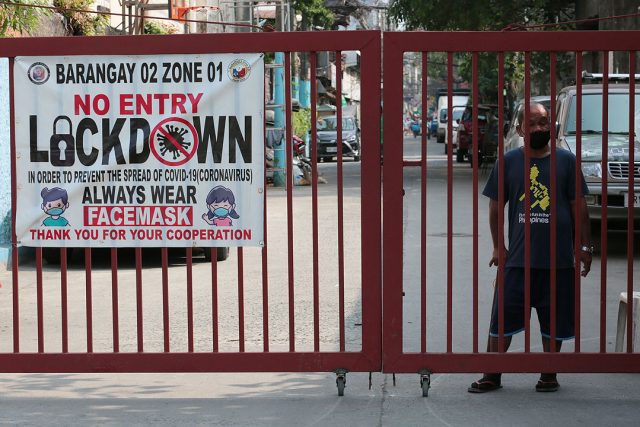
THE no-lockdown policy declared by President Ferdinand R. Marcos, Jr. during his State of the Nation Address (SONA) will help the restaurant industry and other frontline businesses, which oppose measures that cut down on foot traffic and mobility, the Department of Trade and Industry (DTI) said on Tuesday.
Trade Secretary Alfredo E. Pascual told reporters on the sidelines during the post-SONA economic briefing in Pasay City that restaurants will be more confident in doing business if a no-lockdown policy is observed.
“The businesses are always for no lockdown. Clearly, the reason why many frontline establishments collapsed is because there are no customers going to them… With no lockdown, the restaurants will be accessible to consumers,” Mr. Pascual said.
Mr. Marcos said in his SONA on July 25 that he will seek to balance the needs of public health and the economy over the remainder of the pandemic.
“Sa ating sitwasyon ng pangkalusugan, nariyan pa rin ang banta ng COVID-19, lalo’t may mga nadidiskubreng bagong variants ng coronavirus. Pero hindi na natin kakayanin ang isa pang lockdown. Wala na tayong gagawing lockdown (Regarding public health, the dangers of COVID-19 remain, particularly with the emergence of new variants. But we will not be able to afford another lockdown. Lockdowns will not be resorted to),” Mr. Marcos said.
Mr. Marcos said the government is talking to drug manufacturers to bring down the cost of medicine, particularly for generic drugs.
“Sinimulan ko na ang pakikipag-usap sa mga kumpanya ng gamot dito sa Pilipinas at sa ibang bansa. Hinihikayat natin na buksan nila ang merkado upang bumaba ang presyo ng gamot. Halimbawa, kung mas marami ang mas murang generic o hindi branded na gamot sa merkado, mas bababa rin ang presyo dahil sa kumpetisyon (We have begun talks with drugmakers. We are seeking to open our markets in a way that brings drug prices down. The government believes that more generic drugs will help make drugs cheaper because of competition),” Mr. Marcos said.
“Ang DTI ay nakikipag-usap sa mga interesadong manufacturer ng generic drugs na papasok sa ating bansa (The DTI is negotiating with generics companies that are interested in manufacturing here),” he added.
Mr. Pascual confirmed that he has met with the Pharmaceutical and Healthcare Association of the Philippines (PHAP) and plans more meetings with the goal of expanding domestic production.
“I’ve met with the PHAP and we had a good exchange. I’m also going to meet another pharmaceutical company association consisting of domestic companies,” Mr. Pascual said.
“The thing here is how you convince consumers… that generics, especially from reliable producers or manufacturers, are as good as the branded alternative. It is in the advertising or promotion of their products,” Mr. Pascual said.
Separately, Mr. Marcos also said during the SONA that he directed the Philippine Competition Commission (PCC) to ensure an equal playing field among pharmaceutical companies.
“Inuutusan ko naman ang PCC na pantay-pantay dapat at walang kartel sa hanay ng mga pharmaceutical companies. Dahil kapag bukas ang merkado, bababa ang presyo ng gamot para mapakinabangan ng ating mga mamamayan (I have ordered the PCC to ensure fair competition and deter cartel behavior among pharmaceutical companies. An open market will bring down drug prices to the benefit of consumers). This is one of the hard lessons that we learned when the pandemic struck, and therefore, we must act on that shortcoming,” Mr. Marcos said.
PCC Officer-in-Charge Chairperson Johannes R. Bernabe said in a statement on Tuesday that the commission has been monitoring potential anti-competitive practices, including cartel behavior, which may be taking place within the supply chain of pharmaceutical products.
“The PCC will pursue with even more resolve inquiry into the pharmaceutical sector, on top of its current efforts in this priority sector,” Mr. Bernabe said.
Tourism Secretary Ma. Esperanza Christina G. Frasco said in her post-SONA economic briefing that she is planning to offer incentives to encourage sustainable practices within the industry.
“It’s very important to incentivize sustainable tourism,” she said, adding that her department is planning to introduce “incentives for the private sector (for implementing) green policies… as well as… measures that promote environmental protection, energy-efficient usage, and the like,” Ms. Frasco said.
“On the part of the local government units… it’s very, very important to institutionalize zoning and land use regulations, in that we strictly implement the regulation of the development and the use of tourism destinations, to ensure that [its] use as a tourism destination lasts for the long term…,” Ms. Frasco said. — Revin Mikhael D. Ochave
THE government’s focus on agriculture to address rising food costs heralds the distribution of financial assistance and subsidies, as signaled during President Ferdinand R. Marcos, Jr.’s first State of the Nation Address (SONA), farmers said.
“The President’s SONA underscored the problem of high food prices because the cost of producing them is increasing, compounded by the unnecessary layers in the value chain,” Samahang Industriya ng Agrikultura Executive Director Jayson H. Cainglet said in a Viber message.
“The challenge of our times is to locally produce more, and the SONA emphasized the government’s commitment to subsidize essential farm inputs — fertilizer, pesticide, feed and fuel. We also commend the marching orders to (expand) aquafarms, hog and poultry farms as the basis for increasing local production. It is by and large, a welcome start,” he added.
Federation of Free Farmers President Leonardo Q. Montemayor said that the immediate concern is to minimize supply disruptions.
“In the case of rice, our estimate is that we’re looking at a 10-15% drop in palay (unmilled rice),” he said in a phone interview.
Mr. Montemayor said that the President’s value-chain approach is useful in determining what interventions are needed, especially in terms of budgetary support.
“I hope he can scourge around for additional funds. Time is of the essence. What is critical is looking at agriculture as a whole system. It starts from pre-production, research and development, irrigation, production, mechanization, credit availability, all the way to harvesting, post-harvesting, milling, storage, even Kadiwa centers,” he added, referring to government-organized outlets where produce is sold at concessional prices.
He said there is a need to harmonize water policy to ensure agriculture’s water requirements are met.
“There are so many water agencies. Potable water in Metro Manila is always prioritized so irrigation becomes secondary. It’s important to synchronize these activities to come up with good water sources,” he added.
Mr. Montemayor also said there has to be a serious review of the Rice Tariffication Law, which was not mentioned during the SONA.
“Our first priority is productive capacity locally to provide our own food needs. Imports (should be) the last resort. Why is the first line of thinking lessening tariffs on imported food? It’s discouraging to farmers. Even if they apply these modern technologies, they are under the threat of lower palay (unmilled rice) prices,” he added.
Food advocacy group Tugon Kabuhayan said it supports the President’s proposals for financial and technical support for farmers and fisherfolk.
“We welcome the President’s initiative and clear vision to increase and support local production. We view the programs he mentioned as doable and timely especially the need to increase production of livestock, poultry and fish,” Tugon Kabuhayan co-convenor Asis G. Perez said in a statement.
“A more pro-local producer policy would greatly help our goal of making fish cheaper and more accessible for everyone,” he added.
The Kilusang Magbubukid ng Pilipinas said that Mr. Marcos will likely continue the “pro-market policies and programs of former Secretary William D. Dar,” the President’s predecessor as Agriculture Secretary.
“Mr. Marcos did not mention the structural development of domestic agriculture that will foster job generation and overall industrialization… his plans on how to lower the cost of farm inputs are also lacking and only seem aspirational,” the group said in a statement.
Department of Agriculture (DA) Regional Executive Director Arnel V. de Mesa said during the post-SONA economic briefing on Tuesday that the government will be focusing on boosting production of key agri-commodities to help bring down food prices.
“These will be supported by the provision of credit and financial assistance,” he added.
By October, the DA will be launching the Masagana 150 and 200 programs, which aim to increase yields of inbred and hybrid rice, respectively.
“We are also focused on giving targeted interventions to farmers and fisherfolk. We will continue to digitize the sector starting with the registry system. We have more than 12 million farmers and fisherfolk. By digitalizing, we will be avoiding duplication in the interventions,” he said.
The DA will also be building border inspection facilities to prevent any further entry of animal transboundary diseases. These are due to be built in Subic, Batangas, Cebu, Davao and Manila.
Mr. De Mesa said the DA is also looking into strengthening distribution systems, establishing regional food hubs, and tapping renewable energy for irrigation. — Luisa Maria Jacinta C. Jocson
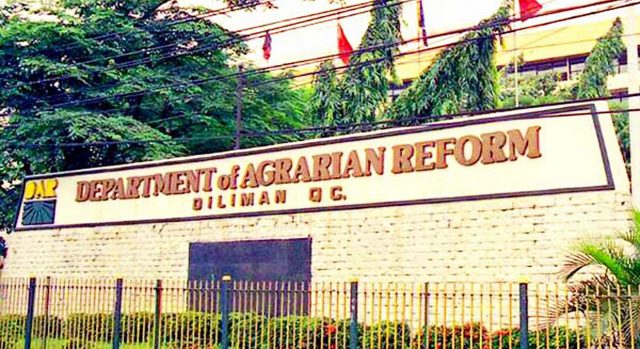
THE administration’s plan to provide relief on debt incurred by agrarian reform beneficiaries is expected to provide a boost to farm productivity, according to analysts.
“This is a step in the right direction because debt condonation will cause farmers to invest more in their land and expand the rural leasing market to promote land consolidation via lease because agrarian reform beneficiaries who have unpaid debts to the government cannot sell or lease their lands,” Foundation for Economic Freedom President Calixto V. Chikiamco said in a Viber message.
President Ferdinand R. Marcos, Jr. announced in his first State of the Nation Address on Monday that he intends to issue an executive order imposing a one-year moratorium on agrarian reform beneficiaries’ amortization and interest payments on land.
“Agrarian reform is not only about acquisition, but also about support services and distribution… the civil society organizations also support this because it will unburden the farmers of their dues and be able to focus on improving farm productivity,” he said.
“A moratorium will give the farmers the ability to channel their resources in developing their farms, maximizing their capacity to produce, and propel the growth of our economy,” he added.
Mr. Marcos also said that Congress must also pass a law that will emancipate agrarian reform beneficiaries (ARBs) from the agrarian reform debt burden, via amendments to Section 26 of Republic Act No. 6657.
“In this law, the loans of agrarian reform beneficiaries with unpaid amortization and interest shall be condoned,” he said.
“Agrarian reform beneficiaries who are still to receive their awarded land under the comprehensive agrarian reform program shall receive it without any obligation to pay any amortization,” he added.
The condonation plan covers over P58 billion in loans taken on by 654,000 ARBs and 1.18 million hectares of awarded land.
A total of 52,000 hectares of unused agricultural land owned by the government will also be distributed to landless war veterans; landless surviving spouses and orphans of war veterans; landless retirees of the Armed Forces of the Philippines and the Philippine National Police; and graduates of agriculture programs who are landless.
“The call of the times is for the infusion of fresh and new blood in the agricultural sector. We need a new breed of farmers equipped with modern agricultural technology able to engage in sustained scientific farming that will not only increase farm yields, but also resilience in the face of climate change,” Mr. Marcos added in his speech.
According to Mr. Chikiamco, debt condonation should be packaged with other reforms or amendments to the Comprehensive Agrarian Reform Law.
He said that the government should also convert all certificates of land ownership awards into simple titles and increase the land retention limit.
“Why do we need to increase the land retention limit from five hectares to 24 hectares? Because 24 hectares is the minimum viable size for commercial farming or agribusiness. The optimal state is to also allow consolidation via ownership, rather than leasing alone. While leasing will lead to land consolidation, the downside is that (those leasing) will tend to over fertilize the land since they don’t own it. Overfertilization will lead to lower productivity of the land in the long term,” he added.
Mr. Chikiamco also proposed removing the requirement for Department of Agrarian Reform clearances on all agricultural land transfers as monitoring of land retention limits should be done by the Land Registration Authority, which has the necessary database to do so.
Federation of Free Farmers Leonardo Q. Montemayor said that Mr. Marcos’ agrarian reform proposals are a significant part of the administration’s approach to the agriculture industry.
“It shows in his thinking that the two go together. The problem is that our economists and intellectuals in the past years or so always see agrarian reform as contrary to agricultural growth and productivity. The President is saying he’s putting the two together,” he said in a phone interview.
Mr. Montemayor said that he hopes Mr. Marcos will extend debt condonation to future farmers as well.
“I hoped he (goes) all the way. Not just condone the past, but the current and future. Amortization payments should not be a bar to them getting the title. The impact on farmers is they will be (confident) knowing they can own the land they are tilling. If you are a tiller, you have a stronger motive to maximize work on the farm,” he added.
On the distribution of unused land, Mr. Montemayor said it was vital that support services are given to landowners.
“It’s not enough to give them just land. There have to be support services and financing to buy basic tools and equipment. They have to be supported, not just in giving them land but giving them assistance,” he added.