Home Blog Page 5577

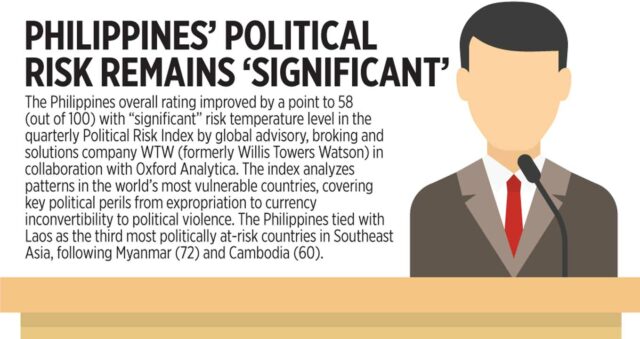
Philippines’ political risk remains ‘significant’

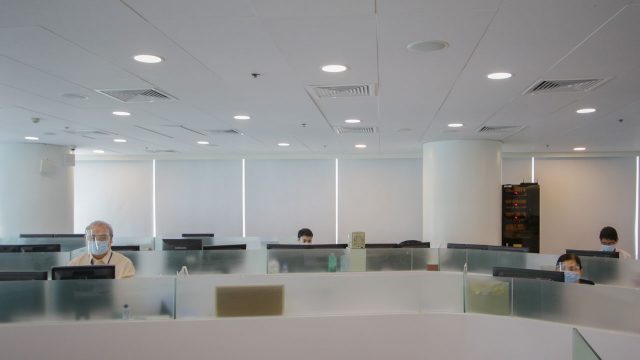
The Philippines overall rating improved by a point to 58 (out of 100) with “significant” risk temperature level in the quarterly Political Risk Index by global advisory, broking and solutions company WTW (formerly Willis Towers Watson) in collaboration with Oxford Analytica. The index analyzes patterns in the world’s most vulnerable countries, covering key political perils from expropriation to currency inconvertibility to political violence. The Philippines tied with Laos as the third most politically at-risk countries in Southeast Asia, following Myanmar (72) and Cambodia (60)

Philippines’ political risk remains ‘significant’

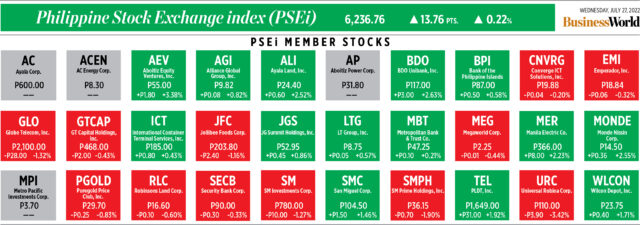
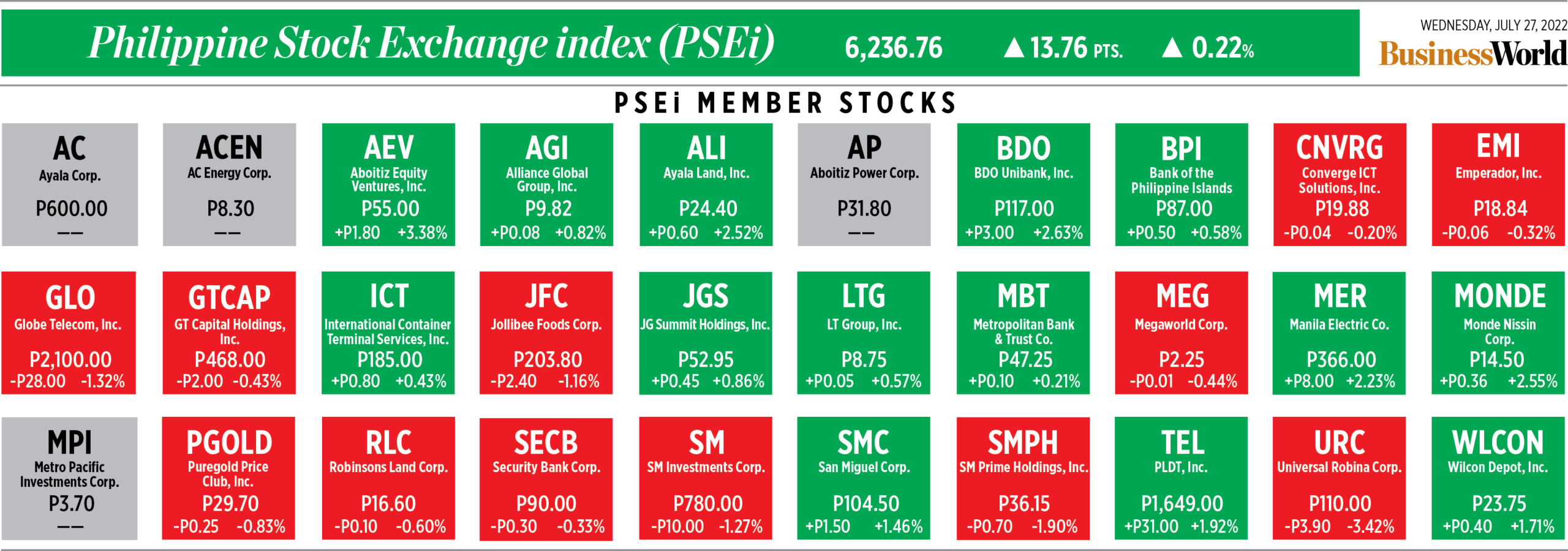
How PSEi member stocks performed — July 27, 2022

Here’s a quick glance at how PSEi stocks fared on Wednesday, July 27, 2022.


Peso weakens vs dollar ahead of Fed decision

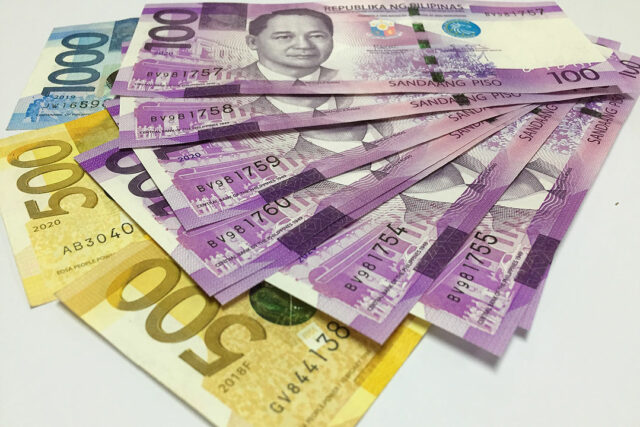
BW FILE PHOTO

THE PESO ended weaker versus the dollar on Wednesday on expectations of another aggressive rate hike from the US Federal Reserve.

The local unit closed at P55.68 against the dollar on Wednesday, down by 38 centavos from P55.30 on Tuesday, data from the Bankers Association of the Philippines’ website showed.

The peso opened the session at P55.40 against the dollar. Its weakest showing was at P55.82, while its intraday best was at P55.37 versus the greenback.

Dollars exchanged went down to $1.01 billion on Wednesday from $1.43 billion on Tuesday.

“[The peso] will take its cue from tonight’s Fed meeting. A hawkish Fed should cause peso to slide once more while a dovish Fed could mean peso rallies a touch to close the week,” ING Bank N.V. Manila Senior Economist Nicholas Antonio T. Mapa said on Wednesday.

“Sharp swings show that [the] BSP (Bangko Sentral ng Pilipinas) didn’t need to conduct their emergency jumbo rate hike and could have settled for more measured 50 bps (basis points) rate increases in June and August to achieve similar results,” Mr. Mapa said.

Likewise, a trader attributed the peso’s decline to the anticipated rate hike from the Fed.

“The local currency might depreciate further ahead of the release of the second-quarter US GDP (gross domestic product) report amid lingering concerns of a US recession,” the trader said.

For Rizal Commercial Banking Corp. Chief Economist Michael L. Ricafort, this is “considered a healthy correction after the strong peso appreciation of 80 centavos the previous day.”

“The peso is still among the strongest in three weeks ahead of the widely expected 75 bps Fed rate hike,” he said.

Market sentiment has been supported by the administration’s presentation of its economic plans, which include the shift towards more local borrowings to manage foreign exchange risks, he added.

The US Federal Reserve is widely expected to raise benchmark rates by at least 75 bps at its July 26-27 meeting to temper soaring inflation that hit another 40-year high in June.

The BSP Monetary Board on July 14 raised its benchmark interest rates by an all-time high 75 bps in an off-cycle review. The surprise move came ahead of its regular policy meeting scheduled on Aug. 18, and follows two 25-bp rate hikes each in May and June.

BSP Governor Felipe M. Medalla said then that the big rate increase was due to signs of growing price pressures, compounded by the impact of aggressive tightening by the US Federal Reserve on the peso, which could lead to higher inflation.

On Tuesday, Mr. Medalla said the central bank will likely hike borrowing costs by another 25 bps or by 50 bps at their August meeting with the Fed expected to continue firing off big rate increases, although he ruled out another off-cycle move.

Headline inflation was at a near four-year high of 6.1% in June, bringing the first-half average to 4.4%, above the BSP’s 2-4% target but still below its full-year forecast of 5%.

For Thursday, Mr. Ricafort sees the peso moving within P55.40 to P55.80 against the dollar, while a trader expects it to be between P55.60 and P55.80. — D.G.C. Robles

PHL shares rise on last-minute bargain hunting

STOCKS climbed on Wednesday on last-minute bargain hunting ahead of the US Federal Reserve’s policy statement, concerns over a possible recession in the United States as well as the wider Philippine budget deficit in June.

The Philippine Stock Exchange index (PSEi) went up by 13.76 points or 0.22% to close at 6,236.76 on Wednesday, while the broader all shares index increased by 5.59 points or 0.16% to 3,370.58.

“The local bourse was able to close in the green, up by 13.76 points (+0.22%) to 6,236.76 due to last-minute bargain hunting,” Philstocks Financial, Inc. Research Analyst Claire T. Alviar said in a Viber message.

Ms. Alviar said that the sideways movement of the PSEi was due to negative sentiment in US markets and the government’s wider budget deficit in June.

“Most investors were also on the sidelines… as they wait for the interest rate decision of the Federal Reserve,” she added.

“Local shares were bought as investors became wary of the US, as Walmart slashed its earnings forecasts, fueling concerns that consumer spending might not be strong enough to keep the US out of the verge of recession,” Regina Capital Development Corp. Head of Sales Luis A. Limlingan said in a Viber message.

Mr. Limlingan said investors were also looking ahead to the US Federal Reserve’s latest policy decision.

The Fed is holding its policy review on July 26-27 and was expected to announce its decision overnight. Markets were pricing in at least another 75-basis-point hike as inflation in the world’s largest economy continues to soar.

Meanwhile, the Bureau of the Treasury on Tuesday said the budget gap stood at P215.5 billion in June, 43.8% higher than the P149.9 billion in the same month a year ago.

In the first six months of 2022, the budget deficit narrowed to P674.2 billion, 5.84% lower than the P716.1-billion gap a year ago and 18.64% below the program.

The majority of sectoral indices ended in the green on Wednesday except for property, which went down by 13.59 points or 0.48% to 2,782.28.

Meanwhile, financials climbed 18.94 points or 1.29% to 1,479.43; services increased by 5.77 points or 0.35% to 1,632.54; mining and oil went up by 30.34 points or 0.26% to 11,312.30; holding firms gained 7.06 points or 0.11% to end at 5,919.51; and industrials inched up by 0.26 point to close at 9,359.24.

Decliners outnumbered advancers, 100 versus 75, while 41 names closed unchanged.

Value turnover inched up to P3.83 billion on Wednesday with 325.86 million shares changing hands from the P3.75 billion with 728.03 million issues seen the previous day.

Net foreign selling further declined to P136.75 million from the P431.57 million seen on Wednesday.

Regina Capital’s Mr. Limlingan placed the PSEi’s support at 6,100 and resistance at 6,400, while Philstocks Financial’s Ms. Alviar put support between 6,100 and 6,150 and resistance at the 6,400 area. — J.I.D. Tabile

Marcos asked if he plans to raise taxes to fund priority programs

PHILSTAR

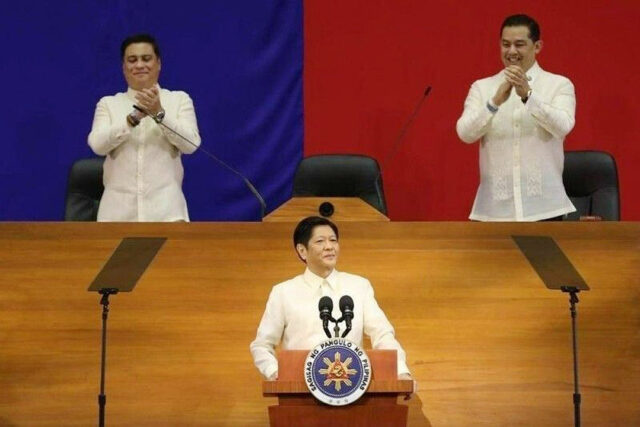
THE ADMINISTRATION has been asked for its funding plan for the priority programs spelled out by President Ferdinand R. Marcos, Jr. during his address to Congress delivered on Monday, particularly whether new taxes are to be imposed.

“The President has presented a very compelling vision of which the country should unite around,” Senator Francis Joseph G. Escudero said in a statement. “What follows is the hard part of funding those dreams.”

He was particularly concerned whether the Department of Finance will raise new taxes to meet its goals, which Mr. Escudero said will be a burden on the population.

During the President’s first State of the Nation Address (SONA), Mr. Marcos promised to modernize and upgrade the healthcare system. He cited plans to devolve to the countryside specialty hospitals currently located in the capital like the Philippine Heart Center, National Kidney and Transplant Institute, and Lung Center of the Philippines — all built during his father’s presidency.

He also promised to expand the Build, Build, Build infrastructure program through public-private partnerships, spurring economic growth in remote areas.

“Every government program carries a price tag, often hidden, while the purported benefits are highly praised. Lost in the euphoria is the fact that it is the people, and nobody else, who will eventually pay for them. The buck begins with the taxpayer,” Mr. Escudero said.

“How do they intend to fund the projects mentioned by the President? Will it be through new taxes or new borrowing? Will the people pay in pain right now through higher taxes or will the government just take out a mortgage on our children’s future?” he added. 

At a news conference on Tuesday, Senator Ana Theresia N. Hontiveros-Baraquel called the economic roadmap laid out in the SONA “unclear” on the matter of how the targets will be achieved. 

“There are so many priorities but when the plan is that ambitious, the revenue generation should also be ambitious,” she said.

Mr. Escudero said a clear and comprehensive proposal should be made on the proposed value-added tax on digital services and e-commerce transactions.

“There is no doubt that the people have united behind the President’s articulation of their aspirations. But unity is soluble in taxes — high and unfair taxes,” he said.

Congress will soon begin budget deliberations for the 2023 General Appropriations Act. Mr. Escudero said he was looking forward to receiving the proposed P5.2-trillion national budget to judge the adequacy of the funding for the government’s program. — Alyssa Nicole O. Tan

Globe ready to support digitalization in health, education, fintech

GLOBE Telecom, Inc. said it is ready to support the government’s digitalization efforts, particularly in government services, healthcare, education and fintech, for which its broadband and technology solutions will serve as critical infrastructure.

The company said Globe’s services are a good fit with the Marcos administration’s plan to digitalize government processes and provide universal connectivity, which President Ferdinand R. Marcos, Jr. highlighted in his address to Congress on Monday.

“The administration can count on the universe of Globe’s digital solutions — from new technologies our core telco business offers to our portfolio companies in and more — to provide innovative services to make its digitalization and connectivity goals a reality,” Globe President and Chief Executive Officer Ernest L. Cu said in a statement on Wednesday.

“Globe also fully supports the President’s call for an e-commerce law that aims to protect consumer rights, data privacy and intellectual property,” he added.

The group is intensifying its online anti-piracy campaign in conjunction with the Intellectual Property Office of the Philippines and the Asia Video Industry Association.

According to Mr. Cu, the President’s State of the Nation Address (SONA) “very much echoes Globe’s long existing programs on digital enablement, intellectual property and clean energy, reflecting our shared goal to see a Filipino nation admired.”

“This fuels our fire in consistently bringing reliable services and solutions towards digital enablement.”

Mr. Marcos said he has tasked the Department of Information and Communications Technology to ensure digital connectivity across the archipelago.

“This will be done through the implementation of the National Broadband Plan, the common tower program, connecting our geographically isolated and disadvantaged areas (GIDA) via our ‘Broad Band ng Masa’ project,” he said in his SONA.

“These may be through a combination of terrestrial or submarine fiber optics, wireless and even satellite technology,” he added.

He called for the deployment of “breakthrough technologies” such as quantum computing, artificial intelligence, nanotechnology, the internet of things, robotics, self-driving electric vehicles, 3D printing, and virtual and augmented reality to revolutionize the way business is done.

The new administration is expecting an increase in direct investment from overseas as a result of the amended Public Service Act, which has opened doors and removed restrictions on foreign investment in key industries. — Arjay L. Balinbin

Pharma industry sees drug prices falling with playing field leveled

THE Pharmaceutical and Healthcare Association of the Philippines (PHAP) said it welcomes the government’s plan to encourage “vibrant competition” in the industry, saying that such market dynamics, as well as high-volume procurement, are expected to lower drug prices.

The industry association said in a statement on Wednesday that the plan by President Ferdinand R. Marcos, Jr. to increase competition in the industry will lead to more affordable medicine and boost economic activity.

“PHAP shares the goal of the government to ignite competition in the pharmaceutical industry as the primary means to lower medicine prices. The market dominance of generics by volume to date is driving medicine prices down and providing a broad price range and treatment options to government, physicians, and patients,” it said.

Mr. Marcos said during his first State of the Nation Address on July 25 that the government is in talks with drug manufacturers to lower medicine prices, adding that he has instructed the Philippine Competition Commission to ensure that industry participants operate within a level playing field.  

According to the PHAP, a “vibrant biopharmaceutical industry” generates employment, investments, and revenue for the government.

“PHAP reiterates its confidence that the country could position itself as a regional and competitive hub for biopharmaceutical innovation under the current leadership,” it said.

“PHAP also welcomes the directive of President Marcos to align health protocols as well as to strengthen cooperation with the private sector to enable full capacity for businesses,” it added.   

It added that mechanisms in place under Republic Act No. 11223 or the Universal Health Care Act and Republic Act 11215 or the National Integrated Cancer Control Act will encourage further competition to lower drug prices.  

“Price negotiation, pooled procurement, and private sector partnership are mechanisms that must be implemented to drive medicine prices down. Countries with low medicine prices employ a single-payer system where the government negotiates and purchases on behalf of their people,” the PHAP said.  

The association noted that the Integrated Roadmap of the Philippine Pharmaceutical Industry, drafted by the pharmaceutical industry with the Department of Trade and Industry, projects the drug market as benefiting from “vibrant and agile” pharmaceutical companies.  

The roadmap seeks to support the pharmaceutical industry en route to becoming a global player in innovation. — Revin Mikhael D. Ochave 

PHL posts decline in rice, corn inventory at start of June

PHILSTAR FILE PHOTO

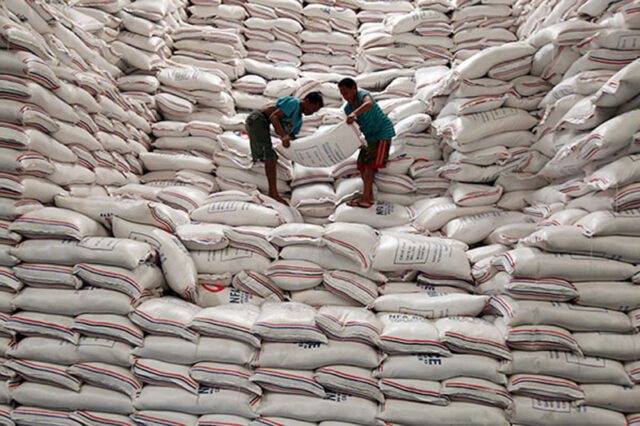
THE Philippines’ inventory of rice fell 12.3% year on year to 2,220.21 thousand metric tons (MT) on June, according to the Philippine Statistics Authority (PSA).

“Relative to the May 2022 inventory level of 2,279.96 thousand MT, the current rice stocks inventory dropped by 2.6%,” the PSA said in a report.

Rice declined across all three categories holding inventory. Stock held by the National Food Authority (NFA) was down 22% year on year, by commercial warehouses/wholesalers/retailers down 15.2%, and by households down 7.3%.

Some 47.3% of all inventory was held by households, 44.8% by commercial warehouses/wholesalers/retailers, and 7.9% by the NFA.

Meanwhile, the corn inventory as of June 1 dropped 9.2% year on year to 873.48 thousand MT.

Month on month, corn stocks rose 12% from 779.79 thousand metric tons at the start of May.

Corn held by households and commercial warehouses/wholesalers/retailers fell 48% and 2.7% year on year, respectively.

Commercial warehouses/wholesalers/retailers held 91.7% of the inventory while 8.3% was held by households. — Luisa Maria Jacinta C. Jocson

Packworks raises $2M from seed round, launches mobile app for sari-sari stores

BW FILE PHOTO

TECHNOLOGY startup Packworks said it raised $2 million in seed capital and launched a mobile application for managing sari-sari store operations.

“We’re going to be improving our app structure performance — user interface and user experience — for our open platform, and we’ll be adding services from our partners and adding more brands and products,” Packworks Chief Marketing Officer Ibba Bernardo said during a briefing in Pasay City on Wednesday.

The startup, founded in 2018, received funding from logistics firm Fast Group and private equity firm CVC Capital Partners, in partnership with the Asian Development Bank Ventures, Arise, Techstars, and IdeaSpace Foundation.

 According to Packworks Chief Executive Officer Bing Tan, the funds will expand hiring and client acquisition.

 He said the company is on track to exceed its target of partnering with over 200,000 stores by the end of 2022.

 “Next year, we’re hoping to do 500,000 stores but keeping our fingers crossed,” Mr. Tan said. — Revin Mikhael D. Ochave

Cryptocurrency accounting and taxation

As the national debt ballooned to P12.50 trillion in May 2022, the previous government’s Finance department proposed new tax measures to the successor administration. One such proposal is to tax cryptocurrency.

DEALING WITH CRYPTOCURRENCY
Cryptocurrency is a type of virtual currency (VC) that exists on a blockchain and relies on a cryptographic protocol to regulate its creation and exchange. Unlike conventional currency, cryptocurrency operates independently of central banks.

There are currently thousands of cryptocurrencies circulating worldwide, the most popular of them being Bitcoin and Ethereum. Cryptocurrency is widely used for speculative purposes like stock trading, but some countries have adopted them as legal tender.

In other countries, such as the US, VC is treated as property. The general tax principles applicable to property transactions are applied to transactions involving VCs. Hence, if the fair market value of property received in exchange for the VC exceeds the taxpayer’s adjusted basis (cost basis adjusted by certain expenditures and deductions) of the VC, the taxpayer has taxable gain. On the other hand, the taxpayer incurs a loss if the fair market value of the property received is less than the adjusted basis of the VC.

In Italy, cryptocurrency is treated like foreign currency. Meanwhile, Germany views cryptocurrency as private money, which will trigger tax if held for more than one year, for later sale or spending.

The Philippine treatment of cryptocurrency, however, remains vague. The Bangko Sentral ng Pilipinas (BSP) has yet to issue guidelines to regulate cryptocurrency, although it advises the public of the features, benefits, and risks of dealing with it. So far, a formal regulatory framework was issued for VC exchanges and companies or businesses engaged in changing VCs into fiat currency (and vice versa), requiring their registration with the BSP as remittance and transfer companies. 

For now, the Philippines characterizes cryptocurrency as digital or virtual assets. As assets, cryptocurrency may be the object of taxation either as an ordinary asset or a capital asset.

TAXING CRYPTO TRANSACTIONS
Despite the lack of clear guidelines from the Bureau of Internal Revenue (BIR), investors should expect their income from dealing with cryptocurrency to be subject to taxation.  But the question is, what type of taxes apply?

Section 32 (A) of our Tax Code states that for purposes of tax computation, gross income means all income derived from whatever source. Meanwhile, Section 43 of the code provides in part that taxable income is computed based on the annual accounting period observed and following the method of accounting regularly employed in keeping the taxpayer’s books. Thus, in the absence of specific tax guidelines, the taxation of cryptocurrency will generally depend on whether it is treated as an ordinary asset or capital asset.

In Philippine Interpretation Committee (PIC) Q&A 2019-02, the accounting treatment for cryptocurrency can follow the rules governing inventory or intangible assets.

Under Philippine Accounting Standard (PAS) 2, inventory is not required to be in physical form, but should consist of assets held for sale in the ordinary course of business. Hence, inventory accounting might be appropriate if an entity holds cryptocurrency for sale in the ordinary course of business. An entity that actively trades cryptocurrency, purchasing them with a view to their resale in a short period of time, and generating a profit from fluctuations in the price or traders’ margin, might consider whether the guidance in PAS 2 for commodity broker-traders should be applied.

If treated as inventory, cryptocurrency may be considered ordinary assets subject to ordinary income tax on the total amount of income.

Does it follow then that its sale or exchange is subject to value-added tax (VAT)? Technically, the sale or exchange of goods and services in the ordinary course of trade or business, and those that are incidental to it, is subject to 12% VAT.  Hence, when cryptocurrency is treated as inventory, sale or exchange may be subjected to VAT if the VAT threshold is satisfied.

However, if the entity holds cryptocurrency for investment purposes (capital appreciation) over extended periods, it will not likely meet the definition of inventory, but that of an intangible asset.

In the Q&A, the PIC explained that cryptocurrency can also be treated as intangible assets since they are non-monetary assets, which are without physical substance and are identifiable. An asset is identifiable if it is separable (i.e., it is capable of being separated or divided from the entity and sold, transferred, etc.) or if it arises from a contractual or legal right. Cryptocurrency for investment purposes would likely meet the definition of an intangible asset.

If treated as an intangible asset, cryptocurrency is considered a capital asset for tax purposes. The term capital asset includes property held by the taxpayer, whether or not connected with his trade or business, but excludes stock in trade or property for sale to customers in the ordinary course of business.

As a capital asset, net capital gains derived from sale or exchange are subject to ordinary income tax after considering the holding period in proper cases; however, capital losses are deductible only to the extent of the capital gain.

Likewise, there is a basis for arguing that the sale or exchange of cryptocurrency treated as intangible/capital assets is not subject to VAT since the transaction is not in the ordinary course of a business nor incidental to it.

Lacking clear guidelines in the taxation of crypto-related transactions, BIR officials may have differing interpretations on the matter. Nevertheless, a taxpayer receiving income from cryptocurrency is still required to contribute to the government — the inevitable and indispensable bidding of taxation.

The views or opinions expressed in this article are solely those of the author and do not necessarily represent those of Isla Lipana & Co. The content is for general information purposes only, and should not be used as a substitute for specific advice.


Rommel Rhino C. Edusma is a senior associate at the Tax Services department of Isla Lipana & Co., the Philippine member firm of the PwC network.

+63 (2) 8845-2728

rommel.rhino.c.edusma@pwc.com

At least 5 die after Magnitude 7 quake hits northern Philippines

BUREAU OF FIRE PROTECTION FACEBOOK PAGE

By Norman P. Aquino, Special Reports Editor
and Kyle Aristophere T. Atienza, Reporter

A MAGNITUDE 7 earthquake rocked the northwestern part of the main island of Luzon in the Philippines early Wednesday morning, according to the US Geological Survey (USGS), killing at least five, damaging buildings and halting train operations in the capital Manila where the tremors were also felt. 

The quake struck about 13 kilometers southeast of the town of Dolores in Abra province at a depth of 10 km, the US agency said on its website. 

The Philippine Institute of Volcanology and Seismology (Phivolcs) reported more than 50 aftershocks ranging from magnitude 1.5 to 4.7 in Abra alone.  

The earthquake killed at least five people, according to the National Disaster Risk Reduction Council spokesman Mark Timbal.  

“So far, the Department of Interior and Local Government has updated their fatality count to 5 persons,” he said in a text message to reporters. “This count is still subject for verification.”  

At least two senior citizens were trapped in a landslide in Benguet, the province said on its Facebook page.  

More than 130 people from 24 families in Tuba town in Benguet, which is a six-hour ride from Abra, were evacuated, the provincial government said, citing initial reports. More than 20 houses were damaged there.  

Several bell towers, churches and heritage houses in northern Philippines, as well as cars and other property were damaged by the quake, Senator Imee R. Marcos, who is from Ilocos Norte, said in a statement, citing unnamed sources. 

Several main roads including Kennon, Paraiso, Pagudpud, Ilocos Norte and Apayao were also damaged, while much of the area did not have power after electrical transformers and transmission lines were hit, she added.  

She urged police and the local disaster agency to remain vigilant because aftershocks could follow.” “If necessary, preventive evacuation of coastal villages and landslide-prone zones should be undertaken swiftly.”  

State seismologists said there was no threat of tsunami because the fault line that triggered the earthquake was located on land.  

“It won’t cause the seafloor to rise and lead to a life-threatening tsunami,” Renato U. Solidum, Jr., head of the state seismology agency, told a news briefing in mixed English and Filipino.  

He cited reports of an “unusual wave” in the coasts of La Union and Ilocos provinces that he said was not a tsunami.  

“A tsunami would be very high waves because of the uplift of the ocean floor due to an earthquake in the ocean,” he said.  “What happened was there was shaking of the island and the coastal water was shaken, so there was minor seawater oscillation.”  

“Some of the waters actually entered some of the rivers,” he added.  

Since 1970, 11 other earthquakes of magnitude 6.5 or larger have occurred within 250 km of Wednesday’s earthquake, the USGS said.  

The largest of these earthquakes was a magnitude 7.7 earthquake on July 16, 1990 in Baguio City in Benguet, where at least 1,600 people died and more than 3,000 were hurt, it added 

The 1990 earthquake also caused landslides in the Baguio-Cabanatuan-Dagupan area.  

The Wednesday quake was also felt in the capital region, where several buildings were evacuated and the rail system was halted during rush hour.  

“Any earthquake at magnitude 7 is considered a major earthquake,” Mr. Solidum told a news briefing streamed live on Facebook.  

More aftershocks were expected in the next two days, he said. “Strong intensities are still possible.”  

“I urge everyone to stay alert and to prioritize safety in light of the possibilities of aftershocks that might be felt after that strong earthquake,” Abra Rep. Ching B. Bernos said in a statement. “We are monitoring the situation on the ground and gathering information on the extent of the damage to the province.”  

NO STATE OF CALAMITY
President Ferdinand R. Marcos, Jr. will only visit areas “where his presence is necessary,” Press Secretary Trixie Cruz-Angeles told a news briefing. “Let’s make an assessment first.”  

A state of calamity declaration is “[not] necessary right now,” Mr. Marcos separately told a news briefing.  “Depending on the information that comes back, that might happen. We have to wait for those reports.”  

The quake has mainly affected 15 provinces in the regions of Ilocos, Cagayan Valley and the Cordillera Administrative Region, Mr. Abalos told the same briefing. 

The President, who described the earthquake as “very strong,” said he would not immediately go to affected areas so the jobs of local authorities are not delayed. 

“It has been my experience as governor that when the national officers go to the affected areas immediately, they just mess with the work of local officials,” he said.   

“Let them do their work. Let us wait for them to tell us what is going to be — what the true situation is — and maybe I can schedule a trip perhaps tomorrow as soon as possible.” he added.  

Mr. Marcos said his Social Welfare chief promptly visited affected areas after the quake. “We are awaiting his report.”  

The Philippines lies in the so-called Pacific “Ring of Fire,” a belt of volcanoes around the Pacific Ocean where most of the world’s earthquakes strike.  

At the briefing, Mr. Marcos backed a bill seeking to create a disaster resilience department.   

“We need more capability than we have now,” he said. “We are now good with typhoons and we know a lot about earthquakes. But the dangers and effects of climate change are different, that’s why we need a specialty agency.” — with Alyssa Nicole O. Tan, Matthew Carl L. Montecillo and Marifi S. Jara


 

6 of 10 Pinoys favor ROTC; gov’t told to promote peace

PHILIPPINE ARMY RESERVE COMMAND FACEBOOK PAGE

SIX of 10 Filipinos favor a proposal to reinstate student military training — dropped two decades ago after a university student who exposed corruption in the program died — a senator said in a statement on Wednesday.

Senator Sherwin T. Gatchalian, citing a Pulse Asia Research, Inc. poll that he commissioned, said 69% of Filipinos agree with the plan, which he said was also supported across socioeconomic groups.

The Child Rights Network in a statement said mandatory military training for students violates international commitments on child human rights and existing laws.

The lawmaker has a refiled a bill seeking to revive the military training for Grades 11 and 12 students to ensure the country has enough soldiers during war. The bill is part of President Ferdinand R. Marcos, Jr.’s priority agenda.

The program will include basic military training for defense preparedness or civil-military operations. Students younger than 18 won’t have to take part in a war, according to a copy of the bill.

Students who fail to take the course can’t graduate unless they are psychologically and physically unfit. Varsity players will be exempted.

“Introducing mandatory Reserve Officers’ Training Corps (ROTC) in senior high school is neither warranted nor needed,” Child Rights Network convenor Romeo Dongeto said in the statement.

“To revive mandatory ROTC is to backtrack on decades-long developments that made the program no longer required in the first place,” he added.

He said mandatory military training for senior high school students undermines international commitments on the protection of children from compulsory recruitment into the armed forces.

“Introducing a militarist course in senior high school, at a time when students are at the height of their adolescence period, may also make them vulnerable to developing various risk behaviors sensitive to adverse and negative experiences which could impact them throughout their lifetime,” Mr. Dongeto said.

The state should instead follow the United Nations Convention on the Rights of the Child recommendation in 2008 to promote the values of peace and respect for human rights. These should become basic subjects, he said.

Ex-President Rodrigo R. Duterte had also sought to revive the ROTC, which the Education department in 2019 said could cost as much as P23 billion.

Mr. Gatchalian, who filed the bill in the past Congress, had said the Senate would not support the ROTC revival if it would cost that much. — Alyssa Nicole O. Tan