Home Blog Page 5575

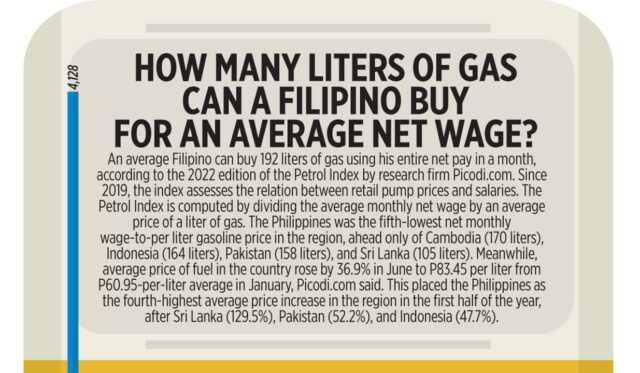
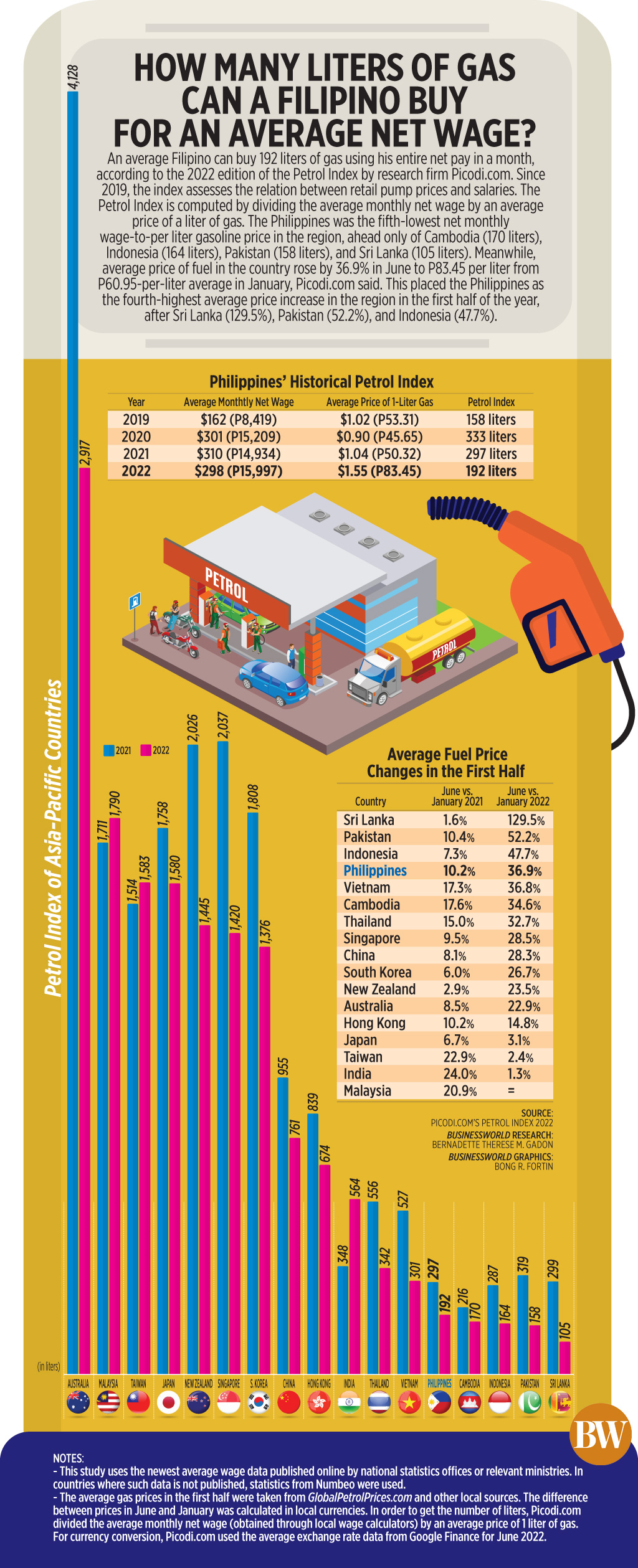
How many liters of gas can a Filipino buy for an average net wage?

An average Filipino can buy 192 liters of gas using his entire net pay in a month, according to the 2022 edition of the Petrol Index by research firm Picodi.com. Since 2019, the index assesses the relation between retail pump prices and salaries. The Petrol Index is computed by dividing the average monthly net wage by an average price of a liter of gas. The Philippines was the fifth-lowest net monthly wage-to-per liter gasoline price in the region, ahead only of Cambodia (170 liters), Indonesia (164 liters), Pakistan (158 liters), and Sri Lanka (105 liters). Meanwhile, average price of fuel in the country rose by 36.9% in June to P83.45 per liter from P60.95-per-liter average in January, Picodi.com said. This placed the Philippines as the fourth-highest average price increase in the region in the first half of the year, after Sri Lanka (129.5%), Pakistan (52.2%), and Indonesia (47.7%).

How many liters of gas can a filipino buy for an average net wage?

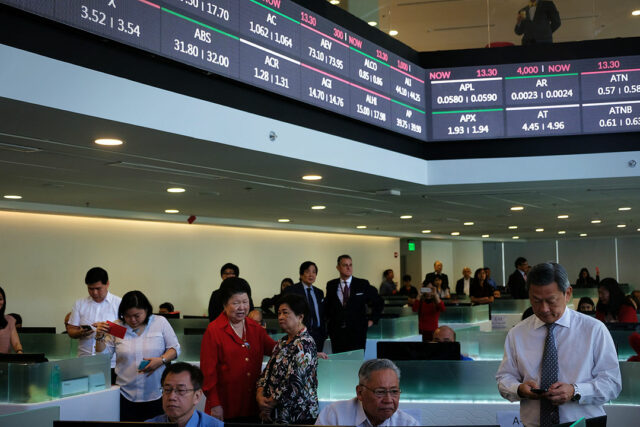
How PSEi member stocks performed — August 3, 2022

Here’s a quick glance at how PSEi stocks fared on Wednesday, August 3, 2022.


Peso sinks further vs dollar on Fed worries

BW FILE PHOTO
THE PESO declined further against the dollar on Wednesday on lingering worries over aggressive US Federal Reserve hikes. — BW FILE PHOTO

THE PESO retreated further versus the greenback on Wednesday after hawkish signals from US Federal Reserve officials and rising tensions between the United States and China.

The local unit closed at P55.74 per dollar on Wednesday, depreciating by 30.5 centavos from its P55.435 finish on Tuesday, based on data from the Bankers Association of the Philippines.

The peso opened Wednesday’s session at P55.55 versus the dollar, which was also its intraday best. Its weakest showing for the day was at P55.777 against the greenback.

Dollars exchanged rose to $922.1 million on Wednesday from $777.17 million on Tuesday.

“The peso exchange again weaker for the third straight day… but still near one-month lows nevertheless, after the healthy upward correction of the US dollar versus major global currencies and also the healthy upward correction of US Treasury yields, amid hawkish signals from Fed officials on the need to continue fighting elevated inflation,” Rizal Commercial Banking Corp. Chief Economist Michael L. Ricafort said in a Viber message.

“The peso weakened after various Fed officials dismissed views that the rate hikes by the US central bank might be nearing its end,” a trader said.

San Francisco Fed President Mary Daly, Cleveland Fed President Loretta Mester and Chicago Fed President Charles Evans said separately on Tuesday that they will continue to support hikes to curb US inflation, which hit another 40-year high in June.

The Fed raised rates by 75 basis points (bps) for the second straight meeting in July. It has hiked borrowing costs by 225 bps since March.

The peso also declined due to geopolitical risks after US House Speaker Nancy Pelosi visited Taiwan, causing China to announce missile tests and drills in the area, Mr. Ricafort said.

“The local currency might continue to depreciate as the escalating geopolitical risks between US and China might drive renewed safe-haven demand for the greenback,” the first trader added.

For Thursday, the first trader sees the peso moving from P55.65 to P55.85 per dollar, while Mr. Ricafort expects a P55.60 to P55.80 range. Meanwhile, a second trader gave a wider trading band of P55.60 to P55.90. — K.B. Ta-asan

PSEi up on US-China tensions, easing Fed concerns

BW FILE PHOTO

PHILIPPINE STOCKS went up further on Wednesday on tensions between the United States and China and as rate hike concerns eased on signs that the pace of the US Federal Reserve’s tightening will slow down.

The bellwether Philippine Stock Exchange index (PSEi) rose by 67.78 points or 1.06% to close at 6,430.08 on Wednesday, while the broader all shares index increased by 25.24 points or 0.74% to 3,436.83.

“Philippine shares were bought up as investors as turned away from the US as House Speaker Nancy Pelosi’s controversial visit to Taiwan would further strain already tense US-China relations,” Regina Capital Development Corp. Head of Sales Luis A. Limlingan said in a Viber message.

China furiously condemned the highest-level US visit to Taiwan in 25 years as House of Representatives Speaker Nancy Pelosi hailed the self-ruled island as “one of the freest societies in the world” and pledged American solidarity, Reuters reported.

Beijing demonstrated its anger with Ms. Pelosi’s presence on an island that it says is part of China with a burst of military activity in surrounding waters, summoning the US ambassador in Beijing and halting several agricultural imports from Taiwan.

“Global funds have started to flow back to equity markets, particularly in EMs (emerging markets) [excluding China], as interest rate concerns began to ease significantly following several compelling signs of a Fed rate hike slowdown,” AP Securities, Inc. Equity Research Analyst Carlos Angelo O. Temporal said in a Viber message.

Mr. Temporal added that since most index heavyweights have already released their results, the market is now expected to focus on external developments.

“Meanwhile, on PH inflation due out on Friday, we don’t expect it to have a significant impact on the market as consensus forecast of 6.2% remains within BSP’s (Bangko Sentral ng Pilipinas) projected range and is likely priced in already,” he said.

Sectoral indices ended split on Wednesday. Mining and oil lost 129.14 points or 1.10% to close at 11,588.62; property declined by 6.66 points or 0.23% to 2,883.71; and services slipped by 0.70 point or 0.04% to 1,677.52.

Meanwhile, holding firms climbed 123.81 points or 2.05% to 6,137.61; financials went up by 25.27 points or 1.69% to 1,513.35; and industrials increased by 84.66 points or 0.89% to 9,507.56.

Value turnover climbed to P6.52 billion on Wednesday with 502.37 million shares changing hands from P5.87 billion on with 528.35 million issues seen on Tuesday.

Decliners narrowly beat advancers, 89 against 88, while 52 names closed unchanged.

Net foreign buying jumped to P726.48 million on Wednesday from the P36.44 million seen the previous trading day.

AP Securities’ Mr. Temporal placed the PSEi’s support at 6,000 and resistance at 6,500, while Regina Capital’s Mr. Limlingan put support at 6,200 and resistance at 6,380. — J.I.D. Tabile with Reuters

Taiwan negotiating for alternative aviation routes

USS Ronald Reagan (CVN 76), conduct an archipelagic sea lane passage through the San Bernardino Strait. — US PACIFIC FLEET

By Kyle Aristophere T. Atienza, Reporter

TAIWAN is negotiating with neighboring Japan and the Philippines to find alternative aviation routes, the official Central News Agency (CNA) reported on Wednesday, after China announced drills that the trade-reliant island said amounted to a “blockade.”

There was no need for global chip manufacturing hub Taiwan to find alternatives for sea transport because ships can avoid Chinese drill zones, CNA reported, citing Transport Minister Wang Kwo-tsai.

Meanwhile, Philippine President Ferdinand R. Marcos, Jr.’s government was “closely monitoring” China’s moves in light of a United States lawmaker’s visit to Taiwan, which Beijing considers part of its territory.

The military and Department of Foreign Affairs “are closely monitoring the situation as they would in any other similar circumstance,” Press Secretary Trixie Cruz-Angeles told a news briefing on Wednesday.

“On matters of international relations, reactions are studied,” she said. “We don’t make knee-jerk reactions because they could adversely affect international relations.”

Mr. Marcos’ press secretary also refrained from commenting on Chinese Ambassador Huang Xilian’s call for the Philippines to abide by the One-China policy.

“There is no reaction,” Ms. Angeles said. “Usually, when it’s a matter of international relations, we take time to study the matter and do not react immediately. Loose words might affect relationships and they’re very difficult to rebuild.”

“We will take our cue from the Department of Foreign Affairs if such a reaction is even warranted,” she added.

US House Speaker Nancy Pelosi arrived in Taiwan on Tuesday, despite threats from China, which calls the visit a “major provocation.” China said the US official’s Taiwan visit is a threat to stability in the Taiwan Strait.

Four US warships, including an aircraft carrier, were positioned in waters east of Taiwan on what the US Navy called routine deployments on Tuesday amid Chinese anger over Ms. Pelosi’s visit to the island.

Ms. Pelosi is the highest-ranking official to visit Taiwan in 25 years. She said her visit is part of a “broader trip” to the Indo-Pacific region that focuses on “mutual security, economic partnership and democratic governance.”

“Our congressional delegation’s visit to Taiwan honors America’s unwavering commitment to supporting Taiwan’s vibrant democracy,” she said in a statement posted on her website. “Our discussions with Taiwan leadership will focus on reaffirming our support for our partner and on promoting our shared interests, including advancing a free and open Indo-Pacific region.”

“America’s solidarity with the 23 million people of Taiwan is more important today than ever, as the world faces a choice between autocracy and democracy,” she added.

Ms. Pelosi said her visit is one of several congressional delegations to Taiwan and it does not contradict America’s key foreign policy principles regarding US-Taiwan relations.

“With the US seeking to maintain its influence within the Pacific as part of its pivot strategy, the Pelosi visit in Taiwan is no longer a surprise,” said Hansley A. Juliano, a political economy researcher studying at Nagoya University’s Graduate School of International Development in Japan.

“Institutionally our security and culture are still very much tied to the US,” Mr. Juliano said. “However, trade and our leaders’ predilection to avoid human rights accountability will continue to make them gravitate to China.” “The Marcos government is not complicated to understand what will it choose based on that.” Mr. Juliano said the split between mainland China and Taiwan is rooted in the post-World War II Chinese Civil War.

“When mainland China was recognized in the aftermath of the Cold War, the unwritten agreement was Taiwan will not be reabsorbed especially since Taiwan has bigger Western allies and trading partners,” Mr. Juliano said.

“This has also been the case with Hong Kong and Macau but these two are lands contiguous to China and hence it’s easier to impose Beijing authority,” he added.

Philippine position on the matter should be dictated by national interest and nothing else,” Michael Henry Ll. Yusingco, a political analyst, said in a Facebook Messenger chat.

“Unless it has changed, the government should simply inform China that for now, like most countries in the world, we still adhere to the One-China policy,” he said.

“The government should not pick any side in this conflict, according to the Constitution’s directive to maintain an independent foreign policy,” he added.

“We can declare a more nuanced position after the national security team in the administration completes their analysis and calibrations.” — with Reuters


Senate to probe P13B worth of expired vaccines

A HEALTH WORKER prepares to administer a coronavirus disease 2019 vaccine at a vaccination facility in Quezon City, June 23, 2021. — PHILIPPINE STAR/ MICHAEL VARCAS

A SENATOR has filed a resolution seeking to investigate agencies that let P13 billion worth of coronavirus vaccines expire.

“It seems like we are throwing away money and vaccines despite the rapid increase in COVID-19 cases,” Senator Ana Theresia “Risa” N. Hontiveros-Baraquel told a news briefing in mixed English and Filipino via Facebook on Wednesday.

Senate Resolution 96 seeks to question the gaps in the process since vaccines during a pandemic “are like gold,” she said.

She cited reports that from April to July, as many as 27 million vaccine doses were wasted after these expired.

“If we only knew that this would be the outcome, we should have given the funds to other sectors that are greatly affected by the pandemic, such as farmers, fishermen, drivers and frontliners,” Ms. Hontiveros said.

She said the government should ensure effective enforcement of its coronavirus vaccination program from acquisition, distribution and deployment, to the provision of vaccination services.

The senator said the Inter-Agency Task Force for the Management of Emerging Infectious Diseases, Department of Health (DoH) and officials in charge of vaccination should explain why they allowed the vaccines to go to waste.

Officials from both the Marcos and Duterte administrations should answer questions from the Senate and explain how they plan to avoid a similar situation from happening again, Ms. Hontiveros said.

“It’s regrettable,” Senator Maria Lourdes Nancy S. Binay said in a statement in Filipino. “The money spent to buy the vaccines is no joke, especially since the pandemic has greatly affected the private sector.”

“Instead of helping to provide additional protection to our countrymen against COVID-19, it ended in nothing,” she added.

“The DoH and its advisers should increase communication with their international counterparts, especially those studying the effectiveness of the vaccine, to immediately know the latest results of their studies and focus on the expiration dates of the vaccine to avoid wasting it.” — Alyssa Nicole O. Tan

SWS: 48% of Pinoy families felt poor

PHILIPPINE STAR/ MICHAEL VARCAS

NEARLY half of Filipino families felt poor, according to a poll by the Social Weather Stations (SWS).

Of 1,500 adults polled on June 26 to 29, 48% rated themselves as “poor,” while 31% said they were “borderline poor,” SWS said in a report on Wednesday. It added that 21% said they were not poor.

The latest results changed significantly from its April poll, when 43% of Filipino families felt poor, 34 % rated themselves borderline poor and 23% said they were not poor.

“The estimated number of self-rated poor families were 12.2 million in June and 10.9 million in April,” it said.

SWS said poor families increased in all areas, especially in Metro Manila and the Visayas region. Self-rated poor families rose to 64% from 48% in the Visayas, and to 41% from 32% in Metro Manila.

Families who considered themselves borderline poor fell to 26% from 46% in Visayas, to 22% from 42% in Metro Manila, and to 31% from 33% in Mindanao.

In Luzon areas outside Metro Manila, families who considered themselves borderline poor rose to 36% from 28%.

Families who said they were not poor also increased to 37% from 26% in Metro Manila, and to 10% from 6% in Visayas. The rate fell in Luzon areas outside Metro Manila to 28% from 37%, while it remained at 7% in Mindanao.

The SWS poll showed that 34% of Filipino families considered themselves “food-poor,” while 40% rated themselves “borderline food-poor.” It added that 26% said they were not food-poor.

A party-list group said the government should take control of oil prices to solve the rising cost of living.

“We’ve been calling for this (price control on oil) since last year,” Anakpawis Party-list National President and former congressman Ariel B. Casilao said in a statement. “If no actions are taken the continued increase of oil products, its effects on the country will get worse.”

Kilusang Magbubukid ng Pilipinas, a group of agricultural workers, and Pamalakaya, an alliance of activist fisherfolk, said the cost of production for rice grains had risen by P8,000, while the cost for fishing rose by P3,800 a month.

The SWS poll had an error margin of ±2.5 points. — Kyle Aristophere T. Atienza and Matthew Carl L. Montecillo

Palace encourages LGUs to seek out PPP infra projects

PHILIPPINE STAR/ MICHAEL VARCAS

PRESIDENT Ferdinand R. Marcos, Jr. has urged local governments to pursue public-private partnerships (PPPs) to build infrastructure within their jurisdictions. 

“I think this is the way forward, and I encourage all our local government units (LGUs) to be open to the possibilities of PPPs,” he said in a meeting with the League of Cities of the Philippines on Tuesday. His remarks were released by the Palace on Wednesday.

Mr. Marcos said the government has received offers to fund big-ticket projects.

“There are many opportunities especially in infrastructure. Many of our friends from abroad — especially the ambassadors who paid courtesy calls to us — are offering help,” he said.

The offers, Mr. Marcos said, include funding via official development assistance and joint ventures by private-sector entities. 

“Well, you’re local government, you know that already. Local government generally cannot do it by itself,” Mr. Marcos said.

“We have to find partners, we have to find local partners, we have to find investors. Sanay na kayo diyan (you’re used to this).”

Mr. Marcos said he sees digitalization playing a prominent role among the PPP projects. “Digitalization is going to be a very natural fit for something like PPPs,” he said.

In his first address to Congress, the President said his government would create more opportunities to collaborate with the private sector.

Mr. Marcos is also pushing for amendments to the Build-Operate-Transfer Law.

The Management Association of the Philippines urged the administration last month to “rectify overly stringent” Material Adverse Government Action provisions that discourage PPP investment due to high regulatory and political risks.

It said the government should also honor the sanctity of contracts through good-faith adherence to PPP contract terms and decisions of international arbitration tribunals.

The government’s infrastructure push is expected to generate jobs. But Terry L. Ridon of InfraWatchPH told BusinessWorld that this is “dependent on how fast PPPs are greenlighted by the current government while ensuring social and environmental safeguards.”

“There can be no massive job generation in PPPs until the last government approval has been secured,” he said. “The government can adopt the initiatives of the private sector to create new areas of study to support the country’s infrastructure push.” — Kyle Aristophere T. Atienza

Early start to sugar milling seen easing shortages

PHILSTAR FILE PHOTO

THE reopening of  some sugar mills ahead of the traditional milling season is expected to address sugar supply concerns, according to the vice-governor of a leading sugar-producing province.

“With (early reopening), we hope (to contribute) to resolving supply issues; in turn, we will also be seeing growth in our local economy,” Negros Occidental Vice-Governor Jeffrey P. Ferrer said in a statement.

Mr. Ferrer said that he made the appeal to sugar mills months ago as sugar prices rose.

“There were rumors of a sugar shortage (at the time). And I am very much appreciative that our sugar mills responded favorably,” he added.

Mills that have announced their reopening include First Farmers, Hawaiian Philippines Co., Victorias Milling Co., URC La Carlota and Sagay Central.

“The early start of the milling season is also going to be beneficial to our sugar farmers as it coincides with the reopening of the school year and they will have one less problem (in terms of expenses to deal with) especially since some schools are now going to conduct face-to-face classes,” he added.

As of July 29, the average price of refined sugar in wet markets was P93 per kilogram, according to the Sugar Regulatory Administration.

The Department of Agriculture (DA) has announced that it will consult the sugar industry to assess the state of the sugar inventory.

The DA is exploring a reclassification of sugar stocks to ensure the diversion of supply to the consumer market and away from industrial users, and also to determine appropriate import levels if needed. — Luisa Maria Jacinta C. Jocson

Tulfo threatens to summon officials of inefficient power co-ops before Senate Energy Committee

THE CHAIRMAN of the Senate Energy Committee said he intends to summon or even file charges against officials of inefficient power cooperatives that fail to deliver reliable and low-cost services to the countryside.

Citing high power costs and frequent rotational power interruptions, Senator Rafael T. Tulfo said in a statement on Wednesday: “I will make sure that I take immediate action on the problems faced by the people, especially the frequent brownouts in the provinces, including Palawan, Bataan, and Davao.”

He also said he plans to investigate officials and individuals involved in delivering unreliable power.

“If we need to summon, we will summon the capitalist politicians, who, more often than not, are partners or directors of electric cooperatives that cause frequent brownouts in the provinces,” he said, raising the possibility of filing charges against such persons.

“Regardless if they are my friends or not, I will charge them,” he said.

“Because that’s my promise to the Filipinos who voted for me that once I get elected as a Senator, I’ll make sure that all the problems they bring to me will be heard in the Senate,” he added.

He plans to set meetings to hear proposals from industry experts and stakeholders, seeking to question why several problems recur and how to solve them.

Priority bills before the energy committee in the 19th Congress include Senate Bill (SB) 358 or the proposed Recoverable System Loss Act, SB 151 or the proposed Waste to Energy Act and SB 156 or the proposed Energy Advocate Act. — Alyssa Nicole O. Tan

Workforce skills critical if Philippines is to gain from ‘demographic dividend’

PHILIPPINE STAR/ WALTER BOLLOZOS

ANY RELIANCE on the so-called “demographic dividend” for economic growth will depend on the skills young workers acquire on the way to becoming the most numerous cohort of the working-age population, analysts said.

However, “this is nothing more than the demographic transition. For the first time in our history, we have a larger proportion of working age individuals instead of those who are still in schooling and those who are retired,” according to Leonardo A. Lanzona, director of the Ateneo Center for Economic Research and Development.

“The main question is how advanced are we in taking advantage of our demographic transition.  Our Asian neighbors have been able to utilize this resource to the full by engaging in more industrialization and enhancing trade. So far, we don’t see much of this developing,” he added in an e-mail on Wednesday.

Finance Secretary Benjamin E. Diokno said on Saturday that the relative youth of the population will drive the consumer-driven economy forward.

“The young population, they consume a lot. (Domestic consumption is) actually the major mover or source of growth, plus investment. Investment… (creates) a lot of jobs, and along the way, you create a lot of consumption also,” Mr. Diokno said.

University of Asia and the Pacific Economist Bernardo M. Villegas said in an e-mail on Wednesday that the relative youth of the workforce remains a powerful driver.

“The greatest asset of the Philippines is our young and growing population. Thanks to a very youthful population (our median age is 24 years), our domestic market is very attractive to both domestic and foreign investors. Personal consumption is a growth driver,” he said.

According to the Philippine Statistics Authority (PSA), the youth labor force consisted of 7.3 million out of an estimated youth population of 20.14 million, or 36.25%, in May 2022.

New entrants to the labor force tagged between 15 and 24 years old increased by 11.12% from a month earlier to 999,000 in May.

The youth employment rate improved to 87.9% in May, against 85.5% a year earlier, and 87.7% a month earlier, according to the PSA.

But Mr. Villegas concurred that human capital development will be critical.

“The challenges we have to face are addressing the poor quality of basic education and the mismatch between what our institutions of higher education are producing as graduates and the actual demand of industry. There should be more emphasis on technical vocational courses than college diplomas,” Mr. Villegas said.

“The problem is that our industry is regionally concentrated in only NCR, Calabarzon and Central Luzon. Unless we push our industries to the other regions, we will remain a fragmented economy regionally. But without the needed skills in these regions, this goal will not be feasible. The priority in infrastructure which the previous and current administrations have indicated will not (deliver the expected) returns if we do not engage in skills development,” Mr. Lanzona said.

A silver lining from the pandemic could be a shift in how the young view technical vocational courses.

“The pandemic convinced many young people to forget getting a college diploma and take short courses in order to reskill, upskill and retool themselves so that they could be immediately employed in industries that are short of technical skills,” Mr. Villegas said.

“It will be the young who can be upskilled, reskilled and retooled to be employed in knowledge-based IT enterprises that will grow faster than the call centers, which are in danger of being replaced by Artificial Intelligence and Robotics,” he added. — Diego Gabriel C. Robles

BPOs hope to ride WFH wave by expanding to countryside

REUTERS

THE business process outsourcing (BPO) industry said 30% of its workforce has relocated to the countryside due to the pandemic, presenting an opportunity for the industry to decentralize operations and generate opportunities in untapped markets.

The IT and Business Process Association of the Philippines (IBPAP) said BPO companies, which are also known collectively as the Information Technology and Business Process Management (IT-BPM) industry, could end up establishing new hubs given the level of talent now dispersed in the countryside.

Frankie Antolin, IBPAP talent attraction and development executive director, said at a conference hosted by the Makati Business Club on Wednesday that “about 30% of our headcount … in the countryside and we want to look for different ways that we can expand that (headcount) a lot more,” Ms. Antolin said.

Ms. Antolin hopes that rural expansion brings IT-BPM work opportunities closer to the people.

“It is not really just about decongesting, but we want to be able to bring the (IT-BPM) sector and create more IT-BPM digital hubs across the country. That is certainly one of the priorities that we have which is to move and expand into the countryside,” Ms. Antolin said.

Ms. Antolin said hybrid work has been a success for the industry since the pandemic began in 2020, with staffing levels and revenue rising in 2021.

“The last two years have been a success for the industry. We have seen that there is no sacrifice in terms of productivity as long as we have appropriate work-from-home (WFH), work from anywhere arrangements,” Ms. Antolin said.

“We’ve had a strong 2021. The number of full-time employees increased by 120,000 bringing the industry’s total headcount to 1.44 million and registering growth of 9.1% compared to 2020. We’ve also recorded very good growth in terms of revenue, (at) P29.49 billion, or a 10.6% jump,” she added.

Digital platform Grab Business Director for Sales Amit Patel said that hybrid work will remain even after the pandemic.

“I feel that hybrid work will be here to stay. Not every organization can support this. There are industries that will need to work in the office because of their type of work. We need to balance that as well. (Hybrid work) will stay. It is probably something that is going to outlast the pandemic,” Mr. Patel said.

On June 21, the Fiscal Incentives Review Board (FIRB) issued FIRB Resolution No. 017-22 which  temporarily permitted registered IT-BPM firms to implement 70% onsite and 30% WFH arrangements between April 1 and Sept. 12 without affecting their fiscal incentives.

Incentives are governed by Republic Act No. 11534 or the Corporate Recovery and Tax Incentives for Enterprises (CREATE) law, which normally requires all operations by companies enjoying the perks to do their work within economic zones.  — Revin Mikhael D. Ochave