SANDREX GAINSAN — SCREENGRAB FROM 8TH WORLD JUNIOR WUSHU CHAMPIONSHIPS YT
SANDREX Gainsan joined a growing list of Filipino world champions as he captured the gold in qiangshu (spear play) event of the 8th World Junior Wushu Championships held recently in Tangerang, Indonesia.
Mr. Gainsan, who won the gold in the Asian Junior Championships in Bandar Seri Begawan, Brunei three years ago, bested Singapore’s Shaoyang Ian Sim and Malaysia’s Waipeng Hew to claim the mint.
The Quezon City-based Taolu artist thus joined the country’s elite group of world-beaters this year like weightlifting Hidilyn Diaz-Naranjo, karate’s Junna Tsukii and jiu-jitsu’s Meggie Ochoa and Kimberly Anne Custodio among others.
Vincent Ventura and Zion Diaraliay pocketed a bronze each in nandao (southern broadsword) and 42-step taijiquan to compete the six-strong Philippine team’s strong showing.
Baguio-based Krisna Malecdan (56 kgs) and Rhomlaiza Dagson (48kgs) and Davao City’s Geoff Basto Bustamante (56 kgs) failed to advance to the medal phases in the sanda event.
“(Mr.) Gainsan’s mint was the country’s fifth in seven junior worlds engagements, a strong indication of the strength of the our junior development program,” said Wushu Federation of the Philippines President Freddie Jalasco. — Joey Villar
NOT even an injured hand could prevent up and coming star Vanessa Sarno from pursuing her 2024 Paris Olympics dream.
Playing through a sore right hand she severely hurt in training a month ago, Ms. Sarno successfully lifted 224 kilograms on a 99kg in snatch and 125kg in clean and jerk in the women’s 71-kg class in the World Championships in Bogota, Colombia on Tuesday.
Romanian Loredana Elena Toma topped the division with a 256kg total.
While the 19-year-old Asian and Southeast Asian Games champion didn’t medal, Ms. Sarno was able to earn Paris Games qualifying points that set in motion her Olympic bid.
More importantly, it was a good sign that Ms. Sarno completed her lift when she wasn’t expected to.
Kristel Macrohon also competed in the same class as Ms. Sarno and wound up eighth with a 232kg.
The country had already raked in three mints courtesy of Tokyo Olympics gold winner Hidilyn Diaz-Naranjo in the 55kg category a few days ago. — Joey Villar
Don’t look now, but the Nets are rolling. Including yesterday’s shellacking of the Wizards, they’ve won eight of their last nine matches. It’s clear that they’ve found a rhythm, and, save for the setback against the Eastern Conference-leading Celtics last week, they’re confident enough to overcome the typical off-day and stay competitive. Which, to fans who have harbored great expectations marquee names Kevin Durant and Kyrie Irving arrived two and a half years ago, is a long time coming.
Not that the Nets are already insulated from failure. With close to seven-tenths of the season still left to play, and given the inherent unpredictability of their stars, it’s hard to view anything with finality. After all, even the most avid followers of the black and white have been let down by development after development, and to the point where hope is deemed an exercise in futility. Even outside of Durant and Irving, whose travails have gone beyond the confines of the court, a checklist of woes and unfortunate turns can easily be compiled.
That said, there is cause for optimism. For the first time in a long while, the Nets are humming and approximating their potential. And, needless to say, their progress is fueled by Durant, still possessing all-world skills even at 34, and Irving, undoubtedly among the most talented players in the National Basketball Association. Assuming they are able to keep their heads in their work, and assuming the others in the regular rotation led by erstwhile All-Star Ben Simmons continues to show a keen understanding of the level and manner of support required, there is reason to believe even better things are in store.
Whether the Nets can get their collective act together and contend for the hardware is anybody’s guess. The mercurial nature of the vital cogs rightly gives critics pause. On the flipside, there is the tantalizing prospect of success fueled by undeniable aptitude. And since consistency is key to eliminating any recency bias, the proof of the pudding is definitely in the eating.
Anthony L. Cuaycong has been writing Courtside since BusinessWorld introduced a Sports section in 1994. He is a consultant on strategic planning, operations and human resources management, corporate communications, and business development.
Leading developer in Visayas and Mindanao (VisMin) Cebu Landmasters, Inc. (CLI) is set to exceed its 2022 growth target and reported a 43% year-on-year surge in revenues to Php10.96 billion in the first nine months of the year.
The firm also successfully listed its first fixed-rated bond offering Php5 billion at the Philippine Dealing and Exchange Corporation last October 7. These bondsearned from Philippine Rating Services Corp. (Philratings) a credit rating of Aa plus with stable outlook. Philratings commended CLI for its sound management and strategies, and competitive advantage in VisMin markets evidenced by continued growth despite the pandemic.
CLI also received multiple accolades including the prestigious PropertyGuru Philippines Property Awards (PPA) as the Best Developer in Visayas and the Best Developer in Mindanao for two consecutive years. PPA further awarded special recognition to CLI for Environmental, Social, and Governance (ESG) and Sustainable Design & Construction.
Founded by Jose Soberano III in 2003, with a vision to provide safe and quality homes for average Filipino workers, Cebu Landmasters started with a single project in the countryside of Cebu. The company has now expanded its portfolio to include offices, hotels and resorts, co-living, mixed-use and townships. Currently, CLI has more than 100 projects in different stages of development in 16 key cities in VisMin.
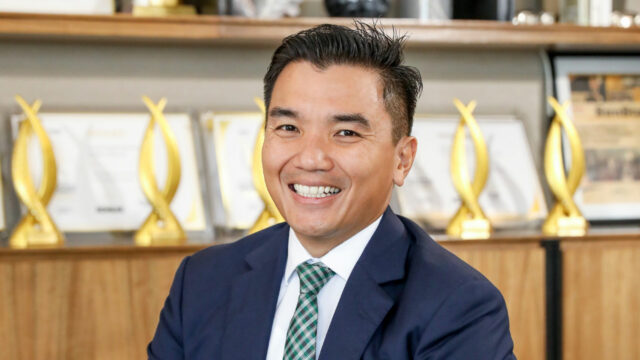
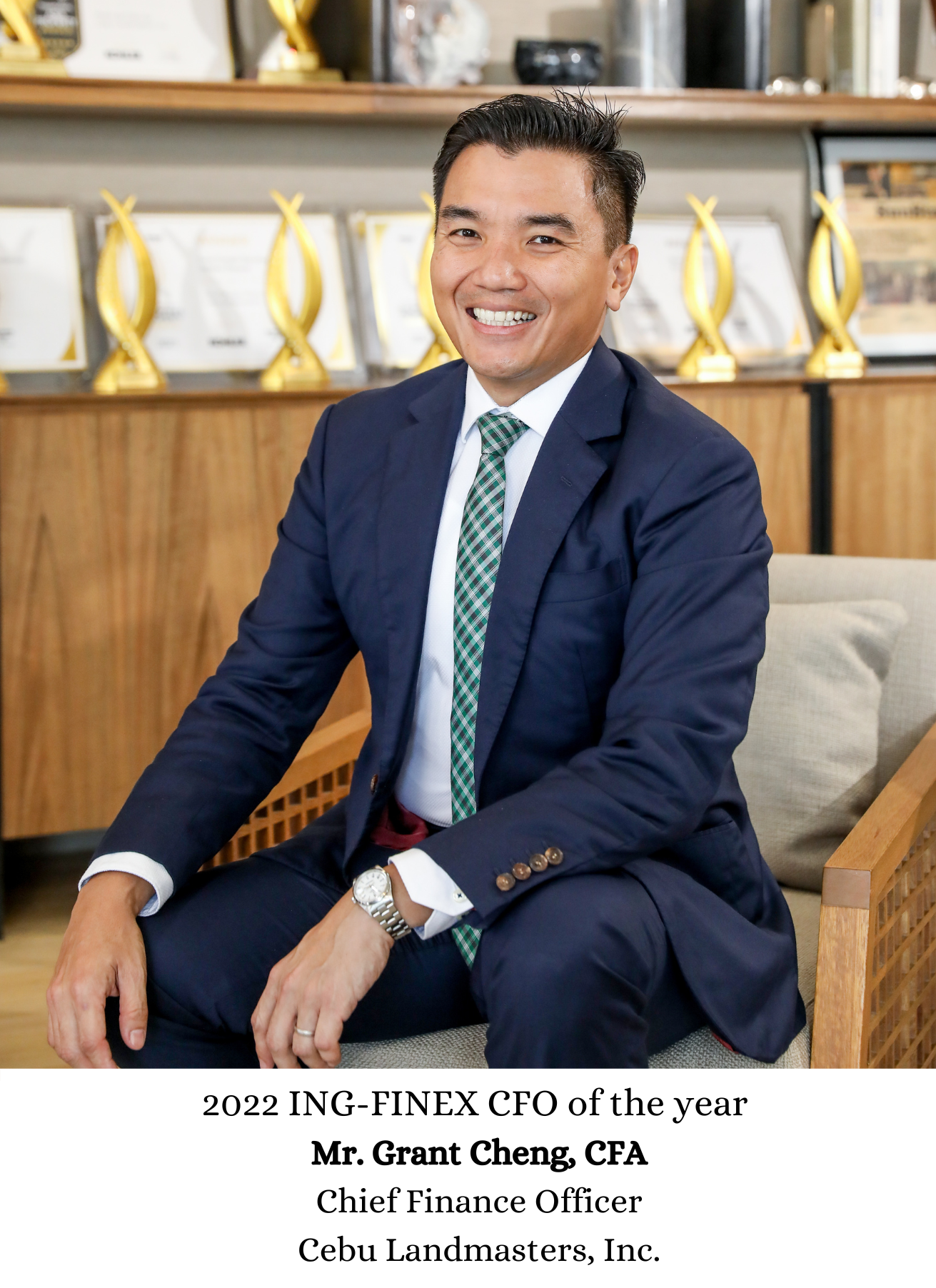
According to Soberano, one of the reasons behind the company’s growth and success even during the pandemic is the quality of its management team. Among the listed company’s high-caliber executives is the recently conferred 2022 ING-FINEX CFO of the Year, CLI chief finance officer Grant Cheng.
Youngest ING-FINEX CFO of the Year awardee
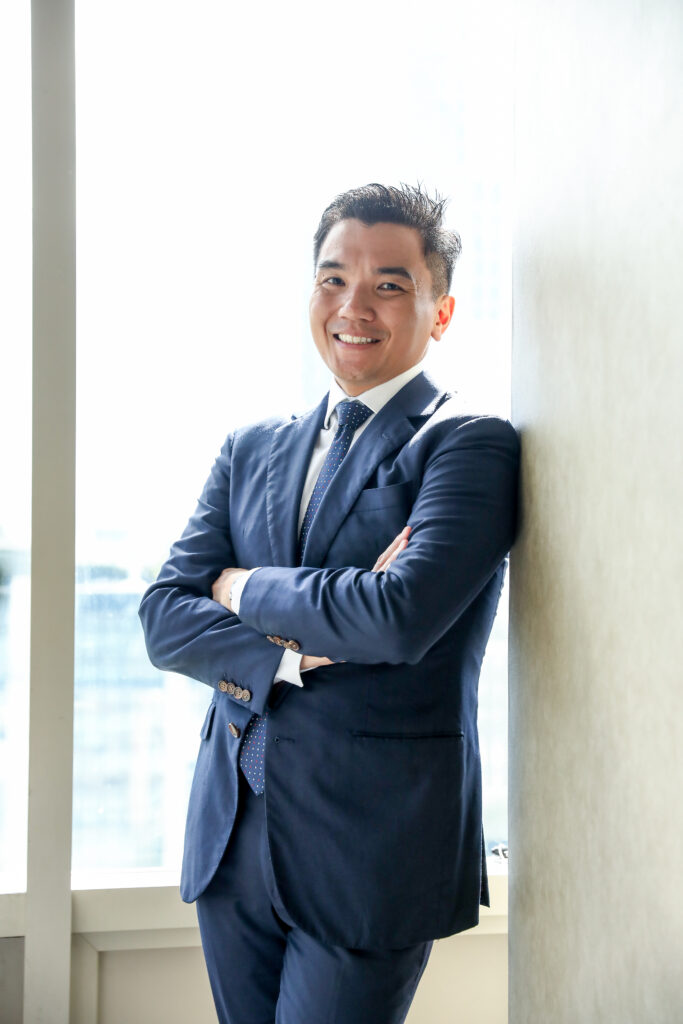
The 41-year-old Grant Cheng made history as the youngest recipient of the prestigious recognition from the longest-running search honoring the country’s top finance chiefs. Cheng is also the first awardee from a non-conglomerate organization.
Cheng was a star scholar and graduated magna cum laude from De La Salle University with a Bachelor of Science degree in Manufacturing Engineering and Management. He also earned his Masters of Science in Wealth Management with distinction from Singapore Management University and Swiss Finance Institute in Zurich.
Before joining Cebu Landmasters, Cheng was a Senior Deal Manager with a rank of Vice-President at BDO Capital and Investment Corporation. He led his project teams in managing various complex capital market transactions and advised companies in a broad array of industries on corporate restructuring and reorganization. He was also a private banker based in Singapore handling accounts for prestigious individuals and institutions.
Cheng was instrumental in the listing of Cebu Landmasters on the Philippine Stock Exchange. He also led in taking CLI to new heights by establishing the firm’s funding framework, driving massive growth with all-time record cash flow and revenue.
CLI chairman and CEO Jose Soberano III proudly says that Cheng serves as a “vital cog” to the company’s tremendous growth over the years. He highlighted: “Grant is a team player, an across-the-board type of leader. He studies his craft very well. If there are issues that are on his table, he weighs things very carefully before he goes to us to lay down the options, putting in the pluses and the minuses, to be able to arrive at a good decision.”
Cheng ensures CLI’s sustainable growth trajectory through close financial monitoring and strong investor relations. He also engineered the bond offering as a major strategy to sustain CLI’s growth. He is credited for streamlining processes in CLI’s accounting and finance. He is a master strategist, and a catalyst for big improvements within the organization.
Through Cheng’s work ethic as CFO, CLI was able to secure a credit rating upgrade. In June 2022, the Philippine Rating Services Corporation (PhilRatings) assigned an Issue Credit Rating of PRS ‘Aa plus with a stable outlook’ for CLI’s maiden peso-denominated fixed-rate bond issuance of P5 billion. PhilRatings also upgraded the issue credit rating for CLI’s outstanding series ‘A’ to ‘C’ corporate notes worth P5 billion to PRS Aa plus with a stable outlook.
Cheng also played a pivotal role in CLI’s remarkable performance during the pandemic. The company remained profitable through the implementation of cost and budget monitoring processes, along with the establishment of approval limits and authority policies. Cheng ushered digital transformation as well that allowed business to continue. Virtual launches for projects, digital tours and the development of an online collections portal enabled CLI to increase sales even as profit declined—a dip, however, that ranks as the lowest in the industry.
“My philosophy on being a CFO is actually (that) you have to manage your past, present, and future,” Cheng said in an interview with CNN. He clarified that managing the past means that the CFO is a historian of the company. “You have to record everything accurately. That’s accounting. The present are your operations—treasury, disbursement, your collections, payments, tax filing. The future is your financial planning. For real estate, you want to acquire a land, build a building or a subdivision, that’s a 3–5-year project. You want to plan ahead and make sure everything from your costing to your availability of funds are something you’ve planned for the future.”
Cheng said that whenever he sees numbers, he can immediately tell how a company is being run.
“This is why I am at home with Cebu Landmasters, knowing that our company and the family’s values and ethics are consonant with my own. When it comes to character, you cannot separate the personal from the professional. And the standard I strive to instill in CLI is that of a fiduciary.”
For all these achievements, Cheng remains steadfast in meeting the challenges of leading a relatively young company against more established industry players. He said representing a non-conglomerate company is not necessarily an advantage to his win as the ING-FINEX CFO of the Year, but a differentiator.
“I hope it offers the perspective that financial excellence and good governance is not an exclusive reserve of large, mature companies,” he said. “To reach higher levels in business, you should have a good financial operation in place to support that growth.”
Spotlight is BusinessWorld’s sponsored section that allows advertisers to amplify their brand and connect with BusinessWorld’s audience by enabling them to publish their stories directly on the BusinessWorld Web site. For more information, send an email to online@bworldonline.com.
National Economic and Development Authority (NEDA) Director General Arsenio Balisacan targets national poverty incidence to be single digit at 9% by the end of the Marcos Jr. administration. It will surprise many Filipinos to learn that the province that President Ferdinand “Bongbong” Marcos, Jr. was once Governor of has been enjoying single-digit poverty incidence for some time, this as the country struggles to bring down the national average from as high as 23% during the height of the pandemic, to 17% today.
According to the latest report of the Philippine Statistics Authority (PSA), Ilocos Norte has a poverty incidence of 2.5% today, one of the lowest in the whole country. The Ilocanos do not have to wait till 2028 to have a single-digit poverty incidence. In fact, I wager that even before the end of the present administration, Ilocos Norte can achieve the admirable goal of bringing its poverty incidence to zero. This fact is even more remarkable if we consider that the incidence of poverty went up practically all over the country during the two years of the COVID-19 pandemic and lockdowns.
Ilocos Norte was the only province in the Ilocos region to have decreased its poverty incidence in 2021 compared to what it was in 2018. In 2018, Ilocos Norte had a poverty incidence of 4.5% (already one of the lowest in the whole country). Despite all the income and employment losses occasioned by the pandemic (for example, the famous Fort Ilocandia had to close down), the poverty incidence dropped to 2.5% in 2021. The other provinces in the Ilocos Region were not as fortunate. For example, in La Union, poverty incidence increased from 4.3% to 9.3% during the same time period; Ilocos Sur from 7.5% to 15.1%; and Pangasinan from 12.9% to 17.9%.
As reported by the Philippine News Agency, during the last 10 years, the PSA has systematically listed Ilocos Norte, which is a first-class province in terms of income, as one of the provinces with the lowest poverty incidence. It also has one of the highest Human Development Index, which measures not only per capita income but also the educational attainment and health of the population. The Ilocos Norte government has long prioritized programs on poverty reduction, especially through programs in agricultural productivity (especially in rice), health, education, job creation, and assistance to micro, small, and medium-scale enterprises.
Of course, it also helps that the Ilocanos are known to be among the hardest working citizens of the country, whether at home or abroad as overseas Filipino workers (OFWs). In fact, even before the term OFWs came into use, Ilocanos were already among the most dependable migrant workers in the sugar plantations of Hawaii. Today, over 55% of Ilocano families continue to receive OFW remittances.
In the next five to six years, there is reason to expect that Ilocos Norte will continue not only to have one of the lowest rates of poverty incidence, but will also be among the fastest growing regions in terms of income and employment.
In a briefing given by Governor Matthew Manotoc in an Investment Roadshow, the following were given as reasons for both domestic and foreign investors to locate in Ilocos Norte. The Laoag International Airport is the only international airport north of Clark and Manila. The road network connecting Ilocos Norte to the rest of Luzon is first class. The North Luzon Expressway, Subic-Clark Expressway, and Tarlac, Pangasinan-La Union Expressway are interconnected highways that serve as the main route from Manila and other provinces south of Ilocos Norte. The port of Currimao plays a vital role in shipping and receiving goods in and out of the province.
The Provincial Government and business community are focusing on investment areas which will experience the most rapid growth in the coming decade or so as the Philippine economy recovers from the ravages of the pandemic.
In food and agriculture, there are bright prospects in processing facilities, equipment, and warehousing; in packaging; cold storage and farm productivity programs. In the tourism and creative industry, there are opportunities in the development of gateways, eco-adventure, leisure and recreation, as typified by the very attractive beaches of the famous Pagudpud; health and wellness; creatives; social entrepreneurship; and hospitality.
In 2019, the province earned P14.88 billion in tourism receipts from over 3.8 million tourist arrivals, 90% of whom were domestic tourists and the remaining 10% foreign, especially from countries of Northeast Asia. As described in some of the brochures given to potential tourists, the province is replete with heritage buildings. There are still many structures standing today which were, built during the Spanish and American colonial periods, such as stone and brick churches with massive belfries and government buildings, bridges, and schools.
It is well known that Ilocos Norte is a pioneer in wind, solar, and hydro energy. The province is ideal for wind turbines because it is near where north westerly winds are consistently strong. The wind power density is 300-800 at 30 m (w/m2) as measured by the National Renewable Energy Laboratory (NREL).
Ilocos Norte’s solar irradiance is well-suited for solar power, with a yearly sum of 1,500-1,600 kWh. The river basins of the province have strong potentials for hydro power generation.
In wind energy, there is an existing 282.90 MW wind power generation plant provided by the Northwind Development Corp., the Energy Development Corp. and the North Luzon Development Corp. In solar energy, the Energy Development Corp., Mirae Asia Energy, and Bosung Solartec, Inc. provide a total of 27.76 MW solar power plants.
Potential investments in wind energy can reach as much as 719 MW in such areas as Pagudpud, Pasugui, Bangui, and Burgos. For solar, the potential can reach 312.5 MW in Pasuquin, Burgos, Paoay, and Currimao. In hydro, the potential areas are Adams, Carasi, Dumalneg, Nueva Era, Pagudpod, and Vintar.
The recent decision of the Energy Regulatory Commission (ERC) to allow 100% foreign investment in renewable energy projects augurs well for the province attracting substantial amounts of FDIs, sorely needed by the country because of the very high level of government debt that was occasioned by all the borrowings made necessary during the pandemic.
Ilocos Norte is a leader in responsible mining and quarrying, with great potentials in mineral deposits and exploration, river dredging and quarrying, mineral ore mining, and the mining support activities. The province showcases a diverse range of mineral potential throughout its 366.20 hectares of total land area that can be devoted to mining among a total of 3,418.75 square kilometers. It is covered by 10.70% of mining tenements according to the Mines and Geosciences Bureau Regional Office. Indicated mineral resources are gold, copper, iron, and magnetite sand, while non-metallic are sand and gravel, shale, feldspar, limestone, and silica. Given these natural resources, potential investments are in mineral deposit exploration, river dredging and quarrying, metallic ore and non-metallic mineral mining, mining unit operations, and auxiliary services and mineral and metal processing.
It may be a happy coincidence that the three sectors enumerated above, i.e., agribusiness, energy, and mining are high in the priorities of the present administration for development as well as facing strong demand as the country and the world recover from the recessionary forces coming from the pandemic.
Food security, especially in rice in which palay producers in Piddig, Ilocos Norte, have some of the highest productivity levels in the country, as well as in high-value vegetable crops, has been already a forte of the province. Ilocos, with a population of only about 610,000, has been punching above its weight by having pioneered in such renewable sources of energy as solar and wind. And finally, by having attracted investors in responsible mining, Ilocos Norte is fortunate to benefit from the high mineral prices — especially in nickel and copper — that are expected to prevail as the whole world experiences the so-called Industrial Revolution 4.0 and the Green Energy Revolution which will require large volumes of these two mineral ores for all the digital devices that will have to be produced to make the IT revolution possible, as well as to manufacture all the solar panels and wind turbines for the production of solar and wind energy.
It would be shortsighted for investors — whether domestic or foreign — to ignore Ilocos Norte in the next three to five years.
(To be continued.)
Bernardo M. Villegas has a Ph.D. in Economics from Harvard, is professor emeritus at the University of Asia and the Pacific, and a visiting professor at the IESE Business School in Barcelona, Spain. He was a member of the 1986 Constitutional Commission.
The pandemic tested us in so many ways. It revealed gaps in our health system, exposed the tendencies of our leaders, and set back our economy. Now that we are about to end 2022 — our third year with COVID-19 in our midst — and as we make our way to the new normal, it is only prudent that we move forward armed with the lessons of the past and with a heightened perspective of what will and what will not work to our country’s ultimate benefit.
Even as the public health crisis now eases and people are no longer hampered by mobility restrictions, it would be a stretch to say that the worst is over. Other external factors continue to threaten our recovery and development — for example, Russia’s invasion of Ukraine has driven up the prices of fuel and other commodities. We remain hostage to developments in the outside world. As a result, despite best efforts to resume economic activity, the Philippines’ growth prospects remain limited. Millions of Filipinos remain poor and hungry, and unable to improve their quality of life.
We have to do things differently to achieve a different outcome.
As always, we begin from what the numbers tell us. A small consolation is that the Philippines’ total trade in September this year grew by 11.3% year on year, according to data from the Philippine Statistics Authority (PSA).
But there is one thing glaring despite the growth: the trade gap continues to widen. Imports remain dominant, accounting for 62.6% of total trade, and far exceeding exports. It is clear that we have to narrow this trade gap by reducing our reliance on imports.
Reinvigorating manufacturing, specifically by encouraging investments, will do much to narrow the import-export deficit. Manufacturing will allow us to cater to our growing domestic base and produce what we need, right here within our shores, without resorting to importing them.
Aside from narrowing the trade gap, enabling the growth of manufacturing and allowing it to expand to its full potential will also set in motion a domino effect for our domestic economy. We will be able to boost productivity and increase output while generating more jobs, providing people with income security, alleviating poverty, and revitalizing consumer spending. These would, in turn, keep the economy running strong — and resilient in the face of whatever external shocks there may be in the future.
There is definitely room for growth in manufacturing. The PSA says total investment pledges of foreign and Filipino nationals in the manufacturing sector, approved by investment promotion agencies (IPAs) in the third quarter of 2022 amounted to P10.78 billion — a measly 6.8% of total pledges.
The amount represents a staggering 73.6% contraction year on year and is also significantly lower than the P17.7 billion registered the previous quarter.
All these must serve as cue to the government to step up its efforts to pursue growth through investments in general, and the manufacturing sector in particular.
Crucial to all this is the creation of a policy environment that is conducive for businesses to thrive.
Thus far, the Philippine government has taken significant steps to open the economy to more trade and investments. Amendments to the Public Service Act, the Foreign Investments Act, and the Retail Trade Liberalization Act all complement the Corporate Recovery and Tax Incentives for Enterprises (CREATE) Act which was signed into law in March 2021. These pieces of legislation enjoy the support of the business community, who acknowledge that recovering from the pandemic entails structural economic reforms.
THE UNTAPPED POTENTIAL OF DOMESTIC INVESTMENTS But when we talk about investments, I do not just mean foreign ones. Domestic investments are equally important and there is great untapped potential among Filipino investors who may want to pursue businesses here, focusing on the needs and wants of the domestic consumer.
A meeting with industry leaders and executives of consumer goods producers revealed that the lack of helpful policies that will support and supplement the growth of their businesses is a major factor why Philippine-based producers do not have the appetite to invest more in the country.
They say, for instance, that they wish the government would provide greater support in the form of incentives, and address issues such as the high cost of electricity and ease of doing business. The latter continues to be a problem given the various bureaucratic and regulatory concerns in both LGUs and the National Government.
They also lack stable access to raw materials such as wheat, sugar, salt, corn, and coffee, and the Department of Agriculture and the Department of Trade and Industry still focus on safeguards based on outdated data instead of re-evaluating the supply and demand for raw materials based on recent data.
The potential investors also cite challenges in trade facilitation from the Bureau of Customs and the Philippine Ports Authority.
Further, micro, small, and medium enterprises lack access to capital when they could fill the gap in producing raw materials and other essential components in certain sectors.
Finally, the government must also help develop and upgrade the skills of workers — this will do much in ensuring greater productivity and higher quality output.
Indeed, there remain many things to do in recovering from the economic crisis and ensuring sustainable and inclusive growth. But the feat is not impossible, especially since we have a fairly good idea of what needs to be done in order to improve the current situation. We only need to muster the will to begin taking the right steps, and to keep on doing them. In the end, a resilient economy will redound to the welfare of our people — and will hopefully make us less vulnerable to external events which may be out of our control.
Victor Andres “Dindo” C. Manhit is the president of the Stratbase ADR Institute.
In October, the Philippine Amusement and Gaming Corp. (PAGCOR) revoked the licenses of 176 Philippine Offshore Gaming Operators (POGOs) in view of rampant immigration violations, tax evasion, and the commission of heinous crimes within the industry. As a result, the Bureau of Immigration (BI) canceled the visas of 48,782 foreign nationals who were working for these companies and included them in the Alert List to monitor their whereabouts and ensure their immediate departure from the Philippines.
To provide context, foreign nationals may be included in the alert list if their visas have been canceled (i.e., the foreign national is no longer connected with the visa sponsor but has failed to formally apply for visa downgrading before leaving the country for good), among other reasons. In the case of POGOs with revoked licenses, it appears that the BI canceled their foreign personnel’s visas and issued alert list orders as they no longer have a legitimate visa sponsor.
Thus, on Nov. 16, the BI issued Operations Order No. 2022-004, or the Guidelines in the Implementation of Alert list Order No. 2022-001-POGO at the Main Office, Satellite Offices and Sub-Port Offices, which provided systematic rules on the implementation and enforcement of these foreign nationals’ alert list orders.
Pursuant to the Guidelines, a foreign national who intends to extend his 9(a)/temporary visitor visa but is found to have been included in the BI’s alert list will only be allowed the extension if his latest arrival in the Philippines was under a 9(a)/temporary visitor visa. In these cases, the Tourist Visa Section (TVS) and the assigned Alien Control Officer (ACO) shall prepare a report to the Legal Division and the Office of the BI Commissioner for the appropriate lifting of the alert list order.
If the foreign national’s application for 9(a)/temporary visitor visa extension was pursuant to a visa downgrading order, and the petitioner of the previous visa is included in the list of revoked POGO licenses, then the TVS and ACO shall refer the application to the Legal Division for the appropriate issuance of an Order to Leave (OTL) and the foreign national’s inclusion in the blacklist. On this note, a foreign national who seeks to downgrade a work visa that was sponsored by these POGOs shall likewise be issued with an OTL and will be included in the blacklist.
On the other hand, a foreign national who intends to convert his 9(a)/temporary visitor visa to another visa category but is found to have an active alert list order shall be subject to the following rules:
a.) The Legal Division will only allow the foreign national’s application for visa conversion if: (i) the applicant’s latest departure from the Philippines is prior to Sept. 19, 2022; (ii) the applicant’s latest arrival in the country is under a 9(a)/temporary visitor visa; and, (iii) the applicant did not previously apply for a Special Work Permit (SWP) or Provisional Work Permit (PWP) that was sponsored by a POGO with a revoked license.
b.) The BI will accept visa conversion applications of foreign nationals who recently downgraded their work visas, provided that the petitioner of the previously downgraded visa is not among the list of PAGCOR-canceled licenses.
c.) On requests for visa implementation, the Office of the Board Secretary will only allow the stamping of an approved visa if the foreign national’s present or previous visa sponsor is not included in the said list. Otherwise, these foreign nationals will be issued with OTLs and will also be blacklisted.
Subsequently, on Nov. 17, the BI issued Operations Order No. 2022-005, which serves as an Addendum to the Guidelines. The BI clarified that requests to remove the alert list are unnecessary and will only be processed if the foreign applicants are leaving the country for good and/or applying for their respective exit clearances. The BI also confirmed that the alert lists shall only be effective until Dec. 31, 2022 or upon the complete verification of their immigration records, whichever comes earlier.
Amidst the ongoing debate on whether the consequences of online gambling outweigh the POGO industry’s contributions to national income, their foreign personnel must nonetheless comply with existing immigration rules of the Philippines. Immigration authorities, on the other hand, must also guarantee that their records are accurate, in order to ensure a strict and impartial implementation of their regulations.
This article is only for general informational and educational purposes and is not offered as and does not constitute legal advice or opinion.
Napoleon L. Gonzales III is a senior associate of the Immigration department of the Angara Abello Concepcion Regala & Cruz Law Offices (ACCRALAW).
Unlike the Pharmally fiasco and the P200 million SSS thievery back in the day of then President Erap, there are probably sincere objectives for national progress behind the sponsors of the proposed Maharlika Wealth Fund bill. The fact that otherwise admirable Congresswoman Stella Quimbo is so passionately for it indicates this. However, there are too many issues that have not been studied adequately.
Thank God, the pension funds which pays for my many maintenance meds are not to be touched. The SSS (Social Security System) funds are private sector funds. Government has no right to risk it on investments. There is an SSS Board that decides that.
A straightforward look at reality should tell them that government corporations do not make money. There are too many examples of this. Aside from outright fraud, the bureaucracy makes it just too difficult to get things done in the speed that enables private business to compete and make a profit. Also, political pressures bring about over-staffing with generally unqualified relatives and constituents of those in office.
As Congresswoman Quimbo points out, the devil is in the details. Let us move further to what kind of investments the Fund will get into. Certainly not in the stock market, as it seems to be forbidden by law. Will it be infrastructure? Does this mean that the Fund will compete in bidding for projects with the likes of the Department of Public Works and Highways, and Department of Transportation? Therefore, will the Fund compete with private businesses in the bidding process? Will private business bother to compete in such a situation? Will the project therefore be subject to friendly negotiations between government entities? This looks ridiculous, if not questionable.
We should also note that government corporations are inept at maintenance of services and utilities. Look at the overhead trains. For years, spare parts were not ordered to replace aging devices. This brought about stoppage of services. Or worse, risks of accidents. Either way, the citizenry, or users of the services suffered greatly. Public service?
Why don’t we just continue with the Public-Private Partnership arrangements? Let private firms bid for infrastructure projects and charge users for their services? The bidding process helps ensure the best terms for government and the citizenry. The partnership also saves government money (which technically adds income). The business firms generate jobs and earn profits, on which they pay taxes. More government income. And maintenance of the equipment, infrastructure, and utilities are more likely ensured, since business wants to gain user satisfaction over the long term.
Safeguards? They will just make it harder for the proposed investment firm to be effective as a provider of goods and services. There will be too many regulations to follow before they can, for example, buy spare parts. Add to this the competition for suppliers among various actors, who will find a way around the “safeguards” anyway. Reality is full of these wasteful cases.
The proposed Maharlika Wealth Fund will just add another administrative and operational layer to government structures. Why put Central Bank “surplus” in another entity; why not just allow it to invest the money directly, if at all?
An economically advanced nation like Norway has lost money on this kind of deal. Malaysia had to put a former Prime Minister in jail for personally abusing a sovereign wealth fund. Why are we even considering this ridiculous idea? Our government cannot even get its act together, without investing in yet another structure for making money. Why don’t we just collect our taxes properly; including those billions that are still unpaid? The structures are in place. We need only to execute the law and impose the penalties, come hell or high water.
Teresa S. Abesamis is a former professor at the Asian Institute of Management and fellow of the Development Academy of the Philippines.
Army soldier figurines are displayed in front of the Ukrainian and Russian flag colors background in this illustration taken, Feb. 13, 2022. — REUTERS/DADO RUVIC/ILLUSTRATION
KYIV – Global economic powers pledged to beef up Kyiv’s military capabilities with a focus on air defense, as Russian missiles, artillery and drones hammered targets in Ukraine with no end in sight to Europe’s biggest conflict since World War Two.
The Group of Seven promised to “meet Ukraine‘s urgent requirements” after President Volodymyr Zelenskiy appealed for modern tanks, artillery and long-range weapons to counter Russia’s devastating invasion.
Mr. Zelenskiy also urged G7 leaders gathered at a virtual meeting to support his idea of convening a special Global Peace Summit dedicated to bringing peace to his country.
The summit would be focused on the implementation of Kyiv’s 10-point peace plan that insists on, among other things, Russia’s withdrawal of all its troops from Ukraine and no territorial concessions on Kyiv’s part.
British Defense Minister Ben Wallace said on Monday he would be “open minded” about supplying Ukraine with longer-range missiles to target launch sites for Russian drones that have hit infrastructure if Russia carried on targeting civilian areas.
U.S. President Joe Biden told Mr. Zelenskiy on Sunday that Washington’s priority was to boost Ukraine‘s air defenses. The United States also shipped the first batch of power equipment to Ukraine under an aid package agreed last month.
Russia is “deliberately trying to freeze Ukrainians to death as we enter winter”, a senior U.S. official said. “Our strategy right now first is to help Ukraine protect itself against this deliberate attacks on civilian energy infrastructure because it could be a humanitarian catastrophe.”
Moscow has denied targeting civilians but the war has displaced millions and killed thousands of non-combatants.
Jan Egeland, head of the Norwegian Refugee Council, said “unliveable conditions” were likely to send another wave of hundreds of thousands of Ukrainian refugees into Europe over the winter.
In the latest fighting, Russian artillery hammered nearly 20 settlements around the ruined eastern city of Bakhmut, and there was “massive shelling” of the southern city Kherson which was liberated by Ukrainian forces last month, Ukrainian military and civilian officials said on Monday.
Reuters could not independently verify the latest battlefield accounts.
ENERGY CRISIS
Mr. Zelenskiy also appealed to G7 leaders to help Ukraine obtain an extra 2 billion cubic meters of natural gas in light of dire energy shortages as millions languish without power in subzero cold.
Sergey Kovalenko, the head of YASNO, which provides electricity to Kyiv, said on his Facebook page that the limitation to power consumption in the capital remained significant.
Ukraine‘s Black Sea port of Odesa on Monday resumed operations suspended after Russia used Iranian-made drones to hit two energy plants two days earlier. Power is slowly being restored to some 1.5 million people, grid operator Ukrenergo said.
Separately, European Union foreign ministers agreed to put 2 billion euros ($2.1 billion) more into a fund that has been used to pay for military support for Ukraine, after it was largely depleted. More money may be added in the future.
There are no peace talks and no sign of an end to the conflict, which Moscow describes as a “special military operation” against security threats posed by its neighbor. Ukraine and its Western allies call it an unprovoked, imperialist land grab.
Russia does not yet see a “constructive” approach from the United States on the Ukraine conflict, RIA news agency quoted Deputy Foreign Minister Sergei Vershinin as saying on Monday.
HEAVY FIGHTING
Against a backdrop of setbacks for Russian forces, President Vladimir Putin will not hold his annual televised year-end news conference this month, an event he has used to showcase his command of issues and stamina.
Ukraine has said Russian forces are suffering huge losses in brutal dug-in warfare on the eastern front, where Moscow is battling to take full control of the Donetsk and Luhansk regions, two of four territories the Kremlin claims to have annexed in votes rejected by most countries as illegal.
Russia and its proxies controlled a “little more than 50%” of Donetsk, Russian-installed administrator Denis Pushilin told Russian state-owned news agency RIA on Tuesday, adding that advancing was difficult.
A senior US military official said Russia was burning through so much ammunition that it was using 40-year-old rounds with high failure rates.
The fighting is also exacting a serious toll on Ukrainian troops.
“There are days when there are many heavily wounded: four or five amputations at once,” Oleksii, a 35-year-old army doctor who declined to give his full name, told Reuters at a military hospital in eastern Ukraine.
There were unverified reports on social media of an attack on a bridge behind the front lines in the Russian-occupied city of Melitopol, seen as vital to Russia’s defense of territory it holds in the south, including Crimea.
Vladimir Rogov, a Russian-installed official in Zaporizhzhia region, shared video on his Telegram channel of what he said was the bridge and blamed Ukrainian “terrorists” for the damage. Ivan Fedorov, the exiled mayor of Melitopol, also shared video showing damage to what appeared to be the same bridge.
Reuters could not independently confirm the reports. – Reuters
SYDNEY/MELBOURNE – Australia’s biggest natural gas producers on Tuesday warned that the government was putting supply at risk, escalating an outcry after the government landed a surprise proposal to control prices beyond a one-year cap.
In the first move that could hit supply, global major Shell SHEL.L paused accepting bids for gas under a plan to boost supply for Australia’s populous east coast in 2023 and 2024 while it assesses the government’s proposal.
The government on Friday announced a 12-month cap on gas and coal prices to keep a lid on bills for households and businesses hit by soaring global energy prices following Russia’s invasion of Ukraine.
But producers are more concerned about the government’s proposed long-term “reasonable pricing” regime that would set gas prices at the cost of production plus an agreed profit margin after the one-year price cap expires.
Top independent gas producer Woodside Energy Group WDS.AX said Labor’s plan would deter investment in new supply, rather than meeting the government’s goals of beefing up energy security, lowering energy bills and boosting renewable power.
“Unfortunately, the proposed market intervention will make it very difficult for industry to economically invest to increase supply,” Woodside Chief Executive Officer Meg O’Neill said in a statement on Tuesday.
“No one wants to see energy shortages and gas rationing,” she said.
Shell said the government’s proposal might undermine the terms of an agreement that three east coast liquefied natural gas (LNG) exporters – Australia Pacific LNG, run by ConocoPhillips, Gladstone LNG, run by Santos Ltd. and Queensland Curtis LNG, run by Shell – reached with the government in September to prevent a forecast supply crunch.
Under that deal, Shell’s QGC arm had offered gas for 2023 and 2024 for domestic customers through an expression of interest (EOI), but on Tuesday said it was pausing the process.
“QGC needs to consider whether the design of the current EOI will meet the new regulatory requirements,” Shell said.
Energy Minister Chris Bowen shrugged off Shell’s move, saying the global major was just protecting its own interests.
“Our job is to protect Australian people, but the CEO of Shell can try and protect its profits. We will be protecting the Australian people,” Bowen said at a media conference in Sydney.
An Australia Pacific LNG spokesperson said APLNG would continue to honor its commitments under the agreement, “which we recognize plays an important role in giving confidence around the security of gas supply to the market”.
Parliament will hold a special session on Thursday to vote on the plan to cap uncontracted gas prices at A$12 ($8.09) per gigajoule (GJ) and coal prices for power producers at A$125 per ton for one year. – Reuters
Winners all. The InLife Negosyo Challenge winners: 2nd runner-up Gina Tongpoen and Paula Bayao of HeySuccess Virtual Assistance Services, 1st runner- up Stephanie Naval of Empath Corporation, 2nd runner-up Czarina Carbonel of MAGWAI, and Champion Noreen Bautista and Sharmaine Blas of Panublix Innovations Inc. (4th to 9th from left, respectively), are shown with program organizers and sponsors (from left) Insular Foundation Program Manager Tere Melad, Insular Foundation Executive Director Ana Maria R. Soriano, InBEST Ventures Managing Partner and Judge David Pangan, Villgro Philippines Co-founder & CEO Priya Thachadi, Villgro Philippines Program Associate for Gender & Inclusion Alyanna Supetran, and Insular Foundation Program Specialist Jaja Monsanto.
After hurdling the intensive online learning labs and virtual pitch days, and successfully presenting their business proposals to a distinguished panel of judges, four women-led businesses won a total of Php2 million cash grants from the InLife Negosyo Challenge.
Declared the grand winner of the Challenge was Panublix Innovations, Inc., a social enterprise that connects designers to regenerative fabrics and artisan craft for a more sustainable lifestyle. They received a cash grant of P1 million.
InLife Chairperson Nina D. Aguas (extreme right), and President and CEO Raoul Antonio E. Littaua (extreme left) award the Champion Panublix Innovations, Inc. and all winners of the InLife Negosyo Challenge with Mr. Pangan and Ms. Thachadi.
Empath Corporation, a women-led business that provides online mental health services, was declared the first runner-up and was awarded P500,000 worth of cash grant.
1st runner-up Empath Corporation
Two social enterprises, meanwhile, tied for second-runner up. They were HeySuccess Virtual Assistance Services and MAGWAI. Hey Success is an enterprise that provides training, mentoring and coaching for would-be digital professionals and virtual assistants for IP communities in Benguet and Baguio City. MAGWAI, on the other hand, is a sustainable personal care company pioneering marine-friendly personal care products that are both effective and sustainable. They received a cash grant of P250,000 each.
Apart from the cash grants, the top four businesses were awarded a 6-month long in-depth & needs-based mentoring and technical assistance, and access to structured peer learning support as part of their prizes.
The InLife Negosyo Challenge was presented by Insular Foundation as part of its social and economic mobility advocacy through enterprise growth and women empowerment. It was held in partnership with the InLife Sheroes Advocacy and Movement (InLife Sheroes), which is committed to empowering women so they could be self reliant and financially independent; and Villgro Philippines, a women-owned and led gender-smart incubator that funds, mentors, and supports impact enterprises. The contest was supported by InBEST Ventures, a local impact investment firm that has preference for women-owned or women-led small and growing businesses.
2nd runner-up MAGWAI
Supporting Enterprises That Create Long-Lasting Change
Ms. Nina D. Aguas, Executive Chairperson of InLife, said that the Challenge is a natural progression of InLife Sheroes.
“The InLife Negosyo Challenge was designed to find start-up social enterprises whose purpose is to give women and the marginalized sectors economic opportunities to earn enough income in order to reach a decent standard of living that every human being deserves. We believe that once a person achieves economic independence, dignity is restored. And when dignity is restored, the person finds a sense of purpose and is inspired to do good for the bigger community,” she said.
Ms. Aguas noted that the pandemic has created widespread economic disruption that mostly affected micro and small enterprises.
“Women comprised a big majority of these enterprises, and they are the ones who are disproportionately affected as workers and as business owners,” she pointed out and encouraged everyone to help start rebuilding women’s careers and businesses.
She added that when women generate their own income, “they invest more in their families and their communities.”
“Women economic empowerment is a powerful catalyst for progress,” Ms. Aguas reiterated.
Women Helping Women
Panublix CEO and co-founder Noreen Bautista said that all the contestants are social entrepreneurs and female founders that she looks up to.
“What I’ve learned about this program is you have a support system. It’s really about women supporting women and I’m thankful for the enablers, the organizers of this program who make up our support system. I know that they will help us in the ups and downs of this journey. The fact that you put up this program is very empowering for us women. We really felt the support. As we say in Hiligaynon, madamo gid nga salamat,” she said.
Steph Naval, CEO and founder of Empath, shared that the company is a “personal passion” as she struggled as a 14-year-old.
“To young girls, always have hope. Don’t give up even if it seems as if everything is too difficult. There were many times when I seriously wanted to give up. When you give up, it guarantees you not pursuing the life that you want and guarantees all the fears that you had. If you keep on fighting, you increase your chances of success. That’s what I learned,” she said.
Apart from the funding that the program is giving, the support, the training, because we don’t have enough funds, are very much appreciated. I am really privileged to live at a time when we have institutions like Insular Life to support these amazing enterprises,,” she said.
Czarina Carbonell, CEO and COO of MAGWAI, shared that MAGWAI’s win is a victory over the struggles of keeping the business afloat during the pandemic.
“The theme of this whole competition is how the courage (we’ve gained) will propel us forward. There were a lot of failures we’ve experienced…the hardships during COVID, when we had 6 months of zero sales because our products are travel-related. We were really hit hard. But now we’re here and we’re growing year on year. We’re also part of the top 4 of the InLife Negosyo Challenge so I am just so happy,” she said.
Thanking InLife, she said that the company sees the importance of nurturing micro, small, and medium enterprises, especially those that are led by women entrepreneurs.
“As Ms. Nina Aguas said, the whole community benefits if the women have more purchasing power and are leading businesses, and that’s so true,” Carbonell said.
For Paula Bayao, founder of Hey Success Virtual Assistance Services, their win is like a new lease on life, a much-needed push to continue the business that she started, with her late brother helping.
“In business, success doesn’t happen overnight, and we don’t come from a place of abundance. My brother and I talked last year that we would give the business time to flourish when suddenly, in the first month of 2022, he passed away. The business was a little shaky. There were a lot of adjustments. In the third quarter of the year, we decided to join the InLife Negosyo Challenge. Out of 70, we made it to the top 20, then to the top 10. We were not expecting anything but here we are,” she shared.
Bayao added that the funding will help propel their business to the next stage.
Helping MSMEs Move Forward and Overcome Challenges
MSMEs generate 62% of the jobs in the Philippines and comprise 99% of the business community. “The basic need of an entrepreneur must be access to mentors, money and market. An entrepreneur would not be successful without doing well in these three areas,” said GoNegosyo Founder and ASEAN Business Advisory Council Philippines Chair Jose “Joey” Concepcion III in his keynote message.
He emphasized the importance of the support, especially mentoring, that big businesses give MSMEs. “They, too, were once micro entrepreneurs who faced challenges and this is one way of paying back. If big business and successful mentors have done it and are willing to share their secret to success and the way forward, it gives a better chance for us to help our MSMEs scale up. If we scale up a micro into a small and a small into a medium (enterprise), you can imagine the economic growth that this country will have. If we really want to scale up the economy in this country and create greater prosperity for all people, this is the way forward.”
Priya Thachadi, co-founder and CEO of Villgro, meanwhile, reminded the social enterprises that failures and mistakes are a huge part of success.
“Failures and mistakes are a huge part of success. Without those failures and mistakes, you’re never going to go forward… As social entrepreneurs, you’re going to face so many challenges. All of your failures and setbacks have brought you here, and the mistakes that you’re going to have ahead of you will keep propelling you forward. When you feel you’ve hit rock bottom, remember that you have what it takes to rise back up. There are many of us who want to support you hoping to build a safety net for you but ultimately, you have to define what your success metric is.”
Spotlight is BusinessWorld’s sponsored section that allows advertisers to amplify their brand and connect with BusinessWorld’s audience by enabling them to publish their stories directly on the BusinessWorld Web site. For more information, send an email to online@bworldonline.com.
Goldman Sachs expects gold, with its real demand drivers, to outperform the highly volatile bitcoin in the long term, the bank wrote in a Monday research note.
Gold is less likely to be influenced by tighter financial conditions, meaning it is “a useful portfolio diversifier,” said Goldman, especially given that gold has developed non-speculative use cases while bitcoin is still looking for one.
Goldman’s analysis showed that while traders use gold to hedge against inflation and dollar debasement, bitcoin resembles a “risk-on high-growth tech company stock.”
The value proposition of bitcoin, which the bank called “a solution looking for a problem,” comes from the scope of its future real use cases, making it a more volatile and speculative asset than the precious metal.
Although investors’ willingness to explore the decentralized currency aided bitcoin adoption, the bank forecast financial conditions will become tighter.
“Bitcoin’s volatility to the downside was also enhanced by systemic concerns as several large players filed for bankruptcy,” it noted, citing the collapse of the FTX exchange and the 3AC hedge fund.
While net speculative positions in both the assets fell sharply over the last year, gold is marginally up year-on-year against bitcoin‘s plunge by 75%, the bank noted.
“Tighter liquidity should be a smaller drag on gold, which is more exposed to real demand drivers” like Asian consumer buying, central bank monetary demand, safe-haven investments, and industrial applications, it said.
“Moreover, gold may benefit from structurally higher macro volatility and a need to diversify equity exposure.” – Reuters





 Leading developer in Visayas and Mindanao (VisMin) Cebu Landmasters, Inc. (CLI) is set to exceed its 2022 growth target and reported a 43% year-on-year surge in revenues to Php10.96 billion in the first nine months of the year.