Home Blog Page 548

Inflation Rates and BSP Policy Rates in the Philippines

THE BANGKO SENTRAL ng Pilipinas’ (BSP) monetary policy and other tools will be key to supporting the economy and ensuring the stability of the country’s financial system amid a volatile external environment. Read the full story.

Inflation Rates and BSP Policy Rates in the Philippines

Inflation rates in the Philippines

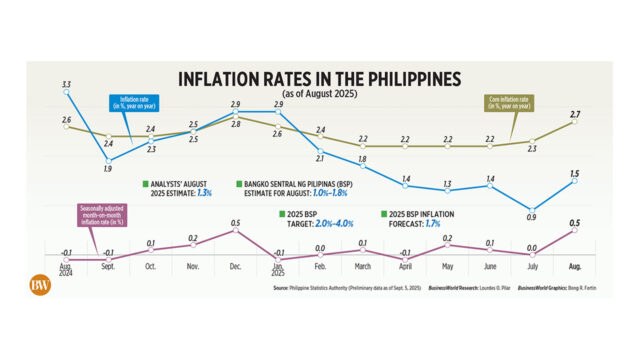
HEADLINE INFLATION picked up to 1.5% in August, as bad weather drove up prices of food, particularly vegetables and fish, the Philippine Statistics Authority (PSA) reported on Friday. Read the full story.

Inflation rates in the Philippines

Weaving a moment into a movement

ANTHILLFABRICS.COM

By Giselle P. Kasilag

Philippine indigenous weaves are having a moment. But for a craft so ancient, this moment took a long time to arrive, and is not without its unusual set of challenges. Unlike other industries, weaving is deeply rooted in tradition. A major part of what makes it valuable is derived from the uniqueness of the culture that produces it. For weaving to flourish, the culture and its environment need to be protected, both of which we as a nation have had very little success with.

In 2009, the Philippines was set to host the 2nd ASEAN (Association of Southeast Asian Nations) Traditional Textile Symposium — a meeting of the region’s textile councils — when Maribel Ongpin discovered that the country had no textile council to begin with. Together with Adelaida “Laida” Lim and other advocates, they formed HABI: The Philippine Textile Council — a non-governmental organization with the mission to “preserve, promote, and enhance Philippine textiles through education, communication, and research using public and private resources.”

“When we started, we realized that there wasn’t much interest in traditional textile,” admitted Ms. Lim who now serves as HABI’s President Emeritus. “In fact, it was a craft that was dying. So, we had to figure out ways of revitalizing the craft and also seeing to it that the tradition gets preserved because we strongly felt, and we learned from the other ASEAN countries, that textiles define our identity.”

“Dying” was the same adjective that Anya Lim used to describe the industry when she co-founded Anthill Fabric Gallery with her mother, Annie Tan Lim, back in 2010 in Cebu. In a way, the indigenous textile was a canary in the coalmine. You can measure the health of a culture by its weaving output or lack of. Fifteen years ago, the output was precariously low.

“When we started Anthill, I was coming from the observation from my field work that a lot of the weaving communities across the country only have elder women continuing the craft,” said the younger Ms. Lim.

She was 16 when her parents first brought her to Banaue which she described as her version of Disneyland. Before her was a thriving village filled with colorful characters from her mother’s bedtime stories come alive. She returned a few years later and was shocked to see a ghost town. No one was weaving textile or carving wood. The scene was repeated in other parts of the country. Only the elders were continuing their traditions. There were no young weavers.

“I witnessed firsthand the threat to the craft,” said Anthill’s Ms. Lim. “I grew up in a household where everything was made in the Philippines and I was thinking in my mind how sad it would be if, fast forward how many years, all these beautiful things that define our identity will just be in coffee table books or museums.”

SAVING THE CRAFT
Like Laida Lim and the members of the HABI Council, her initial goal was to find a way to save the craft. Anthill focused its attention on getting younger women to take up weaving, and the answer lay in ensuring that the livelihood was sustainable.

“The challenge is, how do we preserve culture? But the way to do it is to make sure there’s competent market demand so that young weavers will find sense in learning the craft instead of working in the city or abroad,” she said.

The first five years of Anthill was spent on community building and community development. Capacity building was key so they established the Community Enterprise Development Program. They offered skills training on product design and innovation, and business skills including how to do inventory, swatching (creating fabric swatches) and how to cost the items. The weavers were taught financial literacy, how to open a savings account, and were given incentives to encourage them to save in order to protect what they earned.

There was also a master-apprentice program to ensure that the craft was handed down to the next generation. The weavers receive 20% on top of their income on the condition that they teach a younger weaver.

Everything was geared towards securing the supply chain so that when the business grows, the back end is strong and capable of meeting the demands of the market.

Similarly, the HABI Council was also working with its partner weavers to arm them with skills and financial literacy to compete in the market. And when they were ready, they were invited to join the Likhang Habi Fair, one of the council’s most important and successful programs.

“The goal was to bring the small, grassroot weavers and artisans from far-flung areas to Manila so they can meet designers and customers,” explained Mia Villanueva, president of HABI. She also runs MCV Designs which produces bags and accessories using local weaves and natural materials. “That was one of the goals then: to bring the weavers to the market, and I think we achieved that.”

“We have coined the Likhang Habi Market Fair as a ‘market encounter,’” added HABI Secretary Rambie Katrina Lim who is also behind Rurungan Sa Tubod Foundation which focuses on pineapple fiber (piña) weaving in Palawan. “It is encouraging each weaving entrepreneur, weaver, or weaving community to be able to tell their own story.”

TO MARKET, TO MARKET
There were challenges from both ends. According to HABI’s Laida Lim, it took a lot of arm-twisting to convince the weavers to come to Manila to present their wares at the Likhang Habi Fair.

Traveling to the capital was expensive and they needed to prepare enough inventory to make the trip worthwhile. On the market side, the council had to make sure that the product designs were elevated in order to capture the imagination of buyers whose exposure to local weaves was limited to table runners and blankets. Nobody was going to buy a skirt that would make people mistake them for furniture.

By the second year, it was the vendors who were twisting the arm of the council to be included in the fair. In most cases, the encounters were fruitful and the weaving communities began to see the value of their craft and how to offer them to the public.

“It’s the makers who were actually selling the products,” explained HABI’s Rambie Lim. “Majority of the vendors of Habi have a direct connection to the makers and the textiles that they’re selling. So it lessens the issue of cultural appropriation and not knowing how to use a certain fabric which is the problem that designers have. So in our vendor selection, we make sure that they know the textiles that they are using and its purpose. I think that’s the most important thing when dealing with traditional textiles — the understanding of its meaning because all traditional textiles have meaning, have a purpose.”

SUPPORT FROM CELEBRITIES AND LAW
With all these concerted efforts, then came an explosion of Philippine weaves in the public eye. Designers were using it. Celebrities were advocating it. Retailers began incorporating it in their fashion lines.

“It’s worldwide,” believed HABI’s Ms. Villanueva. “Everybody is more interested in natural, handwoven, sustainable items. What pushed it was that the youth wanted to wear it. We would get young designers with the jean jacket mixing inabel (a cotton weave from the Ilocos region) or some other textile. Then it became hip. It didn’t look like something that’s just for a wedding or graduation. It became daywear. So for me, that was one thing that also helped it.”

Laws such as Republic Act 9242, authored by Senator Loren Legarda, prescribing the use of Philippine tropical fabrics for uniforms of public officials and employees also pushed the visibility of local weaves and normalized their use in daily wear. Furthermore, it aided the ailing industry by creating a secure demand for the textiles, ensuring that weavers’ outputs will always have a buyer.

From the initial 11 vendors, the Likhang Habi Fair now boasts of over 100 vendors with some occupying several booths because they have more products to sell. Aside from the fair, HABI also produced documentaries called Threaded Traditions to educate the public on the cultures that produce these beautiful weaves such as Textiles of Panay Island, Ikat of the Cordillera, and Inabal of the Bagobo-Tagabawa. They have also organized competitions such as the Lourdes Montinola Piña Weaving Competition and the Eloisa Hizon Gomez Abaca Weaving Competition to encourage innovation, especially among the younger generation.

PROBLEMATIC ISSUES
This moment that has now become a movement, brought to light a number of issues plaguing the industry. Foremost is the exploitation of indigenous communities who are not given fair pay for the unique, handmade materials that they produce. This is why Anthill’s Anya Lim is adamant about transparency.

“That’s the challenge we always pose with other brands,” she said. “There are so many brands that are using indigenous fabrics but what is important is that they be as transparent. When people say, ‘Bakit ang mahal ng weaves? (Why are weaves so expensive?)’ we are transparent about how we break down our cost structure, what goes to our artisans, and how much we reinvest back into the programs. We are hoping that all brands that use indigenous weaves ensure that the artisans that they get the fabrics from are also fairly remunerated.”

There is also the multi-sectoral aspect of weaving which encompasses culture, art, environment, agriculture, trade, finance, and foreign relations among others. All of these create a complex structure that affects the production of the fabric. For instance, HABI’s Laida Lim pointed out a problem with cotton which, at some point, hampered their development.

“There was a time when polyester was introduced and cotton disappeared,” she explained. “That was one of our struggles — to try to make cotton yarns available to the weavers. The use of polyester changes the texture. We try to work with government agencies, Philippine Textile and Research Institute and the Philippines Fiber Industry Development Authority to revitalize the cotton industry because that is what is needed.”

HABI’s Rambie Lim explained that the cotton being spun in the Philippines is not tight. It is the loose twist variety because of the mills that are being used. Weavers find it challenging to use because they have to be more gentle in handling it because it may be prone to breaking.

There is also a knowledge loss in terms of fiber production and natural dyeing techniques because the traditions are passed on orally. During the period when there was a dearth of young weavers, many elders passed on without being able to hand down the information.

SEATS AT THE TABLE
All the women agree, though, that the government has given them ample seats at the table where decisions are being made. They have found themselves being consulted often in matters that aid in crafting policy. But the process can be slow and daunting sometimes.

When Baguio City recently passed an ordinance banning machine-made replicas of traditional Cordillera weaves, Anthill’s Anya Lim recalled countless meetings with local government officials and members of congress to push for the much-needed protection. Indeed, it takes hard work, patience, a lot of data, and someone — often several someones from multiple generations — with the drive to see the process through to have policies become lasting safeguards for the industry.

Given a magic wand, Ms. Lim has a substantial wish list that she would love for the government to help with.

“Number one would be a social procurement bill. This is something that Senator Bam Aquino worked on before. They have this in Australia where public and private institutions are required to honor their procurement contracts to social enterprises. That would be a game changer for the weaving communities in terms of building capacity and being able to price the weaves right. It will really elevate the weaving craft into an industry.

“Number two is, it is worth investing on what is endemic in the Philippines. Like abaca — there is so much potential in the natural fiber. We export to Taiwan who process it and sell it to other countries so it’s sad that we’re not really benefiting from it.

“Number three, investment in circular textile innovations because there is so much textile waste. It is the second largest pollutant in the world.”

HABI’s Laida Lim, however, is very hopeful. During the COVID-19 pandemic, she said, a weaving community in the south saw the addition of men into the fold. Weaving is traditionally the domain of women but because the men were unable to leave their homes, they took up the craft to help augment their income. Long after the lockdowns were lifted, some have continued to weave which is helpful in bringing about a new generation of much-needed weavers, though it is also causing a new set of issues within the community where male weavers used to be non-existent. But that is a problem for another day.

“If you will ask at what stage we are at our journey as HABI, we’re slightly shifting a little bit to a more educational thrust,” said Ms. Villanueva. “That is more our objective now. Of course, we still have the fair. That is our biggest project and it is our main fundraiser for our projects. We are now moving to a space where we are figuring out what more we can contribute and how can we redefine our contribution and we think of it in terms of this: educational thrust. We have books, films, documentaries, and we want to work with schools.”

Weaving is truly having a moment which makes this period critical in ensuring its continued success through the concerted efforts of the private and public sector. With our identity at stake, it is certainly an industry that can shine a light on a Philippines that is nurturing of its culture and responsible for its environment. It is a moment to strengthen the ties that bind and sustain a movement for the future.

Philippines ranks 53rd in Global Innovation Index

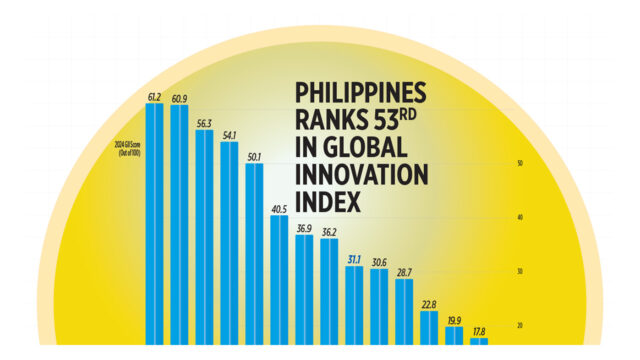
The Philippines rose three spots to 53rd out of 133 economies in the 2024 Global Innovation Index (GII) report by the World Intellectual Property Organization (WIPO). The annually released index measures a country’s innovation performance based on the dimensions of institutions, human capital, infrastructure, markets, and knowledge outputs.

Philippines ranks 53<sup>rd</sup> in Global Innovation Index

Philippines significantly improves in Energy Transition Index

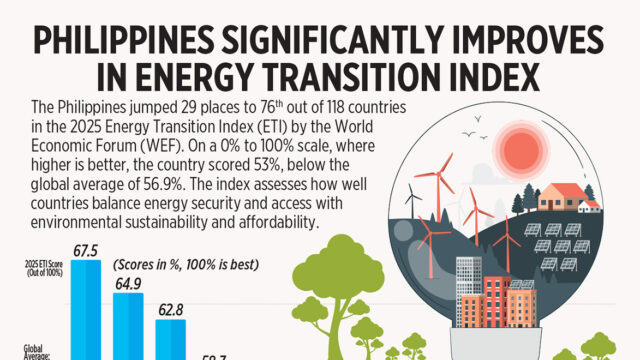
The Philippines jumped 29 places to 76th out of 118 countries in the 2025 Energy Transition Index (ETI) by the World Economic Forum (WEF). On a 0% to 100% scale, where higher is better, the country scored 53%, below the global average of 56.9%. The index assesses how well countries balance energy security and access with environmental sustainability and affordability.

Philippines significantly improves in Energy Transition Index

How PSEi member stocks performed — September 5, 2025

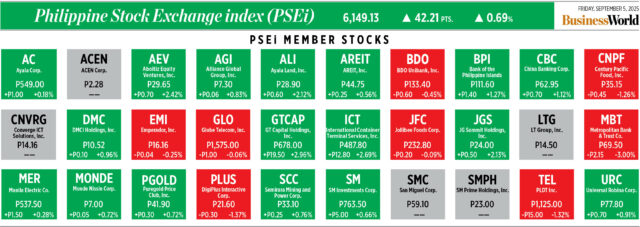
Here’s a quick glance at how PSEi stocks fared on Friday, September 5, 2025.


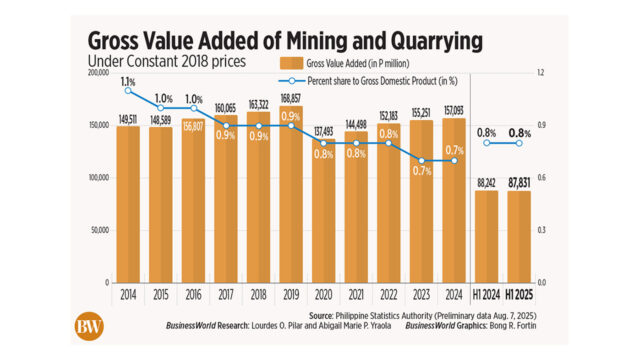
Gross Value Added of Mining and Quarrying

Gross Value Added of Mining and Quarrying

Food video creators weigh in on preservation, innovation, and buying local

STOCK PHOTO | Image by Dmitriy Frantsev from Unsplash

By Joseph L. Garcia, Senior Reporter

THERE’s been a palpable resurgence in Filipino food over the last 10 years. New restaurants are either finding new ways to prepare Filipino food, or are showing off with heritage recipes found through copious amounts of research. That, or old favorite haunts are cherished again. But another effect of this is the proliferation of online videos about Filipino food: either it’s just another vlogger discovering an old carinderia (roadside eatery), or an established chef showing their beloved recipes online.

For The Histolinarya Collective’s Roberto Villarcabral and Martin Narisma, food editor at The Fat Kid Inside studios (his boss, Erwan Heussaff, won a James Beard Award in 2023 for his Instagram account that featured Filipino food), talking about Filipino food is a serious business. Nominations for the FEATR YouTube channel under The Fat Kid Inside followed the next year for three documentaries, including their films on chocolate and calamansi (a Philippine citrus), and their series on Filipino salt. As for Mr. Villarcabral, Histolinarya’s (a portmanteau of “history” and “kulinarya” — an approximation of “culinary history” in Filipino) Facebook and Instagram accounts have thousands of followers; and has worked directly with government institutions to promote Filipino food.

In previous interviews, Mr. Villarcabral expressed having a curiosity about Filipino food since before he was 10 years old. This went hand-in-hand with his own enthusiasm for film. This culminated with his 2023 project, The Lost Filipino Cookbook, which transitioned to The Histolinarya Collective. “Food came in before film,” he said in an interview in July over tea at Chef Jessie in Rockwell (where he had served as an intern). “From there,” — he made a schwoop sound — “it just went like that.”

A FOOD JOURNALIST
Histolinarya’s accounts dive deep into historical records and archives to teach viewers about how food used to be: without him, we wouldn’t have found out about tsin-tsáo, a predecessor to sago’t gulaman (a sweet drink with jelly); or a pre-war ensaymada (a Filipino sweet bread) using Bruun butter (a brand that no longer exists in its native Denmark).

He made clear: “They jump right in and assume that I’m just a vlogger, or a content creator. I am neither. I am a journalist by profession. I’m a journalist who happens to have a social media presence that could use that avenue to raise more awareness and change minds for the better.”

He talked about how he works: “By being a journalist, I also get to play detective. I get to do a lot of investigating.” These include interviews, friendly “interrogations,” and research. “Once I get my answers, I start to deduce.”

“I was always curious about food. I also felt our culture was in shambles, and still is. The cornerstone of every nation’s identity is through their heritage. I wanted to tackle that, and raise more awareness so that people could be mindful about who they are at present, and who were the people before them, that made them who they are today,” he said.

MOM’S INFLUENCE
Mr. Narisma, meanwhile, over a Thai dinner in Bonifacio Global City in July, told us about his own beginnings in food. His mother worked as a newspaper editor, a job which entailed long nights. As a boy, he would see his mother eat processed food with her coffee to stay up late. He thought of better things for his mother to eat, and looked up and prepared various pastries for her. “I didn’t even realize I was using a malfunctioning oven back then,” he recalled. “It started with a desire — even though it’s a small thing — to make my mom’s life a bit easier.” – Martin Narisma, food editor at The Fat Kid Inside (on how his relationship with food started)

Martin Narisma, food editor at The Fat Kid Insislde shares how his relationship with food started. 

He parlayed this into a career in a restaurant kitchen, which brought him to the kitchens of a food conglomerate where he became one of the faces of their TV and online shows. From there, he transitioned to a role under Mr. Heussaff.

On his personal Instagram account, he also shows videos of himself preparing dishes made with Filipino ingredients, but using them innovatively in things like burgers, bread, and fried chicken (Mr. Narisma has two fried chicken outlets, both displaying Filipino flavors like batuan and Bicol Express; and is a partner of another restaurant Gacha).

As for how he and the team find things to feature on Featr, he said, “Our material, most of our research, really, comes from crowdsourcing, and our great team of researchers, who really go to the provinces before anything else. They go there to confirm and find new stories, experience it themselves; see if it’s true.

“That’s where we start writing, meeting about places, and then finally executing our shoots.”

HERITAGE PRESERVATION
Mr. Villarcabral’s channels advocate for food heritage preservation, as does Mr. Narisma’s professional career. However, they differ in that Mr. Narisma’s personal page has a focus on innovating with what can be found in the past (one of his fried chicken recipes, for example, calls for batuan powder, a fruit better known as a souring agent used in soups).

“How would you know your own country, let alone yourself, if you don’t know what’s actually around you?” – Roberto Villarcabral, founder, The Histolinarya Collective

Roberto Villarcabral discusses his advocacy for food heritage preservation, documentation, and education. 

“What made us who we are is because of all the actions of the people in the past — be it the natives, the ones who colonized us, and the ones who traded with us.”

It’s important to preserve these things, just so we can keep our identity, added Mr. Narisma. He talked about some of the islands in the archipelago, once known for their seafood and natural resources, now housing generic joints due to a booming tourist economy. “I wouldn’t want the future generation to be like a hive mind,” he said. “That’s why I give it importance that we still remember where we come from, or at least, our parents and grandparents.”

When both of them feature something on their pages, it’s another day that a forgotten flavor wins back. When we lose a flavor, we lose more than just a taste: we lose a way of life. That doesn’t seem to matter in the city, where they both live, but as Mr. Villarcabral said, “We must take note that the Philippines is not just one culture: it’s an amalgamation of several. What may not be relevant to us might have been something meaningful to someone.”

For example, he discusses a fruit he featured on his page: the dayap (key lime). He found a man growing dayap and selling its juice in San Fernando, Pampanga. The fruit, while featured in numerous heritage recipes, has fallen out of favor and may be endangered in Central and Southern Luzon because of its difficult propagation and low fruit yield compared to its cousin in the citrus family, calamansi, which has since been dominant on tables. He also mentions that the fruit may taste “soapy” to some palates. “I really made an effort to promote the heck out of this guy,” said Mr. Villarcabral. “You’ve got to bring it out there and let people be exposed to it more, so that it could be part of the natural daily experiences of the people.”

As Mr. Narisma said, “Just because you don’t eat ampalaya (bitter gourd) doesn’t mean it’s bad for everyone. Some people will like it; some people just don’t know about it yet.”

With Mr. Narisma, we talked about authenticity: How authentic will something be when one adapts it for the future?

He used his example of making an Italian focaccia, but using kiniing, the cured meat of the Cordilleras. “Not a lot of the Filipinos know that we do that. Most of them, when you say ‘smoked,’ they’d always go for things like Italian preserves,” he said. “Okay, fine. But number one, it’s expensive; we really don’t have that. Number two, who are you helping? By using kiniing in our videos, we don’t have millions and millions of followers, but the few people who watch — it’s very effective. People ask where to buy it.”

NEW MEDIA
They gave several reasons for presenting Filipino food through videos: the written word exists, after all; but then the world also moves.

“I feel like writing will always be effective,” said Mr. Narisma. “But that medium has been around for a while. As we get older and new generations are able to access media, I guess they digest videos easier. It’s easier for them to retain (when) they see it.”

Mr. Villarcabral recalls wanting to raise awareness for many issues as a boy, first channelling these topics through cinema, as he believed it to be a powerful medium. Though his journey took him in a different direction, the same vision informs his work now.  “People go to the movies, have a good time. Rather than me being preachy and writing about it, why don’t I entertain people?” With that approach in mind, he tells the story of food and national issues in an accessible manner for today’s generation.

His goals were — and still are — to educate, inform, and enlighten about political, social, and economic movements, but using food as a starting point. “Something that everybody would just agree on.

“They can bicker about religion, about political affiliations. But one thing that people would just sit down and agree about is food,” he said. “Each of them somehow has a craving.”

“Food just breaks down barriers and brings people together.”

REPRESENTATION
Both say that their videos are viewed by Filipinos, here and abroad, and even people who are not actually part of the worldwide Filipino community. The world teems with cultures, but both men take a stand on why Filipino food deserves a voice. “We have been silenced for such a long time,” said Mr. Villarcabral.

Mr. Narisma talked about his experiences watching Filipinos and Filipino food, as translated through international channels on TV back then. “Every time Filipino food comes up — even until now — people think ‘it’s oily, it’s fat, it’s too rich; it looks yucky, it’s all just stews.’”

“There is no material for them to see,” he said in a mixture of English and Filipino, while also noting that the shows he watched back then may have gotten their recipes and impressions from third-hand accounts. “It’s never firsthand accounts, where a person comes to the Philippines to live here for years and then try to explore the food itself.

“Representation is still important,” he said in a mixture of English and Filipino. “Once you gain (a position) where people listen, you can start bringing up more important stuff,” he said. “We tried our best not to be political, but we still pay attention to things.”

Mr. Villarcabral continued, “We never got that platform to speak about our plight as a people. Whether we live here in the archipelago, or when we migrate to another country. What is their story? How did they live through all of the struggles and hardships to get to where they are today?”

He gave as an example, the cultural hegemony that the United States has held since after the Second World War. Since then, “It’s always been their perspective. We’ve always seen the world through their eyes.”

BUYING LOCAL
We’re often told that buying and consuming local helps in preserving culture, as well as helping your fellow Filipino. You can, and you should, but it doesn’t fix all of the problems. For one thing, it’s been pointed out that several of the artisanal food and ingredients that are often featured can be more expensive and harder to find than what’s readily on shelves.

Mr. Villarcabral gives an example of food readily available on supermarket shelves: chicken nuggets. “I’ve learned that there are a lot of brands here that just distribute chicken nuggets from China. It’s much cheaper to purchase these chicken nuggets than to actually make them and sell them,” he said. “How do we address a problem as simple as chicken nuggets? That is, again, for the government to step in. How do we know that what China is dumping onto us is of good quality?”

The consumer is just influenced by what is being marketed towards them,” said Mr. Villarcabral. Therefore, the onus is on producers and the government to step up. “They should do more inspections on these chicken nuggets from foreign countries before they can pass it on to local distributors,” he said about the nuggets.

“It’s not just about preserving,” Mr. Narisma said in a mixture of English and Filipino. “I think it’s convincing people to be more open to change and modernization.”

He talked about old-school ways of farming and production that do not produce high yields, or crops and species that become endangered because of a lack of modernization in agriculture. He remembers Guimaras mangoes, for example: the island was once one of the top producers of the fruit. But because of lack of support, they weren’t able to catch up to their Southeast Asian neighbors in modernizing the harvest. The Filipino fruit would arrive abroad bruised, and then fall out of favor. He talked about coffee farms he had once visited in Cavite, but due to a lack of support (and the farmers selling their land for cash), several have since closed. “I want our country, our people, to be well-known in a better way,” said Mr. Narisma.

“Meanwhile, local manufacturers should actually be more competitive and find more ways to connect with avenues to distribute their product,” he said. “Even if it means forging business relationships with foreign tech just so that their processing, their production line is more snappy.”

“Be competitive. Make your price accessible (by making) your tech more innovative. Make more innovations. Make your tech more efficient,” said Mr. Villarcabral.

He gave another example of saltmakers from Belison, Antique, whom he documented with fellow food advocate and food archivist John Sherwin Felix (related story:https://www.bworldonline.com/special-reports/2024/09/09/619440/going-local-maybe-the-way-to-become-food-secure-is-to-think-small/). The salt, called budbud, is processed through bamboo tubes (Iloilo has a similar industry, where it is being revived; the Antique way is on the way out). The asinderos (the local name for the saltmakers) told them that they don’t really get much support from the government. The local government found the bamboo tubes expensive, and according to Mr. Villarcabral, the closest thing to help they got was receiving plastic maters to speed up the process — anathema to the artisanal process the salt relies on, not to mention the effects of plastic on what Mr. Villarcabral calls “the cleanest salt in the Philippines.” To that effect, he released a video animating a proposal to the local government that included ideas like growing bamboo by the beach (which can be used for the saltmaking process) and develop the experience as a possible tourist attraction (maybe even a festival). “It just fell on deaf ears.”

“That’s my lament about these people who are supposed to be tha vangaurds of their provinces. Instead of building basketball courts for the community to get votes, they can actually win people over by doing something more positive and more contructive to the community,” he said. (I’m) not saying that basketcall courts are counterproductive, but it can coexist with a lot more important things.”

Mr. Narisma said, “It’s not the producers, it’s not the consumers also. I think it’s the people who are in charge of our systems here.”

Redefining the Philippine music industry in the age of AI and streaming 

STOCK PHOTO | Image by from Freepik

By Brontë H. Lacsamana, Reporter

FOR Filipino musicians, the digital age has led to a democratized music landscape, where anyone can publish and promote their music online. But it has also led to a more competitive, fast-paced industry. Amid a global boom in music, issues of upholding copyright and the rise of artificial intelligence (AI) plague composers and songwriters.

Though concerts and live performances are back in full swing following the COVID-19 pandemic, the music industry remains forever changed in a world driven by online content.

In July, the Linggo ng Musikang Pilipino (LMP), established in 2014 through Proclamation No. 933, celebrated Filipino music for the entire month through performances, discussions, and workshops. It is mounted annually by the Organisasyon ng mga Pilipinong Mang-Aawit (OPM).

“I think these kinds of events are important because I think it’s always important to help artists with their music journey. One way is really giving them a space to learn more and expand their knowledge, especially for those who want to do this professionally and don’t know how the business side of the digital music economy works,” OPM Executive Director Gab Cabangon told BusinessWorld in an interview.

Data from the Philippine Statistics Authority (PSA) showed that the gross value added of the country’s creative industry-related activities expanded by 8.7% year-on-year, from P1.78 trillion in 2023 to P1.94 trillion in 2024. The music sector’s contribution to that is 8.3%, which amounts to P20 billion.

However, allocating resources to better support the music industry remains lacking. “There’s really a lot of homegrown talent, but the global market has so many options,” said Mr. Cabangon on the sidelines of the LMP talk series.

“There’s opportunity for more support from both public and private sectors. For example, we don’t have to follow the K-pop model exactly, but there are some best practices from them that we can apply, such as a bigger investment in music,” he added.

OPM board member, singer Gary Valenciano told BusinessWorld in an interview that “the music industry right now is at an all-time high.”

He cited the Wish Music Awards in January, where each nominee garnered significant cheers resounding throughout the huge Araneta Coliseum. The top winners included BINI, SB19, Dilaw, Cup of Joe, Zack Tabudlo, Al James, Dionela, Arthur Nery, and Hev Abi.

“I don’t think it’s ever been like this. It’s not just surviving; it’s really thriving, and everyone has a lot of respect for each other. There’s a lot of good music to choose from out of all the Pinoy artists we have today,” Mr. Valenciano said.

Spotify’s head of music for Asia, Kossy Ng, said that their promotional initiatives like RADAR — a playlist of new releases that updates every Friday — are geared towards inspiring more Pinoy artists. The latest partnership that Spotify has had with a local artist is with P-pop boy group SB19, which released a multi-platform experience for their Simula at Wakas extended play launch and tour back in May.

“We’re just as excited about how they are inspiring other Pinoy artists and taking the local P-pop scene to the next level,” Ms. Ng said in a statement sent to BusinessWorld via e-mail.

In October last year, Spotify found that the amount of Filipino music on the platform “quadrupled over the past five years.”

Another artist they noted which has seen tremendous success is P-pop girl group BINI, with “a listenership growth of 500% since 2022.”

“We’re committed to providing artists with the ability to share their stories and create richer experiences that deepen their relationship with fans, so listeners feel like they are truly part of the journey,” added Ms. Ng.

FROM LOCAL TO GLOBAL
This year’s Fête de la Musique — the global music event which started in France — had an event that brought together creatives from the Philippines, France, and other parts of Asia to discuss expanding local talent into global markets using technology. Led by SONIK Philippines, the country’s music export arm, it is one of many local initiatives that seek to uncover how the digital creative economy is shaping the future of music.

The past few years have seen significant growth in the local music community and the desire among Filipino artists to collaborate globally, according to Sonik Philippines Co-founder Mike Constantino.

“SONIK is our country’s de facto music export commission, exporting artists since 2019. We co-founded it with NCCA (National Commission for Culture and the Arts) and now we’re working with AFM (Alliance Française de Manille),” he said at the press conference for the event.

“Since then, we’ve seen huge growth in this community and the desire of our artists to share their talents abroad.”

This year’s session identified what the Philippines must do to maximize the global potential of homegrown music talent: improve copyright infrastructure, increase funding in creative industries, and develop long-term export strategies.

The government’s Philippine Creative Industries Development Act, made in 2022, was formed to boost the country’s potential to be a hub for creative industries, but many stakeholders see this as just a starting point. Artists, composers, and musicians will need to make their voices heard to guide the government to a fruitful strategy for all.

“Especially for musicians starting out, my advice is join whatever organization you can to be able to speak with a louder voice,” Jim Paredes, singer-songwriter-producer and board trustee at the Filipino Society of Composers, Authors, and Publishers (FILSCAP), told BusinessWorld in an interview in July.

“This industry needs more synergy. Everybody wants to reinvent the wheel and make new initiatives, but we have to all support those for it to work,” he said.

At the LMP talk series, many industry stakeholders noted that the digital music economy has changed how Filipino music must be promoted on a global scale.

Jeli Mateo, chief executive officer of independent record label Flip Music Productions, said that “visual branding is everything now.”

“How you communicate your story as an artist is vital given the consumption patterns of this generation,” she explained.

This was echoed by Raymond Fabul, Sony Music Philippines’ artist management director. “Because of democratization, around 140,000 songs are released every day globally on digital streaming platforms. It’s overwhelming — but there are success stories that can serve as inspiration for artists,” he said.

Mr. Fabul likened the Filipino music scene as “a rising tide that lifts all boats,” and said that there is room for diversity.

“Music is cyclical, so certain genres dominate at any given time, but it doesn’t mean the less popular ones disappear. There’s just so many people streaming and now so much control over your preferences that algorithms will feed that to you,” he explained.

TRACKING GROWTH
More proof of the growing digital economy is the growing number of streams. Ms. Ng of Spotify told BusinessWorld that when the platform began in the country, it mainly saw foreign acts on its top 50 chart.

The turning point came in 2017, with the likes of Ben&Ben and Moira Dela Torre leading the charge in increasing local music’s streams. “Now, the majority or 75% of the tracks on Spotify Philippines’ Top 50 chart are local music,” she said.

This year, the reach of Filipino music was legitimized through The Official Philippines Chart, an industry-backed weekly chart that showcases top-performing tracks from local and international artists in the country, many of which are P-pop artists, and a new wave of OPM.

The charts are based on streams across major platforms — Apple Music, Deezer, Spotify, and YouTube — and run by the International Federation of the Phonographic Industry, with support from the Philippine Recorded Music Rights, Inc. (PRM).

The chart provides “transparency and visibility… with a clear picture of who is resonating with our audiences, who is breaking barriers, and who is truly making waves in the music scene,” explained Roslyn Pineda, Sony Music Entertainment Philippines general manager and PRM board member, at the launch back in February.

The Official Philippines Chart is made publicly available every Tuesday on The Official Southeast Asia Charts website, Instagram, and Facebook channels.

Big names in OPM who have been part of the initial charts so far are Arthur Nery, Cup of Joe, BINI, Dionela, Maki, TJ Monterde, Flow G, Al James, Ben&Ben, and Hev Abi.

“This data is critical; it provides insights that can help us understand the ever-evolving landscape of our industry,” Ms. Pineda added.

FILSCAP’s Mr. Paredes added that the existence of collecting agencies like theirs allows for avenues for musicians to improve. “For example, if your songs are registered with FILSCAP, they can monitor if their compositions are being played, and you get royalties for it,” he said.

Such groups aid with professionalizing fees, organizing songwriting workshops, developing legislation, and increasing representation — though there’s always room for improvement, Mr. Paredes explained.

FILSCAP is able to collect royalties globally due to being part of the International Confederation of Societies of Authors and Composers (CISAC), the leading collecting agency and network of authors’ societies representing more than 5 million creators across the world.

STRENGTHENING COPYRIGHT
In the Philippines, Republic Act 8293 governs the intellectual property (IP) system. Under it is the Copyright Law, which protects Filipino creators.

“One unique thing about copyright as an IP is the fact that it vests from the moment of creation,” said Emerson Cuyo, director of the Intellectual Property Office of the Philippines’ (IPOPHL) Bureau of Copyright and Related Rights, at a talk in March on copyright in the Philippines.

“This means there is technically no need to register your copyright over your creation — but there are advantages to registering your work. It is for creatives in jurisdictions like the Philippines where the voluntary system of copyright registration is very lacking,” he explained.

Songwriters and composers can consult legal experts within IPOPHL for guidance with registering any form of IP, to properly monetize it.

“Your creations are assets. They are future sources of revenue, so you have to protect them, said Marivic Benedicto, a lawyer and Philippine Association of the Record Industry president, at the LMP talk in July.

“It only costs P500 to have your copyright in the composition registered with IPOPHL, for reference for third parties like YouTube, for example,” Ms. Benedicto explained.

She added that, with the democratization of music where anyone can upload and promote their songs on the internet, record labels and distributors are no longer necessary. However, they can help with visibility, monetization, and legal matters — as long as artists are empowered to always view contracts with a lawyer.

IPOPHL revealed in February that in 2024, the number of copyright registrations in the Philippines reached its highest level over the last five years.

There were 6,552 certificates issued that year, slightly higher than the 6,522 recorded in 2023. Musical compositions account for 7% of these registrations.

On the ongoing improvements to the process of registration, Mr. Cuyo of IPOPHL shared in a statement: “Some authors require prompt access to their certificates for various purposes, including resolving disputes over content ownership or infringement.”

“Our goal is to accelerate the process and reduce waiting times,” he said.

ON THE IMPACT OF AI
IPOPHL has also been readying guidelines for AI use in creative industries, to ensure copyright protections in the application of AI in various works.

As of now, creative works must be the work of a natural person to be eligible for copyright protection.

“We rely heavily on the disclosure of the applicants,” Mr. Cuyo explained. “What’s for sure is that works that are wholly generated by AI do not pass the requirement for copyright protection under our law. But for partially generated works, that’s where the confusion is, and that’s where guidance will come in.”

However, among musicians themselves, there is a strong resistance to using AI, which is largely seen as an efficiency tool that bypasses the joy of the creative process. Ben&Ben member Miguel Benjamin Guico said at the LMP talk that “AI aims to find a perfect answer to something.”

“I feel like, in songs, the beauty is actually in the imperfection. The way we mispronounce words, the way we phrase things weirdly,” he explained. “No machine can replace that.”

AI-generated music became the subject of heated debate in July when a band named The Velvet Sundown, with about 500,000 monthly subscribers gathered over the course of a month, was revealed to be an AI band.

“The Velvet Sundown is a synthetic music project guided by human creative direction, and composed, voiced, and visualized with the support of artificial intelligence,” said its spokesperson Andrew Frelon in a post online. The generative AI program Suno was used to create the virtual act, complete with consistent songwriting.

For Ms. Mateo of Flip Music Productions, it has been important for them to keep their artists and music “AI-free.”

“It is not because we are anti-tech, but because we are pro-human. Music has been built on stories and identities,” she said at the LMP talk. “I know it is a tool. We do use it for administrative tasks, for the mundane things, for efficiency. But for the process of music creation, I don’t see it being useful for artists who want to really connect.”

Trina Belamide, a songwriter and FILSCAP board member, added that creators and founders of programs like Suno and Udio “make art a commodity.”

“In their minds, they help people so that making art will no longer be difficult. They think, who wants to suffer? But they miss the whole point, because that’s exactly what we love to do as artists,” she explained, to the cheers and applause of musicians, songwriters, and composers attending the conference.

“If you’re an artist, you enjoy the process of creating.”

Scorecard: Philippine Development Plan 2025-2028

PRESIDENT Ferdinand R. Marcos, Jr. could face legislative headwinds as a divided Congress threatens to derail his reform agenda, political analysts said, casting uncertainty over his efforts to build a lasting legacy ahead of the 2028 presidential race. Read the full story.

Scorecard: Philippine Development Plan 2025-2028

PHL shares may move sideways before US data

BW FILE PHOTO

PHILIPPINE STOCKS may continue to move sideways as the market awaits the release of August US consumer and producer inflation data, which could provide more support to growing expectations of a US Federal Reserve rate cut this month, especially following the soft jobs reports released last week.

On Friday, the Philippine Stock Exchange index (PSEi) rose by 0.69% or 42.21 points to close at 6,149.13, while the broader all shares index went up by 0.4% or 14.79 points to 3,692.71.

Week on week, however, the PSEi went down by 6.44 points from its close of 6,155.57 on Aug. 29.

“Higher yet manageable August inflation and positive signs for Fed easing in September kept the PSEi above the 6,100 zone despite a frail start during the week,” online brokerage 2TradeAsia.com said in a market note.

“The market ended in the green, … supported by sustained buying pressure as investors continue to take advantage of relatively attractive prices. Moreover, the latest inflation report looks like it was received positively, coming in within the BSP’s (Bangko Sentral ng Pilipinas) target range and boosting sentiment,” Regina Capital Development Corp. Head of Sales Luis A. Limlingan said in a Viber message.

Headline inflation picked up to 1.5% in August from 0.9% in July, but was slower than the 3.3% recorded in the same month a year ago, the Philippine Statistics Authority reported on Friday.

This was slightly higher than the 1.3% median estimate in a BusinessWorld poll of 16 analysts but was within the central bank’s 1%-1.8% forecast for the month.

For the first eight months, inflation averaged 1.7%, matching the central bank’s forecast for this year.

Meanwhile, US job growth weakened sharply in August and the unemployment rate increased to nearly a four-year high of 4.3%, confirming that labor market conditions were softening and sealing the case for a US Federal Reserve interest rate cut later this month, Reuters reported.

Nonfarm payrolls increased by only 22,000 jobs last month after rising by an upwardly revised 79,000 in July, the Labor Department’s Bureau of Labor Statistics said on Friday. Economists polled by Reuters had forecast payrolls would rise by 75,000 jobs after a previously reported gain of 73,000 in July.

Financial markets expect the Fed will deliver a quarter-percentage-point rate cut at its Sept. 16-17 policy meeting, with two more such moves at its remaining two meetings in 2025. The central bank has kept its benchmark overnight interest rate in the 4.25%-4.5% range since December.

For this week, the market’s focus will be on the US inflation reports as these could pave the way for a Fed cut at next week’s review, 2TradeAsia.com said. It put the PSEi’s immediate support at 6,200 and resistance at 6,500.

Mr. Limlingan said markets are consolidating before the Fed’s meeting next week. “Markets are clearly rallying beneath the surface of shifting policy expectations and positioning.” — AGCM with Reuters

Creative industries counted on to make P2-T contribution to GDP

VECTORJUICE-FREEPIK

THE Department of Trade and Industry (DTI) is hoping to raise the creative industries’ contribution to gross domestic product (GDP) to P2 trillion this year.

“I hope we can reach P2 trillion this year. We really need to push the industry,” Trade Secretary Ma. Cristina A. Roque told reporters last week.

The creative economy posted an 8.7% increase in gross value added to GDP to P1.94 trillion last year, the Philippine Statistics Authority reported.

She said the DTI considers the creative industries to be a part of the economy where the Philippines holds a competitive edge.

“The creative industries are important for us because this is really where we excel, and I really believe that we must send our aces out there,” she said.

“When we travel, we get a lot of good reviews; we have used a lot of creative talent to really drive trade for us. But we really feel that the creative industries are a driver of trade and tourism,” she added.

She noted that South Korea has been using creative industries to drive trade and tourism.

To support the industry, she said that the DTI is seeking an increased budget for the creative industries.

“How can we push the industry when we don’t have a budget? They gave us only P50 million,” she said.

“And then we need to also talk to the different businessmen to explore our local talent,” she added.

Under the National Expenditure Program (NEP) 2026, the Malikhaing Pinoy Program has been allotted P50 million.

Among the segments being pushed by the department are gaming and animation.

“Anime and the game design are avenues where we feel we can really excel … I realized that a lot of people are already contracting with us, but a lot of people don’t know that that is also where our edge is,” she added.

On Thursday, the DTI opened the five-day Malikhaing Pinoy Expo 2025, which aims to highlight the Malikhaing Pinoy Program.

“We expect more people to know that there’s a Malikhaing Pinoy Program so more people can join, more people will be aware, and more people can support,” she added.

The event gathered representatives from the audiovisual media, visual arts, digital interactive media, design, performing arts, publishing, traditional cultural expressions, creative services, and cultural-site industries. — Justine Irish D. Tabile