Home Blog Page 5450

US Senate passes bill to ban TikTok on gov’t devices

WASHINGTON — The US Senate late on Wednesday passed by voice vote a bill to bar federal employees from using Chinese-owned short video-sharing app TikTok on government-owned devices.

The bill must still be approved by the US House of Representatives before going to President Joseph R. Biden for approval. The House of Representatives would need to pass the Senate bill before the current congressional session ends, which is expected next week.

The vote is the latest action on the part of US lawmakers to crackdown on Chinese companies amid national security fears that Beijing could use them to spy on Americans.

The Senate action comes after North Dakota and Iowa this week joined a growing number of US states in banning TikTok, owned by ByteDance, from state-owned devices amid concerns that data could be passed on to the Chinese government.

During the last Congress, the Senate in August 2020 unanimously approved legislation to bar TikTok from government devices. The bill’s sponsor, Republican Senator Josh Hawley, reintroduced in legislation in 2021.

Many federal agencies including the Defense, Homeland Security and State departments already ban TikTok from government-owned devices. “TikTok is a major security risk to the United States, and it has no place on government devices,” Mr. Hawley said previously.

North Dakota Governor Doug Burgum and Iowa Governor Kim Reynolds issued directives prohibiting executive branch agencies from downloading the app on any government-issued equipment. Around a dozen US states have taken similar actions, including Alabama and Utah this week.

TikTok has said the concerns are largely fueled by misinformation and are happy to meet with policymakers to discuss the company’s practices.

“We’re disappointed that so many states are jumping on the political bandwagon to enact policies based on unfounded falsehoods about TikTok that will do nothing to advance the national security of the United States,” the company said Wednesday.

Other states taking similar actions include Texas, Maryland and South Dakota.

Republican Senator Marco Rubio on Tuesday unveiled bipartisan legislation to ban TikTok altogether in the United States, ratcheting up pressure on ByteDance due to US fears the app could be used to spy on Americans and censure content. Mr. Rubio also is a sponsor of Mr. Hawley’s TikTok government device ban bill.

The legislation would block all transactions from any social media company in or under the influence of China and Russia, Mr. Rubio’s office said.

At a hearing last month, FBI Director Chris Wray said TikTok’s US operations raise national security concerns.

In 2020, then-President Donald Trump attempted to block new users from downloading TikTok and ban other transactions that would have effectively blocked the apps’ use in the United States but lost a series of court battles over the measure.

The US government’s Committee on Foreign Investment in the United States, a powerful national security body, in 2020 ordered ByteDance to divest TikTok because of the fears that US user data could be passed to the Chinese government, though ByteDance has not done so.

CFIUS and TikTok have been in talks for months to reach a national security agreement to protect the data of TikTok’s more than 100 million users but it does not appear any deal will be reached before the end of the year. — Reuters

Vietnam makes big push to expand South China Sea outposts, says US think tank

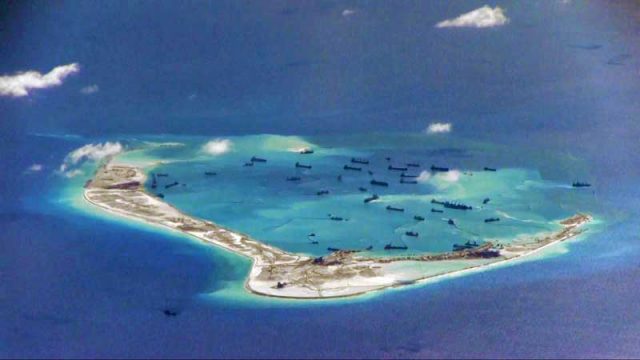
US NAVY/HANDOUT VIA REUTERS/FILE PHOTO

WASHINGTON — Vietnam has conducted a major expansion of dredging and landfill work at several of its South China Sea outposts in the second half of this year, signaling an intent to significantly fortify its claims in the disputed waterway, a US think tank reported on Wednesday.

Washington’s Center for Strategic and International Studies (CSIS) said the work in the Spratly Islands, which are also claimed by China and others, had created roughly 420 acres (170 hectares) of new land and brought the total area Vietnam had reclaimed in the past decade to 540 acres (220 hectares).

Basing its findings on commercial satellite imagery, CSIS’s Asia Maritime Transparency Initiative (AMTI) said the effort included expanded landfill work at four features and new dredging at five others.

“The scale of the landfill work, while still falling far short of the more than 3,200 acres of land created by China from 2013 to 2016, is significantly larger than previous efforts from Vietnam and represents a major move toward reinforcing its position in the Spratlys,” the report said.

Vietnam’s Washington embassy did not immediately respond to a request for comment on the report.

AMTI said Vietnam’s midsized outposts at Namyit Island, Pearson Reef and Sand Cay were undergoing major expansions, with a dredged port capable of hosting larger vessels already taking shape at Namyit and Pearson.

Namyit Island, at 117 acres (47 hectares) and Pearson Reef, at 119 acres (48 hectares), were both now larger than Spratly Island at 97 acres (39 hectares), which had been Vietnam’s largest outpost. Tennent Reef, which previously only hosted two small pillbox structures, now had 64 acres (26 hectares) of artificial land, the report said.

AMTI said Vietnam used clamshell dredgers to scoop up sections of shallow reef and deposit the sediment for landfill, a less destructive process than the cutter-suction dredging China had used to build its artificial islands.

“But Vietnam’s dredging and landfill activities in 2022 are substantial and signal an intent to significantly fortify its occupied features in the Spratlys,” the report said.

“(W)hat infrastructure the expanded outposts will host remains to be seen. Whether and to what degree China and other claimants react will bear watching,” it said.

China claims most of the South China Sea and has established military outposts on artificial islands it has built there. Taiwan, Vietnam, Malaysia, Brunei and the Philippines all have overlapping claims in the sea, which is crisscrossed by vital shipping lanes and contains gas fields and rich fishing grounds. — Reuters

Steely France ends Morocco run to set up Argentina showdown

France battles Argentina in the 2022 World Cup final

AL KHOR, Qatar — France will play Argentina in the World Cup final after beating Morocco 2-0 in an enthralling semifinal on Wednesday to stay on course to retain the title and end the fairytale run of the north Africans in Qatar.

Theo Hernandez scored in the fifth minute in a perfect start for the holders, who would have been looking for an early strike to silence the rowdy Moroccan support at the Al Bayt Stadium and dent the confidence of their team.

But it still proved a close-fought match as Morocco overcame injury blows and showed no deference to France’s reputation, taking the game to them in a gallant effort that added to the glowing reputation they have earned at the tournament.

France settled the outcome with a second goal 11 minutes from time as substitute Randal Kolo Muani, with a first touch after coming on, tucked in a shot at the back post.

They are now into a fourth World Cup final and can become the first country to successfully defend their title since Brazil 60 years ago.

“There’s emotion, there’s pride, there’s going to be a final step, we’ve been together with the players for a month, it’s never easy, there’s happiness so far,” said a smiling coach Didier Deschamps.

For the first goal, Mr. Hernandez had to lift his left foot high to connect with a bouncing ball from a tight angle to finish off a sweeping move started by Antoine Griezmann’s run down the right and a cutback pass that Kylian Mbappé initially fluffed.

Mr. Mbappé was the creator of the second as he attempted first to dribble through the Morocco defense and then shoot, his effort blocked but falling for Kolo Muani to net.

Olivier Giroud struck the post and missed from point-blank range in the first half at the end of a barnstorming run through the middle from Aurelien Tchouameni.

The midfielder threaded a superb ball to find Mr. Mbappé, whose miscued shot was poorly cleared, allowing Mr. Giroud a first-time shot which went wide from close-in.

But Morocco were never overawed and created opportunities of their own as Azzedine Ounahi forced two good saves out of French captain Hugo Lloris with speculative efforts, and curling set-pieces put the French defense under pressure.

The north Africans were hit hard by injuries to their key centre backs with the gamble of naming Nayef Aguerd in the starting line up failing to work as he hurt his hamstring in the warm-up and skipper Romain Saiss was forced off after 20 minutes.

BICYCLE KICK
Replacement center back Jawad El Yamiq was, however, closest to an equalizer with a spectacular bicycle kick on the stroke of halftime, from a poorly cleared corner by the French, with Mr. Lloris getting a vital touch as it hit the base of the upright.

“We gave the maximum, that’s the most important,” said Morocco coach Walid Regragui.

“We had some injuries, we lost Aguerd in the warm-up, Saiss, Mazraoui at halftime. We paid for the slightest mistake. We didn’t get into the game well, we had too much technical waste in the first half, and the second goal kills us, but that doesn’t take away everything we did before.”

France’s victory set up the tantalizing prospect of a decisive clash between Argentina maestro Lionel Messi, at the end of his international career, and France’s Mr. Mbappé, emerging as the next superstar of the world game.

“Playing two World Cup finals in a row is an incredible moment. We did a good job, it was hard, but we are in the final. We will work hard to win this final,” Mr. Hernandez said.

Morocco’s exit was tempered by their achievement of becoming the first African and Arab country to reach the World Cup semifinal, a feat widely celebrated. They can expect to be hailed as heroes when they return home after Saturday’s third-place playoff against Croatia. — Reuters

IM Quizon beats GM Sivuk in Manny Pacquiao chessfest

IM Daniel Quizon (right) and GM Vitaly Sivuk (left) — MCPL FACEBOOK PAGE

FOR FILIPINO International Master (IM) Daniel Quizon to be worthy of gaining Grandmaster status, he needs to beat most of the GMs he plays.

The Southeast Asian Games bronze medal winner did just that yesterday after slaying third seed GM Vitaly Sivuk to enhance his title and GM aspirations in the MCPL’s Manny Pacquiao International Open Chess Festival in General Santos City.

The 18-year-old Dasmariñas, Cavite bet wielded the King’s Indian like a magic wand in bedazzling the 30-year-old Mr. Sivuk, born in war-thorn Ukraine but is representing Sweden, that earned him a place in a chase pack at No. 3 with four points after five rounds.

“I won in the middle game,” said the reigning Asian Juniors blitz prince.

Mr. Quizon will try to catch a bigger fish in top seed GMs Hovhannes Gabuzyan of Armenia in their sixth-round showdown at press time.

If he ends up doing a David to Mr. Gabuzyan’s Goliath, Mr. Quizon will bolster his chances of earning the second of three norms required to become a full-pledged GM and the champion’s loot worth a cool P1.14 million, the country’s biggest in decades courtesy of boxing legend Manny Pacquiao.

Mr. Gabuzyan was tied with second pick Dutch GM Lucas Van Foreest at No. 1 with 4.5 points apiece after the two ended up with a fighting draw.

Grouped with Mr. Quizon No. 4 seed GM Pier Luigi Basso of Italy, IM John Daniel Bryant of the United States and Filipino IMs Kim Steven Yap and Ricky de Guzman.

Mr. Basso clobbered IM Cris Ramayrat; Mr. Bryant waylaid Sherwin Tiu; Mr. Yap shocked GM Darwin Laylo; and Mr. De Guzman edged fancied GM John Paul Gomez.

At No. 9 with 3.5 points each were Russian-born FIDE-represented Konstantin Sek, IM Richilieu Salcedo, IM Michael Concio, Jr., FIDE Master Mari Joseph Turqueza, IM Eric Labog, Jr., Sheider Nebato and GM Joey Antonio. — Joey Villar

Tokyo Olympic medalists Paalam, Petecio to grace ‘23 Batang Pinoy opening

ALL TOKYO OLYMPIC BOXERS and medalists Carlo Paalam (left), Eumir Marcial (center) and Nesthy Petacio (right). — PSC

ILOCOS SUR — No less than  Tokyo Olympics boxing silver winners Nesthy Petecio and Carlo Paalam will usher in the Philippine Sports Commission’s (PSC) Batang Pinoy National Championships unfurling tomorrow at the Quirino Stadium here.

Joining Petecio and Paalam in the inaugurals were Olympian judoka Kiyomi Watanabe and Southeast Asian Games swimming gold medalists Chloe Isleta and Mary Allin Aldeguer.

“The Batang Pinoy program has already produced numerous champions in various sports since it started in 1999. I am sure that the stories of our be-medalled athletes will inspire our young athletes who will be competing in Ilocos Sur, to reach the height they have achieved,” said PSC Chair Noli Eala, who will also grace the opener.

Joining them are host Ilocos Sur Gov. Jerry Singson and Philippine Olympic Committee President Abraham Tolentino.

Mr. Eala said the event, which will be participated in by around 6,000 in and out-of-school youth athletes from 140 local government units, is being done to heed the call of President Bong Bong Marcos to boost the country’s grassroots development program.

A total of nine sports will be played face-to-face like archery, athletics, badminton, chess, cycling, table tennis, swimming, weightlifting, and obstacle course racing as demo sport.

Eight others — arnis, dancesport, judo, karate, muay, pencak silat, taekwondo, and wushu — will be virtually held online and will be streamed via the PSC Facebook and YouTube platforms.

This year’s edition will also be held in partnership with the Philippine Amusement and Gaming Corp. (PAGCOR), the Department of Interior and Local Government Unit (DILG) and the Department of Education (DepED), co-presented by Milo Philippines, Pocari Sweat Otsuka Solar Philippines, Universal Robina Corp., Coca-Cola Beverages Philippines, Globe Telecom, and Beautéderm. — Joey Villar

Doctors shine at PHL Hobie 16 National Championship at TLYC

TALISAY MAYOR Nestor Natanauan (left) and top winners Lindo Pahayahay (second from left) and Michael Ngu (third from left).

TWO doctors proved their mettle outside the medical field as they dominated the 2022 Philippine Hobie 16 National Championships, the country’s longest-running hobie sailing tournament.

Ophthalmologist Michael Ngu of the Manila Doctors Hospital topped the five-race competition at the Taal Lake Yacht Club (TLYC) in Talisay, Batangas, which resumed after a two-year suspension due to the pandemic.

With crew Lindo Pahayahay, they edged other contestants for the top spot in the National Championship which determines the country’s top Hobie 16 sailor for the year.

Coming in at second place is Sunpower Philippines general manager Glenn Everett, crewed by his wife Jana.

Rounding up the winning circle at third place is Makati Medical Center ophthalmologist and former Philippine Eye Doctors Association President Dennis Cruz, along with his local crew, Jason Mendoza.

Now on its 24th year, the tourney started in 1995 at its TLYC homebase, and was rotated around Subic Bay, Laiya Beach in San Juan, Cebu, Anvaya Cove in Bataan, and Punta Fuego Yacht Club and Tali Beach in Nasugbu, Batangas. The home of the Philippine Hobie Fleet and the Philippine Home Boatbuilders Yacht Club, TLYC was dubbed by Lonely Planet magazine as the country’s sailing capital because of its winds ideal for sailing for most time of the year. In an adjunct tournament held, TLYC commodore Peter Capotosto and Jazmine Lucero topped the Governor’s Cup, a single new format race which sailed around Taal Volcano.

Named in honor of the provincial chief executive of Batangas, the Cup is an annual yearend multi-race tourney which showcases the sports tourism potential of the scenic volcano and its vicinity. Governor Hermilando Mandanas, a tourism champion in the Calabarzon Region, personally awarded the top winners.

The sailing events were sponsored by San Miguel Beer, Club Balai Isabel, Barako Coffee, and Active Boating and Watersports as media partner, and supported by the Municipality of Talisay and the Province of Batangas.

UP forward Zavier Lucero injures left knee in Game 2

REIGNING champion University of the Philippines (UP) is praying for the best results with regards to Zavier Lucero’s left knee injury as the UAAP Season 85 men’s basketball finals heads to a winner-take-all Game 3 next Monday.

The versatile forward already underwent a magnetic resonance imaging (MRI) test yesterday morning, UP Fighting Maroons program director Bo Perasol told The STAR.

“We’re still waiting for the advice of our medical team,” said Mr. Perasol as UP absorbed a double whammy in a 65-55 loss against Ateneo in Game 2.

Mr. Lucero, in a non-contact incident, went down hard on his own early in the 8:31 mark of the fourth quarter with UP staring a 44-59 deficit.

The Filipino-American standout grimaced in pain holding on to his left knee and had to be carried out of the court.

As mentioned by UP courtside reporter Carla Elizaga on the TV broadcast, Mr. Lucero said he heard a “crack” after his scary fall that silenced the usually wild Diliman crowd.

The 6-foot-6 Mr. Lucero finished with six points, 11 rebounds, two assists, a steal and a block in 28 minutes of action.

He served as the hero in Game 1 with 14 points, 11 rebounds and two assists as well as the two crucial blocks on Chris Koon and Ange Kouame that willed UP to a 72-66 win in Game 1.

UP, at press time, awaits Mr. Lucero’s official diagnosis as it braces for an all-out war in Game 3 at the Smart Araneta Coliseum on Monday in a tough title defense. — John Bryan Ulanday

Miami Heat hit team-record 24 treys in tight win over OKC Thunder

TYLER Herro tied a career high with 35 points to lead the Miami Heat to a 110-108 win over the host Oklahoma City (OKC) Thunder on Wednesday.

Mr. Herro had a career-high nine 3-pointers as the Heat set a franchise record with 24 3-pointers. But it was inside the arc where Mr. Herro came through for the decisive bucket. Mr. Herro drained a pullup jumper with 5.7 seconds remaining to break a tie, and Miami held on after a timeout.

Shai Gilgeous-Alexander missed a jumper in the closing seconds. Josh Giddey grabbed the rebound, but his shot hit off the bottom of the backboard to end the game, though Mr. Giddey argued for a foul call as Victor Oladipo and Dewayne Dedmon surrounded him.

Miami has won the first two games of a four-game road trip while the Thunder have lost four consecutive games.

The Heat led by as many as 21 in the first half, but the Thunder battled back to take a seven-point lead with four minutes remaining in the game. Miami finished with a 15-6 run, though, to escape with the win.

Mr. Gilgeous-Alexander led the Thunder with 27 points.

Mr. Herro took over to start the second quarter, hitting a trio of 3-pointers in the first 2:18 and scoring the first 11 points of the quarter. By late in the second, the Heat’s lead was stretched to 21.

Miami hit nine 3-pointers in the second quarter and had 16 at the half — both a franchise record for 3-pointers in a half for the Heat and the most the Thunder had ever allowed in a half. Mr. Herro scored 14 of his points in the second quarter.

Oklahoma City closed the first half on a 12-3 run over the final 3:13 to cut the deficit to 12 at the break. — Reuters

Fundamental infirmities

Anthony Davis was quick to blame himself for the Lakers’ loss to the Celtics the other day. Not that he didn’t play well; in fact, his stat line of 37 (on 13-of-24 shooting from the field), 12, three, one, and one underscored yet another brilliant effort in a Most Valuable Player award-worthy season. It was that he failed once more to ice a match against an East powerhouse following a poor effort from the free-throw line. Mimicking his late charity miss against the Sixers over the weekend, he failed to find the bottom of the net in two tries from the stripe with 28 ticks left; the development kept their lead at two and allowed the visitors to force overtime en route to a win.

Significantly, head coach Darvin Ham was likewise ready to accept criticism for what he noted was his mediocre work from the bench, particularly in the fourth quarter. Given that he needed to ride his vital cogs, 37-year-old LeBron James included, in order for the hosts to keep pace with the conference-leading Celtics, he felt that he could have scheduled his timeouts better to allow for rest. Even as he wasn’t wrong to associate the lack of breathing space with Davis’ deadball misses, however, the Lakers’ woes did not start and end there. Far more fundamental infirmities are at the forefront.

As James duly pointed out in his post-contest presser, a loss is a loss. There are no moral victories for the Lakers, and especially not in an encounter that saw them get behind early, manage to right themselves enough to erect a double-digit lead, and then snatch defeat from the throes of triumph by execrable execution down the stretch. They had a 99.3% chance to prevail with four minutes left in regulation, only to be done in by their own frailties.

The best teams in the National Basketball Association manage to cope and deal with adversity in one way or another. Needless to say, the Lakers aren’t one of those teams. And because there is no consolation prize for a near miss, they would do well to address what they need to so that, in the first place, Davis would not need to can free throws just for the purple and gold to avoid seeing red.


Anthony L. Cuaycong has been writing Courtside since BusinessWorld introduced a Sports section in 1994. He is a consultant on strategic planning, operations and human resources management, corporate communications, and business development.

Sustainability reporting is not just a casual tick-the-box exercise

SARAH ELIZABETH-UNSPLASH

The Securities and Exchange Commission (SEC) is expected to require publicly listed companies to submit their sustainability reports next year but several of them are still in a quandary on how to prepare their reports. I sat down with several of these listed companies, and they say they are still at a loss on what to report, how to report, and who will prepare such reports — arguing that they will probably submit the reports out of compliance.

This is very sad. Sustainability reporting should not just be a casual tick-the-box exercise.

Globally, there has been a noted increase in sustainability reporting. In fact, it has become an accepted part of disclosure and transparency initiatives of companies — integrating this with their own financial reporting and disclosure to regulatory agencies and shareholders. More and more companies are reporting their carbon footprint — with the end goal of reducing such in their value chains. Some report on their participation in the greening of economies through various projects that contribute to the protection of biodiversity, promotion of sustainable products, and plastic neutrality among others. There are some that report on their global initiatives on diversity and inclusion, social justice and equality, and community development.

A 2022 survey made by the global accounting, audit, and business advisory firm, KPMG, shows the Asia-Pacific region leads in sustainability reporting with 89% of its companies undertaking sustainability reporting. This is followed by Europe (82%), the Americas (74%) and the Middle East and Africa (56%). Seven Asia-Pacific countries, territories, and jurisdictions have sustainability reporting rates higher than 90%: Japan (100%), Singapore (100%), Malaysia (99%), South Korea (99%), Thailand (97%), Taiwan (94%), and Pakistan (91%). The Philippines and Vietnam have a large number of companies reporting — with both recording 87% of their companies undertaking sustainability reporting.

Kristine Aguirre, Partner, Head of ESG KPMG in the Philippines, noted that a key driver for sustainability reporting in the Philippines is that SEC “memorandum circular” that was issued in 2019. The circular supports publicly listed companies to assess and manage the environmental, social, and governance (ESG) aspects of their organization, and measure and monitor their contributions against universal sustainability targets. The Philippine SEC aims to encourage transparency and accountability from companies with this public. She stressed that the Philippine SEC has indicated that it intends to adopt a mandatory approach to sustainability reporting for listed companies, aligned with similar mandatory sustainability reporting requirements in other jurisdictions in the region.

In the same survey, KPMG disclosed that there are five major trends in sustainability reporting.

One trend is that sustainability reporting grows incrementally with movement towards the use of standards framed by stakeholder materiality assessments. According to the survey, the rates of sustainability reporting among the world’s leading 250 companies are at an impressive 96%. It noted that while there is still a need for global consistency in ESG reporting, the most dominant framework being used is the Global Reporting Initiative framework, with some regions preferring the Sustainability Accounting Standards Board framework. Interestingly, the survey finds that most companies use materiality assessments.

The second trend is the increased reporting on climate-related risks and carbon reduction targets, in line with Task Force on Climate-related Financial Disclosure. The survey shows that nearly three-quarters of companies report their carbon targets, although 20% do not disclose any link to an external target such as a 1.5 °C scenario. The third trend is the growing awareness of biodiversity risk. According to the survey, companies now acknowledge biodiversity risk.

Interestingly, the fourth trend is that the UN SDG reporting prioritizes quantity over quality. Based on the results of the survey, majority of companies report on SDGs, with 10% of companies reporting against all 17 SDGs. The most popular SDGs being used by companies are SDG 8: Decent Work and Economic Growth; SDG 12: Responsible Consumption and Production; and SDG 13: Climate Action.

Finally, the fifth trend is that climate risk reporting is the most acknowledged issue being reported on by companies. It is followed by social and governance risks. According to KPMG, there has been a marked improvement in the number of companies that acknowledge climate change as a risk to their business. However, less than half of companies report on social and governance risks to their business. In general, the description of these risks is overwhelmingly narrative-driven and do not quantify the financial impact of these risks on companies or on society.

While there is a growing acceptance of sustainability reporting as part of the overall disclosure framework for all listed companies, there is still a need for information and education campaigns that the Philippine SEC needs to undertake to enable listed firms to fully understand the value of this type of report.

And this must begin with the most basic question — What really is sustainability reporting?

To keep it simple, sustainability reporting is the disclosure of ESG goals. It also includes the communication of a progressing state towards these objectives. In other words, beyond simply communicating the company’s sustainability ambitions, the organization takes stock of the action plan implemented to reach its targets.

In the preparation of the sustainability reports, or what others term as ESG reports, there is a need to define what the ESG goals are. Environmental, social, and governance goals are defined according to specific criteria, which are also called ESG criteria. Environmental, social, and governance criteria refer to a set of standards that investors can use to screen potential investments. The idea is to allow them to differentiate projects, in order to invest their money in those which turn out to be socially and environmentally conscious.

To be more specific, the environmental part considers how a company performs in an ecological way; the social part pays attention to relationships management with employees, suppliers, customers, as well as all the communities concerned with companies’ operations; and the governance part analyzes the company’s leadership, internal controls, audits, etc.

And the benefits of sustainability reporting? There are a lot.

The benefits include better risk management, costs and savings optimization, decision-making facilitation, and improved corporate confidence and reputation — toward customers as investors. Simple perusal of management literature will show that there are several benefits when companies conduct sustainability reporting. According to scholars, sustainability reporting ensures regulation compliance; companies become more attractive to customers; they attract better talent; build employee pride and loyalty; become more attractive to investors; and they increase transparency, credibility, and accountability to stakeholders and shareholders. At the same time, sustainability reporting is seen as a useful risk management tool, it can help generate savings, it helps in better decision-making, and it helps in increasing stakeholder trust.

Indeed, reporting on ESG goals is very logical business strategy. As social and environmental concerns imply future business threats, investing time and resources into sustainability solutions may allow any company to meet challenges. In other words, sustainability reporting is a way to strengthen long-term strategy of enterprises.


Ron F. Jabal, APR, is the chairman and CEO of PAGEONE Group (www.pageonegroup.ph) and founder of Advocacy Partners Asia (www.advocacy.ph).

ron.jabal@pageone.ph

rfjabal@gmail.com

Words, words, words

BW FILE PHOTO

The proposed Philippine version of a sovereign wealth fund is called the Maharlika Investment Fund (MIF — formerly the Maharlika Wealth Fund) in honor of the late dictator Ferdinand Marcos, Sr. “Maharlika” means of noble or aristocratic birth, and was one of Marcos’ favorite buzzwords. Marcos often used that word to imply that he, his wife, and the rest of his family are the country’s entitled nobility (there are paintings of the duo bedecked a la king and queen, complete with a tiara-crowned Imelda Marcos). He also entertained the idea of renaming the Philippines “Maharlika.”

The use of that word during his son’s regime is similar to the revival of the “Kadiwa” stores, which, as part of the Marcos Sr. dictatorship’s unsuccessful attempt to curb inflation, were supposed to help stabilize the prices of prime commodities, particularly that of rice, the cost per kilo of which, then as now, was increasing by the day.

Kadiwa” means “of the same mind”— it echoed the dictatorship’s “Isang Bansa, Isang Diwa” (One Nation, One Mind) slogan, which made it appear that uniformity rather than diversity of thought is the supreme national virtue.

All that aside, however, the legal and other infirmities of the now renamed MIF bill have outraged lawyers, economists, workers’ groups, pensioners, and the business community. Among those defects were its proposed board of directors’ exemption from accountability and various laws; the Fund’s initial intent of using the contributions of Social Security System (SSS) and Government Service Insurance System (GSIS) members; its possible impact on pensioner funds and even on the Bangko Sentral ng Pilipinas (BSP, the Central Bank of the Philippines); the President of the Philippines’ heading it; and the distinct possibility of its being just another slush fund.

Its proponents have so far announced that the MIF would no longer use SSS and GSIS funds, due perhaps to the protests against it — but most likely because of their realization that both Systems have hundreds of millions of pesos in deficits.

In any case, the way they have been trying to make it appear that they are correcting the flaws of the bill creating the MIF suggests that 1.) it was not well thought out, and 2.), its proponents are determined to pass it. But as serious as its defects and its advocates’ seeming determination to ram it through Congress are, there are far more problematic issues that it raises.

Filed by Marcos cousin and House of Representatives Speaker Martin Romualdez and Marcos son Sandro, who is the First District of Ilocos Norte Representative and also Senior Deputy Majority Leader of the House, the original draft of the bill was hastily passed at the committee level on Dec. 1, which by itself alone raises suspicions about its real intent.

Even Marcos Jr.’s sister, Senator Maria Imelda “Imee” Marcos, expressed serious concerns over the proposal, given the Malaysian experience with former Prime Minister Najib Razak who was accused of misusing that country’s own sovereign wealth fund and was subsequently convicted of corruption. Senator Marcos also pointed out that a sovereign fund is usually established when a country has excess earnings beyond its budgetary requirements, which the Philippines does not have. She questioned the timing of the bill, since the country is indebted to international banking institutions to the tune of P13 trillion-plus, and there is also a looming global recession.

Economist and BSP Governor Felipe Medalla also raised the alarm against establishing a sovereign wealth fund. Recalling Malaysia’s experience, Medalla was concerned about the Fund’s impact on governance and corruption, and its possible effect on the independence of the BSP.

The fundamental question, however, is why the Fund is being proposed despite the lack of resources needed, and the country’s pressing problems with human rights violations, inflation, unemployment, energy and food insecurity, poverty, and the growing incidence of hunger. Marcos Jr. has talked about some of these issues in various venues, such as at the United Nations General Assembly last September and the Asia-Pacific Economic Cooperation (APEC) summit. But both as President of this Republic and as his own Secretary of Agriculture, his motherhood declarations — “we must raise production”; “our industries must develop,” etc., etc. — make it appear that rather than nothing, something is being done about them.

The reality is that there are hardly any coherent programs to remedy the country’s immediate problems. It suggests that the Philippines’ current President does not really know what his government should be doing, such as the steps needed to ease the surge in unemployment the pandemic triggered, and the consequent decline of the economy. He has identified in his speeches what must be done — but he has been sorely deficient in saying exactly how, for example, he intends to combat inflation. In some of his speeches he in effect said that only with luck could the government curb it. He has not declared what he specifically intends to do not only about the country’s low agricultural productivity, but also its other problems, such as the country’s growing food insecurity.

His visit to a “Kadiwa sa Pasko” (Kadiwa on Christmas) store launched by the Quezon City Government on Dec. 1 was typically long in generalities and short in specifics. His speech did nothing more than recall the original purpose of Kadiwa stores, which he said was to connect producers to markets in far-flung areas. He did not say how those stores can do that today, half a century later.

The government-regulated and crony press during his father’s dictatorship did not look into whether those stores served their declared purpose. What is distressing is that much of today’s supposedly free press seems to be just as willing to uncritically echo the current attempt to prettify Marcos Sr.’s governance record and to merely quote his son’s utterances as he attempts to replicate, of only in words and labels, that mythical “golden age.” Marcos Jr. repeated during the Kadiwa sa Pasko QC launch what he had already said about making rice available for only P20 per kilo. Completely missing in his speech was any response to criticisms of that claim as unrealizable, with the current market price of rice still at P38 to P50 per kilo, or higher. And yet, how he will fulfill his P20-per-kilo-rice promise is as important an issue as that of keeping the country’s rice supplies at a sustainable level as the Kadiwa stores take what they will be selling from the country’s buffer stocks.

No one can be blamed for concluding that these Kadiwa launches are nothing more than public relations ploys and a complete waste of taxpayer money. While all this publicity was distracting the public, the inflation rate was rocketing to 8% —the highest since 2008, or 14 years ago. The prices of various products have been steadily rising, and in seeming response, the number of Marcos’ speeches have spiked as well. But he has not said anything concrete during those occasions about curbing inflation and solving other problems of the same urgency; instead, he has been exaggerating the supposed availability of cheap rice in the handful of Kadiwa stores that have opened across this archipelago of 7,000-plus islands and over 100 million souls.

Six months into this Presidency, the only concrete project the Marcos Jr. regime is focused on is the unneeded, unwanted, and untenable but presumably self-servingly lucrative Maharlika Investment Fund. As for the country’s real problems, only words, words, words and even more words are being used to —quite literally — address them.

Luis V. Teodoro is on Facebook and Twitter (@luisteodoro).

www.luisteodoro.com

Transformation and inspiration

FACEBOOK.COM/MAGSAYSAYAWARD

The Ramon Magsaysay Award is Asia’s premier prize and highest honor. It recognizes greatness of spirit in selfless service to the peoples of Asia, regardless of race, gender, or religion. It is Asia’s equivalent of the Nobel Prize.

Sen. Ramon Magsaysay, Jr. and Milagros Magsaysay-Valenzuela, son and daughter of the late President Ramon Magsaysay, stated, “For more than six decades, the Ramon Magsaysay Award Foundation (RMAF) has faithfully recognized outstanding individuals and organizations in Asia and celebrates their remarkable, selfless efforts to make a difference in the lives of people and communities. Through the initiative and generosity of the Rockefeller Brothers Fund, RMAF was established in 1957… It engenders hope and optimism through the Magsaysay laureates and their inspiring stories, in a world that is marred by poverty, strife, inequality, and global calamities.

“These are the heroes of today — champions of the poor and marginalized, public service superstars, advocates of truth warriors of peace, protectors of the earth, and guardians of our heritage.”

Among the global icon-laureates are Mother Teresa, India; the Dalai Lama, Tibet; Princess Maha Chakri Sirindhorn, Thailand; Akira Kurosawa, Japan; Muhammad Yunus, Bangladesh; and Mechai Viravaidya, Thailand.

The RMAF will celebrate its 65th year in 2023. President Susan B. Afan explained their ambitious dreams: “To amplify the life-affirming messages and inspiring values of the Magsaysay laureates, to further promote their successful solutions across borders, and to make them true examples of the best of humanity which young people can emulate.”

Chairman Aurelio R. Montinola III remarked: “The Ramon Magsaysay Foundation had remained constant and true to its mission — identifying outstanding leaders who have shown ‘Greatness of Spirit’ to help Asia grow with a humanistic, unselfish and Help-the-Community approach.”

Here are the 2022 laureates and their stories.

Soetheara Chhim, the founder of the Transcultural Psychosocial Organization (TPO)-Cambodia, which alleviates the suffering of the Cambodian people from trauma and mental health problems over the past decades. He recalled the Khmer Rouge regime that brutally murdered the intellectuals in the country — only 40 doctors survived. “We Cambodians were all living in deep trauma and with baskbat, literally meaning broken courage.”

He became a doctor and saw the need for psychosocial healthcare in rural areas. TPO-Cambodia offers mental health service to hundreds of thousands of Cambodians.

“This award comes with a prize money, I am donating all of this to TPO’s initiative, Operation Unchain Project, to treat and unchain more patients… To do the right thing.

“My mother named me ‘Sotheara’ which means gentle, humble, kind, and compassionate. I hope that I have lived up to this name.”

He thanked Dr. Cornelio Banaag, the Father of Child Psychiatry in the Philippines, who was his revered professor in Phnom Penh 26 years ago.

Tadashi Hattori, an eye surgeon who left Japan to take a new challenge in Vietnam.

“I am in no way an elite doctor,” he said.

“There as a shocking prevalence of cataract blindness in the country… The patients would come to the hospital only when…they have lost sight in both eyes.” He recalled a six-year-old boy who did not turn up again because he could not afford surgery. “I have not forgiven myself since then for having let the boy go…”

That was when he decided, “When patients cannot pay, I tell them… ‘No worries. It will be alright. I will pay for you from my own pocket money and so please have the operation.’

“How would you feel of you have to live in darkness for the rest of your life?… It scares me to think of life without light… If there is anything I can do as an ophthalmologist, it is to bring light to people so that they will turn their despair to hope and live a better life that they deserve to live.

“I am just filled with joy with patients when they see light again. I find happiness in working with the doctors I trained and in providing free treatment for people across the region in Asia… I know that regaining vision is not only about being able to see, but about discovering hope in light. Let there be light.”

Bernadette J. Madrid M.D. is a child protection champion. The multi-awarded pediatrician, a graduate of the University of the Philippines and Assumption Convent Iloilo, is the founder of the Child Protection Unit at Philippine General Hospital (CPU-PGH). It started 25 years ago. It has since expanded throughout the country as the Child Protection Network, with more than 115 Women and Children Protection Units and an excellent multi-disciplinary approach.

“Ending violence against children will not happen on its own. We need to fight for it. It needs planning, commitment, resources, persistence, and leadership. With it comes accountability,” Dr. Madrid emphasized.

“There are no quick fixes….

“Violence against children is a crisis! Children are fast becoming an endangered species and with them goes our humanity. We can prevent violence against children, and we know how. We are stewards of this world and particularly of the children. We are stewards of their soul.

“I am so honored that have my work recognized by Asia’s most prestigious award.

“Why me? It is like the violin player receiving recognition on behalf of the whole orchestra… I am just one violin player. The other members of the orchestra (the CPN Foundation Trustees and the teams) are here. I share this award with each one of them.”

Dr. Madrid called the audience to stand up and pledge, “Ako Para sa Bata: I am for every child.” Everyone present did.

She is the 64th recipient of the award in 64 years.

Gary Bencheghib, the handsome “Rock Star” from Indonesia, is only 28 years old. His parents are French nationals, and he grew up in Bali. He represents the RMAF’s “Emergent Leadership.”

“My short life’s journey has pretty much only revolved around plastics… My mother told me ‘if you don’t do your homework, you’ll end up being a garbage man.’

“I receive the Ramon Magsaysay Award as a garbage man.”

He was referring to his amazing work collecting tons of plastic from the rivers of Indonesia.

“It feels like a never-ending battle. We will be knee-deep in a river, cleaning it up and feeling victorious, but the very next day with big rains, the river is filled up with more trash…

“A new study reveals that there is no surface on earth without signs of plastic pollution. Every island in Indonesia and the Philippines under some shell, under some rock has plastic pollution.

“It is a call for collective action. We need to stop this disaster from destroying our plant and our health. We need to focus on scalable solutions and implement them quickly.”

He revealed that after two short years of running Sungai Watch, and due to growing awareness, they have removed some barriers.

“We have cleaned up some of the worst disaster relief areas. When we fully restore these areas, we let nature do its work. We have seen mangroves regrow.…

“Cleaning up plastics is only half the battle. Processing the trash and turning it into valuable products is a whole other game. We are collecting, sorting, processing, treating and recycling the trash that we collect.

“Join me on this lifelong journey against plastic pollution.

“No little boy dreams of becoming a garbage man but here I am a garbage man, doing everything to make sure that we have a plastic free world… We need to let our planet rest and heal.”

Congratulations to the 2022 Ramon Magsaysay Laureates for their noble mission and inspiring achievements.

Best wishes to the Board of Trustees — Aurelio R. Montinola III, Chairman; Dato Timothy Ong, Vice-Chairman; Susan B. Afan, President; Jose L. Cuisia, Jr. Treasurer, Emily A. Abrera, Randolf S. David, Ernesto D. Garilao, Cielito F. Habito, Cecilia L. Lazaro, Ramon R. del Rosario, Jr., Suzanne E. Siskel and Toshinao Urabe.


Maria Victoria Rufino is an artist, writer and businesswoman. She is president and executive producer of Maverick Productions.

mavrufino@gmail.com