Home Blog Page 5441

Comelec disqualifies Albay governor from elections 

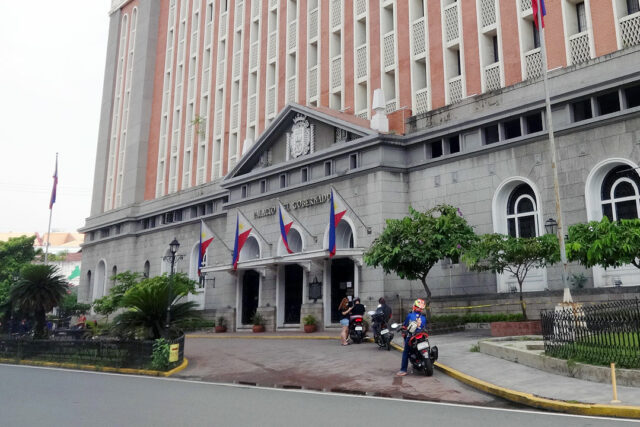
THE COMELEC office in Intramuros, Manila — PATRICK ROQUE

THE COMMISSION on Elections (Comelec) has disqualified Albay Governor Noel E. Rosal from this year’s elections for approving cash aid to tricycle drivers in April, when there was a spending ban. 

In a 12-page resolution on Sept. 19, the Comelec First Division said Mr. Rosal, who was the incumbent Mayor of Legazpi, Albay, violated the law when he authorized the program. 

He had argued that the payout was only a continuation of a social assistance program of Legazpi City. 

Comelec noted that the cash aid is considered a social welfare and development activity prohibited by law. 

“Nowhere in the law does it state that a continuing social welfare and development project is excluded from the prohibition,” according to the ruling written by Election Commissioner Aimee P. Ferolino. 

Mr. Rosal, who won this year’s gubernatorial race, did not immediately reply to a Facebook message seeking comment. — John Victor D. Ordoñez

SIM card bill OK’d on 3rd reading 

REUTERS

CONGRESSMEN on Monday approved on third reading a bill that will require the registration of subscriber identity modules (SIM) cards to prevent mobile phone scams. 

Voting 250-6 with one abstention, the chamber approved House Bill 14, or the proposed Subscriber Identity Module Card Registration Act. 

Under the bill, telecommunication companies are tasked with the safekeeping of information gathered during the registration process. No data may be divulged except in compliance with laws, upon a court order or with the written consent of the subscriber.  

Any breach of confidentiality will be punishable with imprisonment or a fine of as much as P1 million.  

HB 14 is the exact version approved during the 18th Congress.  

Former President Rodrigo R. Duterte vetoed the bill in April after senators included social media accounts in the coverage. 

The Senate approved a counterpart bill on second reading on Monday. — Matthew Carl L. Montecillo and ANOT 

Taiwan wants Philippines to back its UN inclusion  

TAIWAN wants the Philippines to back its bid for inclusion in global discussions including those in the United Nations (UN), as world leaders gather in the US for an annual meeting. 

In a statement, Taipei Economic and Cultural Office in the Philippines Representative Peiyung Hsu said Taiwan “sincerely hopes” that its closest neighbor “could continue to voice their support for Taiwan’s meaningful participation in the UN system.” 

“Taiwan and the Philippines enjoy long-time cordial people-to-people relations,” he said. “As close neighbors and maritime nations, Taiwan and the Philippines uphold the values of freedom, democracy and the rules-based international order.” 

Mr. Hsu asked the UN to reconsider the “One China” policy, saying it is misleading because Taiwan is governed separately. He said Taiwan could only be represented in the global arena by their democratically elected government. 

The pro-Beijing policy prevents Taiwan from participating in world conventions, including those led by the UN.  

“By deliberately conflating its ‘One China’ principle with the United Nations General Assembly Resolution 2758 — the resolution that determined who represents China in the organization some 50 years ago — Beijing is misleading the world by spreading the fallacy that Taiwan is part of the People’s Republic of China,” he added. — Kyle Aristophere T. Atienza

SPED funding without papers rejected 

PHILIPPINE budget planners on Monday said it rejected funding for a learning program for persons with special needs because the Education department failed to document it. 

While DepEd had proposed to retain the P523-million funding for the special education program (SPED), it did not provide sufficient documents to support it, the Budget department said in a statement. 

Education officials earlier denied claims that it had deliberately excluded funding for SPED. 

The Budget department said that as of Jun. 30, the SPED program under the 2022 budget had an obligation rate of 1.13%, or only P6.35 million out of a P560.2-million allocation. 

“This funding provision will still be valid until December 31, 2023.” 

The agency noted that during the budget season, items may be realigned and modified by an agency to fund a program in dire need of resources. 

It also cited a P1.216-billion surplus for the Programs, Activities, Projects for elementary and junior high schools under DepEd’s Maintenance and Other Operating Expenses. 

“We deemed that the program support or additional allocation for the smooth implementation of the SPED may already be accommodated within the same program, and that a separate budget for the purpose may no longer be necessary.” 

Earlier in the day, DepEd said its proposed P523-million fund for SPED was not considered in the spending plan for 2023.  

DepEd, which is headed by Vice-President Sara Duterte-Carpio, has been under fire after it requested a P150-million confidential fund that was not scrutinized at a recent House of Representatives hearing. 

The Alliance of Concerned Teachers has been urging DepEd to realign the confidential fund and use it to improve education quality.  

Budget and policy analysts have said the multimillion confidential fund goes against the austerity theme of the Marcos administration. — Kyle Aristophere T. Atienza

Marcos sends sister to queen’s funeral

PEOPLE gather to pay respects to Britain’s Queen Elizabeth II following her death, in London, Britain, Sept. 15. — REUTERS

PRESIDENTIAL sister Maria Irene Celestina Marcos-Araneta was set to represent the Philippines during the state funeral of Queen Elizabeth II, Britain’s longest-reigning monarch. 

She was accompanied by her spouse, Gregorio María Araneta III, Press Secretary Trixie Cruz-Angeles said in a statement on Monday.  

“Mrs. Marcos-Araneta and her spouse will be attending the events for the state funeral beginning with the lying-in-state of the queen taking place today,” she said.  

President Ferdinand R. Marcos, Jr. is in New York to attend the 17th United Nations General Assembly.  

World leaders and foreign dignitaries were expected to attend Monday’s funeral for the queen, who died on Sept. 8. 

“She exemplified to the world a true monarch’s great dignity, commitment to duty, and devotion to all those in her realm,” Mr. Marcos said after her death. 

Ms. Marcos-Araneta is the youngest among the three children of the late dictator Ferdinand E. Marcos and his wife Imedla. — Kyle Aristophere T. Atienza 

Senate backs Judiciary budget hike 

PHOTO BY MIKE GONZALEZ

THE SENATE on Monday backed a budget increase for the Judiciary, citing the need to fund its digitization and modernization efforts. 

“The budget of the Judiciary should really be increased,” Senator Raffy T. Tulfo said in mixed English and Filipino at a hearing. “It’s about time that it’s modernized, it’s about time that it’ digitalized.” 

The Budget department has proposed a P52.72-billion budget for the Judiciary, 28.9% or P21.46 billion lower than its original proposal. The judiciary wants lawmakers to restore P2.8 billion. 

The country ranked 55th out of 117 countries in the Digital Quality of Life Index 2022 by Surfshark from 48th last year. In Asia, the Philippines placed 14th out of 34 countries. 

Meanwhile, the Philippines dropped 25 places to 45th for internet quality this year. While the average mobile Internet speed and stability improved, speed growth worsened from last year. The average broadband internet speed improved but stability and speed growth worsened. 

The Supreme Court needs more proctors, CCTV cameras for the bar exams In November, which would continue to be digitalized, Administrator Raul B. Villanueva told senators. 

.“That’s why we’re asking for an additional budget next year because this was not included unfortunately,” he added. — Alyssa Nicole O. Tan 

Comelec to start printing ballots for village elections 

THE COMMISSION on Elections (Comelec) on Monday said it would start printing ballots for village and youth council elections amid a proposal to postpone these, according to its chairman. 

“We’ve already submitted the ballot template to the National Printing Office and the office is supposed to start printing on Sept. 19 to Oct. 20,” Comelec Chairman George Erwin M. Garcia told CNN Philippines. “We have to keep our timetable, otherwise we will lack time to prepare for the elections.” 

Comelec has spent more than a billion pesos on preparations, he said. 

Mr. Garcia earlier said all election equipment and materials bought for the Dec. 5 elections could still be used if lawmakers decide to postpone these. 

Last week, the House of Representatives passed on second reading a bill that seeks to postpone village and youth elections to December of next year. 

“We hope that by the end of September, there will be a definite answer to this issue,” the Comelec chief said. 

The elections for youth leaders and village officials were set for May last year but were postponed amid a coronavirus pandemic. — John Victor D. Ordoñez 

House body approves freelance bill

PHILIPPINE STAR/ MICHAEL VARCAS

THE HOUSE of Representatives labor committee on Monday approved a measure that seeks to protect the rights of freelance workers and ensure they work under humane conditions.  

Consolidated House Bill 615 directs the employer and freelance worker to sign a hiring contract. 

Pangasinan Rep. Christopher V.P. De Venecia, who filed the bill, said freelancers are not protected by the employee-employer relationship. 

Under the bill, workers required to go to the office must be paid a night shift differential of not less than 10% of their basic pay for each hour of work performed between 10 p.m. and 6 a.m. unless there is a contrary clause in the contract.  

They must also be paid hazard pay equivalent to at least 25% of the total payment for the period of deployment for freelance workers in dangerous areas such as isolated stations, prison camps, mental hospitals, radiation-exposed clinics, disease-infested laboratories, or areas under a state of calamity. 

Bill vs ‘no permit, no exam’ policy OK’d

THE UNIVERSITY of the Philippines Diliman campus in Quezon City. — UP.EDU.PH 

THE HOUSE committee on higher and technical education on Monday approved separate bills that seek to rationalize local state universities and colleges (LUCs) and banning their “no permit, no exam” policy. 

Party-list Representatives Yedda Marie K. Romualdez and Jude A. Acidre filed the bill seeking to achieve quality and excellence in school administration among local universities. 

The committee at the same hearing also approved House Bill 1160, which seeks to penalize school officials and administrators who prevent students from taking exams without a permit, but subject to style changes. 

“We want to allow students to take their exams even without paying their tuition,” Baguio Rep. Mark O. Go said at the hearing. — Kyanna Angela Bulan 

NIA seeking to make irrigation attractive for PPP

NATIONAL IRRIGATION ADMINISTRATION PHOTO RELEASE

THE National Irrigation Administration (NIA) said many irrigation projects are currently unattractive for public-private partnership (PPP) financing because of the low likelihood of earning commercial returns, but added that it is considering ways to raise the return on investment (RoI) for private partners.

It described irrigation projects as being of “low economic viability” because their primary purpose is to provide irrigation to farmers for a nominal fee.

“NIA is thus currently exploring the addition of investment opportunities that may improve the financial aspect of NIA projects potentially to be applied in PPP projects to provide a reasonable RoI to the partner-investors,” it added.

It said the potential market for irrigation PPPs is about 964,000 hectares of agricultural land currently lacking irrigation, on which it estimates about P1 trillion worth of facilities can be built. The NIA said it has received expressions of interest to build projects on the unirrigated land.

It said President Ferdinand R. Marcos, Jr. has issued instructions to explore the PPP mode of financing for irrigation.

According to the NIA, if irrigation is provided to unserved land, it expects 95% of it to be planted to rice.

“At present, our irrigated lands of 2.49 million hectares are able to produce only a total of 11.28 billion kg of palay or 6.77 billion kg of rice per year, an annual shortage of about 550 million kg of rice,” the agency said.

The NIA is considering 50 irrigation projects alongside other infrastructure.

“NIA has in its pipeline… a ‘menu’ (of) potential investment opportunities, including aquaculture farming, hydro-electric power generation, floating solar panels in the dams, covering the irrigation canals with solar panels to both generate power and at the same time minimize water evaporation, and the possibility of bulk water distribution that may be integrated in each NIA project,” it added. — Luisa Maria Jacinta C. Jocson

Budget opened to plenary debate today

PHILSTAR FILE PHOTO

THE House appropriations committee said the chamber will begin plenary debate today, Sept. 20, after meeting its internal deadline of Sept. 16 for the budget briefings on the 2023 National Expenditure Program, a senior legislator said.

Marikina Rep. Stella Luz A. Quimbo said in a Laging Handa briefing on Monday that with plenary debates on hand, the House is on track with its budget timetable.

Ms. Quimbo said deliberations were facilitated by simultaneous briefings and alternative arrangements for communicating with the various agencies.

“In our budget hearings, we also became strict on time management,” she added. “Congressmen asking questions were limited to only five minutes and this has been followed most of the time.”

She said plenary debate will continue until Sept. 28.

“There is still a chance to review concerns,” she added. “After the plenary debate, we will have a period of amendments.” — Kyanna Angela Bulan

Sardine shortage projected as migration patterns disrupted by changing climate

PHILSTAR FILE PHOTO

THE fishing industry is projecting sardine shortages, with catches currently a fraction of their previous levels due to the changing climate.

“There is an anticipated shortage. We’re not saying there’s a shortage now but it’s going to that direction,” Francisco J. Buencamino, executive director of the Tuna Canners Association of the Philippines, said in an online forum.

“The fishing boats only catch from 20-40% now compared to previous years. What we’re saying is that migratory movements of epipelagic fish are (changing) with climate change… they’re finding safer areas to survive,” he added.

Association of Fresh Fish Traders of the Philippines President Roderic C. Santos said that the current habagat (southwest monsoon) is also affecting the movement of fish.

Epipelagic fish are “not highly migratory like tuna” and live in shallow coastal waters, he said.

“Now that it’s habagat, the plankton will be brought (away) by the wind, so all small epipelagic fish will go there because the food is there,” he added.

Roberto Ballon, representing a Zamboanga fisherfolk association, said that municipal fishermen can supply canneries if they are provided upgraded boats and post-harvest facilities.

“We would need logistics support and facilities both in the production and harvest stages,” he said.

Mr. Buencamino recommended allowing commercial fishing operations a harvest area of 10.1 kilometers from shore and outward, which are classified as municipal waters.

“LGUs should allow us to fish near the shore where there are more fish. We will make sure that it will does affect municipal fishermen. We need to fish closer to build up our inventory before Dec. 1. There will be a shortage if the issue is not addressed,” he said.

There is a scheduled ban on commercial fishing between Dec. 1 and Feb. 28. Commercial fishing boats are also confined to fishing 15 kilometers from shore and beyond.

Food advocacy group Tugon Kabuhayan convenor Asis G. Perez said that the Philippines is one of the biggest producers of canned sardines.

“The canned sardine industry yielded an average volume of 355,000 MT a year, generating an average annual value of P10.45 billion over the last five years. Sardine production is largely situated in the Zamboanga Peninsula, which accounts for up to 60% of total production. Other sardine-producing areas are Palawan, Bicol, the Visayan Sea, Samar, Iloilo, Cebu, and Masbate,” he said.

“The Philippines is rich in sardines. We have six major species of sardines in our territorial waters. Sardines are vital sources of healthy and affordable protein. Over 70% of Filipinos eat seafood, especially sardines, at least five times per month.  It is not only part of our everyday meal, but is also integral to our culture. Any claims of shortage should be resolved with tangible plans and action, because the effects are massive,” he added. — Luisa Maria Jacinta C. Jocson