Home Blog Page 540

BSP says no bank runs as AMLC freezes 700 assets linked to flood scam

BW FILE PHOTO

By Katherine K. Chan

THE BANGKO SENTRAL NG PILIPINAS (BSP) said there has been no sign of bank runs despite the freezing of more than 700 accounts and assets linked to the multibillion-peso fraud in government flood control projects.

“I can say this with confidence: No bank runs,” BSP Governor Eli M. Remolona, Jr. told Money Talks with Cathy Yang on One News on Thursday.

The scandal, which officials have described as unprecedented in scale, has prompted investigations into the Department of Public Works and Highways (DPWH) and its contractors.   

“This flood control scandal was as much of a shock to us as it was to you, but we’re working hard to fix things,” Mr. Remolona said. “We knew there was corruption all along, but not [at] this scale.”

The Anti-Money Laundering Council (AMLC) has frozen hundreds of assets, bank accounts and insurance policies tied to contractors and DPWH officials implicated in the scheme. The BSP has begun probing the frozen accounts under its authority granted by the Anti-Financial Accounts Scamming Act.

Mr. Remolona said early findings showed that most of the questionable transactions were funneled through government-owned banks. “That makes sense because it’s government money,” he said.

The central bank plans to adopt artificial intelligence (AI) tools to sift through suspicious transaction reports filed by banks.

Lenders must report cash or noncash transactions above P500,000. “As far as we know, the banks have been following the rules,” the BSP chief said. “They have reported those transactions.”

He added that AI could help the BSP “connect the dots” between reports and speed up the process of identifying possible money laundering.

The BSP has been providing data to the Independent Commission for Infrastructure (ICI), which is leading the state probe into ghost projects and diverted funds.

“We’re cooperating with the ICI. I’m not sure who was first (to give data), but we were always ready to provide it. We weren’t waiting to be asked,” he added.

The scandal comes as regulators work to avoid renewed scrutiny from the Financial Action Task Force (FATF), which monitors dirty-money risks. The Philippines was removed from the FATF’s “gray list” last year, but online gambling operations and the flood control probe have raised concerns.

“Unlike before, we’re now being more proactive, doing things before the FATF tells us,” Remolona said. “In the past the FATF would tell us what to do with a list of action items and then we have to fulfill it. Now, we’re doing things before they tell us.”

Last week, the BSP imposed a P500,000 daily limit on cash withdrawals, part of a broader effort to curb large-scale laundering activities.

Kimmel’s return to ABC attracts his biggest audience ever

Jimmy Kimmel in Jimmy Kimmel Live! (2003)

JIMMY KIMMEL’S return to late-night TV on Tuesday drew 6.26 million viewers, Walt Disney Co.’s ABC network said in an e-mailed statement, the most ever in the show’s regular time slot.

The total is significantly higher than the 1.55 million viewers Jimmy Kimmel Live! has averaged this year, according to Nielsen data. ABC suspended the program on Sept. 17 following comments the host made two nights earlier about the assassination of conservative activist Charlie Kirk.

His monologue featured video of President Donald Trump speaking from Air Force One, saying the late-night comedian has “no talent” and “no ratings.”

“Well, I do tonight!” said a smiling Kimmel, as the studio audience stood in applause. “You almost have to feel sorry for him.”

In his opening remarks, Kimmel was overall supportive of Disney, although he said he disagreed with the decision to suspend him, which was reached by Chief Executive Officer Bob Iger and Dana Walden, the co-chair of Disney’s entertainment division.

Kimmel criticized Federal Communications Commission (FCC) Chairman Brendan Carr, who had called on station owners to take the program off the air last week.

The numbers don’t include viewers who watched the program on streaming services. The total was particularly high considering that Nexstar Media Group, Inc. and Sinclair, Inc., two large owners of ABC affiliates, chose to not air the show. Together they reach about 23% of US households.

Late-night talk-show hosts have lost viewers for the most part, as audiences shift to streaming services and social media. Kimmel’s ratings this year are down about 37% from a decade ago, according to Nielsen data.

The host’s opening monologue was viewed more than 26 million times on YouTube and social media services. On social media, the monologue attracted nearly 26 million views, ABC reported. That included 15.3 million views on Alphabet’s YouTube, and another 6.3 million on Meta’s Instagram by late Wednesday afternoon.

ABC parent Disney’s decision to cut short Kimmel’s exile marked a high-profile act of corporate defiance in the face of Trump’s escalating crackdown on perceived enemies in the media through litigation and regulatory threats.

Disney was also under pressure from Kimmel’s fans, some of whom were canceling subscriptions to the company’s streaming services Disney+ and Hulu. Kimmel alluded to that in his monologue, joking that the company had asked him to read some remarks on the air.

“To reactivate your Disney+ and Hulu account, open the Disney+ app on your smart TV or TV-connected device,” he read.

Kimmel defended political satire against “bullying” from Trump and officials in his administration. Kimmel’s voice choked with emotion, moments after he took the stage to a standing ovation, and he said: “It was never my intention to make light of the murder of a young man. I don’t think there’s anything funny about it.”

Before Tuesday’s broadcast, Trump said on his Truth Social online platform that he “can’t believe” ABC gave Kimmel back his show, and hinted at further action against the network.

Trump’s post called Kimmel “yet another arm” of the Democratic National Committee, and characterized the comedian’s jokes about the Republican administration as “a major illegal Campaign Contribution. I think we’re going to test ABC out on this.” Previously, Trump had said Kimmel was fired for “bad ratings.” — Bloomberg/Reuters

SEC: Green equity label requires over 50% green revenues, investments

A man inspects solar panels in this file photo. — PHILIPPINE STAR/EDD GUMBAN

THE SECURITIES and Exchange Commission (SEC) has released the country’s first green equity guidelines, requiring companies to derive over half of their revenues from environmentally sustainable activities and allocate most of their investments toward such initiatives to qualify for the label.

Under Memorandum Circular No. 13, series of 2025, companies listed or preparing to list on the Philippine Stock Exchange (PSE) may apply for the Philippine Green Equity Label if more than 50% of their revenues and more than half of their capital and operating expenditures are from or directed toward green activities, as defined under the Philippine Sustainable Finance Taxonomy Guidelines or the ASEAN Taxonomy for Sustainable Finance.

Revenues from fossil fuel–related operations must be limited to less than 5%, the SEC said.

Applicants must submit an external review assessment report to the SEC, which will also be made public. Label holders will undergo an annual assessment by the PSE to ensure compliance.

The SEC said the label is expected to expand the investor base for listed companies by boosting market liquidity and channeling more funds into sustainable enterprises.

“The issuance of the SEC Green Equity Guidelines is a game-changing initiative that will help develop the capital market not only by boosting liquidity but also by supporting our climate goals,” SEC Chairperson Francisco Ed. Lim said in a statement.

“This also positions the country as an emerging destination for foreign investors seeking credible, transparent, and meaningful green investments,” he added.

The guidelines are part of the SEC’s sustainable finance framework designed to complement the P1.02-trillion sustainable finance fixed-income market by providing an equity-based option for green investments.

The SEC said adequate reliefs would be available for companies transitioning toward full alignment with the sustainable finance taxonomies, but applicants are expected to demonstrate that their green activities make a substantial contribution to at least one environmental objective and to attest that these do not cause harm or violate minimum social safeguards. — A.G.C. Magno

BSP sets Nov. 30 deadline for digital bank license applications

ANASTASIA NELEN–UNSPLASH

THE BANGKO Sentral ng Pilipinas (BSP) said it would stop accepting applications for digital bank licenses after Nov. 30, following the moratorium on licensing approved by the Monetary Board earlier this month.

“The closure of the application window follows the Monetary Board’s approval of a moratorium on digital bank licensing on Sept. 18. The moratorium will remain in place until further notice,” the BSP said in a statement on Thursday.

It warned that incomplete or noncompliant applications would not be entertained beyond the deadline. Applications must be submitted with complete documentation and will be evaluated on a first-come, first-served basis, the BSP said.

The central bank lifted its three-year freeze on digital bank licenses in January and allowed four new slots, open to both new players and traditional banks seeking to convert to digital operations.

“The decision is part of the BSP’s broader effort to balance digital innovation with financial stability,” the regulator said, adding that approvals would only be given to applicants with strong governance, sound risk management and a clear value proposition for Filipino consumers.

Six digital banks operate in the Philippines: Tonik Digital Bank, GoTyme Bank, Maya Bank, Overseas Filipino Bank, UNObank and UnionDigital Bank. — Katherine K. Chan

Redeeming the Philippines

A PASSENGER in a car makes their sentiments known at EDSA during the Trillion Peso March last Sunday. — PHILIPPINE STAR/MIGUEL DE GUZMAN

The Trillion Peso March last Sunday was no street carnival, no fleeting tantrum. It was a thunderclap, a warning shot across the bow of a ship of state drifting into dangerous waters. It was the people proclaiming, with unmistakable clarity: the Republic does not belong to politicians, contractors, and their accomplices. It belongs to its citizens — the millions who work, pay taxes, and cling still to the promise of democracy.

For years, the looting of billions was not hidden. It was conducted brazenly, under the gaze of institutions sworn to guard the public purse. The Bids and Awards Committees, the Department of Budget and Management, the Palace itself, and yes, the Commission on Audit (CoA), could not have been blind. They seem instead silent — emasculated, compromised, or complicit.

To imagine that this cycle will collapse of its own weight is folly. Political dynasties, fortified by wealth and violence, have turned corruption into dynastic inheritance. Economic monopolies protect their profits through capture of the state. A culture of impunity emboldens officials who believe, with reason, that justice can be delayed until it becomes meaningless. Unless citizens demand sharper, lawful, and relentless accountability, redemption will remain a slogan.

THE MINIMUM DEMANDS
We spelled out last week what need to be done:

• A comprehensive, independent investigation of all flood control projects of the last decade.

• Forensic accounting to flush out hidden and laundered assets.

• Criminal charges against all with probable cause, without fear or favor.

• Confiscation of stolen wealth, returned to the Republic.

• Public oversight at every stage, to guard against whitewash, foot-dragging, and collusion.

These are not maximalist demands. They are the minimum conditions for a nation to remain viable.

BEYOND THE LEGISLATURE
The obstacle is obvious. The Senate and the House of Representatives cannot be expected to legislate these reforms; they are both hopelessly conflicted. Many lawmakers are themselves implicated, or dependent on the same contractors and networks now under scrutiny.

This is why at the rally last Sunday, the call for a People’s Initiative gained traction.

Former Finance Undersecretary Cielo Magno proposed reforms to tear down the walls of secrecy: mandatory open access to Statements of Assets, Liabilities, and Net Worth (SALNs); automatic disqualification of candidates with unresolved CoA disallowances; and passage of a long-delayed Freedom of Information Law.

Former CoA Commissioner Heidi Mendoza emphasized institutionalizing citizen oversight. Her proposals include Citizens’ Participatory Audits — bringing in engineers, architects, and accountants to monitor procurement — and the regular reshuffling of CoA personnel to prevent capture and cozy relationships.

These are preventive reforms. They must be pursued. But prevention alone will not suffice. When the house is already burning, fire codes are not enough. There must be punishment. Dapat may masampolan (Someone must be made an example of). Careers must be questioned, fortunes confiscated, reputations erased so that those tempted to steal know that betrayal of public trust carries unbearable consequences.

THE FIRST CRACKS
There are signs of positive movement. The Anti-Money Laundering Council secured a freeze order on 135 bank accounts and 27 insurance policies linked to Department of Public Works and Highways (DPWH) officials and contractors. Hundreds of billions of pesos are covered — money stolen from ghost projects and substandard works.

Soon after, another freeze order was issued against the assets of two senators, a party-list congressman, and former DPWH officials, on the strength of testimony before the Senate Blue Ribbon Committee. The Department of Justice is preparing cases ranging from indirect bribery to malversation and graft.

But let us not be deceived. For every name exposed, dozens remain shielded. And the deeper scandal is not merely theft but complicity. How did such grotesque sums enter the banking system?

The Bangko Sentral ng Pilipinas (BSP) requires banks to “know their customers,” monitor suspicious transactions, and report anomalies. Yet tens and hundreds of millions were deposited in single bursts — or in smaller, repeated tranches across multiple banks — without alarm. What happened to the compliance system?

There is room for the BSP to look into this.

INSTITUTION WITH TEETH
This is why an Independent Commission for Infrastructure is essential. But it cannot rest on an executive order, fragile and reversible. It must be created by Congress, endowed with permanence, resources, and independence.

Its first mandate should be a sweeping inventory of flood control projects for the past decade, extending further back as records allow. Whistleblowers must be protected and incentivized, their testimonies used to abbreviate due process and accelerate restitution.

And restitution cannot wait. Senator Rodante Marcoleta’s argument that contractors should return stolen money only after determination of guilt could actually work against public interest. Former Senior Associate Justice Antonio Carpio explained that payments for ghost or substandard projects were made without legal basis. Therefore, they must be returned immediately. To allow contractors to sit on plundered billions while appeals drag on for decades is to invite dissipation of assets and mockery of justice.

THE GLOBAL LESSON
The Philippines is not unique. Across Asia and beyond, citizens have risen when corruption metastasized into existential threat.

• In Indonesia, public fury at the Suharto regime’s plunder culminated in his fall in 1998. The subsequent establishment of the Corruption Eradication Commission (KPK) was far from perfect, but for years it proved relentless, jailing governors, ministers, and even members of parliament. It demonstrated that fear could indeed be instilled in the powerful.

• In Nepal, citizens repeatedly revolted against governments mired in graft and incompetence. Public outrage over corruption scandals was central to the abolition of the monarchy in 2008 and remains a recurring spark for mass mobilization today.

• In Brazil, the Lava Jato (Car Wash) investigation uncovered a web of corruption linking contractors, Petrobras, and politicians at the highest level. Presidents, ministers, and CEOs were prosecuted. The process was messy, politicized, and imperfect, but it proved that scale is no excuse for inaction.

• Even in South Korea, a democracy long plagued by collusion between business and politics, a sitting president, Park Geun-hye, was impeached and jailed for corruption.

The common lesson is that citizens’ outrage, once channeled into institutions with teeth, can yield results. The Philippines must learn from this history. Our people have already signaled they will not be silent. The challenge is whether our institutions will rise to meet that courage, or whether they will once again falter.

THE ECONOMIC PRICE OF CORRUPTION
The cost of corruption is not only moral but economic. Already, investment capital is slowing. Productivity — both labor and capital — has stagnated. Even the BSP projects growth at around the lower end of the 2025 target of 5.5-6.5% in 2025, with little acceleration thereafter.

Meanwhile, fiscal fragility deepens. National government debt stands at P17.6 trillion. External debt alone has ballooned to $148.9 billion, already higher than gross international reserves. Plans to borrow another P627 billion abroad next year will push debt to P18.2 trillion. With growth slowing, this is a recipe for crisis.

The world is watching. The EU’s Ambassador Massimo Santoro has warned that corruption could jeopardize the Philippines’ eligibility for GSP+ trade preferences — lifelines for exports. Losing them would hammer jobs and output.

MUFG Global Markets Research has flagged the flood control scandal as a serious risk to the economy. Deutsche Bank Research has echoed the warning, noting that “downside risks to the Philippine economy have not faded.”

Corruption, in short, is not just theft. It is sabotage of growth, stability, and credibility.

THE CALL FOR REDEMPTION
Redemption requires speed. Swift prosecutions, swift restitution, swift reforms. Justice delayed is justice denied.

It requires courage. Whistleblowers must be protected. Civil society must resist intimidation. Citizens must refuse the narcotic of cynicism.

It requires institutionalization. Reforms must be codified in law; not left to the whims of politicians whose loyalty is to clan and contractor.

It requires fear, fear among the corrupt that betrayal of trust will mean not just exposure but ruin: confiscated assets, destroyed reputations, prison walls.

For if crime is allowed to pay, and pay handsomely, then the Trillion Peso March will not be the last. There will be a second, a third, a fourth. And each will be larger, angrier, less forgiving.

AGAINST THE SIRENS
Some insist that corruption will take generations to curb, that Filipinos must simply wait until hearts and minds are ultimately transformed. This is the song of the sirens. To listen is to be lulled into paralysis while the nation sinks.

We must instead be like Odysseus, aware of temptation, but bound tightly to the mast of principle, deaf to excuses, resolute against allure. For the Republic’s survival depends not on patience but on action, not on gradualism but on courage.

Redeeming the Philippines cannot wait. The people have spoken. The world is watching. Let the time of reckoning begin.


Diwa C. Guinigundo is the former deputy governor for the Monetary and Economics Sector, the Bangko Sentral ng Pilipinas (BSP). He served the BSP for 41 years. In 2001-2003, he was alternate executive director at the International Monetary Fund in Washington, DC. He is the senior pastor of the Fullness of Christ International Ministries in Mandaluyong.

Stuff to Do (09/26/25)


Learn about skin at Shangri-La mall

AT Shangri-La Plaza, an immersive space about the beauty of skin, showcased in a way that art comes to life, will open this weekend. The space, set up by Lactacyd, focuses on skin science. Admission is free. The Museum of Speaking Skin opens on Sept. 25 and will run until Sept. 28.


Got to a benefit concert for Pablo Tariman

FOR the benefit of veteran performing arts and classical music journalist Pablo Tariman, who is battling multiple health complications, longtime friends are putting up a concert. Internationally renowned tenor Arthur Espiritu is one of many musicians headlining the fundraising show Let the Wind Blow: A Bouquet for Pablo, set for Sept. 26, 7:30 p.m., at the Mirror Theatre Studio, SJG Center, Poblacion, Makati City. Other musicians performing are sopranos Stefanie Quintin Avila and Angeli Benipayo, theater actress Jay Valencia Glorioso, baritone Ruzzel Clemeno, guitarist Aaron Aguila, cellist Renato Lucas, pianists Gabriel Allan Ferros Paguirigan and GJ Frias, clarinetist Herald Sison, and violinists Ghio Karylle Esteban and Cedie Nuñez. Tickets are available via 0920-954-0053 or 0918-347-3027, or the e-mail josephuy@yahoo.com.


Catch The Bodyguard The Musical

THE BODYGUARD THE MUSICAL — 9 Works Theatrical’s latest production — opens this weekend on Sept. 26, and runs until Oct. 19. It is an adaptation of the 2012 stage musical with a book by Alexander Dinelaris, which in turn was based on the 1992 film The Bodyguard with songs by Whitney Houston. Directed by Robbie Guevara, and with musical direction by Daniel Bartolome, it will be the first theater production staged at the brand-new Proscenium Theater in Rockwell, Makati City. Telling the story of a musical superstar and her bodyguard as their relationship develops while she is under threat, the musical features West End stars Christine Allado and Matt Blaker as the leads, alongside Sheena Palad, Elian Santos and Giani Sarita, Tim Yap, John Joven-Uy, Vien King, Jasper Jimenez, CJ Navato, Paji Arceo, and Radha. Tickets are available at TicketWorld.


Visit the Gateway Art Fair

THE Gateway Art Fair is back, on view at Gateway Mall 1 and 2 in Quezon City’s Araneta City from Sept. 26  to Oct. 5. Gateway Gallery brings to life Big Works around the mall that include Leeroy New’s sculptures at the UGB, walkways at Gateway Mall 2, Agnes Lenon’s The Giving Canopy, a crochet canopy at the Courtyard in Gateway Mall 1, and Franxyz Paulo’s Shaping Sounds, the Vinyl records Renaissance life-size figurines around Araneta City.


Catch pop-R&B artist HILLARI

HILLARI has been making waves globally and on Sept. 26, the rising artist will be headlining her own show in the Philippines, at the Linya-Linya HQ. The venue is located on the 5th floor of the Magnitude Bldg. in Libis, Quezon City. Doors open at 7 p.m. Tickets can be purchased via https://hillariliveinmanila.helixpay.ph/.


Attend a Cecile Licad piano concert

FAMOUS FILIPINA pianist Cecile Licad will be having a series of concerts around the country. She will be playing at the Baguio Country Club, Baguio City, on Sept. 27; at the Pinto Art Museum, Antipolo City, on Sept. 28; at the Miranila Heritage House, Quezon City, on Oct. 1; the Sta. Ana Parish on Oct. 6 and UPV Museum on Oct. 7, both in Iloilo City; and the ECrown Hotel in Virac, Catanduanes, on Oct. 11.


Watch a fencing competition

THE Philippine Fencing Association is back in Araneta City for its 3rd leg Minime and Veterans ranking competition. This will be held at the Quantum Skyview, Upper Ground B, Gateway Mall 2 on Sept. 27 and Sept. 28. Watch the country’s rookie fencers showcase their prowess and emerge as upcoming fencing stars. Meanwhile, the high-ranking fencers will duel it out to victory as the top dog in the country. 


Play some chess and scrabble

ARANETA CITY has opened an area for chess enthusiasts and Scrabble players to play the games and challenge one another. This is located at the Upper Ground Floor of the Farmers Plaza in Quezon City, and will be open on Sept. 27 and 28, from 1-6 p.m.


Admire Malang Santos’ drawings at Ateneo

THE drawings of Mauro “Malang” Santos will go on view at the Ateneo Art Gallery starting Sept. 28. The exhibition brings together a selection of works on paper from the artist’s six-decade career, from drawings to paintings rendered in oil, watercolor, and gouache. It aims to provide insight into Malang’s way of thinking about life and work. The show will be on view at the 2F Wilson L Sy Prints and Drawings Gallery and runs until Feb. 28, 2026. It opens on Sept. 28, at 2 p.m.


Join the Mars PetCare AFK pet run

THE pet run “Run Fur Life” marks its 10th year, continuing Mars Petcare’s commitment to supporting rescues, reducing pet homelessness, and promoting responsible pet ownership. Mars Petcare is holding the fun run on Sept. 28, starting 5 a.m., at Central Park, Bridgetowne Estate, Pasig City. The registration fee of P1,000 will benefit cats and dogs rescued by the Animal Kingdom Foundation.


Watch a thriller starring Dicaprio

FILMMAKER Paul Thomas Anderson started working on One Battle After Another 20 years ago, and it is now finally on screens. The film tells the story of washed-up revolutionary (Leonardo DiCaprio), who exists in a state of stoned paranoia, surviving off-grid with his spirited, self-reliant daughter (Chase Infiniti). When his evil nemesis (Sean Penn) resurfaces after 16 years and she goes missing, the former radical scrambles to find her. It also stars Benicio Del Toro, Regina Hall, and Teyana Taylor. Distributed by Warner Bros. Pictures, the film is now in theaters and IMAX nationwide.


See K-pop star Cha Eun-Woo on the big screen

THE immersive film Cha Eun-Woo: Memories in Cinemas is having limited screenings exclusively in Ayala Malls. Select cinemas showing the concert film are in Glorietta, Bonifacio High Street, Circuit, UP Town Center, Abreeza, Vermosa, Solenad, Marquee Mall, Harbor Point, Central Bloc, Capitol Central, Feliz, and Ayala Malls Manila Bay. The film includes performances and backstage moments, released to celebrate his 9th anniversary in the entertainment industry. For each purchase of a Memories in Cinemas movie ticket, cinema patrons will get a Cha Eun-Woo photocard.


Listen to J-pop stars Yonezu, Utada’s collab

J-POP superstars Kenshi Yonezu and Hikaru Utada have teamed up for a new collaborative track titled “JANE DOE,” the ending theme song of the anime movie Chainsaw Man: Reze Arc. The song marks the first collaboration between the two Japanese artists and was written and composed by Mr. Yonezu, with Ms. Utada joining in on vocals. The official music video, directed by Tomokazu Yamada and featuring both artists, has also been released.


Take the kids to see Gabby’s Dollhouse: The Movie

AYALA Malls Cinemas is inviting families to come watch Gabby’s Dollhouse: The Movie. It follows the worldwide hit children’s cartoon characters Gabby and the Gabby Cats, in their cinematic debut. Laila Lockhart Kraner reprises her role as Gabby, heading out on a road trip with her Grandma Gigi (four-time Grammy Award winner Gloria Estefan) to the urban wonderland of Cat Francisco. The film is exclusively showing at Ayala Malls.


Listen to Tilly Birds, Ben&Ben joint single

THAI alternative pop-rock band Tilly Birds is continuing their journey into English-language music with their new single “Heaven,” a collaboration with Filipino folk-pop band Ben&Ben. The track brings together the fresh, playful pop sound of Tilly Birds with Ben&Ben’s signature heartfelt melodies. It came to fruition after both bands were in the same lineup at a concert in Malaysia. The three members of Tilly Birds later flew to Manila to co-write the song with Ben&Ben and shoot the music video. “Heaven” is now available worldwide on all streaming platforms.


Listen to NU volleyball coach Kenan’s music

KNOWN as a professional volleyball trainer and coach at the National University (NU), Kenan has opened the door to a career in music through his first official single, “Sabi Mo.” The track captures the struggles of moving on after promises of forever are broken, drawn from his own past experiences with heartbreak. It was produced by Rye Sarmiento of 6cyclemind, and was inspired by the sound of 1990s and early 2000s pop-rock. “Sabi Mo” is out now on digital music platforms.


See Dagitab’s transformation to stage from screen

FOLLOWING a debut run in July, Scene Change is bringing back Dagitab, a stage adaptation of the award-winning Cinemalaya film of the same name by Giancarlo Abrahan. Written and directed by Guelan Varela-Luarca, the story examines the longtime marriage of two professors, Issey and Jimmy, who are on the brink of separation. The original cast returns: Agot Isidro, Jojit Lorenzo, Elijah Canlas, and Benedix Ramos. They are joined by Sam Samarita. The limited two-weekend run from Sept. 20 to 28, takes place at the Power Mac Center Spotlight Blackbox Theater in Circuit, Makati. Tickets are available through Ticket2Me.


Catch the newbies’ works in Shorts & Briefs

FIRST-TIME theater creatives and performers will grace the stage for Eksena PH’s 11th edition of Shorts & Briefs, a theater festival for newbies. This year, the lineup of entries boasts of adult themes: Ang Babae at ang Mangga, Josefino at ang Statwa, The Red Hotel, Reklamasyon Headquarters, Shit, and Warla Arena. The theater festival will run for three weekends, from Sept. 20 to Oct. 5, with 2 and 7:30 p.m. shows, at Café Shylo at the Skyway Twin Towers Condominium, 327 Capt. Henry P. Javier St., Pasig. For tickets send inquiries via Eksena PH on Facebook and Instagram.


Figure out the complexity of Para Kay B

BASED ON National Artist Ricky Lee’s bestselling novel of the same name, Para Kay B weaves together five interconnected love stories, as written by Eljay Castro Deldoc and directed by Yong Tapang, Jr. The production initially ran in March and returns to the Doreen Black Box Theater, Ateneo de Manila University, Quezon City, ongoing until Sept. 28. Returning cast members include Ava Santos, Liza Diño, Martha Comia, Sarah Garcia, Via Antonio, AJ Benoza, Esteban Mara, Jay Gonzaga, Aldo Vencilao, Divine Aucina, and Vincent Pajara. Joining the cast are Mario Magallona, Sarina Sasaki, Maria Alilia “Mosang” Bagio, Ingrid Joyce, Phi Palmos, Manok Nellas, Drew Espenocilla, and Air Paz. Tickets are available through Ticket2Me.


See why Pingkian was named Best Musical

ADJUDGED the Best Musical at the 2024 Aliw Awards, Tanghalang Pilipino’s Pingkian: Isang Musikal is being restaged, with performances ongoing until Oct. 12. The full-length musical follows the journey of Emilio Jacinto (played by Vic Robinson), a young revolutionary who navigates the complexities of leadership in the final years of the Philippine Revolution and the beginning of the Philippine-American War. It stars Vic Robinson as Emilio Jacinto/Pingkian. Also in the cast are Gab Pangilinan, Tex Ordoñez-De Leon, Kakki Teodoro, Paw Castillo, Almond Bolante, Joshua Cadeliña, Marco Viaña. Directed by Jenny Jamora and written by Juan Ekis with music by Ejay Yatco, it will run at the Tanghalang Ignacio Gimenez, CCP Complex, Pasay City. Tickets are available at TicketWorld and Ticket2Me.


Watch Dear Evan Hansen at Solaire

GMG PRODUCTIONS presents the Manila run of the UK touring production of Tony Award-winning musical Dear Evan Hansen at The Theatre at Solaire in Parañaque until Oct. 5. It tells the story of Evan, an anxious high school student longing for a sense of belonging, and features music by Benj Pasek and Justin Paul and a book by Steven Levenson. It stars Ellis Kirk in the titular role. Tickets are available through TicketWorld.


Catch PETA’s Walang Aray

TWO YEARS after its debut, the original Filipino musical Walang Aray is back at the PETA Theater Center, running until Oct. 12. It is centered on the love story between Julia and Tenyong, set during the Philippine revolution of 1896. Many of the award-winning lead cast from 2023 are returning: Shaira Opsimar and Marynor Madamesila who alternate in the role of Julia, and Gio Gahol and Jon Abella as Tenyong. They are joined by a new cast member, Lance Reblando who also plays the role of Julia. Tickets are available through Ticket2Me.


Bring the kids to Rep’s Wonderland

REPERTORY THEATER for Young Audiences presents the fantastical world of Alice in Wonderland every weekend until Dec. 14. Based on the book by Lewis Carroll, with music and lyrics by Janet Yates Vogt and Mark Friedman, it is directed by Joy Virata and Cara Barredo. As Alice follows the rabbit into Wonderland, the production highlights audience participation with kids in attendance. It runs at the REP Eastwood Theater in Quezon City. For ticket inquiries and showbuying opportunities, message REP’s pages @repertoryphilippines, call 0962-691-8540 or 0966-905-4013, or e-mail info@repphil.org or sales@repphil.org.


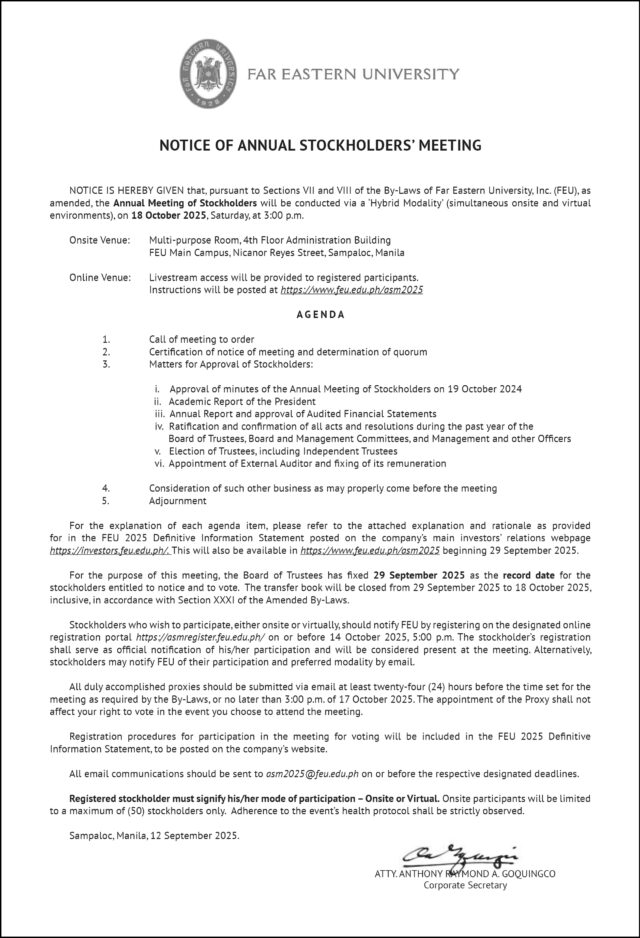
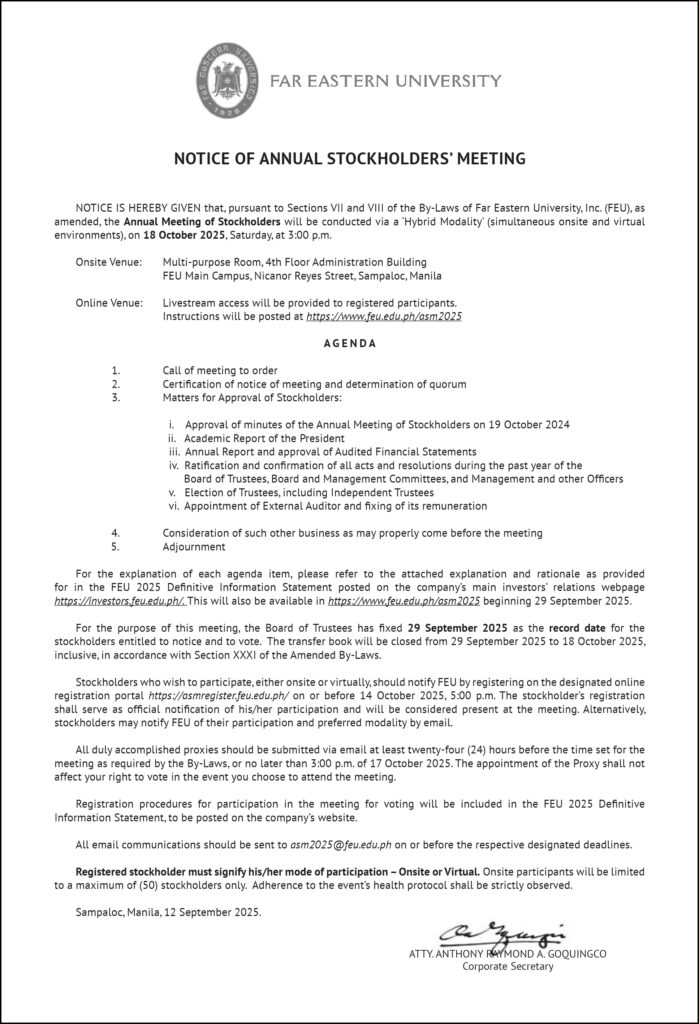
Far Eastern University, Inc. (FEU) to conduct 2025 Annual Meeting of Stockholders via a hybrid modality on Oct. 18


Spotlight is BusinessWorld’s sponsored section that allows advertisers to amplify their brand and connect with BusinessWorld’s audience by publishing their stories on the BusinessWorld Web site. For more information, send an email to online@bworldonline.com.

Join us on Viber at https://bit.ly/3hv6bLA to get more updates and subscribe to BusinessWorld’s titles and get exclusive content through www.bworld-x.com.

Ayala Land injects P2.7B into New World Hotel, Mandarin Oriental, and Arbor Lanes

NEW WORLD/PHILSTAR FILE PHOTO

LISTED property giant Ayala Land, Inc. (ALI) has disbursed over P2.7 billion raised from last year’s sale of 75 million shares in its real estate investment trust unit, AREIT, Inc., using the proceeds to fund hotel and residential developments.

The company disbursed P1.44 billion to New World Hotel, a five-star property in Makati City that ALI acquired in July, it said in a regulatory filing on Thursday.

About P699.21 million was allocated to Arbor Lanes, a five-tower mid-rise development under ALI’s luxury residential brand, Ayala Land Premier. The property is located within the 74-hectare ARCA South in Taguig City.

ALI also disbursed P559.42 million to the 276-room Mandarin Oriental. The project, located within Ayala Triangle Gardens in Makati City, is slated to open by 2026.

In September last year, the company raised P2.72 billion from the block sale of AREIT shares at P36.20 apiece under a placement agreement with UBS AG Singapore Branch and BPI Capital Corp.

Last month, ALI announced plans to launch P57 billion worth of property development projects in the second half of the year, covering the completion of upgrades to its malls and hotels.

Around two-thirds of the planned launches will be under the premium segment, while the remaining one-third will be part of the core segment, ALI President and Chief Executive Officer Anna Ma. Margarita Bautista-Dy said earlier.

ALI’s hospitality arm, Ayala Land Hospitality, also noted plans to invest $500 million (around P28.63 billion) over the next five years to increase its room capacity to 8,000.

The company recorded an 8% increase in first-half net income to P14.2 billion, while its property development revenue rose slightly by 0.77% to P52.3 billion, driven by strong commercial and industrial lot sales and bookings in its premium residential segment.

At the local bourse on Thursday, ALI shares declined by 2.26% or 60 centavos to close at P26 apiece, while AREIT were up by 0.23%, or 10 centavos, to close at P43.45 each. — Beatriz Marie D. Cruz

SC: Banks liable for moral damages due to negligence

PHOTO BY MIKE GONZALEZ

BANKS may be held liable for moral damages arising from negligence, even without proof of bad faith or malice, the Supreme Court (SC) has ruled.

In a decision written by Associate Justice Samuel H. Gaerlan, the SC’s Third Division ordered Banco de Oro (BDO) to pay depositors Remedios and Angelita Antonino the proceeds of their time deposits, along with P100,000 in moral damages.

The Antoninos, US green card holders residing abroad, had placed more than $150,000 in three-time deposits with BDO’s San Lorenzo branch. The funds, stored in a Banco Filipino deposit box, were not released after the branch closed without notice.

BDO claimed the deposits had been withdrawn through a draft allegedly signed by one of the depositors. However, handwriting experts and immigration records confirmed that the depositor was abroad at the time.

Both the lower court and Court of Appeals ruled in favor of the Antoninos. The SC affirmed these rulings, stressing banks’ obligation to exercise “very high diligence” in safeguarding deposits.

The tribunal said moral damages for mental anguish and anxiety may be awarded when negligence is proven, citing BDO’s failure to verify the identity of the withdrawer and to produce key documents despite the significant amount involved. — Erika Mae P. Sinaking

Both hunger and obesity stalk our children

STOCK PHOTO | Image by imdadul hussain from Unsplash

By Dinesh Arora and Nina Badgaiyan

FOR THE FIRST TIME in history, childhood obesity worldwide has overtaken the problem of being undernourished.

Among older children and adolescents aged five to 19, overweight and obesity more than doubled between 2000 and 2022, rising from 194 million to 391 million. Low- and middle-income countries now account for more than 80% of these cases.

In Asia and the Pacific, nearly one in 10 children remains underweight even as obesity rates are climbing in East and Southeast Asia, showing how undernutrition and obesity increasingly coexist within the same region.

Food environments are central to this crisis. The number of people consuming fast food and sugary drinks nearly equals those consuming the five recommended food groups, according to the 2024 International Food Policy Research Institute report.

Weak food safety systems add further risks, with unsafe food causing 600 million illnesses and 420,000 deaths every year — many of them children. Marketing of unhealthy products is pervasive: children in some countries see more than 100 online ads for sugary snacks and drinks each week.

A global UNICEF poll of young people found that three out of four had seen such ads in the previous week, and most said these increased their desire to consume the products.

The costs are immense. Malnutrition in all its forms — including undernutrition, micronutrient deficiencies, and obesity — can cut GDP by up to 3% annually. At the household level, obesity drives medical costs for diabetes and heart disease, while undernutrition continues to rob children of growth, learning, and opportunity.

The double burden of malnutrition is not inevitable.

Solutions exist, but they require bold choices. Nutrition guidelines from the World Health Organization and UNICEF stress food diversity and reduced consumption of ultra-processed foods. Yet these diets remain unaffordable for many households, as government subsidies still prioritize cereals over diverse nutrition. This policy paradox leaves families consuming what they can afford, not what is healthiest.

Governments and partners can act decisively to address the double burden of malnutrition by redesigning subsidy models — moving beyond cereal-heavy rations to diversified food baskets, tailoring meals in public programs to local food cultures and nutrition needs.

They can also promote dietary literacy by mainstreaming nutrition guidelines through schools, health centers, and community networks, while mobilizing self-help groups and frontline workers to improve household awareness.

Supporting local food systems is another step, leveraging indigenous crops such as pulses and millets, expanding nutrition-sensitive agriculture, and strengthening logistics to make diverse fresh foods more affordable.

Regulation and food safety can be strengthened by enforcing clear labeling, mandating front-of-pack warnings on sugar, salt, and fat, eliminating harmful trans fats, and ensuring stricter food safety oversight.

Healthier school environments can be created by setting nutrition standards for meals, banning junk food sales, and integrating food literacy programs, as Mexico has done for over 34 million children.

Fiscal measures can be implemented to tax sugary drinks and ultra-processed foods while subsidizing healthy staples. Mexico’s soda tax decreased purchases by 10% in two years, with the strongest impact among low-income households.

Policy should also be safeguarded from industry interference by adopting conflict-of-interest safeguards to ensure public health remains the priority.

Governments and partners can measure what matters by tracking dietary diversity, marketing exposure, and nutrition outcomes to hold systems accountable and inform evidence-based reforms.

The double burden of malnutrition is not inevitable. It is the result of policy choices and weak regulation. With stronger food safety systems, smarter fiscal tools, and regulation that prioritizes health over profit, countries across Asia and the Pacific can reshape food environments to nurture healthier generations.

The stakes are high, but decisive action today can yield lasting returns in education, productivity, and sustainable development.

The views expressed are those of the authors and do not necessarily reflect the views of the Asian Development Bank, its management, its Board of Directors, or its members.


Dinesh Arora is a principal health specialist at ADB’s Sectors Department. Nina Badgaiyan is a senior consultant on Public Health at ADB.

One Battle After Another: this insane movie about leftwing radicals and rightwing institutions is a powerful exploration of US today

Movie Review
One Battle After Another
Directed by Paul Thomas Anderson
MTRCB Rating: R-16

THE recent death of Robert Redford was a reminder of just how much All the President’s Men unsettled old certainties about American democracy. An exposé of the Watergate scandal of 1972 (when members of the campaign to re-elect Richard Nixon were caught planting secret recording devices at the Democratic National Committee’s Watergate building), Alan J. Pakula’s film fed into an increasing sense that the institutions of American governance were riddled with corruption.

Maybe not everyone agreed with Pakula’s dark vision. But he was not alone. Over the years since, Oliver Stone could also be relied on to make state-of-the-nation cinema, as could Martin Scorsese — or before them, Frank Capra. Such films attempted to capture, usually to critique, the national mood at that moment in time.

Paul Thomas Anderson’s new film, One Battle After Another, suggests that there is still a place for challenging filmmaking in today’s culture. Along with the recently released Eddington by director Ari Aster, these new state-of-the-nation films explore an America that is in crisis and throw it in our faces in staggering, epic narratives.

Both films speak to the chaos of a social order that is falling apart. Both, but particularly Eddington, also threaten to be so overwhelmed by this chaos that they end up by falling into incoherence.

The term, “incoherence,” is not chosen at random. One of the seminal texts for film scholars of the 1980s was Robin Wood’s The Incoherent Text, Narrative in the ’70s. Looking back at a series of films from this decade, Wood argued that “here, incoherence is no longer hidden and esoteric: the films seem to crack open before our eyes.” These two films do much the same, exposing through chaos something incomprehensible about our times and falling into incoherence in the process.

Set during the pandemic in a desert town, Eddington hurls itself from one flashpoint to the next. The sheriff, Joe Cross (Joaquin Phoenix) refuses to wear a mask and this apparently minor infraction soon pits him against his old enemy and competitor in love, Mayor Ted Garcia (Pedro Pascal). Borrowing from MAGA-style campaigning, Cross enters the election as candidate for new mayor.

At home, Cross is living with his conspiracy theory-loving mother-in-law, Dawn (Deirdre O’Connell). His wife Louise (Emma Stone) is retreating further into mental illness and isolation.

On the edges of this, a mysterious conglomerate is building a data center just outside of town. Race riots are also breaking out following the George Floyd killing. But there is much more to come.

Director Ari Aster could hardly have dreamed up more issues than he does here. With so much weight piling onto the narrative, Eddington concludes with an extended shoot-out that tips an already over-extended film into terminal disarray.

One Battle After Another, like Eddington, is a truly American film. Where Aster shot his neo-western in classic Panavision, Anderson goes one further, following The Brutalist in creating a VistaVision print, a format that is best experienced on a 70 mm screen. These formats hark back to Hollywood’s grandiose epics of the 1950s, adding to the films’ evocation of history — both filmic and social.

A further historical layering is Anderson’s source material for One Battle, Thomas Pynchon’s Vineland. Anderson updates Vineland’s kaleidoscopic exhumation of the revolutionary movements of the ’60s by casting his ageing hippie hero, now called Bob (Leonardo di Caprio), as a relic of a fictional noughties brigade, the French 75. Led by his lover Perfidia Beverley Hills (Teyana Taylor), they robbed banks, bombed buildings, and liberated detention centers in the name of their ideology of “free borders, free choices, free from fear.”

Left to bring up their daughter, Willa (Chase Infiniti) as a single parent, Bob spends his days off-grid unshaven, smoking weed, and watching the classic political drama, The Battle of Algiers. All is (somewhat) well until the brutal army veteran, Colonel Lockjaw (Sean Penn), who believes himself to be Willa’s real father, barrels back into their lives in pursuit of his “daughter.”

In common with Eddington, One Battle is at heart a family melodrama. It draws on the classic tropes of bad versus good father and conflicted mother, questioning the legitimacy of the family unit. On to these narratives bones, Anderson grafts a vision of a post-Obama America in thrall to shadowy corporate interests, a legacy of rounding up and deporting immigrants, and an old white male order hell-bent on its own agenda of personal revenge.

Robin Wood concluded his thoughts on American cinema of the ’70s with the prognosis that in their incoherence they pointed to one inescapable solution: the logical necessity for radicalism.

Aster and Anderson have looked radicalism in the eye and dismissed it as yet another failed ideology. Neither names the forces behind their vision of the end of American democracy and, to be fair, the current political crisis postdates both films’ completion in early 2024.

Where Aster sees only bloodshed and impotence, Anderson clings on to a fragile utopianism that in the present day is as unlikely as it is consoling. After the lights have gone up, it may well be that what his film leaves behind is its terrifying imagery of detention centers and the horror of immigrant round-ups. It is this certainly that led Steven Spielberg to acclaim “this insane movie” as more relevant than Anderson could ever have imagined.


Ruth Barton is a professor in Film Studies, Trinity College Dublin.

Credentials track addresses upskilling needs

ONLINE LEARNING platform Coursera said its new Skills Track program is designed to help provide credentials to workers that will be instrumental in building their careers.

“Companies are deploying new technology faster than their people can keep pace, and they need learning solutions that are adaptive and personalized,” Coursera Chief Executive Officer Greg Hart said in a statement.

Skills Track offers credential-earning courses where student progress is assessed by industry experts from Microsoft and Amazon Web Services as well as academics from Yale and Stanford.

“Learners make progress toward credentials based on real-world assessments, providing motivation and proof that skills are not only learned but also demonstrated,” Coursera said.

The Future of Jobs Report 2025 by the World Economic Forum (WEF) found that around 68% of Philippine employers identified skills gaps as the biggest barrier to business transformation.

The report added that Philippine employers expect nearly three in 10 workers to be upskilled and redeployed to new roles.

By 2030, the WEF expects the most in-demand skills globally will include AI and big data, networks and cybersecurity, technological literacy, creative thinking, resilience, flexibility and agility, and curiosity and lifelong learning.

The four Skills Tracks offered by Coursera are Software and Product, IT, Data, and GenAI.

“Each Skills Track offers a structured learning experience that clearly defines the critical skills and courses employees need at each role and experience level,” it said.

“The solution integrates expert content, hands-on practice, and skills verification, enabling employees to apply new skills immediately and drive measurable business outcomes faster,” it added.

Coursera plans to roll out additional Skill Tracks and enhanced features in the coming months, including skill diagnostics to guide learners at the appropriate level and verified skills paths with performance-based evaluations to provide credentials that reflect practical, job-ready expertise.

“It’s a major step towards helping learners master the right skills to grow their careers,” Mr. Hart said. — Almira Louise S. Martinez