
Analysts’ Expectations on Policy Rates (October 2025)
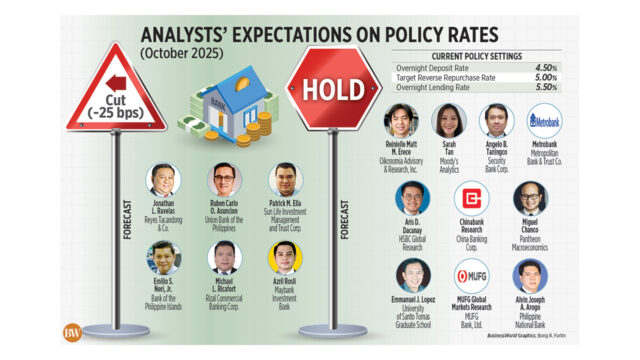
THE BANGKO SENTRAL ng Pilipinas (BSP) will likely keep interest rates on hold this week as inflation risks linger, according to most analysts polled by BusinessWorld. Read the full story.

THE BANGKO SENTRAL ng Pilipinas (BSP) will likely keep interest rates on hold this week as inflation risks linger, according to most analysts polled by BusinessWorld. Read the full story.

PHILIPPINE STOCKS may continue to rise this week, although the market is expected to stay cautious due to lingering domestic and global uncertainties.
On Friday, the Philippine Stock Exchange index (PSEi) jumped by 1.14% or 69.10 points to close at 6,108.86, while the broader all shares index rose by 0.72% or 26.56 points to end at 3,685.85.
Week on week, the PSEi also increased by 81.74 points from its 6,027.12 close on Sept. 26, mostly driven by bargain hunting after a seven-day losing run that saw the bellwether fall below the 6,000 mark early in the week.
“The local market managed to partially recover some lost ground in last week’s trading as investors hunted for bargains. However, trading activity was thin, implying that market confidence remains weak amid lingering uncertainties,” Philstocks Financial, Inc. Research Manager Japhet Louis O. Tantiangco said in a Viber message.
“The local bourse managed to recover midweek after briefly dipping below the 6,000 level as bargain hunting and repositioning ahead of key data lifted sentiment… Low trading volumes and lackluster sentiment reflect cautious investor positioning amid global uncertainties and local politico-economic headwinds,” online brokerage 2TradeAsia.com said in a market report on Friday.
For this week, Mr. Tantiangco said investors will wait for the release of September Philippine inflation data on Tuesday (Oct. 7) and the Bangko Sentral ng Pilipinas’ (BSP) policy meeting on Thursday (Oct. 9) for leads.
“An inflation rate within the BSP’s 1.5%-2.3% projection, especially one biased towards the lower end, may give sentiment a boost. Meanwhile, a rate cut and/or signals of further policy easing in the near term are expected to help lift sentiment, too,” he said.
“The local market’s chart is still showing a bearish bias as it formed a lower low last week. On a positive note, in the market’s latest rebound, it was able to get past its 10-day exponential moving average. Moving forward, the market may try to hold its position above the said line… Major support is at 6,000.”
A BusinessWorld poll of 12 analysts yielded a median estimate of 1.9% for September inflation, within the BSP’s 1.5-2.3% forecast for the month. If realized, this would be faster than 1.5% in August but would match the 1.9% clip in September 2024.
On the other hand, 10 of 16 analysts in a separate BusinessWorld poll expect the Monetary Board to pause at this week’s meeting due to emerging inflation risks following three consecutive cuts that brought its policy rate to 5%. The remaining six said the BSP could deliver a fourth straight 25-basis-point cut to support the economy amid weaker growth prospects.
Meanwhile, 2TradeAsia.com said the market will continue to monitor developments in the United States as government operations remain halted amid lawmakers’ failure to pass a budget.
It placed the PSEi’s immediate support at 6,000 and secondary support at 5,800, while resistance is pegged at 6,200. — Alexandria Grace C. Magno

By Adrian H. Halili, Reporter
A PHILIPPINE SENATE resolution calling on the International Criminal Court (ICC) to place former President Rodrigo R. Duterte under house arrest highlights the family’s enduring political influence, analysts said, even as the country is no longer a member of the tribunal.
Fifteen senators voted in favor of the measure, with three opposed and two abstaining. While the ICC has no obligation to act on the request, the vote underscored the former leader’s sway in Congress and the alignment of lawmakers with his daughter Vice-President Sara Duterte-Carpio, a potential 2028 presidential candidate.
“The resolution has no real effect on the ICC but is symbolic posturing that speaks volumes about the Duterte bloc’s ability to rally allies,” Arjan P. Aguirre, a political science lecturer at the Ateneo de Manila University, said in a Facebook Messenger chat.
“This is meant to intimidate the Marcos-Romualdez camp, sending the message that the Senate won’t cower to the President’s wishes,” he added.
The Senate recently shelved impeachment proceedings against Ms. Duterte after the Supreme Court ruled them unconstitutional. She had faced allegations of fund misuse, unexplained wealth and destabilization efforts, including a supposed plot to assassinate President Ferdinand R. Marcos, Jr. and Speaker Ferdinand Martin G. Romualdez. She denied all charges.
Mr. Aguirre said the Senate majority’s support for the house arrest resolution reflects “a pragmatic alignment” with Ms. Duterte ahead of the 2028 elections.
Gary D. Ador Dionisio, dean of De La Salle-College of Saint Benilde’s School of Diplomacy and Governance, said the move shows the shifting political landscape. “Senators who are up for re-election and vying for higher office are strategically weighing their options,” he said via Messenger chat.
He described the resolution as a “very problematic symbolic request,” noting that the Philippines’ 2019 withdrawal from the Rome Statute ended its obligations to the ICC. “It means Duterte still has an upper hand in politics and can still wield influence, perhaps even threaten victims and complainants,” he added.
The withdrawal does not affect the ICC’s jurisdiction over alleged crimes committed before the exit, such as those linked to Duterte’s anti-drug campaign.
The 80-year-old Mr. Duterte, arrested in March, faces three counts of murder in connection with his drug war. The charges cover killings attributed to the Davao Death Squad from 2013 to 2016, executions of “high-value targets” from 2016 to 2017 and dozens of murders and attempted murders during village raids from 2016 to 2018.
Mr. Duterte’s lawyers earlier told the ICC he was no longer mentally or physically able to take part in hearings, prompting the tribunal to postpone proceedings.
The ICC has been investigating Mr. Duterte and his cohorts for alleged crimes against humanity in connection with his anti-illegal drug campaign as mayor of Davao City and for the first three years of his presidency, when the Philippines was still a member of the ICC.
In 2018, the ex-President withdrew the Philippines from the ICC’s founding treaty when it started looking into allegations of systematic extrajudicial killings. It took effect in 2019.
The war on drugs was his signature campaign platform that swept the tough-talking Mr. Duterte to power in 2016. More than 6,200 suspects were killed during police drug raids, based on the police’s own count.
Critics say as many as 30,000 people died in suspicious circumstances, most of them poor Filipinos who were put on community watch lists after they signed up for rehabilitation.

PHILIPPINE PRESIDENT Ferdinand R. Marcos, Jr. said corruption cases tied to infrastructure spending must be backed by solid evidence, warning that weak filings could lead to failed prosecutions.
“We have to follow the law, otherwise whatever we do is not legitimate,” he said in a preview of his podcast released by the Presidential Communications Office on Sunday. “We know many of these people are not innocent. But if you’re going to bring them to court, you must have a very strong case.”
He said incomplete evidence could result in dismissals, which he described as “much, much, much worse.”
The podcast episode is expected to focus on due process and credible evidence in corruption probes. The President last month formed the Independent Commission for Infrastructure (ICI) to investigate irregularities in projects of the Department of Public Works and Highways (DPWH). The commission can recommend criminal, civil or administrative cases against erring officials.
In his State of the Nation Address on July 28, Mr. Marcos rebuked those involved in questionable flood control projects, saying they should be “ashamed.” He also launched the Sumbong sa Pangulo website, which lets citizens flag substandard or nonexistent public works.
Senator Panfilo M. Lacson said the chamber’s blue ribbon committee has suspended its own inquiry into flood control anomalies “until further notice,” citing pending documents and a packed schedule of budget deliberations and Commission on Appointments sessions.
The controversy is under review by several bodies, including the Department of Justice, ICI and the Senate.
Meanwhile, Las Piñas Rep. Mark Anthony G. Santos questioned the DPWH for dropping its mandatory integrity pledge for contractors, a safeguard against collusion and corruption in project bidding.
“The integrity pledge was no longer enforced as a mandatory requirement,” he said in a statement. “To this day, there is no clear public document explaining why it was removed or allowed to lapse.”
He urged former DPWH Secretary and Senator Mark A. Villar to explain why the requirement was not upheld during his tenure.
The senator, who has been drawn into a widening probe of irregular flood control projects, said last week he had no ownership ties to companies bidding for DPWH contracts. “I welcome and fully support any investigation into these issues, as I have nothing to hide and believe firmly in accountability and due process,” he said in a statement.
The Department of Justice said Mr. Villar would be included in its investigation of anomalous flood control projects, citing possible conflict of interest. The Independent Commission for Infrastructure has also invited him to its hearings.
Mr. Santos said the integrity pledge added a crucial safeguard beyond existing procurement laws. “By stripping away this safeguard, the bidding system fell back to the bare minimum protection of the procurement law,” he said.
Introduced under Department Order No. 86 in 2013, the pledge required all contractors to sign a commitment against corruption and collusion, and was included in official bidding documents. Contractors also had to be listed on the DPWH Registry of Contractors to qualify.
“The integrity pledge was the seatbelt and CCTV of the bidding process,” Mr. Santos said. “While procurement laws were already in place, the pledge served as an added moral and reputational safeguard to deter collusion.”
He added that its absence might have allowed collusion to thrive.
The DPWH is under mounting scrutiny over multibillion-peso anomalies in flood-control projects, where public funds were allegedly siphoned off by contractors and officials. — Erika Mae P. Sinaking and Adrian H. Halili

SENATOR Panfilo “Ping” M. Lacson on Sunday said he would resign as chairman of the Senate Blue Ribbon Committee after fellow senators criticized his handling of the chamber’s inquiry into anomalies flood control projects.
“No amount of criticisms from misinformed netizens and partisan sectors can distract or pressure me from doing my job right, but when my own peers start expressing their group or individual sentiments, maybe it is best to vacate,” he said in a statement.
He said he would manifest his resignation in plenary when the Senate resumes session.
Mr. Lacson, who was named Blue Ribbon Committee chairman after Vicente “Tito” C. Sotto III became Senate president, had taken over amid concerns about former Senate chief Francis “Chiz” G. Escudero’s links to the flood control controversy.
“Rightly or wrongly, when quite a number of them have expressed disappointment over how I’m handling the flood control project anomalies, I thought it’s time for me to step aside in favor of another member who they think can handle the committee better,” Mr. Lacson, a former national police chief, said.
He added that while he thinks he managed the hearings well, some senators sought to disrupt proceedings, fueling perceptions that the probe was mishandled.
The Senate is investigating irregularities in multibillion-peso flood control projects, following reports that lawmakers and officials received kickbacks from infrastructure funds allocated since 2022.
“Nevertheless, I will continue to fight a corrupt and rotten system in the misuse and abuse of public funds as I have consistently done in the course of my long years in public service,” Mr. Lacson said. — Adrian H. Halili

TEN FILIPINO crew members of a vessel struck by Houthi rebels off Yemen in September have safely returned to the Philippines, the Department of Migrant Workers (DMW) said on Sunday.
The seamen, part of the crew of the Netherlands-flagged MV Minervagracht, arrived at the Ninoy Aquino International Airport on Oct. 4 aboard Air France Flight 224, according to the agency.
“Their safe return home was made possible through the cooperation of the Philippine Embassy in Ankara, Philippine Consulate General in Istanbul, Migrant Workers Offices and the licensed manning agency with their local agent in Istanbul,” the DMW said in a statement.
The Minervagracht was carrying 19 seafarers — 12 of them Filipinos — when it was attacked with missiles by Houthi rebels while transiting the Gulf of Aden on Sept. 29. The remaining crew members were from Russia, Ukraine and Sri Lanka. All were rescued.
At least two Filipinos sustained injuries, Migrant Workers Secretary Hans Leo J. Cacdac said earlier. He added that the agency would help the victims secure new employment opportunities and provide support for livelihood and training.
“The government through DMW is also offering health services, including physical and mental health support and psychosocial counseling to supplement the assistance provided by your licensed manning agency,” Mr. Cacdac said.
The crew will also be given accommodations by their manning agency, training vouchers from the Technical Education and Skills Development Authority and financial aid from the DMW, Overseas Workers Welfare Administration and Department of Social Welfare and Development.
The incident underscores the heightened risks faced by Filipino seafarers, who make up a significant share of the global maritime workforce. — Adrian H. Halili

THE SUPREME COURT’S (SC) recent decision halting the Oct. 13 Bangsamoro Autonomous Region in Muslim Mindanao (BARMM) parliamentary elections has cleared the path for the scheduled December 2025 Barangay and Sangguniang Kabataan Elections (BSKE), a petitioner said on Sunday.
In a press statement, lawyer Romulo B. Macalintal said in nullifying Bangsamoro Autonomy Act (BAA) No. 77 and BAA No. 58, the main justification for Republic Act (RA) No. 12232, which postponed the December 2025 BSKE, has ceased to exist.
“There can be no BARMM parliamentary elections on October 13, 2025, because of the lack of a valid district law,” the SC ruled.
BAA No. 77, the Bangsamoro Parliamentary Redistricting Act of 2025, was declared unconstitutional for violating Section 5 of the Voter’s Registration Act, which bars altering precincts after the election period has begun.
BAA No. 58, the Bangsamoro Parliamentary Districts Act of 2024, was also struck down as the SC argued it cannot be revived since it was based on an outdated framework that still included Sulu as part of BARMM.
“There is no more legal or practical means to justify the postponement,” Mr. Macalintal, who filed the petition challenging the postponement of the BSKE, said.
The Commission on Elections (Comelec) had earlier indicated that delaying the BSKE to November 2026 would require an additional P4 billion and would frustrate the voting hopes of 2.7 million newly registered voters. “These voters registered from August 1-10 and expected to participate in the December BSKE for the first time,” Mr. Macalintal said.
According to the petitioner, the postponement of the BARMM elections has already wasted nearly a billion pesos in manpower and ballot printing costs, and additional millions will be needed to conduct the polls no later than March 31, 2026, as directed by the SC.
Mr. Macalintal urged Comelec to resume preparations for the December BSKE. “If Comelec continued preparations for the BSKE while the BARMM postponement issue was pending, there is no reason it should not continue now,” he said.
He also called on the SC to immediately resolve petitions challenging RA 12232’s BSKE postponement, emphasizing the need to uphold the principles of genuine and periodic elections.
“The Supreme Court should either decide on the pending petitions or direct Comelec to continue with BSKE preparations to ensure electoral integrity,” Mr. Macalintal added.
The high court has yet to issue a final resolution on the petitions against the BSKE postponement. — Erika Mae P. Sinaking

A PHILIPPINE SENATOR called for the full digitalization of the government’s civil registry system to avoid fraud in official records.
“The way to solve it is digitalization from end to end, from the hospital and the local civil registry up to the central data system, so we can detect anomalies faster,” Senator Sherwin T. Gatchalian said in a statement.
He added that this full digitalization of government records would close the loophole used by foreigners to legitimize illegal activities in the country.
Mr. Gatchalian added that the move would enhance transparency and prevent fraud in official records.
“We also need to hold accountable the officials who enabled this. Let’s plug the gaps,” he said.
Citing the Philippine Statistics Authority, the senator said that a total of 1,472 birth certificates from foreign entities conducting illegal activity in the Philippines have been cancelled. — Adrian H. Halili

THE government-administered Board Licensure Examination for Professional Teachers (BLEPT) needs to undergo reforms to strengthen education quality and ensure that only competent, well-prepared educators enter classrooms, an education advocacy group said on Sunday.
The Philippine Business for Education (PBEd), an organization led by the country’s top business leaders advocating systemic education reform, said fixing the foundations of teacher preparation and licensure is crucial to addressing the Philippines’ learning crisis.
“Teachers are at the heart of learning recovery, but to empower them, we must start by ensuring that those who enter the profession are well-trained, well-supported, and rigorously screened,” PBEd Executive Director Hanibal E. Camua said in a statement. “The BLEPT must be a fair, valid, and reliable measure of teacher readiness.”
In its study Fixing the Foundations: Strengthening the Teaching Workforce through the BLEPT, presented by the Second Congressional Commission on Education (EDCOM II), PBEd identified critical weaknesses in how the exam is designed and administered.
These include misalignment between the BLEPT and the teacher education curriculum, a shortage of qualified test item writers and reviewers, and the absence of pilot testing and systematic item analysis, raising questions about the exam’s validity and fairness.
“Fixing teacher licensure is not just a technical issue — it’s a matter of national survival,” Mr. Camua added. “We can’t solve the learning crisis without first ensuring that every classroom is led by a competent, compassionate, and well-prepared teacher.”
PBEd urged the Professional Regulation Commission, Commission on Higher Education, Teacher Education Council, and Department of Education to jointly overhaul the BLEPT’s test development process.
The group proposed deputizing subject-matter experts to craft and review test items, conducting pilot testing and psychometric analysis, establishing a comprehensive item bank for exam monitoring, and institutionalizing standardized testing protocols to ensure exam integrity across testing sites.
“Strengthening the BLEPT is not about making it harder — it’s about making it smarter and aligned with the current needs of teachers and learners,” Mr. Camua said.
Data from PBEd showed that from 2010 to 2022, fewer than four in ten exam takers passed the BLEPT, reflecting long-standing issues in teacher preparation and assessment. — Erika Mae P. Sinaking

GLOBE TELECOM, Inc. is ramping up its investments in anti-cybercrime initiatives to help fight the rising number of online scams and frauds, driven in part by the growing adoption of artificial intelligence (AI).
“Fraud today moves at digital speed, exploiting new technologies like AI. We have proven that practical interventions can make a real difference… But these efforts must go beyond one country or one telco,” Globe Head of AI and Data Privacy and Governance Derick Ohmar Adil said in a media release on Sunday.
With this, Globe said it continues to strengthen its efforts against scams and frauds, highlighting its collaborations with regulators, and the international community to address the sophistication of fraud.
Mr. Adil said there is a need to strengthen cross-border intelligence sharing to combat the rising number of frauds and scams.
Globe also continues to invest in initiatives like digital literacy and other information dissemination efforts to help empower communities against fraud, it said, while also highlighting the need for enterprises to have enough safeguards as businesses are becoming the target of scams and threats.
“We are committed to shaping safer digital ecosystems not just for enterprises but for every individual who relies on technology to live, work, and connect,” Globe Business Vice-President for Business Development and Sales Glenn Estrella said.
At the local bourse on Friday, shares in Globe closed P43, or 2.84% higher to end at P1,558 apiece. — Ashley Erika O. Jose

CEBU CITY served as the final stop of Villa Vie Odyssey, despite the recent earthquake that struck the city, the Department of Tourism (DoT) said.
As part of the maiden call of the cruise ship to the country, the MV Odyssey under the Villa Vie Residences docked at the Cebu International Port on Sunday, the department said in a statement over the weekend.
“We are very grateful that MV Odyssey has arrived in Cebu. It’s been a very difficult past few days for our fellow Cebuanos who have experienced the devastation of the 6.9-magnitude earthquake,” said DoT Secretary Ma. Esperanza Christina G. Frasco.
“And for this vessel that has sailed to 147 countries around the world to come here to the Philippines and to come to Cebu today is very meaningful, for it shows that there is hope,” she added.
Prior to Cebu, the cruise ship docked at Subic Bay Metropolitan Authority Port on Sept. 23, followed by stops in Manila, Boracay Island, and Puerto Princesa.
“The ship is scheduled to return in May 2026, further strengthening the Philippines’ place on the global cruise map,” the department said.
In 2025, the country is expecting 140 cruise calls to Manila, Boracay, Puerto Princesa, Cebu, Samar Island, Kalanggaman, and Bucas Grande.
These are expected to generate 47,295 foreign arrivals.
“With cruise calls like Villa Vie Odyssey and landmark industry events, the DoT is determined to propel the Philippines toward becoming a leading tourism hub in Asia,” the DoT said. — Justine Irish D. Tabile

THE Department of Information and Communications Technology (DICT) said it hopes to obtain World Bank loans within three to four months to finance the remaining phases of the national fiber backbone project.
“There are two loans for phases four and five (of the national fiber backbone). The one for Eastern Mindanao is already approved. There will be a second loan for Western Mindanao, the status of which is already approved by the (Philippine) Economic Development Committee,” Information and Communications Technology Secretary Henry Rhoel R. Aguda said on the sidelines of a recent forum.
The second loan is estimated at around $300 million, Mr. Aguda said, noting that the agency is now awaiting word from the World Bank on the loan.
“What we are waiting for now is for the World Bank to give us the formal proposal. Maybe the study would take around three to four months, but at least on the side of the Philippine government, we’re okay to entertain their proposal of extending us a loan,” Mr. Aguda said.
In August, the DICT announced that phases 4 and 5 of the national fiber backbone will be completed next year, following the start of construction that same month.
The project is expected to bring high-speed internet to more nodes in Mindanao via a 1,000-kilometer high-speed government-owned fiber network connecting Butuan, Cagayan de Oro, Bukidnon, Zamboanga, and Davao.
The completion of the project is expected to spur growth in rural areas, especially in the Visayas and Mindanao.
The National Fiber Backbone project aims to provide faster and reliable internet connectivity. The DICT expects around 70 million Filipinos to benefit from the project.
The current two phases cover southern Luzon and parts of the Visayas and Mindanao.
The first phase, which involves high-speed connections between Laoag, Ilocos Norte and Quezon City, was completed in April 2024. It covers 1,245 kilometers with 28 nodes. It has an initial 600 gigabits per second optical spectrum capacity that will serve the government and at least 14 provinces. — Ashley Erika O. Jose
