Home Blog Page 536

Peso strengthens as market digests Fed guidance
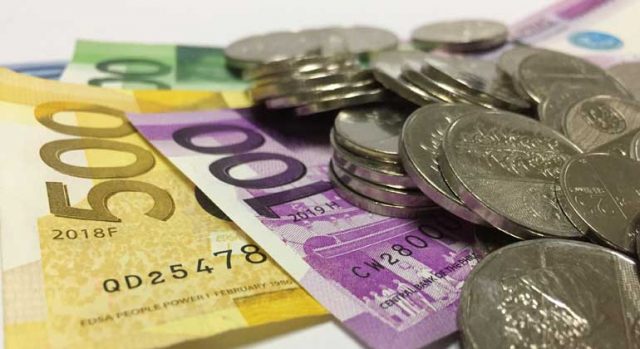
BW FILE PHOTO

THE PESO strengthened against the dollar on Monday as the market continued to digest the US Federal Reserve’s rate cut last week and policy guidance from officials.

The local unit closed at P57.056 versus the greenback, rising by 9.4 centavos from its P57.15 finish on Friday, Bankers Association of the Philippines data showed.

The peso opened Monday’s session weaker at P57.15 versus the dollar. Its intraday high was at P57.04, while its worst showing was at P57.195 against the greenback.

Dollars exchanged went down to $1.27 billion on Monday from $1.31 billion on Friday.

“The peso continued to appreciate on more dovish expectations following the Fed decision last week,” a trader said in a Viber message.

The peso was also supported by the dollar’s decline late last week after the Fed meeting and lower global crude oil prices, Rizal Commercial Banking Corp. Chief Economist Michael L. Ricafort said in a Viber message.

For Tuesday, the trader said the peso could continue to appreciate on expectations of a mild uptick in the August US personal consumption expenditures price index data to be released this week, which would support further Fed easing.

The trader sees the peso moving between P56.90 and P57.15 per dollar, while Mr. Ricafort expects it to range from P56.95 to P57.15.

The dollar rose slightly on Monday as traders looked ahead to a slew of speeches from Federal Reserve officials throughout the week that could provide further clues to the US rate outlook, after the central bank resumed its easing cycle last week, Reuters reported.

The greenback hovered near levels seen before last week’s Fed decision. The current pricing is consistent with the central bank’s messaging, which highlighted rising concerns over the labor market as the key driver of policy, analysts said.

Last week’s US economic data showed the number of Americans filing new applications for unemployment benefits fell, reversing the prior week’s jump.

“The lack of significant data until Friday’s core personal consumption expenditures inflation release leaves investors open to rethinking Fed rate cuts and the plan ahead,” said Bob Savage, head of markets macro strategy at BNY Mellon.

“Fed speakers will be important, with over 18 events planned,” he added, mentioning Chair Jerome H. Powell, but also the Cleveland Fed’s Beth Hammack and the St. Louis Fed’s Alberto Musalem given their hawkish view prior to the Fed meeting. — A.M.C. Sy with Reuters


South Asia lived with inequality. Then ‘Nepo Babies’ arrived.

STOCK PHOTO | Image from Freepik

By Mihir Sharma

SOUTH ASIA’s relative tranquility has always puzzled outsiders. It has grotesque inequality, but few revolutions. Class solidarity is rare, and its politics are seldom oriented around narrowing the gap between the rich and poor. This centuries-old stability might not, it turns out, survive the age of Instagram. In South Asia, the revolution is being streamed.

New Delhi’s political elite will be thinking carefully about events in their small Himalayan neighbor, Nepal, which is closely integrated — culturally and economically — with India. This month, mobs of young people, including college students, occupied the streets of its capital Kathmandu; the prime minister was forced to resign; 13,500 prisoners escaped when their jails were damaged; and the main government complex was set on fire. The spark for this conflagration? Short videos on TikTok and Instagram that edited together the luxurious life of Nepo Baby influencers — many related to senior politicians — with scenes of harrowing poverty.

That wasn’t all that happened: The government made major missteps, including trying to shut down social media, and using live ammunition against demonstrators. When men in uniforms kill students in the streets, protests tend to metastasize — that’s what happened in Bangladesh last year as well. In both countries, overreaction by the security forces had a great deal to do with how things turned out for those who gave them their orders.

Still, it’s strange for a movement to go from reels to revolution in a fortnight. Particularly since the pictures and videos that provoked the initial marches were not so unusual: Young people filming themselves in the expensive, manicured parts of the world where rich people congregate, while holding up designer handbags or brightly colored drinks. They could have been related to oligarchs from anywhere — Russia, maybe, or the Persian Gulf. That’s who the influencers benchmarked themselves against, perhaps: Other scions of other political elites. Not other Nepalis.

In previous decades and centuries, that would not have been a problem. Maharajas could buy Rolls-Royces, and nary a mob would turn up. But something’s changed. In 2022, protesters outraged at Sri Lanka’s economic meltdown took over the country’s presidential palace and were stunned by its luxury. In 2024, after Bangladesh’s prime minister fled the country, crowds looted furniture and handbags from her Dhaka residence — as well as a giant fish. (Some things, including jewelry and a cat, were later returned.)

Nepal’s protestors have been much more violent than their counterparts elsewhere in South Asia. Politicians’ homes were attacked, and one former prime minister’s house was burned down while his elderly wife was still inside. It is easy to see this as a trend: Anger on the streets that is more violent the longer it has been suppressed.

What of India, then? In the past, protests against corruption have helped remove governments in New Delhi. Could a building anger at inequality do the same? The country’s elite has always thought that dynasty-building is one of the perks of office, and it will take more than a revolution next door to change that.

But there have certainly been murmurs of resentment that members of the political establishment — even those who insist on self-reliance or vernacular education — send their children abroad to study. That was a crucial part of the anger in Kathmandu as well. Conspicuous consumption at home might be tolerated; much more resentment attaches to the ability to leave the country, to transcend the difficult circumstances that shackle everyone else. You can carry an expensive handbag as long as you don’t post pictures of yourself buying it on Fifth Avenue.

And perhaps that tells us something about how circumscribed, how limited this anger still is. The crowds are off the streets of Kathmandu for now, and a new prime minister, Sushila Karki, has been chosen. Her name emerged not from the streets, or from the army that won them back — but from a vote on a Discord server.

Nepal has 30 million people, and a lot of them are on the internet. But it’s a much smaller proportion that might participate in an English-language Discord poll. In the final vote, only 7,713 participated.

It is a safe bet that those 7,713 people earn a lot more than the $1,400 a year that is Nepal’s per-capita income. The Nepo Baby videos might have contrasted influencers with the country’s poorest people, but it wasn’t the most deprived who were on Discord, or on the streets holding posters inspired by Japan’s long-running One Piece manga.

Perhaps the reason that South Asia has been quiescent so long is that its upper-middle class felt it had as good a shot at a better, globalized life as the politically connected elite. But slowing growth, technological changes, and restrictions on travel and trade are closing off their options, while TikTok and Instagram insistently reminds them of what they’re missing.

Some social media networks, we know, are performative. They’re set up to inspire, but also to influence — and to generate envy. But it’s no longer just individuals whose self-esteem is affected, but entire societies. Even those with a long history of handling wealth disparities might yet be sent over the edge.

BLOOMBERG OPINION

Entertainment News (09/23/25)


The Summer I Turned Pretty gets a movie

PRIME VIDEO has just announced that the global hit series The Summer I Turned Pretty will conclude with a feature film written and directed by Jenny Han. The reveal was made during the Season 3 finale red carpet celebration in Paris, marking a milestone for the coming-of-age series. While story details are still under wraps, the film promises to deliver “a heartfelt final chapter to Belly’s journey.”


The Favors releases debut album

POP ACT The Favors, made up of acclaimed solo artists FINNEAS and Ashe, released their debut album The Dream via Darkroom Records. Its focus track is “David’s Brother,” a high-spirited song that has its own music video directed by Claudia Sulewski. The up-tempo yet nostalgic track dives into the tension of running into someone unexpectedly at a bar and balancing self-restraint. The rest of the album aims to revive the warmth and groove of 1970s pop, drawing inspiration from the golden era of Laurel Canyon and artists like Carole King and Simon & Garfunkel.


Museum of Speaking Skin opens at Shangri-La mall

AT Shangri-La Plaza, an immersive space about the beauty of skin, showcased in a way that art comes to life, will open this week. The space, set up by Lactacyd, focuses on skin science. Admission is free. The Museum of Speaking Skin opens on Sept. 25 and will run until Sept. 28.


Mind S-cool TV to premiere 7th season

THE 7th season of the show Mind S-cool TV kicks off on Sept. 28 on Cignal TV’s ONE PH channel and streaming via the Mind S-Cool YouTube channel. The educational program centers on Barangay Komplikado, a neighborhood where six Very Important Problems (VIPs) personify pressing environmental and societal issues in the Philippines: KLIMA, SARI, SUSI, UNOS, HILOM, and the elusive BUKAS. Though science-based narratives, Season 7 invites audiences of all ages to explore the interconnected challenges of climate change, biodiversity loss, sustainability, and resilience.


Chen Linong collaborates with Lola Amour

ACCLAIMED Mandopop artist Chen Linong has collaborated with Filipino band Lola Amour for a single titled “With You.” It features Mr. Chen’s crystal-clear vocals alongside the expressive tones of Lola Amour’s vocalist, Pio Dumayas. An acoustic piece, “With You,” a reflection on love and longing, was inspired by an unwritten letter to a former lover. It is out now on all digital music streaming platforms.


Cinemalaya reveals new venue partners this October

The 21st edition of Cinemalaya film festival returns with 10 full-length films and 10 short film entries in three partner venues. From Oct. 3 to 12, Shangri-La Plaza will serve as the main hub of the festival for the first time, while films will also be screened at Ayala Malls Cinemas and Gateway Cineplex 18.


Pacquiao to lead athletes in Physical: Asia

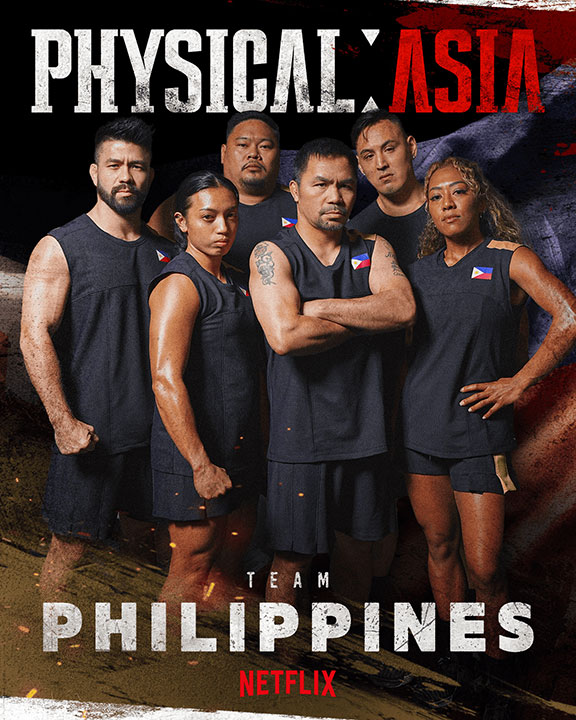
THE Physical:100 franchise has revealed the 48 contestants of Physical: Asia, a nation-vs-nation showdown. Eight countries — Korea, Japan, Thailand, Mongolia, Türkiye, Indonesia, Australia, and the Philippines — will take part in a competition of strength, strategy, and teamwork. The six-person squad for the Philippines will be led by boxing icon Manny Pacquiao. His teammates are Fil-Am national team sambo athlete Mark Mugen, strongman Ray Jefferson Querubin, national team rugby player Justin Coveney, national team hurdler Robyn Lauren Brown, and crossfit athlete Lara Liwanag. The eight-nation spectacle premieres in October, streaming on Netflix to audiences worldwide.


ONE OR EIGHT releases second track

FRESH off their VMA appearance, rising global boy group ONE OR EIGHT has released “BET YOUR LIFE,” the second track in their ongoing Anthems of Challenge series. It is out now on all digital music streaming platforms while its official music video premieres Sept. 26.


Korean thriller No Other Choice to screen in PHL

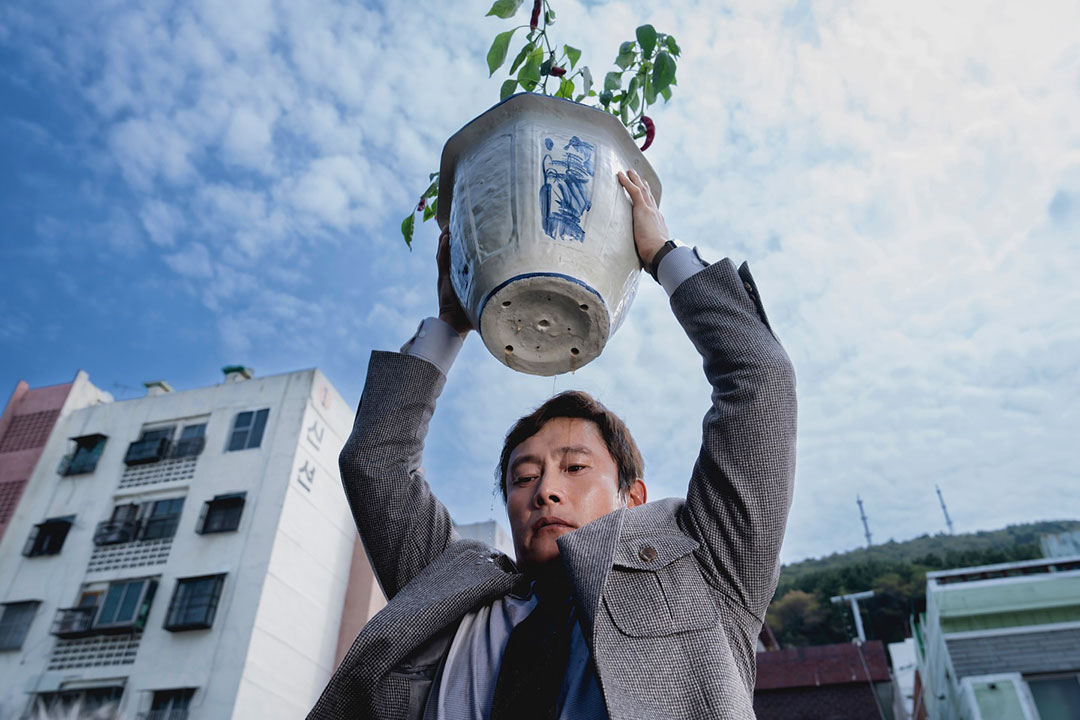
CREAZION Studios has announced that it is bringing No Other Choice, the Korean thriller by director Park Chan-wook and South Korea’s official entry to the 98th Academy Awards, to Philippine cinemas. It will premiere on Oct. 29.

Century Properties Group joins FTSE Microcap Index

CENTURY-PROPERTIES.COM

LISTED developer Century Properties Group, Inc. (CPG) has been added to the Financial Times Stock Exchange (FTSE) Global Equity Index Series (GEIS) – Microcap Index, the company said on Monday.

“Inclusion in the index enhances the company’s visibility in global capital markets and may potentially increase liquidity and broaden its shareholder base,” CPG said in a disclosure.

The FTSE Microcap Index is part of the globally recognized FTSE Global Equity Index Series, which serves as a benchmark for institutional investors and fund managers worldwide.

“We are honored by this inclusion, which represents a key milestone in our growth trajectory,” CPG President and Chief Executive Officer Marco R. Antonio said.

“This recognition underscores the strength of our business model and our commitment to delivering long-term value to our stakeholders — from homebuyers and communities to our shareholders.”

CPG also noted that its free float improved from 27.4% to 34.21% after the Social Security System (SSS) acquired a 6.4% stake in July.

“CPG’s stock price and trading liquidity should benefit from fund flows from foreign money managers who track the FTSE Microcap Index. Being part of a reputable stock index also lends a certain stature to CPG that could attract more institutional investors,” China Bank Capital Corp. Managing Director Juan Paolo E. Colet said.

Earlier this year, the developer announced plans to launch 10 projects under its first-home residential development segment, PHirst, over the next two years, totaling more than 10,000 units across seven administrative regions.

CPG reported a 14% growth in first-half net income to P1.22 billion, driven by its affordable housing segment.

At the local bourse on Monday, CPG shares closed flat at 69 centavos each. — Beatriz Marie D. Cruz

Easing inflation, index inclusion hopes boost foreign flows into PHL gov’t bonds

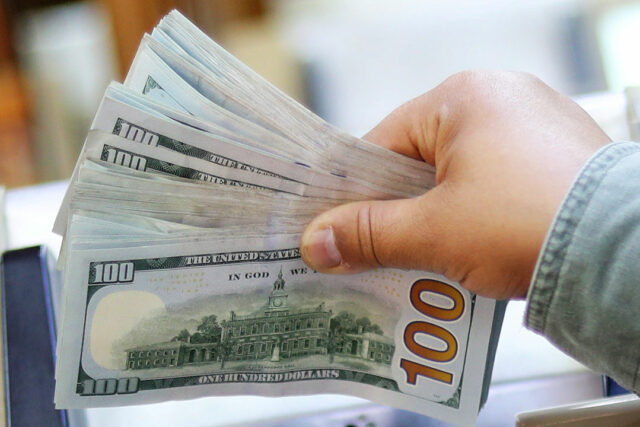
US dollar bills are seen at a money exchange office. — REUTERS

SLOWING INFLATION and the country’s potential inclusion in the JPMorgan Chase & Co.’s emerging market government bond index have boosted foreign inflows into Philippine bonds, Nomura Global Markets Research said.

“Foreign inflows into government bonds have increased materially, reflecting a combination of factors, and authorities seem comfortable with a further rise in the share of foreign holdings,” Nomura said in a Sept. 19 note authored by research analysts Euben Paracuelles and Nabila Amani.

Bureau of the Treasury (BTr) data cited by Nomura showed that the share of foreign holdings in Philippine government securities rose to 6% at end-August, equivalent to P728.8 billion, from just 4.2% in 2024 (P454.1 billion) and around 2% in 2020 to 2023.

“We believe this pickup was driven by a combination of factors, such as declining inflation, which has allowed BSP (Bangko Sentral ng Pilipinas) to lower its policy rate substantially, as well as prospects of bond index inclusion,” Nomura said.

“Based on our discussions with authorities, we believe they would welcome a gradual rise in foreign participation to around 10%.”

Philippine headline inflation averaged 1.7% in the first eight months, below the Bangko Sentral ng Pilipinas’ (BSP) 2-4% target.

In 2024, the consumer price index averaged 3.2%, down from 6% in 2023, when prices spiked amid higher global commodity costs and supply chain disruptions following the coronavirus pandemic.

Slowing inflation since last year has allowed the BSP to shift to a more accommodative policy stance. It has lowered benchmark borrowing costs by a cumulative 150 basis points (bps) since August 2024, with the policy rate now at 5% following a third straight 25-bp cut last month.

BSP Governor Eli M. Remolona, Jr. has signaled that this round of policy loosening is nearing its end, with one more reduction possible within this year to support the economy if needed as global uncertainties linger.

Easing inflation and prospects of more rate cuts here and in the United States have helped bring down domestic bond yields, pushing up prices.

Nomura said it expects one more 25-bp cut from the BSP next month and further reductions in big banks’ reserve requirement ratio, which would support market activity.

Meanwhile, JPMorgan this month tagged Philippine peso-denominated government bonds as “Index Watch Positive,” which is final review phase for inclusion in its Government Bond Index for Emerging Markets (GBI-EM) series.

The Philippines would have a weight of about 1% of the GBI-EM Global Diversified Index if included, according to the bank.

National Treasurer Sharon P. Almanza earlier said they expect foreign fund inflows to rise by about one percentage point or around P100 billion if the country successfully reenters the GBI-EM index.

“Steps taken to support GBI-EM index inclusion include the tax treaty enrollment process, as well as focusing on benchmark building through regular issuances of three-, five- and 10-year bonds to improve liquidity,” Nomura said.

It added that expectations of reduced bond issuances by the BTr this quarter following its large issues earlier this year could also support market conditions. “The government remains committed to its fiscal consolidation plan, although it has slowed the pace to support growth.”

Officials have said they are unlikely to launch more jumbo bond offerings this year as they have already raised most of their borrowing requirements and want to ensure a steady supply of debt instruments via its weekly auctions of securities for the remainder of the year.

In January, the National Government raised $3.29 billion from its sale of US dollar and euro bonds, almost filling its $3.5-billion commercial borrowing program for this year. The BTr also sold P300 billion in new 10-year fixed-rate benchmark Treasury notes in April  and P507.16 billion in retail Treasury bonds in August.

The Development Budget Coordination Committee (DBCC) in June revised its medium-term fiscal program amid global uncertainties.

Under the new plan, the DBCC now expects the budget deficit as a share of gross domestic product (GDP) to end at 5.5% this year from 5.3% previously. In 2024, the government’s budget gap was at P1.506 trillion or 5.7% of GDP. — K.K. Chan

RLC unit expanding office portfolio with projects in Davao, Dumaguete

ROBINSONS OFFICES, the office development arm of Robinsons Land Corp. (RLC), topped off Cybergate Dumaguete, a premium office building integrated with a retail podium, on March 20. — BW FILE PHOTO

ROBINSONS OFFICES, the office leasing arm of Robinsons Land Corp. (RLC), is set to expand its portfolio by around 100,000 square meters (sq.m.) with new developments by next year, including an office project in Dumaguete.

“Combining the planned office developments for next year, Robinsons Offices is expected to add approximately 100,000 sq.m. of office space to its portfolio by 2026,” RLC Senior Vice-President and Business Unit General Manager Jericho P. Go said in an e-mail.

The expansion covers Robinsons Cybergate Dumaguete, a three-level office project designed for high-density operations, particularly the business process outsourcing sector.

RLC is also completing the 30-storey GBF Center 2 in Bridgetowne, Quezon City, and Cybergate Iloilo Tower 3 in Pavia, Iloilo City.

Other projects in the pipeline include Asscher Tower, the first of four towers at The Jewel in Mandaluyong, and Cybergate Apo 1 along JP Laurel Street in Davao City.

Mr. Go said demand for office spaces continues to rise as more companies decentralize operations.

He also cited the increasing need for sustainability-driven workspaces, noting that Robinsons Offices has 19 buildings certified under the Leadership in Energy and Environmental Design (LEED) and Excellence in Design for Greater Efficiencies (EDGE) standards.

The developer has allotted P100 million for office lobby upgrades through 2026, which will include energy-efficient lighting, sky farms, and electric vehicle charging stations.

Robinsons Offices posted 50,000 sq.m. in new office transactions in the second quarter.

RLC’s office unit also reported a 5% increase in revenues to P4.11 billion, with an 87% occupancy rate.

On Monday, RLC shares slipped by 1.42% or 22 centavos to P15.26 apiece. — Beatriz Marie D. Cruz

On Martial Law, the lockdown dictatorship, and CDC PH

I write this in beautiful city of Valencia — the third largest city of Spain by population size — where I attended the Tholos Forum 2025 which ended last Saturday. This is the Tholos Foundation’s premier annual gathering of international coalition leaders, free market-leaning think tank and institute leaders, plus a few policy makers and national legislators.

I am among the International Fellows of the Tholos Foundation (US), the only Fellow from Asia, and I have been a friend of the Foundation since 2004 or 21 years ago. The Foundation has invited me to their many international conferences, starting with the Pacific Rim Policy Exchange 2007-1010 in Hawaii, Hong Kong, Singapore, Sydney. There have been more recent events in Australia, France, Argentina, and Spain.

Thus, I missed the huge anti-corruption rally held last Sunday, Sept. 21, the anniversary of the start of the Marcos Sr. Dictatorship. The declaration of Martial Law was made on Sept. 21, 1972 under former President Ferdinand Marcos, Sr. (Actually, it was made on Sept. 23 then backdated to a more auspicious date. — Ed.).

Another important date is Sept. 17, 2020, which was when the Concerned Doctors and Citizens of the Philippines (CDC PH) was formed. It was the largest and most consistent anti-lockdown movement in the country during the dark days of 2020-2021 under former President Rodrigo Duterte. CDC PH turns five years old this month. As I am the only economist in the core group, I will again review what happened to our economy during the lockdown years compared with other major economies in the world at the time.

In 2020, the Philippines suffered a horrible GDP contraction of 9.5% — the worst in Asia and the worst in Philippine economic history since just after World War 2. We had among the worst COVID-19 lockdown policies, irrational and senseless, some of which were not seen in many other countries. These included the shutdown of public transport, from jeepneys, taxi, and buses to planes; the shutdown of shops and malls, with public markets limited to only four hours a day; the closure of borders between and among municipalities, barangays, and even among sitios in the same barangays; the mandatory use of face shields that covered the whole face on top of mandatory facemasks; the mandatory use of a plastic separator between motorcycle drivers and their passengers; no entry into schools, offices, malls, buses, planes, etc. without a vaccination card, and so on.

None of these measures were practiced during the dictatorship of the 1970s. Back then there were curfew hours, the imprisonment of political opponents, and government takeover of non-friendly media, but the people had the freedom to move across municipalities and provinces, and they could open their shops and businesses.

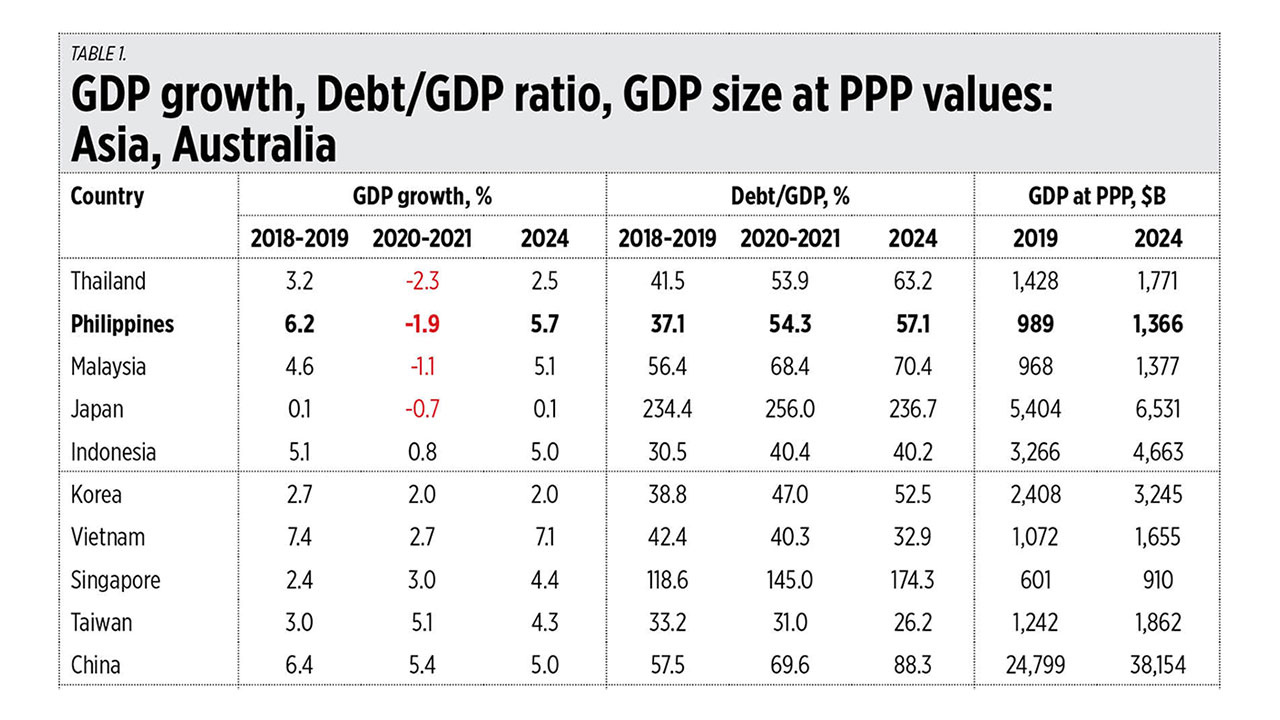
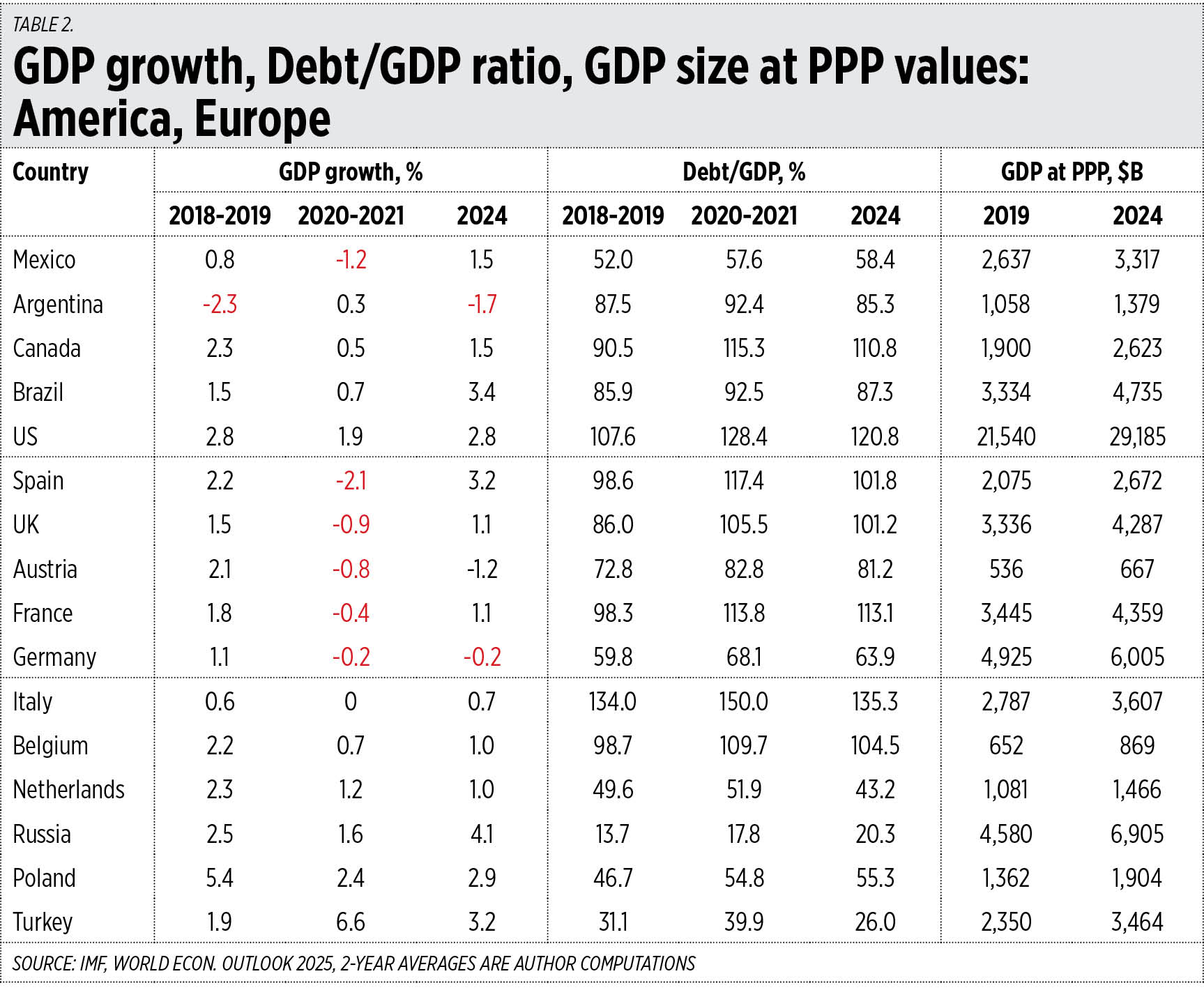
For this exercise, I have compared three indicators: a.) using economic growth in 2018-2019 as the baseline, growth or contraction in 2020-2021, then growth in 2024; b.) public debt/GDP ratio same periods; and, c.) GDP size at purchasing power parity (PPP) values in 2019 and 2024.

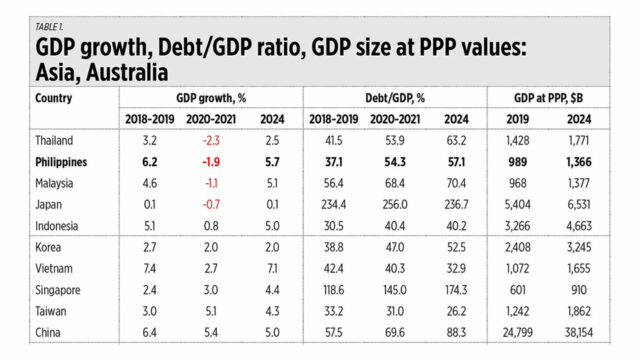
In Asia, the Philippines was second only to Thailand which also suffered a deep contraction in 2020-2021 — but Thailand was already growing slowly before this period, while the Philippines had a brisk GDP growth of 6.2% pre-lockdown. When it comes to Debt/GDP ratio, ours jumped by a huge 17 percentage points after the lockdown, meaning the borrowings were big in order to “help” jobless people and the bankrupt businesses that were shut down by the government in the first place (see Table 1).

Many European countries, including Spain and the UK, and Mexico suffered deep contractions in 2020-2021. But like Thailand and Japan, they already had slow growth pre-lockdown. The rise in their Debt/GDP ratio was also not as steep as the rise in the Philippines (see Table 2).

ECONOMIC FREEDOM
The sharing of ideas and experiences among participants and speakers at the Tholos Forum pointed to the need to continue fighting for economic freedom, and for protection of individual liberty and our pockets from the abuses of big government and big corruption.

And I tip my hat to the original convenors and organizers of CDC PH — doctors and entrepreneurs who understand the value of individual freedom and individual choice to trust in natural immunity over experimental vax immunity. Especially to Dr. Benigno “Iggy” Agbayani, Jr., the first President of CDC PH. His soul should be at peace in heaven now.

May the dark days of the lockdown dictatorship stay in the minds of our people as it was worse than the Martial Law dictatorship. We should never allow it to happen again.


Bienvenido S. Oplas, Jr. is the president of Bienvenido S. Oplas, Jr. Research Consultancy Services, and Minimal Government Thinkers. He is an international fellow of the Tholos Foundation.

minimalgovernment@gmail.com

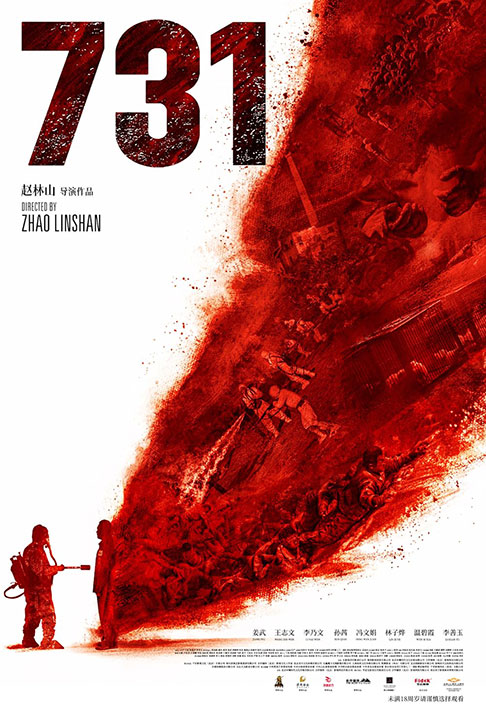
Chinese film on ‘evil’ World War II germ warfare unit risks adding fuel to Japanese tensions

731 (2025) — IMDB

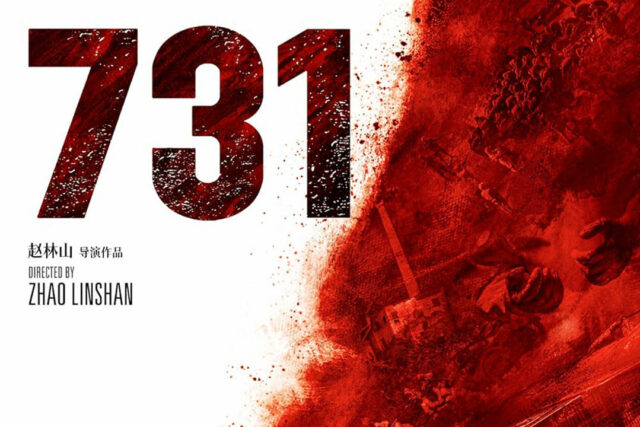
BEIJING — Evil Unbound, which depicts Japanese germ warfare during World War II, set a first-day box office record among the war films released in China this year, as Beijing seeks to highlight Tokyo’s war-time actions and what it calls a lack of accountability.

The film dramatizes the Japanese military research base Unit 731 in northeastern China that was notorious for live human experiments. The film took in more than 345 million yuan ($48.5 million) on Thursday, according to ticketing platform Maoyan.

The depiction risks inflaming tensions between China and Japan, which occupied parts of China before and during World War  II.

According to Chinese state media, Unit 731 conducted tests from the mid-1930s to 1945 on an estimated 3,000 Chinese, Korean, Russian, and Mongolian prisoners to develop germ weapons, including anthrax and bubonic plague bombs. None survived the experiments.

Japan’s Foreign Ministry did not immediately respond to a request for comment on the film and on Unit 731’s activities.

Prime Minister Shigeru Ishiba, asked in parliament earlier this year about Unit 731’s actions, said the means to verify the facts had been “lost with history,” Japanese media reported.

“The film focuses on the wartime atrocities of Japan’s Unit 731, exposing long-concealed truths in certain countries and serving as part of China’s efforts to promote historical justice and strengthen its voice on the global stage,” the state-run Global Times wrote, citing an associate professor at Nanjing Normal University, Zhang Peng.

The movie follows the tribulations of fictional Chinese prisoner Wang Yongzhan, depicted as an anti-Japanese hero leading prisoners to escape. Several graphic scenes of torture are shown as Wang uncovers the various laboratories and a crematorium.

The movie is set to be released in numerous countries including Australia, the United States, Singapore, and South Korea. It will not be screened in Japan.

The Japanese embassy in China last week issued a security advisory cautioning Japanese nationals to be “vigilant against anti-Japanese sentiment” due to related films, drama, and events held in conjunction with the World War II anniversary.

China has released at least four World War II films this year retelling events including the 1937 Nanjing massacre and the 1942 sinking of Japanese cargo liner Lisbon Maru as it marked 80 years since the end of the war, as well as hosting a lavish military parade. — Reuters

Vietnam wins Russia’s ‘Intervision’ song contest, geopolitical and conservative rival to Eurovision

MOSCOW — Vietnam was crowned the winner of the Russian-hosted Intervision song contest in the early hours of Sunday morning, a competition backed by President Vladimir Putin and conceived as a geopolitical and socially conservative rival to Eurovision.

Mr. Putin in February ordered the revival of Intervision, a Soviet-era regional musical contest based on “traditional family values” after Moscow was excluded from the Eurovision Song Contest in 2022 following Mr. Putin’s decision to send tens of thousands of troops into Ukraine.

Kyiv has called the event “an instrument of hostile propaganda.”

Shown live on Russian TV and broadcast across parts of Asia, Africa, South America, and Europe, Intervision was held at an arena outside Moscow with singers hailing from more than 20 countries accounting for 4 billion people, half the world’s population, including China, India, and Brazil.

Vietnam’s Duc Phuc, whose song was based on a folktale about a king famous for repelling an enemy army, was crowned the strongest act by a jury made up of participating countries.

His reward for strong vocals and a slickly produced performance featuring pyrotechnics: a cash prize of 30 million roubles ($360,000) and a trophy.

Kyrgyzstan was awarded second place with Qatar third.

Russia’s entrant — ultranationalist singer Shaman, whose real name is Yaroslav Dronov — asked the jury to disregard his performance due to Moscow being the host. The organizers said that Saudi Arabia had agreed to host the contest next year.

Saturday’s competition featured acts from countries Russia considers friendly, including Belarus, Cuba, South Africa, the UAE, and Venezuela.

Mr. Putin opened the final with a video statement saying the world was changing fast.

There was controversy though about who would represent the United States, a geopolitical outlier. Vassy, an Australian-born singer who also has a US passport, dropped out at the last minute after coming under “political pressure from the government of Australia,” the organizers said in a statement. There was no comment from Australia.

Vassy was already a stand-in for US-born R&B singer Brandon Howard, who dropped out days earlier citing family reasons.

Foreign Minister Sergei Lavrov, in a pre-contest news conference, spoke of the importance of “preserving traditions and national cultures, as well as religious, spiritual and moral constructs.”

He took a sideswipe at Eurovision which he said had once been won by “a bearded man in a dress,” an apparent reference to Eurovision’s 2014 winner, Austrian drag queen Conchita Wurst.

In Russia, stringent rules ban any actions deemed to promote homosexuality, and “the international LGBT public movement” is branded an extremist organization. — Reuters

FNG eyes completion of Riverpark Uniqlo hub in Cavite this year

Riverpark North, Cavite — FNG.PH

FEDERAL LAND NRE Global, Inc. (FNG) is set to complete the construction of a Uniqlo logistics facility at Riverpark North in Cavite by the end of the year, a company official said.

“We’re developing for Uniqlo Philippines. I think it’s going to be their biggest in the country. It’s coming along very well, and it should be ready by the end of this year,” Federal Land, Inc. Vice-Chairman William Thomas F. Mirasol told BusinessWorld Editor-in-Chief Cathy Rose A. Garcia as part of BusinessWorld One-on-One’s online interview series.

The human-centric logistics facility is being developed in partnership with Fast Retailing Philippines, the local arm of the global company that operates Uniqlo.

The hub is located at Riverpark North, a 6.9-hectare mixed-use district in General Trias, Cavite, slated for completion by 2027.

FNG plans to launch its second batch of commercial lots at Riverpark North by early 2026, after fully selling out its first batch, Mr. Mirasol said.

“We already have one major locator that’s going to be there, and we’ll be in a position to disclose that as soon as the contract has been signed,” Mr. Mirasol said, adding that the new locator is a major Philippine-Japanese company.

FNG is also set to launch two model homes at Yume at Riverpark, an 18-hectare Japanese-inspired neighborhood within the Riverpark township, Mr. Mirasol said.

“Nomura Real Estate is a big home builder in Japan as well as a high-rise condominium builder. So, we’re leveraging their experience, their technology in this to offer the same thing here in the Philippines,” he said.

The model homes will feature clean lines and efficient layouts, Mr. Mirasol added.

“We do expect that the living experience, which again is always the most important thing for us, is something that I think the Philippine market will value.”

FNG is a joint venture between listed conglomerate GT Capital Holdings, Inc.’s subsidiary Federal Land and Japanese real estate developer Nomura Real Estate Development Co., Ltd.

On Monday, shares of GT Capital fell by 1.65% or P11 to close at P654 apiece. — Beatriz Marie D. Cruz

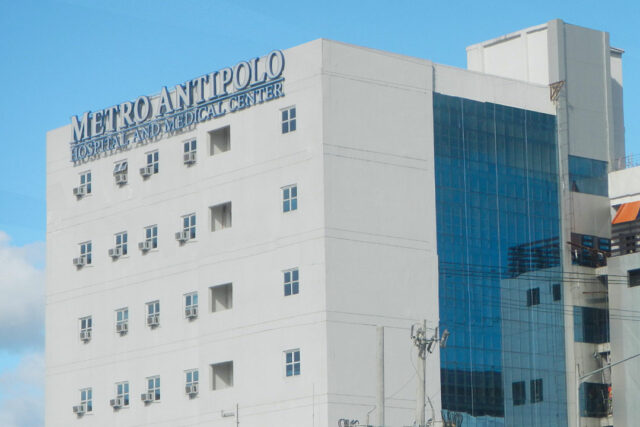
Metro Antipolo Hospital joins Metro Pacific Health network

METROANTIPOLO.COM

METRO PACIFIC HEALTH CORP. (MPH) is expanding its hospital network with a major investment in Metro Antipolo Hospital and Medical Center, Inc. (MAHMC), marking its 28th acquisition.

“With MAHMC becoming our 17th provincial hospital, we are reaffirming our commitment to enhancing access to high-quality healthcare services to communities beyond Metro Manila,” MPH President Augusto P. Palisoc, Jr. said in a media release on Monday.

MPH, the healthcare unit of Pangilinan-led Metro Pacific Investments Corp. (MPIC), plans to upgrade MAHMC with a new Urgent Care Center, expanded outpatient services, enhanced medical equipment, and a cardiac catheterization laboratory.

The company did not disclose the total scope of its investment.

MAHMC, a Level 2 hospital that opened in 2016, is Rizal’s largest healthcare provider.

“This investment demonstrates the commitment of Metro Pacific Health to improve the delivery of quality and affordable healthcare throughout the nation by not only improving the hospitals in our network, but also continuously growing our nationwide portfolio of healthcare facilities,” MPH said.

Other hospitals under MPH include Makati Medical Center, Asian Hospital and Medical Center, Cardinal Santos Medical Center, Davao Doctors Hospital, and Riverside Medical Center.

MPIC is one of three key Philippine units of Hong Kong-based First Pacific Co. Ltd., alongside Philex Mining Corp. and PLDT Inc.

Hastings Holdings Inc., a unit of the PLDT Beneficial Trust Fund subsidiary MediaQuest Holdings, Inc., has a majority stake in BusinessWorld through the Philippine Star Group, which it controls. — Ashley Erika O. Jose

Asia-Pacific banks struggling to hyper-personalize — FICO

STOCK PHOTO | Image by Macrovector from Freepik

BANKS in Asia-Pacific are struggling to implement hyper-personalization strategies even as most of them already use predictive analytics as they look to deliver the products and services that their customers need, according to a survey by global analytics software firm FICO.

According to the FICO poll of 30 senior executives and C-suite leaders from Asia-Pacific banks conducted in November 2024, only 11% said their hyper-personalization strategies are highly advanced, even if 88% said they already use predictive analytics to anticipate customer needs.

“Consumers now expect the same level of personalization from their banks as they do from Netflix and Amazon. With most banks still struggling to meet these expectations, those that succeed will gain a decisive edge in a market where customer experience is the ultimate differentiator,” FICO Asia-Pacific Managing Director Dattu Kompella said in a statement.

The majority or 72% of the respondents said among the key barriers to hyper-personalization is the lack of seamless customer engagement in their banks as their communication channels remain siloed or only partially integrated.

“Meanwhile, automation adoption remains uneven. Half of the executives said their organizations had automated no more than half of their customer-facing decisions, including credit approvals, fraud alerts, and personalized offers, hindering personalization efforts,” FICO said.

Asia-Pacific banks’ use of real-time data and advanced analytics remains in its nascent stages, it added.

“While 43% of executives said they leverage real-time data significantly or fully for customer insights in areas such as fraud detection and service, most remain at minimal or moderate adoption,” it said.

“Similarly, just 37% reported extensively or fully predictive use of analytics, underscoring that while adoption is broad, maturity remains limited.”

FICO said banks need to use the data they have across the customer lifecycle to achieve hyper-personalization.

“Every interaction, whether it’s a declined offer, a payment pattern, or a service request, contains valuable insight. By consolidating activities, behaviors, and preferences into a single decisioning platform, banks can act on insights in real-time, driving deeper engagement and loyalty,” Mr. Kompella said.

He said FICO Platform uses applied intelligence to take these data to allow banks to predict their customers’ needs and deliver the appropriate services and products. — A.M.C. Sy