Home Blog Page 5328

Kai Sotto to play for Hiroshima Dragonflies in Japan B. League

ADELAIDE 36ERS FACEBOOK PAGE

KAI Sotto has taken his talents from Australia to Japan to play for the Hiroshima Dragonflies.

The Dragonflies yesterday announced the signing of the 7-foot-3 Filipino sensation, who they consider as one of the best players in Asia at only 20 years old.

“Same as Rui Hachimura and Yuta Watanabe, Kai Sotto who is drawing so much attention from all around the globe, is also a highly talented player and will be one of the best Asian Players,” said Hiroshima general manager Shuji Okazaki.

“I am looking forward to playing for the Hiroshima Dragonflies. I want to do everything I can so that the Dragonflies, who are aiming to advance to the B. League Championship, have a great season,” added Mr. Sotto.

Mr. Sotto’s transfer to the Japan B. League from the Australia National Basketball League (NBL) came just two days following the early exit of his previous team, the Adelaide 36ers, for the second straight season of his tenure.

The Gilas Pilipinas mainstay right after the 36ers’ 116-107 defeat against Melbourne United said that it’s already his last game in the NBL, accepting an offer to a different overseas league he did not disclose yet until yesterday.

He played for a total of 56 games in two seasons for Adelaide, registering 6.98 points and 4.48 rebounds on 51-percent clip in over 13 minutes of play. He served as the team’s starting center for the majority of this year.

In Japan with an expected longer playing time and more active role, Mr. Sotto is bound to unleash his full potential especially with a Hiroshima side needing a formidable anchor inside the paint to take care of the defensive and rebounding duties.

“Kai (Sotto) is going to fit our basketball style. We believe that the addition of Kai will make up for our weaknesses. We also will have a huge advantage for simply inside of the paint with his height and talent,” added Mr. Okazaki.

Hiroshima, which is among the B. League contenders at fourth place so far with a 27-9 card, was the former team of another local ace in Justine Baltazar before they parted ways late last year.

Mr. Baltazar rarely played as the Dragonflies’ Asian import, seeing action in a grand total of 13 minutes in eight games with two points, a rebound, an assist and a steal to show. — John Bryan Ulanday

GM Darwin Laylo back as Philippine top chess player

GRANDMASTER Darwin Laylo is back on top as the country’s top chess player after 17 years. — NATIONAL CHESS FEDERATION OF THE PHILIPPINES

AFTER a 17-year wait, Grandmaster (GM) Darwin Laylo is back on top as the country’s top chess player.

The 42-year-old Mr. Laylo recalled the old form that pushed him to the pedestal in 2004 and 2006 in ruling the National Chess Championships at the Malolos City Auditorium in Bulacan Monday night.

The Army man from Dasmariñas, Cavite split the point with International Master Daniel Quizon, the last winner of this meet two years ago in Lapu Lapu, Cebu, and finished with 6.5 points on four triumphs and five draws.

Mr. Laylo’s four victories, which came at the expense of Woman GM Janelle Mae Frayna, WIM Marie Antoinette San Diego, IM Paulo Bersamina and GM Joey Antonio, happened in the early rounds that allowed him the luxury of drawing his last three assignments to seal the deal.

He took home P100,000 courtesy of Malolos City Mayor Christian Natividad for his feat.

“Big thanks to my family and the people who helped me to get back to the top,” said Mr. Laylo, who also cited the support of Army Special Service Center Col. John Oliver Gabun.

IMs Jan Emmanuel Garcia and Michael Concio, Jr. fought Frayna and Bersamina to draws to end up second and third and prizes worth P80,000 and P50,000, respectively.

Rounding out the top 10 were IM Paulo Bersamina, WGM Janelle Mae Frayna Frayna, Mark Jay Bacojo, IM Daniel Quizon, GM John Paul Gomez, GM Joey Antonio and WIM Marie Antoinette San Diego. — Joey Villar

Denden Santos edges Phoy Andal, 7-6, in the 5th Leg of Amit Cup

(LEFT TO RIGHT) Tournament director Ren De Vera, 5th leg champion Denden Santos, organizer Rubilen Amit

PHILIPPINE pool queen Rubilen Amit is far from calling it a career.

But when the time comes, she hopes to leave a legacy not just by winning tournaments, but by paving the path she took when she emerged as one of the best female players in the world to take up the sport.

Enter a tournament named after her — the Amit Cup.

Now on its fifth leg after staging editions in Zamboanga, Bicol, Bacolod and Pangasinan starting in May last year, the event has drawn hundreds of lady players all aspiring to become like Ms. Amit, a two-time world 10-ball champion and many-time Southeast Asian Games gold winner.

The most recent one, organized by the Metro East Bilyar Club with Ren De Vera as co-founder and tournament director and done in Cainta, Rizal over the weekend, was topped by Denden Santos, who edged Phoy Andal, 7-6, that assured the former a spot in the grand finals where the 16 highest ranked qualifiers will battle it out one last time.

And the 41-year-old Ms. Amit, who gives the token prizes from her own pockets and some from her friends, is hoping one of them could emerge as a potential national team mainstay like herself.

“Since I started, there are only two representatives of the Philippines in the international women’s events, others countries have five,” Ms. Amit told The STAR. “I am hoping through this advocacy of giving opportunities to women players through tournaments will emerge players who will represent and bring honor to the country.” — Joey Villar

Remulla replaces Panlilio as chef-de-mission to Paris Olympics

CAVITE Governor Jonvic Remulla will take the place of Samahang Basketbol ng Pilipinas (SBP) President Al Panlilio as the country’s chef-de-mission (CDM) to next year’s Paris Olympics.

Mr. Remulla got the important task yesterday from Philippine Olympic Committee (POC) President Abraham Tolentino and the former will immediately fill the vacuum left by Mr. Panlilio, who begged off due to his busy schedule at SBP and PLDT and Smart where he is the chief executive officer.

The 55-year-old Mr. Remulla is a sports man himself, being the honorary chairman of the national rowing association and team manager of the University of the Philippines men’s basketball squad.

“We understand Al’s [Panlilio] situation so we decided to appoint a new CDM for the Paris Olympics, somebody who has a great passion for sports, a true sportsman, somebody who has leadership, a workhorse and that’s Governor Jonvic [Remulla],” said Mr. Tolentino.

“The POC wanted a dedicated sportsman or personality who could live up to the responsibilities and obligations as CDM to Paris,” he added.

Mr. Tolentino also named wrestling’s Alvin Aguilar and rugby’s Ada Milby as CDMs to the World Combat Games set in Riyadh, Saudi Arabia from Oct. 21 to 30 this year and the Winter Olympic Youth Games slated in Gangwon Province, South Korea from Jan. 19 to Feb. 1 next year, respectively.

Mr. Remulla will have in his hands the unenviable task of steering the country to eclipsing, if not replicating, its magnificent effort in the 2021 Tokyo Olympics where it hauled a historic gold medal courtesy of weightlifter Hidilyn Diaz-Naranjo.

The country also copped a couple of silver and a bronze from boxers Nesthy Petecio, Carlo Paalam and Eumir Marcial in Tokyo.

“He [Mr. Remulla] accepted the position without hesitation and he’s really happy and excited about his role as Paris Olympics CDM. We at the POC are confident that he can get the job done. He’s a true sportsman and very dedicated to helping athletes,” said Mr. Tolentino. — Joey Villar

PL charges Man City over alleged financial rule breaches

THE PREMIER League (PL) has referred Manchester City to an independent commission over more than 100 alleged breaches of finance rules since the club were acquired by the Abu Dhabi-based City Football Group.

The referral came weeks before the expected publication of a government white paper set to recommend the establishment of an independent regulator in English soccer to deal with the game’s finances, club ownership and corporate governance.

City, the world’s highest revenue-generating club last season according to Deloitte, are alleged to have committed multiple financial breaches between 2009 and 2018, the league said on Monday.

League rules state that charges such as those faced by City could, if proved, result in a club being expelled from the Premier League in the worst-case scenario.

Offending clubs may alternatively be deducted points, fined or reprimanded.

While it remains to be seen what sanctions the commission imposes on City, a stricter stance by the Premier League on club finances could deter potential investors in clubs like Manchester United, according to a sports finance lawyer.

Both Manchester United and Liverpool are seeking new investors, in large part due to Middle Eastern investment in clubs such as City and Newcastle United and the collapse of a planned Super League, industry experts have told Reuters.

City, who were acquired by City Football Group in 2008, are also charged with failing to cooperate with the Premier League’s investigation, which was launched in December 2018.

City are alleged to have breached rules relating to the provision of accurate financial information, “in particular with respect to its revenue (including sponsorship revenue), its related parties and its operating costs”, the league said.

The club, who have won the Premier League title six times since the Abu Dhabi takeover, said they were surprised by the league’s “issuing of these alleged breaches”.

“The club welcomes the review of this matter by an independent commission, to impartially consider the comprehensive body of irrefutable evidence that exists in support of its position,” City added.

The charges stem from a Premier League investigation into City’s financial dealings launched four years ago, after the release of a tranche of “Football Leaks” documents obtained by the German publication Der Spiegel.

SUBSEQUENT BAN
Man City were subsequently banned from the Champions League by European governing body UEFA for two years, but successfully appealed to the Court of Arbitration for Sport (CAS), which overturned the ban in 2020.

The club were fined €30 million ($32.28 million) by UEFA, which CAS reduced to €10 million.

In addition to the charges relating to the club’s revenue and operating costs, City are also alleged to have not fully disclosed managerial remuneration from 2009 to 2013, when Roberto Mancini was manager.

The club are also charged with failing to comply with Premier League’s rules requiring clubs to follow UEFA’s financial fair play (FFP) regulations from 2013 to 2018 and failing to follow the Premier League’s rules on profit and sustainability from 2015 to 2018.

FFP regulations are designed to stop clubs running up big losses through spending on players. They also ensure sponsorship deals are based on their real market value and are genuine commercial agreements — and not ways for owners to pump cash into a club to get around the rules.

“The proceedings before the Commission will… be confidential and heard in private,” the Premier League said in a statement.

“The Premier League will be making no further comment in respect of this matter until further notice.” — Reuters

NBA approves Phoenix Suns sale

PHOENIX Suns President and CEO Jason Rowley resigned Monday, hours before the team’s sale was officially approved by the National Basketball Association (NBA) Board of Governors.

Mr. Rowley’s exit was announced to the organization in an email sent by Suns interim governor Sam Garvin and obtained by ESPN.

“I wanted to let you know that Jason Rowley made the decision to leave the organization,” Mr. Garvin wrote. “After almost 15 years of hard work and dedicated service, Jason felt that the transition in ownership created ideal timing to close this chapter of his professional journey and pursue new opportunities.”

Mat Ishbia, the billionaire president and CEO of United Wholesale Mortgage, is set to complete his purchase of the team — and the WNBA’s Phoenix Mercury — for $4 billion from disgraced majority owner Robert Sarver. According to a statement from the league, the transaction is expected to be finalized sometime this week. Mr. Ishbia could be introduced as the new majority owner as early as Wednesday.

Mr. Rowley was linked to allegations of retaliation, intimidation and verbal abuse by more than two dozen former and current Suns employees, according to an ESPN report.

An independent investigation into allegations he created a toxic work environment in Phoenix was conducted. A summary report said he used a racial slur at least five times, sexually harassed female employees and yelled and cursed at workers during nearly two decades of ownership. — Reuters

Irving in Dallas

No doubt about it. The Mavericks have become much, much more competitive after they landed eight-time All-Star Kyrie Irving in a trade with the embattled Nets. In winning the sweepstakes for the mercurial guard, they latched on to the type of marquee name franchise foundation Luka Doncic had been seeking. They bid goodbye to a bevy of assets in the process, but there was no question that they had to go all in; even with their once-in-a-generation talent posting humongous numbers off an ultimately untenable usage rate, they were merely treading water.

It’s fair to wonder if the Mavericks will be getting the significant short-term gain they’re hoping for from Irving’s arrival. After all, not even the best of talents get to jell from the get-go; Doncic and the others in blue and white need to get acquainted with him on and off the court, and vice versa. That said, they needed change — perhaps any change. It made no sense for them to continue doing what they did given the results; they would have been proving the definition of insanity as doing the same time over and over again, and expecting a different outcome.

How far the Mavericks’ new high-wattage pairing will take them through their 2022-23 campaign remains to be seen. The quick turnaround will not be to their favor. On the other hand, they now have cause to cast moist eyes on a deep postseason run; Irving’s a magician with the ball in his hands, and, with the burden on Doncic to produce at an unsustainable rate eased, they’ll be better equipped to fend off contenders in any long playoff series.

Whether the Mavericks will come close to the hardware is, of course, another matter altogether. Just like Doncic, Irving’s a minus on the other end of the floor. And with dogged on-ball defender Dorian Finney-Smith gone, they’ll be even more hard-pressed to keep their coverages halfway decent. If there’s any good news, it’s that they still have draft picks and ample bait to stay involved in discussions leading up to the trade deadline.

In any case, the honeymoon period figures to be crucial in determining the future. Irving wanted out of the Nets after the latter failed to give him the long-term deal he sought. Will the Mavericks give him what he wants? They’ll be looking at the next two months to determine the answer.


Anthony L. Cuaycong has been writing Courtside since BusinessWorld introduced a Sports section in 1994. He is a consultant on strategic planning, operations and human resources management, corporate communications, and business development.

Philippine Long Term Investment Fund: insulated from politics

BW FILE PHOTO

(Part 3)

When the Senators start to deliberate on the Maharlika Investment Fund, they should make it a point to avoid wasting their time raising objections to features of the old version that have already been eliminated precisely in response to the very valid criticisms by some top leading economists, lawyers, bankers, and other experts on the issue of savings and investments. These criticisms were solidly based on evidence-based comments contained in a “Statement on the Maharlika Wealth Fund” dated Dec. 7, 2022, signed by leading former government officials, economics professors, and professional economists.

As originally drafted, the Maharlika Wealth Fund bill assumed that there was excess long-term investment funds in the Philippines as can be found in countries with consistent large budget surpluses, windfall revenues from booming extractive industries, and excess foreign currency reserves from enduring balance of payments surpluses. None of these conditions exist in the Philippines. The Philippine economy today is suffering from a heightened fiscal deficit, ballooning balance of payments deficits, and mediocre levels of foreign currency reserves. Worst still, the Philippines has the lowest Gross Domestic Savings to GDP at 9% compared to the average of East Asian countries of between 25% to 35%. The Philippines has no alternative but to attract foreign savings in the form of Foreign Direct Investments. Our borrowing capacity has been severely limited by the increase in our debt-to-GDP ratio to dangerous levels exceeding 60%.

Proponents of the Maharlika Investment Fund (MIF) must convince the Senators that it will be an efficient vehicle to “create jobs, promote trade and investments, strengthen connectivity, expand infrastructure, achieve energy and food security.” One way of doing so is to relate it to the amended Public Service Act (PSA) that allows as much as 100% foreign ownership of such capital-intensive infrastructure as international airports, railways, subways, telecom facilities, data centers, and green energy facilities. The proposed MIF can own minority shares in these infrastructure investments in order to assure the foreign investors that they will be helped by a National Government agency to overcome the usual red tape and bureaucracy that foreign investors usually encounter when they come to the Philippines.

Contrary to what the Statement on the Maharlika Fund issued by some leading economists and former government officials declared, to continue the Build, Build, Build program started during the Duterte Administration, the government’s goal of promoting infrastructure can no longer be efficiently facilitated through annual appropriations, concessional lending, or public-private partnership (PPP). Infrastructure spending will have to compete with the huge amounts required for improving the quality of basic education (increase the education budget to 6% of GDP) as well as that needed for healthcare, not to mention what will be needed to boost agricultural productivity. In fact, these necessary increases in the budgets of the education and health sectors show why it is unwise for the MIF to use the dividends of the Central Bank as a source of capitalization. Those dividends, if channeled to support the government’s annual budget, can help improve the salaries and benefits of teachers, nurses and health workers.

As regards PPP with domestic investors, we are witnessing a drying up of long-term capital among leading PPP proponents like San Miguel Corp., First Metro, DMCI, and Megawide.

There is no alternative to FDIs, which fortunately, even in 2021 when the pandemic was still raging, reached a level to $12 billion. It is encouraging to note that, as the Financial Times recently reported, a rebound in the global capital markets has led to a flow of $1 billion a day into stocks and bonds of emerging markets. With a very attractive domestic market of 112 million consumers, the Philippines is definitely going to be one of these emerging markets if we get our act together.

Fortunately, in the revised bill passed by the Lower House, the Government Service Insurance System and Social Security System, better known as GSIS and SSS, are no longer going to be required to invest in the MIF. Investments from the Development Bank of the Philippines (DBP) and the LANDBANK can be justified if, in addition to physical infrastructure, the MIF will be a vehicle for partnering with foreign direct investors in large-scale agribusiness investments and in renewable energy projects — which belong anyway to the mandate of both the DBP and the LANDBANK.

In this regard, the Senators should seriously consider the recommendation of former Finance Undersecretary Romeo Bernardo (BusinessWorld, Jan. 30, 2023) to tweak the MIF so that it could attract generous grant and soft loans from donor countries, multilaterals, and private sector investors that will fund green energy projects. In his proposed scheme, funding will primarily come from donor countries, multilaterals, and private institutions that have already pledged or set aside “COP” (the Conference of the Parties summit on the United Nations Framework Convention on Climate Change) funding and would like to support the climate adaptation components of the Philippine economic program.

Also to address climate change, the MIF can be a vehicle to attract FDIs to replicate the success story of Malaysia in utilizing the “nucleus estate” model to invest heavily in large-scale corporate farming in palm oil and rubber. In this case, the nucleus estate approach will be applied to the more than 3.5 million hectares of coconut farms which can be consolidated into 20,000-hectare units as proposed by foreign-owned and operated Lionheart Farms in Palawan, which has successfully adapted the nucleus estate model to 3,500 hectares of coconut farms. Not only will the replication of this model in at least five more coconut regions around the Philippine archipelago result in a significant improvement of the living standards of small coconut farmers (among the poorest of the poor), it will result in the Philippines earning huge amounts of carbon credits since large-scale coconut farming can be readily combined with agro-forestry — as Lionheart Farms has already demonstrated in the municipality of Rizal, Palawan.

Under this “Maharlika Green Investment Fund” concept proposed by Dr. Romeo Bernardo can be subsumed the plans of a good number of foreign investors who are ready to invest in renewable energy projects in the Philippines.

The Ambassador from Denmark already announced in an investment forum in Palawan that a Danish company intends to invest $2 billion in a solar energy project in the Philippines. One of the largest infrastructure companies in Spain, Acciona, is considering investing heavily in solar energy in the country. If and when the decision is made to rehabilitate the Bataan Nuclear Power Plant (BNPP), the MIF can partner with the Korean company that has expressed its interest in investing and operating the BNPP. In fact, the National Economic and Development Authority (NEDA) should go through the 3,600 infrastructure projects worth $372 billion in its list, to find out which of them can attract FDIs that can have the MIF as its local minority shareholder.

Especially for the big-ticket items in this NEDA list, Secretary of Finance Benjamin Diokno has singled out the unique advantage of the Maharlika Investment Fund in reducing the risk of administrative and legal challenges compared with financing through the national budget or through proposals for ODA funding which are usually slowed down by lengthy negotiations, court challenges, and more careful appraisal. The amended Public Service Act in tandem with the MIF as a vehicle for financing will do wonders for the Build, Build, Build program under the Administration of President Marcos Jr.

If we have the best and brightest people in finance and investment banking designated to run the MIF, helped by the four independent directors envisioned in the law, there is no reason why the MIF cannot be insulated from politics, as suggested by a study of the US-based Milken Institute. There will be no politician involved in its operations (since the President is no longer the Chairman). This completely professional team will ensure that the recommendation of the Milken Institute will be followed: that the MIF will be equipped with a long-term investment strategy, along with performance benchmarks that are aligned with short- and long-term goals, minimal currency risk, as well as a range of indicators to measure financial performance, ESG risk, and developmental goals. With this guarantee of professional and competent management, the MIF will be one of the most powerful instruments for the Philippines to attain the goal of increasing its investment to GDP ratio to over 30% (from the present low of 23%). This is the only way we can accelerate our annual GDP growth rate from the 6-7% to the range of 8-10%, which is what we need to reduce poverty to single-digit of 9% or less by the end of the Marcos Jr. administration.

In FDI terms, this would mean reaching the level of annual FDI flows that Vietnam already reached in the last five years: $15 billion to $20 billion. Thanks to the amendment of the Public Service Act, we are now in a position to compete with Vietnam in attracting FDIs, not in manufactured export products, but in infrastructures, green energy projects, and large-scale agribusiness ventures.


Bernardo M. Villegas has a Ph.D. in Economics from Harvard, is professor emeritus at the University of Asia and the Pacific, and a visiting professor at the IESE Business School in Barcelona, Spain. He was a member of the 1986 Constitutional Commission.

bernardo.villegas@uap.asia

Strengthening our defense posture with allies

PHILIPPINE STAR/KRIZ JOHN ROSALES

United States Defense Secretary Lloyd Austin III, during his visit to Manila last week, reaffirmed his country’s commitment to help the Philippines strengthen its defense posture. The US would support the Philippines in case of attacks, he said. Citing the deep, strong, and lasting ties between the two countries, Mr. Austin and his Philippine counterpart, Defense Secretary Carlito Galvez, Jr., discussed concrete actions to address destabilizing activities in our archipelagic territory.

Secretary Austin went as far as describing the Philippines as more than an ally. “We’re family,” he said.

These words provide a measure of comfort as we look for the best way to respond to China’s continued aggression — and deceptive narratives — in the West Philippine Sea (WPS). Last month, just a few days after Chinese leader Xi Jinping assured President Ferdinand Marcos, Jr. that Filipino fishermen would not be prevented from fishing in the WPS and that a dedicated communication line on the issue would be established between the two capitals, reports broke out that a ship belonging to the Chinese Coast Guard had driven Filipino fishermen away from Ayungin Shoal.

The diplomatic protests and notes verbale have been many. Too many, in fact. Clearly, protesting China’s incursions using words is not enough. Clearly, too, we need to understand and anticipate the designs of our giant neighbor before we can find the most effective way to deal with it.

The Stratbase ADRi-organized roundtable forum among geopolitical experts held on Jan. 31 suggested ways for the Philippines to move forward. The situation is becoming increasingly tense and volatile, not only in the waters surrounding our archipelago, but in the entire Indo-Pacific region. This is a region which China, judging by its actions over the years, is bent on projecting its influence. The question is: how prepared are we to protect our interests?

One of the panelists in the forum, Lowy Institute Senior Analyst for East Asia Richard McGregor, believes that a crucial, fundamental step is understanding the complex dynamic of China and its leadership. He discussed how the current leader, Xi, who recently won a fresh five-year term, has successfully entrenched himself in power. He described how the top leadership of the Communist Party are all loyal to Xi and is above the law, how term limits have been eliminated with blurred the lines of succession, and how China is asserting economic power and technology on the international stage.

Given its disputes with numerous countries, however, China “simply does not have the trust of its neighboring countries to allow it to exercise the kind of role that Americans have. China will never be able to enjoy the influence of the United States on the rest of the world,” he said.

Still, China will keep on flexing its military might, as well as building on its economic influence. And this is why the next few years will bear watching.

“It will be highly unstable in the next decade or two,” Mr. McGregor said. Aside from China’s expansionist stance involving countries like South Korea, Japan, Vietnam, Brunei, Malaysia, Indonesia, and its violations of our sovereignty and territorial rights in the West Philippine Sea, it also has simmering tensions with Taiwan which lies just to the north of our country.

Another geopolitical expert and panelist at the forum, Rear Admiral Rommel Jude Ong (Ret.), Professor of Praxis at the Ateneo School of Government and Trustee of the Foundation for National Interest, said the Philippines is considered “strategic real estate,” hence its crucial role and location in the Indo-Pacific. He identified the main maritime security challenges faced by the Philippines and outlined the components of a sound archipelagic defense posture that will allow us to address these challenges — a whole-of-nation/whole-of-government maritime defense strategy, interagency maritime security strategy, alliance/partnership management strategy — specifically with the US, Japan, Australia, and the European Union, especially France — and a whole-of-government supply chain strategy with countries like India and South Korea.

Mr. Ong acknowledged China’s efforts to influence local governments and businesses through sister-city engagements and investment pledges and warned about the so-called “hotline” between Manila and Beijing. “Optics,” he said. He cited the need for counterintelligence and synergy for the many maritime agencies tasked to protect and defend Philippine waters.

For his part, Richard Heydarian, non-resident Fellow of the Stratbase ADR Institute and Senior Lecturer at the University of the Philippines-Asian Center said the Philippines cannot be neutral in this ongoing game of deterrence, being an ally of the United States. He said we should focus on intelligence and security, with the guidance and help of countries like the US, Australia, Japan, and France.

All these point to one thing: Given the current threat that China poses to the Philippines and, to a wider extent, to the Indo-Pacific region, it’s the help of countries that share our values that will help us maintain our defense posture.

President Marcos always says that only “national interests” will govern the foreign policy of his administration. In this case, the national interest dictates that we defend our sovereignty and protect what is rightfully ours, secure our marine resources, and refuse to allow others to bully our fishermen and mock international law.

In upholding this interest, we must engage other states that share our values and principles. Specifically, we must bolster our intelligence and security capability, empower our maritime agencies, and conduct joint patrols with our allies.

We live in a complex and volatile world, made more challenging by the hegemonic ambitions of China. It is up to the rest of the international community, especially among countries that share the same values and principles, to work together to preserve a rules-based order that respects everyone and does not condone territorial infringement.


Victor Andres “Dindo” C. Manhit is the president of the Stratbase ADR Institute.

We’re not even close to running out of green minerals

KUMPAN ELECTRIC-UNSPLASH

FOR THOSE BETTING against the world’s ability to kick its carbon addiction, the commodities boom of the past few years has provided fresh ammunition.

Tesla, Inc.’s Model 3 contained 4.5 kilograms of cobalt in its power pack in 2018, materials analyst Benchmark Minerals Intelligence estimated at the time. Scale that up to the 7.8 million electric vehicles sold last year — 10% of the global market — and then project forward into a future where that share rises toward 100%, and you can quickly see the world running into a supply problem.

Sure enough, prices for lithium-ion batteries rose last year for the first time since at least 2010 as materials pushed up the price, according to Bloomberg. You would hardly be surprised if things got worse as green investments in the US, European Union, and China ramp up over the coming years.

The metals demand from the energy transition “may top current global supply,” the International Monetary Fund warned in a 2021 analysis. Difficulty securing materials such as lithium, cobalt, tellurium, and copper could hamper the shift to cleaner energy, Imperial College London’s Energy Futures Lab wrote in December.

New data from the US Geological Survey (USGS) show why some of those fears are likely to be overblown. Each year, the USGS analyzes almost every commodity on earth, from iron ore to indium and palladium to peat, to get a handle on whether production is sufficient to meet the world’s — and in particular, America’s — needs.

The latest figures show a boom in supplies of many of the most important minerals for the energy transition. Lithium reserves are up 18% from last year. Cobalt has seen a 9.2% gain. Rare earths, which have a range of high-tech applications including magnets in electric car motors and wind turbines, saw reserves up 8.3% after standing still for at least five years.

Part of this is a mathematical result of the rising prices that pushed lithium carbonate to nearly $80 a kilogram ($36 a pound) last year, from a range of $10/kg to $20/kg previously. “Reserves” measure minerals =that can be profitably mined, so when price expectations increase, the reserve base will grow as well. Mostly, however, it comes from miners going out and doing what miners do when the market prices of their commodities go through the roof: Dusting off old geological results and drilling rock to find new deposits.

This process is aided by the sums of money that have flowed into battery materials in recent years as fears of supply tightness have grown. The small volumes involved in elements such as lithium, cobalt, and battery-grade nickel have meant that major mining companies tended to ignore them to focus on the vast cashflows that can be generated from iron ore, copper, aluminum, and (until recently) coal.

Automotive companies, which have most to lose from a supply shortfall, have stepped in, too. General Motors Co. last week invested $650 million in Lithium Americas Corp., which hopes to produce 80,000 metric tons of lithium carbonate from a mine in Nevada — equivalent to more than 10% of global production last year. Tesla, meanwhile, has reconfigured its batteries so that half of its cars contain no cobalt or nickel at all, helping to shave demand even as supply increases. Goldman Sachs Group, Inc. argued last year that the battery materials boom had already peaked, with huge supply investments likely to push prices into a slump until the second half of this decade.

The same goes for the effect of all these materials on another non-renewable resource — the atmosphere’s carrying capacity for carbon dioxide emissions. Building all the power sector infrastructure needed to give the world a two-thirds chance of keeping global warming to 1.5 degrees Celsius would use up between 1% and 9% of the world’s carbon budget, according to a study in the science journal Joule last month by researchers led by Seaver Wang of the Breakthrough Institute, a climate-related US think tank. In 84% of the scenarios the researchers examined, all the wind turbines, cement foundations, solar panels, and steel frames installed up to 2050 would use up about six months’ worth of current emissions, while decarbonizing a sector that accounts for as much as 40% of our annual carbon pollution.

In that, the market for transition materials is just repeating a pattern that’s held since the Biblical Pharaoh dreamed of seven years of plenty turning to seven years of famine. Fears of catastrophic shortfalls aren’t so much a prophecy of doom, as a corrective that ensures the right investments are made to guarantee supply always meets demand. Even a once-in-history switch to low-carbon power won’t be enough to break that eternal rule.

BLOOMBERG OPINION

Quake death toll rises past 4,400 in Turkey, Syria

A woman stands near a collapsed building after an earthquake in Kahramanmaras, Turkey Feb. 6, 2023. — REUTERS

ANTAKYA, Turkey — Overwhelmed rescuers struggled to save people trapped under the rubble as the death toll from a devastating earthquake in Turkey and Syria rose past 4,400 on Tuesday, with despair mounting and the scale of the disaster hampering relief efforts.

In the Turkish city of Antakya near the Syrian border, where 10-storey buildings crumbled onto the streets, Reuters journalists saw rescue work being conducted on one out of dozens of mounds of rubble.

The temperature was close to freezing as the rain came down and there was no electricity or fuel in the city.

The magnitude 7.8 quake hit Turkey and neighboring Syria early on Monday, toppling thousands of buildings including many apartment blocks, wrecking hospitals, and leaving thousands of people injured or homeless.

In Turkey, the death toll climbed to 2,921 people, Turkey’s Disaster and Emergency Management Authority (AFAD) said.

The death toll in Syria, already devastated by more than 11 years of war, stands at more than 1,500, according to the Syrian government and a rescue service in the insurgent-held northwest.

Freezing winter weather hampered search efforts through the night. A woman’s voice was heard calling for help under a pile of rubble in the southern Turkish province of Hatay. Nearby, the body of a small child lay lifeless.

Weeping in the rain, a resident who gave his name as Deniz wrung his hands in despair.

“They’re making noises but nobody is coming,” he said. “We’re devastated, we’re devastated. My God … They’re calling out. They’re saying, ‘Save us’ but we can’t save them. How are we going to save them? There has been nobody since the morning.”

Families slept in cars lined up in the streets.

Ayla, standing by a pile of rubble where an eight-storey building once stood, said she had driven to Hatay from Gaziantep on Monday in search of her mother. Five or six rescuers from the Istanbul fire department were working in the ruins — a sandwich of concrete and glass.

“There have been no survivors yet. A street dog came and barked at a certain point for long, I feared it was for my mother. But it was someone else,” she said.

“I turned on the lights of the car to help the rescue team. They took out only two bodies so far, no survivors.”

In Kahramanmaras, north of Antakya, families gathered around fires and wrapped themselves in blankets to stay warm.

“We barely made it out of the house,” said Neset Guler, huddling with his four children. “Our situation is a disaster. We are hungry, we are thirsty. It’s miserable.”

AFAD said nearly 8,000 people have been rescued from 4,758 buildings destroyed in the tremors a day earlier.

It said 13,740 search and rescue personnel were deployed and more than 41,000 tents, 100,000 beds and 300,000 blankets had been sent to the region. “The delivery of personnel and vehicles continued uninterrupted during the night,” it said.

AFTERSHOCKS
The earthquake, which was followed by aftershocks, was the biggest recorded worldwide by the US Geological Survey since one in the remote South Atlantic in August 2021.

Another earthquake of 5.6 magnitude struck central Turkey on Tuesday, the European Mediterranean Seismological Centre said.

Monday’s quake was the deadliest in Turkey since one of similar magnitude in 1999 that killed more than 17,000. Nearly 16,000 were reported injured in Monday’s quake.

Poor internet connections and damaged roads between some of the worst-hit Turkish cities, homes to millions of people, hindered efforts to assess the impact and plan help.

Turkish President Tayyip Erdogan, preparing for a tough election in May, called the quake a historic disaster and said authorities were doing all they could.

In the Turkish city of Iskenderun, rescuers climbed an enormous pile of debris that was once part of a state hospital’s intensive care unit in search of survivors. Health workers did what they could to tend to the new rush of injured.

“We have a patient who was taken into surgery but we don’t know what happened,” said Tulin, a woman in her 30s, standing outside the hospital, wiping away tears and praying.

In Syria, the effects of the quake were compounded by the destruction of more than 11 years of civil war.

In the rebel-held northwest, the death toll stands at more than 740 people, according to the Syrian civil defense, a rescue service known for digging people from the rubble of government air strikes.

The civil defense said hundreds of families were trapped under the rubble and time was running out to save them.

A top U.N. humanitarian official in Syria said fuel shortages and the harsh weather were creating obstacles to its response.

“The infrastructure is damaged, the roads that we used to use for humanitarian work are damaged, we have to be creative in how to get to the people … but we are working hard,” U.N. resident coordinator El-Mostafa Benlamlih told Reuters in an interview via video link from Damascus.

The Syrian health ministry said the death toll in government-held areas stood at 764 people. — Reuters

Indonesia GDP growth races to 9-year high

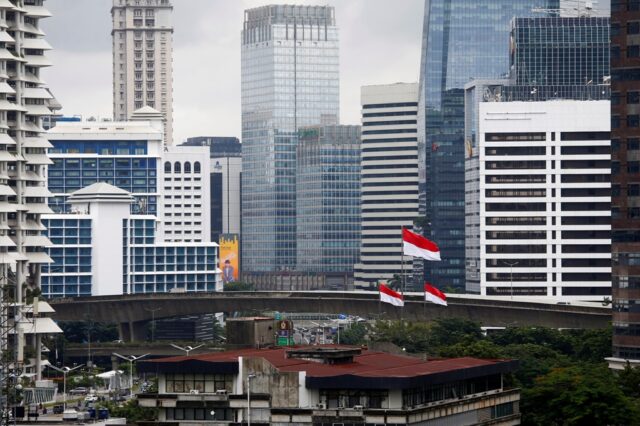
INDONESIAN national flags fly at a business district in Jakarta, Indonesia, Feb. 5, 2021. — REUTERS

JAKARTA — Indonesia’s economic growth climbed to its strongest in nine years last year fueled by revived spending from the lifting of pandemic restrictions and as a global commodity boom sent exports to a record high.

But momentum slowed in the final quarter as prices moderated, and weaker global demand, higher inflation and a rise in interest rates could pose a drag on activity this year.

Southeast Asia’s largest economy expanded 5.31% in 2022, Statistics Indonesia data showed on Monday, its best annual growth rate since 2013, and faster than the 5.29% expected in a Reuters poll.

In the fourth quarter, gross domestic product (GDP) expanded 5.01% on an annual basis, compared with 4.84% growth predicted by the poll and 5.72% in the previous three months. The annual rate was the slowest since the third quarter of 2021, the statistics agency said.

The resource-rich economy gained from high global commodities prices in the aftermath of the Russia-Ukraine war that aided the rupiah and improved the country’s current account, but global demand is faltering.

“We expect growth to slow further over the coming quarters. Exports will struggle due to weaker global growth and lower commodity prices,” Capital Economics analyst Shivaan Tandon said.

“Global commodity prices have dropped back since late last year, and we expect further falls over the coming months. Meanwhile, despite the rebound now underway in China, we expect global growth to struggle this year as the US falls into recession.”

Indonesia’s exports grew on the back of soaring commodity prices last year, with shipments reaching a record high of $292 billion. The country is a major supplier of thermal coal, palm oil and nickel steel.

STRONG CONSUMPTION
Household consumption, which accounts for more than half of Indonesia’s GDP, accelerated last year, especially supported by travel-related spending as COVID-19 restrictions eased.

Indonesia removed most movement curbs last year after daily cases dropped and vaccination rates rose, driving up household consumption. All remaining measures were lifted at the end of the year.

Investment grew 3.87% last year, similar to 2021’s growth but is yet to return to pre-pandemic levels, the statistics bureau said.

Meanwhile, government spending in 2022 contracted as Jakarta started to ease back from pandemic-era health and social spending.

This year’s growth would likely be supported by household consumption amid continued improvement in people’s mobility, Bank Mandiri economist Faisal Rachman said, predicting growth of 5.04% in 2023.

The recent tightening of monetary policy may drag on growth prospects, analysts said, although Indonesia’s central bank has signaled that its rate hike cycle was ending as inflation has cooled.

Bank Indonesia has raised its policy interest rate by 225 basis points since August. Myrdal Gunarto of Maybank Indonesia predicted that the policy rate will be kept at the current level of 5.75% until the end of 2023 to uphold growth.

Jakarta has set a target of 5.3% for economic growth in 2023. — Reuters