Home Blog Page 5261

AFL-CIO wants bigger say in US digital trade deals

REUTERS

WASHINGTON — The Biden administration has made digital trade the centerpiece of its trade negotiations, and the AFL-CIO wants a bigger say in how the US Trade Representative’s (USTR) office sets goals in this area, arguing they are too often dictated by big technology companies.

The largest US labor organization on Tuesday issued a set of principles that it says is needed to protect workers, the public’s privacy and governments’ ability to regulate a rapidly evolving sector as the USTR negotiates digital trade agreements.

The USTR is expected to soon propose text on the digital chapter in negotiations for the Indo-Pacific Economic Framework, the Biden administration’s signature economic agreement. US Trade Representative Katherine Tai has pledged to create a “worker-centric” trade policy, but the AFL-CIO said digital trade negotiations too often make no mention of labor standards nor the workers who write software or support networks.

“To date, US ‘digital trade’ agreements have sought to expand market access for large technology companies by granting broad digital data and intellectual property rights while narrowly constraining the ability of governments (of both the United States and our trade partners) to adopt measures to adopt measures to address the economic transformation,” the AFL-CIO said in its plan.

The heart of the organization’s demands involve ensuring that digital trade agreements are subject to strong and enforceable labor standards, the AFL-CIO said, discouraging the “exploitative” use of “gig” workers who often are deprived of benefits and subjected to difficult working conditions, and discouraging the offshoring of back-office or telemedicine jobs to countries with low labor standards.

But the AFL-CIO’s demands also push back against a key component of recent US trade deals that prohibit countries from imposing “data localization” policies to require data to be stored locally.

The renegotiated North American free trade deal, which went into effect in 2020, included such provisions, and USTR has sparred in recent years with countries including India over their plans for such policies, arguing that US-based data platforms should be free to operate anywhere in the world.

The AFL-CIO said that not all data is created equal and in some cases, governments should have the ability to require that individuals’ sensitive personal information, such as medical or biometric data, be kept on-shore to ensure it is safe.

The principles also call for negotiating strong safeguards against misappropriations of voices, images or likenesses that could be used in digital content generated by artificial intelligence (AI) technologies.

“Corporations shouldn’t dictate the rules of the global digital economy with no regard for working people,” AFL-CIO President Liz Shuler said in a statement. “Their drive to monetize data frequently violates crucial privacy rights and exploits workers.”

Ms. Tai made her first major USTR speech at AFL-CIO headquarters in Washington to outline her worker-centered trade strategy. Since then, a USTR spokesperson said she has continually “embedded workers’ voices into all of our trade initiatives,” including pursuing six trade cases to defend worker rights in Mexico.

“We look forward to reviewing the AFL-CIO’s ideas and continuing to work closely with them,” the spokesperson added.

Other AFL-CIO demands for digital trade negotiations include:

• Requiring governments to enact strong policies to safeguard individuals’ personal data as opposed to the current largely voluntary “self-regulation” model that has proven inadequate.

• Facilitate meaningful oversight of source codes and algorithms to ensure compliance with labor laws. The labor group says automated employee monitoring systems and other AI-enabled tools can undermine workers rights and promote discrimination.

•Address “abusive” employment practices in the technology sector, to discourage the use of contractors and require firms to eliminate labor abuses in their own operations and supply chains.

• Protect and promote economic security of creative professionals in the United States, including motion picture, television and music industry workers by aggressively addressing the stolen or unlicensed use of copyrighted content on digital platforms.

• Address the rise of cybercrime by state and private actors by requiring improved cybersecurity standards and a common enforcement agenda. — Reuters

What to See This Week (02/10/23)

Leonardo DiCaprio and Kate Winslet in Titanic

Titanic

James Cameron’s blockbuster film Titanic — remastered in 3D — returns to the big screen for its 25th anniversary. The film is the recounting of 101-year-old Rose DeWitt Bukater of life aboard the doomed ocean liner Titanic, 84 years earlier. A young Rose boards the ship in first class with her mother and fiancé. Meanwhile, the poorer Jack Dawson and Fabrizio De Rossi win third-class tickets to board the ship. Rose tells the story from Titanic’s departure on its first and last voyage on April 15, 1912, formed through her love story with Jack. The film stars Kate Winslet, Leonardo Dicaprio, Billy Zane, Gloria Stuart, Kathy Bates, and Victor Garber.

MTRCB Rating: PG


Magic Mike’s Last Dance 

AFTER a long hiatus, Mike Lane returns to the stage after a business deal goes bust, leaving him broke and taking bartender gigs in Florida. Mike heads to London with a wealthy socialite who lures him with an offer he can’t refuse until he discovers what she really has in mind. Directed by Steven Soderbergh, the film stars Channing Tatum, Salma Hayek, Caitlin Gerard, Gavin Spokes, and Ayub Kan Din. The film has garnered mixed reviews, getting a measly 56% on review aggregate site Rotten Tomatoes’ Tomatometer. The New York Times’ A.O. Scott writes: “The dance numbers, choreographed by Alison Faulk and Luke Broadlick, feel a bit tame this time around, but the movie still pays ample respect to the terpsichorean craft practiced by Tatum and the hard-working members of Mike’s ensemble.” Meanwhile, Dana Stevens of Slate is less impressed: “To the disappointment of this once-enthusiastic ogler, Magic Mike’s Last Dance fails to capture the eponymous magic of the first two very different but both delightful movies.”

MTRCB Rating: R-13


The Devil Conspiracy 

THE FILM’S premise is this: the biggest global biotech company has discovered they can clone history’s most influential people from the dead. Now, they are auctioning clones of Michelangelo, Galileo, Vivaldi, and others for tens of millions of dollars to the world’s super rich. But when they steal the Shroud of Turin and clone the DNA of Jesus Christ, all hell breaks loose. Directed by Nathan Frankowski, the film stars Alice Orr-Ewing, Joe Anderson, and Peter Mensah. Peter Sobczynski of www.rogerebert.com writes, “For a while, I was almost willing to forgive The Devil Conspiracy its numerous artistic trespasses — like its clunky action and clunkier performances — because of the absolute absurdity of it all. However, towards the film’s final third, The Devil Conspiracy starts reining in the craziness and becomes more familiar and repetitive, right when it should be ramping up to even madder heights.Film Review aggregate site Rotten Tomatoes gives it a low score of 27%, and an audience score at 51%.
MTRCB Rating: PG


The Point Men

INSPIRED by true events, The Point Men follows a diplomat and a national intelligence service agent who risk their lives on foreign soil to save Korean hostages that have been abducted in the Middle East. Directed by Yim Soon-rye, the film stars Hwang Jung-min, Hyun Bin, and Kang Ki-young. John Lui of Singapore’s The Straits Times writes: “A real hostage crisis has become fodder for an action movie. The consolation is the production has the budget to make it look good.”

MTRCB Rating: PG

Entertainment News (02/10/23)

SINGER-songwriter Ice Seguerra

A Valentine’s date with Ice Seguerra

SINGER-songwriter Ice Seguerra will perform in a post-Valentines concert titled Becoming Ice on Feb. 18 at the Pacific Grand Ballroom, Waterfront Cebu Hotel and Casino in Cebu City. In this concert, Mr. Seguerra will be serenading the audience with songs that chronicle his journey as an artist, including “Pagdating ng Panahon” and “Anong Nangyari sa Ating Dalawa” and many more. Tickets are available at SM Tickets (https://bit.ly/BecomingIceCebu) and at the Waterfront Cebu ticket counter. For ticket inquiries and reservations, call 023-232-6888 or 0915-535-3873.


Harry Styles coming to PHL

GRAMMY Award winner Harry Styles’ Love on Tour will make a stop at the Philippine Arena in Bulacan on March 14. Smart subscribers will have a chance to win tickets by visiting the Smart Live site at https://smart.com.ph/Pages/smartlive and clicking on the raffle registration for Love on Tour to get a link to the registration form. The promo is ongoing until Feb. 21. Smart Prepaid and TNT users can avail of the PowerAll 99 or GigaPower 99 to earn two times more raffle entries; PowerAll 149 or GigaPower 199 to earn four times more entries; and GigaPower 499 to earn six times more raffle entries. Smart Postpaid subscribers with Plan 999 and up can hike it up to eight times more entries while subscribers with lower plans can gain six times more raffle entries.     


Copycat Killer on Netflix

NETFLIX will be releasing the Chinese-language crime thriller Copycat Killer globally on March 31. Adapted from a popular crime mystery novel by Japanese writer Miyuki Miyabe, Copycat Killer is set in 1990s Taipei and tells the story of the first-ever serial murder case in Taiwan. Taking advantage of the widespread interest, the media-savvy serial killer turns the case into a national spectacle, fueling gossip and notoriety. A no-nonsense prosecutor, played by award-winning actor Wu Kang-ren, vows to solve the case only to realize that things are not what they seem. The cast includes Alice Ko, Tuo Tsung-hua, Yao Chun-yao, Fandy Fan, Cammy Chiang, and Hsia Teng-Hung, with a guest appearance by Ruby Lin (producer and leading actress of Light the Night).

A guide to dealing with character references

We were told that you (the columnist) are personally known to a job applicant. She passed a series of interviews and other tests resulting in her becoming one of our three shortlisted candidates. In her curriculum vitae (CV), you were listed as one of her character references who can vouch for her. Please confirm. — Orange Juice.

Since the rise of social media, I’ve interacted with hundreds of people who have contacted me for various reasons, mainly to seek advice about their workplace issues. I’ve not met them personally except for about 2% who agreed to pay for my services for a lengthy in-person and deep dive management consultation.

Your applicant is one of 98% who asked me for my insights on certain issues about human resources and other related issues. I gave her answers based on my experience. She often reciprocates by liking and sharing my posts.

Other than that, I can’t remember meeting her in person or dealing with her for long, especially during the last three years of the pandemic.

With that in mind, I can’t give you any positive or negative impressions about her. I wish I could help her but I just can’t do it, other than what I have said above. But don’t take my word for it. Don’t decide by relying solely on my statements. Give her a chance by vetting her credentials through other means.

Also, everything depends much on her ranking in your shortlist of three candidates. If she’s number one on your list and the rest are kilometers away, then it’s better to double check her experience and capacity with her other character references. Conversely, if she’s number two or three in your list, then better to consider the number one candidate, subject to your usual screening process.

RIGHT QUESTIONS
Common sense dictates that you start doing background verification of your number one candidate. You don’t jump to checking the background of the number two or three candidates unless the number one choice is disqualified for some reason.

The best character reference is someone who can give objective information about the applicant. That person could be a third party like a former boss, a work colleague or a university teacher. The more recent the relationship between the job applicant and the character reference, the better.

Much depends on the identity of the character references, who can be anyone other than a family member or best friend. However, the bigger issue in checking character references is not the answers they’ll give you, but rather the questions that you’re posing to them.

If you don’t ask the right questions, you’ll only get the wrong answers. Fortunately, there are a lot of people out there who are willing to help applicants if the circumstances are right. That’s why, it’s imperative for applicants to secure first the permission of their character references before naming them in their CVs so that there are no surprises.

In the case of your applicant, she failed to obtain my permission. If she had approached me, I would have discouraged her from naming me as one of her references.

Moving on, what are the right questions that a prospective employer should ask from the applicant’s character reference? There are only four basic questions. The fewer questions you ask, the better as most people are too busy to answer queries even by telephone or e-mail.

The key questions are as follows:

One, what is your professional relationship with the applicant? This question provides the context for the recommendation. If it’s a boss-subordinate relationship, the expected answer should relate to the capacity and work performance of the applicant. Also, it validates the information given by the applicant to the prospective employer.

Two, how would you describe the applicant’s capacity to do the job? This question should be linked to your job vacancy at hand. Be specific as much as possible as to the job content and specific job title. Trust begets trust. If you’re truthful, you can expect to get accurate and detailed answers from the character reference.

Three, would you rehire the applicant in your organization? If not, would you hire the person in your current company or elsewhere? This is the real test for the character, integrity and employability of the job applicant.

Last, is there something that you would like to tell us regarding the applicant? This is the joker in the pack; it’s also known as the shotgun clause question. It allows the character references to conclude their statements by giving related information not covered by the first three questions.

Don’t force the issue by requiring the character reference to execute a formal document.


Learn from Rey Elbo’s “Superior Subordinate Supervision” program to help train your line supervisors and managers. Or chat with him on Facebook, LinkedIn, Twitter or e-mail elbonomics@gmail.com or via https://reyelbo.com

ICTSI’s Mexico unit gets carbon-neutral certification

INTERNATIONAL Container Terminal Services, Inc. (ICTSI) announced on Thursday that its Mexican unit became the first organization in the Mexican port industry to be certified carbon neutral.

The concessionaire of the Specialized Container Terminal of the North Zone of the Port of Manzanillo — Contecon Manzanillo S.A. de C.V. — was recognized for its initiative in combating climate change, promoting renewable energy, and decarbonizing ports and maritime transport.

“We are proud to be the first terminal in Mexico verified under this regulation. At Contecon, we are quite clear about maintaining an agenda aligned with our business in which climate change is combatted and the use of renewable energy is encouraged,” Contecon Chief Executive Officer Jose Antonio Contreras said in a press release.

Among the company’s efforts include maintaining zero emission from its equipment, sponsorship of forests, initiating circular economies and incorporation of technologies that reduce the operational impact of the port it operates.

In 2021, the company’s direct and indirect carbon dioxide equivalent emissions amounted to 25,368.67 tons, while its total offset emissions amounted to 25,369 tons.

A study by the Energy Transition of Maritime Transport shows that the shipping sector emits 2-3% of global greenhouse gas emissions and contributes around 13% of sulfur and nitrogen oxide emissions. Contecon sees this as a driver to increase sustainable practices within the industry.

“At Contecon, we know the transition of fuel in maritime transport and the commitment of more organizations in our sector to become zero-emission industries is a challenge,” Mr. Contreras said.

“The sector will need to develop and build new ships, integrate and adopt innovative technological solutions, and develop new fuel supply chains and shore-based infrastructure while taking advantage of synergies with other sectors seeking to decarbonize their business activities,” he added.

ICTSI is the parent to Contecon, which had signed a 34-year concession for the development and operation of the Second Specialized Container Terminal at the Port of Manzanillo in Mexico. — Justine Irish D. Tabile

Boosting FDIs through economic charter change

VIETNAM has overtaken the Philippines in terms of gross domestic product (GDP) per capita. The latest national accounts data from the World Bank (WB) showed that our GDP per capita of $3,460.50 trailed behind Vietnam’s $3,756.50 as of end-2021. Even earlier in 2020, the International Monetary Fund announced that Vietnam’s GDP per capita had already surpassed ours in the midst of the pandemic.

How did a socialist economy that had undergone a civil war for almost two decades manage to outperform an early player in the development game like ours? One indicator is the level of foreign direct investments (FDIs) that flowed into both countries over the past 12 years. According to records from 2010 to 2019, Vietnam attracted $112 billion worth of FDIs or almost double the $57 billion generated by the Philippines. In 2021 alone, Vietnam bagged 50% more FDIs amounting to $15.7 billion compared to that of the Philippines at $10.5 billion.

And to think that we had a 30-year head start over this latecomer and war-torn nation whose population is 98.5 million today versus our 115 million. During the 1950s, the Philippines had the second-largest economy in Asia next to Japan, and we were Number One in Southeast Asia at that time. Singapore, Malaysia, Thailand, and Indonesia had backward economies then, but look where they are now.

Singapore became the leading investor in the Philippines in 2021, with investments amounting to P80.2 billion or 41.7% of the total value of FDIs that year, based on statistics from Germany-headquartered Statista. It was followed by the Netherlands, Japan, United Kingdom, United States, South Korea, China, Cayman Islands, and Taiwan.

President Ferdinand R. Marcos, Jr. has embarked on a working visit to Japan this week, reflecting his policy of maintaining friendly relations with all countries that are open to expanding economic cooperation and two-way trade. Former Senate President Franklin M. Drilon, an opposition stalwart, praised Mr. Marcos for projecting an independent foreign policy and pivoting away from the previous administration’s acquiescence to China.

This is in line with Article 2 Section 7 of the 1987 Philippine Constitution that states: “The State shall pursue an independent foreign policy. In its relations with other states, the paramount consideration shall be national sovereignty, territorial integrity, national interest, and the right to self-determination.” Before he left for Tokyo two days ago, Mr. Marcos led the celebration of Philippine Constitution Day in Malacañang and committed to “make sure that the spirit of the Constitution prevails over its letter.”

The next important step is to fully open the country’s doors to foreign investors as the key to a more robust economy. This can be achieved by amending the economic provisions of the Constitution that restrict foreign ownership of land and several sectors that are reserved for Filipino citizens and Filipino-owned corporations.

Before he stepped down from office in June 2022, then President Rodrigo R. Duterte signed an executive order updating the Board of Investment’s negative list consisting of areas where foreign ownership is limited or barred. These include the practice of the legal profession; mass media; small-scale mining; operation of private security agencies; the use of marine resources in archipelagic waters; and small-scale use of natural resources in rivers, lakes, bays and lagoons — all of which are exclusively for locals.

Foreigners are allowed to engage in particular industries with an equity ranging from 20% to 40%, such as infrastructure projects, educational institutions, advertising, private recruitment, exploration of natural resources, production of rice and corn, private radio communications networks, operation of public utilities, ownership of condominium units, and operation of deep-sea commercial fishing vessels.

Former National Security Adviser Clarita Carlos was the resource speaker at the public hearing conducted by the House of Representatives committee on constitutional amendments this week. She expressed her hope that the Constitution be amended soon, especially the restrictive economic provisions. Her sentiments were echoed by National Economic and Development Authority (NEDA) Director-General Arsenio M. Balisacan, who has served as Economic Planning Secretary and NEDA chief under Presidents Benigno S.C. Aquino III and Marcos, Jr.

If foreign investors are allowed to own up to at least 60% of Philippine companies, it can trigger the massive entry of foreign capital and help spur economic recovery from the aggravation brought about by more than two years of pandemic-induced lockdowns. This would enable our country to catch up with its more advanced neighbors and let Manila reclaim its position as the premier Southeast Asian business hub.

The opinion expressed herein does not necessarily reflect the views of these institutions and BusinessWorld.


J. Albert Gamboa is the chief finance officer of Asian Center for Legal Excellence and vice-chair of the FINEX Ethics Committee. #FinexPhils www.finex.org.ph

Globe Business and Mapúa Malayan Digital College team up for enhanced learning experiences

In today’s highly digital world, pushing the limits of education beyond the four walls of the classroom is what Mapúa Malayan Digital College (MMDC), one of the country’s primary digital-first colleges, has been aiming for. This vision has come to fruition – in partnership with Globe Business, they are now able to equip students with reliable internet connection that allows them to learn and participate in classes from anywhere, whether at home, at designated Learning Hubs, or even while out doing part-time or full-time work.

“Mapúa has always been a game changer in the education sector. We always aim to innovate and modernize our services for the learners,” said Noel Torregoza, Instructional System Design Director of Mapúa Malayan Digital College. “As such, it’s important to us to find partners who share the same values and beliefs, such as Globe Business.”

MMDC’s mission is to be a world-class higher learning institution focused on business and technology. Prioritizing quality and innovative education, MMDC only requires their students to attend 7.5 hours of synchronous online classes per week. They educate their students with specific skills through projects and case studies that have real-world applications, and follow it up with best-in-class career guidance and placement services.

This partnership enabled the digital-first college to access solutions and technology experts from Globe Business, allowing them to innovate and maximize every opportunity for student learning.

Through Globe Business, MMDC provides their students with Load Up with Pocket WiFi to help them attend their online classes anywhere, finish their assignments anytime, and collaborate with their classmates when needed.

Aside from providing fast and reliable internet access for students, this solution is also able to block websites that are not appropriate for student learning. This is specifically designed to keep students safe online and to promote a distraction-free environment for studying.

To create more spaces that are safe and conducive to learning, MMDC also established Learning Hubs located in Ayala Malls Cloverleaf in Quezon City and Ayala Malls Capitol Central in Bacolod, powered by Globe Business Direct Internet Access with Managed WiFi.

“Internet connectivity is essential for Mapúa Malayan Digital College,” shared Jonathan Dayao, Vice President for Administration, Mapúa Malayan Digital College. “By partnering with Globe Business, we are able to keep a lean dev-ops team and focus our efforts on services that are close to our students.”

These hubs are equipped with stable and reliable connectivity, providing a space for students to do collaborative group work while being connected to the internet. To implement this, MMDC worked with Globe’s team of network experts, resulting in faster and optimized network deployment.

“We admire the drive of Mapúa Malayan Digital College to push the boundaries of traditional education through its innovative digital-first college concept,” said Chris Cheng, Vice President for Connectivity and Digital Products, Globe Business, Enterprise Group. “Globe Business is thrilled to help redefine the norms of learning through our digital solutions-enabled connectivity products and award-winning managed services portfolio.”

The college has also partnered with companies such as Ayala Group, Concentrix, Genpact, Everise, Sutherland, and many others to provide students with relevant employment opportunities in the market. They also offer scholarships such as the Asenso Scholarship for the first 500 enrollees, Continuing Education Scholarship for working students, and the Sidlak Scholarship for deserving students residing in Bacolod and its nearby areas.

This partnership with the innovative digital-first college further strengthens Globe’s strong commitment towards upholding the United Nations Sustainable Development Goals (SDGs), particularly UN SDG No. 8, which promotes quality education, and UN SDG No. 9 which highlights the role of innovation as a crucial driver of economic growth and development.

To learn more about how Globe Business empowers the new normal of digital learning, visit  https://www.globe.com.ph/education.html.


Spotlight is BusinessWorld’s sponsored section that allows advertisers to amplify their brand and connect with BusinessWorld’s audience by enabling them to publish their stories directly on the BusinessWorld Web site. For more information, send an email to online@bworldonline.com.

Join us on Viber at https://bit.ly/3hv6bLA to get more updates and subscribe to BusinessWorld’s titles and get exclusive content through www.bworld-x.com.

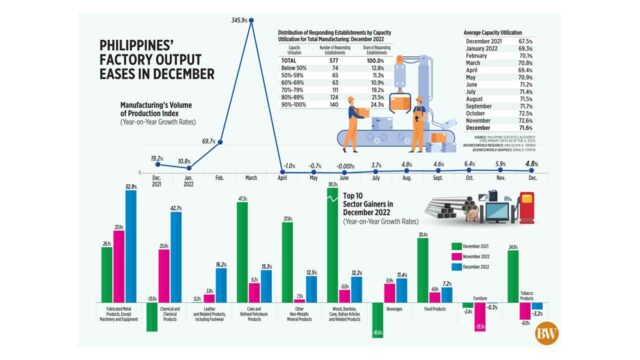
Philippines’ factory output eases in December

FACTORY PRODUCTION grew at its slowest pace in three months in December due to seasonal factors and a decline in trade performance, economists said. Read the full story.

Philippines’ factory output eases in December

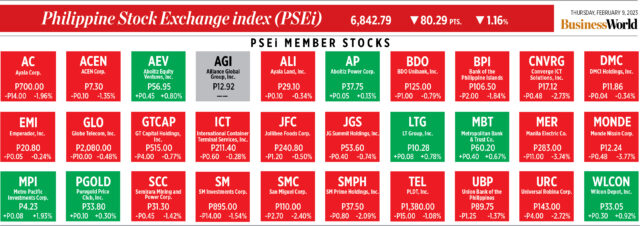
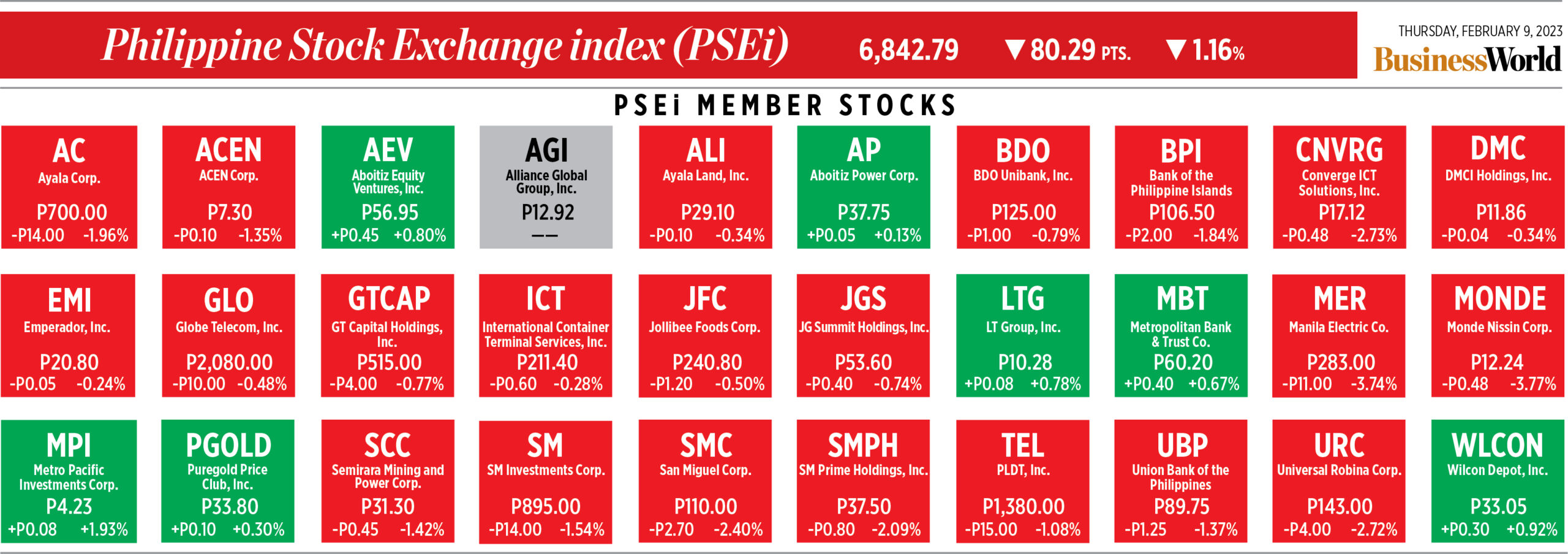
How PSEi member stocks performed — February 9, 2023

Here’s a quick glance at how PSEi stocks fared on Thursday, February 9, 2023.


Peso climbs further as dollar weakens amid slowdown fears

THE PESO strengthened on Thursday amid broad dollar weakness due to concerns over the health of the world’s largest economy.

The local currency closed at P54.45 versus the greenback on Thursday, appreciating by 35 centavos from Wednesday’s P54.80 finish, data from the Bankers Association of the Philippines showed.

The peso opened Thursday’s trading session slightly weaker from Wednesday’s close at P54.86 per dollar. It dropped to as low as P54.955, while its intraday best was at P54.44 against the greenback.

Dollars traded rose to $1.375 billion from $1.147 billion on Wednesday.

“The peso appreciated significantly after dismal US corporate earnings reports bolstered views of potential weakening of US economic activity this year,” a trader said in an e-mail on Thursday.

“The gauge of the US dollar versus major global currencies again slightly corrected lower from near one-month highs… after the latest hawkish Fed signals in the quest to bring down elevated US inflation back to the target of 2%,” Rizal Commercial Banking Corp. Chief Economist Michael L. Ricafort said in a Viber message.

The US dollar hovered near the middle of recent ranges versus major peers on Thursday as investors digested comments from a slew of US Federal Reserve officials, while crucial consumer inflation data loomed next week, Reuters reported.

The dollar index, which measures the US currency against six rivals, slipped 0.13% to 103.32, pulling away from the one-month high of 103.96 it touched on Tuesday at the peak of a rally following Friday’s stronger-than-expected jobs report. At the same time, 103 has provided a firm floor all week.

New York Federal Reserve President John Williams backed views of a peak rate of 5%-5.25%, higher than what markets expect, a day after Fed Chair Jerome H. Powell acknowledged that the battle against inflation will take quite a bit of time.

Money market participants are now betting the Fed’s benchmark rate to rise above 5% in May before peaking to 5.16% by July, levels that officials have backed vociferously.

Fed Governor Lisa Cook said the US central bank is not yet done raising rates and even though inflation has shown signs of moderation, the economy is still running too hot.

The US central bank last week hiked its fed funds rate by 25 basis points (bps) to a 4.5% to 4.75% range. This brought cumulative increases since March 2022 to 450 bps.

The comments from Fed officials added to the cautious mood in US markets caused by mixed earnings results.

The peso was also supported by the increase in the country’s gross international reserves (GIR) at end-January, Mr. Ricafort added.

Preliminary data released by the Bangko Sentral ng Pilipinas late on Tuesday showed the GIR increased by 3.7% to $99.7 billion in January, from the $96.1 billion as of end-December 2022. Year on year, dollar reserves fell by 7.4%.

This is the highest level of dollar reserves since the $99.84 billion posted in July 2022.

For Friday, the trader said the peso could weaken against the dollar ahead of a likely upbeat US consumer sentiment report.

The trader gave a forecast range of P54.30 to P54.65, while Mr. Ricafort sees the peso trading between P54.35 and P54.55 against the dollar. — A.M.C. Sy with Reuters

Shares drop on profit taking, rate hike worries

LOCAL STOCKS declined on Thursday on profit taking and fears that the central bank will deliver a big rate hike next week following faster-than-expected inflation in January.

The benchmark Philippine Stock Exchange index (PSEi) went down by 80.29 points or 1.16% to close at 6,842.79 on Thursday, while the broader all shares index dropped by 31.51 points or 0.85% to end at 3,643.50.

“The local bourse dropped on the higher possibility that the Bangko Sentral ng Pilpinas (BSP) will be aggressive on its upcoming meeting and might raise interest rates by 50 basis points (bps),” Philstocks Financial, Inc. Research Analyst Claire T. Alviar said in a Viber message.

“Other than the rate hike, investors were also concerned about the high inflation in the country that triggers the BSP to tighten the monetary policy. The January’s inflation came in higher than the forecast of the BSP. This shows robust demand, especially with the strong labor data,” Ms. Alviar said.

Rizal Commercial Banking Corp. Chief Economist Michael L. Ricafort said in a Viber message that the PSEi dropped on Thursday to track Wall Street’s decline overnight following policy signals from US Federal Reserve officials.

“Headline inflation accelerated to a fresh 14-year high of 8.7% in January as food prices continued to surge, faster than the 8.1% print in December 2022 and 3% in the same month last year and fueling rate hike bets.”

BSP Governor Felipe M. Medalla earlier said the central bank could hike borrowing costs by 25 or 50 bps at their policy meeting on Feb. 16 to anchor inflation expectations.

Meanwhile, on Wednesday, the Dow Jones Industrial Average fell 207.68 points or 0.61% to 33,949.01; the S&P 500 lost 46.14 points or 1.11% to 4,117.86; and the Nasdaq Composite dropped 203.27 points or 1.68% to 11,910.52.

Fed officials on Wednesday said more interest rate rises are in the cards as the US central bank moves ahead with efforts to control inflation. None hinted though that January’s strong jobs report could drive more aggressive policy actions, Reuters reported.

Back home, all sectoral indices closed lower on Thursday. Industrials declined by 169.70 points or 1.71% to 9,744.61; property lost 38.61 points or 1.27% to end at 2,993.22; holding firms went down by 65.88 points or 0.98% to 6,612.26; financials retreated by 15.12 points or 0.82% to 1,824.29; services decreased by 5.88 points or 0.33% to 1,726.5; and mining and oil dropped by 25.64 points or 0.22% to 11,409.03.

Value turnover went down to P5.62 billion on Thursday with 940.9 million shares changing hands from the P6.28 with 1.15 billion issues traded on Wednesday.

Decliners outnumbered advancers, 112 versus 81, while 45 names closed unchanged.

Net foreign selling rose to P808.79 million on Thursday from P113.85 million the previous trading day. — J.I.D. Tabile with Reuters

Japan’s economic leverage to undercut China, analysts say

PRESIDENTIAL COMMUNICATIONS OFFICE

By Kyle Aristophere T. Atienza, Reporter

THE JAPANESE government might be using its economic power to boost defense ties with the Philippines and other countries locked in territorial disputes with China in response to growing Chinese militarism in the region, political analysts said on Thursday.

“Japan is leveraging its economic and financial wherewithal to promote its expanding security interests,” Lucio Blanco Pitlo III, a research fellow at the Asia-Pacific Pathways to Progress Foundation, said in a Facebook Messenger chat.

“It is providing support to the maritime capacity building of coastal states, including those with longstanding disputes with its neighboring rival China,” he said. “Manila is an obvious target of those overtures.”

Japan, which is upgrading the Philippines’ coast guard, wants more patrols in the South China Sea, President Ferdinand R. Marcos, Jr. told reporters on his way for a working visit to Tokyo on Wednesday. He added that Japanese support for the Philippine Coast Guard is nothing new.

He said Japan might be interested in upgrading the former Subic Naval Base for the Philippine Coast Guard. “Naturally, the reason behind all these is they would like to have more patrols along, up and down the South China Sea so that we can assure the freedom of passage.”

Mr. Marcos Jr. said Japan has been helping develop the agency, having built two brand-new multi-role response vessels for the Philippines. The Philippines also bought four Mitsubishi air surveillance radars from Japan last year. 

“In 2018, for the first time since the end of World War II, Japanese armored vehicles rolled out in foreign soil as Japanese soldiers took part in the Philippine-United States Kamandag exercises,” he added.

The Philippines has given the United States, one of Japan’s key allies, access to four new military bases under the Enhanced Defense Cooperation Agreement (EDCA), which was signed in 2014 under the late President Benigno S.C. Aquino III.

“As the US gains greater military access to Philippine locations through the implementation and expansion of EDCA, it is likely that Japan will follow suit,” Mr. Pitlo said, noting that the country could enter into a reciprocal access agreement with Japan.

“Japan may dangle more market access, infrastructure finance and capital to secure access to strategic Philippine real estate through the deal,” he said. Japan may also co-locate with the US for agreed EDCA sites and help finance the construction of related military infrastructure.

On Wednesday, Mr. Marcos said there were no formal talks yet between Manila and Tokyo on a reciprocal deal. “I don’t know if the prime minister will bring it up with me in this trip.”

“Japan itself is also in the middle of its continuing economic contractions, so that also ultimately puts a cap on what it can actually give us,” Hansley A. Juliano, a political economy researcher studying at Nagoya University’s Graduate School of International Development in Japan, said via Messenger chat.

The level of security ties between the two countries could be measured by looking at how Japan treats the Philippines after giving military equipment.

“You do not only give away hardware, you ensure that people are trained to maintain them, make them useful throughout the hardware’s natural lifespan, and hopefully also enable us to develop and manufacture them ourselves,” he said.

Mr. Juliano said Japan, like the Philippines, is also tied with the US in terms of security. “Any presence of the Japan Self-Defense Forces and any potential partnerships with the Philippine government is ultimately tied to American strategic goals, and will probably not happen unless American strategy is needed.”

Mr. Juliano said Japan has been struggling to convince its people about the scope of its military’s international operations. The Japanese Constitution forbids the use of force in settling international disputes and bars Japan from maintaining an army, navy or air force.

The constitutional limitation on Japan’s defense expansion makes the Tokyo-Manila security ties “tricky,” said policy analyst Michael Henry Ll. Yusingco. “Any possibility of doing joint patrols or entering into a visiting forces agreement will have to factor in this limitation,” he said in a Messenger chat. 

He said Mr. Marcos should be wary of the possibility of Japan using “our troubles” in the South China Sea “as a way to circumvent the constitutional limitation.”

“Hawkish elements in the Japanese government may use our troubles in the South China Sea as a justification to strengthen their military capability without contravening their Constitution.”

In 2016, a United Nations-backed tribunal voided China’s claim to more than 80% of the South China Sea based on a 1940s map. 

Japan and the US are seen as major obstacles to China’s global ambitions.

Herman Joseph S. Kraft, who teaches political science at the University of the Philippines, expects the Marcos government to seek the help of Japan in developing the former military base at the Subic Freeport “as a port that can host maintenance capability.”

“Whether this would eventually lead to Japanese coast guard ships berthing there, and eventually operating jointly in patrols with the Philippine Coast Guard, will require other agreements to come into place, such as a kind of status of forces agreement with Japan,” he said via Viber.

The deal lays down the rights and privileges of foreign forces in a host country.

“If the Philippines enters into such an agreement with Japan, it would allow for a deepening of operational cooperation between them,” Mr. Kraft said, noting that Filipinos could oppose the deal.

ASEAN WORRIES
A firmer foothold by Japan and the US in the Philippines is expected to raise concerns for China, Mr. Pitlo said. “This is especially so if Manila agrees to conduct joint patrols with both allies in the contested South China Sea. This can add complications to Manila’s ties with its largest trade partner, Beijing.”

Critics also worry that the Philippines might be dragged into Washington’s conflict with China, which claims sovereignty over self-ruled Taiwan.

Increased tensions in the Taiwan Strait and unresolved disputes with China are the “biggest potential flashpoints” affecting Southeast Asia, according to a survey by the ASEAN Studies Centre at the ISEAS-Yusof Ishak Institute in Singapore.

In a report, the center said 43.3% of the respondents feared that hostilities in the Taiwan Strait could destabilize the region, while 28.7% felt that member countries of the Association of Southeast Asian Nations could be forced to take sides. Of the 1,308 Southeast Asian respondent, 7.6% were Filipinos.

More than 15% felt it would reduce economic cooperation with either China or Taiwan. “Only 3.4% of the respondents say that it will not affect the region at all.”

Increased military tensions arising from potential flashpoints ranked third on the list of concerns of Filipinos at 50.5%. Their top concern was climate change at 76.8%, followed by unemployment and recession at 60.6%.

For ASEAN, unemployment and recession was the top concern (59.5%), followed by climate change (57.1%) and the widening socioeconomic gaps and military tensions (tied at 41.9%).

ADVERTISEMENT
ADVERTISEMENT