Home Blog Page 511

DENR sues Cebu developer

PHILSTAR.COM/DOMINIQUE NICOLE FLORES

THE Department of Environment and Natural Resources (DENR) has filed a criminal complaint against the developer of the Monterrazas de Cebu project for alleged violation of the country’s forestry law tied to the controversial hillside development in Cebu City.

The agency filed the case on Dec. 3 for violation of the law against cutting or collecting timber without a permit, Environment Assistant Secretary for Legal Affairs and Enforcement Norlito A. Eneran told a news briefing on Wednesday.

The project was earlier flagged for several environmental violations, including unreported tree cutting and the lack of required water discharge permits. The DENR said the developer had failed to report 734 trees cut from the 140-hectare site, leaving only 11 from the 745 recorded in 2022.

The agency also cited violations of 10 conditions under the project’s amended environmental compliance certificate. Mont Property Group, the developer, did not immediately reply to an e-mail seeking comment. — Vonn An-drei E. Villamiel

Bangkok celebrates 2025 PUBG Mobile Global Championship

BANGKOK — PUBG Mobile, one of the world’s most popular mobile games, launches its largest-ever citywide celebration as Bangkok, Thailand, plays host to the 2025 PUBG Mobile Global Championship (PMGC).

Throughout December, 16 of the world’s best PUBG Mobile teams will compete to be in with a chance of lifting the trophy and taking home the lion’s share of a $3,000,000 prize pool from Dec. 12 to 14 at the 2025 PMGC Grand Finals.

Players and fans around the world can experience the thrill of the 2025 PMGC live, streaming the action on PUBG Mobile Esports’ YouTube, Facebook, and Twitch channels, to stay front row for all the PUBG Mobile action.

The spectacle continues with the debut of PUBG Mobile Ultimate Runway, the game’s first-ever global X-Suit runway show, taking place live at the PMGC Grand Finals on Dec. 14 at 16:30 ICT, and broadcast worldwide via the official live stream.

Porsche will invigorate the PMGC stage with the prize of a Porsche Cayenne to the MVP player.

Vietnam set to make it harder for journalists to protect sources

STOCK PHOTO | Image by Georgios Domouchtsidis from Unsplash

HANOI — Vietnam’s parliament adopted reforms to the media and state secrets laws on Wednesday which press freedom advocates say will make it harder for journalists to protect the identities of their sources and increase legal risks for reporting.

“We are appalled by the further restriction to the legal framework governing press freedom in Vietnam,” Aleksandra Bielakowska, from Reporters Without Borders, said on Wednesday.

The changes will make Vietnam “an almost impossible place for journalists to report freely,” said Ms. Bielakowska.

Reporters Without Borders ranks Vietnam 173rd of 180 countries in its world press freedom index.

Vietnam’s government did not immediately respond to a request for comment.

Vietnam’s lawmakers adopted a revamped press law, to take effect in July, which will require journalists to reveal sources at the request of authorities investigating any crime, according to the amended text reviewed by Reu-ters.

Under the current press law, a journalist can only be compelled to disclose a source in probes of “serious crimes.”

The reformed press law will also allow the public security ministry and local police to order source disclosures, whereas at present only judges can do so.

The reform comes amid an escalation of restrictive measures in recent months in the Communist-run country, such as the withdrawal of passports from foreign media reporters, including a BBC Vietnamese jour-nalist, the ban of a printed edition of the Economist, the temporary suspension of Telegram messaging app and an expanded role for the public security ministry.

While domestic media are under state control, foreign journalists face surveillance, trip-approval requirements and limited access to press events. — Reuters

Ms. Bielakowska said at least 28 journalists are currently imprisoned in Vietnam “often in inhumane conditions, simply for doing their jobs.”

In a separate move, legislators also amended the state secrets law, expanding the categories of protected information.

The new law, reviewed by Reuters and set to take effect in March, designates as additional state secrets details of leaders’ overseas programs, state compensation and settlements of international investment disputes.

Disclosing state secrets is already punishable by fines and prison terms.

“This amendment is granting authorities yet another tool of repression against an already shattered media landscape,” Ms. Bielakowska said. — Reuters

PHL shares retreat, weighed by economic concerns

BW FILE PHOTO

PHILIPPINE SHARES retreated on Wednesday as sentiment turned cautious in anticipation of the policy decisions of the US Federal Reserve and the Bangko Sentral ng Pilipinas (BSP) and lingering concerns over the domestic economy.

The Philippine Stock Exchange index (PSEi) went down by 0.27% or 16.70 points to end at 5,959.94, while broader all shares index decreased by 0.1% or 3.51 points to 3,462.70.

“Philippine stocks drifted lower as investors stayed on the sidelines ahead of policy rate announcements from the US Fed and the BSP, as well as pricing the disappointing 5% unemployment rate in October,” AP Securities, Inc. said in a market note.

The Fed was set to announce its policy decision at the end of its two-day meeting overnight. A second straight 25-basis-point (bp) cut is largely priced in, but markets will monitor the statement of Fed Chair Jerome H. Powell for clues on the central bank’s future policy path.

Meanwhile, a BusinessWorld poll showed that 17 of 18 analysts expect the BSP to deliver a fifth straight 25-bp reduction at its own meeting on Thursday to bring the policy rate to 4.5%, the lowest since September 2022.

“The local market pulled back as investors dealt with the World Bank and ADB’s (Asian Development Bank) downgrade of their Philippine economic growth projections, the decline in September foreign investments, the rise in October unem-ployment, and the weakness of the peso,” Philstocks Financial, Inc. Research Manager Japhet Louis O. Tantiangco said in a Viber message.

The World Bank and the ADB this week lowered their respective Philippine gross domestic product forecasts as they expect governance concerns to drag economic growth below target.

The corruption scandal has also hit investor confidence, with net inflows of foreign direct investments plunging to an over five-year low of $320 million in September from $432 million a year ago.

Meanwhile, the peso on Tuesday sank to a new record low of P59.22, mostly due to a strong dollar in anticipation of the Fed’s decision. On Wednesday, it inched up by a centavo.

Sectoral indices ended mixed on Wednesday. Mining and oil rose by 1.22% or 169.29 points to 13,986.43; property increased by 0.2% or 4.64 points to 2,242.90; and industrials went up by 0.13% or 11.33 points to 8,474.99. Meanwhile, holding firms declined by 0.54% or 25.31 points to 4,656.04; services shed 0.37% or 9.26 points to end at 2,487.43; and financials went down by 0.32% or 6.31 points to 1,920.22.

“Metropolitan Bank & Trust Co. was the day’s top index gainer, climbing 2.8% to P66. Converge ICT Solutions, Inc. was the worst index performer, dropping 3.23% to P14.36,” Mr. Tantiangco said.

Decliners outnumbered advancers, 100 to 93, while 63 names closed unchanged.

Value turnover went down to P6.75 billion on Wednesday with 657.57 million shares traded from the P10.55 billion with 1.19 billion issues that changed hands on Tuesday.

Net foreign selling decreased to P787.08 million from P2.63 billion. — A.G.C. Magno

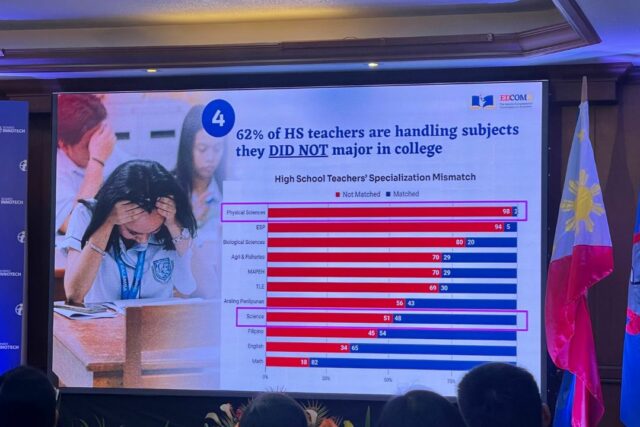
62% of high school teachers teach outside their specialization says EDCOM 2

A graph presented by the Second Congressional Commission (EDCOM 2) showing high school teachers’ specialization mismatch. — ALMIRA LOUISE S. MARTINEZ

The Second Congressional Commission (EDCOM 2) said that more than half of high school teachers in the Philippines are handling subjects beyond their specialization as schools grapple with a nationwide shortage of educators.

“Most of our teachers were teaching a subject they did not study or learn from themselves,” EDCOM 2 Executive Director Karol Mark R. Yee said during his presentation at an event.

“The fields that we are truly lacking are STEM (science, technology, engineering, and mathematics) teachers, teachers of GMRC (good moral and right conduct) or Edukasyon sa Pagpapakatao (EsP), and teachers of MAPEH (music, arts, physical education, and health),” he added.

Data from the commission found that 62% of secondary education teachers are teaching without a proper educational background for the subject.

Physical science had the highest subject-teacher mismatch at 98%, followed by EsP at 94% and biological sciences at 80%.

Agriculture and fisheries, along with MAPEH are at 70%, while technology and livelihood education (TLE) is at 69%.

Other subjects affected by the mismatch are araling panlipunan (56%), science (51%), Filipino (45%), English (34%), and math (18%).

“We had a lot of questions from teachers. They are asking “Sir, how can I teach science well? I finished English. How can I teach math well? I finished TLE”,” the EDCOM 2 official said.

Mr. Yee noted that the specialization mismatch stems from improper scholarship allocations in teacher education.

“We have not done supply and demand mapping and strategic allocations of scholarships, in a way that resolves our own problems as a country and even just specifically public schools,” he said.

“If you look at all programs of higher education today, most of them are either elementary education or English education; teaching English in secondary,” he added.

A study by the EDCOM 2 and the Philippine Institute for Development Studies (PIDS) in November also underscored the same concern, linking it to teacher shortage.

Under Department Order (DO) No. 13, series of 1994, teachers must be assigned to subjects aligned with their academic background. However, the study said the policy’s implementation is hindered by “systemic limitations,” including limited professional deployment opportunities.

The Department of Education (DepEd) said earlier this month that it aims to hire more than 32,000 Teacher I in 2026 to address the nationwide teacher shortage while 20,000 teaching positions are slated for hiring and deployment for FY 2025. — Almira Louise S. Martinez

Proposed nuclear power plant could make Pangasinan town rich, says lawmaker

PNRI.DOST.GOV.PH

The construction of a nuclear power plant in Labrador, Pangasinan could make the municipality the richest town in the Philippines, a local lawmaker said.

“Can you imagine if not only 1,000 megawatts of nuclear (power) is built in Labrador, but maybe 4,000 or even 6,000 megawatts? I think Labrador will become the richest town in the entire Philippines,” Marcos Juan Bruno O. Cojuangco, 2nd District of Pangasinan representative, said during the Atomic Energy Week on Tuesday.

Mr. Cojuangco said this is possible because, for every 1,000 megawatts installed, a nuclear plant can generate enough power to supply Labrador with twice its total 2021 electricity consumption every year across the facility’s 80-year lifespan.

He added that such a facility could significantly reduce generation charges, leading to lower electricity rates that may help attract investments.

“I think foreign investors and local investors will flock to Labrador to set up their businesses and industries, and it will enable us to create the thousands of jobs necessary to uplift the lives of Labradorans,” Mr. Cojuangco said.

Last year, Mr. Cojuangco, a staunch advocate of nuclear energy, proposed the construction of a 1,000-megawatt nuclear power plant in Pangasinan.

The plant’s cost is estimated to be at least P225 billion and will possibly be built within a 120-hectare area.

In previous statements, the lawmaker said electricity from nuclear power could drop to as low as P5 per kilowatt-hour or even provided free to residents of Labrador under certain arrangements.

The municipality has a population of 26,811 based on the 2020 census.

Mr. Cojuangco also said the income tax generated from the nuclear plant could help lift Labrador out of poverty, similar to the nearby town of Sual, which saw revenue gains from hosting a 1,000-MW coal power plant.

Labrador is currently the second-poorest municipality in Pangasinan, he said.

Meanwhile, the Archdiocese of Lingayen-Dagupan voiced opposition to the proposed nuclear plant last weekend, citing that its planned location is near the East Zambales Fault Line, making any nuclear project “an unacceptable risk.”

“Not in Pangasinan! Not anywhere else!” the bishops said in a statement. They also recalled the 2011 Fukushima disaster, which caused significant harm to both lives and the environment.

Mr. Cojuangco stressed that the proposed plant will not be built on top of a fault line and would be engineered to withstand the maximum possible earthquake intensity that the fault could generate.

Amid opposition to nuclear energy, he urged the Philippine Nuclear Research Institute (PNRI) to promote a more positive narrative about its benefits.

PNRI is the country’s primary research and technical agency for nuclear science and technology, responsible for conducting research, providing scientific expertise, and training personnel in the safe and peaceful use of nuclear energy.

Meanwhile, the newly created Philippine Atomic Energy Regulatory Authority (PhilATOM) under the recently enacted RA 12305, serves as the independent regulator, overseeing licensing, inspections, and enforcement of nuclear and radiation safety, with PNRI providing technical guidance and support.

The law also includes measures such as the establishment of a national registry for radiation sources, stricter safety protocols, and penalties for unauthorized nuclear activities.

PNRI is leading this year’s Atomic Energy Week from December 9 to 12, highlighting the importance of nuclear science and technology in national development. One of the event’s centerpieces is the open-house technical exhibits, showcasing recent nuclear technologies developed by Filipino scientists and researchers. — Edg Adrian A. Eva


Families on both sides caught in crossfire as Thai-Cambodian fighting continues

STOCK PHOTO | Images by Aranjuezmedina from Freepik

SAI THO 10 VILLAGE, Thailand/SAMRAONG, Cambodia – Thousands of families on both sides of the disputed border separating Thailand and Cambodia have fled to escape a bitter new conflict between the two Southeast Asian nations, but some have been forced to stay behind.

Wuttikrai Chimngarm, a Thai security guard who also serves as village head, hunkered down behind a makeshift bunker built from six layers of tires as shelling continued to shake the Thai border province of Buriram.

“I have to stay behind. I’m the head of the village, if not me then who? Who will be safeguarding the houses and belongings of the villagers from looters? I’m the leader, and all the village security guards have to stick together.”

Hundreds of thousands of people have moved into temporary shelters since fighting resumed on Monday, breaking a fragile truce brokered by US President Donald Trump in July.

Mr. Wuttikrai said he was concerned the shelters could also be targeted.

“I am worried and those villagers who evacuated are also worried because they (Cambodia) possess heavy weapons that have a firing range of up to 130 kilometers, according to the news,” he said.

In the Thai border district of Ta Phraya, civilians expressed rage at this week’s fresh outbreak of hostilities, with 65-year-old villager Sopee Kunkem calling for Cambodia’s military capabilities to be “blown to oblivion”.

“They said they would have a ceasefire,” he said. “They signed the agreement, but they didn’t stop firing.”

Both sides accuse the other of reigniting the conflict, and both accuse the other of targeting civilian areas.

At Kaun Kriel, a disputed village about 25 kilometers (15 miles) northwest of the Cambodian city of Samraong, wary residents remembering the five-day July border clash, which killed at least 48 people, began to flee as soon as fighting erupted again on Monday.

“This is my second run because the place I live is very close to the border and was under attack both times,” said Cambodian Marng Sarun, a 31-year-old harvester who left the village with his wife and two children.

Mr. Marng said he and his family were among the last to flee Kaun Kriel, which is close to the 11th-century temple Ta Krabey. He barely had time to grab a sack of rice and a few cooking supplies, and is now trying to feed his family with fish caught in a pond near the refugee site, he added.

He said he never expected Thailand to “attack” Cambodia again, or that he would have to leave Kaun Kriel for a second time.

“I only thought that we may have tensions but it would not reach this far. Especially after US President Donald Trump helped to get the peace agreement, I didn’t think that they would fight again.”— Reuters

Bank of France will give slight upgrade to France’s GDP forecasts

STOCK PHOTO | Image by Rodrigo Pignatta from Pixabay

PARIS — The Bank of France will slightly raise its economic growth forecasts for France, said central bank governor Francois Villeroy de Galhau, who added that the country’s economy was holding up despite the climate of political uncertainty.

Mr. Villeroy de Galhau was commenting after French lawmakers narrowly approved the 2026 social security budget on Tuesday, handing Prime Minister Sebastien Lecornu a crucial victory but at enormous political and financial cost that could still threaten his fragile government.

Mr. Lecornu is battling to get a budget approved before the end of this year, as the government tries to find ways to reduce France’s deficits despite opposition over public spending cuts.

Mr. Villeroy de Galhau told CNews TV and Europe 1 radio on Wednesday that the new Bank of France forecasts would be published on December 19.

“We are going to raise our growth forecast slightly for this year and next year. We were at 0.7 percent for this year and 0.9 for next year,” he said.

“We are going to raise our growth forecast slightly,” he added.

The Bank of France published late on Tuesday its latest business sentiment survey, which showed the euro zone’s second-biggest economy was set to grow 0.2% in the fourth quarter.

That would leave France in good stead to achieve, if not surpass, the 0.8% annual growth expected by the government this year as the economy proves relatively resilient in the face of the recurring political instability.

“We are still seeing economic activity, in spite of the uncertainty,” Mr. Villeroy de Galhau told CNews TV.— Reuters

Russia says it awaits an answer from the US on New START as nuclear treaty ticks down

A RUSSIAN FLAG flies with the Spasskaya Tower of the Kremlin in the background in Moscow, Russia, Feb. 27, 2019. — REUTERS

MOSCOW — Russia on Wednesday said it was still awaiting a formal answer from Washington on President Vladimir Putin’s proposal to jointly stick to the last remaining Russian-US arms control treaty, which expires in less than two months.

New START, which runs out on February 5, caps the number of strategic nuclear warheads that the United States and Russia can deploy, and the deployment of land- and submarine-based missiles and bombers to deliver them.

Mr. Putin in September offered to voluntarily maintain for one year the limits on deployed strategic nuclear weapons set out in the treaty, whose initials stand for the (New) Strategic Arms Reduction Treaty (START).

Mr. Trump said in October it sounded “like a good idea.”

“We have less than 100 days left before the expiry of New START,” said Sergei Shoigu, the secretary of Russia’s powerful Security Council, which is like a modern-day politburo of Russia’s most powerful officials.

“We are waiting for a response,” Mr. Shoigu told reporters during a visit to Hanoi. He added that Moscow’s proposal was an opportunity to halt the “destructive movement” that currently existed in nuclear arms control.

NUCLEAR ARMS CONTROL IN PERIL
Russia and the US together have more than 10,000 nuclear warheads, or 87% of the global inventory of nuclear weapons. China is the world’s third largest nuclear power with about 600 warheads, according to the Federation of American Scientists.

The arms control treaties between Moscow and Washington were born out of fear of nuclear war after the 1962 Cuban Missile Crisis. Greater transparency about the opponent’s arsenal was intended to reduce the scope for misunderstanding and slow the arms race.

US AND RUSSIA EYE CHINA’S NUCLEAR ARSENAL
Now, with all major nuclear powers seeking to modernize their arsenals, and Russia and the West at strategic loggerheads for over a decade – not least over the enlargement of NATO and Moscow’s war in Ukraine – the treaties have almost all crumbled away. Each side blames the other.

In the new US National Security Strategy, the Trump administration says it wants to “reestablish strategic stability with Russia” – shorthand for reopening discussions on strategic nuclear arms control.

Rose Gottemoeller, who was chief US negotiator for New START, said in an article for The Arms Control Association this month that it would be beneficial for Washington to implement the treaty along with Moscow.

“For the United States, the benefit of this move would be buying more time to decide what to do about the ongoing Chinese buildup without having to worry simultaneously about new Russian deployments,” Ms. Gottemoeller said.— Reuters

US bank executives say AI will boost productivity, cut jobs

REUTERS

NEW YORK — US banks including JPMorgan Chase and Wells Fargo said artificial intelligence will boost productivity at their companies and likely cause job losses.

JPMorgan Chase’s consumer and community banking chief Marianne Lake said at the Goldman Sachs financial services conference the bank has doubled productivity to 6% with AI, from a previous 3% without it.

Operation specialists’ productivity is expected to grow by 40% to 50%, Lake said. The higher productivity means less impact on jobs on a net basis, she said.

AI represents the biggest technological upheaval to the world economy since the rise of the internet.
It has brought trillions of dollars of investment and dizzying stock-market gains, but also a shortage of memory chips, regulatory scrutiny, and rising anxiety about job displacement.

Wells Fargo CEO Charlie Scharf said the bank has not reduced the number of people, but added “we’re getting a lot more done” because of AI.

“There are other places out there where we’re gonna be able to look at and figure out how are we able to do more with less people,” he said.

“It’s not going to totally replace humans, but does create an opportunity to do things significantly different.”

PNC Financial CEO Bill Demchak said the bank’s head count is the same as it was 10 years ago when the bank was a third of the size — all through the process of automation and branch optimization.

“You know, the big buzz right now is it’s going to continue because AI is going to drive it. But we’ve been on a journey of automation for years, and AI may well be an accelerant,” he said.

“It will most definitely be an accelerant in our tech headcount.”

Citigroup’s incoming CFO Gonzalo Luchetti said the bank has seen a 9% productivity increase on the coding front.

“Not only can we increase the self-service ratio, which we’re already seeing and doing with our Gen AI, but in addition we’re able to assist real time those calls that end up with a human and they can be more productive,” Luchetti said, referring to the US Personal Banking unit. In October, Goldman Sachs informed employees of potential job cuts and a hiring slowdown through the end of the year, according to an internal memo seen by Reuters, as the Wall Street giant aims to use AI to enhance productivity.

Calling the initiative “OneGS 3.0”, the memo said some of the priorities for its AI initiative are sales and client on-boarding process, as well as other critical areas such as lending processes, regulatory reporting, and vendor management. Bank of America plans to spend billions of dollars on technologies such as artificial intelligence to boost bankers’ productivity and bring in more revenue, its chief technology and information officer told Reuters last month. — Reuters

How Infrastructure and Housing Shape Cement Consumption in the Philippines

John Reinier H. Dizon, president and board member of the Federation of Philippine Industries, Inc., talks about Gross Domestic Product growth, infrastructure, and the other factors shaping cement demand in the Philippines.

Interview by Edg Adrian Eva
Video editing by Richard Mendoza

Driving Organizational Culture with Leadership Programs

A GCash executive talks about how the company’s leadership development programs shape resilient teams and a consistent organizational culture.
Interview by Almira Martinez
Video editing by Richard Mendoza