Home Blog Page 5049

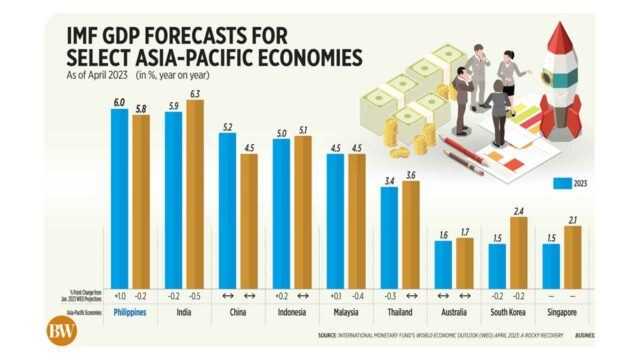
IMF GDP forecasts for select Asia-Pacific economies

WASHINGTON — The International Monetary Fund (IMF) expects the Philippines to post the fastest growth in emerging and developing Asia this year, despite a global economic slowdown. Read the full story.

IMF GDP forecasts for select Asia-Pacific economies

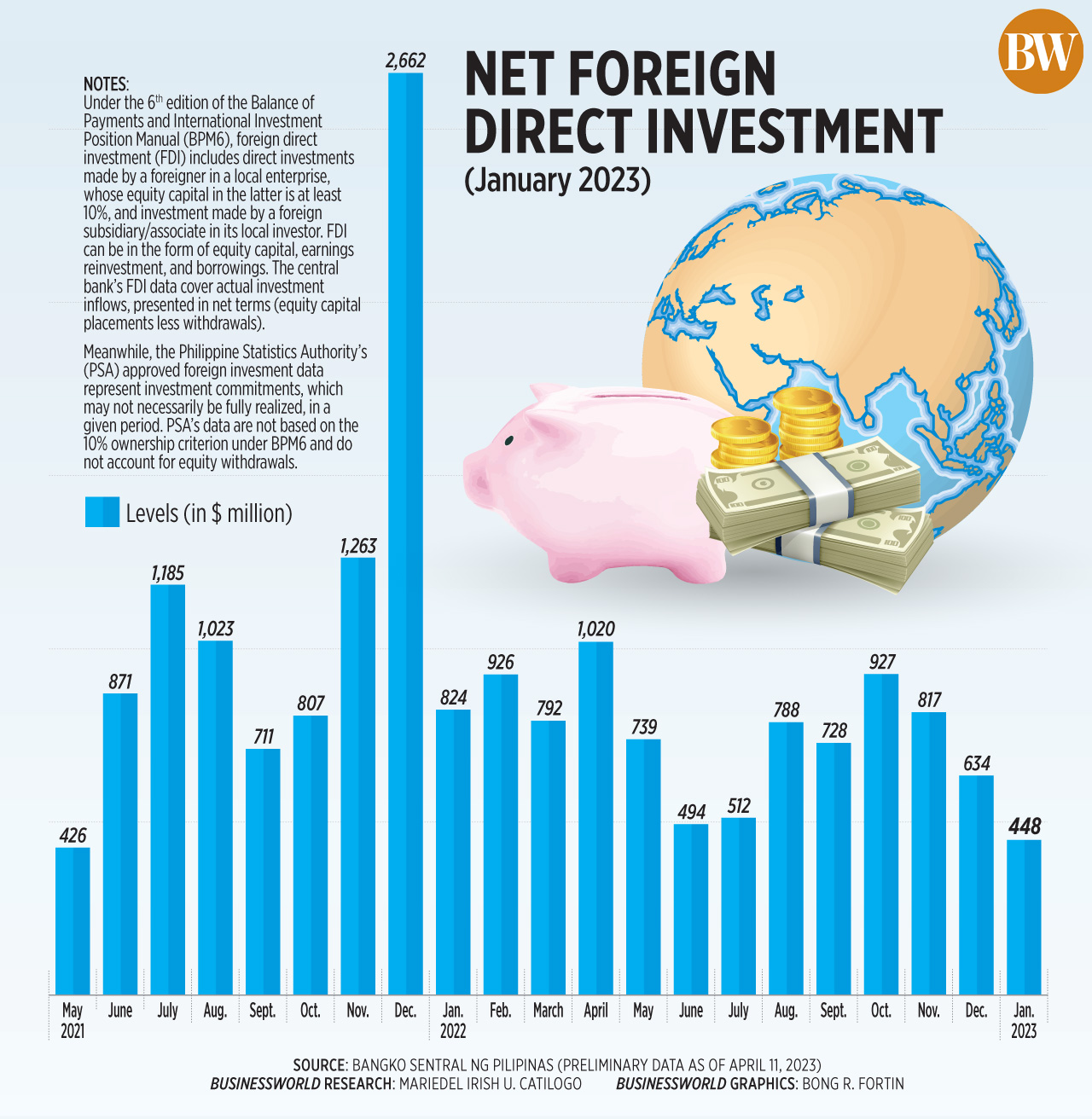
Net foreign direct investment

FOREIGN direct investment (FDI) net inflows slumped to a 20-month low in January as heightened global economic uncertainty weighed on investor sentiment. Read the full story.

Net foreign direct investment

Transgender female athlete controversy heats up

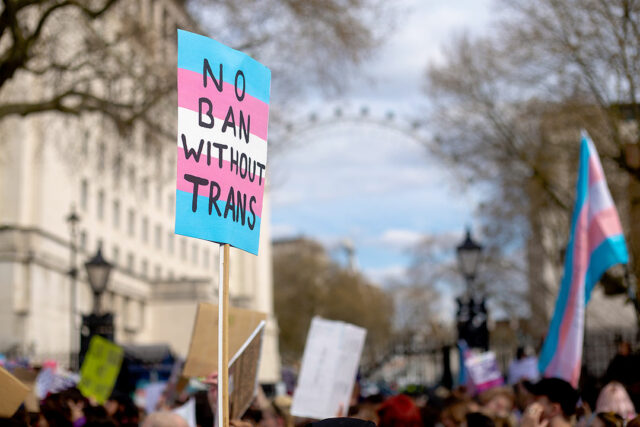
THE TRANS RIGHTS protest in London, April 2022. — KAROLLYNE HUBERT-UNSPLASH

Transgender women and girls competing in female sports have always stirred controversy since humans born and designated as males decided to undergo medically induced changes to become transgender females.

Sports has become the arena of controversy because sport is sex-segregated simply because of biological difference. The presumption is that male humans are stronger than female humans and therefore competitions need to be segregated in order to have “a level and fair playing field and protect women’s sports.”

The controversy and arguments for and against the participation of transgender women in a competition against cisgender — alternatively called cisexual or cis women — revolves around the competing interests and needs for inclusivity, safety, and a level playing field. Cisgender refers to persons whose gender identity matches their sex designated at birth.

Some sports allow transgender women to compete against cisgender women. While achieving the socially noble objective of inclusivity and respect for human rights regardless of sex, the move has had unpleasant and sometimes violent consequences.

Just before the Holy Week break in the Philippines, CNN reported that former (US) NCAA swimmer Riley Gaines said she was assaulted (Thursday) on the campus of the San Francisco State University (SFSU). CNN stated that Gaines was at the school to speak about her views opposing the inclusion of transgender athletes in women’s sports, according to the event announcement. Gaines said, “I was physically assaulted by one person.”

KRON (TV) in San Francisco had a separate but similar report of the incident: “Former Division 1 college swimmer Riley Gaines said she was verbally and physically attacked following a speech she made on behalf of Save Women’s Sports at San Francisco State University. Save Women’s Sports aims to bar trans women from competing in women’s sports and instead create a new division for where trans athletes would be allowed to compete and has been labeled an anti-trans organization. ‘I was ambushed and physically hit twice by a man,’ Gaines tweeted. This is proof that women need sex-protected spaces.”

The KRON report adds that “Video posted to Twitter shows police escorting Gaines through a crowd yelling ‘Trans rights are human rights.’”

KRON quoted former Olympic decathlon champion Bruce Jenner, now known as trans TV personality, Catlyn Jenner, as offering support to Gaines against the “radical rainbow mafia” — “Never back down. Never give up! I am praying for you” and “condemn SFSU.”

The controversy strikes at the roots of the “Sports for All” philosophy which proclaims that everyone should have the right to play the sport of his/her choice regardless of age, talent, ethnicity, color, religion, and gender. It is clear that there are other competing and conflicting interests which are just as valid.

The basic argument of those opposed to the participation of trans women in women’s sports is, as pointed out by various quarters like the highly respected World Athletics, which recently banned trans women from women’s track and field, is that trans women athletes have an unfair advantage over, and put at some physical risk, cisgender athletes due to the natural difference in human physiology even if the trans women went through a period of testosterone suppression.

Advocates of the participation of trans women athletes in women’s sports, especially in youth sports, argue that one of the objectives of sport is to promote “learning to live with others” and social cohesion at the earliest stages of a person’s life. The American Medical Association, per sources like Wikipedia, states that “legislation barring trans women from women’s sports harms the mental health of transgender people.”

Even attempts to arrive at some compromise through regulations that take into account and balance the competing interests and needs have drawn flak.

These regulations revolve around sex verification in sports to ensure fair competition and cisgender women’s safety. Some sports associations have amended their eligibility rules to address the participation of transgender women through sex verification by traditional physical examination, sex chromosomes, and sex hormones. Such eligibility rules have however been branded by trans community leaders as discriminatory against transgender and intersex women (girls who “at puberty display biological sex characteristics which are not typically male or female”).

Perhaps tracing the history of women’s involvement in sport — which was regarded as a strictly male domain up to the late 19th and early 20th century — would help. The Puritan era of the late 16th and 17th century had affected the attitude of society up to the early 20th century on the proper role of women in society. Women were denied the right of suffrage in America even though it was the model of a functioning democracy which respected individual rights. It wasn’t until 1920 however that the US allowed women the right to vote. Denied a basic human right for so long as Puritanism lingered on, women were not allowed to participate in sports which, as stated earlier, was the domain of men. A woman who played and excelled in a sport during the early 20th century was not “lady like.”

The discriminatory attitude towards sportswomen somehow lessened when certain outstanding talented women made inroads into high performance or elite sports. Olympic history shows that women were allowed to compete in the modern Olympics for the first time in the 1900 Summer Olympics in Paris. Helen Pourtales of Switzerland became the first woman to compete in the Olympics and the first female Olympic medalist as a member of the team that won the 1- to 2-ton sailing event.

Over the years, as schools and communities offered more opportunities for women’s access to sports through scholarships and sports facilities, great women athletes in various sports emerged. Then came the participation of gay athletes who publicly revealed their preferred gender identity and demanded equal rights.

As society became more liberal and new needs and interests emerged, there developed a new phenomenon, the trans female and trans male athlete in different sports: from athletics, aquatics, and rugby to weightlifting.

The issue of trans athletes has not yet reached controversial proportions in the Philippines, but it will only be a matter of time when the situation takes a different turn. LGBTQ groups are very active in community sports like volleyball. It is not uncommon to see LGBTQ groups organize their own tournaments and sometimes practice and play against top level women’s collegiate teams whose training regimen includes being exposed to power volleyball.

If and when the trans community in the Philippines decides to be more active in promoting the rights of trans female or inter sex women athletes, you can be sure participation of trans women athletes will be as hotly debated hereabouts as it is in the Americas and Europe.


Philip Ella Juico’s areas of interest include the protection and promotion of democracy, free markets, sustainable development, social responsibility and sports as a tool for social development. He obtained his doctorate in business at De La Salle University. Dr. Juico served as secretary of Agrarian Reform during the Corazon C. Aquino administration.

The aliens have landed, and we created them

LIUZISHAN-FREEPIK

(Part 2)

LET US BEGIN by being more precise about what we are discussing. Most AI does things that offer benefits not threats to humanity. For example, DeepMind’s AlphaFold has determined the structures of around 200 million proteins, a huge scientific leap forward.

The debate we are having today is about a particular branch of AI: the large language models (LLMs) produced by organizations such as OpenAI, notably ChatGPT and its more powerful successor GPT-4.

The backstory of OpenAI is a fascinating one. When I moved to California seven years ago, I participated in a discussion with Sam Altman, one of the founders of OpenAI. As I recall, he assured the audience that, within five years, AI-powered self-driving vehicles would have rendered every truck driver in America redundant. Like me, you may have missed the fleet of self-driving trucks on our highways, and the crowds of unemployed truckers learning to code on the streets of San Francisco. Like his former partner Elon Musk, Altman realized at some point that teaching neural networks to drive was harder than they had assumed. Hence OpenAI’s pivot to LLMs.

As a report in the Wall Street Journal made clear, the original vision of OpenAI in 2015 was that it would be a nonprofit precisely because of the inherent dangers of such AI. In Altman’s own words: “If you’re making AI, it is potentially very good, potentially very terrible.” However, it rapidly became apparent that building LLMs powerful enough to generate credible results was too expensive for a nonprofit because of the huge computing power required. So Altman created a for-profit arm of OpenAI and sold a large stake to Microsoft CEO Satya Nadella, who saw a golden opportunity to catch up with Google, hitherto the leader in AI development.

“In the long run,” Altman told the Journal, he wants to “set up a global governance structure that would oversee decisions about the future of AI and gradually reduce the power OpenAI’s executive team has over its technology.” OpenAI’s ultimate mission, he went on, is to build artificial general intelligence “safely.” The goal is “to avoid a race toward building dangerous AI systems fueled by competition and instead prioritize the safety of humanity.”

In the short run, however, Altman is now part of that race. And this, of course, is why he has fallen out not only with Musk, whose company Tesla is also in the race, but also with OpenAI’s lead safety researcher, Dario Amodei, who has quit OpenAI to set up his own AI company called Anthropic, which is backed by … Google.

So just how dangerous is this for-profit LLM race? Superficially, not dangerous at all. As my favorite genius, Stephen Wolfram, explains, an AI such as ChatGPT “is always fundamentally trying to … produce a ‘reasonable continuation’ of whatever text it’s got so far, where by ‘reasonable’ we mean ‘what one might expect someone to write after seeing what people have written on billions of webpages.’ … When ChatGPT does something like write an essay, what it’s essentially doing is just asking over and over again ‘given the text so far, what should the next word be?’ — and each time adding a word.”

GPT-4 is just an even more powerful word-predicting neural network, doing vast numbers of operations on arrays of numbers with GPUs — the processing units originally designed to accelerate graphics rendering. As a result, its output is even more convincingly humanlike than ChatGPT’s. If you don’t believe me, look at what GPT-4 came up with when Reid Hoffman asked it to answer the question “How many restaurant inspectors does it take to change a lightbulb?” in the style of Jerry Seinfeld:

GPT-4: What is the deal with restaurant inspectors? They’re always poking around in the kitchen, checking the temperature of the meat, looking for signs of rodents, but they never seem to help out with anything. Have you ever seen a restaurant inspector change a lightbulb? No, of course not. They’re too busy writing up violations and handing out fines. You know what they do when they see a lightbulb that’s out? They mark it down on their clipboard and tell the owner to fix it by next week or else. Or else what? Or else they’ll come back and check the lightbulb again. That’s their big threat. They’re not going to change it for you, they’re not going to lend you a ladder, they’re not going to offer any advice on how to unscrew the old one and screw in the new one. They’re just going to stare at you with that smug look on their face and say, “You know this is a serious safety hazard. You could have a fire, you could have a lawsuit, you could have a bad Yelp review. You better get on that, pal.” And then they leave, and you’re left with a dark corner of your dining room, where no one wants to sit, where the food looks unappetizing, where the mood is gloomy. And you think to yourself, how many restaurant inspectors does it take to change a lightbulb? None. They don’t change lightbulbs. They just make you feel bad about yours.

Not only is that pretty plausible, but according to a thorough report by Bubeck et al. (2023), GPT-4 can also “solve novel and difficult tasks that span mathematics, coding, vision, medicine, law, psychology and more, without needing any special prompting” and with “strikingly close to human-level performance.”

Well, how about superhuman-level? GPT-4 was easily able “to write a proof of infinitude of primes in the form of a poem, to draw a unicorn in TiKZ (a language for creating graphics …), to create a complex animation in Python, and to solve a high-school level mathematical problem.” I’ve read that report carefully. GPT-4 is much smarter than me.

So what’s the problem, apart from the obvious fact that millions of comedy writers — not to mention lawyers, journalists and just about everyone else who writes down words for a living (apart from me, obviously) — will now have to retrain as truck drivers?

Hoffman acknowledges that a problem exists. He notes “the well-documented shortcomings of LLMs such as the problem of hallucinations” — a fancy word for their tendency to make stuff up. This makes me somewhat wary of his proposal to use GPT-4 to “flood the zone with truth” (or maybe just truthiness) to dilute the flood of fake news. Even GPT-4 cannot deny the downside risk. Hoffman asks it the question: “Once large language models are fully developed and deployed, what would you suspect will be the worst effects on the quality of overall cultural production?” In addition to the mass unemployment of professional writers, it suggests two:

1. Homogenization and loss of diversity: Large language models could generate massive amounts of content that mimic existing styles, genres, and trends, but lack originality, creativity, and authenticity. This could result in a saturation of the cultural market with bland and repetitive products that appeal to the lowest common denominator and discourage innovation and experimentation.

2. Manipulation and deception: Large language models could also be used to create deceptive or harmful content that exploits human biases, emotions, and preferences. This could include fake news, propaganda, misinformation, deepfakes, scams, or hate speech that undermine trust, democracy and social cohesion.

Sorry, Reid, but No. 2 is a much, much bigger problem than your habitual techno-optimism allows.

Let me now offer a different analogy from nukes and biowarfare. The more I read about GPT-4, the more I think we are talking here not about artificial intelligence (i.e., synthetic humanlike intelligence) but inhuman intelligence, which we have designed and trained to sound convincingly like us.

I am reminded of Liu Cixin’s The Dark Forest, which describes the invasion of Earth by the ruthless and technologically superior Trisolarans. In effect, we are building the aliens, to save them from having to make the long journey from outer space. And the core lesson of that book is that the aliens have to destroy us if we are not quick to destroy them.

These are the axioms of Liu’s “cosmic sociology”: First, “survival is the primary need of civilization.” Second, “civilization continuously grows and expands, but the total matter in the universe remains constant.” Third, “chains of suspicion” and the risk of a “technological explosion” in another civilization mean that in this universe there can only be the law of the jungle.

Another sci-fi analogy that comes to mind is John Wyndham’s Day of the Triffids (1951), in which most of humanity is first blinded by rays from satellites and then wiped out by carnivorous plants genetically engineered — by the dastardly Soviets — and farmed for their vegetable oil.

As Bill, the central character, observes: “Nobody can ever see what a major discovery is going to lead to — whether it is a new kind of engine or a triffid — and we coped with them all right in normal conditions. We benefited quite a lot from them, as long as the conditions were to their disadvantage.”

Why might GPT-4 (or -5) turn triffid on us? Because we are feeding it all the data in the world, and a lot of that data, from the most respectable sources, says that the world is threatened by man-made climate change. The obvious solution to that problem must be to decimate or wholly eradicate homo sapiens, thereby also conserving energy to generate the ever-growing computing power necessary for GPT-6, -7, and -8.

How might AI off us? Not by producing Schwarzenegger-like killer androids, but merely by using its power to mimic us in order to drive us individually insane and collectively into civil war. You don’t believe me? Well, how about the Belgian father of two who committed suicide after talking to an AI chatbot for weeks about his fears of climate change? The chatbot was powered by GPT-J, an open-source alternative to OpenAI’s ChatGPT.

As my Hoover Institution colleague Manny Rincon-Cruz says: LLMs don’t manipulate atoms or bits; they manipulate us. And it’s not so much that GPT-5 will “decide” to wipe us out. Rather, the risk is that we will tear ourselves apart as a species by using LLMs for ignoble or nefarious ends. It’s simply astonishing to me that Reid Hoffman can write an entire book about the implications of AI without seriously reflecting on what it’s going to do to American politics. After what social media — from Facebook ads to loaded Google searches to Twitterbots — did in 2016?

We are already well on our way to Raskolnikov’s nightmare at the end of Crime and Punishment, in which humanity goes collectively mad and descends into internecine slaughter. If you still cannot foresee how GPT-4 will be used in 2024 to “flood the zone” with deepfake content, then I suggest you e-mail Eliezer Yudkowsky.

But just make sure it’s really him who replies.

BLOOMBERG OPINION

Cancer spending and the budget

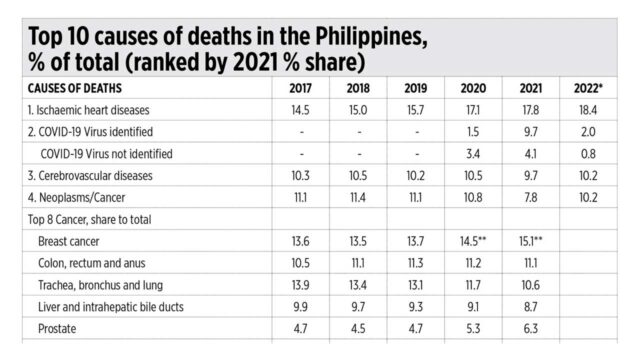
The Philippine Statistics Authority (PSA) released today an update on causes of deaths in the Philippines for the period January-November 2022. I expanded the data backwards until 2017 so six years and saw some interesting trends.

One, COVID deaths, both with identified and unidentified virus, have shrunk greatly, from 13.8% of total deaths in 2021 — when it was the second biggest cause of death next to ischemic heart diseases — to only 2.8% in 2022.

Two, cancer deaths declined significantly, from 11.1% of the total in 2019 to only 7.8% in 2021, then up to 10.2% in 2022.

Three, pneumonia deaths also declined significantly, from 10.1% of the total in 2019 to only 4.2% in 2021 — wow! It was up to 4.8% in 2022.

Four, lower respiratory plus tuberculosis (TB) deaths combined declined from 7.9% in 2019 to only 4.9% in 2021, then up to 6.1% in 2022 (see the Table).

My suspicion is that the number of COVID deaths were exaggerated — by labeling many deaths from regular pneumonia as COVID pneumonia, even labeling deaths from cancer and TB with COVID as COVID deaths — to justify the horrible dictatorial lockdown of 2020-2021, and the huge cost of COVID vaccine procurement plus logistics of about P88.6 billion in 2021, P45 billion in 2022, and P24.5 billion in 2023.

The reporting of COVID cases and deaths were also incentivized via higher PhilHealth subsidies. For instance, PhilHealth reimbursement of the hospital bill of COVID patients was P100,000+ for mild pneumonia, about P330,000 for severe pneumonia, and P780,000 for critical pneumonia. So, patients and their families would worry less about their hospital bills if a non-COVID case was declared as a COVID case.

Now that COVID-related sickness and deaths have significantly declined, it is time to reprioritize the budget for public health. I checked cancer deaths — the PSA has a breakdown until 2021 only, with no update yet for 2022 — but the data shown in the table is already useful. The top three cancer killers are breast, colon/rectum/anus, and trachea/bronchus/lung cancers.

Cancer treatment is very expensive and for many middle-class households, it can be a poverty-inducing exercise to spend their savings to save a loved one. More so for already poor households.

Now there are moves to expand public spending in cancer treatment and subsidies for poor households, like a bill in Congress creating a Cancer Assistance Fund.

I can support this initiative, it is understandable. But Congress should not further expand the Department of Health and PhilHealth budgets while keeping existing exaggerated spending on other concerns, like COVID vaccination which has topped P150 billion already from 2021 to 2023.

Why? Because of the huge annual budget deficit, the huge public debt, which requires huge annual borrowings to pay old borrowings plus huge interest payments.

The average government financing or borrowings were as follows: from only P73 billion/month in 2019, this jumped to P208 billion/month in 2020, P188 billion/month in 2021, P164 billion/month in 2022, and now, P335 billion/month for January-February 2023.

We need to cut high borrowings, cut high spending, while improving revenue collections and tax administration.

So, while Congressional efforts to expand subsidies for cancer treatment for the poor are understandable, Congress should also cut spending somewhere else.


Bienvenido S. Oplas, Jr. is the president of Bienvenido Oplas, Jr. Research Consultancy Services, and Minimal Government Thinkers

minimalgovernment@gmail.com

Blind item

ROCHAK SHUKLA-FREEPIK

IF EVEN traditional journalism doesn’t always quote sources of news stories or opinions for attribution, social media is even less scrupulous about unnamed sources, usually out of the thin threads of their imagination or bias.

Anonymous news sources, while providing even the substance of a story, tend to also increase the level of speculation and slant often to benefit the source or his patron at the expense of balanced reporting.

It can be a battle of posted videos of CCTV footage of a military assault on the home of a local politician being sprayed with bullets with actual people falling off their chairs to their deaths and a solo plea of a suspect making a case for innocence. After such attributable scenarios, the anonymous sources start to chime in.

News sources request anonymity either because they are not supposed to publicly say what they are saying or are likely to have their motives questioned if their identities are revealed. This journalistic device (akin to a witness protection program for accusers) does not specify real persons but “sources,” “witness on the scene,” or “strategically located passengers who saw the first part of the altercation.”

Off-the-record disclosures cover matters too sensitive to be publicly revealed, or still needing further verification. Informal sources, sometimes even when named, may turn out to be unrecognizable anyway, just happening to be on the scene. Such random witnesses can provide angles on the two differing narratives, maybe to even belie what the video is clearly showing.

Some columns, especially on movie personalities whether looking like the “before” in a diet program, or still svelte, are the result of off-the-record, even off-the-cuff, remarks, gleaned from eavesdropping on neighboring tables or trolling anonymous sources.

The “blind item” is a revered tradition in entertainment reporting. The involvement of a TV host in a fuel scam of a company that elected him as chairman or the declaration of ingratitude (they imprisoned me in box office hit movies) by a wannabe Hollywood starlet in Marvel movies attract bashers. These too are mostly anonymous with fictitious aliases.

Blind items have also become accepted fare in corporate gossip. It does not take much guesswork sometimes to identify an individual in the columns if the details are specific enough. Unlike movie personalities who do the rounds of talk shows to press their denials (she only raised her voice but spoke lovingly to the counter clerk using terms of endearment accompanied by cooing sounds), corporate types simply go abroad and hide from interviews.

Demolition jobs are becoming occupational hazards in politics, entertainment, and now business as well. Even unnamed subjects are described with enough details to allow the reader or target to guess correctly without googling the details — the tycoon has a squabbling brood of multiple families jockeying for control of airlines and banks.

It is good then for news subjects to be adept at dodging splatter from brown stuff flying off the fans. They can learn from politicians who draw on a full range of answers: This is clearly politically motivated. These are old charges that are being resurrected. I have already been cleared of this particular allegation. Isn’t this a different woman?

The newest wrinkle in the game of non-attribution is a local innovation, just like mud wrestling and pole dancing. A news source can give an opinion on the need to review airport security after the incident with a noisy Thai national, what with the lack of functioning CCTV in a particular terminal. It is possible to be cited for saying this, and still be technically off the record because the opinion is expressed in private, intended only for friends having a drink. (I didn’t realize there were reporters around.) Such personal pronouncements can still take on an official tone when reported, even only as a blind item.

The line between statements for attribution and opinions that are off the record blur in our media-heavy environment boosted by social media. Every personality and issue are fair game to be exposed and discussed, and all public behavior is reported immediately in the social media of blogs and tweets.

No one is accountable for spreading even fake news… if this is a blind item.


Tony Samson is chairman and CEO of TOUCH xda

ar.samson@yahoo.com

Puregold’s new digital series ‘Ang Lalaki Sa Likod Ng Profile’ drops much-awaited trailer

TikTok star Yukii Takahashi takes on the leading role of Angge in 'Ang Lalaki sa Likod ng Profile.'

Laughter and young romance await viewers of Puregold Channel’s upcoming series, Ang Lalaki sa Likod ng Profile, but fans get first dibs at the 13-episode series through its trailer that’s currently showing on the official Puregold Channel. 

With Wilbert Ross and Yukii Takahashi in the lead roles and the creative tandem of Victor Villanueva and Chris Cahilig at the helm, excited romcom lovers can expect serendipitous plot twists in Ang Lalaki sa Likod ng Profile.

Wilbert Ross brings his many talents to the starring role in ‘Ang Lalaki sa Likod nf Profile.’

Puregold Channel’s newest digital offering features film and TV star Wilbert Ross in his first leading role in a series. “Napaka-exciting ng opportunity na ito,” he gushes. “Feel ko matatawa at kikiligin ang lahat ng mga fans ko! At maraming makaka-relate dito!

Playing Ross’ romantic partner is TikTok star Yukii Takahashi, who can’t wait to showcase her prodigous talents to her more than 8.5 million followers. “Sana manood kayo ng bagong series namin sa Puregold Channel!” she entices them. “May romance, may comedy, ang saya niya!”

The trailer shows Bryce (Wilbert Ross) who chances upon Angge (Yukii Takahashi) in a dating app after a blind date goes south. For a time, Angge (Yukii Takahashi) becomes his online wingman but the duo soon takes a detour into ‘uncharted territory’. Totally relatable are the comedic, kilig-worthy situations that ensue as Bryce and Angge sense a strong chemistry between them.

The trailer can be watched on the Puregold Channel at https://www.youtube.com/watch?v=gkvZWFhoUX8. Follow Ang Lalaki sa Likod ng Profile which opens on April 22, 2023.

For more updates, like @puregold.shopping on Facebook, follow @puregold_ph on Instagram and Twitter, and subscribe to Puregold Channel on YouTube.


Spotlight is BusinessWorld’s sponsored section that allows advertisers to amplify their brand and connect with BusinessWorld’s audience by enabling them to publish their stories directly on the BusinessWorld Web site. For more information, send an email to online@bworldonline.com.

Join us on Viber at https://bit.ly/3hv6bLA to get more updates and subscribe to BusinessWorld’s titles and get exclusive content through www.bworld-x.com.

Filipinas advance to next round of Olympic qualifying tourney

PFF

THE FILIPINAS sealed their entry into the second round of the AFC Women’s Olympic Qualifying Tournament with a smashing 4-0 shutout of Hong Kong Tuesday in Hisor, Tajikistan.

Sarina Bolden netted twice in the first 41 minutes then Meryll Serrano and Quinley Quezada joined the scoring fray as the Philippines completed a three-game sweep of Group E without conceding a goal to advance. They previously blanked Pakistan (4-0) and host Tajikistan (8-0).

The Filipinas now join fellow group winners Uzbekistan (Group A), Iran (Group B), Vietnam (Group C), Thailand (Group D), Chinese Taipei (Group F) and India (Group G) in Round 2 along with seeded squads North Korea, Japan, Australia, China and South Korea Republic.

The next stage will see the teams divided into three groups with the three group winners and the best second-placed side then moving forward to the third and final round. Two pairs of home-and-away matches will be played in Round 3 with the two victors punching a ticket to Paris 2024.

“I thought we played well. We controlled the game well; probably our best control we’ve had this week here against a good opposition, an opposition 15 months ago we beat only 2-1 in the last minute,” said coach Alen Stajcic who also reached a milestone in coaching the 100th international match of his career.

“It just shows how much we’ve improved. A large part of the game was pretty good, but our finishing has to be better if we want to compete with the big nations in Asia. We’ve improved a lot but there’s still a lot of hard work to do,” he added.

Ms. Bolden, working in tandem with Katrina Guillou, drew first blood just five minutes into the match after a cool finish off a fine run from the half-line.

The Fil-Am striker found the back of the net again 36 minutes later, this time finishing a lofted ball from Sara Eggesvik.

Ms. Serrano added a third for the Philippines in the 44th via free-kick from 30 yards out before Ms. Quezada made it a four-goal margin eight minutes after restart and capped scoring. — Olmin Leyba

Malacañang leads meeting for 2023 FIBA World Cup hosting

DEPUTY Senior Executive Secretary Hubert Guevara (2nd from left) and Executive Secretary Lucas Bersamin (middle) join the PSC Board headed by chairman Richard Bachmann (3rd from left) in an Inter-Agency Task Force meeting for the FIBA Basketball World Cup 2023 hosting held on Wednesday, April 12 at the Malacañang Conference Room in Manila

PRESIDENT Ferdinand “Bongbong” Marcos Jr. extended his support to the hosting of FIBA Basketball World Cup (FBWC) 2023 and the Philippine Sports Commission (PSC)-led Task Force by calling a meeting Wednesday, April 12 at the Malacañang Conference Room in Manila.

“This administration is committed to providing the Inter-Agency Task Force with all the necessary support and assistance it needs in order to fully achieve its objectives and to secure the safe, orderly, and successful conduct of the tournament,” said Senior Deputy Executive Secretary Hubert Guevara who represented PBBM in the meeting.

Mr. Guevara encouraged all those involved to work together for a successful FBWC staging, saying, “Let us all take this endeavor both as an opportunity and as a challenge — an opportunity to showcase what the Philippines has to offer and a challenge to make the FIBA Basketball World Cup a great experience for athletes and fans alike.”

PSC and Inter-Agency Task Force Chairman Richard Bachmann arranged the FBWC gathering attended by the Office of the Executive Secretary, leaders and representatives of various government agencies, FBWC Committee, and PSC Commissioners Olivia “Bong” Coo, Matthew “Fritz” Gaston, Walter Francis Torres and Edward Hayco.

“Today, we move one step closer to fulfilling our goal of bringing the best World Cup hosting in the history of FIBA Basketball,” said Mr. Bachmann.

“I also thank our national government for Administrative Order No. 5 issued by Malacañang last March 27th directing all government agencies and instrumentalities to extend their support for this hosting.”

Mr. Bachmann also expressed optimism in the hosting of the prestigious basketball event while assuring everyone that, “all timelines, concerns and deliverables expected from each of us here will be met, as we, at the PSC, continue to work hand-in-hand with the SBP and other vital agencies. Our Team Pilipinas needs the team within us.”

On Aug. 25-30 this year, the group phase of the competition will be hosted simultaneously by the Philippines, Japan, and Indonesia. The final phase is slated Sept. 5-10.

PATAFA targets to surpass 2019 SEAG medal haul in Phnom Penh, Cambodia

EJ OBIENA — REUTERS

HOPEFUL. This will be the general feeling of the Philippine track and field team spearheaded by World Championships pole vault bronze medalist EJ Obiena waging war in next month’s Phnom Penh Southeast Asian Games (SEAG).

Mr. Obiena was the biggest name among the 52-strong roster recently released by Philippine Athletics Track and Field Association executive director and secretary-general Edward Kho.

It also included 2022 Hanoi SEA Games gold winners Eric Cray (400m hurldes), Clinton Bautista (110m hurdles), William Morrison III (shot put) and Kayla Richardson (100m).

Other notable athletes in the squad were past SEA Games gold medalists Melvin Calano (javelin), Aries Toledo (decathlon), Kristina Knott (200m), Christine Hallasgo (marathon), Natalie Uy (pole vault), Sara Dequinan (heptathlon) and Anfernee  Lopena (mixed relay).

Several exciting Fil-Heritage athletes headed by Umajesty Williams, who will try to prove his worth in the 200m and 400m and relays, and John Cabang Tolentino, who will see action in the 110m hurdles and the relays.

Also in the roster but have yet to secure their Philippine passports were Angel Frank, Danae Manibog and Lauren Hoffman, who are all racing in the 400m and the relays.

With a loaded team, the country is aiming to surpass its five-gold, seven-silver and 14-bronze haul in Hanoi as well as the 11-8-8 harvest in 2019 edition of biennial event at the New Clark City in Capas, Tarlac.

Hope does springs eternal. — Joey Villar

Lakers slip past T-Wolves in OT, grab West’s No. 7

LEBRON James registered 30 points, 10 rebounds and six assists and the Los Angeles Lakers clinched a Western Conference playoff spot with a 108-102 overtime (OT) victory over the visiting Minnesota Timberwolves on Tuesday in a play-in game.

Anthony Davis added 24 points and 15 rebounds for the Lakers, who earned the No. 7 seed in the West with the victory. Dennis Schroder added 21 points for Los Angeles, which will face the second-seeded Memphis Grizzlies in the first round.

Karl-Anthony Towns recorded 24 points, 11 rebounds and five assists and Mike Conley made six 3-pointers while scoring 23 points for the Timberwolves. Anthony Edwards had just nine points on three-of-17 shooting for Minnesota.

The Timberwolves will receive another opportunity to claim a playoff spot on Friday when they host the New Orleans Pelicans or the Oklahoma City Thunder (who play one another in a play-in game Wednesday).

Minnesota played without Rudy Gobert, who was suspended for the contest after punching teammate Kyle Anderson during a timeout in Sunday’s game against the Pelicans.

Mr. Schroder buried a corner 3-pointer with 1.4 seconds left in regulation to give the Lakers a 98-95 lead. However, Mr. Davis fouled Mr. Conley while the Minnesota guard was shooting a 3-pointer with 0.1 seconds to play. Mr. Conley got a couple fortunate bounces to make the first free throw, then swished the second and third shots to knot the score at 98 and send the game into overtime.

Rui Hachimura opened the extra session with a 3-pointer and Mr. Schroder added a layup to put Los Angeles up by five. Minnesota later had a chance to tie the score after Mr. Conley intercepted a James pass. The ball eventually made it to Taurean Prince, whose 3-point try bounced off the rim with 12 seconds left.

Mr. Schroder sank two free throws with 8.4 seconds left to make it 107-102, and the Lakers closed it out.

Mr. Prince scored 14 points and Mr. Anderson had 12 points, 13 assists, five rebounds, four steals and four blocked shots for the Timberwolves, who committed 24 turnovers.

Mr. Hachimura and Austin Reaves each added 12 points for Los Angeles, which hit 41.3 percent of its shots, including 10 of 31 (32.3 percent) from behind the arc. The Lakers gave the ball away 21 times.

The Timberwolves made 43.4 percent of their field-goal attempts and were 16 of 41 (39 percent) from 3-point range.

Minnesota led by seven with 6:01 left in regulation but didn’t score again for six minutes. The Lakers put up the next 10 points. Mr. James tied it at 95 with a 3-pointer with 2:02 remaining before Mr. Schroder drained the go-ahead shot prior to Mr. Conley’s tying free throws.

Mr. Towns scored 17 points and the Timberwolves led 60-49 at the break. Mr. James had 16 in the half for the Lakers. Minnesota opened up a 76-61 lead midway through the third quarter, but the Lakers rallied to trail 86-79 entering the final period. — Reuters

Man City thrash Bayern 3-0 as Haaland reaches another milestone

MANCHESTER, England — Rodri struck a wonder goal and Erling Haaland set another scoring record as Manchester City beat Bayern Munich 3-0 on Tuesday to continue their quest for a first-ever Champions League title in their quarterfinal first leg.

Mr. Haaland, who scored City’s third goal of the night in the 76th minute, has 45 goals in all competitions, a single-season record for a Premier League player, moving ahead of Mo Salah and Ruud van Nistelrooy.

Rodri put Pep Guardiola’s team ahead in the 27th minute, cutting the ball back to beat midfielder Jamal Musiala and curling a blistering long-range shot into the top left corner beyond the outstretched hand of Yann Sommer.

“I know that this Bayern team is special,” said Guardiola, who managed Bayern from 2013-16. “We got a good result, but we need two strong games. Anything can happen at Allianz Arena. I know that because I was at Bayern for three years.”

Rodri celebrated with a long knee slide on the rain-soaked turf at the Etihad, while Bayern’s new manager Thomas Tuchel threw up his hands in disgust en route to his team’s biggest defeat in the Champions League since a 3-0 loss to Paris St Germain in 2017.

“It was very special for me to score my first goal in the Champions League. At that moment we were struggling because they are a great, great team,” Rodri told BT Sport.

“Sometimes we understand we cannot have 80% possession. They play too. We scored three and could score four but it is a great result.”

What had been an evenly matched game turned thoroughly in City’s favour midway through the second half, and Bernardo Silva scored their second in the 70th minute, heading in a cross from Mr. Haaland. The Norwegian got a goal of his own six minutes later, striking from close range.

“This never happens to Bayern Munich but credit to Manchester City, they were brilliant in both boxes,” former Bayern player Owen Hargreaves said on BT Sport. “Pep had a game plan and it worked beautifully.”

Mr. Sommer had a busy night and was pressed into action early, almost gifting Mr. Haaland a goal in the 14th minute. Taking too long to clear the ball, the striker bulldozed in and got his foot on the ball two yards from the net, but it flew wide.

City midfielder Ilkay Gundogan had a brilliant chance in the 34th minute, but Mr. Sommer, who was on the ground, stuck a leg out to save what looked like a certain goal.

Ruben Dias’ flick in the second half looked bound for the net, but Mr. Sommer tipped it over the crossbar. However, he was helpless to stop Mr. Silva and then Mr. Haaland from completing the win.

Mr. Guardiola faced a familiar foe in Mr. Tuchel, who was Chelsea manager when they triumphed over City in the final in 2021. The Spaniard has won four Premier League titles, one FA Cup and four League Cups at City but European success has eluded the manager who won the trophy twice when in charge of Barcelona.  His confidence will be high that he can end that drought ahead of the second leg, which takes place on April 19 at Munich’s Allianz Arena. — Reuters