Home Blog Page 4882

LTO’s Tugade says departure will give Transport department ‘free hand’ in running agency

ASSISTANT Transport Secretary Jose Arturo M. Tugade said his departure from the Land Transportation Office (LTO) was the result of a conflicting ideas on how to run the office with the Department of Transportation (DoTr), its parent agency.

“For this reason, I am stepping down so Secretary Jaime J. Bautista will have the free hand to choose who he can work best with,” Mr. Tugade said in a statement.

“Even as the Department of Transportation (DoTr) and LTO both aim to succeed in serving the public, our methods to achieve that success differ,” Mr. Tugade said.

Mr. Tugade did not elaborate on his differences with the DoTr.

The resignation takes effect on June 1.

Mr. Tugade took office on Nov. 17, 2022. He is the son of the former Transport Secretary, Arthur P. Tugade.

“I will continue to root for the LTO’s success even as a private citizen, because I will always share in Secretary Bautista’s belief that our offices can be a formidable force for good in our country,” he said.

In a separate statement, Mr. Bautista said that the DoTr will recommend to the Office of the President a new official to head the LTO.

“We extend our appreciation to Assistant Secretary Tugade for his seven-month stint as Assistant Secretary of the LTO,” Mr. Bautista said.

“His pursuit of service innovations at LTO benefited the public, for which this office is grateful,” he said.

During his term, Mr. Tugade introduced electronic systems, online renewal options, a cap on driving school rates, incentives for electric vehicle users, and a three-year validity period for registering motorcycles with engine displacements of 200 cubic centimeters and below.

Late Monday, the Palace announced in a statement the appointment of Roque I. Verzosa III as regional director of the LTO-National Capital Region (NCR).

The appointment signals the merger of LTO’s the two NCR offices, the Palace said.

“With the appointment of Mr. Verzosa, the LTO-NCR East and the LTO-NCR West are now merged into one regional office, which shall be composed of at least 65 field district offices, extension offices, licensing centers, including those located at malls, and other similar offices,” the Palace said.

Before the appointment, Mr. Verzosa had served as officer-in-charge regional director of LTO-NCR-West starting October 2022. He also held the position of assistant regional director of LTO-NCR-West. — Justine Irish D. Tabile

Miners facing scrutiny over type of energy used

MINING COMPANIES are increasingly being evaluated by their buyers over the type of energy they use in their operations, an industry official said.

“A new ethic in doing business, particularly in the mining industry, is now emerging worldwide,” Offshore Mining Chamber of the Philippines, Inc. Chairman Michael Raymond A. Aragon said in a statement.

Mr. Aragon said that miners are now being required to disclose to their buyers the types of energy they use.

“If the energy source used for mining is not clean or green then most buyers will refuse the miner’s business,” he said.

“We welcome this new emerging norm in doing business transactions internationally especially in the mining industry… we all have to act on the urgent need to fight the global climate emergency that threatens humanity with species extinction if not abated soon,” he added.

Michael L. Ricafort, chief economist from the Rizal Commercial Banking Corp., said demand for clean energy in supply chains is largely driven by companies who are being rated on their performance on environmental, social, and governance (ESG) criteria.

He said ESG drives many companies to “further reduce, if not eliminate, carbon emissions/footprint in the coming years” with the encouragement of institutional investors and regulators.

“This encourages the shift towards more renewable and sustainable power/energy and other business practices as the cost of renewable power such as wind, solar, hydro, among others has decreased in recent years,” he said in a Viber message.

However, Mr. Ricafort said some miners in the Philippines remain constrained due to the lack of access to renewable power.

“One of the challenges includes the need to bring in/roll out more renewable power capacity in the country and reduce dependence on non-renewable power sources such as coal and other petroleum-based energy/hydrocarbons,” he said.

The Department of Energy estimates that renewable energy (RE) capacity increased 4% to 8,255 megawatts in 2022.

RE currently accounts for 29% of the energy mix, with a target to expand to 35% by 2030 and 50% by 2040. — Sheldeen Joy Talavera

Labor sector pushes back against proposal to restructure Duty Free PHL

DUTY FREE PHILIPPINES

By John Victor D. Ordoñez, Reporter

A RETRENCHMENT PLAN for Duty Free Philippines Corp. (DFPC) runs counter to a government pledge to raise employment in the tourism industry over the next five years, a labor group said.

“The Federation of Free Workers (FFW) is committed to supporting initiatives to generate jobs from tourism,” FFW President Jose G. Matula said in a Viber message.

“To protect jobs in the industry, FFW urgently calls on the government to halt the ongoing downsizing plan and worker retrenchment within DFPC.”

In March, DFPC released the implementing rules and regulations for its rightsizing plan, which the FFW said could lead to the retrenchment of over 700 rank-and-file employees.

The retrenchment plan is authorized by Republic Act 10149 or the Government-Owned and -Controlled Corporation Governance Act of 2011.

DFPC had not replied to a request for comment at the deadline.

Mr. Matula said the government should ensure security of tenure for government employees in the tourism industry.

“The government should avoid any unnecessary terminations and explore alternative measures such as retention, redeployment, and performance evaluations to ensure the workforce remains intact and productive,” he said.

The Department of Tourism (DoT) hopes to generate 34.7 million tourism-related jobs and take in 51.9 million international arrivals by 2028, according to the recently approved National Tourism Development Plan.

Last week, President Ferdinand R. Marcos, Jr. approved the plan, which aims to establish a tourism industry “anchored on Filipino culture, heritage and identity which aims to be sustainable, resilient and competitive in order to transform the country as a tourism powerhouse.”

Jose Enrique A. Africa, executive director of the think tank IBON Foundation, said the government should also consider workers’ rights as well as tourism’s impact on the environment and local communities.

“We’d also be concerned about the obsession with metrics for tourism success like investment, revenue and visitors yet heedless of the economic rights of workers in the industry,” he said in a Viber message.

“An industrialized economy is the only real and sustainable source of economic dynamism and strength for the Philippines.”

The government should look to the modernization of agriculture and industrialization in fostering development and job creation, Mr. Africa added.

This year, the DoT aims to attract 4.8 million international tourists and set a revenue target of P316 billion from foreign tourist spending. The revenue goal for domestic tourist spending is P1.93 trillion.

The Philippines has logged 2.029 million international visitors and P168.5 billion in visitor receipts in the four months to April, according to the Tourism department.

House approves measure calling for 30-year infrastructure program plan on third reading

PHILIPPINE STAR/ MICHAEL VARCAS

THE House of Representatives approved on third reading a bill seeking to adopt a 30-year National Infrastructure Program (NIP).

At Monday’s plenary session, 254 legislators voted to approve House Bill No. 8078, with three voting against and zero abstentions.

The infrastructure plan aims to achieve “the overall long-term development vision for the Philippines by the middle of the century as a prosperous, predominantly middle-class society,” according to the bill.

The bill proposed to focus infrastructure efforts on transportation, energy, water resources, information and communications technology, agri-fisheries modernization and food logistics, and social infrastructure.

The NIP will be funded by the national budget, public-private partnership (PPP) arrangements, including hybrid PPPs, or local government units, or a combination of these sources.

The measure set a goal of developing a national transport system that is safe, efficient, economical, accessible, affordable, environmentally sustainable, user-oriented, integrated, and seamless. It also seeks to address the “fragmented” nature of water resources management.

The bill set objectives for a digital infrastructure network that ensures internet access to unserved and underserved areas, and to provide schools with facilities for online or distance learning.

“Massive infrastructure spending has been a consistent feature of previous and current administrations, (which see it) as key driver of economic growth and a generator of job opportunities. However, we have seen how this policy thrust has barely translated to meaningful transformative changes in the Philippine economy, especially on the quality of life,” Assistant Minority Leader and Gabriela Party-list Representative Arlene D. Brosas, one of the legislators voting against the measure, said.

She added that the NIP “will lock in public resources towards projects that will primarily benefit foreign investors, exporters of steel and cement and local partners for a long period of time.”

She said that resources should be focused on producing capital goods and achieving genuine agrarian reform. — Beatriz Marie D. Cruz

Nuclear planners should prepare for plant life cycles of up to 100 years — PIDS 

DOOSAN HEAVY INDUSTRIES

THE PHILIPPINES must be prepared for some of the little-discussed aspects of operating nuclear power plants, including a plan life cycle of as long as 100 years, a government think tank said.

“Should the Philippines commit to a nuclear energy program, it must be prepared for a period of 100 years from construction to decommissioning,” Adoracion M. Navarro, senior research fellow at the Philippine Institute for Development Studies (PIDS), said in a statement.

At a webinar organized by PIDS, Ms. Navarro said the government must look into all the ramifications of adopting nuclear power.

“The Philippines is not letting go of its nuclear power ambitions; that is why we need to seriously consider the implications,” she said.

According to Ms. Navarro, the positive side of the nuclear power equation includes “reliability and how it can help the country’s climate targets given nuclear power’s zero carbon emissions.”

She said issues that need to be addressed include safety, waste disposal, and the cost of complying with rigorous international rules governing nuclear power.

Ms. Navarro recommends that the government conduct a comprehensive assessment of a nuclear power plant’s disaster risks and establish clear protocols for construction, decommissioning, and waste disposal and storage.

The Philippine Nuclear Research Institute has said that the government is considering small modular reactors in Occidental Mindoro and Palawan.

“It is the DoE (Department of Energy) that knows the suitable locations for SMRs, if SMRs are pursued. For big nuclear power plants our option is to revive BNPP or build a new one beside it because there is space for another reactor. The original plan for BNPP is to have two reactors. It depends on the decision of policymakers and willingness of private investors,” Ms. Navarro said.

At the webinar, Anne Estorco Montelibano, president of Philippine Independent Power Producers Association, said a policy and regulatory framework should be established to assess the feasibility of nuclear power.

“It needs a strong framework both on the policy and regulatory side. As investors, as generators, we would like to see what direction it is headed before actually trying to evaluate feasibility. As regards SMRs, the technology is expensive without the proper framework and we don’t want to pre-empt anything. This is a technology that we have to be very careful with,” Ms. Montelibano said.

Kris A. Francisco, a research fellow at PIDS said that the government should also ensure climate-proofing the power infrastructure surrounding any plant, which she called a significant investment that needs to be planned for. — Ashley Erika O. Jose

House approves land use, town specialization bills on third reading

PHILSTAR FILE PHOTO

THE House of Representatives passed on third reading measures that optimize land use and encourage municipalities to consider product specialization.

At Monday’s plenary session, 262 legislators voted in favor of House Bill (HB) No. 8162, while three voted against and zero abstained.

The proposed National Land Use Act seeks to help local governments and land users identify the best use of land.

The measure proposes to create the National Land Use Commission (NLUC) under the office of the President. It will be authorized to resolve land use conflicts between and among agencies, branches, or levels of government. The NLUC will take over the powers of the National Land Use Committee, which will be abolished.

The NLUC is tasked with drafting the National Physical Framework Plan, which will have a 30-year timeline and must be updated every 10 years.

The bill calls for a 5% idle land tax on any person or entity that causes irrigated land to remain unproductive for more than a year. If the land remains unproductive for two years, it will revert to the State.

Meanwhile, 268 legislators also approved on third reading HB 1171, which seeks to institutionalize the Trade and Industry department’s One Town, One Product (OTOP) Philippines program. No legislator voted in opposition or abstained.

The OTOP program was first launched in 2004, and has since been extended to micro, small, and medium enterprises.

The measure seeks to ensure that OTOP production follows standards set by the Department of Trade and Industry, including brand development.

The Senate approved a similar bill in March. — Beatriz Marie D. Cruz

A taxpayer’s right to receive notice of assessment

In one of the episodes of Suits when Mike Ross was being tried for fraud, for impersonating a lawyer, Donna Paulsen was questioned by Anita Gibbs. When asked if she knew whether Mike went to Harvard Law School, this question caught her off guard and prompted her to invoke the Fifth Amendment. While watching this episode, I was amazed that even on TV shows, the characters know their rights. It’s hard not to make comparisons to taxpayers in terms of understanding rights. In tax assessment cases, many taxpayers may be unaware of their basic rights. As such, this article will briefly discuss one of the substantive requirements in assessment cases The Notice of Informal Conference (NIC) or Notice of Discrepancy (NoD).

WHAT IS NIC?
As a rule, the BIR has 240 days (for large taxpayers) and 180 days (for taxpayers registered with Revenue District Offices) from the date of issuance of the electronic Letter of Authority (LoA) to complete the examination of the taxpayer’s books of account and other accounting records.

After the examination is completed, the BIR issues the NIC to the taxpayer. It is a written notice issued to the taxpayer that informs him of the details of the initial tax findings made by the authorized Revenue Officers of the BIR. The taxpayer is given 15 days to submit explanations for the tax findings and supporting documents.

The issuance of the NIC is part of the due process requirement in the issuance of a deficiency tax assessment, as outlined by Revenue Regulations (RR) No. 12-99 to implement the provisions of the National Internal Revenue Code of 1997 (Tax Code), as amended.

WHAT IS NOD?
However, in RR No. 18-13, the NIC was removed from the due process requirement to expedite the assessment process and prevent corruption by limiting interaction between the taxpayer and the revenue case officers. Recognizing that the NIC is an integral part of the due process, the BIR reinstated the NIC at the beginning of 2018 through RR No. 7-2018. Further amendment by RR No. 22-2020 renamed the NIC to NoD.

The discussion of the NoD should not exceed 30 days from the taxpayer’s receipt of the notice. During the discussion, the taxpayer is given the opportunity to present its side of the case, explain any discrepancies found during the investigation of the Revenue Officers, and submit supporting documents explaining its arguments.

ABSENCE OF NIC VIOLATES RIGHT TO DUE PROCESS
In Court of Tax Appeals (CTA) En Banc (EB) Case No. 2229, dated March 27, 2023, the CTA had the opportunity to rule on the importance of the NIC. In that case, the tax authorities contested the Court’s decision to cancel deficiency tax assessments for the taxable year 2008, on the grounds that the taxpayer’s right to due process had been violated. The tax authorities argued that the assessment notices and even the Final Decision of Disputed Assessment (FDDA) issued to the taxpayer were properly served to the taxpayer’s registered addressed and authorized persons, contrary to the taxpayer’s claim. The Court agreed with the argument of the tax authorities that the assessment notices and FDDA were properly served. However, the Court noted that an NIC was not issued prior to the issuance of the assessment notices and FDDA, resulting in a violation of due process.

Considering the importance of the NIC/NoD, the Court emphasized the mandatory and corresponding due process requirement in the issuance of a deficiency tax assessment. In the aforementioned case, the CTA ruled in favor of the taxpayer by reaffirming its decision, prohibiting the collection of assessed deficiency tax by the tax authorities against the taxpayer for violation of the right to due process. In the case at bar, the tax authorities did not issue an NIC but issued a Post Reporting Notice (PRN).

The tax authorities contend that there is no violation of due process since the PRN and the NIC serve the same purpose of informing the taxpayer of deficiency taxes and providing an opportunity to explain its side before the issuance of the Preliminary Assessment Notice. However, the Court rejected the tax authorities’ arguments and explained that the issuance of the NIC has been recognized as part of the due process requirement from the time of the 1977 Tax Code. The implementing regulation of the 1977 Tax Code, RR No. 12-1985, states that the BIR must send the taxpayer an NIC. This requirement was retained in RR No. 12-99 when the Tax Code of 1977 was amended by the Tax Code of 1997, as amended. Although the issuance of RR No. 18-2013 removed this requirement, it was later reinstated by RR No. 7-2018. Furthermore, at the time the PRN was issued, the governing regulation was RR No. 12-99, and there was no indication that an NIC was issued by the tax authorities. The Court was not convinced by the tax authorities’ argument that the PRN issued to the taxpayer served as the NIC required under RR No. 12-99 because the PRN did not include an invitation to schedule a conference or discussion between the tax authorities and the taxpayer.

In a similar vein, the Supreme Court ruled in G.R. No. 172598 that a taxpayer is deprived of due process when the tax authorities fail to issue an NIC as required by RR No. 12-99.

Based on the above rulings, it is clear that the NIC, now NoD, is an integral part of due process. An assessment case is considered void if the taxpayer’s due process rights are violated. When it comes to the power of the State to tax versus an individual’s right to due process, the scale favors the taxpayer’s right to due process. As taxpayers, it is crucial that we are aware of our basic rights and equipped with knowledge so that we are not deprived of our rights and placed at a significant disadvantage in tax assessment cases.

Luckily for Donna, she knew her rights. Let us be reminded that we should know ours too.

Let’s Talk Tax is a weekly newspaper column of P&A Grant Thornton that aims to keep the public informed of various developments in taxation. This article is not intended to be a substitute for competent professional advice.


Lorenzo Miguel A. Soriano is a senior in charge from the Tax Advisory & Compliance division of P&A Grant Thornton, the Philippine member firm of Grant Thornton International Ltd.

pagrantthornton@ph.gt.com

The Procurement law needs a quick review

VECTORJUICE-FREEPIK

As we go around different Shared Service Facilities (SSF) given as grants to communities around the country, our hearts are full just knowing that the poorest of the poor do get government assistance. What we lament, though, is the fact that the procurement laws of government lack evaluation and must be reviewed soon.

First, with the rise of new technology and the rate of obsolescence being so fast, we must go back to the drawing board, so to speak.

Second, it truly is a waste of precious resources only because present day laws no longer address the need it was made for. For example, the admonition to “Buy Local” may be good for fresh food, but is it the same for modern equipment? Do we have the engineering capability and after-sales service that China or Vietnam, for example, can provide?

COFFEE EQUIPMENT
Vietnam and China have become coffee giants, surpassing old producers like Indonesia and even the Philippines. Yes, China produces more coffee than we do. Because of its high volume of production, Vietnam is now also already a manufacturer of coffee processing equipment which is affordable and easily imported into our country. Why do we then still attempt to manufacture such equipment locally when we can import it from Vietnam?

Vietnam is the No. 1 producer of Robusta, and No. 2 in volume next only to Brazil (still the biggest producer of coffee). It got to those positions because it has the right equipment. The Vietnamese government also focused on coffee production and gave support to farmers in Da Lat and Buon Ma Thot in 1975 after the war ended. These farmers, who were only in their 20s then, started coffee plantations and are now the proud owners of coffee companies, passing on their success to the next generation. Vietnam has drilled down the design of the processing equipment to an exact science, and we can import the equipment under the ASEAN Free Trade Agreement (AFTA). Why do we still attempt to produce a handful of this equipment, without economies of scale? Could it be the Procurement Law which requires buying local? Please tell me.

Second, we have equipment that is given to communities so they can also roast their own coffee, adding value to the crop, and allowing farmers to sell their produce as roasted coffee beans. Again, the equipment is made locally — a poor imitation of the German or Turkish kind of coffee roaster. The farmers we talked to say the roaster takes two hours to process a batch using electricity, which we know is costly. So, they are better off with a wood-fired roaster that they just made in the backyard. It’s not perfect but it works for them, right now. China, however, sells roasters on Alibaba.com for cheap. You order online and it gets to your door almost in no time. Why are we manufacturing coffee roasters? And poor copies of the real deal at that, and inefficient to use.

The last 10 to 15 years have been phenomenal in the regional coffee industry because of the advent of China’s manufactured roasting equipment and Vietnam’s processing equipment. These two countries manufacture in scale and have after-sales service through the internet, with chat features and online manuals. But I dare you to go around our coffee areas and what you will see are poor imitations of imported processing equipment. Is it the mistake of the agencies giving them away, or the Procurement Law needing review? Much as we would like to buy local, we need to check with industry if cheaper, more efficient imported versions or models are now available.

Every day we find another piece of equipment going obsolete. With advances in technology, coffee is not the only industry needing review. It could be done also for other crops, like cacao, corn, and rice to name a few. I once visited a facility in the Visayas where a grinder was called “all in one.” It could mill rice, corn, coffee, and most grains. Instead of being impressed, I got worried. This is equipment that will not be used well because it is trying to be “everything to everyone.” How can cacao and coffee be processed in the same machine? But this equipment was bought and passed the procurement standards!

With all due respect to our administrators, it is high time we looked at our Procurement laws and checked the scientific and logical reasons on why instead of imported equipment we rather make a makeshift version only to comply with our antiquated bidding procedures. It is sad that our beautiful produce, like coffee, becomes bad only because of using the wrong equipment, or, due to lack of a better choice, farmers have to make do and end up with poor results.

REINVENTING THE WHEEL
I also have been exposed to an agency that does research on equipment and they showed me two “inventions”: a solar tunnel dryer and a coffee moisture meter. These did not have to be “reinvented” by a government agency. These two items, both used to make production of agricultural products better and more efficient, have already been invented and manufactured at scale by India, China, and Vietnam. Why are we reinventing it?

The solar tunnel dryer is now given to communities whether they have the minimum production required or not. So small producers and medium-scale producers get the same model. Some find it too big for their needs, others find it too small for theirs. It is not “one size fits all” but that is the model so far invented. There are other models of these solar dryers already existing if one looks online.

A coffee or grain moisture meter, now manufactured at scale by India from UK standards, is affordable for many farmers. But this agency attempted to again invent a model similar, but of course more expensive, than that from India. Why do they reinvent something already in the market?

Now, you ask me why our Agriculture is not improving? Have we looked at the whole value chain? It is not the lack of farmers. It is the big stumbling block called procurement that prevents our farmers from being more efficient and profitable. Maybe we ought to have a look at the Procurement Law and check what we need to amend.


Chit U. Juan is the co-vice-chair of the Management Association Environment Committee. She is president of NextGen Organization of Women Corporate Directors (NOWCD), and founder of ECHOstore Sustainable Lifestyle. She is a member of the global Slow Food community promoting good, clean, and fair food.

map@map.org.ph

pujuan29@gmail.com

The tenuous grand alliance breaks up

WIRESTOCVK-FREEPIK

The demotion of Senior Deputy Speaker Gloria Macapagal Arroyo to Deputy Speaker last Wednesday drew both formal statements and casual comments from the parties involved. Many are contradictory, some cryptic, and others incongruous. Here are my musings on those statements and on the implications of the originally trivial matter of the unceremonious demotion from a ceremonial position turned into an event of national import.

The initial reaction of the person at the center of the maelstrom, Ms. Macapagal Arroyo, was, “It’s the prerogative of the House.” Subsequently, she issued this lengthy statement: “When I learned that there were reports that I was suspected of plotting a ‘coup’ against Speaker Romualdez, I decided I must speak out to clarify my political position. Indeed, some of my actions may have been misconstrued, such as my recent trip with a delegation of Congressmen to Korea for some official meetings.

“To be clear, my political objectives are three: First, to represent the 2nd district of Pampanga. Second, to support the legislative agenda of Speaker Romualdez and President Marcos. Third, to use whatever experience I have as a former President to help out when I am called upon to do so.

“Outside of my role as Congresswoman, my public interest going forward is to help reduce tensions between the United States and China, given that I was strongly allied to both countries when I was President. This time, I am a mere Congresswoman, so issues of national importance no longer depend on my role in Congress. Thus, I have no compelling reasons to change my mind about foregoing my ambitions for the Speakership.”

If she thought that she was suspected of plotting a coup because of her actions, I think she should have explained those actions, particularly that recent trip with a delegation of congressmen to Korea. Apparently, House Speaker Ferdinand Martin Romualdez was not in on that official meeting of congressmen in Korea, otherwise it would not have caused suspicion of a sinister scheme. But Ms. Macapagal Arroyo did not say what it was all about to allay negative impressions.

She also said that now that she is a mere congresswoman, issues of national importance no longer depend on her role in Congress. If so, why did she join President Ferdinand “Bongbong” Marcos, Jr. on all his foreign trips, including that one to Davos?

Reacting to the demotion of Ms. Macapagal Arroyo to Deputy Speaker, President Marcos Jr. said, “I really see it as just a run of the mill [thing] that they do in the House. I think we should also be careful to not read too much into it.” The President himself reacting to a “run-of-the-mill” thing done in the House and cautioning people from reading too much into it just gave the matter some significance.

The day after Ms. Macapagal Arroyo was demoted to Deputy Speaker, Vice-President Sara Duterte resigned from the Lakas-Christian Muslim Democrats (Lakas-CMD) party, which helped her get elected to her present position. She declared: “I am here today because of the trust of the Filipino people in me to lead and serve them and the country, and this cannot be poisoned by political toxicity or undermined by toxic political powerplay.

“I am grateful to all the party members for the support that also once demonstrated that unity is possible to advance our shared dreams for our fellow Filipinos and our beloved country. Nothing is more important to me than being able to serve our fellow Filipinos and the Philippines with President Ferdinand Marcos, Jr. leading the way.”

If she was sickened by the toxic powerplay within Lakas-CMD, she should have disciplined, if not expelled, those who engaged in combative politics. After all, she was chairperson of the party. But I surmise she resigned because she sensed the inevitability of the breakup of the alliance between Gloria Macapagal Arroyo and the first cousins Martin Romualdez and Bongbong Marcos. She must have decided “I am outta here!” She will probably go on her own from here on.

On VP Duterte resigning from Lakas-CMD, President Marcos Jr. had this to say: “You know that VP Inday Sara is very plain spoken. She really means what she says. She has too much work to do that she cannot… allow herself to be distracted. That is the way I see it.” I take that as an endorsement of VP Duterte leaving Ms. Macapagal Arroyo’s party. He is like saying, “That’s right, Inday Sara, don’t get involved in the Lakas-CMD intramurals, don’t take sides. You are better off leaving the tumultuous party.”

House Majority Leader Mannix Dalipe said that the move to replace Ms. Macapagal Arroyo as Senior Deputy Speaker with Rep. Aurelio Gonzales, Jr. was meant to “unburden” her from “the heavy load required from the position.” But the position was only ceremonial, there was nothing to unburden.

It is said the position was specially created for her. That is probably true. She is known to want to be “first among equals.” That is what her former classmates in Assumption College say. Her father, Diosdado Macapagal, was the Vice-President and subsequently the President of the Philippines when the young Gloria was a student in Assumption.

Anyway, even if the position of Senior Deputy Speaker were only ceremonial, the imperious Gloria Macapagal Arroyo would still want it. Her removal from it and the unceremonious way she was yanked out of it would have serious repercussions on the people responsible for the caper. Hell has no fury like Gloria Macapagal Arroyo crossed.

Those who testified that there was bribery in the deal involving the National Broadband Network (NBN) and China’s telecommunication giant ZTE suffered serious consequences. They were businessman Joey de Venecia, son of then Speaker Jose de Venecia; Jun Lozada, technical consultant of Romulo Neri, National Economic and Development Authority Director-General; and Neri himself. They accused President Macapagal Arroyo’s husband Mike and Commission on Elections Chairman Benjamin Abalos of being intermediaries in bribery.

As no wrongdoing could be pinned against businessman Joey for which he could be punished, President Macapagal Arroyo took it out on his father. Jose de Venecia was ousted as Speaker by the then-president’s minions in the House of Representatives, never mind if Jose de Venecia was the one who accommodated the party-less Gloria Macapagal Arroyo as his vice-presidential running mate in the 1998 general elections.

Jun Lozada was abducted by agents of the state when he arrived at the airport from Hong Kong where he was sent to keep him away from the Senate committee investigating the aborted NBE-ZTE deal. Had he not been rescued by the La Salle Brothers, he would probably be considered “missing” or “disappeared.” In 2009, the year after the NBN-ZTE scandal, the Ombudsman filed graft and corruption charges against Lozada for selling 6.599 hectares of public land to his brother Orlando when Jun was president of Philippine Forest Corp., a government entity. He and Orlando were found guilty and sentenced to six to 10 years in jail.

Jun and Orlando Lozada are in jail while former Congressman Prospero Pichay, convicted of three cases of graft valued at P780 million and sentenced to 18 years, is not.

Romulo Neri went into hiding during the Senate hearing on the NBN-ZTE deal. He was subsequently charged with grave misconduct in the handling of the NBN-ZTE scandal. He was eventually convicted and is perpetually barred from holding public office.

When there is a power struggle at the highest levels of Philippine officialdom, four Cabinet members would become the subjects of loyalty checks because of the sensitive positions they hold. They are the Executive Secretary, the secretaries of the departments of Interior and Local Government (DILG), Defense, and Justice.

The Executive Secretary is the President’s Man-Friday and also the eyes and ears of the President. He knows all the secrets in the presidential palace. He must be extremely loyal to the President. The DILG secretary is the liaison between the president and the governors and mayors. Under him is the Philippine National Police. The Defense secretary is the commander of the Armed Forces of the Philippines, including the Presidential Security Guards. The Justice Secretary is the chief prosecutor of the country. Under him is the National Bureau of Investigation.

Executive Secretary Lucas Bersamin had no previous ties with Presidents Marcos, senior or junior. He was appointed a judge by President Cory Aquino, associate justice of the Supreme Court by President Macapagal Arroyo, and named Chief Justice by President Rodrigo Duterte.

DILG Secretary Ben Hur Abalos was the general campaign manager of the Bongbong Marcos-Sara Duterte presidential ticket in the 2022 general elections. He is the son of Benjamin Abalos, an anti-Marcos activist during Martial Law. Ben Abalos, Sr., as mentioned above, was Commission on Elections chairman during President Macapagal Arroyo’s incumbency and alleged to have been her bagman in the anomalous NBN-ZTE deal.

When Defense Secretary Carlito Galvez was an Army lieutenant, he joined the Reform the Armed Forces Movement (RAM), a loose organization of military officers, mostly alumni of the Philippine Military Academy, who clamored for reforms in the much-politicized military establishment during the reign of President Ferdinand Marcos, Sr. He was on the side of the rebels during the EDSA uprising. He was named Chief-of-Staff of the Armed Forces by President Duterte.

When Justice Secretary Crispin Remulla was in the House of Representatives, he was always on the side of the sitting president. During President Duterte’s presidency, he was a staunch ally. It should be noted though that his father, Johnny Remulla, political warlord of Cavite, was close to President Marcos, Sr.

We will know in the days ahead as the power struggle intensifies if there is collateral damage among the four Cabinet members.


Oscar P. Lagman, Jr. has been a keen observer of Philippine politics since the 1950s.

The Laffer Curve of Philippine tobacco taxation

One important concept in Public Finance Economics is the Laffer Curve. It shows a bell-shape relationship between tax rates and revenues: as tax rates increase, revenues also increase initially then plateau at some point and start to decline after. The concept was developed by US economist Arthur Laffer.

Consider income tax. At 20% to 30% tax, people would tolerate it. But as income tax rises to 40% and higher as their income rises, some people would reduce work to an income level where the tax rate is only 30% or lower and instead enjoy more rest. Other people would misdeclare their real income, like getting a second or third job and not declaring it because their tax rate would then jump to 50% or higher. This undeclared, unreported income is considered among “underground economy” activities and tax collection on this is zero. And the government’s overall revenues start to decline.

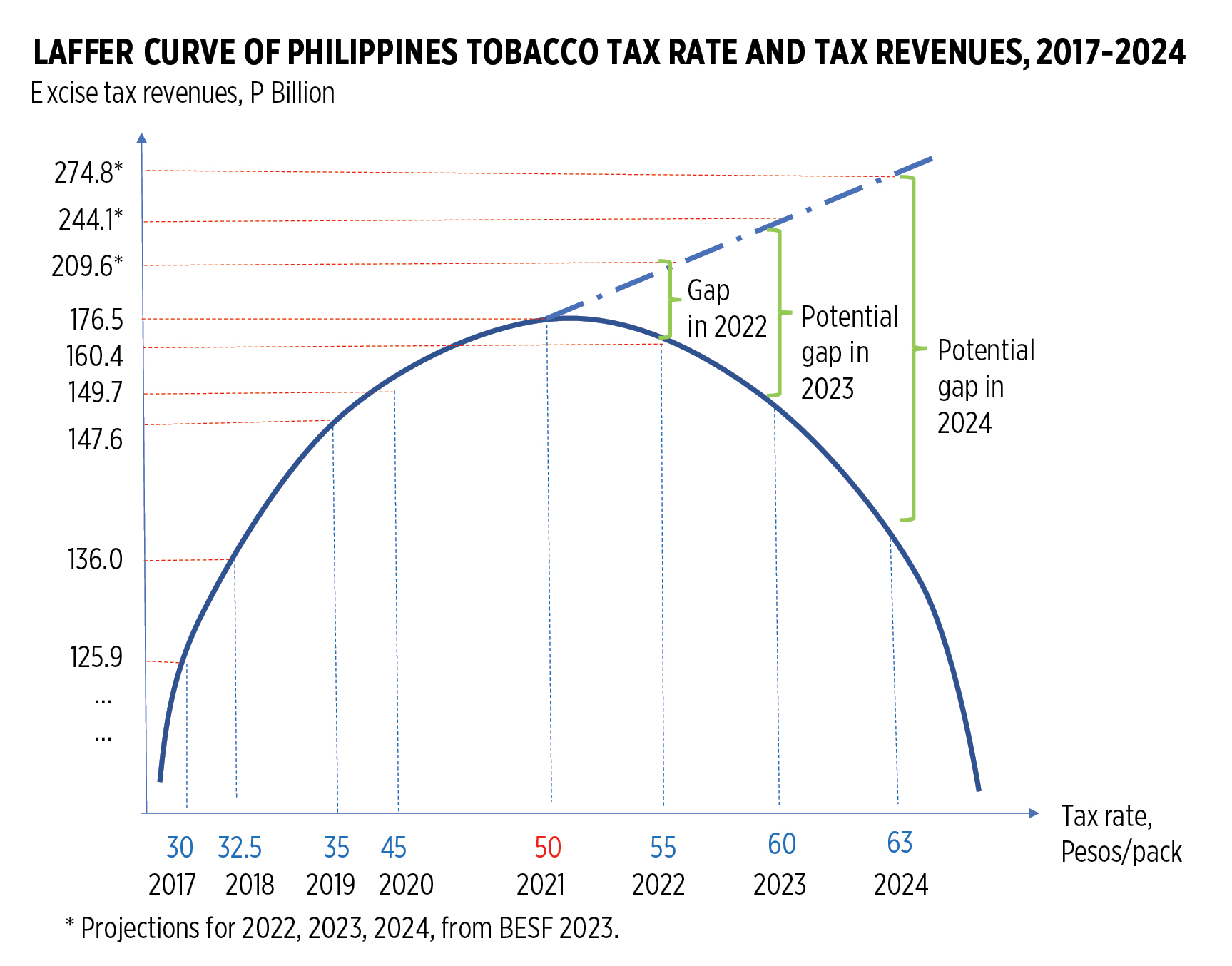
This column has discussed the Philippines’ excise tax revenues from “sin” or “public bad” products — alcohol, mining, petroleum, sugar-sweetened beverages, tobacco — before (“Taxpayers’ burden from uniformed pensions,” May 1). Tobacco tax revenues were the highest in the following years: P126 billion in 2017, P136 billion in 2018, P148 billion in 2019, P150 billion in 2020, P176 billion in 2021, and P160 billion in 2022. Tobacco tax revenues experienced a decline for the first time in 2022, coinciding with the big tax rate imposed — P55/pack — and as more people shifted to smuggled or illicit tobacco products which are very cheap.

This column has also previously discussed estimates of tax losses from cigarette smuggling alone: Congressman Joey Salceda, the Chairman of the House Committee on Ways and Means, put it at P30 billion/year; former party-list congressman Jericho Nograles, said it was P31 billion/year; Jesus Aranza, Chairman of the Federation of Philippine Industries (FPI), said it was P25 billion/year; and Bureau of Internal Revenue (BIR) Commissioner Romeo Lumagui, Jr., put it at a whopping P100 billion/year. See Table 2 in the column “Addressing high inflation and tax leakage” of March 13.

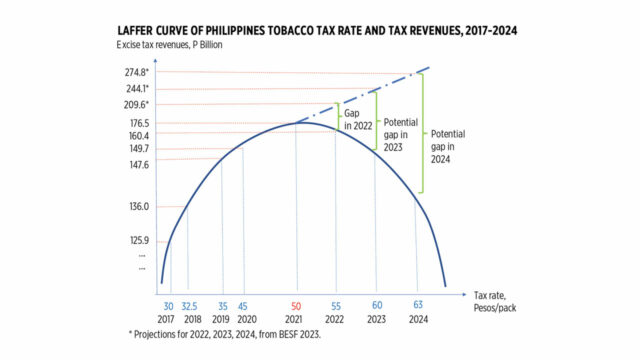
I constructed this illustration of a Laffer Curve using data on actual tobacco tax collections from 2017-2022, then projected collections for 2022-2024, and the tax rates per pack. So a tax rate of P30/pack in 2017 yielded P126 billion in revenues; P50/pack in 2021 yielded P176 billion revenues; P55/pack in 2022 yielded P160 billion, versus the projection of P210 billion in the Budget of Expenditures and Sources of Financing (BESF) 2023.

This represents P50 billion (P210 billion minus P160 billion) in unrealized revenues, which is midway and consistent with the various estimates of P30 billion to P100 billion in yearly tax losses from tobacco smuggling and illicit trade.

If this trend continues, the potential revenue gap in 2023 could be as high as P90 billion, and even larger in 2024 (see Figure 1).

So, from a Laffer Curve analysis, the optimal tax rate — where tax revenue is largest — is P50/pack. The P55/pack imposed last year yielded a decline in revenues. Government is worse off while smugglers, criminals, and their protectors in government are better off.

Assume tax losses of P50 billion from smuggling in 2023 and beyond. If this can be cut to just half via better law enforcement by national and local governments, the P25 billion in additional revenues can do any of these, and more:

1. If used to subsidize electricity prices, this will lead electricity that is cheaper by P0.23/kwh (P25 billion/110 billion kwh), for all on-grid consumers nationwide.

2. If used to retire some public debt, this will lead to savings of P26.5 billion/year (P25 billion principal plus P1.5 billion in interest at the current 6% a year Treasury-bills and Treasury-bond rates).

3. Such savings can fund a Targeted Cash Transfer (TCT) program covering 7.60 million households. For 2022, the Department of Budget and Management released P27.1 billion for the TCT program — P19.43 billion last year and a follow up of P7.68 billion last week.

Last week, on May 18, The Economist Impact organized a big conference, “Global Anti-Illicit Trade Summit, South-East Asia,” at the Shangri-La The Fort at BGC in Taguig City. The keynote speech was given by BIR Commissioner Romeo Lumagui, Jr. Among the things he said was, “the damage that illicit trade can wreak on an economy… most immediate impact is the loss of tax revenues that are urgently needed to fund development efforts.” He also pointed out the “unfair competition between the players in these illegal activities and legitimate business enterprise… money generated from illicit trade is used to fund organized crime, resulting in heightened security risks both locally and internationally.”

Then he discussed four measures that the government can take to control smuggling and illicit trade, especially of tobacco products. These are: a.) improved border controls, b.) enhancement of intelligence networks and interagency coordination between the country’s key law enforcement agencies, c.) have a comprehensive legal framework on trade of products in “brick-and-mortar” stores and e-commerce platforms, and, d.) strict enforcement of applicable laws and regulations against illicit trade and new anti-illicit trade legislation.

I think these measures are practical and workable. In addition, the Commissioner and Congress may also consider two other policies that I propose.

One, freeze the tobacco excise tax to between P50 to P55/pack. Reduce the price gap between legitimate tobacco — the cheapest pack now costs P120 (P60 of which is excise tax alone) vs the prevailing smuggled tobacco price of only P40/pack. A lower price differential between the legal and illegal products can lead to reduced consumption of the latter.

Two, partially peg the annual budget of law enforcement agencies like the Philippine National Police, Philippine Coast Guard, and National Bureau of Investigation on revenue collections from excise tax, especially tobacco products. If excise tax collections (with the oil excise tax removed) flat line or decline, these agencies’ budgets will be affected for the worse. This way, there is an incentive among the agencies to strictly enforce laws against illicit trade and products.

FEWER BIRTHS
Also last week, the Philippine Statistics Authority (PSA) released an update on monthly vital statistics for 2023. To save space, I computed the monthly data to January-November averages, as the December 2023 data is still incomplete.

There has been an alarming, consistent decline in the number of births in the Philippines starting during the 2020 lockdown, then the mass vaccinations starting 2021. There were nearly 30,000 fewer births a month in 2022 than in 2019. This is not good (see Figure 2).

The lockdowns of 2020-2021 plus the mass vaccinations of 2021-2022 — or political tyranny plus medical tyranny — coincided with, if not triggered, the reduction of births in the Philippines.

The proposed Senate Bill 1869 creating a new bureaucracy —the Center for Disease Control (CDC) — is a dangerous bill. Among the coercion explicitly provided for in the bill is “Promote treatment, vaccination, or immunization against a contagious disease, compelling the isolation or quarantine of persons who are unable or unwilling, for reasons of health, religion, or conscience, to undergo immunization or treatment” (Section 13, #5).

Mandatory vaccination or mandatory isolation is equivalent to mandatory discrimination. The vax-vax-vax narrative and business has contempt for the natural immunity developed by people and only believes in “vax immunity.” It only believes in virus mutation but not human mutation in response to new viruses and bacteria. It is a dishonest narrative and now senators want to institutionalize the dishonesty via legislation. SB 1869 is political and medical tyranny. It should not be passed.


Bienvenido S. Oplas, Jr. is the president of Bienvenido S. Oplas, Jr. Research Consultancy Services, and Minimal Government Thinkers.

minimalgovernment@gmail.com

What innovation means for the Philippines

PIKISUPERSTAR-FREEPIK

THE ADMINISTRATION argues that the future of the nation is “innovation,” as this is the catalyst to sustaining growth. On paper, this certainly looks like a very defensible strategy. The Philippine Development Plan (PDP) 2023-2028’s Chapter 8: Advance Research and Development, Technology, and Innovation, lays out strategies, programs, and legislative priorities to be pursued to promote innovation among industries, and identifies metrics to measure the country’s progress in harnessing research and development, technology, and innovation.

In this article, I clarify where the idea that innovation matters comes from, and discuss what type of innovation the Philippines needs in order to sustain growth.

Innovation refers to the creation of a new idea, method, device, product, service, or process; or to the introduction or use of such novelties in economic and social spheres. Innovation matters to an economist because it leads to productivity gains. These can be passed on to workers in the form of higher wages, and to consumers in the form of lower prices and products of higher quality. The term “innovation” is used in the literature to mean both original inventions and the creative use of existing products or processes. Economists argue that the former is what advanced economies do — that is, invent. This is so because their governments and companies have developed national innovation systems and invest in research and development (R&D). This is what allows them to make high cost, complex (unique) products and systems such as airplanes, robotics equipment, satellite systems, intelligent buildings, submarines, dams, luxurious yachts and cruise liners, or nuclear power plants. These are not just products but entire “systems” that require knowledge and coordination that most developing countries do not have. Historical experience tells us that this type of innovation is passed on to workers in the form of higher wages.

A country’s potential (maximum) growth is given by the sum of the growth rates of the labor force and labor productivity. Both are low in advanced economies, with the consequence that growth is low. In many of them, labor force growth is zero or even negative. Labor productivity growth is also relatively low because they are on the technological frontier, which means that firms are already highly mechanized and have high organizational capabilities (these refer to how to organize the flow of work in both a manufacturing shop floor and in an office). Therefore, the level of labor productivity is high in developed countries but, at the same time, the growth rate is low. If they want to grow, they need to create new products, invent. Innovation and R&D became buzzwords in the 1980s and 1990s in the literature that was created to explain growth in the developed countries, and not in the developing nations. Yet, many scholars started trying to explain growth in developing countries by appealing to the innovation paradigm.

Aren’t developed countries inventing new products? Yes, but many economists believe that today’s technologies are not as revolutionary as those of the late 19th and early 20th centuries, the Second Industrial Revolution (electricity, the internal combustion engine, running water, indoor toilets, communications, entertainment, chemicals, petroleum). The introduction and spread of these technologies lasted until the 1970s, and delivered very high growth rates and huge increases in humanity’s living standards. The technologies of the Third Industrial Revolution (computers, mobile phones, the web) did not do the same, with the consequence that growth since the 1970s in the developed nations declined significantly. We do not know yet whether the technologies of the Fourth Industrial Revolution (Artificial Intelligence, nanomaterials, blockchain, neuro technologies, synthetic biology) will do the same as those of the Second.

The situation in developing countries is different. They do not create new products. At best, they do process innovation (small changes in products created by developed countries). These types of innovations most often are not transferred to workers in the form of higher wages but instead lead to lower prices. In these countries, potential growth can be high, as labor force growth is still positive (certainly it is in the Philippines), and labor productivity growth is significant because developing countries are adopting the technologies created in the advanced economies. This type of progress is called behind-the-frontier catch up. This is what the East Asian countries did during the period of high growth in the 1970s and 1980s. South Korea is the best example. China’s labor force growth has already reached developed-nation rates — zero and even negative. Hence, output growth is about labor productivity. China is still adopting technologies from the advanced nations and, at the same time, developing its own (innovating and inventing) and competing with the advanced economies in the most advanced sectors. No other developing nation can do this.

The Philippines is clearly far from the technological frontier. Moreover, it does not have the capabilities to invent and compete through research at the frontier, certainly not in the areas of the Fourth Industrial Revolution. The optimal strategy is to accelerate the behind-the-frontier catch up by adopting technologies from the advanced nations. This is about learning, adopting, and improving fast what others have done. It is also about improving firms’ organizational capabilities — low in many Filipino companies. This is productivity-enhancing and a form of innovation that does not require huge investments in capital. This is where the government should help small- and medium-size Filipino companies. There is nothing wrong with this — quite the opposite. This is what the successful East Asian countries did. Filipino innovation that translates into productivity will hardly come from pure research and development.

The above considerations do not imply that a relatively poor nation cannot innovate at the frontier in some sectors. Besides China, take the case of Vietnam. It has developed its own electric automobile, the VinFast. What is impressive is that it has done it in less than a decade. It is already making inroads in Europe and in the United States, some of the world’s most sophisticated markets. Vietnam is clearly determined to nurture its new national champions with a package of proactive trade and industrial policies. This requires a very clear and well-focused industrial policy that targets a few products, led by the government and a group of companies willing to invest, develop a competitive product, and sell it to the whole world, not just in the domestic market. Vietnam will certainly move forward. It is already slightly ahead of the Philippines in GDP per capita, and it will continue opening the gap in the coming decades.

I close this article with a reference to education. What type of workers needed to undertake behind-the-frontier catch up? Surely education matters for innovation and growth. Yet, one can hardly argue that for the Philippines as a whole, the key constraint on growth is education. There might be specific sectors that lack good professionals but this is not true at the aggregate level of the nation. This is a country where helpers, guards, and drivers, have college degrees. Claiming that education is the binding constraint is barking up the wrong tree. When today’s advanced economies reached high income status in the 20th century, it was not because half of their labor forces had PhDs.

What is true is that today’s technological world has magnified the returns to those with strong math and science skills and who can use them in fields such as finance, software development, or genetics. This is increasing inequality in both developed and developing countries. In the Philippines, and given that it is not a leading nation in the development of advanced technologies, this group represents a very small percentage of the labor force. What the Philippines needs is a well-trained labor force: workers who can perform in an office and in an assembly line, who can read and write, understand a manual, and who can be easily redeployed to perform news tasks. I am talking about plumbers, electricians, carpenters, bricklayers, mechanics, workers who can build a road properly, mid-level technicians, and workers with skills to make quality products (shoes, furniture) that meet international standards and can compete in world markets. The skills of these workers do not require college degrees, and much less graduate degrees. And while it is important to think about the skills that will be needed for tomorrow’s jobs, the nation needs jobs for the workers it has today. If the education paradigm were true, it would imply that the Philippines would have to wait for a new whole generation of “well-educated” workers; and also, that today’s Filipino workers cannot do what Korean or Singaporean workers did in the 1970s, what Chinese workers did in the 1990s and 2000s, and what Vietnamese workers seem to be doing today.

I reiterate that certainly innovation matters for the future of the nation, but we must be clear about what type of innovation makes sense and is feasible in the Philippines. This will be the result of fast assimilation and adaptation of advanced technologies, not of research and development (except in well targeted areas), and improvement of firms’ organizational capabilities to increase productivity.


Jesus Felipe is a distinguished professor of Economics and the director of the Angelo King Institute, De La Salle University.

David Carlos rules FIBA 3×3 Manila Masters Dunk contest 

FILIPINO high-flyer David Carlos soared to another title, leaving over fancied counterparts to rule the Chooks-to-Go FIBA 3×3 World Tour Manila Masters 2023 Dunk Contest over the weekend at the Glorietta Activity Center in Makati.

Mr. Carlos, 34, scored 55 points on two roaring dunks in the final round for his another crown in the 3×3 dunk circuit that capped the country’s magnificent hosting of another FIBA 3×3 World Tour leg.

He bested Australia’s Brodie Stephens and compatriot Daniel Marcelo for a $4,000 grand prize after jumping over four people for 28 points in his first attempt and completing a “tetris” slam over two individuals piled up on top of each other for 27 points in the second dunk.

“Against the time, with two missed attempts, I didn’t lose hope. This is for the fans. I thank my Chooks-to-Go family for their unwavering support,” said Mr. Carlos, who beat the buzzer in his third try.

Mr. Carlos’ win made up for the early exit of Manila Chooks in the pool play with a 0-2 slate following losses against Utsunomiya BREX EXE, 22-18, and eventual champion Ub Huishan NE of Serbia, 21-9.

Ub, the world No. 1 3×3 team, bested China’s Futian, 21-17, for its second straight Manila Masters championship and $40,000 grand prize.

Strahinja “Doctor Strange” Stojacic fired six points and was named the Manila Masters MVP. Marko Brankovic and Dejan “The Maestro” Majstorovic, added nine and six points, respectively.

“We really played well and we deserved the championship. Every team wants to beat us because we are the number one team in the world, so we have to stay focused,” Mr. Stojacic said.

Futian settled for a bridesmaid finish and a $30,000 prize while its fellow Chinese team Beijing took home $22,000.

Up next for the Philippines in 3×3 pro circuit hosting is the Cebu Masters in September. — John Bryan Ulanday

ADVERTISEMENT
ADVERTISEMENT