
Metro Manila’s Construction Materials Retail Price Indices
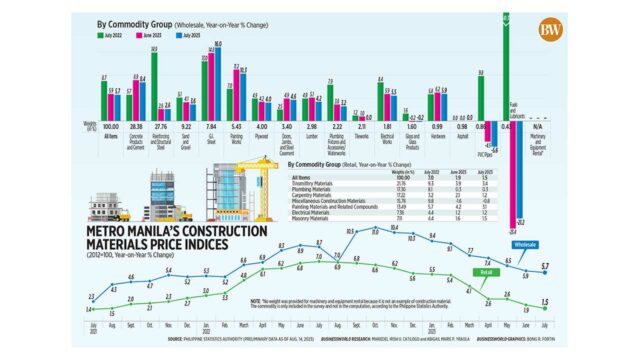
GROWTH in wholesale and retail prices of building materials in Metro Manila eased in July, the Philippine Statistics Authority (PSA) reported on Monday. Read the full story.
GROWTH in wholesale and retail prices of building materials in Metro Manila eased in July, the Philippine Statistics Authority (PSA) reported on Monday. Read the full story.

THE Philippine Amusement and Gaming Corp. (PAGCOR) plans to start privatizing 45 casinos by the third quarter of 2025, its chairman told a House of Representatives committee on Monday.
“The privatization of PAGCOR’s 45 properties will commence during the third quarter of 2025 at the earliest,” PAGCOR Chief Executive Officer and Chairman Alejandro H. Tengco told the House Appropriations committee during its deliberations for the P5.768-trillion 2024 national budget.
House Government enterprises and privatization committee Chairman and Parañaque Rep. Edwin L. Olivarez cited the agency’s conflicting roles as a regulator and casino operator.
“I have been doing some studies about the privatization. My goal is to increase the value of what we will privatize,” Mr. Tengco said, noting that the privatization had been given the green light by President Ferdinand R. Marcos, Jr.
As of June 30, 75% of the agency’s income is generated by integrated resorts and licensees, while 25% is sourced from PAGCOR-operated casinos, Mr. Tengco added. “It is clear that PAGCOR should purely be a regulator and not an operator at the same time.”
Mr. Tengco added that he is consulting the Department of Finance on whether PAGCOR will remain a government-owned and -controlled corporation (GOCC) or become an agency if the casinos are divested.
He said PAGCOR’s P3-million logo redesign, launched in July, was intended to counteract the circulation of fake licenses used to operate in the Philippines and overseas.
Party-list Rep. Raoul Danniel A. Manuel said the cost of the redesign was excessive.
“We claim that we don’t have fiscal space for other budget items but (we spend this much) for a logo,” Mr. Manuel told the committee. “Many people could have benefited from a budget this large if it was used properly.”
PAGCOR reported a net profit of P36.21 billion in the first six months, Vice-President Sharon SJ. Quintanilla told the committee, with funds surrendered to the government to help fund its projects amounting to P22.62 billion.
GOCCs are required by law to remit at least 50% of their profits to the Treasury to finance government priority projects like universal healthcare and other nation-building exercises.
Last year, PAGCOR generated a net profit of P58.96 billion, up from P35.48 billion in 2021, Ms. Quintanilla told the committee.
PAGCOR paid taxes to the Bureau of Internal Revenue of P3.54 billion in 2022. Ms. Quintanilla said that P307.83 million of this represented corporate income tax, while P2.71 billion was transmitted as franchise tax. PAGCOR also paid P521.83 million in withholding taxes.
Cities that host PAGCOR casinos are allocated a fixed amount for community development projects, Ms. Quintanilla said.
PAGCOR projects a net profit of P75.5 billion and P80.28 billion in 2023 and 2024, respectively.
POGOs
Meanwhile, Cagayan Do Oro Rep. Rufus B. Rodriguez proposed to shut down Philippine Offshore Gaming Operators (POGOs), citing reports of kidnapping, murder and prostitution from the industry.
In response, Mr. Tengco added that POGO licensees, sublicensees and service providers have been placed under probationary status and have until Sept. 15 to reapply, or else their licenses will be revoked.
“I have warned them that this is one one-strike policy and that if they will continue to be involved in the illegal activities such as credit card scams, crypto-investment scams, love match scams, I will recommend the closure of the industry,” Mr. Tengco said.
He also noted that PAGCOR is no longer generating e-sabong revenue as the cockfight betting operation was shut down by the previous administration. — Beatriz Marie D. Cruz

THE Philippine Amusement and Gaming Corp. (PAGCOR) estimates that it will be able to contribute up to P4 billion to the Maharlika Investment Fund (MIF), its chairman told the House Committee on Appropriations on Monday.
“If our interpretation is correct, we will be able to contribute anywhere between P3.6 billion to P4 billion in the Maharlika fund,” PAGCOR Chief Executive Officer and Chairman Alejandro H. Tengco told legislators during deliberations on the P5.768-trillion 2024 national budget.
PAGCOR said the contribution will be taken from the dividend it owes by law to the National Government (NG) of at least 50% of its earnings.
“Within that 50% (dividend), we are clarifying if this is where we’ll get our investment for the Maharlika fund,” he said.
Republic Act (RA) No. 11954, which created the MIF, requires that 10% of the National Government’s income from PAGCOR will go to funding the MIF.
PAGCOR is also studying the possibility of investing its retained earnings in the MIF.
“We are seeking clarification if (a certain percentage of) our retained earnings can be invested in the Maharlika fund,” Mr. Tengco said.
President Ferdinand R. Marcos, Jr. signed RA 11954 on July 18.
“The fund shall be used to make high-impact and profitable investments, such as the Build Better More program. The gains from the Fund shall be reinvested into the country’s economic well-being,” Mr. Marcos said in his State of the Nation Address last month.
The MIF law designates as providers of initial capital the Land Bank of the Philippines, which will invest P50 billion. The Development Bank of the Philippines will inject P25 billion, while the P50 billion will come from the National Government.
The bill also prohibits government pension funds and insurers from contributing seed capital to the MIF. These include the Government Service Insurance System, Social Security System, and the Philippine Health Insurance Corp.
The fund has raised concerns that the NG will not be able to fund social services after it accumulated P14.1 trillion worth of outstanding debt as of the end of May.
NG debt is expected to hit P15.84 trillion in 2024, the Department of Budget and Management said last week.
The Maharlika Investment Corp., which will operate the fund, is expected to be fully operational by the end of 2024. — Beatriz Marie D. Cruz

RETAILERS said they could resort to layoffs if Congress proceeds to legislate a higher minimum wage.
Roberto S. Claudio, Sr., Philippine Retailers Association (PRA) president, said businesses would need to shed workers to comply with a Congress-imposed wage hike.
“This is the concern of the industry. If the minimum wage is increased, more jobs will be lost because most of the businesses… will simply reduce staffing,” Mr. Claudio told reporters on the sidelines of an expo in Pasay City last week.
Mr. Claudio estimated that the proposed wage hike will result in the loss of 50,000 jobs from mainstream retailers, equivalent to 10% of their workforce.
Senate President Juan Miguel F. Zubiri has said that senators will push for legislation calling for a P150 across-the-board wage hike.
In June, the National Capital Region Tripartite Wages and Productivity Board approved a P40 wage hike for workers in Metro Manila, which brought the daily minimum wage to P610 for non-agricultural workers.
The minimum wage was also raised to P573 for agricultural workers, services and retail establishments with 15 or fewer employees, and manufacturers with less than 10 employees.
Mr. Claudio said that retailers are scrambling just to comply with the P40 wage hike for Metro Manila.
“We are finding ways (to comply with) the wage hike that has already been approved. Anything more will definitely be answered (with job cuts),” Mr. Claudio said.
Mr. Claudio called for wage hikes to be set instead via collective bargaining.
“Most companies have their own labor unions. Let them work it out because every renegotiation, every renewal of contract with the union… will always be additional (wages), more benefits,” Mr. Claudio said.
“If you (legislate wage hikes), you are forcing others who are not in a position to give additional wages or adjustments in their wages (to increase pay),” he added. — Revin Mikhael D. Ochave

A NON-GOVERNMENT organization asked the government to impose price controls on rice, citing the need to deter traders from stockpiling rice instead of releasing inventory onto the market.
“As long as there is (the Rice Tariffication Law, or Republic Act 11203) and the government does not take drastic measures to impose price controls or check the warehouses of traders… rice prices will continue to rise,” Bantay Bigas Spokesperson Cathy L. Estavillo said in a briefing.
RA 11203, signed in 2019 liberalized rice imports, which used to be a government monopoly. Instead, importers had to pay a tariff of 35% on shipments of Southeast Asian grain to generate revenue for the government and finance the Rice Competitiveness Enhancement Fund.
At the same time, Ms. Estavillo also warned that the arrival of new imports from Vietnam and possibly India may depress prices at the farmgate level prices during the harvest in September.
Kilusang Magbubukid ng Pilipinas Chairman Danilo H. Ramos also blamed “the cartel in rice” — stockpiling by traders — for the increase in retail prices.
“The farmers as a whole have no capability to store their palay because that is what they use to pay for their debts and daily needs,” he added.
Both groups reiterated their call to repeal the Rice Tariffication Law, which they said have worsened the rice crisis and imposed losses on farmers.
This (increase) in the price of rice is (the result of) price manipulation by traders, millers, and importers. Since the signing of RA 11203, the private sector sets the price of the rice in the market, and the government has done nothing,” Ms. Estavillo said.
Agriculture Assistant Secretary and Deputy Spokesperson Rex C. Estoperez told reporters on Monday that the increase in rice prices was due to higher international prices.
“We talked to a lot of rice retailers and rice importers, mataas ang kanilang kuha dahil nga sa presyo ng kanilang imports din naman (their acquisition costs are high because import prices are also high),” he said.
Mr. Estoperez said price controls are not possible, but the DA’s enforcement and inspectorate arm could start visiting warehouses to validate claims of hoarding.
“What would be our basis (for price controls?) We are not in an emergency (that justifies price controls),” he said.
Asked to comment on calls to repeal the Rice Tariffication Law, he said: “A review, I think, is the best solution. We will revisit the Rice Tariffication Law. Will look at what else needs to be amended, what provisions need to be strengthened.”
On Monday, the DA’s Bantay Presyo price monitors quote domestic well-milled rice prices at between P42 and P53, while regular-milled rice was sold for between P38 and P52.
Imported well-milled rice sold in Metro Manila markets for between P45 and P46. — Sheldeen Joy Talavera

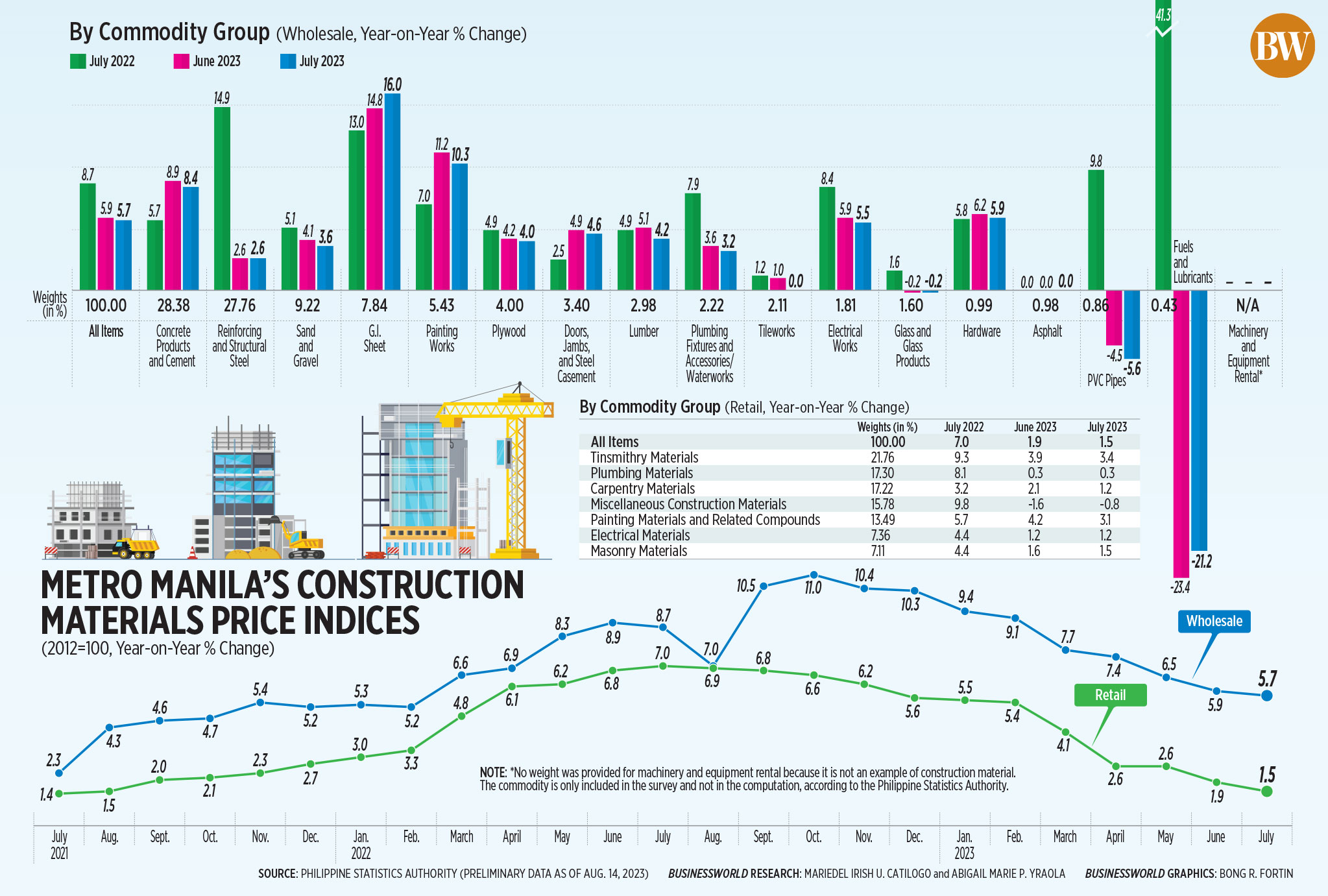
GROWTH in wholesale and retail prices of building materials in Metro Manila eased in July, the Philippine Statistics Authority (PSA) reported on Monday.
The PSA said growth in its construction materials wholesale price index (CMWPI) eased to 5.7% year on year in July, the lowest since the 5.2% reading in February 2022.
In June the index returned to a growth rate of 5.9%. In July 2022, the index posted 8.7% growth.
The July reading marks the ninth month of decline in the CMWPI after the 11% peak in October.
This brought the CMWPI to a 7.4% average in the seven months to July, against a 7.1% reading a year earlier.
The PSA attributed the lower July reading to easing price growth in heavily-weighted concrete products and cement (8.4% from 8.9% in June). These items account for 28% of the bulk construction materials basket of goods.
Easing price growth was also noted in sand and gravel (3.6% in July from 4.1% in June); hardware (5.9% from 6.2%); plywood (4% from 4.2%); lumber (4.2% from 5.1%); electrical works (5.5% from 5.9%); painting works (10.3% from 11.2%); plumbing fixtures and accessories/waterworks (3.2% from 3.6%); and doors, jambs, and steel casements (4.6% from 4.9%).
Year-on-year price growth at the retail level, as measured by the construction materials retail price index (CMRPI) in the National Capital Region (NCR), also weakened to 1.5% in July from 1.9% in June and 7% a year earlier.
This was the weakest CMRPI reading since the 1.4% posted in July 2021.
In the seven months to July, CMRPI averaged 3.3%, against the 5.3% from a year earlier.
Easing price growth in heavily-weighted items such as tinsmithry materials (3.4% from 3.9%) and carpentry materials (1.2% from 2.1%) dragged down the July CMRPI reading.
Also easing were painting materials and related compounds (3.1% from 4.2%) and masonry materials (1.5% from 1.6%).
Plumbing materials and electrical materials prices were steady at 0.3% and 1.2%, respectively. — Andrea C. Abestano

A MINER controlled by Global Ferronickel Holdings, Inc. said it will appeal the lifting of a cease-and-desist order (CDO) covering its operations in Brooke’s Point, Palawan.
In a statement on Monday, Ipilan Nickel Corp. (INC) called on National Commission on Indigenous Peoples (NCIP) Chairman Allen A. Capuyan to lift the order that the NCIP’s regional office for Mimaropa (Mindoro, Marinduque, Romblon and Palawan) imposed on the company and its predecessor Celestial Nickel Mining Exploration Corp. (CNMEC).
The NCIP had cited the company’s alleged failure to comply with the requirements for securing a permit to operate.
“The company expresses its deep concern over the immediate issuance of the CDO by the regional director, citing an alleged deficiency in INC’s Certificate Precondition (CP), despite the company’s fruitful partnership with the indigenous community and its sincere efforts to address royalty concerns in consultation with NCIP,” Ipilan Nickel said.
In a resolution dated Aug. 11, Ipilan Nickel was given five days after receipt of the document to halt operations and implement safety protocols.
In June, representatives of the Indigenous Cultural Communities (ICCs) submitted a resolution of non-consent to the NCIP, alleging material misrepresentations made by the company during the Free, Prior, and Informed Consent process.
The company said that “the NCIP itself confirmed that the CP was no longer necessary” after entering an agreement with the government for a mineral production sharing agreement in 1993, or four years before the Indigenous Peoples Rights Act (IPRA) was signed into law.
“The IPRA and its implementing rules state that existing contracts for the exploitation of natural resources within the ancestral domain continue until they expire,” Ipilan Nickel said.
It said that the CNMEC had engaged with the IPs/ICCs through a Memorandum of Agreement (MoA) signed on Dec. 18, 2008, followed by another MoA on Sept. 1, 2022.
Ipilan Nickel said that the cease-and-desist order impeded its initiatives “designed to uplift the indigenous community” such as scholarship grants, medical and funeral assistance, livestock allocation, provision of solar panels and generator sets, among others.
The company said it will tap “all available legal avenues, including the option to appeal, challenge the cease-and-desist order, and ensure uninterrupted operations,” the company said in a disclosure to the stock exchange. — Sheldeen Joy Talavera

Thousands of families with unsettled estates will welcome Republic Act (RA) No. 11956, which further amends RA 11213 or the Tax Amnesty Act. RA 11956 lapsed into law on Aug. 5. In the Philippines, 6% estate tax is imposed on the net estate of a decedent which must be filed and paid within one year from the death of the decedent. Failure to file and pay within the tax deadline is subject to penalties and interest.
The Tax Amnesty Act was signed into law in 2019 to allow heirs to settle any unpaid estate taxes on or before June 15, 2021, without penalty or interest. Due to the COVID-19 pandemic, the estate tax amnesty was extended by two years until June 14, 2023, through RA 11569. In 2023, legislators lobbied for another two-year period in response to the acknowledged difficulties in applying for the estate tax amnesty, especially for those in the provinces where information dissemination on the estate tax amnesty is wanting.
Apart from stretching the deadline to file the estate tax amnesty returns and to pay the corresponding estate taxes until June 14, 2025, RA 11956 also amended the coverage of the amnesty. The Tax Amnesty Act only covered unpaid estates of decedents who died on or before Dec. 31, 2017. In the latest amendment, estate tax amnesty now covers those estate taxes that have remained unpaid or have accrued as of May 31, 2022, a very good development as the expanded coverage allows more heirs to avail of the benefits of the estate tax amnesty.
RA 11956 also enumerated the requirements to apply: death certificate or certificate of no record of death from the Philippine Statistics Authority (PSA) and any valid secondary evidence to establish the fact of death of the decedent, Tax Identification Number (TIN) of decedent and heir/s, proof of claims against estate, proof of the claimed “property previously taxed,” proof of the claimed “transfer for public use,” at least one government-issued identification card of the executor/administrator of the estate or its authorized representative, and the duly notarized original Special Power of Attorney (SPA) if the person transacting is the authorized representative. If the document is executed overseas, it must be certified by the Philippine Consulate or apostilled.
For real property, the requirements are certificate/s of title of the real property, tax declaration nearest to the time of death of the decedent, and Certificate of No Improvement issued by the assessor’s office, if applicable. In the event that the zonal value of the real property cannot be readily determined from the documents submitted, the law requires submission of a location plan or vicinity map. On the other hand, for personal property, RA 11956 requires the Certificate of Deposit/Investment/Indebtedness owned by the decedent alone or jointly with the surviving spouse or with others, Certificate of Registration of vehicle/s, Certificates of Stock, proof of valuation of shares of stock at the time of death, or proof of valuation of other types of personal property.
The recent law is also in line with the government’s push to digitize by allowing the filing of returns and payment of estate taxes either manually or electronically with any authorized agent bank, Revenue District Office through the Revenue Collection Officer or authorized software provider. Further, the law also allows payment by installment of estate taxes due within two years from the statutory date for its payment without civil penalty or interest.
With that said, the government is yet to issue the implementing rules and regulations of RA 11956.
Parting from a loved one can be taxing — physically, emotionally, and financially. It is completely understandable why some families have postponed the timely payment of estate taxes of their deceased loved ones. However, such taxes are inevitable especially if the heirs will want to transfer their inherited property and obtain a Certificate Authorizing Registration from the Bureau of Internal Revenue (BIR).
Death is one of the hard conversations we must talk about more openly. To quote American surgeon and bestselling author Atul Gawande in one of his books, Being Mortal — lacking a coherent view of how people might live successfully all the way to the very end, we have allowed our fates to be controlled by medicine, technology, and strangers. His book notes the need for courage to confront the reality of mortality. Conversely, there are ways to gain control of our lives going forward, which includes estate planning.
Estate planning is a legal tool that can minimize the burden of taxes upon a person’s death. Contrary to popular belief, not only high net-worth individuals need estate planning. As long as you own property, you can set a plan in place to settle your affairs in the event of your passing. The Supreme Court in several cases has acknowledged the legality of tax avoidance which is a tax-saving device within the means sanctioned by law.
The 6% estate tax can be burdensome even without penalties and interest. The extension of the application period for estate tax amnesty will definitely benefit thousands of families. We hope that the pending IRR of RA 11956 will streamline the application process and ease the compliance requirements to accommodate the families who still plan on availing of the amnesty within the new deadline.
Let’s Talk Tax is a weekly newspaper column of P&A Grant Thornton that aims to keep the public informed of various developments in taxation. This article is not intended to be a substitute for competent professional advice.
Azanith Ann B. Payad is a manager from the Tax Advisory & Compliance Practice Area of P&A Grant Thornton. P&A Grant Thornton is one of the leading audit, tax, advisory, and outsourcing firms in the Philippines, with 29 Partners and more than 1000 staff members.
Tweet us: @GrantThorntonPH
Facebook: P&A Grant Thornton, pagrantthornton@ph.gt.com

CHINA might have an informant in the Philippines, a local coast guard official said on Monday, citing how the Chinese Coast Guard had managed to block Manila’s resupply mission at Second Thomas Shoal on Aug. 5.
Six Chinese Coast Guard vessels involved in “dangerous maneuvers” against four Philippine vessels on Aug. 5 had been stationed at different parts of the South China Sea — including Mischief Reef, Pagasa Island, Bajo de Masinloc and Subi Reef — before the incident, Philippine Coast Guard (PCG) spokesman Jay Tristan Tarriela told ABS-CBN New Teleradyo.
The Chinese ships suddenly converged at Second Thomas Shoal a day before the incident, blocking the Philippines’ resupply mission, he said. The vessels immediately returned to their areas after the incident.
He said China had every intent to block the supply mission, dismissing claims that the Chinese Coast Guard had allowed one of the two Philippine boats to reach a Philippine outpost at Second Thomas Shoal.
Mr. Tarriela said the Chinese Coast Guard might have “intel on the ground.” “They might have an informant and that’s how they knew about our resupply operations.”
Philippine authorities have said Manila would never abandon the shoal and would continue its resupply missions within its exclusive economic zone.
Meanwhile, Mr. Tarriela hit Filipinos on social media whom he accused of spreading lies about a supposed deal with China for the Philippines to abandon its grounded World War II-era ship at Second Thomas Shoal.
“I’m not aware of any such arrangement or agreement that the Philippines will remove from its own territory its ship, in this case, the BRP Sierra Madre from Ayungin Shoal,” President Ferdinand R. Marcos, Jr. said last week, referring to Second Thomas Shoal.
“And let me go further, if there exists such an agreement, I rescind that agreement now.”
A handful of Filipino troops are stationed on a rusty World War II-era US ship that the Philippines intentionally grounded at the shoal in 1999 to assert its claims.
On Monday, the Chinese Embassy’s Deputy Chief of Mission Zhou Zhiyong urged the Philippines to meet China halfway through diplomatic talks and manage their sea dispute.
“China has repeatedly expressed its willingness to resolve differences with the Philippines through bilateral dialogues,” he told a forum organized by Filipino businessman Wilson Lee Flores.
“We hope that the Philippine side will abide by the existing consensus and cherish the hard-won situation in our bilateral relations,” Mr. Zhou said. “Meet the Chinese side halfway and find an effective way of managing the situation on the sea through diplomatic consultations.”
The Chinese official said Beijing had lodged “solemn representations immediately requesting the Philippine side to tow away” the BRP Sierra Madre. He added that the Philippines had agreed to remove the ship.
“The Philippine side also made explicit commitments to do so. The representations were put on record and are well documented,” Mr. Zhou said.
He said it’s been 24 years since BRP Sierra Madre was grounded at the shoal “and the Philippines side has yet to honor its commitment.” “The Chinese side, however, has always exerted the utmost restraint, with a view to maintaining relations with the Philippines and safeguarding regional peace and stability.”
The Philippines and China in 2021 held discussions to manage the dispute over the shoal, reaching a consensus for resupply missions to BRP Sierra Madre.
However, starting early this year, the Philippine government “refused to acknowledge and implement the existing consensus and started to take a series of unilateral actions,” Mr. Zhou said.
“To prevent any incidents from occurring, the Chinese side has lodged representations both in Beijing and Manila to the Philippine side, requesting the Philippines to return to the track of honoring the existing consensus and refrain from taking unilateral actions before any new understanding is reached between us,” he added.
The Philippines had insisted on transporting construction materials to the grounded vessel for overhaul and reinforcement “with the intent of permanently occupying Ren’ai Reef,” Mr. Zhou said, referring to the shoal’s Chinese name.
“The above is the cause of this incident,” he said, referring to the Aug. 5 incident where China’s coast guard fired water cannons at the Philippine vessels to block the resupply mission.
Mr. Zhou noted that under “temporary and special arrangements,” Beijing has allowed Manila to conduct resupply missions for troops stationed at Second Thomas Shoal by only bringing food and other daily necessities “out of humanitarian consideration.”
“The Chinese side has also made it clear that we are firmly against transportation of large-scale construction materials to the ground… with the purpose of permanent occupation through reinforcements,” he added.
Armed Forces of the Philippines (AFP) chief Romeo Brawner, Jr. has said China was using its coast guard instead of its Navy force to harass Philippine vessels because “they want to act short of declaring war.”
He noted that the Chinese Coast Guard is not a civilian agency because it is under China’s Central Military Commission.
Mr. Brawner said the Philippines would deploy more ships and aircraft to secure Philippine waters in the South China Sea. The government might tap naval reservists and Filipino fisherfolk to help establish Philippine presence in the disputed water, he added. — Kyle Aristophere T. Atienza
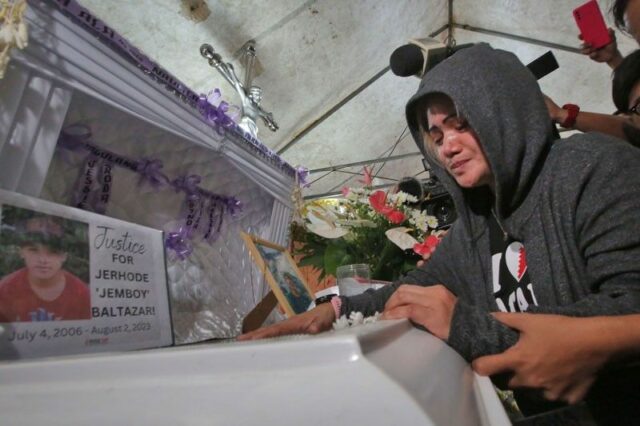
THE PHILIPPINE Commission on Human Rights (CHR) on Monday said the entire police force should be retrained after Navotas City cops shot and killed a 17-year-old boy in a supposed case of mistaken identity.
CHR Chairman Richard P. Palpal-latoc welcomed the Northern Police District’s announcement of a refresher course for police, but said this should be done nationwide.
“It should not be limited to that station,” he said in Filipino. “It should be for the entire police force. In fact, they are being trained now on human rights.”
Meanwhile, the Department of Interior and Local Government (DILG) said the national police chief should be able to punish the erring cops.
The police chief should have the freedom to hold erring policemen accountable for misconduct, Interior Secretary Benjamin C. Abalos, Jr. told an online news briefing.
“The three-strike policy is good, but we should have that elbow room for the national police chief to hold these officers, even commanding officers, accountable,” he said in mixed English and Filipino. “One thing is certain: we need to update these police proceedings.”
The Philippine National Police (PNP) has implemented the three-strike rule for erring police officers during drug and gambling raids, Mr. Abalos said.
He said the DILG would consult with the National Police Commission about revising the three-strike policy.
Six Navotas policemen shot and killed Jerhode Baltazar on Aug. 2 after he was mistaken for a suspect in a previous shooting incident. Navotas police chief Colonel Allan B. Umipig has called it a “lapse in judgment” on the part of his men.
National Capital Region Police Office Director Brigadier General Jose Melencio C. Nartatez, Jr. told the same briefing the six cops have been detained pending investigation. The Navotas City prosecutor has filed homicide complaints against the policemen.
Mr. Abalos said his agency would coordinate with the Department of Justice to determine additional criminal and administrative complaints that could be filed against the law enforcers.
Mr. Abalos on Aug. 11 said his agency and the Philippine National Police would review standard law enforcement procedures after the teen’s killing.
Last month, the Department of Justice said it would revive an inter-agency task force that probed unlawful deaths in the Philippine government’s deadly war on drugs.
The inter-agency committee formed 15 teams in 2021 that investigated extralegal killings and human rights violations in connection with the government’s anti-illegal drug campaign. The task force investigated at least 17,000 policemen.
CHR has said the government of ex-President Rodrigo R. Duterte had encouraged a culture of impunity by hindering independent probes and failing to prosecute erring cops.
The government estimates that at least 6,117 suspected drug dealers were killed in police operations. Human rights groups say as many as 30,000 suspects died. — John Victor D. Ordoñez

PHILIPPINE SCHOOLS damaged by recent typhoons would use blended learning if repairs were not completed on time, the Education department said on Monday.
“The ones hit by typhoon Egay will be the priority in our budget for repair this year,” Vice-President and Education Secretary Sara Duterte-Carpio told reporters after participating in a cleanup activity at a Manila high school.
“If the repairs will not make it to the opening on Aug. 29, we will immediately implement blended learning programs,” she added.
Ms. Carpio said the Department of Education (DepEd) aims to avoid learning disruption. “It’s either blended learning or in-person classes. Classes will continue even if there are classroom issues.”
Meanwhile, President Ferdinand R. Marcos, Jr. said some schools were being renovated, noting that government is working with local governments to fast-track repairs.
A total of 169 schools, including more than 500 classrooms, were damaged by Typhoon Doksuri, locally known as Egay, and a southwest monsoon that triggered rains for weeks.
The Education department is studying a proposal to raise teachers’ salaries based on an order issued by the President, Ms. Carpio said.
The study will take into consideration economic indicators including inflation, she added.
Ms. Duterte said teachers have been receiving salary increases in tranches every year since 2020 under a 2019 Salary Standardization law.
ACT Teachers Party-list earlier lamented the zero allocation for salary increases for government employees in the proposed P5.768-trillion national budget for next year.
The party-list has been calling for a P50,000 entry-level pay for teachers and P33,000 for salary grade 1 employees.
Kabataan Party-list has also flagged the 62% budget cut for the capital outlay of state universities and colleges, saying it could worsen the country’s classroom shortage.
Also on Monday, Mr. Marcos said climate change should be considered in deciding whether the country should return to the old academic calendar.
“It’s not that simple, we changed the schedule before because of the pandemic. Right now, we need to talk about climate change… because it’s too hot,” he said.
Party-list Rep. France C. Castro has filed a bill that seeks a return to the June to March school calendar, saying the August to May calendar has negatively affected the education sector, “with students and teachers struggling with prolonged and intensified exposure to heat during the summer months.”
“This has resulted in decreased productivity, poor student performance and even health problems,” she said in House Bill 8550.
Under the bill, the school year will start between the first Monday of June and the last day of August.
The measure covers all basic education institutions in the Philippines, including foreign and international schools. — Kyle Aristophere T. Atienza

A SENATE bill that seeks to ease the process of paying taxes should clarify the benefits for micro, small and medium enterprises (MSME), a senator said on Monday, noting that the measure’s objectives are too broad.
“We don’t have to reinvent the wheel,” Senator Aquilino Martin “Koko” D. Pimentel III told a ways and means committee hearing. “We just need to clarify things so as not to make it difficult for taxpayers.”
He also urged the Department of Finance (DoF) and Bureau of Internal Revenue (BIR) to establish a period for the proposed shift to a single invoice requirement for taxes from using official receipts to allow taxpayers to adjust.
Senate Bill 1346 filed by Senator Sherwin T. Gatchalian aims to “cater to the needs of taxpayers by achieving better service and tax administration.”
At the hearing, Mr. Gatchalian said the committee would work with DoF and BIR in clarifying how the bill can benefit these businesses.
He said the measure aims to create a special category for MSMEs to simplify their compliance with tax obligations. “We will improve the language.”
Mr. Gatchalian earlier said the measure, which is a priority of President Ferdinand R. Marcos, Jr., is expected to be approved by yearend. The House of Representatives passed a counterpart bill in September.
The measure aims to streamline and simplify tax collection by making tax requirements easier. It also proposes the filing of returns and payment of taxes through electronic channels or authorized agent banks.
Jason R. Payapag, assistant chief of BIR’s assessment division, proposed a shift to an accrual method of accounting from a cash-based accounting method for value-added tax (VAT) on sales of services, which he said would fast-track tax collection.
An accrual accounting method for taxpayers immediately records revenues and expenses as soon as they are incurred or earned, regardless of whether the money is received or paid, he said.
The country’s tax system uses a cash-based accounting method for VAT on sales of services, which only accounts for payments made. The cash-based method also does not recognize accounts receivable and payable. — John Victor D. Ordoñez
