Home Blog Page 4464

Canada considering foreign student visa cap to address housing shortage

PRAVEEN KUMAR NANDAGIRI-UNSPLASH

OTTAWA — The Canadian government, under pressure over the rising cost of housing, could consider capping foreign student visas, which have rocketed in recent years, new Housing Minister Sean Fraser said on Monday.

Official data show there were more than 800,000 foreign students with active visas in 2022, up from 275,000 in 2012. Canada is a popular destination for international students since it is relatively easy to obtain a work permit.

Fraser, who was immigration minister before taking up his job last month, said the sharp rise in the number of students was putting pronounced pressure on some housing markets.

Asked whether a cap could be imposed on the number of foreign students, he said, “I think that is one of the options that we ought to consider.” The government has not yet made a decision, he added.

“We’ve got temporary immigration programs that were never designed to see such explosive growth in such a short period of time,” Fraser told reporters on the sidelines of a cabinet retreat in the Atlantic province of Prince Edward Island.

The official opposition Conservative Party, ahead in the polls of a federal election which must be held by October 2025, say the Liberal government of Prime Minister Justin Trudeau is not doing enough to tackle the housing issue.

Canada, which has a population of around 39.5 million people, plans to take in a record 500,000 new permanent residents in 2025. Fraser said limiting the number of newcomers was not the answer. — Reuters

US FDA approves Pfizer’s maternal RSV vaccine to protect infants

The US Food and Drug Administration on Monday approved Pfizer’s respiratory syncytial virus (RSV) vaccine for use in women during the middle of the third trimester of pregnancy to protect their babies.

The approval allows the vaccine to be given to women 32 to 36 weeks into a pregnancy to prevent lower respiratory tract infection and severe disease in infants until they are six months old, the company said.

An FDA panel of outside experts backed the safety and effectiveness of Pfizer’s RSV vaccine for women in their second and third trimesters earlier in May.

A Pfizer spokesperson could not comment on the FDA’s reasoning for the more limited window for administering the vaccine, but said the company was confident the shot would have a positive impact on public health and RSV rates.

RSV is a common respiratory virus that usually causes mild, cold-like symptoms but can also lead to serious illness and hospitalization.

The vaccine, sold under the brand name Abrysvo, is already approved for use in adults age 60 and older to block infection from the disease that kills an estimated 160,000 people globally each year.

Infants are at greatest risk for severe illness from RSV. An estimated 58,000 to 80,000 children below the age of five years are hospitalized every year due to RSV infection in the US, according to government data.

The US Centers for Disease Control and Prevention still needs to sign off on use of the vaccine, making it the first ever maternal shot against RSV widely available in the United States. That is expected to come shortly after Monday’s approval announcement.

The FDA’s decision was based on data from a late-stage trial with more than 7,000 participants showing the vaccine to be 82% effective in preventing severe infections in infants when given to expecting mothers in the second half of their pregnancy.

Pfizer said the most common side effects in pregnant women were fatigue, headache, pain at the injection site, muscle pain, nausea, joint pain, and diarrhea.

Some experts raised concerns during an advisory committee meeting over the higher number of pre-term births among those who received the vaccine in the clinical trial compared with pregnant women in the placebo group.

Sanofi and partner AstraZeneca in July received US approval of their antibody therapy, nirsevimab, to prevent lower respiratory tract disease in infants and toddlers.

In May, the FDA also gave the green light to GSK’s GSK.L RSV vaccines for older adults, helping it and Pfizer seal their presence in a multibillion-dollar market.

GSK is not seeking approval for its shot in expectant mothers. — Reuters

[B-SIDE Podcast] PHL’s battle against fake news on West Philippine Sea

Follow us on Spotify BusinessWorld B-Side

China’s increased aggression in the South China Sea has made it more challenging for the Philippines, now regarded as an Asian middle power, to ignore the situation, an analyst said.

On Aug. 5, the Chinese Coast Guard, backed by its maritime militia and People’s Liberation Army ships, fired water cannons to block a resupply mission to a Philippine military outpost on Second Thomas Shoal. The shoal is located about 200 kilometers from the Philippine island of Palawan and over 1,000 kilometers from China’s nearest major landmass, Hainan Island.

China’s move prompted a diplomatic protest from the Philippines and statements of concern from countries including the US, Japan, Australia, South Korea and members of the European Union.

But China was quick to counter international backlash, with the Chinese Coast Guard accusing the Philippines of failing to honor a supposed promise to remove its grounded warship from the Second Thomas Shoal, which the Philippines calls Ayungin.

Don McLain Gill, a geopolitical analyst and international studies lecturer at De La Salle University, said that this propaganda is just one aspect of China’s complex strategy in the South China Sea, which aims to avoid direct military conflict.

In particular, China’s narrative on the World War II-era warship named BRP Sierra Madre is a form of psychological warfare that seeks to alter the status quo without the use of overt military force, he told BusinessWorld.

“Information, or disinformation, is a vital tool in altering the narrative on the South China Sea, or the West Philippine Sea in particular,” Mr. Gill said. “If you say something that is not backed by evidence, and you say it over and over again, every single day, you are bound to have people believe in what you are saying. You are bound to have some attractiveness.” 

People who will believe in the narrative “will eventually take part in spreading the word — consciously or subconsciously,” the analyst added, “and it will eventually snowball.”

Mr. Gill said the Philippines needs to counter China’s influence operations by, among others, providing “legitimate information.”

Philippine authorities have already debunked China’s claim, with Mr. Marcos saying he was not aware of an agreement to remove BRP Sierra Madre from the Second Thomas Shoal. 

“And let me go further, if there exists such an agreement, I rescind that agreement now.”

Mr. Gill said China’s provocative actions that stops short of a military confrontation will continue “until a significant cause will be placed on China’s multifaceted strategy.”

In deterring Chinese aggression, the Philippines needs to consider Beijing’s cabbage tactics, which refer to the strategy of seizing control of an island by surrounding and wrapping it in successive layers of Chinese naval and coast guard ships and fishing boats, said Mr. Gill, who noted that China is avoiding moves that could prompt Washington to invoke a 1950s mutual defense treaty with Manila. 

The analyst cited the need for the Philippines to boost its defense partnerships with like-minded nations and expand its economic networks. 

China is the Philippines’ largest trade partner, with their total trade amounting to $3.01 billion in April, according to the local statistics agency. Manila’s exports to China reached $772.47 million in the same month, while its imports from Beijing hit $2.26 billion. 

The Southeast Asian nation also needs to conduct “consistent” joint patrols and military activities in the West Philippine Sea, Mr. Gill said. “The Philippines and its allies must push back by cementing the status quo in the South China Sea.” 

“These must be done with utmost consistency and over a long period of time. The battle now will rely on patience and consistency — above anything else.” — Kyle Aristophere TAtienza

BSP may extend pause until yearend

PHILIPPINE STAR/ MIGUEL DE GUZMAN

By Keisha B. Ta-asan, Reporter

THE PHILIPPINE central bank is more likely to extend its policy pause for the rest of the year, analysts said.

However, a sharp depreciation of the peso due to the US Federal Reserve’s further tightening may prompt the Bangko Sentral ng Pilipinas (BSP) to resume its tightening cycle, they added.

Former BSP Governor Felipe M. Medalla on Friday said current Governor Eli M. Remolona, Jr. will be in a “tough spot” if the US Federal Reserve hikes borrowing costs again this September.

“The Philippines already has a large current account [deficit]. If the borrowing cost of the Philippines is the same with the US, people will prefer to put money in the US, including Filipinos,” Mr. Medalla told reporters on Friday, adding this would lead to the further depreciation of the peso against the US dollar.

He also warned that too much peso depreciation may cause a “backlash” on prices and wages.

The former BSP chief’s statement comes after the Monetary Board paused its tightening cycle for a third straight meeting on Aug. 17. This kept the benchmark policy rate unchanged at 6.25%, the highest in nearly 16 years. From May 2022 to March 2023, the central bank has raised borrowing costs by 425 basis points (bps).

The US Federal Reserve hiked by 25 bps last month to 5.25-5.5%, its highest level in 22 years.

A Reuters poll last week showed a majority of economists believe the Fed is likely done raising rates this year. The Fed’s next meeting is in September.

Security Bank Corp. Chief Economist Robert Dan J. Roces said the BSP is unlikely to tighten policy again this year, although a large rate hike by the Fed may force its hand.

“The main risk for the BSP to move higher, we think, is that if the Fed does so. This will narrow the interest rate differential and likely result in a sharp depreciation of the peso,” he said.

The peso closed at P56.18 on Friday, strengthening by 59 centavos from Thursday’s P56.77 finish. Year to date, the peso depreciated by 0.7% or 42.50 centavos from its P55.755 close on Dec. 29.

Bank of the Philippine Islands Lead Economist Emilio S. Neri, Jr. said a rate cut is “premature” in the Philippines due to the hawkish stance of the US central bank.

“It should be noted that the country’s trade and current account deficit remains wide, which means there is a fundamental tendency for the peso to depreciate. This makes the economy more vulnerable to any actions done by the Fed,” he said.

Based on central bank data, the current account deficit was at $4.3 billion in the first quarter, up from $4 billion a year ago. This is equivalent to -4.3% of gross domestic product (GDP).

The current account deficit is projected to reach $15.1 billion, or -3.4% of GDP, this year.

The wide current account deficit is also the reason why the foreign exchange market is “sensitive” to the interest rate differential, Mr. Neri said.

“It is very uncertain if the Fed is already done with its hiking cycle. Additional rate hikes are still possible given the tight labor market in the US and its impact on wages,” he said.

Meanwhile, Pantheon Chief Emerging Asia Economist Miguel Chanco said he sees BSP cutting policy rates by a total of 50 bps in the fourth quarter. If realized, this will bring the key rate to 5.75% by yearend.

“Inflation should fall below the key 4% mark in October, in time for the (Monetary) Board’s meeting in November,” Mr. Chanco said.

The BSP expects inflation to return to the 2-4% target band by the fourth quarter of 2023.

In July, headline inflation eased for the sixth consecutive month to 4.7%, bringing the seven-month average to 6.8%.

The Philippine economy may also lose momentum in the near term after GDP growth slowed significantly in the second quarter, Mr. Chanco said.

“Our base case is that the Philippines is undergoing a modest technical recession that should last until the third quarter, pulling full-year GDP growth down sharply to 4.5% from 7.6% in 2022,” he said.

Philippine GDP grew by 4.3% in the second quarter, its slowest growth in two years.

For the first half, GDP growth averaged 5.3%, lower than the government’s 6-7% target.

Despite the slower economic growth, Mr. Neri said rate cuts are still premature.

“The recent drop in GDP growth can be attributed mostly to government underspending, which shaved off 1.3% from growth. If government spending did not contract, the economy would have grown by at least 5.5% in the second quarter,” he said.

Mr. Neri said addressing government underspending will bring economic growth close to 6%. This will reduce the need to cut interest rates in order to boost the economy. 

“It is also premature to cut interest rates at this point given the upside risks to inflation. It should be noted that inflation has been above the target of the BSP for almost two years already,” Mr. Neri said.

July inflation marked the 16th straight month that inflation breached the 2-4% target.

“A longer period of above target inflation may affect the BSP’s credibility as an inflation targeting central bank, which in turn may limit their ability to control inflation,” Mr. Neri said.

Last week, the BSP cited several upside risks to the inflation outlook such as supply constraints on key food items, impact of likely higher transport and wage adjustments, and the effects of the El Niño.

“Although we agree that the inflation path is tilted to the upside, we do not see the BSP hiking anymore this cycle as inflation is still bound to come down to the BSP’s target in November (our previous estimate was October),” China Banking Corp. Chief Economist Domini S. Velasquez said.

The BSP slightly raised its average inflation forecast for 2023 to 5.6% (from 5.4% previously) and 3.3% (from 2.9%) for 2024, respectively. It also hiked its 2025 inflation forecast to 3.4% from 3.2%.

The BSP is next scheduled to discuss policy on Sept. 21, Nov. 16, and Dec. 14.

Remolona wants further RRR cuts

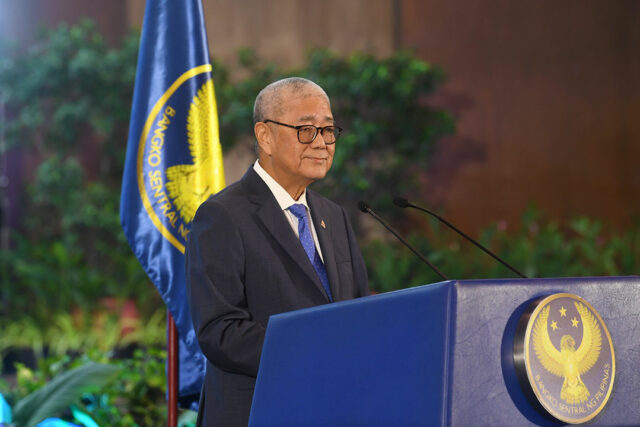
BANGKO SENTRAL ng Pilipinas Governor Eli M. Remolona, Jr. — BANGKO SENTRAL NG PILIPINAS

THE BANGKO SENTRAL ng Pilipinas (BSP) intends to further reduce the amount of cash that banks must have in reserve, but analysts said it may have to wait until inflation returns to the 2-4% target band first before adjusting the reserve requirement ratio (RRR).

BSP Governor Eli M. Remolona, Jr. has said the Monetary Board still plans to lower the banks’ RRR but is unsure when it will be implemented.

“I don’t think it makes sense to lower the reserve requirement while we’re still in the tightening mode. They are not consistent,” he said at a briefing after the Monetary Board’s policy-setting meeting on Aug. 17. “One is about inflation and the other one is more about the efficiency of the banking system.”

Last week, the Monetary Board extended its hawkish policy pause for a third straight meeting, keeping the key interest rate at 6.25% — the highest in nearly 16 years. 

The BSP has raised borrowing costs by 425 basis points (bps) from May 2022 to March 2023 to tame inflation. 

Adjusting the reserve requirement affects credit allocation in the banking system, Mr. Remolona said. 

The RRR is the portion of reserves that banks must hold onto rather than lending out.

In June, the BSP slashed the ratio for big banks and nonbank financial institutions with quasi-banking functions by 250 bps to 9.5%. It has also reduced the ratio for digital banks by 200 bps to 6% and by 100 bps for thrift banks, and rural and cooperative banks to 2% and 1%, respectively.

The BSP has brought down the RRR for big banks to a single-digit level this year from a high of 20% in 2018.

“Since there have been no signals on local policy rate cuts this year, there could be no immediate cut on banks’ RRR until inflation reaches the inflation target as early as fourth quarter of 2023 and for as long as monetary policy remains restrictive in the fight versus inflation,” Rizal Commercial Banking Corp. Chief Economist Michael L. Ricafort said, adding this is consistent with overall monetary policy.

The BSP, he said, will avoid inflicting any inflationary pressures, “since there would be no offsetting end of regulatory relief measures similar to June 30, 2023 during the last RRR cut that effectively created a net neutral monetary policy.”

When a bank is required to hold a lower reserve ratio, it has more funds to lend to borrowers. This increases the bank’s lending capacity, impacting its ability to support economic growth and meet the credit needs of individuals and businesses.

The RRR cuts in June coincided with the expiration of the BSP’s pandemic relief measures, which allowed banks to count their lending to small businesses as part of their compliance with the reserve requirement for deposit liabilities and substitutes.

Mr. Ricafort said that if the BSP further cuts the banks’ RRR once inflation is within the 2-4% target, the move will support monetary easing. 

“Any further cut in banks’ RRR would release more funds to the banking system that can increase lending activities and spur greater loan demand and faster economic growth,” he said.

Security Bank Corp. Chief Economist Robert Dan J. Roces likewise said cutting the RRR is one option for the BSP instead of policy rate cuts. 

Last week, after leading his first policy meeting as governor, Mr. Remolona said he does not see any policy easing at the next meeting as policy rates still support economic growth.

The Philippine economy expanded by 4.3% in the second quarter, the slowest in two years. For the first half, gross domestic product growth averaged 5.3%, below the government’s 6-7% target. — Keisha B. Ta-asan

Suspension of Manila Bay reclamation projects seen to discourage foreign investors

THE PHILIPPINE government earlier this month suspended reclamation projects in Manila Bay to assess their environmental and social impact. — PHILIPPINE STAR/EDD GUMBAN

THE SUSPENSION of the reclamation projects in Manila Bay may discourage the entry of more investments in the country, according to some business groups.

Philippine Chamber of Commerce and Industry President George T. Barcelon said the government’s recent move to halt reclamation projects in Manila Bay creates “unnecessary uncertainty” for investors.

“In the business world, a contract should be honored. If they (investors) see this, they would be concerned and they might step back. That is a concern. The other concern is if a lot of businesses are legitimate and we do something like that, other countries may also be concerned,” he told BusinessWorld via mobile phone.

President Ferdinand R. Marcos, Jr. earlier this month suspended all reclamation projects in Manila Bay, except for one, as the government reassesses their overall long-term impact on the environment.

The Department of Environment and Natural Resources (DENR) has not given a timeline for the completion of the review of the reclamation projects.

“The issue of inconsistent policy is one but stopping projects is something that will really terrorize possible investors… Now I think they will all disappear because of this,” Philippine Exporters Confederation, Inc. President Sergio R. Ortiz-Luis, Jr. said in an ANC interview on Aug. 19.

Mr. Ortiz-Luis said foreign investors have always been concerned about dealing with the Philippines due to inconsistent policies.

“That is why they choose Vietnam or Thailand. In the case of the reclamation, to advertise that we are halting (reclamation) projects is really damaging,” he added. 

Mr. Ortiz-Luis said Manila Bay reclamation projects would have provided more areas for expansion in Manila and Pasay.

“The reclamation can give spaces where the city can expand, bring new technology. The planned expansion will deescalate prices of land in the area. With the additional land that will be reclaimed, the price will stabilize and be more affordable,” he added.   

Mr. Ortiz-Luis urged the government to make a final decision on the issue of reclamation projects.

“The government has to decide… We cannot have this track record of rescinding contracts because it will destroy our credibility worldwide… It is unfortunate,” he said.

Meanwhile, Rizal Commercial Banking Corp. Chief Economist Michael L. Ricafort said investors would be concerned over the lack of policy certainty and the change in rules while projects are already being implemented.

“There should be a dispute mechanism through a special local court with quicker resolution as well as courts in the region, especially for foreign investors for the country’s various infrastructure projects that are long-term in nature and involves large amounts of capital,” he said in a Viber message.

“The faster the resolution is, the better.”

The US embassy previously expressed concern that a Manila Bay reclamation project was being undertaken by a China-owned company. China Communications Construction Co. was blacklisted by Washington in 2020, along with other companies after it allegedly assisted the Chinese military in building and militarizing artificial islands in the South China Sea. — R.M.D.Ochave

Travel will represent a $15.5-trillion global industry by 2033 — WTTC

Travel is set to become a $15.5-trillion industry by 2033, according to World Travel & Tourism Council. — BLOOMBERG

THE CROWDS of travelers filling airports in many parts of the world this summer are a telltale sign of what’s ahead for tourism.

By 2033, travel is set to become a $15.5-trillion industry — accounting for more than 11.6% of the global economy. This represents a 50% increase over its $10-trillion value in 2019, when travel represented 10.4% of the world’s gross domestic product.

The 10-year forecast comes from the World Travel & Tourism Council (WTTC), the leading advocacy group dedicated to quantifying the industry’s economic impact. Although it was released in May as part of a 2023 World Economic Impact report on travel, the data hasn’t circulated beyond a small set of industry executives until now.

The report breaks down the economic contributions of the world’s major tourism markets and reveals the top five most powerful travel and tourism economies as of 2022 in terms of GDP contribution. These remained the same as pre-2019: the US, China, Germany, UK and Japan, with Japan overtaking the UK in the most recent list. France, Mexico, Italy, India and Spain rounded out the top 10.

The report also includes figures on travel and tourism’s contribution to the labor market: As a whole, the industry will employ up to 430 million people by 2033, compared with 334 million in 2019. That accounts for roughly one of every nine jobs globally.

It’s not just that travel represents an enormous slice of the global economy, it’s also growing far faster than the economy at large.

“Economists are saying that the global GDP is going to grow on an annualized basis about 2.6% a year,” says Julia Simpson, president and chief executive officer at the World Travel & Tourism Council, speaking to Bloomberg from her office in New York. “In travel and tourism, we’re expecting [annual growth of] about 5.1%.”

Another projection from the WTTC points to big changes afoot, Ms. Simpson adds: Over the next 10 years, the US travel economy, which is the largest in the world in terms of its annual $2 trillion in total economic output, will lose its crown to China.

In 2033, China’s travel sector is forecast to contribute $4 trillion and will make up 14.1% of the Chinese economy. By contrast, the US industry is projected to reach $3 trillion and will represent 10.1% of the US economy. (These figures represent both the amount spent in-country by international visitors and how much citizens of each country spend on their own travel abroad.)

Pre-pandemic, Chinese travelers represented 14.3% of global outbound travel spending; their delayed return to international travel, thanks to extended border closures that only lifted in January 2023 and ongoing passport and visa processing delays, has hampered the rebound. But the rest of the world has compensated. Latin America, North America and Europe have driven a strong enough recovery, the WTTC’s report shares, that the industry expects to be almost back to 2019 levels by the end of this year.

Once Chinese travelers return in full force, which is expected by 2024, it will kick off another significant wave of growth for global tourism — with the Chinese share of global outbound travel spending predicted to reach 22.3% by 2033.

Despite overall economic uncertainty, people “really, really want to travel and they are prioritizing their spending on travel,” Ms. Simpson says, citing WTTC findings released on Aug. 15 in a separate nonpublic report on global trends.

Even the short-term outlook for travel paints a bullish picture. In data examining more than $63.6 billion in transactions, Virtuoso, a network of more than 20,000 luxury travel advisers, reported on Aug. 16 that its sales in the first half of 2023 resulted in a 69% uptick compared with 2019 levels. And with more people booking trips further out, the company is already seeing a 107% increase in sales for 2024 and early 2025, compared with what was on the books with similar advance notice in 2019 and early 2020.

Virtuoso’s data points to a spike in nature-based travel, including scientific expeditions with researchers to Antarctica and the Galapagos. The WTTC’s Ms. Simpson agrees, saying that while she’s noticed a real return to cities, there’s also increased appetite for lesser-known destinations, such as Bulgaria and Slovenia. “Travelers are getting more adventurous. They want to really try and see different places.”

These shifts plus bureaucratic hurdles have left the giant US industry lagging behind its competitors. But stateside jobs are on the rise. According to an as-yet unpublished WTTC report on America’s travel sector, the country will see 21 million people working in travel and tourism by 2033 — up from 17.5 million in 2019 — representing one in eight jobs across the country. — Bloomberg

Big firms post mixed results; banks lift earnings

BW FILE PHOTO

PHILIPPINE conglomerates reported mixed earnings results for the first half of the year amid market headwinds, but those with banking units came out stronger, analysts said.

“Corporate earnings for the top Philippine conglomerates in the first half of 2023 were mixed. Some companies reported strong earnings growth, while others, saw their earnings decline,” Globalinks Securities and Stocks, Inc. Head of Sales Trading Toby Allan C. Arce said in a Viber message.

Mr. Arce added that among the top listed firms, SM Investments Corp. and Ayala Corp. reported stronger earnings during the six-month period.

Carlos Angelo O. Temporal, senior equity research analyst for Unicapital Securities, Inc., likewise said noteworthy gains were observed from SM Investments and Ayala Corp., but GT Capital Holdings, Inc. stood out as it doubled its earnings.

“All three conglomerates benefitted from the robust performances of their banking units, which have continued to capitalize on elevated interest rates and sustained loan growth,” Mr. Temporal said in a Viber message.

He added that the companies also have property arms that “saw superb growths as residential revenues gain traction while cancellation rates significantly ease from last year’s lumpy figures.”

For the semester, GT Capital more than doubled its consolidated net income to P16.61 billion from P8.1 billion as its core businesses delivered better results.

GT Capital’s first-half earnings were primarily driven by an impressive increase in auto sales, which surged by about 50% year on year, accompanied by a substantial improvement in margins due to the relative stability of the peso.

Ayala Corp. booked an attributable net income of P18.41 billion for the first half, 13.2% higher than the P16.27 billion in the same period last year.

Mr. Temporal said the results were mainly due to ACEN Corp.’s profits, which were facilitated by the easing of fuel prices and the company’s shift to a net-selling merchant position in the spot market.

SM Investments saw a consolidated net income of P36.5 billion for the first half, reflecting a 32% increase from P27.7 billion, driven by solid consumer sentiment on the back of a positive economic environment.

Meanwhile, Mr. Temporal said these companies might face a couple of developing major headwinds: higher inflation due to rising oil prices and peso volatility.

“Resurgence in inflation from higher oil prices and other factors may lead to lower consumer demand across different sectors and higher input costs for companies,” he said.

He added that the peso’s volatility could result in “elevated interest expenses for entities with substantial dollar-denominated debt, reduced margins for net importers, and increased [capital expenditure] for companies relying on foreign-sourced materials and equipment.”

However, Mr. Arce said that these conglomerates with diversified portfolios that span multiple sectors might be better equipped to weather the challenges. — Adrian H. Halili

New barcode system seen to benefit supermarkets

FREEPIK

SUPERMARKETS are set to benefit from the planned adoption of a new barcoding system by 2025 as this would help make their operations more efficient, according to an industry group.

Philippine Amalgamated Supermarkets Association President Steven T. Cua said the upcoming shift to the quick response (QR) code matrix 2D barcodes from the 1D black and white vertical lines would boost the efficiency of retailers.

“The benefits include efficiency in transactions on the part of retailers,” Mr. Cua told BusinessWorld in a Viber message, citing “pertinent product information on the part of store merchandise buyers like place of origin, date of manufacture/harvest, date of expiration/spoilage, and customers (institutional/commercial users, smaller retailers and end-users).”

However, Mr. Cua said the new price coding system would require a change in the software and hardware used by supermarkets.

He added that it would take longer for smaller retailers to implement the new barcode due to the required capital outlay unless service providers would introduce installment payment programs. 

“Supermarkets are totally unprepared for this given an overhaul in this price-capturing system. There is, after all, a need for advanced scanning technology/software requiring totally new hardware,” Mr. Cua said.

“The new price coding system using the QR Code requires a total change of software and hardware to capture the more comprehensive data of manufactured products and fresh produce. The sooner retailers jump into the fray to create volume for software and hardware providers, the cheaper the technology becomes available to retailers,” he added.

Meanwhile, Mr. Cua said the economy would also benefit from the shift to the new barcoding system since it would be implemented globally by 2025.

Mr. Cua said that since the global system will be uniformly implemented worldwide — much like the current barcode system — the country should adopt it “to make trade and merchandising of products hailing from anywhere in this planet easy to understand, monitor and acceptable.”

He added that local food retailers “will have to swallow the bitter pill” and shift or adopt the “new economic order within the next few years or be left behind in serving the demands of evolving consumers.” 

The Philippine Retailers Association previously said that the new barcoding system would be trialed in the country by the first quarter of next year ahead of the upcoming global implementation. Both 1D and 2D barcodes will be used in the first two years of implementation to allow a transition period for retailers and manufacturers. 

Some of the expected benefits of the new barcode include better traceability with more available information and more consumer-friendly as the QR code also contains other product information that could be accessed by consumers. — Revin Mikhael D. Ochave

LIONSGATE Play stabilizes subscriber base in Southeast Asia

LIONSGATE Play, the global streaming service of entertainment company Lionsgate, is planning to stabilize its subscriber base in Southeast Asia this 2023 by seeking out mobile and broadband partnerships in the region and continuing to provide adrenaline-fueled action and suspense content.

“We launched in the Philippines last year and we’re very happy having partnered with broadband service provider PLDT. The awareness of our streaming platform among PLDT users is 70% upwards,” said Amit Dhanuka, Lionsgate Play’s Executive Vice President for South Asia and Southeast Asia, at a media event in August.
“Asia is a significant contributor to the app’s growth even though we only entered the market in 2019,” he said, adding that it grew four or five times during its first year in the Philippines.

Lionsgate Play is hoping to be the biggest provider of the content they specialize in, which are “edgy, provocative, thrilling” action films and TV series, according to Mr. Dhanuka. Known titles on the platform include The Hunger Games, the Twilight saga, John Wick, Saw, and Mad Men. It also streams awards shows like the Emmys and the Golden Globes. Its latest offering is an espionage drama called Gray, which premiered exclusively in the Philippines on Aug. 18. New titles are added every Friday.

PLDT HOME PARTNERSHIP
Lionsgate Play Philippines’ country manager Ma. Cecilia Marino said that their exclusive partnership with PLDT Home gives Fiber users full access to the platform. “We can really deliver compelling stories to the Filipino audience by building partnerships with mobile and broadband,” she said. Mr. Dhanuka added that once the subscriber base is stable, they will consider producing more local content for the Philippines.

“We have around 20 million subscribers globally and we expect Southeast Asia to be crucial in growing that number,” said Mr. Dhanuka.

Early in August, Lionsgate Play even rebranded its service in the region, changing to a multicolored iridescent design and upgrading the look and interface of the app. The rebranding is meant to show that the platform’s content has “the variation of a prism,” according to Ms. Marino. Its app rating on the Play Store is currently at 4.0 stars.

For more information, visit https://pldthome.com/lionsgateplay. Hastings Holdings, Inc., a unit of PLDT Beneficial Trust Fund subsidiary MediaQuest Holdings, Inc., has a majority stake in BusinessWorld through the Philippine Star Group, which it controls. — Brontë H. Lacsamana

Bucking headwinds: Landlords and tenants navigate an evolving work landscape in PHL

STOCK PHOTO | Image by Adolfo Félix from Unsplash

LIKE the Philippine property market in general, Colliers is seeing positive trends for the Metro Manila office market.

Occupiers can benefit by re-thinking their workplace as an investment that can help achieve their company’s vision and goals. In our view, the office can be maximized not only in terms of space utilization but also in terms of its value in talent recruitment and retention, and how it can align both employee and company values.

Metro Manila saw a marginal decline in office vacancy due to improved transaction activity and a slowdown in non-renewals in the first half of 2023.

Uneven recovery in rents is still being experienced across Metro Manila submarkets, with rental recovery noted in Makati central business district (CBD), Fort Bonifacio and Ortigas CBD.

Net absorption for the second quarter has improved, mainly driven by higher transactions volume coupled with the slowdown in vacated spaces.

With these new developments in the market, we project a higher net take-up by year-end. However, vacancy is still expected to remain elevated with more supply coming online in the latter part of 2023.

Colliers believes that landlords and tenants should continue seizing opportunities given the current tenant-leaning market. Occupiers may consider implementing flight-to-value or incorporate flex workspace in their real estate strategies.

With the increased interest in ESG (environmental, social, and corporate governance) and DE&I (diversity, equity, and inclusion), landlords can work with tenants on office renovations and incorporate these elements within building amenities and common areas to help align corporate and employee values.

INVEST IN A WORKPLACE THAT ‘WORKS’
Amid the ongoing transformation of the workplace and the workforce, occupiers should facilitate continuous dialogue with their stakeholders to determine how best they work and what can retain and attract talent to the organization.

Occupiers continue to see the office as critical to employee engagement, especially for new hires. More are using the office as a recruitment tool and training floor, as it now becomes a company’s platform to encourage people to come together.

With the renewed interest in DE&I and ESG, occupiers should consider these in their real estate strategies. Reflecting this in workplace strategy and design helps in differentiating the company and ensures talent retention.

CONSIDER PROVINCIAL STRATEGY TO CLOSE GAP BETWEEN WFH AND RTO
One of the major employee concerns on return to office (RTO) is the cost of moving back to their Metro Manila head offices. Implementing full RTO increases the risk of employee attrition, which can be costly for companies.

To address this, opening sites in provincial areas may be a viable strategy to address the gap between work from home (WFH) and RTO for employees.

SUBSTANTIAL SUPPLY FOR 2ND HALF 2023
In the second quarter of 2023, Colliers recorded the delivery of 80,400 square meters (852,200 square feet) of new office space, with the completion of Primex Tower in San Juan and Parqal Buildings 1-9 in the Bay Area.

In 2023, Colliers expects the completion of 668,400 sq.m. (7.2 million sq.ft.), higher than our previous estimate of 569,100 sq.m.  (6.1 million sq.ft.) as some landlords are on track to meet their buildings’ completion timelines to accommodate upcoming demand.

We project 538,900 sq.m. (5.8 million sq.ft.) of additional supply coming online in the second half of 2023, with Fort Bonifacio, Ortigas CBD and Quezon City likely accounting for nearly two-thirds of the new supply.

Meanwhile, 402,000 sq.m. (4.3 million sq.ft.) in the pipeline were put on hold or shelved by developers as of the first half of 2023, higher than the 166,000 sq.m. (1.8 million sq.ft.) in the first quarter of 2023. In our view, these projects may be redeveloped or reactivated by developers in the future.

From 2023 to 2025, Colliers sees the completion of 492,400 sq.m. (5.3 million sq.ft.) annually. This is only half of the one million sq.m. (10.8 million sq.ft.) completed annually from 2017 to 2019, a period wherein office completion was heavily influenced by the Philippine Offshore Gaming Operators’ (POGO) demand.

TRANSACTIONS DOWN 5%
In the first half of 2023, office deals in the capital region reached 306,000 sq.m. (3.3 million sq.ft.), down 5% year on year. Traditional firms including government agencies, telcos, insurance firms, and flexible workspace operators logged transactions of 125,700 sq.m. (1.4 million sq.ft.).

In the second quarter of 2023, outsourcing and shared services firms dominated transactions with 73,000 sq.m. (785,500 sq.ft.) of closed deals. Colliers has observed that most outsourcing firms are still actively expanding and are employing flight-to-value strategies despite hybrid work arrangements, transferring to new, high-quality towers in Makati CBD, Fort Bonifacio, and Ortigas Center.

Per submarket, the Bay Area, Ortigas CBD and Makati CBD recorded the largest volume of transactions in the first half of 2023, covering 57% of total office deals in Metro Manila.

Among the notable transactions in the first half of 2023 include spaces leased by Telus, 24/7 Intouch and Reed Elsevier in Quezon City; IGT Solutions in Alabang; Chevron and Opentext in Makati CBD; and Transparent BPO and the Department of Transportation (DoTr) in San Juan City.

SUSTAINED PROVINCIAL DEALS
Office transactions in key provinces rose quarter on quarter as deals in the first quarter of 2023 reached 60,400 sq.m. (649,900 sq.ft.), from 29,300 sq.m. (315,300 sq.ft.) a quarter ago.

In the first half of 2023, these deals totaled 89,700 sq.m. (961,900 sq.ft.), a marginal drop from the 90,700 sq.m. (975,900 sq.ft.) recorded a year ago. Cebu accounted for 48% of total provincial deals, mostly from outsourcing firms, followed by Pampanga (26%) and Davao (11%).

Colliers is optimistic that gains in the Metro Manila office sector will be sustained for the remainder of the year. The profile of tenants occupying physical space remains diverse while key office hubs outside Metro Manila continue to record transactions. Optimistic business sentiment and robust macroeconomic growth forecast should support firms’ expansion over the next 12 months.


Kevin Jara is the associate director for office services — tenant representation at Colliers Philippines.

AllHome, AllDay set to resume store expansion

BW FILE PHOTO

LISTED companies AllDay Marts, Inc. and AllHome Corp. are set to begin expanding their retail stores starting next year, its top official said.

“By next year, we will resume our expansion. We will start the expansion of AllDay and AllHome,” Manuel B. Villar, Jr., the companies’ chairman, told reporters in a recent briefing.

Mr. Villar said the companies’ expansion efforts would begin with smaller freestanding projects.

“Smaller siya pero pareho pa rin, freestanding pero mas maliit,” he said.

(It’s much smaller but still the same as previous projects, freestanding but smaller.)

He added that the Villar group’s retail businesses were largely affected by lower foot traffic mainly attributed to the pandemic.

“We will come back strongly next year,” he said. “Most of our [retail businesses] are mall-based.”

Both companies said earlier that part of the proceeds from their initial public offering would be used for store expansions, with the rest for debt repayment and capital expenditures.

AllDay conducted its maiden listing on the Philippine Stock Exchange in 2021, while AllHome held its market debut in 2019.

For the second quarter, AllHome reported an 8.1% decline in attributable net income to P229.85 million from P250.02 million, mainly attributed to higher expenses by 3.8% to P2.75 billion.

Its top line for the three-month period inched up by 3% to P3.12 billion from P3.03 billion in the same period last year.

Meanwhile, AllDay’s attributable net income for the second quarter fell by 4.4% to P83.40 million from P87.21 million a year ago.

Its revenues rose 6.8% during the April-to-June period to P2.46 billion from P2.30 billion in the same period last year.

The company’s first-half attributable income surged to P171.97 million, a significant rise from P11.63 million a year earlier.

Last Friday, AllDay shares went up by 0.6% or P0.001 to P0.169 apiece while AllHome shares rose by 1.25% or two centavos to P1.58 apiece last Friday. — Adrian H. Halili