Home Blog Page 4236

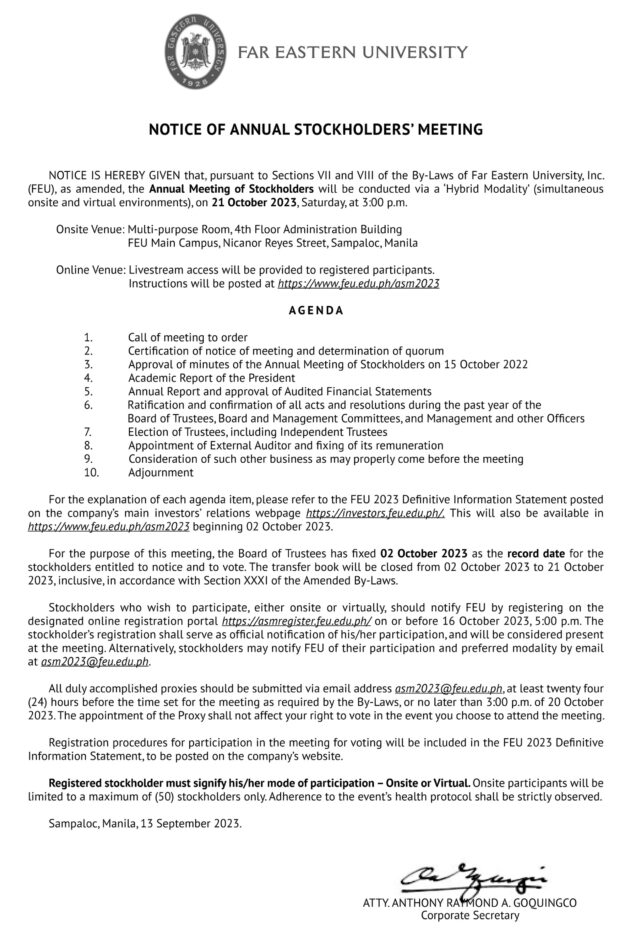
Far Eastern University, Inc. to conduct 2023 Annual Meeting of Stockholders on Oct. 21


Spotlight is BusinessWorld’s sponsored section that allows advertisers to amplify their brand and connect with BusinessWorld’s audience by enabling them to publish their stories directly on the BusinessWorld website. For more information, send an email to online@bworldonline.com.

Join us on Viber at https://bit.ly/3hv6bLA to get more updates and subscribe to BusinessWorld’s titles and get exclusive content through www.bworld-x.com.

Girls avoid internet due to abuse and bias, report warns

TRUSTPAIR.COM

Deeply entrenched gender norms, biases, and perceptions are affecting the ability of girls and young women to use the internet, influencing their online activity and hurting their access to information and work, a new report has found.

A survey of more than 10,000 users aged 14-21, and their parents, in over half-a-dozen countries including Ethiopia, Kenya, Nigeria, Tanzania, and India, found that girls are constantly being monitored and told they are vulnerable and not competent online, “creating a crisis of confidence.”

“This is resulting in girls setting up more protections and behaving more conservatively when connecting with others and sharing personal information online,” said the report by nonprofit Girl Effect, the Malala Fund, the United Nations’ children’s agency United Nations Children’s Fund (UNICEF), and the Vodafone Americas Foundation.

“These attitudes are not just impacting girls’ access and usage, they are influencing their self-confidence and shaping their own perceptions of their ability to use these tools to pursue their social, educational, and intellectual interests,” said the report.

The gender digital divide has persisted despite efforts by governments worldwide. A UNICEF study earlier this year showed that in 54 countries, the median gender parity ratio is 71, meaning that for every 100 adolescent boys and young men who use the internet, only 71 adolescent girls and young women do.

At the same time, women experience more online abuse, and harassment is driving girls to quit social media platforms such as Facebook and Instagram, recent studies have found.

Among digitally connected youth, 12% more girls than boys said that they feel self-conscious while using social media, and are 11% less likely to post photos or comments online compared to boys of the same age, the report by Girl Effect found.

VICIOUS CYCLE
As girls’ exposure to the internet is restricted by biases and fear of abuse, they do not see themselves as tech-savvy, and do not see the internet as something that is for them, the report from Girl Effect said.

“This creates a vicious cycle whereby girls avoid tech because they don’t think it’s for them, and then tech is seen as ‘not for them’ because they have been avoiding it,” it said.

As teenagers who scrutinize, regulate, and limit their behavior online, women “often carry these traits to their workplace, where they face difficulties in demonstrating their skills and building strategic connections,” said Mitali Nikore, a gender policy specialist at research group Nikore Associates.

“This negatively affects women’s behaviour at workplaces, constraining their labour market opportunities and professional advancement… and their access to potential sources of revenue-generating activities,” Nikore told the Thomson Reuters Foundation. 

Besides better smartphone access for girls and young women, digital literacy programs and an end to discrimination based on gender norms are needed, said Ms. Nikore.

Girls must also be involved in creating digital products for their needs, said a spokesperson for Girl Effect.

For example, Girl Effect developed artificial intelligence-enabled chatbots in South Africa and India — Big Sis and Bol Behen (“tell me, sister”) — with girls, as a source of accurate information on general health and sexual well-being for girls.

While new laws such as Britain’s Online Safety Act and the proposed Kids Online Safety Act in the United States can help protect children somewhat, “regulations can only go so far, and often lag behind technological advances,” the spokesperson for Girl Effect said.

“Adolescent girls and young women want to be involved in co-creating solutions; they have clear ideas for the functions, experiences, and strategies that could be applied to make the internet a safer, more accessible place.” — Thomson Reuters Foundation

Chelsea launches travel booking app

CHELSEA Logistics and Infrastructure Holdings Corp. launched on Wednesday an all-in-one travel booking app for its subsidiaries Starlite Ferries, SuperCat, and Trans-Asia Shipping Lines.

“The Chelsea Travel App, powered by Outsystem, is focused on innovations that aim to make booking more convenient, reliable, and satisfying not only for our passengers but also for our back-end users who are tasked to diligently review and validate an average of 300 transactions daily,” Chelsea Logistics Information Technology Head Efren M. Bernardino said in a media release on Wednesday.

The company said its app features a group booking option and self-service booking management.

Chryss Alfonsus V. Damuy, president and chief executive officer of Chelsea Logistics, said the group will continue enhancing its services “to make our valued passengers happy and satisfied with their travel experience.”

“We believe that sea travel is not only a mode of transportation, but also a way of discovering new places, cultures, and perspectives. That’s why we are constantly investing in our fleet, our crew, and our techno,” he added.

Chelsea Logistics is the listed shipping and logistics arm of Udenna Corp.

For the second quarter, it trimmed its attributable net loss to P106.83 million from the P587.63 million loss recorded a year ago, lifted by an increase in the company’s revenues for the period.

For the April-to-June period, its gross revenue increased to P1.87 billion, higher by 16.1% than the P1.61 billion a year ago

At the local bourse on Wednesday, shares in the company gained two centavos or 1.69% to end at P1.20 apiece. — Ashley Erika O. Jose

US judge throws out Texas ban on drag acts, calls it unconstitutional

A FEDERAL judge in Texas ruled on Tuesday that the state’s new law limiting public drag performances was an unconstitutional restriction on speech and he permanently forbids enforcement of it.

“Not all people will like or condone certain performances,” US District Judge David Hittner wrote. “This is no different than a person’s opinion on certain comedy or genres of music, but that alone does not strip First Amendment protection.”

More than a dozen states have sought to restrict drag shows over last year, with Texas one of at least four to pass restrictions into law, part of broader Republican efforts to regulate the behavior of LGBT people.

Mr. Hittner ruled that the Texas law was discriminatory and improperly vague. He said drag performances were not inherently obscene, and were the sort of expressive speech protected by the US Constitution’s First Amendment.

Drag performers and Pride march organizers joined the American Civil Liberties Union in a lawsuit in Houston’s federal court seeking to block the law. Modern drag has roots in musical and dance performances in LGBT venues.

The office of the Texas attorney general defended the law, which, among other restrictions, banned “the exhibition of sexual gesticulations using accessories or prosthetics that exaggerate male or female sexual characteristics” in public, or in venues where people under 18 may see it. Violations could be punished by fines and a jail sentence of up to one year.

Texas lawmakers said the law was needed to protect children from seeing “sexually explicit” content.

Opponents of the law said it was so broad that it appeared to criminalize acts by pop stars and cheerleaders, and that it was explicitly intended to target LGBT performers.

Other federal judges in Tennessee, Florida, and Montana have blocked similar new drag restrictions, finding similar free-speech violations. — Reuters

Philippines 25th globally in organized crime list

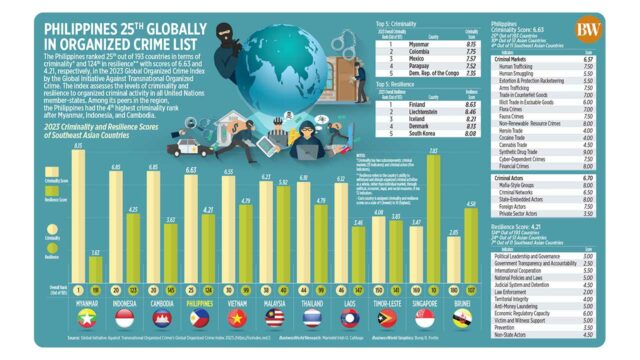
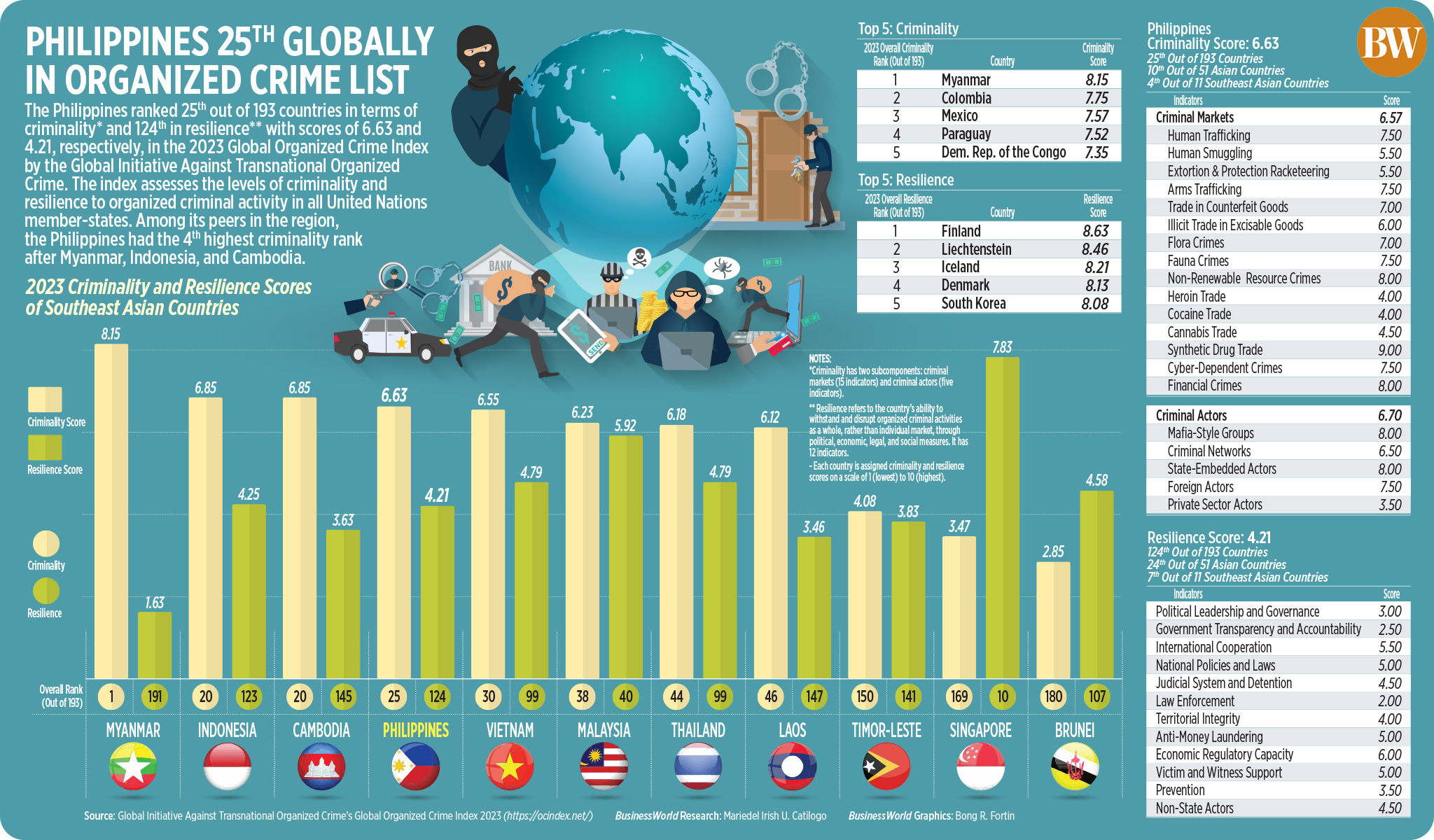
The Philippines ranked 25th out of 193 countries in terms of criminality* and 124th in resilience** with scores of 6.63 and 4.21, respectively, in the 2023 Global Organized Crime Index by the Global Initiative Against Transnational Organized Crime. The index assesses the levels of criminality and resilience to organized criminal activity in all United Nations member-states. Among its peers in the region, the Philippines had the 4th highest criminality rank after Myanmar, Indonesia, and Cambodia.

Philippines 25<sup>th</sup> globally in organized crime list

How PSEi member stocks performed — September 27, 2023

Here’s a quick glance at how PSEi stocks fared on Wednesday, September 27, 2023.


Marcos to hear data-based arguments on rice price cap

PHILIPPINE STAR/EDD GUMBAN

By Luisa Maria Jacinta C. Jocson, Reporter

PRESIDENT Ferdinand R. Marcos, Jr. will meet next week with the National Economic and Development Authority (NEDA) to discuss the possible lifting of the price ceiling on rice, NEDA Secretary Arsenio M. Balisacan said.

“We’ll more likely meet again next week because (Mr. Marcos) did say he wants us to meet again and see the numbers, see the indicators, see the outcomes versus the objectives of the price cap and then we’ll make a decision,” Mr. Balisacan said in chance remarks to reporters in Manila on Wednesday.

“But we all recognize there are so many moving parts, and this price cap could not be expected to last very long because that creates a lot of problems,” he added.

Price caps on rice have been in force since Sept. 5 to address rising prices. The ceiling has been set at P41 per kilo for regular-milled rice and P45 per kilo for well-milled rice.

“What we want to see now is the lifting soon of the price cap. The President will announce that once we have all the information that he is asking us to show (and) to study the indicators that would be useful to inform that decision, hopefully in the next, in a week or so, maybe we can come up with those indicators and the President can make a decision,” he added.

Separately, Mr. Balisacan said that the proposed tariff cut on rice imports is no longer needed amid improving market conditions.

“The risk of further price increases on the world market seems to be diminished compared to the situation we were looking at a month or two ago. So that is the context” behind the President’s decision not to consider a reduction in the tariff, he said.

“Again, what you would want to do is reduce the tariff when world rice prices are increasing; increase the tariff when the world prices are decreasing to stabilize local prices and… protect our local producers, rice farmers in this particular case, and also protect our consumers, particularly the poor, and also address inflation,” he added.

Mr. Marcos late Tuesday announced that he rejected proposals to temporarily reduce rice tariffs.

“We decided with the agriculture and economic managers that… it was not the right time to lower the tariff rates because the projection of world rice prices is that it will go down. So, this is not the right time to lower tariffs,” Mr. Marcos was quoted as saying in a statement.

NEDA and the Department of Finance (DoF) earlier proposed the temporary reduction of rice import tariffs to lower domestic prices. The DoF in particular proposed to slash the 35% rice import tariff to zero percent or maximum of 10%.

Peso inches up before US economic data

BW FILE PHOTO

THE PESO inched up versus the dollar on Wednesday on expectations of a weak US durable goods report overnight.

The local currency closed at P56.95 versus the dollar on Wednesday, rising by half a centavo from Tuesday’s P56.955 finish, data from the Bankers Association of the Philippines’ website showed.

The local unit opened Wednesday’s session stronger at P56.90 per dollar. Its intraday best was at P56.87, while its weakest showing was at P56.98 against the greenback.

Dollars traded rose to $1.35 billion on Wednesday from the $1.06 billion on Tuesday.

“The peso appreciated slightly ahead of a potentially downbeat US durable goods report,” a trader said in an e-mail.

The US Census Bureau was scheduled to release the data overnight.

The peso inched up on Wednesday after President Ferdinand R. Marcos, Jr. rejected a proposal to temporarily reduce tariffs on imported rice and the ceiling on rice prices, which could have helped stabilize inflation, Rizal Commercial Banking Corp. Chief Economist Michael L. Ricafort likewise said in a Viber message.

Mr. Marcos turned down his economic managers’ proposal as he said that projections show that world rice prices would go down.

The National Economic and Development Authority (NEDA) had proposed to cut the tariff rates to as low as 0% from 35%.

During the Tuesday meeting, NEDA Secretary Arsenio M. Balisacan and Agriculture undersecretaries Leocadio Sebastian and Mercedita Sombilla “agreed that it was not the right time to lower tariff rates because of the downtrend in rice prices in the world market,” the presidential palace said.

At the meeting, the President said the executive order that set a price cap of P45 a kilo for well-milled rice and P41 for regular milled rice would remain in effect.

Headline inflation rose to 5.3% in August from 4.7% in July.

Year to date, inflation averaged 6.6%, still well above the central bank’s 2-4% target for the year.

For Thursday, the trader sees the peso moving between P56.80 and P57 per dollar, while Mr. Ricafort sees it ranging from P56.78 to P56.98.

Meanwhile, the dollar scaled a 10-month high against its major peers on Wednesday, pushing the euro and sterling to 6-month lows and keeping the yen deep in intervention territory, as the prospect of higher-for-longer US rates gripped markets, Reuters reported.

The euro was last 0.1% lower at $1.0567, after hitting a six-month low of $1.0555 earlier in the session. The single currency is on track to lose more than 3% for the quarter, its worst quarterly performance in a year.

Sterling was also down 0.1% at $1.2149 after hitting a six-month trough of $1.2135 earlier on Wednesday, and was headed for a quarterly loss of more than 4%.

The US dollar index, meanwhile, peaked at a 10-month high of 106.32.

Fed officials have in recent days flagged the possibility that the central bank would need to raise interest rates further, after it kept rates steady last week but stiffened its hawkish monetary policy stance. — AMCS with Reuters

High prices to continue as Palace rejects tariff cuts on rice imports

PHILSTAR FILE PHOTO

THE administration’s rejection of a proposal to lower tariffs on imported rice will keep the commodity expensive, with the government dependent on foreign rice to stabilize the domestic supply of the staple, a government researcher said.

Roehlano M. Briones, a senior research fellow at the Philippine Institute for Development Studies (PIDS), said the rejection of lower tariffs “will make imported rice more expensive.”

“The tariff keeps the already elevated price of foreign rice high,” he said via phone, noting that the Philippines now has “narrower options” in terms of mitigating the shortage in domestic rice.

He said the government needs to focus on “more innovative and productivity-improving agriculture and value chain intervention” to ultimately lower costs.

Instead of incentivizing farmers to make themselves more competitive in world markets, “we are conditioning them to expect increasing protection and increasing subsidies,” he added.

Leonardo A. Lanzona, who teaches economics at the Ateneo de Manila, said the existence of price controls at both the retail and farmgate level makes the proposed reduction of tariffs irrelevant.

“In fact, the huge harvests now mean that none of these government regulations was needed in the first place,” he said in a Facebook Messenger chat. “They should just have left the market alone, and there would not have been any dilemma about the tariff rates.” 

Mr. Lanzona noted that “in the guise of populism,” the government has just “gone back to the inefficient system of reinstating the National Food Authority,” whose power had been reduced by the Rice Tariffication Law of 2019, and “promoting extensive government interference, institutions that were dismantled after Martial Law.”

Dante B. Canlas, a former chief economic planner for the Arroyo administration, said lowering the duties on rice imports throws Philippine rice farmers under the bus twice: “cheap imports put local farmers at a disadvantage (while) duties on rice imports under the law finance Rice Competitiveness Enhancement Fund (RCEF),” referring to the tariff-funded program to modernize farming practices.

“If RCEF declines, that’s putting rice farmers at a disadvantage again,” he said in a Viber message.

Farmers said they recognize the rejection of the tariff cuts as a win for the industry.

Raul Q. Montemayor, national director of the Federation of Free Farmers, rejected the need to cut tariffs or to import large volumes of rice at the moment because “the harvest is about to peak.”

“We are happy about the decision,” he said in a Viber message, after the Palace ruled out the tariff reduction proposal put forward by economic managers.

Even if the Philippines does not import rice until the end of December, “we will still end up with about 65 days’ equivalent of stocks for carryover to next year,” he said.

Mr. Montemayor said the more immediate concern now is the possible move of President Ferdinand R. Marcos, Jr.’s economic advisers to extend or make permanent the tariff cuts on non-ASEAN rice, corn and pork under Executive No. 10, which will lapse at the end of the year.  

“And we will still have to prepare for the effects of El Niño and possible supply tightening again come July-September next year, through a combination of expanded local production and managed imports,” he noted.

The President’s economic team had proposed to cut the tariff on imported rice to as low as 0% from 35%.

But Mr. Marcos, according to a Palace statement issued on Tuesday night following a meeting with Cabinet officials said, “it was not the right time to lower the tariff rates because the projection of world rice prices is that it will go down.”

The Palace said National Economic and Development Authority Secretary Arsenio A. Balisacan and Agriculture undersecretaries Leocadio Sebastian and Mercedita Sombilla support the President’s decision.

Mr. Marcos, meanwhile, said at the same meeting that the executive order that capped rice retail prices at P45 a kilo for well-milled rice and P41 for regular-milled rice will remain in effect.

“Let’s study it carefully,” he said, referring to the order that took effect on Sept. 5.

Mr. Marcos has said that the supply of rice is adequate, blaming smugglers and hoarders for increasing prices.

Output of palay, or unmilled rice, hit 4.25 million metric tons (MT) in the second quarter, against 4.2 million MT a year earlier. — Kyle Aristophere T. Atienza


PHL, neighbors studying Palawan-Borneo power link

DOE.GOV.PH

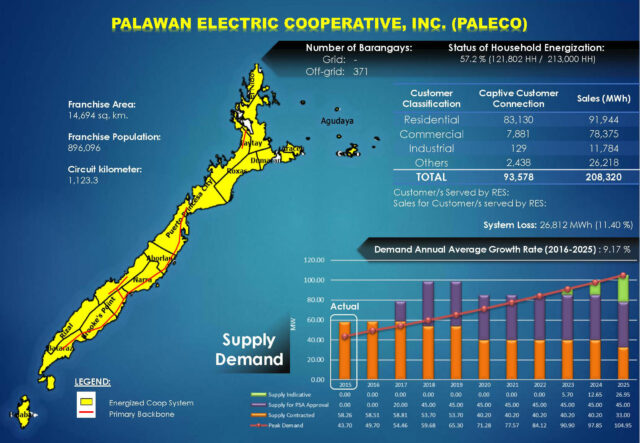
THE PHILIPPINES and its neighbors are conducting a feasibility study on a power transmission project that will connect Palawan with northern Borneo, the Department of Energy (DoE) said on Wednesday.

“It has already been shown to be feasible in the continental ASEAN. That’s why they want to do it also,” Energy Secretary Raphael P.M. Lotilla told reporters, referring to the possibility of connecting archipelagic Southeast Asia.

Mr. Lotilla added that the power transmission link between Palawan and Borneo — an island shared by Malaysia, Brunei, and Indonesia — could eventually connect to Singapore.

“This is one of the things that actually Singapore is interested in, which is to diversify its own sources of power,” he said.

“But that means that they are looking forward to the Philippines’ developing its renewable sources, particularly onshore wind. By the time we are able to produce excess renewable energy from offshore wind, they will be interested in sourcing power even from the Philippines,” he added.

He said the feasibility study falls under a pilot program known as the Brunei Darussalam, Indonesia, Malaysia, and the Philippines Power Integration Project (BIMP PIP).

“If the Australians can dream of laying out submarine cables to deliver their electricity to Singapore, what more for the Philippines,” Mr. Lotilla added.

Mr. Lotilla said the BIMP PIP working group will assess the potential project, and examine the technical, policy, regulatory, legal, commercial, and capacity-building issues relating to cross border power links.

Separately, Energy Undersecretary Rowena Cristina L. Guevarra said that the DoE hopes to connect Mindoro Island to the Luzon Grid by 2025.

Ms. Guevarra said that the National Grid Corp. of the Philippines (NGCP) has committed to complete the project in two years.

“The DoE requested them (to expedite the power link)… They can do it. NGCP is cooperative,” she said.

She said the power link will land on the Luaon side in Batangas province.

The universal charge for missionary electrification could fall 20% once Mindoro is connected to the Luzon grid, Ms. Guevarra said. — Sheldeen Joy Talavera

PHL seeking to expand World Bank loan for digital transformation

REUTERS

THE PHILIPPINES is seeking to increase the size of a digital transformation development loan to $600 million from $400 million, the World Bank said.

The loan aims to support government reforms to “foster an enabling environment for greater digital technology adoption by improving digital transformation of government and digital infrastructure policies, expanding financial inclusion through digital finance and boosting business growth in digital services,” the bank said on its website.

In March, the World Bank indicated that the Philippines was initially seeking $400 million for the digitalization program.

“Digitalization has the potential to drive productivity-led growth by reducing operating costs for firms and enhancing their resilience and preparedness for future crises,” the World Bank said.

The loan will finance measures that will improve digital government service delivery and pro-competition infrastructure policy; expand financial inclusion through digital finance; and boost business growth in digital services.

As of March 2022, the World Bank was the country’s third-largest source of official development assistance (ODA), accounting for around 23.38% of the total ODA portfolio. — Luisa Maria Jacinta C. Jocson

PSE index extends rally on improved sentiment

BW FILE PHOTO

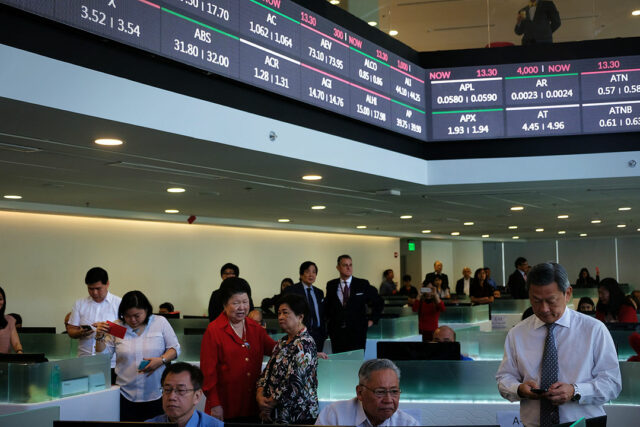
PHILIPPINE SHARES continued to climb on Wednesday as investors picked up bargains and amid improved market sentiment.

The Philippine Stock Exchange index (PSEi) went up by 110.74 points or 1.76% to end at 6,374.68 on Wednesday, while the broader all shares index rose by 51.50 points or 1.53% to 3,412.88.

“The local bourse surged by 110.74 points (1.76%) to 6,374.68, thanks to continued buying of local investors amid optimism towards the fourth quarter. Investors are also taking the opportunity to buy shares at bargain levels,” Philstocks Financial, Inc. Research Analyst Claire T. Alviar said in a Viber message.

“Today’s upward market movement can be attributed primarily to a substantial rebalancing event that triggered changes in index composition, closely watched by investors,” Seedbox Securities, Inc. Equity Trader Moses Frando said in a social media message on Tuesday.

Effective Tuesday, Bloomberry Resorts Corp. and Century Pacific Food, Inc. became part of the main index, replacing Aboitiz Power Corp. and Metro Pacific Investments Corp.

He added that sentiment improved as the Securities and Exchange Commission (SEC) said it supported a proposed measure lowering the stock transaction tax.

The SEC on Tuesday said it supports House Bill (HB) No. 9277, which seeks to lower the stock transaction tax to 0.1% from the current rate of 0.6%.

The measure also aims to reduce the tax dividends of foreign nonresidents to 10% from 25%.

HB 9277, which is pending at the committee level, is a substitute bill to HB 8958 filed by Albay Rep. Jose Ma. Clemente S. Salceda on Aug. 23. HB 8958 also proposed lower taxes on stock transactions to encourage greater participation of local and foreign investors in the Philippine capital market.

“The market displayed robust activity, marked by a strong rally that propelled the PSEi to close at its resistance level of 6,374. This resulted in a surge of interest among investors looking for undervalued opportunities…,” Mr. Frando added.

Value turnover went down to P6.73 billion on Wednesday with 764.54 million shares changing hands from the P35.16 billion with 6.41 billion shares seen on Tuesday.

All sectoral indices rose on Wednesday. Financials gained 41.55 points or 2.27% to end at 1,864.86; holding firms went up by 105.98 points or 1.78% to 6,058.11; industrials rose by 119.68 points or 1.34% to 9,042.69; services climbed by 18.77 points or 1.25% to 1,516.82; property increased by 30.53 points or 1.17% to 2,637.75; and mining and oil added 60.84 points or 0.58% to close at 10,506.67.

Advancers outnumbered decliners, 118 versus 74, while 42 shares closed unchanged.

Net foreign selling declined to P301.32 million on Wednesday from P15.20 billion on Tuesday. — SJT