Home Blog Page 386

SM-backed NU says hiring strategy aims to address brain drain

NU Cebu — SM INVESTMENTS CORPORATION

NATIONAL UNIVERSITY (NU), backed by the SM Group, said it is focusing on hiring local talent in regional areas to help address brain drain in the country.

In a statement on Tuesday, SMIC said 96% of employees at NU Bacolod are local hires, while NU Laguna has 99% local employees. NU Cebu, which opened this academic year, has a 100% local hire rate.

Other campuses also reported high local employment: NU Baliwag at 98%, NU Dasmariñas at 96% with 4% transferees, NU Lipa at 98%, and NU Clark at 97%.

NU President and Chief Executive Officer Renato Carlos H. Ermita, Jr. said the university implements a standardized salary matrix nationwide to attract and retain employees.

“By allowing the campus to be a part of the SM community, accessibility is achieved and affordability is maintained,” he noted.

The company stressed the importance of strengthening local ecosystems for work and enterprise to reduce the inequality gap between urban and rural areas.

NU campuses in regional areas help retain local talent and ensure contributions to the local economy, it said.

Mr. Ermita added that most NU campuses are located near transport hubs, providing convenience for both students and staff.

Currently, NU serves 84,000 students across 14 campuses nationwide, including the main campus and the Nazareth School in Sampaloc, Manila, and campuses in Mall of Asia, Pasay; Fairview, Quezon City; East Ortigas, Pasig; Calamba, Laguna; and Lipa, Batangas.

NU plans to reach 100,000 students by 2027, with new campuses scheduled to open in Davao, Iloilo, and Urdaneta.

The SM group acquired majority ownership of NU in 2008, when the university was experiencing low enrollment.

SMIC reported a 6% increase in nine-month consolidated net income, driven by growth in its banking, property, and retail businesses.

At the local bourse on Tuesday, SMIC shares rose 1.56%, or P11, to close at P716 each. — Beatriz Marie D. Cruz

Peso falls on Trump’s Korea tariff threat

BW FILE PHOTO

THE PESO dropped to the P59-per-dollar level again on Tuesday as US President Donald J. Trump threatened to impose higher tariffs on South Korea.

The local unit ended at P59.085 versus the dollar, weakening by 11.4 centavos from its P58.971 finish on Monday, data from the Bankers Association of the Philippines showed.

The peso opened Tuesday’s trading session weaker at P59.05 against the dollar. Its intraday best was at P59.035, while its worst showing was at P59.10 against the greenback.

Dollars traded went up to $1 billion from $954 million on Monday.

The peso dropped as the market reacted to Mr. Trump’s fresh tariff threats, the first trader said by phone.

South Korea scrambled on Tuesday to assure the US it remained committed to implementing a trade deal after Mr. Trump said he would hike tariffs on autos and other imports from its ally, blaming a delay in enacting the pact agreed last year, Reuters reported.

Mr. Trump said on Monday that South Korea’s parliament was not living up to its side of the deal by swiftly enacting the agreement he reached with President Lee Jae Myung to make huge investments in US business projects in return for tariff cuts.

South Korea’s presidential Blue House said it was committed to implementing the deal and would continue to take the required steps to finalize it to stave off tariff hikes.

Mr. Trump has upended global trade by imposing tariffs on imports from nearly every country since beginning his second term in office in 2025. In some cases, he has threatened tariff hikes and delayed them or not followed through.

“The peso depreciated anew from stronger than expected US durable goods report, signifying strength in US consumer spending,” the second trader said in a Viber message.

For Wednesday, the second trader said the peso could depreciate further amid expectations that the US Federal Reserve will hold borrowing costs steady at its policy meeting this week.

The first trader sees the peso moving between P58.90 and P59.10 per dollar on Wednesday, while the second trader expects it to range from P59 to P59.25. — A.M.C. Sy with Reuters

It’s ICE that ‘engineered chaos’ in my Minneapolis community

KEITH GARDNER/US IMMIGRATION AND CUSTOMS ENFORCEMENT

By Adam Minter

ON SATURDAY MORNING, Border Patrol agents fatally shot Alex Pretti on a busy Minneapolis street. The Trump administration wasted no time in doing a bit of preemptive inoculation.

In a post on X Saturday, Vice-President JD Vance claimed that “far left agitators, working with local officials,” had “engineered chaos” in Minneapolis. President Donald Trump echoed the sentiment in a series of social media posts on Sunday, blaming local authorities for refusing to cooperate with Immigration and Customs Enforcement (ICE). The messages from the president and vice-president were clear: If the city erupts, it won’t be ICE’s fault. Responsibility would belong to Governor Tim Walz and Mayor Jacob Frey.

But Vance and Trump had the story backwards. What local officials engineered wasn’t chaos. It was a firewall. By separating local law enforcement from ICE operations, they’ve earned public trust and reminded wary Minneapolis residents that ICE is the source of the city’s recent tumult.

It’s been a daunting task.

Since launching in December, Operation Metro Surge, as ICE calls the crackdown, has become the agency’s largest-ever immigration enforcement action. It’s a striking escalation of aggression in a state that isn’t on the US-Mexico border, given the Trump administration’s stated emphasis on the southern border as the epicenter of immigration challenges.

As of Sunday, roughly 3,000 agents were taking part, a number roughly triple the number of sworn police officers in Minneapolis and St. Paul.

For me and thousands of other Twin Cities residents, they’re a pervasive source of dread and anger.

In my neighborhood, which is west of Minneapolis and home to numerous immigrants, community group chats are filled with messages about ICE vehicles, staging areas, and masked enforcers. We learn the worst. Agents target school bus stops; cars are left behind, sometimes in the middle of the road after arrests; and citizenship is no protection if you speak with the wrong accent.

These tactics strike an especially sensitive nerve in Minneapolis, where the police department spent decades harassing and terrorizing Black neighborhoods. The 2020 riots that followed the murder of George Floyd were a tragic outcome that forced the city to confront law enforcement that operates with impunity.

What’s followed is five years of reform efforts that have begun to restore trust and instill needed accountability in local law enforcement. Progress has been slow but tangible — and now it’s under pressure.

Needless to say, Operation Metro Surge wasn’t intended to build upon civic progress. Like other ICE enforcement operations, it demands collaboration, support, and supplication.

Some communities across the country cooperate and partner to locate, arrest, and deport people, perhaps hoping that ICE will go easy on them.

Others, including Minneapolis, seek to limit cooperation except where their policies or specific legal obligations require it, such as when complying with judicial warrants or public‑safety situations. In December, as ICE’s operations in Minnesota intensified, Minneapolis, under Mayor Frey, explicitly prohibited city resources from supporting immigration enforcement. There will be no shared data access, intelligence sharing, or joint operations for civil immigration enforcement purposes.

It’s a sanctuary city policy, that solves a couple of problems at once. First, it ensures that immigrants feel comfortable calling the police — for a traffic accident, a robbery, a domestic assault — without inviting deportation. Second, it aligns Minneapolis with the community and against federal overreach.

Of course, one city can’t do it alone. Walz has fortified the separation at the state level and revealed something important. Where ICE operates through intimidation and secrecy, Minnesota’s response has been visible and humane. Where ICE escalates, Minnesota and its leaders seek ways to lower the temperature.

A critical test came on Saturday, when the city’s fragile peace felt as if it might shatter. Following Pretti’s death, Walz deployed the National Guard to key Minneapolis locations. They did not wear masks. Instead, members wore yellow reflective vests not unlike what a school crossing guard might wear. The point was to distinguish Guard personnel from ICE, and they did.

Purposely or not, the crossing guard wear also conveyed a friendlier, more local image when I encountered them. It’s a point the Guard seemed determined to telegraph loudly this weekend. On Sunday, they distributed coffee and donuts to anti-ICE protestors at a government building that houses ICE detainees.

Gestures like these aren’t going to prevent ICE from violating constitutionally guaranteed rights. Indeed, there’s no reason to believe the agency plans to change its ways any time soon. Likewise, there are other factors that may have contributed to the calm, including cold weather, lessons learned from 2020, and widespread calls for de-escalation.

On Sunday, the restraint was evident at the impromptu memorial of flowers, pictures, candles and other items that had sprouted at the site of Pretti’s death. The local police presence was up close and personal, yet the trickle of mourners in the -10 degree weather didn’t seem bothered by it. Five years ago, when I visited the site of Floyd’s murder, law enforcement remained blocks away, when they were present at all.

That shift, from absence born of fear to presence born of confidence, is the firewall’s true achievement.

Whether the peace holds is only partly under Minneapolis’ control. Warmer weather might encourage more audacious protests; ICE may decide to build a permanent presence. But for now, the city seems to have learned the power of empathy. As ICE continues to sow chaos, that’s the kind of message Minneapolis needs.

BLOOMBERG OPINION

Paris Hilton seeks to unveil new sides to herself in documentary Infinite Icon

LOS ANGELES — Paris Hilton is known for being a socialite, reality TV star, model, and occasional actor. Now the 44-year-old American wants to show audiences she can be a musician and activist, too.

Infinite Icon: A Visual Memoir, arrives in theaters on Jan. 30, following Ms. Hilton as she records her 2024 electro-pop album Infinite Icon and prepares for a one-time performance at the Hollywood Palladium.

She said she wants to show a more serious side to herself than the bubbly blonde persona she was known for when she first became famous in the late 1990s.

“In the beginning, I developed this persona and character, I think, as an armor or shield,” she told Reuters at her home in Beverly Hills.

“I had just been through so much trauma in my life and then getting the first reality show with The Simple Life and then playing that character on and on — you know, I didn’t realize I’d have to do it for five seasons straight — and then the whole world just got to know me in that way,” she added.

While the media personality said that she believes that her playful persona will always be a part of her, she now wants to show a more mature side.

That includes her campaigning for greater federal oversight of youth care programs.

Ms. Hilton, the great-granddaughter of Hilton Hotels founder Conrad Hilton, has spoken out about the emotional and physical abuse she endured when she was placed in residential youth treatment facilities as a teen. She has also been working with congresswoman Alexandria Ocasio-Cortez to push for passage of the Defiance Act, which would improve rights for those affected by deep-fake pornography.

“I knew that I had to stand up and use my voice,” Ms. Hilton said, highlighting how her campaigning had contributed to 15 state laws and two federal bills.

Her activism was “the most meaningful work” of her life, Ms. Hilton added. — Reuters

ABS-CBN says digital operations remain key growth driver

PHILIPPINE STAR/ MIGUEL DE GUZMAN

ABS-CBN Corp. said its YouTube media channel remained the most subscribed in Southeast Asia with 54.4 million subscribers.

In a media release on Tuesday, the listed media company said its YouTube channel led the platform in the Philippines in terms of views and engagement, generating 72.4 billion views and 526 million engagements in 2025.

Its YouTube channel provides a wide range of content, including full episodes and exclusive videos, as well as livestreaming of its popular programs.

ABS-CBN has also maintained a strong digital presence on social media platforms such as Facebook, with combined official network, program, and affiliated pages reaching 300 million followers to date.

“ABS-CBN continues to hinge on its digital operations as a catalyst for growth,” the company said.

To recall, the company said last year that it was anticipating a return to profitability within 18 months, citing higher advertising revenue and contributions from its digital, film, and music operations.

For the first nine months of 2025, ABS-CBN narrowed its net loss to P2 billion as expenses declined faster than revenue.

For the January-to-September period of 2025, the company’s gross revenue declined by 3.05% to P11.75 billion, while its gross expenses fell by 10.99% to P13.52 billion from P15.19 billion.

At the local bourse on Tuesday, shares in the company closed four centavos, or 1.05% higher, at P3.85 apiece. — Ashley Erika O. Jose

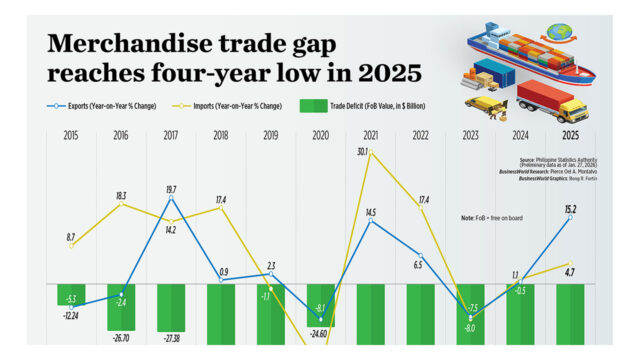
Merchandise trade gap reaches four-year low in 2025

THE Philippines’ trade-in-goods deficit narrowed to a four-year low in 2025, as exports rose by double-digits and import growth remained muted, the Philippine Statistics Authority (PSA) reported on Tuesday. Read the full story.


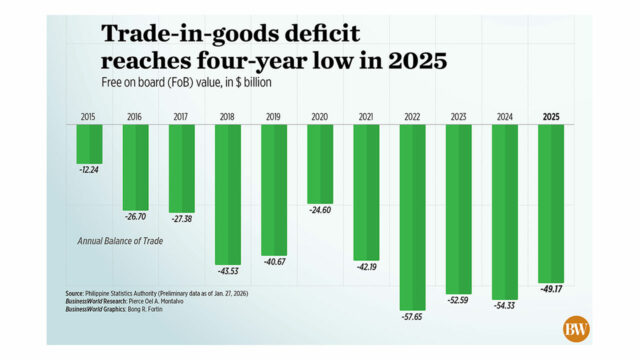
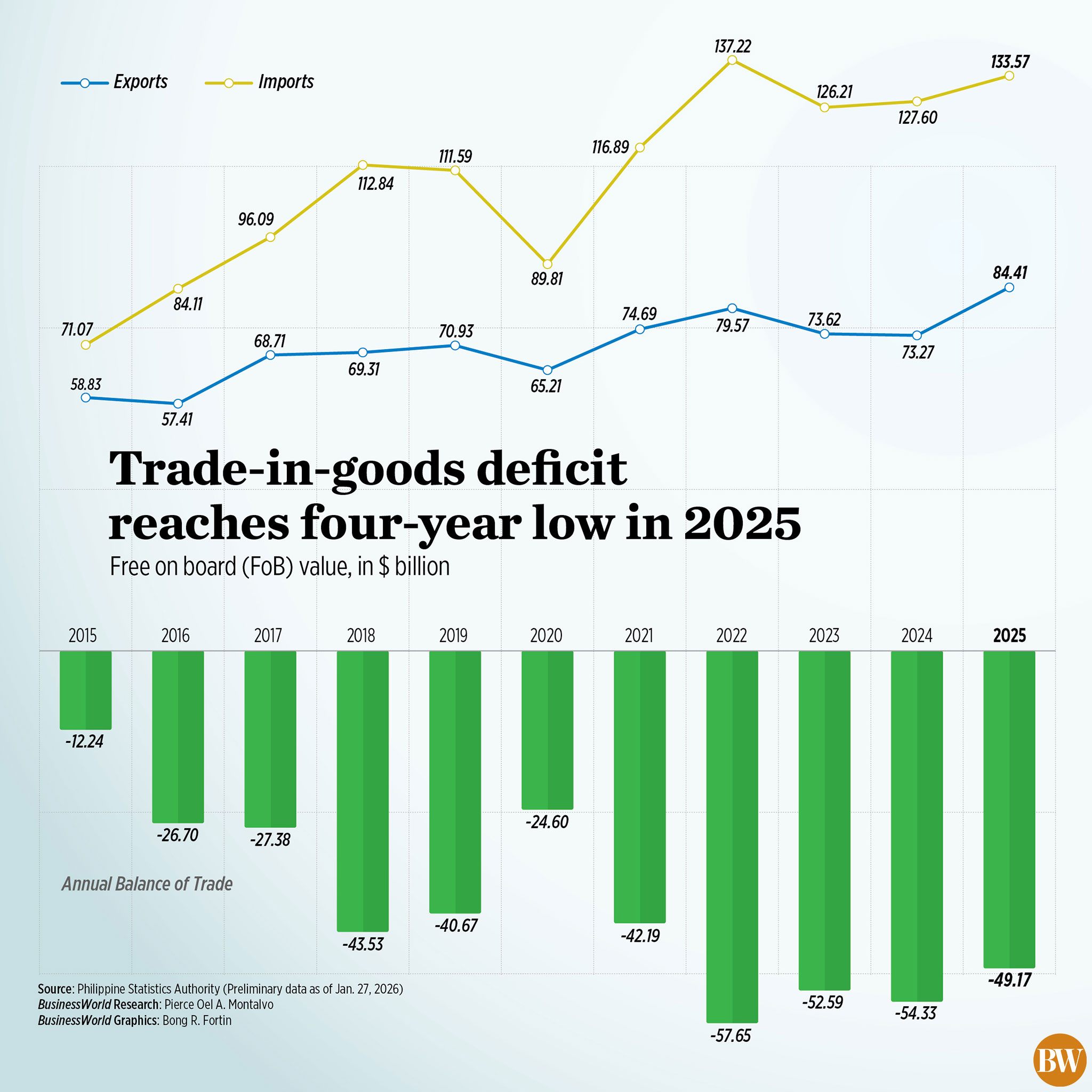
Trade-in-goods deficit reaches four-year low in 2025

THE Philippines’ trade-in-goods deficit narrowed to a four-year low in 2025, as exports rose by double-digits and import growth remained muted, the Philippine Statistics Authority (PSA) reported on Tuesday. Read the full story.

Venture capital bets on Philippine lifestyle brands

EDAMAMA offers a case study of how venture capital can support brand growth. — EDAMAMA

By Joseph L. Garcia, Senior Reporter

WHAT DO an online baby product marketplace, a global footwear platform and one of the world’s biggest technology companies have in common? All received an early boost from venture capital.

Google is perhaps the most cited example. In 1999, its founders Larry Page and Sergey Brin were introduced to US venture capital firm Kleiner Perkins by Sun Microsystems co-founder Andy Bechtolsheim. The pair said they believed their search engine could generate $10 billion in annual revenue. Kleiner Perkins wrote what it later described as the largest check in its history. More than two decades on, Google’s parent Alphabet reported $348.16 billion in revenue in 2024, according to Statista.

Venture capital follows a similar logic in smaller markets like the Philippines, where funds are backing brands and platforms they believe can scale quickly and solve clear problems.

In the Philippines, Globe Telecom, Inc.’s venture capital arm, Kickstart Ventures, Inc., invests mainly in technology-driven startups. Its role goes beyond writing checks, said Mike Maté, general partner at Kickstart Ventures.

“We help people with good ideas turn them into real, problem-solving companies,” Mr. Maté told BusinessWorld in an e-mailed reply to questions. “We do that by providing money to founders so they can build their products.”

“We also help them think through hard problems, introduce them to the right people and support them as they grow,” he added.

Kickstart operates three funds. Fund One focuses on digitizing consumer and enterprise experiences in the Philippines. Fund Two targets investments that complement Globe Telecom’s core business in tech, media and telecommunications. The ACTIVE Fund serves as Ayala Corp.’s technology innovation fund.

Beyond capital, Kickstart gives portfolio companies access to business expertise, commercial partnerships and regional markets.

Being linked to Globe and the Ayala Group can help young companies gain credibility and scale faster in Southeast Asia, where conglomerates play an outsized role, Mr. Maté said.

At the same time, Kickstart aims to deliver strategic value to its corporate backers by exposing them to advanced technologies and business models.

“It’s a win for both sides,” he said. “When those companies succeed, they create jobs, solve real problems and help boost the economy.

CROWDED FIELD
Kickstart is not alone. Other venture capital firms operate across sectors in the Philippines. The Gokongwei group’s JG Digital Equity Ventures backs platforms such as Growsari, which connects about two million micro, small and medium enterprises (MSMEs).

Other investors focus on financial technology through partnerships like GoTyme, while firms such as Kaya Founders support startups in finance, digital marketing and consumer brands spanning skincare and health.

Kickstart’s own portfolio includes parenting marketplace Edamama, Pickup Coffee and fashion and e-commerce platform Zalora.

“A big part of investing is understanding what the market is telling you,” Mr. Maté said. “In the Philippines, the market is telling us that lifestyle brands can do well.”

He pointed to demographics. The Philippines has the youngest population in Southeast Asia, with a median age of 26, and is not expected to reach peak age until the 2050s. Gross domestic product (GDP) per capita has climbed above $4,000, and the gross savings rate stands at about 29% of GDP.

“You have a growing, young and wealthier population with rising discretionary income,” he said. “And what will they do with their money? Buy lifestyle brands.”

Edamama offers a case study of how venture capital can support brand growth. Founded in 2020 by Bela Gupta, the platform was built to address the fragmented and often unsafe experience of buying baby products online.

“Parents were shopping across multiple platforms that weren’t built for them,” Ms. Gupta said in an e-mailed reply to questions. “It was fragmented, overwhelming, inconsistent and unsafe.”

Since launching, Edamama has processed thousands of online orders and expanded into physical retail, opening 10 stores across Metro Manila, Antipolo and Pampanga. Ms. Gupta said partnering with Kickstart aligned with the company’s focus on sustainable growth and on working with investors who understood the local market.

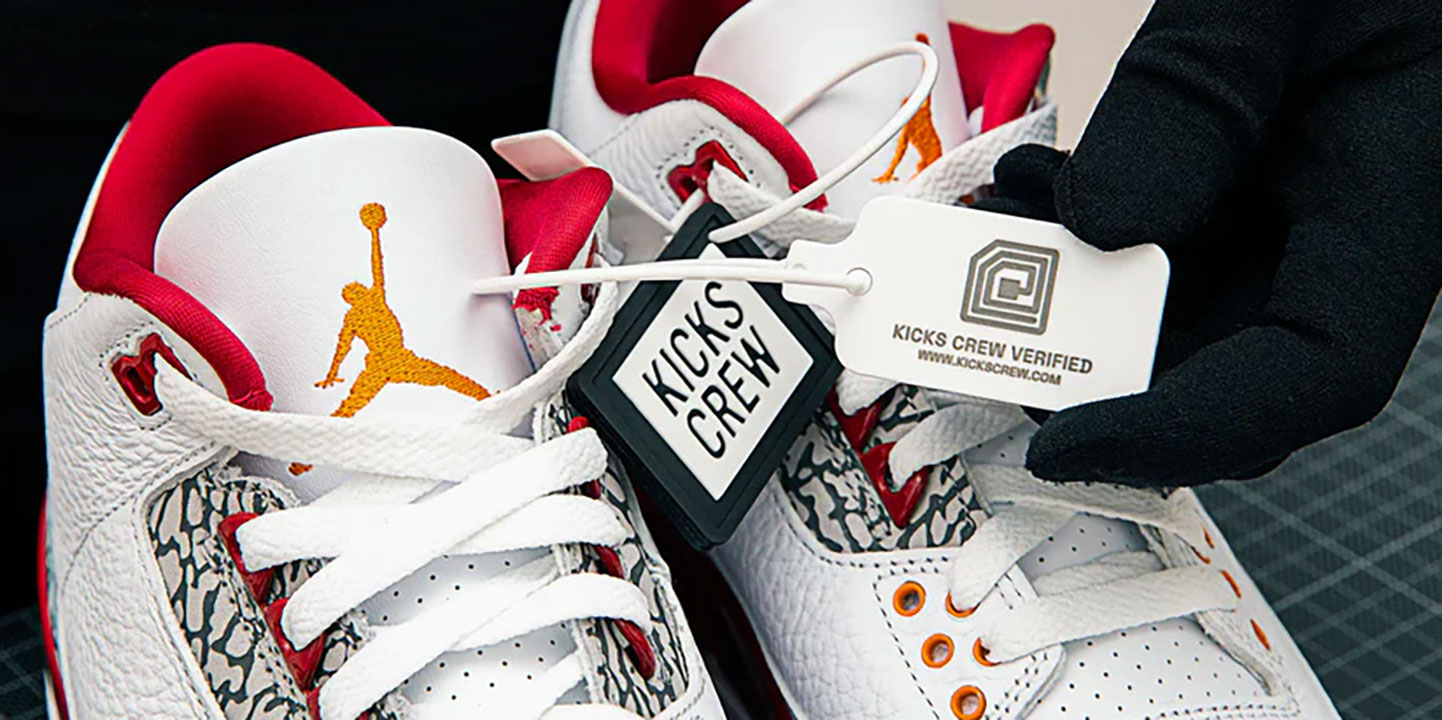
For venture capital firms, brand strength matters as much as technology. Mr. Maté cited New York-based footwear and apparel platform Kicks Crew, another Kickstart portfolio company.

Strong customer retention, repeat purchases and growing basket sizes were key factors, supported by brand credibility and endorsements from NBA players such as Kyrie Irving and Damian Lillard.

In Edamama’s case, investor confidence came from its focus on community-building among parents, which helped establish trust and repeat usage.

Many venture-backed success stories rely on technology. “Tech is the great equalizer,” Mr. Maté said, noting that digital-first companies could scale faster than traditional brick-and-mortar businesses.

He added that the line between startups and MSMEs is narrowing, as more young companies focus early on profitability and cash flow. Technology, he said, is now a baseline requirement. What matters next is whether a brand solves a real problem and can grow responsibly.

Edamama said it has delivered more than 5 million products nationwide and has become the country’s biggest diaper subscription platform. It has also launched its own private label, Bean, spanning diapers, skincare, fashion and baby gear.

“Venture capital is a means to allocate capital into high-risk assets with the goal of securing outsized returns,” Mr. Maté said. “We don’t create the future. Our portfolio companies do.”


IC closes pre-need firm Danvil Plans

PHILSTAR FILE PHOTO

THE INSURANCE COMMISSION (IC) has closed pre-need firm Danvil Plans, Inc. following nearly a decade of liquidation proceedings.

The company has been released from the IC’s regulation and will continue doing business under a different name and purpose other than pre-need or insurance-related endeavors, according to an IC directive dated Jan. 21.

“Henceforth, it will be the full responsibility of Danvil to direct the audit of its remaining corporate assets and liabilities should it find it necessary or in compliance to certain government reportorial requirements and to address its own corporate issues, if any,” the IC said.

Danvil Plans submitted its application for formal closure on Jan. 8, 2021. The company was placed under liquidation in December 2014 after it was issued a stay order in October 2013 and put under conservatorship in October 2010.

The IC said liquidation proceedings reached almost 10 years due to unclaimed checks. Part of the requirements for Danvil Plans’ closure was the distribution of P2.23 billion in payments of maturity benefits to planholders.

“The distribution of matured plans (100% of maturity value) was approved by the order dated Dec. 16, 2015. The proposal for the final distribution was approved by the issuance of the Directive dated Feb. 24, 2016,” the IC said.

“Distribution has been ongoing for almost ten years now and no new planholder incident emerged during the said period aside from the request of those with lapsed and pre-terminated plans. The IC and the Liquidator exerted all possible means to speed up the said distribution including various publications and communications with the planholders. Had it not for the said delay in claiming the checks, liquidation proceedings should have been completed and closed.”

It added that Danvil Plans has already distributed 68% of benefit checks representing the values ordered by the IC for immediate distribution.

Following its closure, the company will transfer the remaining funds to the IC for distribution. — Aaron Michael C. Sy

Special and immigrant visas for foreign entrepreneurs and investors in the Philippines

STOCK PHOTO | Image by Macrovector from Freepik

Public interest is a paramount consideration underlying Philippine immigration policy. In admitting foreigners and regulating the scope of their permissible activities, the government ensures that foreigners do not become a public charge and that their presence benefits the society.

Special privileges, such as multiple-entry privileges and permanent residence, are generally accorded only to foreigners who possess special skills or expertise that advance national development objectives, or those who have sufficient capital for investments that stimulate the economy and boost local employment.

Two immigration pathways are particularly relevant for such foreigners: the Special Visa for Employment Generation (SVEG) and the Quota Immigrant Visa. The updated guidelines on these visas were issued by the Bureau of Immigration (BI), through Board Resolution No. 2025-002, and took effect on Sept. 15, 2025.

SVEG
The SVEG is a special visa issued to qualified foreigners who actually employ at least 10 Filipinos in a lawful and sustainable enterprise. The SVEG is provided for under Executive No. 758 s. 2008, with the primary objective of creating job opportunities for Filipinos.

SVEG holders, who are considered special non-immigrants under Section 47(a)(2) of the Philippine Immigration Act (PIA), are granted multiple-entry privileges and conditional extended stay in the country. These privileges may also extend to the foreigner’s spouse and unmarried children below 18 years old.

To qualify for the SVEG, the applicant must comply with the following conditions:

1. He shall actually, directly or exclusively engage in viable and sustainable commercial investment/enterprise in the Philippines, exercises/performs management acts or has the authority to hire, promote and dismiss employees;

2. He evinces a genuine intention to indefinitely remain in the Philippines;

3. He is not a risk to national security; and,

4. His commercial investment/enterprise must provide actual employment to at least 10 Filipinos in accordance with Philippine labor laws and other applicable special laws.

Continuous compliance with these conditions is required. Otherwise, the SVEG may be revoked and the foreigner may be subject to deportation via summary proceedings.

Under the New Guidelines, SVEG applicants must undertake to employ at least 10 full time Filipinos on a regular basis and/or to invest in the rehabilitation of an existing business to enable the retention of at least 10 Filipino workers. They must also undertake to pay the employees’ required social security contributions and ensure that no employee receives compensation below the minimum wage.

To address national security considerations, applicants must have no derogatory records, and must submit a valid clearance from the National Bureau of Investigation if the application is filed six months or more from the date of their first arrival in the Philippines. Should the applicant occupy a position in the company, he must also secure an Alien Employment Permit from the Department of Labor and Employment.

QUOTA IMMIGRANT VISA
Under Section 13 of the PIA, the quota immigrant visa, which allows the holder to permanently reside in the Philippines, may be issued to not more than 50 of any one nationality or without nationality in a calendar year.

In allotting quota numbers, the New Guidelines provide that the BI must accord preferential status to applicants who possess qualifications, skills, or scientific, educational, or technical knowledge (special qualifications) which will advance and be beneficial to the national interest of the Philippines, and sufficient capital for a viable and sustainable investment in the country. Notably, the New Guidelines increased the minimum required investment from $50,000 to $100,000.

Unlike previous rules which applied a sequential order of priority by first considering the applicant’s special qualifications, and only thereafter assessing the applicant’s sufficient capital for investment, the New Guidelines indicate that both factors are now evaluated concurrently in the allocation of quota numbers. This change reflects a more holistic approach in assessing an applicant’s overall contribution to national development.

The New Guidelines further require applicants to be at least 30 years old and to have a cumulative stay in the Philippines of at least 180 days within a calendar year. Applicants must also submit proof of their special qualifications and of their financial capacity or investment. Acceptable proof of investment includes a Certificate of Inward Remittance, certificates of ownership or purchase of a condominium unit, or documents evidencing ownership of or investment in an existing corporation, enterprise or business.

The Philippines’ evolving visa policies continue to advance public interest by encouraging foreign investments that generate employment and foster skills development among Filipinos. While these policies recognize the role of foreigners in contributing to economic growth, these are carefully calibrated to ensure compliance with immigration laws and to safeguard national security and public welfare. Foreigners who avail of the SVEG and the Quota Immigrant Visa must therefore strictly comply with the conditions of their stay to sustain the balance between openness to investment and responsible regulation.

This article is only for general informational and educational purposes and is not offered as and does not constitute legal advice or opinion.


Kristine Bernadette F. Soriano is an associate of the Immigration department of the Angara Abello Concepcion Regala & Cruz Law Offices (ACCRALAW).

kfsoriano@accralaw.com

(632) 8830-8000

Katy Perry, other celebrities urge citizen action after Minnesota shootings

COMMONS.WIKIMEDIA.ORG

WASHINGTON — Singer Katy Perry and other US celebrities have called for citizens to contact lawmakers and speak out against federal immigration officials’ killing of two US citizens during the Trump administration’s immigration crackdown in Minnesota.

Ms. Perry asked her Instagram followers on Monday to write to their US senators and urge them to oppose funding for the Immigration and Customs Enforcement agency, which is a part of the Department of Homeland Security.

The killings this month of Renee Good, a mother of three, and intensive care nurse Alex Pretti have sparked demonstrations against President Donald J. Trump’s surge of agents in Minnesota.

The Last of Us star Pedro Pascal posted drawings of Ms. Good and Mr. Pretti on Instagram with the message: “Pretti Good reason for a national strike.”

Singer Billie Eilish, also posting on Instagram, called Ms. Pretti “a real American hero” and urged others to raise their voices: “hey my fellow celebrities u gonna speak up? or.”

The National Basketball Players Association, the union for NBA players, issued a statement on Sunday that players “can no longer remain silent.”

“Now more than ever, we must defend the right to freedom of speech and stand in solidarity with the people in Minnesota protesting and risking their lives to demand justice,” it said.

Trump administration officials said the recent killings were acts of self-defense by officers, although video evidence from the scenes contradicted that characterization.

US celebrities have often spoken out on behalf of social and political causes. Many criticized police brutality after the killing of George Floyd and US ally Israel’s assault on Gaza. — Reuters

Razon-backed MegaFUNalo! eyes more Pinoy-themed digital games

MEGAFUNALO.COM

RAZON-BACKED MegaFUNalo! is looking to expand its lineup of Filipino-themed games beyond the initial two developed with partner Gioco.

“We are working very closely with the Gioco team to try to come up with some more of their games as well as maybe some bespoke games that we can develop together,” MegaFUNalo! Executive Vice-President and Head of Gaming Cyrus Sherafat told reporters on the sidelines of the partnership launch on Monday.

“I think that’s our idea, to stick with the Filipino theme, culture, and familiarization,” he added.

On Monday, MegaFUNalo! launched Gioco Arcade, a set of Pinoy-themed digital arcade games. The initial lineup includes Jeepney Go, inspired by the country’s iconic transport, and Cash Cash Fiesta, drawing from street fair visuals, with Tuktuk Gold and Slice n Go slated for release soon after.

“I definitely think the partnership with Gioco is going to help expand that as we’re going to get more of our content to being Filipino themed,” Mr. Sherafat said.

He added that while many online gaming operators draw from the same pool of titles, the Gioco partnership stands out for its focus on Filipino content, creating distinct market positioning.

Asked about MegaFUNalo!’s performance since launch, Mr. Sherafat said: “MegaFUNalo is growing nicely. We’ve been able to continuously increase our user base.”

Launched in June last year, Bloomberry Resorts Corp.’s MegaFUNalo! expands the company’s digital portfolio, complementing Solaire Online, which focuses on live gaming and integration with physical casino operations.

At the local bourse on Tuesday, Bloomberry Resorts Corp. shares rose by 4.89% to P2.79  apiece. — Alexandria Grace C. Magno