Home Blog Page 3841

Panay power plant outages raise yellow alert in Visayas

BW FILE PHOTO

THE Visayas power grid was placed on yellow alert on Tuesday after major power plants on Panay Island stopped operating, reducing the safety margin for available power, the National Grid Corp. of the Philippines (NGCP) said.

In a statement, the NGCP said it issued a yellow alert over the Visayas grid for between 4 p.m. and 10 p.m.

“Restoration of affected plants is ongoing. While NGCP did not implement manual load dropping, distribution utilities may implement load drops due to voltage-sensitive loads or manual disconnection to secure voltage levels,” the NGCP said.

According to the grid operator, multiple plants tripped starting with the power plant unit 1 of the Panay Energy Development Corp. (PEDC) as of 12:06 p.m.

This outage was followed by PEDC Unit 2, the tripping of the power plant of Palm Concepcion Power Corp., and “other plants” in Panay Island.

About 302 megawatts (MW) was lost to the power grid, in addition to 150 MW from the planned maintenance shutdown of PEDC Unit 3.

“In total, 452 MW is unavailable. Currently, none of the power plants in Panay Island is generating power,” the NGCP said.

It has yet to disclose the cause of the power plant outages.

“NGCP is focusing its efforts on stabilizing voltage, and has extended feedback power to Iloilo and PEDC,” the grid operator said. “Load restoration will be done conservatively, by matching loads to restored generation, to prevent repeated voltage failure.”

The Negros-Panay interconnection was restored at 3:24 p.m. after a brief trip at 3:07 p.m.

Meanwhile, the Department of Energy (DoE) said in a statement that it is closely coordinating with the NGCP and all affected generation plants and distribution utilities.

“We assure the public that power restoration is a priority,” the DoE said.

The Energy Regulatory Commission is investigating the incident, according to the Energy department. — Sheldeen Joy Talavera

Beekeepers to be tapped for export markets

PHILIPPINE STAR/ANDY ZAPATA JR.

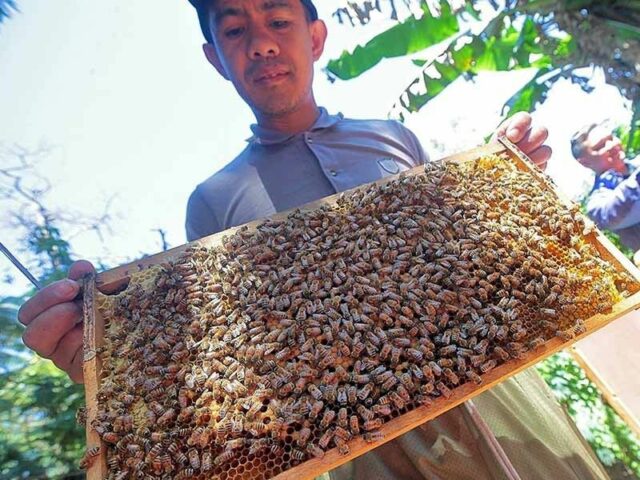
THE Department of Agriculture (DA) said it hopes to expand the beekeeping industry, citing the prospect of new export markets.

Agriculture Undersecretary Deogracias Victor B. Savellano said the DA will explore funding for the expansion to be overseen by the Bureau of Animal Industry.

“Beekeeping is a high-value farm sector. It has export potential given an organized national program to develop it,” Mr. Savellano added.

He said Philippine honeybee breeds are easy to raise, setting the stage for a significant expansion.

“The program offers huge opportunities as income earners for farmers. Honey has medicinal and pharmaceutical properties,” he added.

The DA said it plans to accredit bee suppliers to develop the industry, as a measure to reduce the smuggling of queen bees.

“Queen bee smuggling has been destroying our domestic industry,” he said.

The DA added that apiculture products include antibacterial soap, massage oil, lip balm, and shampoo.

“Philippine bee products have reportedly been reaching prominent export markets,” it said.

The DA has also partnered with the University of the Philippines-Los Baños (UPLB) to develop a roadmap for developing export markets and a community-based beekeeping program.

“UPLB has been developing technologies using native bees, particularly stingless bees, in order to raise crop yields and sustain biodiversity,” the DA said.

The project has benefited communities of Lanao del Norte and indigenous Mangyan in Victoria, Occidental Mindoro.

It added that bee farms are also being developed as agriculture tourism sites.

“One of the sites is the Balay Buhay sa Uma Bee Farm in Bulusan, Sorsogon. It is accredited by the Department of Tourism,” it said.

Additionally, the program is also set to establish a Food and Drug Administration-accredited bee facility for testing product quality. — Adrian H. Halili

Miners expect ‘green transition’ minerals to drive industry growth

EREN GOLDMAN-UNSPLASH

By Adrian H. Halili, Reporter

MINERS are expected to perform well in 2024 due to increased demand for transition minerals used by the renewable energy industry, mining officials said.

“The government is pushing for local mineral processing of energy transition metals such as nickel and copper and the Philippine metallic mining industry would like to participate and take advantage of opportunities presented by this development,” Michael T. Toledo, chairman of the Chamber of Mines of the Philippines (CoMP), said in a Viber message.

Environment Secretary Maria Antonia Yulo-Loyzaga has said that the Department of Environment and Natural Resources (DENR) will encourage exploration for critical minerals this year, with the Mines and Geosciences Bureau (MGB) instructed to gear up for enabling projects undertaken with foreign mining partners.

Nickel, cobalt, and copper are deemed essential for the production of electric vehicles (EVs), the large-scale batteries which power them, and also wind and solar farms.

“A lot still needs to be done but we believe the signposts show we are on a course that is likely to result in success,” Mr. Toledo added.

The Philippine Nickel Industry Association (PNIA) said the industry is pushing for the government to fast-track the approval of mining permits by establishing a “one-stop shop” application process.

According to the PNIA, the streamlining of approvals will attract more investment in mining.

About 470 applications are currently awaiting approval. They are proposing to explore for copper, chromite, nickel, and cobalt, according to the MGB.

Phase 1 of the MGB’s priority list consists of metallic mines, with about 12 projects expected to start operations in the next six months.

“If realized, this (encourages) upbeat expectations for the production and export of more of these goods, given the high level of global demand,” the MGB said in its metallic production report.

These operations are a magnetite sand (Iron) site in Region 2, nickel laterite in Region 3, gold in Region 5, four nickel, copper and gold sites in Region 11, and five nickel, copper and gold sites in Caraga.

CoMP said metals prices would mainly depend on the recovery of China’s economy, a major user of Philippine minerals.

“Traders are cautious of the incoming year, considering the weaker Chinese economy and significantly cheaper nickel pig iron (NPI) from Indonesia,” Mr. Toledo said.

He added that the mining industry expects Indonesia to keep up its NPI output.

NPI is low-grade ferronickel, which serves as a cheaper alternative to higher-grade nickel used in stainless steel production.

“We don’t know when China’s economy will improve. Most developed countries are challenged at this time,” he said.

PNIA has said that nickel production this year will likely remain flat due to the limited capacity in ore-supplying regions.

The MGB said however that due to domestic nickel supply concerns in Indonesia, Chinese demand for nickel ore from the Philippines will rise.

It added that Indonesia has become a new export market for nickel ore. The Philippines has exported about 102,100.72 dry metric tons of nickel ore to Indonesia amounting to P171.37 million during the nine months to September.

Mr. Toledo said that the industry is optimistic that the Philippines can service global copper demand.

However, he said that in the absence of new copper mining operations in the next five years, “there could be a supply deficit that would drive prices upward.”

“In the next few years, we believe the Philippine copper sector can keep up with the demand for this metal as an input for renewable energy technologies,” he said.

“As the global demand for critical minerals for the energy transition intensifies, however, there are concerns on whether copper from Philippine mines can keep up,” he added.

Rizal Commercial Banking Corp. Chief Economist Michael L. Ricafort said the demand for raw materials from the renewable energy industry is expected to grow in the coming years.

“There will still be a large shift towards renewable and towards electric vehicles for the coming years amid the need for more sustainable source of energy and the need to reduce carbon emissions,” Mr. Ricafort said in a Viber message.

Mr. Ricafort added that a decline in global interest rates could also drive more investment towards minerals.

“Lower borrowing costs will encourage more investment and business activity, as well as the demand for minerals,” he said.

The Federal Reserve maintained its target rate in the 5.25%-5.5% range for a third straight meeting on Dec. 12-13.

The Bangko Sentral ng Pilipinas kept its key borrowing rate unchanged at 6.5% during its Dec. 15 meeting.

Regina Capital Development Corp. Head of Sales Luis A. Limlingan said metal prices will largely be influenced by the strength of the Chinese economy and its adoption of EVs.

“The Philippines will be able to take advantage, should responsible mining practices be put in place to allow further export of our precious minerals,” Mr. Limlingan said in a Viber message.

Prices for nickel ore declined to $10.39 per pound from $11.97 per pound the previous year.

“For nickel, attributing factors to growth during the period are the improvement of nickel ore prices and better loading conditions on account of good weather, particularly in the southern part of the country,” Mr. Toledo said.

The price of gold increased to $1,932.07 per troy ounce, while copper prices fell to $3.9 per pound from $4.12 a year earlier. Silver prices rose 7.32% to $23.55 per troy ounce.

“The low copper prices were offset also by good weather, which resulted in less production interruptions, as well as by the strong dollar-to-peso exchange rate,” he added.


Marcos should have vetoed P450-B unprogrammed funds hike — Lagman

BW FILE PHOTO

By John Victor D. Ordoñez, Reporter

A PHILIPPINE lawmaker scored President Ferdinand R. Marcos, Jr. on Tuesday for not striking down the P450-billion increase in unprogrammed funds in this year’s P5.768-trillion General Appropriations Act (GAA), saying it is illegal.

“The President’s utter failure to veto the excess items aggravates the constitutional defect,” Albay Rep. Edcel C. Lagman said in a statement.

“Consequently, a constitutional challenge before the Supreme Court is in order to cleanse the General Appropriations Act of a fatal defect and give guidance to the Congress and the President in the future budget seasons.”

Unprogrammed appropriations are funds on standby in case of additional priority programs or projects when revenue collection exceeds targets.

Under the Constitution, the lawmakers are barred from boosting appropriations recommended by the President “for the operation of the government as specified in the budget.”

Mr. Lagman said the increase has boosted unprogrammed funds which could be used to fund politically motivated projects.

“The unprogrammed appropriations have become the sanctuary of partisan and pet projects where funding and releases for implementation would even antedate programmed appropriations,” the congressman said.

Senate Minority Leader Aquilino Martin “Koko” D. Pimentel, III said he would challenge the legality of the boosted allocation in unprogrammed appropriations since the Budget department only recommended a total of P281.9 in these funds.

The President had vetoed sections of the 2024 GAA that are related to a proposed revolving fund for the Department of Justice, and a provision related to the implementation of the National Government’s Career Executive Service Development Program.

Mr. Marcos signed the spending plan on Dec. 20, which he called a “battle plan” to boost education, combat hunger, and create more jobs.

“Verily, since the Constitution does not distinguish between the programmed appropriations and the unprogrammed appropriations with respect to the congressional ban, the ceiling of both cannot be exceeded by the Congress,” Mr. Lagman said.

“These are serious allegations which should first be provided with actual evidence by Rep. Lagman, particularly a supposed previous practice in which it has ‘become the sanctuary of partisan and projects.’ In the first place, unprogrammed appropriations remain unfunded appropriations unless and until adequate funding is found by government in the course of the fiscal year.”  Terry L. Ridon, a public investment analyst and convenor of think tank InfraWatch PH, said in a Facebook Messenger chat.

159 Filipinos in Japan evacuate after quakes

CHRIS BARBALIS-UNSPLASH

AT LEAST 159 Filipinos have been evacuated in western Japan after a 7.6-magnitude earthquake rocked the island of Honshu on Monday, resulting in a tsunami sweeping the west coast, the Philippine Department of Foreign Affairs (DFA) said.

No Filipino was among the 30 reported fatalities, based on official reports on Tuesday, Foreign Affairs Undersecretary Jose Eduardo A. de Vega told BusinessWorld in a WhatsApp message.

But he confirmed the number of Filipinos who fled danger areas and stayed at evacuation centers. A total of 157 of them have since returned to their homes, according to latest updates reaching the DFA.

On Monday, the Japanese government issued tsunami warnings for the central prefecture of Ishikawa and the coastal areas of Toyama, Fukui, and Hyogo prefectures as over 140 tremors have been detected since the first quake hit the coast.

Over 100,000 people were ordered to evacuate their homes to sports halls and school gymnasiums.

In an advisory later the same day, the Migrant Workers Office of the Philippine Consulate General in Osaka asked employers and supervisors in the affected prefectures to immediately report any incident involving Filipino workers related to the earthquakes.

Here in Manila, the Department of Migrant Workers activated hotlines for affected Japan-based migrant workers.

President Ferdinand R. Marcos, Jr. also issued this statement: “We are deeply saddened to hear of the magnitude 7.6 earthquake in Japan on New Year’s Day. We are in close collaboration with the Japanese government to secure the welfare of our countrymen, who thankfully remain unharmed.”

Japanese Prime Minister Fumio Kishida had ordered over 3,000 Japanese army personnel, firefighters and policemen across the country to the quake sites in the Ishikawa prefecture.

“The search and rescue of those impacted by the quake is a battle against time,” he told an emergency meeting on Tuesday.

Local authorities said the 30 deaths were all in Ishikawa prefecture, but more than 33,000 households in Western Japan were plunged in darkness due to power outages.

Temperatures in the area have reached below-freezing numbers, according to Hokuriku Electric Power Company, which supplies power to Toyama, Ishikawa, and Fukui prefectures.

There are about 469 Filipinos living in the Ishikawa Prefecture and 725 in the Toyama Prefecture, Migrant workers officer-in-charge Hans Leo J. Cacdac said in a statement.

He said about 90% of them work in the manufacturing, welding, and carpentry sectors, while 10% are caregivers.

“We are monitoring the employment situation of OFWs, especially in the Ishikawa and Toyama Prefectures. We will provide financial assistance to OFWs whose employment has been suspended or ceased due to the quake,” Mr. Cacdac said. — John Victor D. Ordoñez

Youth groups join clamor vs public transport policy

PHILIPPINE STAR/EDD GUMBAN

By Jomel R. Paguian

VARIOUS youth groups have voiced their opposition to the Public Utility Vehicle Modernization Program (PUVMP), expressing solidarity with the plans of jeepney drivers and operators to wage more strikes this month.

In an interview with BusinessWorld, youth coalition Samahan ng Progresibong Kabataan (SPARK) national coordinator John Lazaro said support for drivers and operators will continue as long as the government proceeds with its modernization policy, which is claimed to have failed in consulting the transport sector.

“If the government continues to make policies that actively harm the livelihood of the working class, then we have a duty to stand by them,” he said.

Meanwhile, 111 Sangguniang Kabataan (SK) officials throughout the country signed a year-end unity statement condemning the PUVMP and its franchise consolidation deadline, encouraging the youth to advocate for the preservation of the livelihoods and rights of public transport workers.

“We, the undersigned members of the Sangguniang Kabataan, stand in solidarity with our fellow Filipinos — especially the 200,000 jeepney drivers and operators — whose livelihoods are a stake due to the looming Dec. 31 franchise consolidation deadline,” read part of the statement.

Kabataan Partylist national executive vice president Renee Louise Co, spearheading the unity statement, told BusinessWorld that the group currently receives additional signatories from more SK officials.

For SPARK, Mr. Lazaro added that the phaseout of unconsolidated public utility jeepneys (PUJs) will affect not just the livelihood of the transport workers but also the situation of students who rely on public transport.

“When the livelihood of PUJ drivers is affected, our livelihood, our right to education and learning are also at risk,” he said in Filipino. “We are connected to every move of our workers; hence, we support them in their strikes”

Days before the New Year, the Land Transportation Franchising Regulatory Board (LTFRB) issued new guidelines permitting unconsolidated public utility vehicles (PUVs) to operate until Jan. 31 — a month-long grace period beyond the Dec. 31, 2023 consolidation deadline.

The Department of Transportation (DoTr) on Monday said only 40% of jeepneys in Metro Manila have consolidated their franchises under the PUVMP. Nationwide, the numbers reached approximately 70%.

The year-end deadline for the application for consolidation pushed through despite opposition from transport groups and a pending Supreme Court petition.

Mr. Lazaro argued that the grace period is insufficient to address their demands as no amendments to the franchise consolidation component of the PUVMP have been made.

In a separate interview on the sidelines of a year-end protest against franchise consolidation under the PUVMP in Manila last week, members of the Kabataan Partylist declared opposition to the modernization plan.

“The Kabataan Party supports the strikes because the struggles of drivers are also the struggles of commuters,” said Party member Carmela Aldip in Filipino. “Fare increases may occur because of the program which adds difficulty for students who depend on their parents.”

Progressive-leaning think tank IBON Foundation last month said that jeepney fares could surge up to fivefold, attributing it to the percentage of consolidated public utility vehicles nationwide.

BARMM generates P3.3-B investments in Q4 of 2023

By John Felix M. Unson, Correspondent

COTABATO CITY — The Bangsamoro region generated P3.3 billion worth of investments in the last three months or fourth quarter (Q4) of 2023, generating employment for 1,927 workers.

Records obtained by BusinessWorld on Tuesday from the Bangsamoro Board of Investments (BBOI) and the Ministry of Trade, Investments and Tourism (MTIT) indicated that besides the capital inputs by investors from within and outside the region, entrepreneurs and merchants earned P16.9 million from last year’s 30-day Ramadhan Trade Fair at the capitol of the Bangsamoro Autonomous Region in Muslim Mindanao in this city.

Mohammad O. Pasigan, chairman of the BBOI, said there were a number of unfavorable incidents in the BARMM last year that hit the news, but did not dampen the positive investment climate in the region.

Of the P3.3-billion investments BARMM had in the past three months, P3.1 billion was poured in by investors through the efforts of the BBOI.

Up to P3.4 million more worth of investments were generated via the programs of the MTIT, according to the Bangsamoro Information Office.

The Bangsamoro region generated P7.6 billion worth of investments from January to September 2023, according to documents from the BBOI, the Bangsamoro Business Council (BBC), the MTIT and the regional government’s agriculture and labor ministries.

“Businesses in BARMM are improving. Our focus now is to convince investors to put up viable agricultural projects in the region’s six provinces,” the lawyer-entrepreneur Ronald Hallid D. Torres, chairman of the BBC, said.

DoLE sets pay rules for 2024 holidays

BW FILE PHOTO

THE DEPARTMENT of Labor and Employment (DoLE) released on Tuesday the rules for payment of wages for the holidays, confirming 12 regular holidays and eight special non-working days for the year.

In a two-page advisory dated Dec. 12, made public on Tuesday, the labor department clarified payment schemes for holidays declared by the Malacañang in October last year.

DoLE reiterated that employees are entitled to receive double pay for work done during regular holidays, while workers who did not report for work are entitled to full pay under certain conditions.

Included in the declared regular holidays were Jan. 1 (New Year’s Day), Mar. 28-29 (Holy Week), Apr. 9 (Day of Valor), May 1 (Labor Day), June 12 (Independence Day), Aug. 26 (National Heroes Day), Nov. 30 (Bonifacio Day), Dec. 25 (Christmas Day), and Dec. 30 (Rizal Day). Dates for Eidul Fitr and Eidul Adha are yet to be determined.

An additional 30% of the hourly rate on said days shall be granted for work done in excess of eight hours.

Special non-working days, on the other hand, include Feb. 10 (Chinese New Year), Mar. 30 (Black Saturday), Aug. 21 (Ninoy Aquino Day), Nov. 1-2 (All Saints’ Day and All Souls’ Day), Dec. 8 (Feast of the Immaculate Conception of Mary), Dec. 24 (Christmas Eve), and Dec. 31 (last day of the year).

The department said the “no work, no pay” principle shall apply on special non-working days unless a presence of a company policy or agreements. Work done for the said days is entitled to an additional 30% of the basic wage on the first eight hours of work. Overtime work shall be granted an additional 30% of the hourly rate. — Jomel R. Paguian

Holiday revelry injuries hit 443

PHILIPPINE STAR/MIGUEL DE GUZMAN

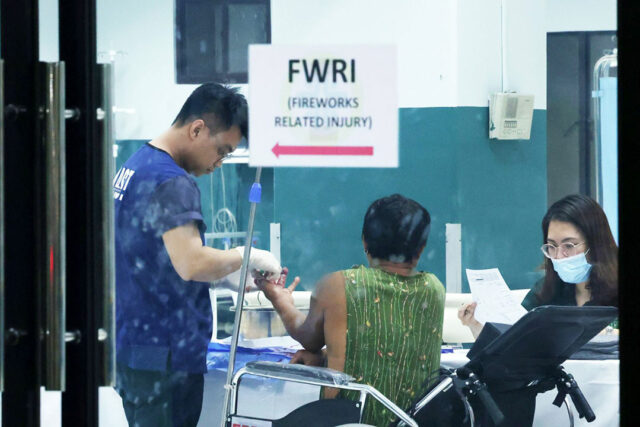
THE PHILIPPINE health agency on Tuesday posted 212 more fireworks-related injuries during the New Year festivities between Dec. 31 and Jan. 2, including a fatality from Ilocos Region in the country’s north, bringing the total cases during the holiday season to over 440.

The first confirmed fatality was a 38-year-old male “who lit a cigarette while drinking with others near firecrackers in storage,” the Department of Health (DoH) said in a statement. The agency also reported the country’s first stray bullet injury case, who had a gunshot wound to his left upper back.

The total injuries during the holiday season climbed to 443, 441 one of which were due to fireworks. One of the total cases was due to watusi ingestion and another one was due to a stray bullet.

The agency said 97% or 206 of the new cases occurred at home and in the streets.

“The new cases range from 1 to 71 years old (median age: 22), with almost eight out of 10 cases that are male,” it said.

There were six new amputation cases, bringing the total to 17, it said. There were 122 cases with eye injuries and two cases with hearing loss, it added.

“The death reported today was an incident waiting to happen because liquor impairs judgement,” DoH said. “We can prevent these; we must work together across all sectors to do so.”

Metro Manila accounted for more than half or 254 of the total fireworks-related cases, followed by Ilocos Region with 36 cases, Central Luzon with 35 cases, Cagayan Valley with 35 cases, and Calabarzon with 29 cases.

Kwitis was the top cause of injuries, followed by 5-Star, boga, pla-pla, whistle bomb, fountain, luces, piccolo, and triangle.

“Illegal fireworks are to blame for just four out of every 10 cases (173, 39%), with legal fireworks causing more injuries.” — Kyle Aristophere T. Atienza

P200M set for Borongan Airport

CAAP.GOV.PH

THE PHILIPPINE government has allocated P200 million to upgrade the aviation infrastructure of Eastern Samar’s Borongan Airport, a congressman said on Tuesday.

“The airport’s improvement will facilitate the transfer of people and goods, and help bring in more tourists,” Party-List Rep. Marcelino C. Libanan said in a statement. “Our goal is to increase the airport’s capacity to accommodate more commercial flights.”

The government earlier started a 200-meter extension of the airport’s 1.3-kilometer runway. Last year, the flag carrier Philippine Airlines (PAL) started Cebu to Borongan flights that would operate twice a week to make it easier for travelers to get to Borongan.

Mr. Libanan, who used to be the lone congressional representative of Eastern Samar, said upgrading the airport would be a step closer to making Borongan the surfing capital of Visayas.

Borongan City earlier hosted the Surf City Borongan Masters, which had over 150 participating surfers from across the Philippines.

“We look forward to other airlines operating flights in and out of Borongan,” the congressman said. — John Victor D. Ordoñez

Number coding schedule restored

PHILIPPINE STAR/ RUSSEL PALMA

THE METROPOLITAN Manila Development Authority (MMDA) said on Tuesday that the number coding traffic scheme has been reinstated from 7 a.m. to 10 a.m. and from 5 p.m. to 8 p.m., on weekdays except on holidays.

The number coding system, formally called the Unified Vehicle Volume Reduction Program (UVVRP), was suspended during the holidays of Dec. 25-26, 2023, and Jan. 1, 2024.

Under the scheme, vehicles are prohibited from traveling on Metro Manila roads based on the last digit of their license plates during the specified coding hours. Plates ending in 1 and 2 are covered on Mondays, 3 and 4 on Tuesdays, 5 and 6 on Wednesdays, 7 and 8 on Thursdays, and 9 and 0 on Fridays.

MMDA said vehicles exempted from the codings scheme include: public utility vehicles, transport network vehicle services, motorcycles, garbage trucks, marked government vehicles, petroleum trucks, media-marked vehicles, fire trucks, ambulances, and vehicles carrying perishable and essential goods.

In a separate statement posted on Facebook on Tuesday, MMDA Chairman Romando “Don” S. Artes reminded motorists to be mindful of special lanes on roads in Metro Manila. In Filipino, he reminded motorists to “stay in their respective lanes for smooth flow of traffic and to prevent accidents.”

The exclusive bus lane policy in EDSA is still in effect, dedicated to carousel passenger buses, emergency vehicles, and government-marked vehicles responding to emergencies. — Jomel R. Paguian

Meralco makes donation to MSU

BW FILE PHOTO

THE MANILA Electric Co. (Meralco) has donated electrical system equipment for the electrical engineering students at the Mindanao State University (MSU) Main Campus in Marawi City, Lanao del Sur.

“Meralco is one with MSU in enhancing its educational offerings as it moves forward from recent challenges faced by the university. This donation signals the start of a fruitful and productive partnership between Meralco and MSU,” Meralco Executive Vice President and Chief Operating Officer Ronnie L. Aperocho said in a statement on Tuesday.

Meralco, through its corporate social responsibility arm One Meralco Foundation (OMF), has turned over equipment for the simulation of a mini substation which the students can use for their laboratory training.

“It is Meralco’s hope that this equipment will be used for real-life applications of classroom learnings and contribute to further upskilling of MSU electrical engineering students,” Meralco Chief Corporate Social Responsibility Officer and OMF President Jeffery O. Tarayao said. 

The donation includes a protection and control panel, a vacuum circuit breaker, a control switch, miniature circuit breakers, multimeters, battery chargers, voltmeters, and test leads.

“We look forward to more innovative collaborations to further enhance the learning experience of the next generation of electrical engineers,” said Mr. Tarayao.

MSU President Basari D. Mapupuno said that the company’s donation has “contributed to the university’s healing” from the blast last month.

On Dec. 3, a bombing incident occurred at MSU’s gymnasium during a Catholic mass service, killing four people and hurting some 50 others.

“Rest assured that this gift will be used wisely and responsibly to enhance our educational opportunities and advancements. This gift will equip our electrical engineering students with the tools not just to become engineers but agents of change,” he said.

Meralco’s controlling stakeholder, Beacon Electric Asset Holdings, Inc., is partly owned by PLDT Inc.

Hastings Holdings, Inc., a unit of PLDT Beneficial Trust Fund subsidiary MediaQuest Holdings, Inc., has an interest in BusinessWorld through the Philippine Star Group, which it controls. — Sheldeen Joy Talavera