Home Blog Page 3684

BDO raises P63.3B via sustainability bonds

BDO UNIBANK, Inc. (BDO) has raised P63.3 billion from its second offering of Association of Southeast Asian Nations (ASEAN) sustainability bonds.

The issue size was well above the original offer of P5 billion and higher than the P52.7 billion raised from BDO’s first offering of ASEAN sustainability bonds in January 2022, the lender said in a disclosure to the local bourse on Monday.

“The issuance was backed by strong demand from retail and institutional investors, with a rapid buildup in orders resulting in the shortening of the offer period by a week to Jan. 16, 2024,” BDO said.

The 1.5-year notes have a coupon rate of 6.025% per annum.

Proceeds from the issuance will be used to diversify BDO’s funding sources and finance or refinance assets eligible under the bank’s Sustainable Finance Framework.

Standard Chartered Bank was the sole arranger of the transaction. BDO and Standard Chartered Bank were also the selling agents, while BDO Capital & Investment Corp. was the financial adviser.

BDO’s net profit rose by 16.5% year on year to P18.7 billion in the third quarter of 2023 amid higher interest income and lower provisions.

Its shares rose by 0.07% or 10 centavos to close at P144.90 each on Monday. — AMCS

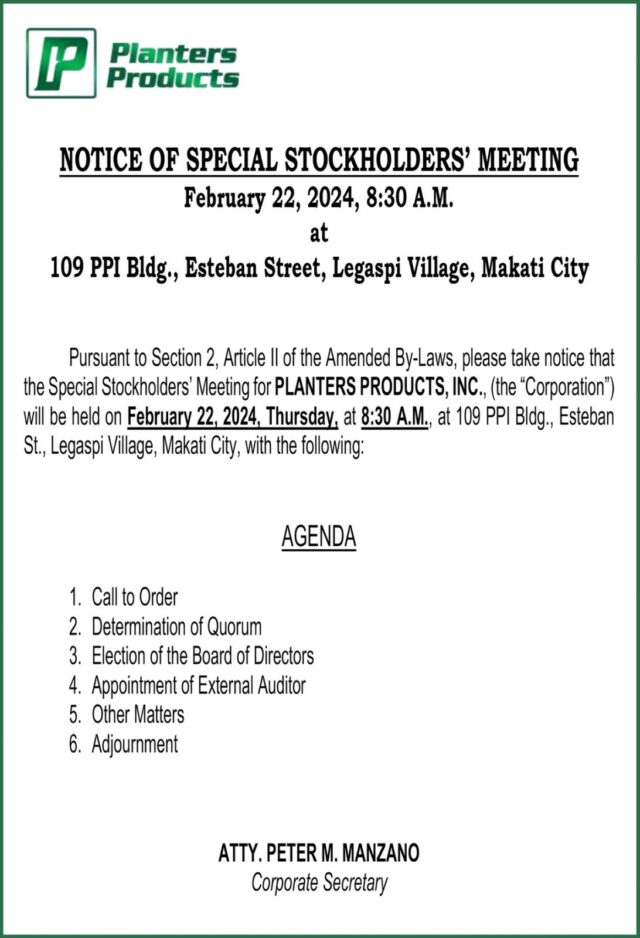
Planters Products, Inc. to hold Special Stockholders’ Meeting on Feb. 22


Spotlight is BusinessWorld’s sponsored section that allows advertisers to amplify their brand and connect with BusinessWorld’s audience by enabling them to publish their stories directly on the BusinessWorld website. For more information, send an email to online@bworldonline.com.

Join us on Viber at https://bit.ly/3hv6bLA to get more updates and subscribe to BusinessWorld’s titles and get exclusive content through www.bworld-x.com.

Basic Energy board OK’s partnership with Renova for wind project

BASIC Energy Corp. has approved a partnership with Japanese renewable energy company Renova, Inc. for the joint development of the proposed 50-megawatt Mabini wind power project in Batangas, the company announced on Monday.

“The company appointed its president as its representative authorized to negotiate with Renova and execute the memorandum of understanding (MoU) and all related documents,” the company said in a disclosure.

The Mabini wind power project covers 4,860 hectares in the Mabini Peninsula. It is expected to operate and deliver power to the grid by 2027.

The renewable energy service contract for the project was awarded by the Department of Energy to the company in 2021.

In February last year, Mabini Energy said it had allocated an initial budget of around P31 million for the wind resource assessment campaign, permits and licenses, and ancillary activities.

Renova develops and operates multiple renewable energy power sources, including solar, wind, biomass, geothermal, and hydro power, based on its website.

At the local bourse, shares in the company slightly fell by P0.005 or 2.63% to close at P0.19 apiece. — Sheldeen Joy Talavera

Digital payments may make up 67% of total retail transactions this year

MORE THAN HALF of retail payments in the Philippines will be done digitally this year amid the growing adoption of online solutions, Filipino financial technology (fintech) firm Mochi said.

Mochi, a startup that specializes in invoicing and billing solutions, said in a statement on Monday that they see continued growth in digital payments this year.

“The projections of Philippine-based fintech startup Mochi suggest that 67% of retail payments in the country will be digital this 2024. This figure was derived from the 43% average year-on-year growth rate of digital retail pay-ments from 2019 to 2022 released by the Bangko Sentral ng Pilipinas (BSP) while considering the post-pandemic slowdown of said growth rate,” the company said.

The increased adoption of online payment solutions, the expansion of small and medium enterprises (SMEs), and the recovery in economic activity following the coronavirus pandemic will drive digital payments, Mochi said.

“Digital payments remained strong post-pandemic despite the slowdown,” Mochi Co-Founder and Chief Executive Officer Yroen Guaya Melgar was quoted as saying.

“With more than 90% of businesses in the Philippines being small businesses, it’s no wonder they’ve become champions of the digitization of financial services,” she said.

Based on latest data from the BSP, the share of online payments in the total volume of retail transactions in the country rose to 42.1% in 2022 from 30.3% a year earlier.

The total payment volume stood at 4.85 billion in 2022, with those done via digital platforms totaling 2.04 billion transactions. The top contributors for the increase in volume were merchant payments, person-to-person trans-fers, and salaries and wage payments.

According to central bank officials, the country was on track to meet its goal to have 50% of total retail transactions done digitally at end-2023. The next digital payments report of the BSP will be released in July this year.

However, the rise in online payments may also negatively affect SMEs as digitalization calls for these firms to be vigilant against fraud, miscalculations, and productivity bottlenecks, Mochi said.

“As an accounts receivable platform, Mochi is excited to help more SMEs manage the growing number of digital payments that they are receiving,” Ms. Melgar said.

“With digital invoice creation, integrated payment channels, and automated reminders, SMEs can be assured that the digital payments they are receiving will be more easily managed,” she added.

Under the Philippine Development Plan, the government wants 60-70% of retail payment transactions done online by 2028. — K.B. Ta-asan

Now is the perfect time to change the Constitution

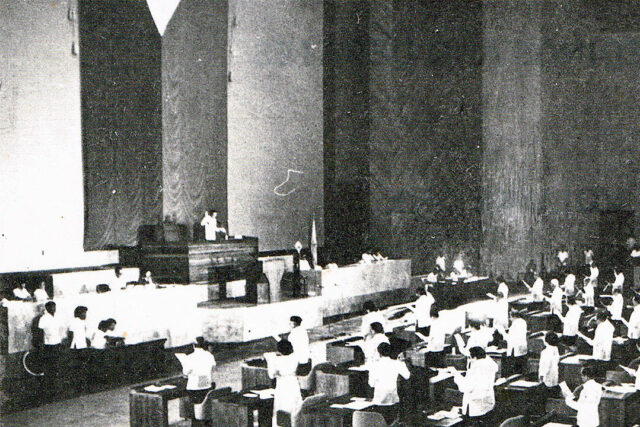
THE INAUGURAL session of the Constitutional Commission of 1986 — OFFICIALGAZETTE.GOV.PH

NOW is the perfect time to change the Constitution. It’s the perfect time because Ferdinand Marcos, Jr. is president.

It’s the perfect time politically.

President “Bongbong” Marcos is not invested in the 1987 Constitution. He’s the perfect person to initiate changes because the 1987 Constitution was born from the ouster of his late father. The stars aligned when he, representing the anti-thesis to the Anti-Marcos Yellow People’s Power revolution, became President and head of government.

He is also the first President to be elected with an overwhelming mandate of 59%. This is a mandate for systemic change.

The coalition that deposed his father and wrote the 1987 Constitution has been defeated politically. This means that the people have rejected the ideology behind the 1987 Constitution.

The informal coalition behind the 1987 People Power revolution included the anti-Marcos oligarchy, the Catholic Church, middle-class professionals and social democratic activists, and the communist Left. While the CPP-NPA (Communist Party of the Philippines – National People’s Army) boycotted the 1983 elections, nonetheless they were still part of the informal coalition. They formed the core of the anti-dictatorship rebel forces, with at least 25,000 NPA fighters pinning down the Marcos military. The Left’s united front organization, the National Democratic Front, was active in the anti-Marcos struggle.

The ideology of this coalition was reflected in the 1987 Constitution, which was written by appointed members to a Constitutional Commission by former President Corazon Aquino. The anti-Marcos oligarchy got Filipino First and Filipino Only provisions in the Constitution, ensuring a lack of competition from foreign investors.

Not only were the Filipino Only provisions from the 1935 and 1973 Constitutions carried over, but these were expanded to mass media and advertising and the practice of professions.

The Filipino First policy provisions in the Constitution also ensured an overarching advantage to the Filipino oligarchy. These protectionist provisions made rent-seeking the economic model of the Philippine economy.

The Catholic Church got a provision effectively prohibiting abortion in Section 12 Article 2 that states, as a matter of principle and national policy, “the State shall equally protect the life of the mother and the life of the unborn from conception.”

The Yellow-Leftist ideas in the Constitution enshrined “statism,” or state intervention, in the provision that “the State shall regulate the acquisition, ownership, use, and disposition of property and its increments.”

A significant portion of the Constitution is about Yellow-Leftist ideas on social justice and asset distribution. While in theory, this was commendable, in practice, since the economy was based on rent-seeking and statism, it merely resulted in the redistribution of poverty.

An example is the landmark 1987 Comprehensive Agrarian Reform Law (CARL), a product of the ideas on social justice in the 1987 Constitution. Instead, as real social justice demands redistributing lands to the farmers for free and giving them economic freedom, CARL saddled agrarian reform beneficiaries with long-term debt, prohibited them from mortgaging and selling their lands, prohibited them from expanding beyond the land retention limit of five hectares, and substituted the landlord with an inefficient and corrupt government. The result has been perverted social justice. Landless peasants became impoverished landlords. Agricultural productivity fell. The Philippine became more food import dependent. Bureaucrats, on the other hand, who had to give permits, from land conversions to food importation, became rich, as well as the criminal syndicates behind them.

Statism together with Protectionism ensured that rent-seeking (and its manifestation, massive corruption) became the dominant economic activity.

The Left, particularly the communist Left, has been a driving force behind Statism and Protectionism. The Left and its allies have been loud opponents of opening the economy. Their anti-imperialist ideology is aligned with that of the Filipino oligarchy and makes the Left strange allies with the oligarchic Right.

Now is also the perfect time to change the Constitution because the Left is nearly dead politically and militarily. CPP Founder, Jose Ma. Sison, died on Dec. 16, 2022, after decades in exile. The CPP conjugal leaders, Benito and Wilma Tiamzon, died on Aug. 22, 2022, when their boat exploded while being chased by military forces. From about 25,000 active fighters in 1987, the NPA has dwindled to about 1,500 armed fighters and zero guerrilla fronts.

The last elections showed a clear political defeat of the Left. The leftist Makabayan bloc, which used to win at least 12 representatives to Congress based on the party-list system, managed to eke out only three representatives. The socialist candidate, Leody de Guzman, got a measly 0.2% of the vote.

The Yellows too suffered a big political defeat. Their candidate Leni Robredo got only 15 million votes, less than half of the 31 million votes of Bongbong Marcos. Only Risa Hontiveros managed to get elected senator. In the coming 2025 senatorial elections, not a single Yellow candidate is among the top 12 based on the latest surveys.

The Catholic Church, which had been influential in politics under the late Cardinal Sin, has retreated from political activities, must contend with sex abuse scandals, and is focused on its schism (between the conservatives and the progressives under Pope Francis).

The decisive political defeat of the Yellows and the coalition behind the 1987 Constitution showed the failure of the 1987 Constitution to meet the aspirations of the Filipino people. The overwhelming mandate given to Marcos and Duterte in 2022 showed that the Filipino people wanted a different direction for the country and an overhaul of the failed economic model and ideology behind the 1987 Constitution.

It’s timely to change the Constitution because President Bongbong Marcos also has overwhelming support from the majority in the Senate and Congress. The timing is also right because the next presidential election is still four years away. Marcos is not yet a lame-duck president.

It would be a political mortal sin if Marcos and Duterte don’t listen to their mandate. Keeping to leftist and oligarchic policies of Protectionism and Statism would not be in keeping with the voice of the people. Politicians risk voters’ anger if they don’t listen to the mandate given to them.

If we don’t change the Constitution now, when the political conditions are ripe, when will we ever get another chance to change it?


Calixto “Toti” V. Chikiamco is a BPO entrepreneur, book author, and is president of the Foundation for Economic Freedom.


Mercedes-branded $1-B tower is Dubai’s latest bet on the super-rich

MERCEDES-BENZ GROUP AG insignia flashed on screens as thousands of guests thronged a hotel best known for hosting Dubai’s biggest horse-race. The glitzy event marked the unveiling of the city’s latest luxury tower, where some apartments will cost up to $10 million apiece.

The $1 billion development with unobstructed views of the world’s tallest tower, Burj Khalifa, is being built by Binghatti Properties in a first of its kind tie-up with the German automaker. Featuring 150 apartments starting at $2.7 million, the building is another high-stakes bet on Dubai’s property market that’s emerged as one of the world’s hottest over the past few years. The project is the latest in a series of branded developments, a pocket of the market that now makes up a big chunk of all apartment sales in the city. Last year, Binghatti broke ground on a tie-up with Bugatti Automobiles SAS on a project that will include elevators to transport cars to penthouses. The firm is also partnering with jeweler Jacob & Co. on a 500-meter (1,640-feet) tower that’s set to become the world’s tallest residential building.

Those high profile projects — and the return of the lavish parties to announce them — are reminiscent of the days leading up to the 2009 crash, which ended a speculative boom built on debt and brought Dubai to the brink of bankruptcy. While no one has so far predicted a crash, some analysts have forecast less of a boom in 2024. Binghatti isn’t worried about a possible slowdown, and its Chief Executive Officer Muhammad Binghatti expects prices to climb 12% to 18% this year.

To cash in, the builder is set to complete 20,000 homes in 18 months — twice the number of properties it built in the last five years. Binghatti owns a contracting business with 5,000 employees handling everything from engineering to construction, enabling it to build quickly. Most of its projects are completed within 18 months, with luxury developments like the Mercedes-Benz and Bugatti towers set to finish in three years.

The firm has been snapping up land, spending about $330 million in the past three months alone, and is considering raising $500 million from a bond sale to finance projects.

WEALTH MIGRATION

“We’re definitely going to see more growth this year and the following year,” Mr. Binghatti said in an interview. “There is clear wealth migration coming to Dubai and an increase in the population, which provides room for organic growth in the market.” The growth in prices hasn’t been limited to the luxury end of the market. Since January 2020, rentals have surged about 45%, while average home prices have jumped roughly 35%, according to property advisory firm CBRE Group, Inc. Villa rentals have seen some of the biggest increases, hitting an average of $88,400.

“Usually, the beginning of the year is a good indication of what’s to follow and I haven’t seen any slowdown in activity or downturn in the prices,” Mr. Binghatti said. “I don’t see a possible crash on the horizon and when interest rates soften, we will see more borrowing.”

The firm has already sold 32 of the 182 residences at the Bugatti Tower, with buyers shelling out as much as 9,624 dirhams ($2,620) per square foot — some of the highest prices in the city. For the Mercedes tower, the devel-oper said it had sold all apartments available in the first phase, without disclosing a number.

“People who come to Dubai, a lot of them already have the liquidity to deploy,” Mr. Binghatti said. “They want a safe haven to invest.” — Bloomberg

Tom Odell on fans embracing his truthful anxieties: ‘It’s so magical’

LOS ANGELES — British singer-songwriter Tom Odell surged in popularity in the last two years and even returned to the UK charts in 2022 with his 2012 debut single “Another Love,” a song used heavily on social media to soundtrack anti-government protests in Iran and by peace activists in Ukraine.

His latest single “Black Friday,” also the title of his new album released on Friday, appears to follow suit with its themes about self-deprecation and anxiety, and has been used for videos displaying those subjects on TikTok.

“I’ve always had anxiety and over the past five years, it’s been up and down, a struggle with my head and it still is, I would say, a struggle,” Mr. Odell told Reuters in an interview in late October.

“But… there is some solace in writing about it and there’s even more solace in then subsequently feeling that other people feel the same way.”

The 33-year-old, whose accolades include winning the prestigious songwriter of the year prize at the Ivor Novello Awards and the critics’ choice award at the BRITs, says the secret to writing good songs is telling the truth.

“When we listen to something, we know what is true and what is not and as a musician, it’s so easy to become cerebral,” he said.

“When music is felt, it’s something that is intuitive and it’s from the heart… It’s something deeper and our job is to get rid of the cerebral and find the stuff from the heart.”

Being a hit on social media has given Odell more time, namely not having to continuously promote his music.

“When I first started my career… so much of my time was spent promoting the music, flying around, doing radio stuff and TV and I do so little of that now and I think a lot of that is because of social media,” he said.

“It’s allowed me to have a direct relationship with my audience and I feel very lucky to have that but when I make records, I have to kind of switch that off to some extent.” — Reuters

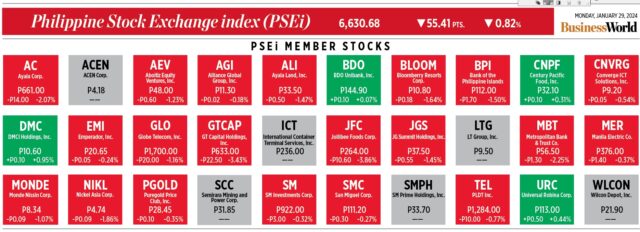
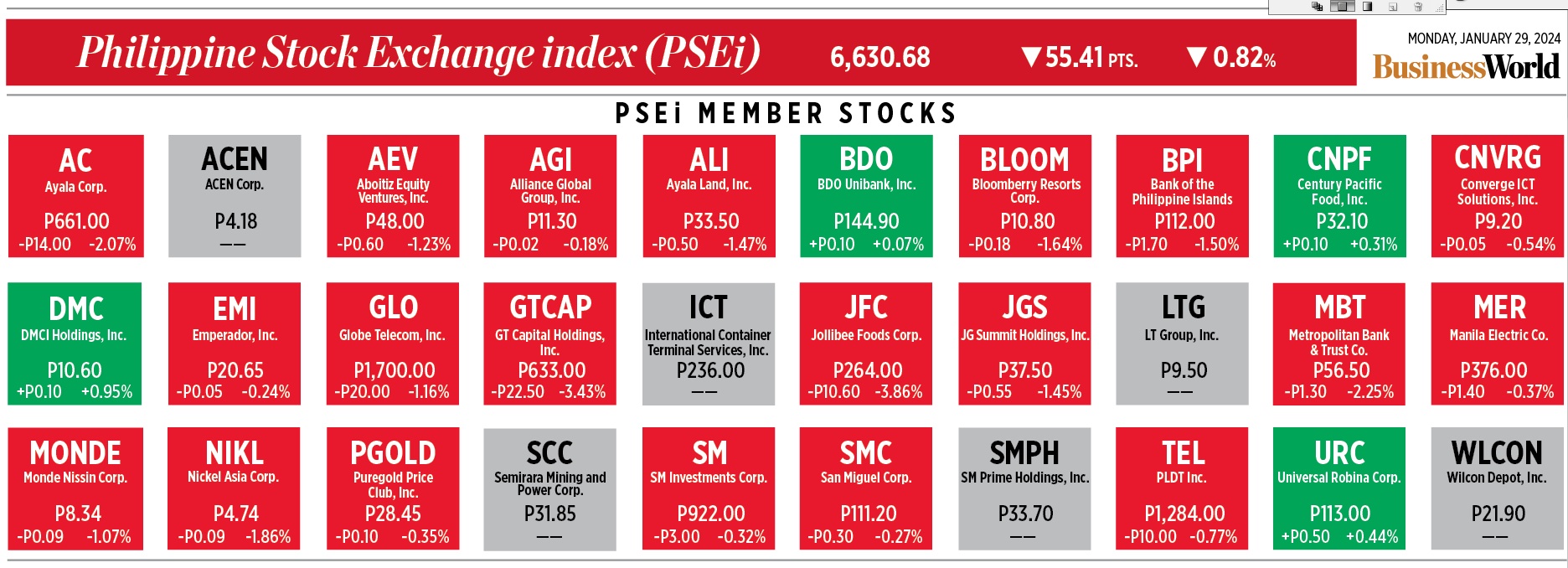
How PSEi member stocks performed — January 29, 2024

Here’s a quick glance at how PSEi stocks fared on MondayJanuary 29, 2024.


Vince McMahon resigns from TKO, WWE over sex assault lawsuit

VINCE MCMAHON — WIKIPEDIA

VINCE MCMAHON resigned from wrestling giant TKO Group and the subsidiary World Wrestling Entertainment (WWE) that he founded, over a lawsuit accusing him of sexual assault and trafficking, which he said he will fight, the company said on Friday.

“I have decided to resign from my executive chairmanship and the TKO board of directors, effective immediately,” McMahon said in a statement released by TKO.

The suit by a former employee, filed on Thursday in federal court in Connecticut, accuses McMahon, WWE, and another executive of “physical and emotional abuse, sexual assault and trafficking at WWE,” and seeks unspecified costs and damages.

McMahon denied the allegations in the statement, saying, “I intend to vigorously defend myself against these baseless accusations, and look forward to clearing my name.”

WWE President Nick Khan wrote in a memo to employees that McMahon “will no longer have a role with TKO Group Holdings or WWE.”

McMahon had retired from WWE in 2022 amid allegations of misconduct and paid $17.4 million to the company to cover costs related to an investigation into that case. He returned in January 2023.

The powerhouse behind the wrestling entertainment company, McMahon transformed it from a regional player in a highly fragmented industry of the 1980s to a global giant, with about $1 billion in revenue in 2021.

He used scripted matches, celebrity wrestlers, and glitz to make the brand more acceptable to television audiences, and created the concept of pay-per-view matches for bigger events such as “WrestleMania” to build its revenue base.

TKO was formed last year when McMahon forged a deal between WWE and Endeavor Group-owned mixed martial arts franchise UFC. — Reuters

Projects granted green-lane certificates valued at P1.2T

THE Board of Investments (BoI) said on Monday that 36 projects have been approved for green lane services since the passage of the Executive Order (EO) No. 18 in February, with the projects valued at a combined P1.2 trillion.

The BoI said 23 projects worth P498.91 billion were approved last year, while the remaining P697.98 billion were approved this year.

The list includes the P22-billion floating solar project of Fuego Renewable Energy Corp. (FREC) in Nueva Ecija.

“This is the fourth green lane certificate in our portfolio, and we have experienced responsiveness from government agencies and institutions in our various permitting needs,” FREC President Aristotle Natividad said in a statement. 

“With this latest green lane endorsement, we expect to achieve the same results and materialize our project at the soonest,” he added.

According to the investment promotion agency, FREC is set to build the Pantabangan Floating Solar Power Plant which is a 464-megawatt alternating current (MWac) floating solar photovoltaic project.

Its other three projects that were endorsed for green lane services are the 137.48-MWac Ubay Power Plant under Ubay Solar Corp., the 175.29-MWac Barotac Viejo Solar Power Project under Magallanes Solar Energy Corp., and the 59.84-MWac Gamu Solar Power Plant under Intramuros Solar Energy Corp.

FREC’s recently-endorsed project which will rise on the surface of Pantabangan Lake is scheduled for commissioning in 2025, with its energy output contracted for export to the National Grid.

“Notably, the project site is located within the Pantabangan-Carranglan Watershed Forest Reserve. The location of the transmission lines and other facilities onshore will fall under the protected area or watershed classification,” the BoI said.

The project is expected to generate 2,000 temporary and permanent direct jobs in its construction, commissioning, operations and maintenance.

 EO 18, approved on Feb. 24, established green lanes within government agencies which will expedite the process of granting permits and licenses through the One-Stop Action Center for Strategic Investments (OSACSI).

OSACSI issues endorsement letters to the Department of Energy, National Government agencies, and local government units, which designate projects as strategic, which will in turn ensure processing times fall within the periods prescribed in EO 18. — Justine Irish D. Tabile

Cancer, diabetes, hypertension, TB drugs added to BIR’s VAT-exempt list

THE Bureau of Internal Revenue (BIR) said it updated the list of drugs exempt from value-added tax (VAT) to include treatments for cancer, diabetes, and hypertension.

In a memorandum circular, the BIR said other such medicines treat kidney disease, mental illness and tuberculosis (TB), as classified by the Food and Drug Administration (FDA).

The update also features the removal of one hypertension drug from the list.

According to the circular, two medicines for cancer were added to the VAT-exempt list — Panitumumab and Fulvestrant.

It also added five diabetes medicines: Teneligliptin (as hydrobromide hydrate), Sitagliptin (as phosphate monohydrate) + Metformin Hydrochloride; Sitagliptin (50mg); Sitagliptin (100mg); and Metformin Hydrochloride.

It also included Atorvastatin Calcium and Atorvastatin + Fenofibrate, which are medicines for high cholesterol.

Also joining the VAT-exempt list are the hypertension drugs Clonidine hydrochloride in solution for injection and in tablet form; as well as Lisinopril as dihydrate in 5mg, 10mg, and 20mg tablets.

Medicines for kidney disease included Mannitol; Tolvaptan in 15mg and 30mg tablets; and Alpha Ketoanalogues + Essential Amino Acids.

It also added one medicine for mental illness, Desvenlafaxine (as succinate monohydrate) and two for tuberculosis, Bedaquiline (as Fumarate) and Isoniazid + Pyridoxine Hydrochloride.

Meanwhile, it removed from the VAT-exempt list Macitentan, a hypertension treatment.

The updated list will take effect upon the issuance of a FDA advisory, the BIR added. — Luisa Maria Jacinta C. Jocson

Small-bank MSME loans counted as reserves estimated at P6.7B

REUTERS

SMALL BANKS lent around P6.71 billion to micro, small, and medium enterprises (MSMEs) as of November, with the loans counting as an alternative form of compliance with reserve requirements, the Bangko Sentral ng Pilipinas (BSP) said.

The BSP in a report said other segments of the industry, like rural and cooperative banks, designated P12.4 million in such loans as compliance with the reserve requirements.

“Banks’ availment of the BSP’s relief measure on the use of new or refinanced loans to MSMEs and eligible large enterprises as alternative compliance with the reserve requirements (RR) declined,” the central bank said.

“This is in view of the lapse of the temporary relief measure on alternative RR compliance, particularly for U/KBs (universal and commercial banks) effective 01 July 2023,” it said.

During the coronavirus pandemic, the central bank allowed banks to count their loans to MSMEs and pandemic-hit large enterprises as part of their compliance with reserve requirements.

The relief measure expired last year, but small lenders can still count their loans to MSMEs and LEs as alternative compliance with reserve requirements until they are fully paid, but not later than Dec. 31, 2025.

In 2022, banks lent P493.5 billion to MSMEs as alternative compliance. This was 6.6% higher than the P463.1 billion a year prior.

Universal and commercial banks extended P390.9 billion in loans to MSMEs, while rural and cooperative banks lent P52.7 billion. — Keisha B. Ta-asan