Home Blog Page 3652

Transformational growth through sustainability, diversity and digitalization

Leading think tanks, analysts and multilateral agencies expect the Philippines to become a high middle-income country within the decade and the 18th largest economy in the world by 2050. This growth is expected to be fueled by our traditional economic drivers of remittances and BPO revenues, coupled with the demographic dividend from a growing and young population. It is against this backdrop that corporations and entrepreneurs have developed their plans and budgets to make the necessary investments that will allow them to capture opportunities and expand their businesses. And yet, given the volatile environment filled with the complex issues that we face, it is difficult to imagine how we can achieve our growth goals.

As I reflected on these, I was reminded of a quote attributed to Andy Grove that best summarizes his book Only the Paranoid Survive: “A corporation is a living organism; it has to continue to shed its skin. Methods have to change. Focus has to change. Values have to change. The sum total of those changes is transformation.”

This is the real challenge of our times — how to achieve “transformational growth” in what is perhaps the inflection point that will either see us rise to expected economic success or muddle along with the rest of the world. Which then begs the question: How do we make it happen? Let me propose three components that I believe drive transformational growth — sustainability, diversity and digitalization.

SUSTAINABILITY
In the realm of ESG, environmental sustainability stands out as a pivotal pillar. The urgency to preserve our planet has never been more apparent, with climate change and environmental degradation posing existential threats.

The Philippine government has demonstrated its commitment on the global stage by signing key international agreements. The Kyoto Protocol in 2003 and the Paris Agreement in 2016 affirmed its intention to reduce greenhouse gas emissions and combat climate change.

And more recently, it has participated in the Conference of Parties (COP) meetings, including COP28, where nations come together to address global environmental challenges. These efforts underscore the country’s commitment to preserve biodiversity and foster sustainability nationally and internationally and encourage us to integrate environmentally sustainable practices into our daily lives.

As finance executives, we must recognize the impact our decisions can have on the environment and strive to align our corporate strategies with sustainable practices. We wield considerable influence over resource allocation and corporate decision making. Incorporating ESG metrics into financial evaluations, encouraging disclosure of environmental impacts and fostering a culture of environmental responsibility are integral steps. Moreover, promoting responsible investing and engaging in collaborative industry initiatives can amplify our impact.

At Ayala Land, Inc., realizing that our products and services are valued by generations, we have ingrained sustainability at our core. This thrust has driven positive change, yielding substantial benefits. Our journey began in 2007 when we formalized sustainability as a guiding principle in land use and development. Then, in 2009, we launched our first sustainable estate in the country, Nuvali, spanning 2,290 hectares and straddling the cities of Sta. Rosa, Cabuyao and Calamba in Laguna. In the same year, our board formed a sustainability committee to oversee Ayala Land’s sustainability program.

In 2014, following a materiality process, we identified our four focus areas — site resilience, pedestrian mobility and transit connectivity, resource efficiency, and local economic development. Fast forward to 2017, we announced our carbon neutrality program, wherein we aimed to neutralize scope 1 and 2 emissions from our commercial properties.

In 2021, aligning with global efforts to prevent the earth’s temperature from exceeding 1.5C, we announced, as part of the Ayala group of companies, our commitment to achieve net-zero emissions by 2050. Our business-as-usual growth scenario predicts a simultaneous rise in carbon emissions, necessitating immediate and critical interventions. To address this now, our proactive measures involve a comprehensive strategy that includes increased use of renewable energy and sustainable sources alongside the decarbonization of our supply chain and downstream activities. Anticipated results include an emission reduction of more than 50% of our 2030 target compared with the business-as-usual scenario, propelling us significantly closer to our 2050 goal of net-zero emissions.

Along this journey, our sustainable practices have not only aligned us with the values of an evolving consumer base demanding more livable spaces, but have also encouraged a culture of innovation within our organization.

Encouraging eco-friendly solutions has led to the advancement of pioneering concepts and developments in our country. Among these are the One Ayala Integrated Transport Hub, the transit connectivity and pedestrianization of the Makati central business district, Bonifacio Global City and our other estate developments, circular waste management systems aimed at diverting waste that would otherwise go to landfills and recycling practices that have led to the commercial production of eco-bricks and pavers and precast walls and stairs.

Including sustainability in our business practices and strategies not only protects our environment for future generations but also positions our companies for resilience and long-term growth.

DIVERSITY
Diversity is the condition of having or being composed of differing elements or qualities, according to the Merriam-Webster dictionary. It is within this context that I refer to diversity as a growth enabler, fostering an inclusive environment that values and learns from diverse backgrounds, experiences and perspectives. Recognizing the importance of diversity acts as a catalyst for innovation and untapped potential. Diverse teams bring fresh approaches to problem-solving, stimulating creativity and leading to more holistic solutions to complex challenges. A Boston Consulting Group study pointed out that companies with more diverse management teams had 19 percentage points higher innovation revenues than those with below-average diversity scores. In addition, inclusive companies are 1.8 times more likely to be change-ready than their less inclusive peers.

Ayala Land, led by Meean Dy, the company’s first female CEO in its 35-year history, is strategically incorporating talents and experts from various fields including digitalization, HR and hotel operations. As the company continues its customer-centric cultural transformation, which requires innovative thinking, creativity and change readiness to be successful, it recognizes the need to bring to the table diverse skill sets, expertise and backgrounds to provide unique problem-solving approaches while fostering a dynamic environment that allows ideas to flourish. This year, the company will establish a council to develop its diversity framework and initiatives.

DIGITALIZATION
In the rapidly evolving landscape of today’s global economy, digitalization is not a mere choice; it is imperative not only for growth but also for survival and relevance. Nations and companies face complex challenges ranging from managing vast amounts of data, ensuring efficient and transparent operations and enhancing engagement with customers and stakeholders. Digitalization is the key to unlocking innovative solutions for these challenges.

In the Philippines, the government has been promoting digitalization through initiatives like the National ICT Ecosystem Framework, which focuses on enhancing the country’s digital infrastructure, fostering innovation and promoting the use of technology for economic growth. There’s also the e-Government Master Plan, which “aims to create a networked and collaborative environment for improved public service delivery” through the digital transformation of essential public services. Recognizing that digitalization is not just a technological upgrade but a strategic imperative, the Philippine government’s efforts exemplify the crucial role of embracing technology for national development.

Over the past decade, we at Ayala Land have diligently built our digital foundation by following a roadmap, establishing and investing in our captive BPOs, adopting and continuously upgrading our enterprise resource planning system and fortifying our cybersecurity measures. Today, we have embarked on digitalization 2.0, with a focus on elevating customer experience.

As we refine this strategy, we have brought in industry experts to ensure our approach is not only comprehensive but also superior in delivering value to our stakeholders. Digitalization is not merely a technological shift but a strategic move to remain at the forefront in an increasingly competitive and digital-centric world.

TRANSFORMATIONAL GROWTH
Why do sustainability, diversity and digitalization lead to transformational growth? The answer lies in recognizing that these are not isolated endeavors; they are interwoven threads shaping the fabric of a future-ready organization.

Sustainability guarantees our longevity and adaptability. Diversity brings depth to our perspectives, fostering innovation and resilience. Digitalization, the backbone of modern enterprises, allows us to efficiently deliver new products and services, find new ways to engage customers and turn them into lifelong partners.

These three components are key to achieving Ayala Land’s aspiration to grow at 2x the country’s GDP or to double its net income by 2028, translating to an annual compounded growth of 15%.

As finance executives, we are responsible for navigating our organizations through these challenging times. It is incumbent that we collectively harness the power of sustainability, diversity and digitalization to chart a course toward a future marked by growth and collective prosperity.

The views and opinions expressed here are those of the author and do not represent the views of Ayala Land and FINEX.


Augusto “Toti” D. Bengzon is the CFO, chief compliance officer and treasurer of Ayala Land, Inc., and the 2024 FINEX president.
Former UK pop star Gary Glitter, jailed for child sex crimes, denied parole

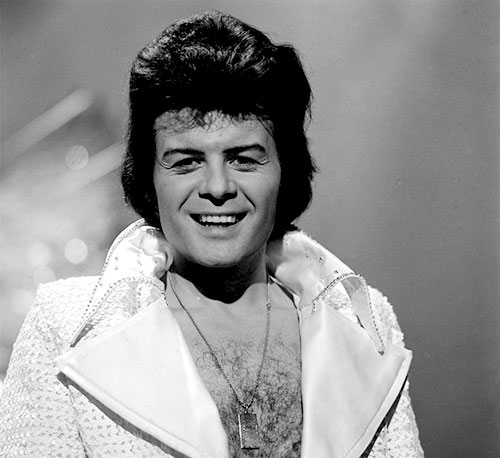
LONDON — Former British pop singer Gary Glitter, who shot to fame in the 1970s as a “glam-rock” star but was later convicted of child sex crimes, lost a bid to be released from prison on parole, officials said on Wednesday.

Mr. Glitter, 79, whose real name is Paul Gadd, rose to prominence with the hit song “Rock and Roll,” and became renowned for his figure-hugging shiny silver jump suits and platform shoes. But he was later convicted of a number of child sex abuse offenses including indecently assaulting three girls and was sentenced to 16 years in prison in 2015. He was released in February 2023 but was returned to jail the following month for breaching the conditions of his release.

Following a hearing last month, the Parole Board said it had concluded he should not be allowed out of prison.

“After considering the circumstances of his offending, the lack of progress made while in custody and on license, and the other evidence presented at the hearing, the panel was not satisfied that release at this point would be safe for the protection of the public,” the Board said in a summary.

It said Mr. Gadd would be eligible for another review “in due course” but if not released would serve the remainder of his sentence behind bars until 2031. — Reuters

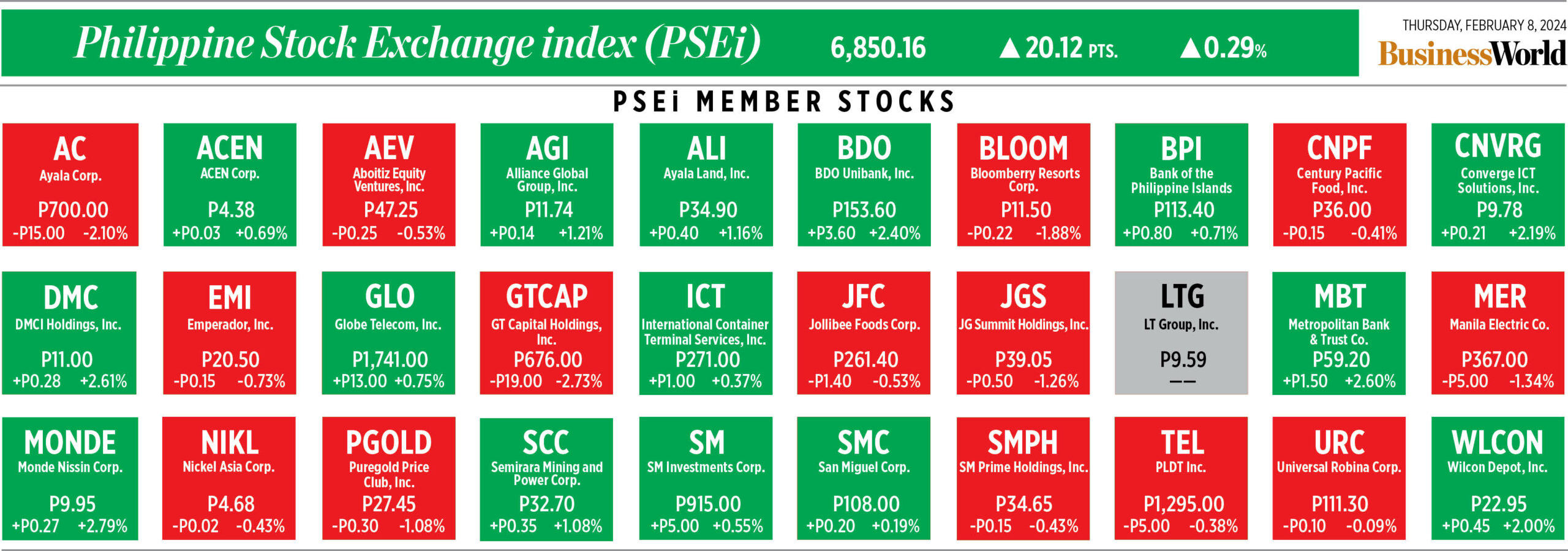
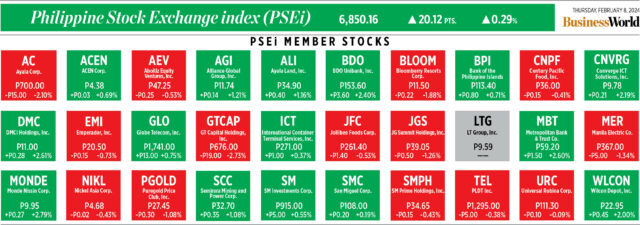
How PSEi member stocks performed — February 8, 2024

Here’s a quick glance at how PSEi stocks fared on Thursday, February 8, 2024.


Swiss firms cited easy business conditions in PHL — minister

REUTERS

SWISS companies now see the Philippines as an attractive investment destination due to the improved business environment compared to previous years, Switzerland’s Foreign Minister said in Manila on Thursday.

“There is a growing interest by Swiss companies investing in this country, with the free trade agreement between the European Trade Association (consisting of) Switzerland, Norway, Iceland and Lichtenstein, and (the Philippines),” Swiss Federal Councilor and Minister of Foreign Affairs Ignazio Cassis said during a meeting with Foreign Affairs Secretary Enrique A. Manalo.

“Doing business between the Philippines and Switzerland has become easier and more attractive than earlier.”

He said that more about 28,000 jobs with decent salaries have been created through recent Swiss-Philippine business deals.

In January 2023, the Philippines bagged $24.7 million in initial investment commitments from Swiss firms during a roadshow on the sidelines of the Philippines-EFTA and the 5th Philippines-Switzerland Joint Economic Committee meetings in Switzerland.

Swiss companies engaged in metal processing and optical security were among those that expressed interest in doing business in the Philippines during the roadshow.

“We have a multi-faceted appreciation for the Philippine-Swiss relations, spanning political, economic and people-to-people connections,” Mr. Manalo said at the bilateral meeting.

More than 15,000 Filipinos live and work in Switzerland, while 4,000 Swiss nationals live in the Philippines, he said.

According to the Board of Investments, Switzerland was the Philippines’ 26th largest trading partner in 2021, 17th largest export market, and 29th largest source of imports.

Philippine exports to Switzerland rose 17.3% to $528.2 million in 2021.

“Indeed, the strongest ties that bind the Philippines and Switzerland are the various individuals and families who personify Philippine-Swiss connections,” the Philippine Foreign Affairs Secretary said. — John Victor D. Ordoñez

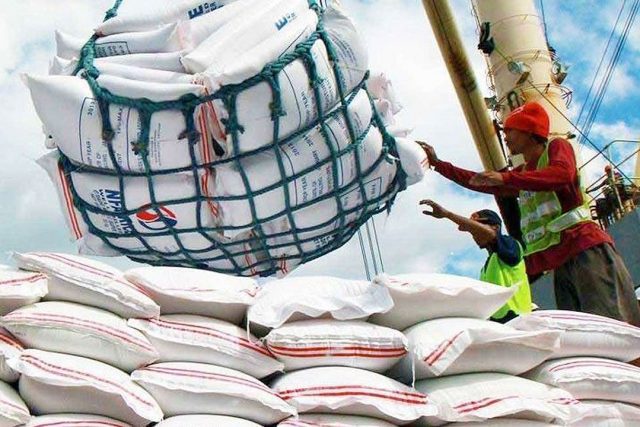
Rice supply deemed sufficient through first six months — DA

PHILSTAR FILE PHOTO

THE Department of Agriculture (DA) said the supply of rice will be sufficient during the first half of the year, with supply to include the dry season harvest supplemented by imports.

“We have enough rice, so prices should remain stable through the first half of the year. Our priority now is market stability,” Agriculture Secretary Francisco P. Tiu Laurel, Jr. said on Thursday.

Mr. Laurel said prices may remain elevated until September due to concerns over the impact of El Niño on the global rice supply and “heightened demand for the grain that… is keeping international prices high.”

Palay or unmilled rice production rose 1.5% to 20.06 million metric tons (MT) in 2023. This translates to about 13.2 million MT of milled rice.

The DA has targeted palay production of 20 million MT of palay in 2024, which would be little changed from 2023, to account for El Niño.

The government weather service, known as PAGASA (Philippine Atmospheric, Geophysical and Astronomical Services Administration), has said that the effects of El Niño may last until the second quarter. An estimated 63 provinces will experience droughts or dry spells.

In a bulletin, the DA said that El Niño damage has been valued at P151.3 million, affecting palay and corn in the Western Visayas and Zamboanga Peninsula. The agency estimates that 6,618 MT have been lost, while 3,291 hectares were affected by the dry spell.

“Most of the damage and losses were incurred by rice and corn that are in their reproductive stage,” it added.

The DA has also said that rice import shipments between December and January amounted to 750,000 MT, bolstering domestic supply.

The Philippines imported 3.58 million MT of rice in 2023, according to the Bureau of Plant Industry.

Vietnam, the Philippines’ major source of imported rice, recently signed a five-year agreement to ship 1.5 million to 2 million MT of rice per year through private-sector exporters.

In October, India also gave the Philippines a quota of 295,000 MT of non-basmati white rice, after imposing restrictions on exporting the grain to assure domestic supply is adequate.

The Philippines is projected to remain the world’s top importer of rice, with shipments projected at 3.8 million MT in 2024, according to the US Department of Agriculture.

“What we need to guard against now are profiteers who may attempt to exploit the situation by using El Niño as excuse to hoard rice to push prices to unreasonably high levels,” Mr. Laurel said.

He added that the DA will work with the Department of Trade and Industry and law enforcement agencies to monitor surges in the market price of rice.

The national average price of well-milled rice was P54.42 per kilogram in late January, while regular- milled rice was P49.9 per kilo, according to the Philippine Statistics Authority. — Adrian H. Halili

UK chamber of commerce raises concerns on reported plan to suspend MAV for pork imports

REUTERS

THE British Chamber of Commerce of the Philippines (BCCP) said on Thursday that it is concerned about the plan to suspend the minimum access volume (MAV) for pork, saying that such a move would affect domestic supply and run counter to existing trade agreements.

“The BCCP has been a consistent advocate of the lowered tariffs on meat and has supported the last two consecutive extensions as this will further assist in augmenting the pork supply,” the chamber said in a statement.

“We are concerned about the Department of Agriculture’s (DA) reported plan on the suspension of MAV for pork and we support the reported comments of MAV Advisory Council (MAC) on the impact on domestic supply and existing trade agreements,” it added.

The MAV is a feature of the global trading system, by which a participating country agrees to open its market to shipments from overseas producers of selected commodities, up to a designated limit.

Citing the Philippine Star, the BCCP said that the suspension could impact the domestic supply of meat and risk trade agreements, including bilateral ones.

“We reiterate our support for Executive Order (EO) No. 50 and its full implementation to manage inflation and food supply,” the BCCP said.

“We hereby acknowledge the role of agriculture in Philippine economic growth, and we look forward to the Bicameral Conference and therefore, the passage of the Anti-Agricultural Economic Sabotage Act,” it added.

In December, President Ferdinand R. Marcos, Jr. signed the EO 50 which extended a lower tariff regime on pork, rice, corn and coal.

Tariff rates were kept at 15% (within the MAV quota) and 25% (for shipments exceeding the quota) for pork, 5% (within the quota) and 15% (for shipments exceeding the quota) for corn, and 35% (all shipments) for rice until Dec. 31 to help manage down prices.

“The British Chamber maintains its commitment to ensuring food security and helping with the challenge of inflation by introducing quality British meat and establishing long-term relations with the importers to support the Philippine market,” it said.

BCCP Executive Director Chris Nelson has said that total trade in goods and services between the UK and the Philippines grew to 2.9 billion pounds last year, with UK exports to the Philippines accounting for 1.3 billion pounds.

The top exports of the UK to the Philippines include meat and meat preparations. The Philippines is also UK’s second top pork export destination in Asia, next to China.

Asked to comment, DA Undersecretary for Operations Roger V. Navarro said that a meeting regarding the issue is yet to be held.

“However, the committee already has a position which Secretary Kiko (Francisco P. Tiu Laurel, Jr.) will present to the MAV Advisory Council,” Mr. Navarro told BusinessWorld via a Viber message.

The Philippine MAV for pork currently stands at 54,210 metric tons. — Justine Irish D. Tabile

NCR hubs designed to promote capital to tourists set to be built

PHILSTAR FILE PHOTO

THE Department of Tourism (DoT) is set to launch three more hubs this year designed to promote cities in the National Capital Region (NCR) as tourist destinations.

The so-called Hop-On-Hop-Off (HOHO) hubs are “really meant to drive not just international tourism but also domestic tourism. In some countries, it is really domestic tourism that is driving economic growth,” DoT Regional Director of NCR Sharlene Zabala-Batin told BusinessWorld.

“One of our objectives through HOHO is to make Metro Manila a premier destination… most major cities in the world have a HOHO program so we cannot be left behind,” she added.

The Philippines’ most-heavily promoted destinations tend to be beaches, leading travelers to skip the capital and fly off to resorts in the Visayas, Mindanao and Palawan.

The DoT said that the three remaining HOHO hubs that will be launched later in the year will be positioned as Heart, Lifestyle, and Mind Hubs, feeding visitors to San Juan, Pasig, Mandaluyong, Bonifacio Global City, and educational institutions in Quezon City.

On Thursday, the department launched its third HOHO hub, touted as the Entertainment Hub, covering the cities of Pasay and Parañaque.

The launch of the hubs is part of the HOHO Travel by the Hubs tour program that aims to provide tourists with flexible transportation in exploring cities within Metro Manila.

“The program operates through designated hubs, where tourists have the freedom to choose their preferred destination and duration of stay,” the DoT said.

Meanwhile, Tourism Secretary Maria Esperanza Christina G. Frasco announced on Thursday that the DoT is also working on the launch of layover tours by the second quarter. She said that the DoT is currently working with other National Government agencies as well as with airport authorities which include the Manila International Airport Authority, Bureau of Customs, Bureau of Immigration, and the Philippine National Police.

Ms. Frasco said that the layover tours will initially be connected to the Entertainment Hub due to the cities’ proximity to the Ninoy Aquino International Airport.

Last year, the DoT launched the Business and Culture Hubs which attracted 805 participants in the first six months of operations. — Justine Irish D. Tabile 

Most provinces, top cities had economic growth in 2022

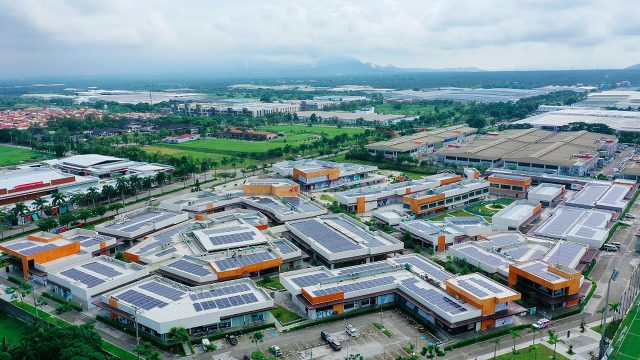
LIMA Estate’s 30-hectare commercial area in Batangas. — BW FILE PHOTO

NEARLY all provinces and highly urbanized cities (HUCs) reported growing economies in 2022, the Philippine Statistics Authority (PSA) said on Thursday.

The Provincial Product Accounts (PPA) indicator had Aklan as the fastest growing of all provinces and HUCs with 22.5% in 2022, accelerating from 3.4% in the prior year.

In terms of share of national gross domestic product (GDP), Laguna led with 5% in 2022, followed by Cavite (3.7%) and Batangas (3.1%).

The combined GDP of the 82 provinces and 17 HUCs, according to the PPA, was P13.68 trillion as of November 2023, accounting for 68.6% of national GDP, the PSA said.

The PSA was publishing the PPA results for the first time for 16 regions outside Metro Manila, which include 82 provinces and 17 HUCs.

The PPA compiles the GDP at the subnational level. — Abigail Marie P. Yraola

ADB urges accelerated clean-energy transition

THE Asia-Pacific region must ramp up its efforts in transitioning to clean energy systems by strengthening government support, expanding financing options and advancing digitalization, according to the Asian Development Bank (ADB).

“Countries across the Asia and Pacific region must expedite their efforts in energy transition to increase the uptake of clean energy solutions and attain their climate and development goals,” it said in a report detailing the results of its Asia Clean Energy Forum.

“The shift should ensure a fair energy transition, dismantle sectoral silos, and encourage stakeholder collaboration. ADB and similar multilateral banks can assist in financial de-risking for countries,” it added.

The bank said government support will be crucial in promoting clean energy policy frameworks to drive investment.

“This backing can develop state-supported financial incentives for clean energy, encourage state entities to invest in clean infrastructure, accelerate the development of policies, such as guidelines for implementing direct power purchase agreements and increase awareness of the market for renewable energy certificates,” it said.

“The formation of agile, effective partnerships is crucial for boosting clean energy demand and accelerating energy transition across Asia and the Pacific. Collaboration among governments, the private sector, philanthropies, and development agencies can enhance clean energy procurement and lower financing costs,” it added.

The bank noted that more companies in the region are shifting to sustainable energy practices, citing ACEN Corp.

“The Philippines’ ACEN Corp. is at the forefront of the renewable energy transition, divesting from coal plants and setting ambitious goals of achieving 100% renewables by 2025 and reaching a renewable energy capacity of 20 gigawatts by 2030,” it added.

The ADB also said that concessional and blended financing must be made more accessible especially for small- and medium-sized enterprises in the region.

It cited financing options such as mezzanine financing, blended funding, and integrated project development processes.

Emerging technologies such as Artificial Intelligence can also be utilized in the clean energy transition, the ADB said.

“Applying algorithms, machine learning, and artificial intelligence can improve data analysis,” it said.

“Blockchain, digital applications, cloud technology, and internet-of-things devices facilitate real-time monitoring of energy consumption and production, enabling more informed decision-making, and driving cost reductions,” it added. — Luisa Maria Jacinta C. Jocson

Marcos says Mindanao separation push ‘doomed to fail’

PHILIPPINE STAR/KRIZ JOHN ROSALES

By Kyle Aristophere T. Atienza, Reporter

PHILIPPINE President Ferdinand R. Marcos, Jr. has warned against the push of his predecessor-turned-critic, Rodrigo R. Duterte, for the separation of the southern island of Mindanao from the rest of the nation, saying it is a violation of the 37-year-old Charter.

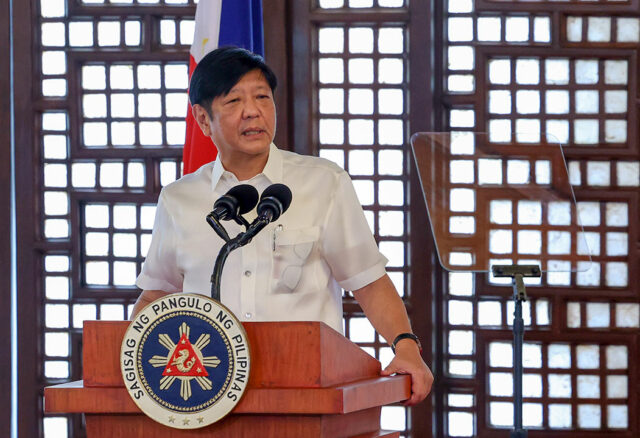
“The new call for a separate Mindanao is doomed to fail, for it is anchored on a false premise, not to mention a sheer constitutional travesty,” Mr. Marcos said in a speech at a commemoration event for the 1987 Constitution on Thursday.

Mr. Duterte in late January said local political forces would be regrouping in the Davao region to start a signature campaign for the separation of Mindanao from the Philippines — a move that has been opposed by various government agencies, including the departments of Justice and Defense.

Mr. Marcos said current the leadership of the Bangsamoro region, which was created in 2019 after successful talks between the National Government and Moro separatists, has already “repudiated this preposterous proposal.”

“And so did other political leaders of Mindanao,” he added, noting “effective local autonomy has been achieved across the country, especially in the Bangsamoro region, “without compromising our national integrity in the slightest degree.”

“I strongly appeal to all concerned to stop this call for a separate Mindanao,” he said. “This is a grave violation of the Constitution.”

Earlier in the day, Mr. Marcos led the 17th meeting of the National Government–Bangsamoro Government Intergovernmental Relations Body, where he warned against forces that seek to thwart democratic processes ahead of the first parliamentary election in the Bangsamoro Autonomous Region in Muslim Mindanao (BARMM).

“We cannot allow forces outside of the democratic process to deviate our dreams and our aspirations from a democratic process,” he said in a speech, as he called for the protection of the parliamentary elections in the region in 2025.

He said Filipinos should never allow even a single voter to be disenfranchised by violence, intimidation, or bribery.

The Bangsamoro Transition Authority (BTA) in March last year passed an electoral code that paved the way for the creation of political parties in the region with representatives from women, youth, indigenous people, and settler communities.

The first-ever parliament elections in the region was originally set for May 2022 but was postponed due to the coronavirus pandemic.

“A stronger BARMM is a stronger Mindanao; a stronger Mindanao means a stronger Philippines, bringing us closer to achieving our agendas,” Mr. Marcos said.

Citing its December 2023 survey, research firm WR Numero said recently that 57% of Filipinos hold either a positive or a very positive view of the creation of the BARMM.

It replaced the Autonomous Region in Muslim Mindanao (ARMM) after peace talks between the National Government and the Moro Islamic Liberation Front, which had called for a region with more powers.

Bangsamoro Chief Minister Ahod Balawag Ebrahim and BTA Deputy Speaker Omar Yasser Sema, a second-generation member of the Moro National Liberation Front, have already rejected Mr. Duterte’s separatist call.

Moro rebels have long abandoned calls for secession, they said, citing gains from past peace negotiations.

Mr. Duterte unveiled the plan for a separate Mindanao days after openly attacking the Marcos administration in a political rally in Davao City on Jan. 28, where he called his successor a drug addict and slammed the International Criminal Court for its probe on its deadly war on drugs.

The former populist leader also linked Mr. Marcos and his allies in Congress to a so-called people’s initiative for Charter change and warned that could lead to him being ousted like his late father and namesake.

At the Constitution Day event, which was hosted by the Philippine Constitution Association (Philconsa) and the Manila Overseas Press Club, Mr. Marcos also stressed the need to amend the Charter’s “restrictive” economic provisions.

His support for reform “extends to economic matters only” and “nothing more.”

“We are happy that he also took note of our consistent advocacy in the House of Representatives for changing those restrictive provisions for more than three decades since the 8th Congress, or since 36-37 years ago,” Speaker Martin G. Romualdez, a cousin to Mr. Marcos, said in a statement.

“At the risk of being makulit (stubborn), we have been saying that we do not advocate any political amendment,” said Mr. Romualdez, who joined Mr. Marcos and other officials on the stage.

The House Speaker heads the Constitution association.

Marcos warns against forces seeking to disrupt Bangsamoro polls in 2025

PRESIDENT Ferdinand R. Marcos, Jr. talks to Bangsamoro Autonomous Region in Muslim Mindanao Chief Minister Ahod Ebrahim. Budget Secretary Amenah Pangandaman joined them at Thursday’s meeting between National Government and Bangsamoro officials at the Philippine International Convention Center in Pasay City. -- PHILIPPINE STAR/KRIZJOHN ROSALES

By Kyle Aristophere T. Atienza, Reporter

PHILIPPINE President Ferdinand R. Marcos, Jr. warned the nation on Thursday against forces that seek to thwart democratic processes ahead of the first parliamentary election in the Bangsamoro Autonomous Region in Muslim Mindanao (BARMM) in 2025.

“I strongly appeal to all concerned to stop this call for a separate Mindanao. This is a grave violation of the Constitution,” Mr. Marcos said as he addressed the 17th Meeting of the National Government-Bangsamoro Government Intergovernmental Relations Body at the Philippine International Convention Center in Pasay City.

His call comes on the heels of a separatist threat from his predecessor, Rodrigo R. Duterte, who unveiled a plan last month to separate Mindanao from the rest of the nation.

“We must remind ourselves that we are now operating under different rules and that we cannot allow forces outside of the democratic process to deviate our dreams and our aspirations from a democratic process,” the President said.

He said Filipinos should never allow even a single voter to be disenfranchised by violence, intimidation, or bribery.

The Bangsamoro Transition Authority (BTA) passed in March last year an electoral code that paved the way for the creation of political parties in the region with representatives from women, youth, indigenous people, and settler communities.

The first-ever parliament elections in the autonomous region was originally set for May 2022 but was postponed due to the coronavirus pandemic.

“A stronger BARMM is a stronger Mindanao; a stronger Mindanao means a stronger Philippines, bringing us closer to achieving our agendas,” Mr. Marcos said.

Mr. Duterte, in late January, said local political forces would be regrouping in the Davao region to start a signature campaign for the separation of Mindanao from the Philippines — a move that has been opposed by various government agencies, including the Departments of Justice (DoJ) and of National Defense (DND).

Citing its December 2023 survey, research firm WR Numero said recently that 57% of Filipinos hold either a positive or a very positive view of the creation of the BARMM.

It replaced the Autonomous Region in Muslim Mindanao after peace talks between the National Government and the Moro Islamic Liberation Front (MILF), which had called for a region with more powers.

Bangsamoro Chief Minister Ahod Balawag Ebrahim and BTA Deputy Speaker Omar Yasser Sema, a second-generation member of the Moro National Liberation Front, have already rejected Mr. Duterte’s separatist call.

Moro rebels have long abandoned calls for secession, they said, citing gains from past peace negotiations.

BARMM is composed of the provinces of Maguindanao del Norte, Maguindanao del Sur, Lanao del Sur, Basilan, Sulu, and Tawi-Tawi.